

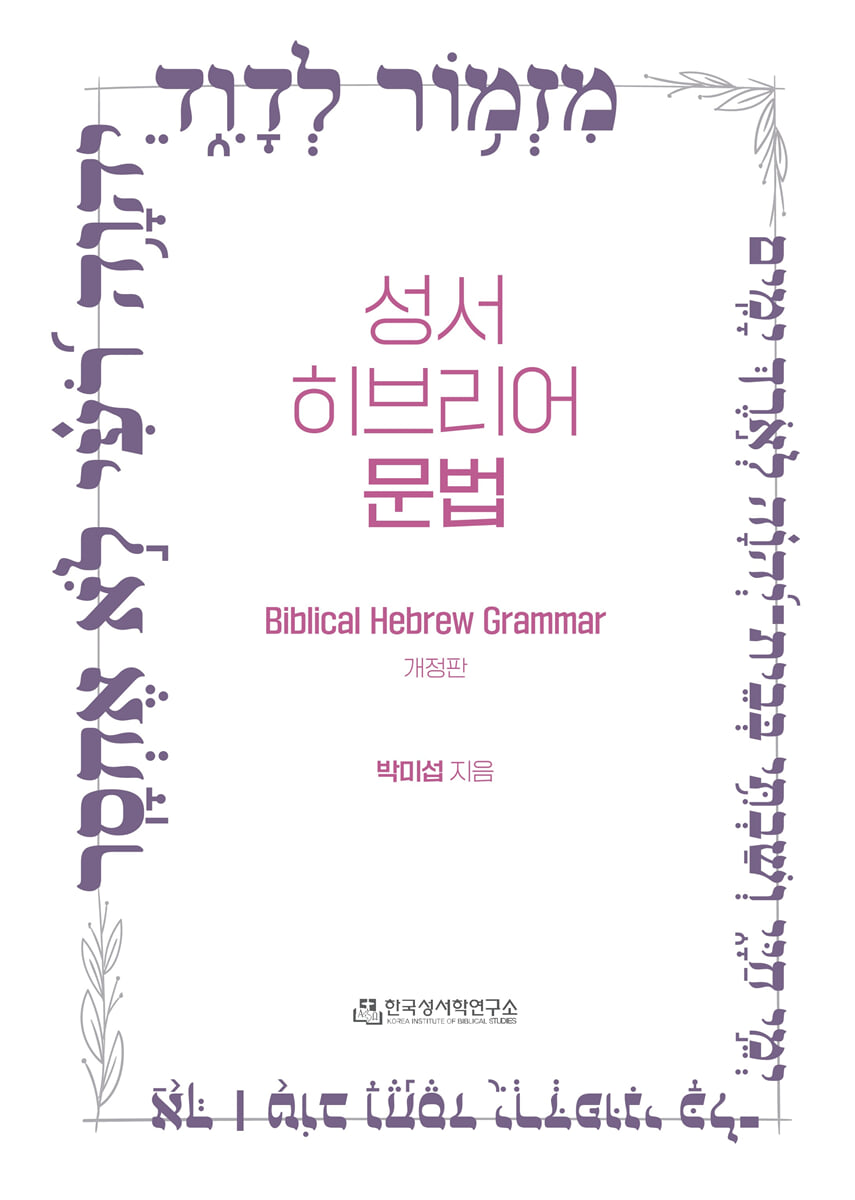
Biblical Hebrew Grammar
 |
Description
Book Introduction
An excellent grammar book for beginners who want to learn Biblical Hebrew!
Learning Biblical Hebrew will not only give you the thrill of reading the Old Testament, the root of our faith, in its original language, but it will also help you better understand expressions that modern translations often struggle to fully convey, and you will experience the ancient world of the Old Testament in a more vivid way.
Moreover, since the Bible is the most important text in all theological fields, studying its original languages will provide the linguistic tools necessary for deep and rich theological study.
This grammar book was written by Professor Steven Parsberg, who was my advisor while studying Hebrew in Israel for over ten years.
Steven E.
It was created by referencing the knowledge learned from excellent professors including Professor Fassberg, the experience gained while teaching Hebrew to date, and the materials included in the bibliography of this book.
This book also covers the phonetics, morphology, and sentence structure that make up grammar, and includes not only the basic content for grammar classes but also the content necessary for subsequent Old Testament original text reading classes.
Learning Biblical Hebrew will not only give you the thrill of reading the Old Testament, the root of our faith, in its original language, but it will also help you better understand expressions that modern translations often struggle to fully convey, and you will experience the ancient world of the Old Testament in a more vivid way.
Moreover, since the Bible is the most important text in all theological fields, studying its original languages will provide the linguistic tools necessary for deep and rich theological study.
This grammar book was written by Professor Steven Parsberg, who was my advisor while studying Hebrew in Israel for over ten years.
Steven E.
It was created by referencing the knowledge learned from excellent professors including Professor Fassberg, the experience gained while teaching Hebrew to date, and the materials included in the bibliography of this book.
This book also covers the phonetics, morphology, and sentence structure that make up grammar, and includes not only the basic content for grammar classes but also the content necessary for subsequent Old Testament original text reading classes.
- You can preview some of the book's contents.
Preview
index
Author's Note
Recommendation
Note
Abbreviations and symbols
Lesson 1 Hebrew Consonants
Lesson 2 Hebrew Vowels
Lesson 3: Dagesh · Syllable · Stress · Accent System
Lesson 4 Nouns 1 · Barb Conjunction
Lesson 5 Nouns 2 · Vowel Changes in Nouns
Lesson 6: Articles, Prepositions, and Adjectives
Lesson 7 Personal Pronouns, Demonstratives, and Interrogatives
Lesson 8: Noun Linking Structure and Adverbs of Existence
Lesson 9 Personal Pronoun Possessive Suffixes
Lesson 10: The Rule of the Sword Verb Perfect Tense · Verb Sentence Order
Lesson 11: Irregular Verbs: Perfect Tense, Relative Pronouns, and Directional Suffixes
Lesson 12: Imperfect and Imperative Verbs
Lesson 13 Irregular Verbs Imperfect and Imperative
Lesson 14: Shortened imperfective, expanded imperfective, and long imperative verbs
Lesson 15: Participle of the Verb Kal
Lesson 16: Infinitive form of the verb "kal"
Lesson 17: Barb's Continuation
Lesson 18 Investigation
Lesson 19: Niphal Verbs
Lesson 20 Piel Verb
Lesson 21: Verbs of Pual
Lesson 22 Hitpael Verb
Lesson 23: Hipil Verbs
Lesson 24 Hopal Verbs
Lesson 25 Personal Pronoun Objective Suffixes
supplement
I.
The Place of Hebrew in Semitic Languages and the History of Hebrew
II.
Morphological change table
III.
Vocabulary
IV.
concordance
V.
References
VI.
Practice Problem Solutions
Recommendation
Note
Abbreviations and symbols
Lesson 1 Hebrew Consonants
Lesson 2 Hebrew Vowels
Lesson 3: Dagesh · Syllable · Stress · Accent System
Lesson 4 Nouns 1 · Barb Conjunction
Lesson 5 Nouns 2 · Vowel Changes in Nouns
Lesson 6: Articles, Prepositions, and Adjectives
Lesson 7 Personal Pronouns, Demonstratives, and Interrogatives
Lesson 8: Noun Linking Structure and Adverbs of Existence
Lesson 9 Personal Pronoun Possessive Suffixes
Lesson 10: The Rule of the Sword Verb Perfect Tense · Verb Sentence Order
Lesson 11: Irregular Verbs: Perfect Tense, Relative Pronouns, and Directional Suffixes
Lesson 12: Imperfect and Imperative Verbs
Lesson 13 Irregular Verbs Imperfect and Imperative
Lesson 14: Shortened imperfective, expanded imperfective, and long imperative verbs
Lesson 15: Participle of the Verb Kal
Lesson 16: Infinitive form of the verb "kal"
Lesson 17: Barb's Continuation
Lesson 18 Investigation
Lesson 19: Niphal Verbs
Lesson 20 Piel Verb
Lesson 21: Verbs of Pual
Lesson 22 Hitpael Verb
Lesson 23: Hipil Verbs
Lesson 24 Hopal Verbs
Lesson 25 Personal Pronoun Objective Suffixes
supplement
I.
The Place of Hebrew in Semitic Languages and the History of Hebrew
II.
Morphological change table
III.
Vocabulary
IV.
concordance
V.
References
VI.
Practice Problem Solutions
Publisher's Review
This book focuses on the following areas:
1.
This paper introduces the pronunciation of Modern Hebrew consonants and vowels used in everyday conversation and Bible reading by the general public in Israel today, and explains the various vowel changes that are characteristic of Hebrew.
2.
First, we covered nouns, adjectives, personal pronouns, definite articles, prepositions, etc. to help students understand simple sentence structures, and then we introduced the verb system and verb sentences, which account for a large portion of Hebrew grammar.
Additionally, after focusing on studying the basic Qal verb type among the seven verb types, it is structured so that you can easily learn the other verb types assigned one lesson each.
3.
From Lesson 7 onwards, we have included familiar Bible verses in the text and practice problems so that you can directly apply what you have learned in each unit to the original text of the Bible and practice translating it.
4.
Of the approximately 8,000 words in the Old Testament (excluding about 2,700 proper nouns), about 700 basic words are used in this book.
5.
The appendix provides a brief explanation of the place of Hebrew in Semitic languages and of its history, which will be helpful after studying the grammar of this book, and will be of benefit to those who wish to continue their study of the Old Testament and other Hebrew literature.
Additionally, a table of morphological changes for nouns, prepositions, and verbs has been added to the appendix to allow for an overview of the entire form, and a Hebrew-Korean and Korean-Hebrew vocabulary has been included.
In addition, a glossary of terms has been provided to help you find related content, and the references section includes references to the books referenced in this book, as well as books and Hebrew-related Internet sites that can be helpful for continuing your Hebrew studies after learning basic grammar.
6.
It reflects the latest grammar research achievements of several Hebrew scholars that have not been introduced to Korea, including the Hebrew vowel system and pronunciation.
7.
To make learning Hebrew more enjoyable, we've included short modern Hebrew phrases and song lyrics at the end of each lesson.
The sheet music and music of the song can be found on the Israeli song site and YouTube video introduced in the references.
8.
We tried to increase the usability of the book by adding practice problem solutions at the end of the book.
9.
The revised edition maintains the overall content and paragraph divisions, includes some partially supplemented paragraphs, and adds pronunciations to useful Hebrew expressions at the end of each lesson.
1.
This paper introduces the pronunciation of Modern Hebrew consonants and vowels used in everyday conversation and Bible reading by the general public in Israel today, and explains the various vowel changes that are characteristic of Hebrew.
2.
First, we covered nouns, adjectives, personal pronouns, definite articles, prepositions, etc. to help students understand simple sentence structures, and then we introduced the verb system and verb sentences, which account for a large portion of Hebrew grammar.
Additionally, after focusing on studying the basic Qal verb type among the seven verb types, it is structured so that you can easily learn the other verb types assigned one lesson each.
3.
From Lesson 7 onwards, we have included familiar Bible verses in the text and practice problems so that you can directly apply what you have learned in each unit to the original text of the Bible and practice translating it.
4.
Of the approximately 8,000 words in the Old Testament (excluding about 2,700 proper nouns), about 700 basic words are used in this book.
5.
The appendix provides a brief explanation of the place of Hebrew in Semitic languages and of its history, which will be helpful after studying the grammar of this book, and will be of benefit to those who wish to continue their study of the Old Testament and other Hebrew literature.
Additionally, a table of morphological changes for nouns, prepositions, and verbs has been added to the appendix to allow for an overview of the entire form, and a Hebrew-Korean and Korean-Hebrew vocabulary has been included.
In addition, a glossary of terms has been provided to help you find related content, and the references section includes references to the books referenced in this book, as well as books and Hebrew-related Internet sites that can be helpful for continuing your Hebrew studies after learning basic grammar.
6.
It reflects the latest grammar research achievements of several Hebrew scholars that have not been introduced to Korea, including the Hebrew vowel system and pronunciation.
7.
To make learning Hebrew more enjoyable, we've included short modern Hebrew phrases and song lyrics at the end of each lesson.
The sheet music and music of the song can be found on the Israeli song site and YouTube video introduced in the references.
8.
We tried to increase the usability of the book by adding practice problem solutions at the end of the book.
9.
The revised edition maintains the overall content and paragraph divisions, includes some partially supplemented paragraphs, and adds pronunciations to useful Hebrew expressions at the end of each lesson.
GOODS SPECIFICS
- Publication date: April 9, 2021
- Page count, weight, size: 366 pages | 772g | 188*254*18mm
- ISBN13: 9791191619058
- ISBN10: 1191619052
You may also like
카테고리
korean


korean

![GQ KOREA Mark (Monthly): December [2025]](http://librairie.coreenne.fr/cdn/shop/files/8ef265dbbfbf186523ed75ba7319009d.jpg?v=1765340328&width=3840)


