

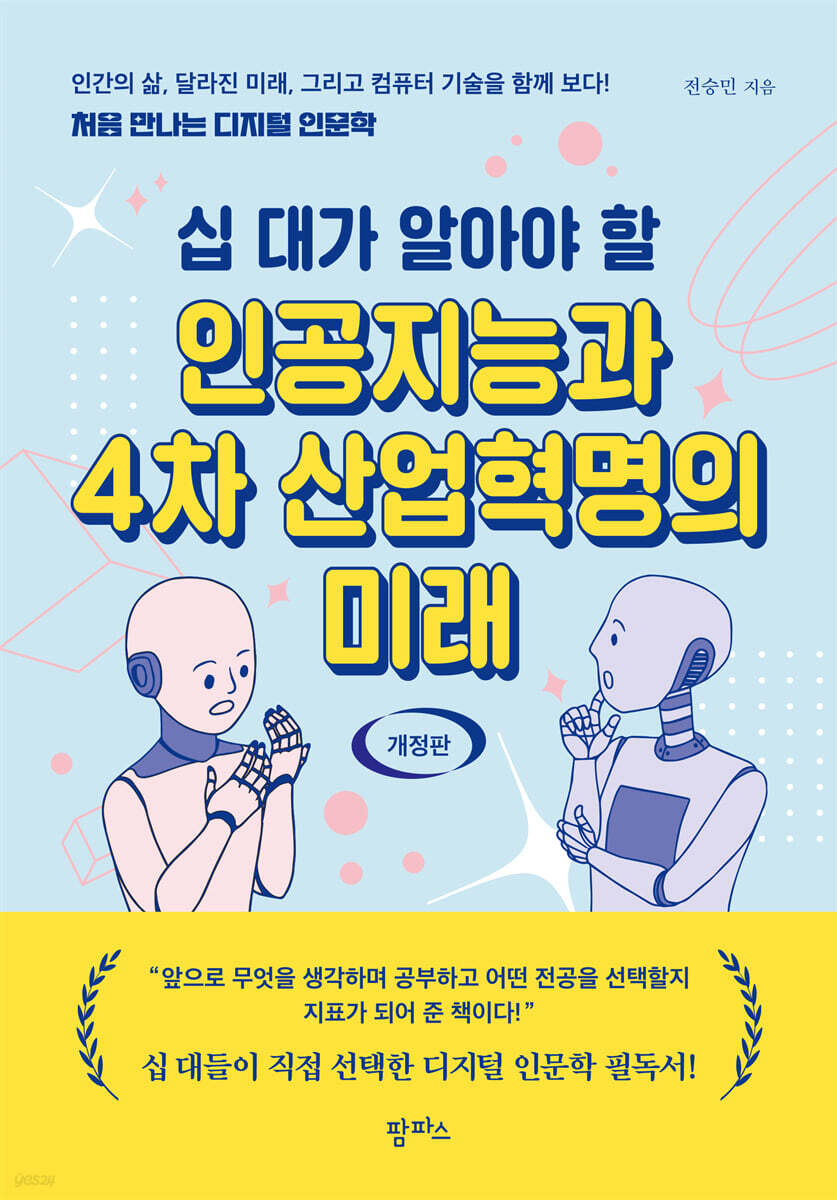
What Teenagers Need to Know About Artificial Intelligence and the Future of the Fourth Industrial Revolution
 |
Description
Book Introduction
Published in 2018, when the wave of the Fourth Industrial Revolution was slowly emerging, and firmly established as a science bestseller, "What Teenagers Need to Know About Artificial Intelligence and the Future of the Fourth Industrial Revolution" has now published a revised edition.
This book complements the current scientific and technological trends that have changed since the first edition was published at the dawn of the Fourth Industrial Revolution, and examines the waves of the Fourth Industrial Revolution, such as the emergence of generative AI, which have become huge waves that have transformed our lives.
This book explores what teenagers need to prepare for a future that will be more transformative than they can imagine, and how they can live and develop their talents. At a time when understanding AI is essential for becoming a future leader, this digital humanities book offers the easiest and most systematic way to understand AI and the Fourth Industrial Revolution.
"Artificial Intelligence and the Future of the Fourth Industrial Revolution: What Teenagers Need to Know (Revised Edition)" covers the beginning, changes, and completion of the Fourth Industrial Revolution, and discusses the digital science knowledge that future leaders, youth, must know and the resulting changes in their lives.
We explore key technologies of the future, such as artificial intelligence, robotics, big data, the Internet of Things, and communications, and also provide information on promising future jobs emerging in the industry and the reasons for their popularity.
It can be said to be the first digital humanities book that young people encounter, as it helps them develop an eye for understanding the process and flow of technology and the future world being created together.
The author, a science journalist who has covered Korea's first humanoid robot, Hubo, for 10 years and has closely observed the technological advancements of the Fourth Industrial Revolution, presents the most specific and vivid images of the technology that connects the present and the future, rather than providing vague explanations.
From the first computers to 'wearable computers' and 'generative AI', it explains the relationship between technological advancement and the development of the world in an easy-to-understand way.
Because of this, teenagers will feel as if they are reading a 'storybook' as they turn the pages.
Teenagers learn about the trends and current connectivity of the Fourth Industrial Revolution era, and acquire essential knowledge and intellectual abilities.
This book is for young people who are challenging themselves to discover their future self-worth.
This book complements the current scientific and technological trends that have changed since the first edition was published at the dawn of the Fourth Industrial Revolution, and examines the waves of the Fourth Industrial Revolution, such as the emergence of generative AI, which have become huge waves that have transformed our lives.
This book explores what teenagers need to prepare for a future that will be more transformative than they can imagine, and how they can live and develop their talents. At a time when understanding AI is essential for becoming a future leader, this digital humanities book offers the easiest and most systematic way to understand AI and the Fourth Industrial Revolution.
"Artificial Intelligence and the Future of the Fourth Industrial Revolution: What Teenagers Need to Know (Revised Edition)" covers the beginning, changes, and completion of the Fourth Industrial Revolution, and discusses the digital science knowledge that future leaders, youth, must know and the resulting changes in their lives.
We explore key technologies of the future, such as artificial intelligence, robotics, big data, the Internet of Things, and communications, and also provide information on promising future jobs emerging in the industry and the reasons for their popularity.
It can be said to be the first digital humanities book that young people encounter, as it helps them develop an eye for understanding the process and flow of technology and the future world being created together.
The author, a science journalist who has covered Korea's first humanoid robot, Hubo, for 10 years and has closely observed the technological advancements of the Fourth Industrial Revolution, presents the most specific and vivid images of the technology that connects the present and the future, rather than providing vague explanations.
From the first computers to 'wearable computers' and 'generative AI', it explains the relationship between technological advancement and the development of the world in an easy-to-understand way.
Because of this, teenagers will feel as if they are reading a 'storybook' as they turn the pages.
Teenagers learn about the trends and current connectivity of the Fourth Industrial Revolution era, and acquire essential knowledge and intellectual abilities.
This book is for young people who are challenging themselves to discover their future self-worth.
- You can preview some of the book's contents.
Preview
index
In the revised edition
Chapter 1: A New World Unpredicted Opens
-A new world brought about by automation and information technology, and development
Talk 1 A stupid but necessary item: a computer
Supercomputers and smartphones are the same thing?
Find the world's best computer/Computers do the same thing now as they did 40 years ago/Will computers become tools that overpower humans?
How was this thing called a 'computer' created?
Von Neumann, perfecting the computer architecture/Who was the greatest contributor to making a house-sized computer small?/Computers have entered every field of work.
Beyond palm-sized computers, now is the era of 'wearable computers'.
Leading the Revolution: Smartphones/What's Next for Smartphones? The Invasion of Wearable Devices/What if the Scouters from Dragon Ball become a reality?
The computers of the future will be everywhere in our lives.
Chapter 2: Unraveling the Myths of Artificial Intelligence in the Coming Future
-The truth and fiction of artificial intelligence that we will actually encounter
Talk 2 Will 'computers that think like humans' become a reality?
Advances in computer technology ≠ the birth of intelligence
The emergence of intelligence: will human-like robots emerge?
There are different types of artificial intelligence.
The Difference Between Strong and Weak AI/Analytical and Generative AI
Misconceptions and Truths about Generative AI
Can we actually build a 'really thinking machine'?
As the "brain project" diversifies, let's start with creating an "artificial brain." Weak AI becomes a "useful tool."
How do machines learn?
What is an 'artificial neural network'? / Distinguishing between dogs and cats is too difficult for machines / The limitations of weak AI are further revealed by machine learning.
Chapter 3: Technologies that make cinematic imagination a reality are coming.
Four technologies of the Fourth Industrial Revolution that will make things beyond imagination a reality.
Talk 3 New technologies are coming that will transform life and industry.
Is this the era of the 4th Industrial Revolution?
The core of the Fourth Industrial Revolution is artificial intelligence and data.
What if you could learn to ski with AI? / The value of data that will change the future
There is no AI society without communication capabilities.
Communication technologies becoming increasingly important in the future: The Internet of Things (IoT)
Interface technology connects humans and machines
How Machines and Humans Communicate: A Look at Past Interface Technologies/Is There Technology That Allows Direct Communication Between the Human Brain and Machines?
Completing the Fourth Industrial Revolution with Robotics Technology
What kind of robots do we want? Robots that collaborate with people.
Chapter 4 So Should We Learn to Code Right Now?
-Knowledge and skills essential to leading the AI era
Talk 4 Will you be swept away by the wave of change or will you ride it?
How did the Fourth Industrial Revolution come about?
Industry 4.0, the precursor to the Fourth Industrial Revolution
The world stands on the threshold of change.
The computer world and the real world connected by software
Jobs that machines can't replace vs.
Value that machines cannot create
Is it possible for robots to completely replace humans?
Creativity is ultimately a product of experience and knowledge.
The 4th Industrial Revolution's Requirements for Talent: Communication Skills and Problem-Solving Abilities
Korean, English, and Math will become more important? / What will the capabilities of talented people be in 10 years?
Chapter 5 What will the jobs that will attract attention in the future look like?
The changing future of work, the specifics of new jobs
Talk 5 What should I do if my current job disappears?
Are we coming to a world where only computer programmers will survive?
The Future of Work: A Look at the History of Work
Jobs will definitely decrease and more jobs will be created.
A glimpse into promising future careers
What's important is a vision for the future, rather than fragmented technology!
Chapter 6: Finally, Humans! Step onto a New Stage and Create the Future
-In the age of robots, finding uniquely human values becomes more important.
Talk 6 Let's be reborn as emotional people with empathy.
If a machine that is superior to humans appears
Wait, my boss is a robot? / The center of goods and economic life is ultimately humans.
Creating a 'safety device' for living with robots
Changes in occupational and social structures are inevitable.
The Completion of the Fourth Industrial Revolution and What Comes After/Basic Income System and Robot Tax
In the age of generative AI, this is what's needed in addition to human creativity.
Well, artificial intelligence cannot have this domain that only humans can have/Two basic abilities that have become more important to survive in the future world/To be able to read the ever-changing social system
The era of emotional humans who understand the new civilization
Chapter 1: A New World Unpredicted Opens
-A new world brought about by automation and information technology, and development
Talk 1 A stupid but necessary item: a computer
Supercomputers and smartphones are the same thing?
Find the world's best computer/Computers do the same thing now as they did 40 years ago/Will computers become tools that overpower humans?
How was this thing called a 'computer' created?
Von Neumann, perfecting the computer architecture/Who was the greatest contributor to making a house-sized computer small?/Computers have entered every field of work.
Beyond palm-sized computers, now is the era of 'wearable computers'.
Leading the Revolution: Smartphones/What's Next for Smartphones? The Invasion of Wearable Devices/What if the Scouters from Dragon Ball become a reality?
The computers of the future will be everywhere in our lives.
Chapter 2: Unraveling the Myths of Artificial Intelligence in the Coming Future
-The truth and fiction of artificial intelligence that we will actually encounter
Talk 2 Will 'computers that think like humans' become a reality?
Advances in computer technology ≠ the birth of intelligence
The emergence of intelligence: will human-like robots emerge?
There are different types of artificial intelligence.
The Difference Between Strong and Weak AI/Analytical and Generative AI
Misconceptions and Truths about Generative AI
Can we actually build a 'really thinking machine'?
As the "brain project" diversifies, let's start with creating an "artificial brain." Weak AI becomes a "useful tool."
How do machines learn?
What is an 'artificial neural network'? / Distinguishing between dogs and cats is too difficult for machines / The limitations of weak AI are further revealed by machine learning.
Chapter 3: Technologies that make cinematic imagination a reality are coming.
Four technologies of the Fourth Industrial Revolution that will make things beyond imagination a reality.
Talk 3 New technologies are coming that will transform life and industry.
Is this the era of the 4th Industrial Revolution?
The core of the Fourth Industrial Revolution is artificial intelligence and data.
What if you could learn to ski with AI? / The value of data that will change the future
There is no AI society without communication capabilities.
Communication technologies becoming increasingly important in the future: The Internet of Things (IoT)
Interface technology connects humans and machines
How Machines and Humans Communicate: A Look at Past Interface Technologies/Is There Technology That Allows Direct Communication Between the Human Brain and Machines?
Completing the Fourth Industrial Revolution with Robotics Technology
What kind of robots do we want? Robots that collaborate with people.
Chapter 4 So Should We Learn to Code Right Now?
-Knowledge and skills essential to leading the AI era
Talk 4 Will you be swept away by the wave of change or will you ride it?
How did the Fourth Industrial Revolution come about?
Industry 4.0, the precursor to the Fourth Industrial Revolution
The world stands on the threshold of change.
The computer world and the real world connected by software
Jobs that machines can't replace vs.
Value that machines cannot create
Is it possible for robots to completely replace humans?
Creativity is ultimately a product of experience and knowledge.
The 4th Industrial Revolution's Requirements for Talent: Communication Skills and Problem-Solving Abilities
Korean, English, and Math will become more important? / What will the capabilities of talented people be in 10 years?
Chapter 5 What will the jobs that will attract attention in the future look like?
The changing future of work, the specifics of new jobs
Talk 5 What should I do if my current job disappears?
Are we coming to a world where only computer programmers will survive?
The Future of Work: A Look at the History of Work
Jobs will definitely decrease and more jobs will be created.
A glimpse into promising future careers
What's important is a vision for the future, rather than fragmented technology!
Chapter 6: Finally, Humans! Step onto a New Stage and Create the Future
-In the age of robots, finding uniquely human values becomes more important.
Talk 6 Let's be reborn as emotional people with empathy.
If a machine that is superior to humans appears
Wait, my boss is a robot? / The center of goods and economic life is ultimately humans.
Creating a 'safety device' for living with robots
Changes in occupational and social structures are inevitable.
The Completion of the Fourth Industrial Revolution and What Comes After/Basic Income System and Robot Tax
In the age of generative AI, this is what's needed in addition to human creativity.
Well, artificial intelligence cannot have this domain that only humans can have/Two basic abilities that have become more important to survive in the future world/To be able to read the ever-changing social system
The era of emotional humans who understand the new civilization
Detailed image
Publisher's Review
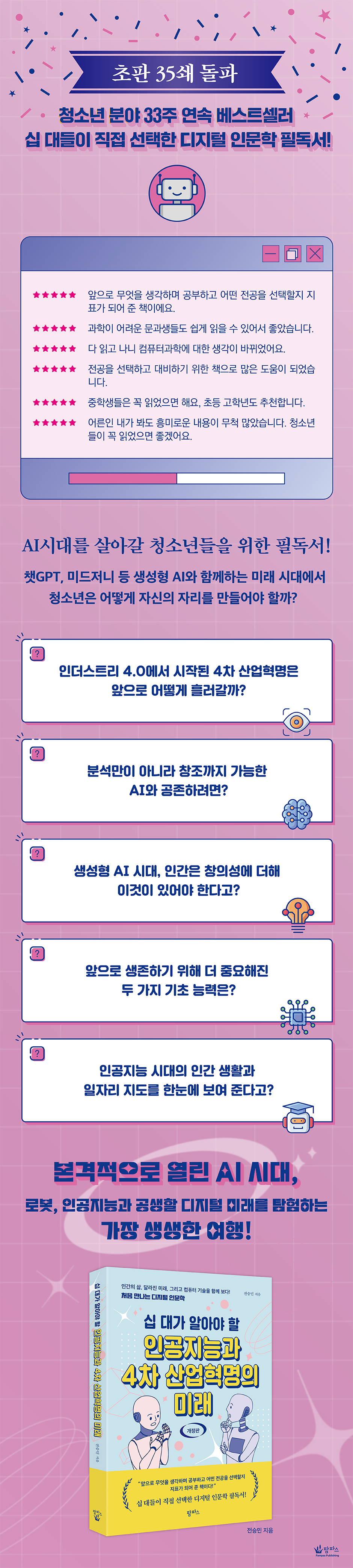
First edition sold 35 times,
Bestseller in the youth category for 33 consecutive weeks
Must-read digital humanities books chosen by teenagers themselves!
“This book has served as a guide for what to think about, what to study, and what major to choose in the future.”
“It was great that even liberal arts students who find science difficult could easily read it.”
“After reading it, my thoughts on computer science changed.”
“This book was very helpful in helping me choose a major and prepare for it.”
“I highly recommend this book to middle school students, and I also recommend it to upper elementary school students.”
“Even as an adult, I found a lot of content interesting.
I really hope young people read it.”
A must-read for young people living in the AI era!
How will the Fourth Industrial Revolution, which began with Industry 4.0, unfold in the future?
How can we coexist with AI that can not only analyze but also create?
In the age of generative AI, do humans need this in addition to creativity?
What two fundamental skills will become more important for survival in the future?
A map of human life and jobs in the age of artificial intelligence at a glance?
“Who said computer science was difficult?”
I am so grateful that so many young readers have loved this book since its first edition was published in 2018.
Sometimes, we even receive contact from students who say, “Thanks to you, I started dreaming of becoming a scientist.”
Those were the days when I thought it was the greatest honor I could have had as an author.
To repay the love of many, and to further supplement the changes that have occurred in the five years since the book was published in our rapidly changing modern society, I have compiled the content that needs to be revised and added.
That's why we're introducing a newly revised edition of "What Teenagers Need to Know About Artificial Intelligence and the Future of the Fourth Industrial Revolution."
From the author's note
Technology has become stronger and faster!
Now, understanding AI has become a prerequisite for talent!
In the future era with generative AI such as ChatGPT and Midjourney,
How should young people make their own place?
This book, "Artificial Intelligence and the Future of the Fourth Industrial Revolution: What Teenagers Need to Know," which met readers at the dawn of the Fourth Industrial Revolution, has been loved by many readers, reaching 35 editions and remaining an online bestseller for 33 consecutive weeks since its publication.
More than five years have passed since this book was first published, and teenagers have praised it as "a systematic digital science humanities book that can be read like a storybook," explaining the vague reality of the Fourth Industrial Revolution in the easiest and clearest way possible.
Meanwhile, a revised edition has been published, examining the present transformed by the waves of the Fourth Industrial Revolution, sketching the future, reflecting changing scientific and technological trends, and including the latest content, including generative AI.
Having covered the scientific field for a long time, the author now meets teenage readers through many lectures and hears diverse voices directly.
Based on that voice , we have revised the book to address the areas that teenagers are truly curious about, and to summarize the qualities and abilities that future talents should cultivate, as well as useful information to know before choosing a career path and major.
In the era of artificial intelligence, where analysis and creation are possible, a deep understanding of AI will become an essential requirement for future talent.
Only then can teenagers find their place in the battle for jobs over AI.
Rather than being swept away by the ever-accelerating waves of technological change, it has become increasingly important to learn how to ride the wave of technology by acquiring more robust human values.
The author, who has long covered the human role and needs of the tech landscape, also guides teenagers on the crucial skills they need to develop in the digital future.
This is why teenagers who will lead the ever-changing digital future should read this book over and over again.
Unique human values, a sense of humanities!
Now we need to read computer science and humanities together!
The most vivid picture of the 4th Industrial Revolution told to young people by a current science journalist.
A story about artificial intelligence, robots, software, and the future of life!
The term '4th Industrial Revolution', which is emphasized in various media, is no longer an unfamiliar word.
After the match between Lee Sedol and AlphaGo, people intuitively felt that artificial intelligence technology would change the future faster than expected.
Countless books and articles related to the Fourth Industrial Revolution are being published, and the term "Fourth Industrial Revolution" is even included in the titles of self-improvement courses.
While interest in the Fourth Industrial Revolution has grown, the pace of development in artificial intelligence is progressing at a rate that exceeds expectations.
People seem to be more fearful than excited about the rapid technological changes that are difficult for humans to keep up with.
There is a growing concern that I will be left behind by the changes brought about by the Fourth Industrial Revolution.
Young people entering the world during this period of rapid change also feel a vague sense of anxiety.
They say that many human jobs will disappear in the future, so I'm worried about which career path I should choose right now.
In a world driven by cutting-edge technology, there is confusion as to whether it is still appropriate to study Korean, English, and math.
Many books about the digital future only tell us about the changes that will occur in the future, but do not tell us what to do and prepare for right now.
This vagueness deepens the anxiety and worries of young people about the future.
This book provides teenagers with the most vivid and clear picture of the future and science and technology brought about by the Fourth Industrial Revolution in an easy-to-understand manner.
It explains the core science and technology of the future through various illustrations and examples.
It also vividly portrays the changes in life and careers that the technology brings and its impact on young people.
Technologies we've only heard about but haven't yet fully grasped—artificial intelligence, robotics, the Internet of Things, big data, interfaces, and communication technologies—are explained in a way that's accessible to teenagers. From the origins of the first computers to the current state of the art, the history of computer science will be told like a fascinating storybook.
It provides the most vivid and realistic reality to teenagers who are curious about what the Fourth Industrial Revolution is and how the digital future will unfold.
This is the first digital humanities book that young people encounter, and it will help them develop an eye for reading future trends.
Uncovering the four critical technologies driving the Fourth Industrial Revolution!
In the AI era, learn about the essential skills young people must cultivate!
The author's focus on explaining difficult digital science knowledge to teenagers in an engaging way that connects it to their lives was greatly influenced by his encounters with young people during lectures.
Having covered Korea's first humanoid robot, Hubo, for over 10 years and witnessed the development of cutting-edge technology up close, the author realized through countless lectures that the "misunderstanding and anxiety about future digital science and technology" among the young people he met was greater than expected.
Young people need 'accurate digital science information' to see AI as a useful tool rather than a competitor to humans.
This book aims to help young people develop a vision for the future and develop their strengths.
Starting with the story of 'Industry 4.0', the predecessor of the Fourth Industrial Revolution, we explain four core technologies that can be seen as central to this revolution.
It explains the nature of these technologies, which are artificial intelligence, data, interface, and communication technology, in an easy-to-understand way.
This alone will allow teenagers to clearly see the future changes that the Fourth Industrial Revolution will bring.
This will be a great help to teenagers who are concerned about their future career paths, as it vividly shows promising future jobs based on this technology.
We also examine from a humanistic perspective how technology has changed jobs and what human values and areas of life will be filled in place of jobs replaced by robots.
We also discuss current measures for coexisting with robots, such as robot taxes and basic income.
This will also give young people the opportunity to think about how humans and technology can work together.
We also explore the essential qualities that young people need to develop in the age of science, technology, and creativity.
It may provide useful information and assistance to teenagers who are struggling to discover their future self-worth.
Bestseller in the youth category for 33 consecutive weeks
Must-read digital humanities books chosen by teenagers themselves!
“This book has served as a guide for what to think about, what to study, and what major to choose in the future.”
“It was great that even liberal arts students who find science difficult could easily read it.”
“After reading it, my thoughts on computer science changed.”
“This book was very helpful in helping me choose a major and prepare for it.”
“I highly recommend this book to middle school students, and I also recommend it to upper elementary school students.”
“Even as an adult, I found a lot of content interesting.
I really hope young people read it.”
A must-read for young people living in the AI era!
How will the Fourth Industrial Revolution, which began with Industry 4.0, unfold in the future?
How can we coexist with AI that can not only analyze but also create?
In the age of generative AI, do humans need this in addition to creativity?
What two fundamental skills will become more important for survival in the future?
A map of human life and jobs in the age of artificial intelligence at a glance?
“Who said computer science was difficult?”
I am so grateful that so many young readers have loved this book since its first edition was published in 2018.
Sometimes, we even receive contact from students who say, “Thanks to you, I started dreaming of becoming a scientist.”
Those were the days when I thought it was the greatest honor I could have had as an author.
To repay the love of many, and to further supplement the changes that have occurred in the five years since the book was published in our rapidly changing modern society, I have compiled the content that needs to be revised and added.
That's why we're introducing a newly revised edition of "What Teenagers Need to Know About Artificial Intelligence and the Future of the Fourth Industrial Revolution."
From the author's note
Technology has become stronger and faster!
Now, understanding AI has become a prerequisite for talent!
In the future era with generative AI such as ChatGPT and Midjourney,
How should young people make their own place?
This book, "Artificial Intelligence and the Future of the Fourth Industrial Revolution: What Teenagers Need to Know," which met readers at the dawn of the Fourth Industrial Revolution, has been loved by many readers, reaching 35 editions and remaining an online bestseller for 33 consecutive weeks since its publication.
More than five years have passed since this book was first published, and teenagers have praised it as "a systematic digital science humanities book that can be read like a storybook," explaining the vague reality of the Fourth Industrial Revolution in the easiest and clearest way possible.
Meanwhile, a revised edition has been published, examining the present transformed by the waves of the Fourth Industrial Revolution, sketching the future, reflecting changing scientific and technological trends, and including the latest content, including generative AI.
Having covered the scientific field for a long time, the author now meets teenage readers through many lectures and hears diverse voices directly.
Based on that voice , we have revised the book to address the areas that teenagers are truly curious about, and to summarize the qualities and abilities that future talents should cultivate, as well as useful information to know before choosing a career path and major.
In the era of artificial intelligence, where analysis and creation are possible, a deep understanding of AI will become an essential requirement for future talent.
Only then can teenagers find their place in the battle for jobs over AI.
Rather than being swept away by the ever-accelerating waves of technological change, it has become increasingly important to learn how to ride the wave of technology by acquiring more robust human values.
The author, who has long covered the human role and needs of the tech landscape, also guides teenagers on the crucial skills they need to develop in the digital future.
This is why teenagers who will lead the ever-changing digital future should read this book over and over again.
Unique human values, a sense of humanities!
Now we need to read computer science and humanities together!
The most vivid picture of the 4th Industrial Revolution told to young people by a current science journalist.
A story about artificial intelligence, robots, software, and the future of life!
The term '4th Industrial Revolution', which is emphasized in various media, is no longer an unfamiliar word.
After the match between Lee Sedol and AlphaGo, people intuitively felt that artificial intelligence technology would change the future faster than expected.
Countless books and articles related to the Fourth Industrial Revolution are being published, and the term "Fourth Industrial Revolution" is even included in the titles of self-improvement courses.
While interest in the Fourth Industrial Revolution has grown, the pace of development in artificial intelligence is progressing at a rate that exceeds expectations.
People seem to be more fearful than excited about the rapid technological changes that are difficult for humans to keep up with.
There is a growing concern that I will be left behind by the changes brought about by the Fourth Industrial Revolution.
Young people entering the world during this period of rapid change also feel a vague sense of anxiety.
They say that many human jobs will disappear in the future, so I'm worried about which career path I should choose right now.
In a world driven by cutting-edge technology, there is confusion as to whether it is still appropriate to study Korean, English, and math.
Many books about the digital future only tell us about the changes that will occur in the future, but do not tell us what to do and prepare for right now.
This vagueness deepens the anxiety and worries of young people about the future.
This book provides teenagers with the most vivid and clear picture of the future and science and technology brought about by the Fourth Industrial Revolution in an easy-to-understand manner.
It explains the core science and technology of the future through various illustrations and examples.
It also vividly portrays the changes in life and careers that the technology brings and its impact on young people.
Technologies we've only heard about but haven't yet fully grasped—artificial intelligence, robotics, the Internet of Things, big data, interfaces, and communication technologies—are explained in a way that's accessible to teenagers. From the origins of the first computers to the current state of the art, the history of computer science will be told like a fascinating storybook.
It provides the most vivid and realistic reality to teenagers who are curious about what the Fourth Industrial Revolution is and how the digital future will unfold.
This is the first digital humanities book that young people encounter, and it will help them develop an eye for reading future trends.
Uncovering the four critical technologies driving the Fourth Industrial Revolution!
In the AI era, learn about the essential skills young people must cultivate!
The author's focus on explaining difficult digital science knowledge to teenagers in an engaging way that connects it to their lives was greatly influenced by his encounters with young people during lectures.
Having covered Korea's first humanoid robot, Hubo, for over 10 years and witnessed the development of cutting-edge technology up close, the author realized through countless lectures that the "misunderstanding and anxiety about future digital science and technology" among the young people he met was greater than expected.
Young people need 'accurate digital science information' to see AI as a useful tool rather than a competitor to humans.
This book aims to help young people develop a vision for the future and develop their strengths.
Starting with the story of 'Industry 4.0', the predecessor of the Fourth Industrial Revolution, we explain four core technologies that can be seen as central to this revolution.
It explains the nature of these technologies, which are artificial intelligence, data, interface, and communication technology, in an easy-to-understand way.
This alone will allow teenagers to clearly see the future changes that the Fourth Industrial Revolution will bring.
This will be a great help to teenagers who are concerned about their future career paths, as it vividly shows promising future jobs based on this technology.
We also examine from a humanistic perspective how technology has changed jobs and what human values and areas of life will be filled in place of jobs replaced by robots.
We also discuss current measures for coexisting with robots, such as robot taxes and basic income.
This will also give young people the opportunity to think about how humans and technology can work together.
We also explore the essential qualities that young people need to develop in the age of science, technology, and creativity.
It may provide useful information and assistance to teenagers who are struggling to discover their future self-worth.
GOODS SPECIFICS
- Date of issue: March 30, 2024
- Page count, weight, size: 268 pages | 468g | 153*220*16mm
- ISBN13: 9791170266372
You may also like
카테고리
korean


korean

![GQ KOREA Mark (Monthly): December [2025]](http://librairie.coreenne.fr/cdn/shop/files/8ef265dbbfbf186523ed75ba7319009d.jpg?v=1765340328&width=3840)


