

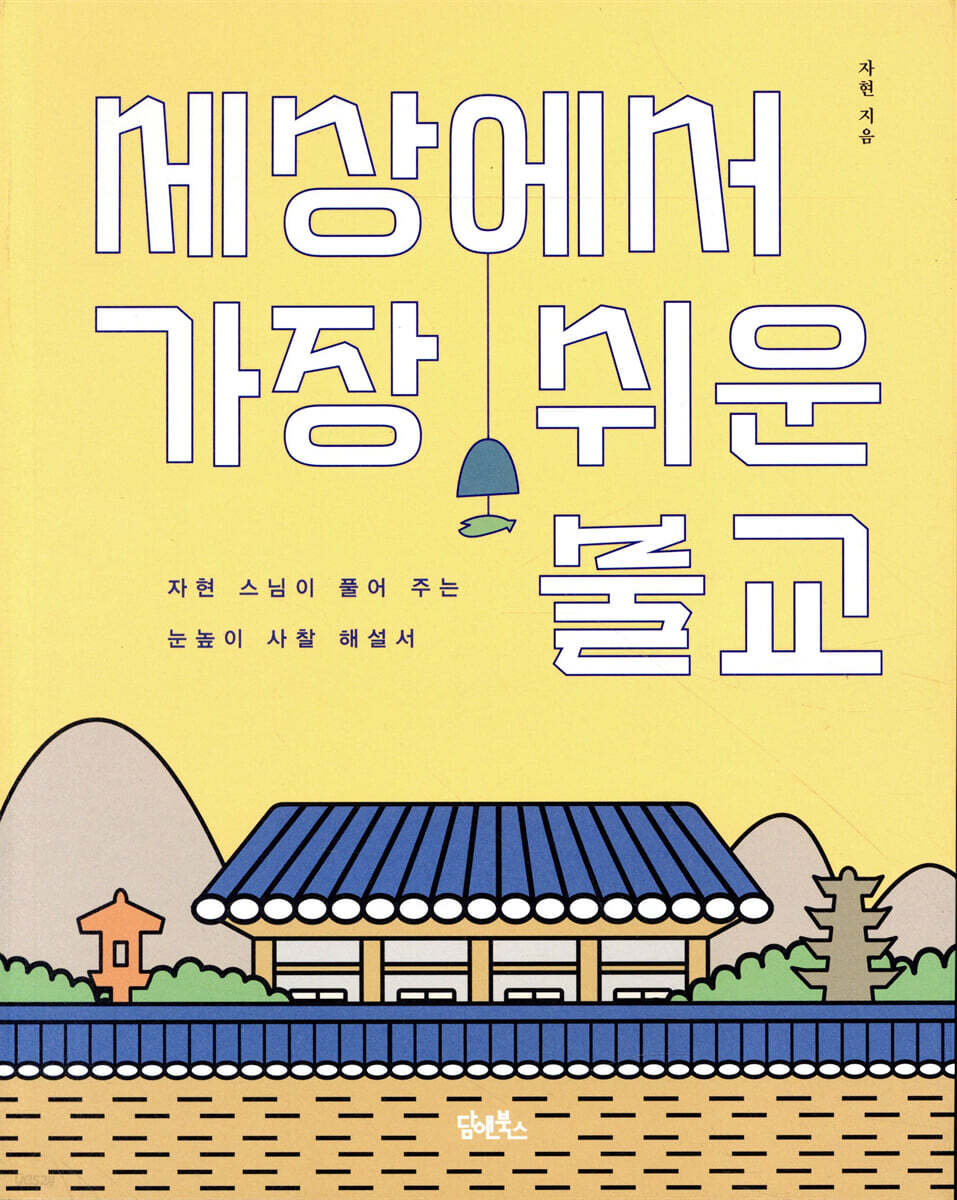
The easiest Buddhism in the world
 |
Description
Book Introduction
Monk Ja-Hyeon's new book, "The Easiest Buddhism in the World," has been published.
Why are Buddha statues golden?
Why are there so many Buddhas in a temple?
How many times a month should I go to the temple?
Questions that remained unanswered even after visiting temples for decades, and Buddhist culture learned over the shoulders, explained in the easiest language possible.
Buddhism was difficult for beginners because they did not know about it, and it was difficult for Buddhists because they could not ask questions.
A temple guidebook written by Monk Ja-Hyeon, which explains temples at eye level with easy-to-understand explanations and over 200 photos, excluding difficult Buddhist terms.
The Easiest Buddhism in the World
Monk Ja-Hyeon, who holds doctorates in five fields including architecture, Seon Buddhism, ancient Korean history, Buddhist education, painting, and Vinaya, is a monk and Buddhist intellectual who covers everything from Korean history to art studies and Buddhist doctrine.
He also communicates with Buddhists through YouTube, Naver Band, Buddhist TV, etc., and spreads Buddhism through his unique way of speaking and perspective.
This book is a 'beginner's introduction to Buddhism' that covers everything from the introduction to Buddhism to culture, faith, and pilgrimage. It is structured in a way that lowers the threshold for Buddhism while covering the basics.
In particular, the monk explained the direction of this book in the preface, saying, “A common mistake made by people who write Buddhist books is that they pursue ‘as easy as possible,’ but it ends up being difficult.” He added, “This book excludes as much Buddhist terminology as possible, and with the concept of ‘Buddhism that is fun and easy like a picture book,’ it is a summary of Buddhism that anyone can understand.”
Why are Buddha statues golden?
Why are there so many Buddhas in a temple?
How many times a month should I go to the temple?
Questions that remained unanswered even after visiting temples for decades, and Buddhist culture learned over the shoulders, explained in the easiest language possible.
Buddhism was difficult for beginners because they did not know about it, and it was difficult for Buddhists because they could not ask questions.
A temple guidebook written by Monk Ja-Hyeon, which explains temples at eye level with easy-to-understand explanations and over 200 photos, excluding difficult Buddhist terms.
The Easiest Buddhism in the World
Monk Ja-Hyeon, who holds doctorates in five fields including architecture, Seon Buddhism, ancient Korean history, Buddhist education, painting, and Vinaya, is a monk and Buddhist intellectual who covers everything from Korean history to art studies and Buddhist doctrine.
He also communicates with Buddhists through YouTube, Naver Band, Buddhist TV, etc., and spreads Buddhism through his unique way of speaking and perspective.
This book is a 'beginner's introduction to Buddhism' that covers everything from the introduction to Buddhism to culture, faith, and pilgrimage. It is structured in a way that lowers the threshold for Buddhism while covering the basics.
In particular, the monk explained the direction of this book in the preface, saying, “A common mistake made by people who write Buddhist books is that they pursue ‘as easy as possible,’ but it ends up being difficult.” He added, “This book excludes as much Buddhist terminology as possible, and with the concept of ‘Buddhism that is fun and easy like a picture book,’ it is a summary of Buddhism that anyone can understand.”
- You can preview some of the book's contents.
Preview
index
Chapter 1
What is Introductory Buddhism?
1.
Both the temple and the incense are imported 013
2.
Why are temples located in mountains? 022
3.
Why are Buddhist statues gold? 031
4.
How Did Buddhism Begin? 041
5.
The Three Elements of Buddhism 047
6.
Do Buddhists Believe in God? 055
7.
What's the difference between meditation and Zen? 064
- Buddhism in World Religions 070
Chapter 2
Understanding Cultural Temples
1.
Why do temples have so many doors? 077
2.
How are temple buildings different? 087
3.
Bell and drum that awaken living beings 097
4.
What function does a pagoda serve in a temple? 105
5.
Different hand shapes of Buddha statues 114
6.
122 Bodhisattva statues, magnificently expressed and magnificently
7.
Why are there so many Buddhas in a temple? 131
- Expressions of other religions that coexist with Buddhism 139
Chapter 3
What is a prayer of faith?
1.
Daily Religious Rituals 145
2.
How many times a month should I go to the temple? 153
3.
The Five Major Buddhist Holidays 158
4.
What's the difference between Confucian and Buddhist rites? 168
5.
The Purpose of Chanting and 108 Bows 176
6.
The Heart Sutra and the Diamond Sutra 184
7.
Thousand-Hand Sutra and Avatamsaka Sutra 190
- Buddhist Principles of Prayer 196
Chapter 4
Where should I go on a pilgrimage?
1.
Where is the Sambo Temple? 203
2.
Where are the five major archery locations? 216
3.
224 sacred mountains in our country
4.
Where are the three major Guanyin holy sites? 236
5.
Where is the sacred place of Ksitigarbha Bodhisattva? 244
6.
What kind of temples do foreigners like? 256
7.
Reasons for the Three Pilgrimages and the Release of Life 270
- A loach becomes a dragon? 277
What is Introductory Buddhism?
1.
Both the temple and the incense are imported 013
2.
Why are temples located in mountains? 022
3.
Why are Buddhist statues gold? 031
4.
How Did Buddhism Begin? 041
5.
The Three Elements of Buddhism 047
6.
Do Buddhists Believe in God? 055
7.
What's the difference between meditation and Zen? 064
- Buddhism in World Religions 070
Chapter 2
Understanding Cultural Temples
1.
Why do temples have so many doors? 077
2.
How are temple buildings different? 087
3.
Bell and drum that awaken living beings 097
4.
What function does a pagoda serve in a temple? 105
5.
Different hand shapes of Buddha statues 114
6.
122 Bodhisattva statues, magnificently expressed and magnificently
7.
Why are there so many Buddhas in a temple? 131
- Expressions of other religions that coexist with Buddhism 139
Chapter 3
What is a prayer of faith?
1.
Daily Religious Rituals 145
2.
How many times a month should I go to the temple? 153
3.
The Five Major Buddhist Holidays 158
4.
What's the difference between Confucian and Buddhist rites? 168
5.
The Purpose of Chanting and 108 Bows 176
6.
The Heart Sutra and the Diamond Sutra 184
7.
Thousand-Hand Sutra and Avatamsaka Sutra 190
- Buddhist Principles of Prayer 196
Chapter 4
Where should I go on a pilgrimage?
1.
Where is the Sambo Temple? 203
2.
Where are the five major archery locations? 216
3.
224 sacred mountains in our country
4.
Where are the three major Guanyin holy sites? 236
5.
Where is the sacred place of Ksitigarbha Bodhisattva? 244
6.
What kind of temples do foreigners like? 256
7.
Reasons for the Three Pilgrimages and the Release of Life 270
- A loach becomes a dragon? 277
Into the book
If you go to the mountain temple, you have to walk quite a long distance even after parking your car in the parking lot.
Sometimes it gives a nice atmosphere, like the fir forest of Woljeongsa Temple or the pine forest of Tongdosa Temple.
But sometimes I wonder why the driveway is so long.
These long access roads are one of the unique features of our country's mountain temples.
Although mountains today benefit humans in every way, in the past they were also home to dangerous creatures such as tigers.
You might be thinking, 'How many tigers must there be to do such a thing?', but tiger disease was scarier than smallpox.
So when comparing something scary, we say it's a compatible mother.
There are also famous proverbs related to tigers, such as, "Even a tiger will come if you call it," "In a valley without tigers, the rabbit is king," "Tigers leave their skins behind when they die, and people leave their names behind when they die," and "Even if you are bitten by a tiger, you will survive if you come to your senses."
But there is a chilling proverb related to the mountain temple here: 'The tiger of dawn does not discriminate between monks and dogs.'
This proverb clearly explains why almost every mountain temple has a shrine dedicated to the mountain god and a picture of a tiger painted inside it.
Our country had many mountainous regions and thus was prone to conflict, but ironically, it was Japan that helped us completely escape from this.
Japan mass-killed wild animals under the pretext of a marine rescue operation, which resulted in the near extinction of tigers, leopards, and wolves by 1925.
Mountain temples located in deep valleys are the most vulnerable to damage.
So, Sansa tried to overcome this problem by making the access road as long as possible and leaving no human traces.
This is because the presence of humans can reduce damage from animals.
In order to leave traces of people along the long driveway, the mountain temple erected gates here and there.
But this door has no wall or door leaf.
A rather ridiculous 'doorless door' was created, with only a door placed there.
---From “Why are there so many doors in a temple?”
As the pronunciation of Confucian and Buddhist rites became the same and the use of Hangul instead of Chinese characters was implemented, the two different religious rites began to face serious confusion.
Confucian ancestral rites are centered around offering food to the deceased.
In Confucianism, there is no separate afterlife.
So the dead live invisibly in the same space as the living.
In the past, noble families would provide a separate house for them to stay in, and this was called a shrine.
The most representative of these shrines is Jongmyo Shrine, a UNESCO World Heritage Site related to the royal family.
In fact, if you look a little more closely at the ancestral tablets we commonly use in ancestral rites, you can see that they are shaped like tile-roofed houses.
The ancestral tablet was a single house.
In today's terms, you can understand it as an apartment or a studio apartment.
The fact that our ancestors remain with us after they pass away and do not go to another world means that they also need a supply of food.
That is why sacrifices exist.
In fact, Confucian funeral rituals have a lot of food-related table settings.
After the three-day market, three meals a day must be offered separately, and after that, there are ceremonies such as the Balinje, Noje, Samwooje, and Jolgokje.
Also, although it has disappeared now, in the past, people lived in a temple for three years and prepared three meals a day.
When you first return, you cannot forget the habits you had while alive, so you offer food every day.
Then, as time passes, it is simplified to ancestral rites and joint ancestral rites on holidays.
However, the core is always food, and this is confirmed through the practice of sharing food eaten by ancestors with descendants.
Eumbok is a method of sharing food within the same blood group through inheritance.
In other words, sharing food through offering and passing on food is the most important part of the ritual.
This aspect is also confirmed through the word ‘je’.
The upper part of the Chinese character for offering is written as 月肉 (meat) which represents meat, and 又 (also) which means that a lot of meat was displayed.
It refers to a ceremonial table with a lot of meat.
This is what the word "je" means, to show this, that is, to make the ancestors come and see it and be happy.
In contrast, the Buddhist fasting refers to the fasting precepts that correct one's body and mind.
You can think of it as a bathing ritual, which we often use.
This relates to the fundamental human nature of wanting to sanctify the secular mind.
In other words, the goal of Buddhism is to correct oneself and move towards holiness, and thus change oneself and the world.
From this perspective, we can see that Je and Jae are religious concepts with completely different perspectives.
Sometimes it gives a nice atmosphere, like the fir forest of Woljeongsa Temple or the pine forest of Tongdosa Temple.
But sometimes I wonder why the driveway is so long.
These long access roads are one of the unique features of our country's mountain temples.
Although mountains today benefit humans in every way, in the past they were also home to dangerous creatures such as tigers.
You might be thinking, 'How many tigers must there be to do such a thing?', but tiger disease was scarier than smallpox.
So when comparing something scary, we say it's a compatible mother.
There are also famous proverbs related to tigers, such as, "Even a tiger will come if you call it," "In a valley without tigers, the rabbit is king," "Tigers leave their skins behind when they die, and people leave their names behind when they die," and "Even if you are bitten by a tiger, you will survive if you come to your senses."
But there is a chilling proverb related to the mountain temple here: 'The tiger of dawn does not discriminate between monks and dogs.'
This proverb clearly explains why almost every mountain temple has a shrine dedicated to the mountain god and a picture of a tiger painted inside it.
Our country had many mountainous regions and thus was prone to conflict, but ironically, it was Japan that helped us completely escape from this.
Japan mass-killed wild animals under the pretext of a marine rescue operation, which resulted in the near extinction of tigers, leopards, and wolves by 1925.
Mountain temples located in deep valleys are the most vulnerable to damage.
So, Sansa tried to overcome this problem by making the access road as long as possible and leaving no human traces.
This is because the presence of humans can reduce damage from animals.
In order to leave traces of people along the long driveway, the mountain temple erected gates here and there.
But this door has no wall or door leaf.
A rather ridiculous 'doorless door' was created, with only a door placed there.
---From “Why are there so many doors in a temple?”
As the pronunciation of Confucian and Buddhist rites became the same and the use of Hangul instead of Chinese characters was implemented, the two different religious rites began to face serious confusion.
Confucian ancestral rites are centered around offering food to the deceased.
In Confucianism, there is no separate afterlife.
So the dead live invisibly in the same space as the living.
In the past, noble families would provide a separate house for them to stay in, and this was called a shrine.
The most representative of these shrines is Jongmyo Shrine, a UNESCO World Heritage Site related to the royal family.
In fact, if you look a little more closely at the ancestral tablets we commonly use in ancestral rites, you can see that they are shaped like tile-roofed houses.
The ancestral tablet was a single house.
In today's terms, you can understand it as an apartment or a studio apartment.
The fact that our ancestors remain with us after they pass away and do not go to another world means that they also need a supply of food.
That is why sacrifices exist.
In fact, Confucian funeral rituals have a lot of food-related table settings.
After the three-day market, three meals a day must be offered separately, and after that, there are ceremonies such as the Balinje, Noje, Samwooje, and Jolgokje.
Also, although it has disappeared now, in the past, people lived in a temple for three years and prepared three meals a day.
When you first return, you cannot forget the habits you had while alive, so you offer food every day.
Then, as time passes, it is simplified to ancestral rites and joint ancestral rites on holidays.
However, the core is always food, and this is confirmed through the practice of sharing food eaten by ancestors with descendants.
Eumbok is a method of sharing food within the same blood group through inheritance.
In other words, sharing food through offering and passing on food is the most important part of the ritual.
This aspect is also confirmed through the word ‘je’.
The upper part of the Chinese character for offering is written as 月肉 (meat) which represents meat, and 又 (also) which means that a lot of meat was displayed.
It refers to a ceremonial table with a lot of meat.
This is what the word "je" means, to show this, that is, to make the ancestors come and see it and be happy.
In contrast, the Buddhist fasting refers to the fasting precepts that correct one's body and mind.
You can think of it as a bathing ritual, which we often use.
This relates to the fundamental human nature of wanting to sanctify the secular mind.
In other words, the goal of Buddhism is to correct oneself and move towards holiness, and thus change oneself and the world.
From this perspective, we can see that Je and Jae are religious concepts with completely different perspectives.
---From "What is the difference between Confucian ancestral rites and Buddhist rites?"
GOODS SPECIFICS
- Publication date: April 14, 2021
- Pages, weight, size: 286 pages | 604g | 175*220*20mm
- ISBN13: 9791162012888
- ISBN10: 1162012889
You may also like
카테고리
korean


korean

![GQ KOREA Mark (Monthly): December [2025]](http://librairie.coreenne.fr/cdn/shop/files/8ef265dbbfbf186523ed75ba7319009d.jpg?v=1765340328&width=3840)


