

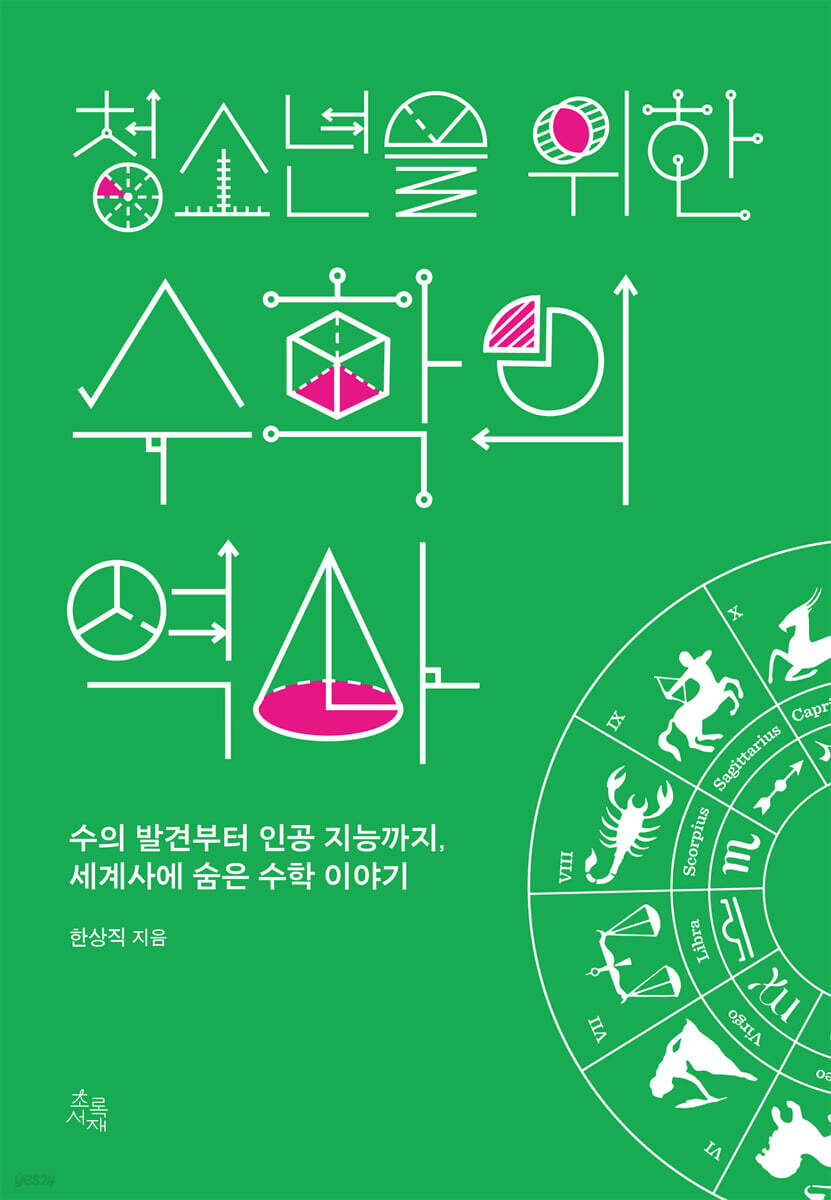
A History of Mathematics for Young People
 |
Description
Book Introduction
Math + World History: Kill Two Birds at Once!
A must-read for teenagers before they give up on math.
A clear milestone that tells you why you should learn math.
More and more young people are finding math difficult.
There are many young people who wonder why they should learn math in the first place.
How can we best introduce mathematics to young people? The author's words, "I wrote this book because I wanted to share with young people how mathematics has shaped civilization and how closely it permeates our lives," provide the answer.
It's too early to be scared and become a 'dropout'.
They say that if you persevere, you will win every battle.
By reading this book, we will learn about the history of mathematics and approach the principles of mathematics step by step.
Eventually, you will become interested and curious about mathematics and become familiar with it naturally.
A must-read for teenagers before they give up on math.
A clear milestone that tells you why you should learn math.
More and more young people are finding math difficult.
There are many young people who wonder why they should learn math in the first place.
How can we best introduce mathematics to young people? The author's words, "I wrote this book because I wanted to share with young people how mathematics has shaped civilization and how closely it permeates our lives," provide the answer.
It's too early to be scared and become a 'dropout'.
They say that if you persevere, you will win every battle.
By reading this book, we will learn about the history of mathematics and approach the principles of mathematics step by step.
Eventually, you will become interested and curious about mathematics and become familiar with it naturally.
- You can preview some of the book's contents.
Preview
index
Entering
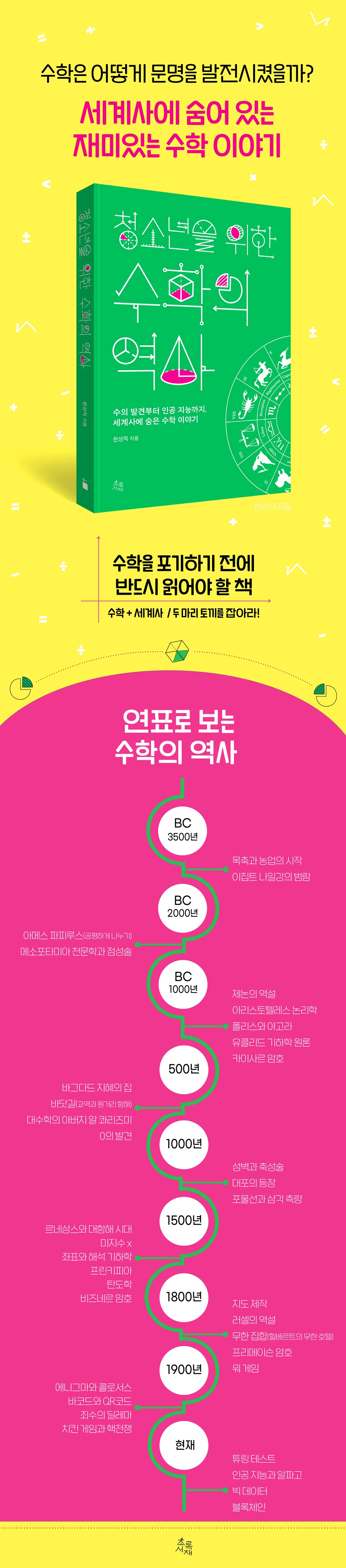
Lecture 1: The Rise of Civilization: Mathematics That Gave Birth to Civilization
Livestock and agriculture
Nile River flood
Share fairly
Astronomy and Astrology
Lecture 2: Greek Philosophy: Logic Developed in the Agora
Police and Agora
logic
Zeno's Paradox
Elements of Geometry
Lecture 3: Islamic Mathematics: Practical Mathematics Developed by Commerce
The House of Commercial Civilization and Wisdom
algebra
Trade and long-distance navigation
Lecture 4: Indian Mathematics: Philosophical Reflections and the Invention of Zero
formation
Invention of 0
binary scale
5. War and Mathematics: Understanding Triangulation Without Going There
bow, spear, sword
Walls and fortifications
The appearance of the cannon
Parabolas and triangulation
Lecture 6: Descartes and Coordinates: Analytical Geometry, Combining Geometry and Algebra
Renaissance and the Age of Exploration
Use of unknown x
Coordinate and analytical geometry
Map making
Lesson 7 Differentiation and Integration: Predicting Motion
Principia
ballistics
Calculus and Real Life
Lecture 8: Sets and Mathematical Logic: From the Finite to the Infinite
infinite set
Expressing logic in symbols
Russell's paradox
Incompleteness theorem
Lesson 9: The Code: The Code That Decides the Victory or Defeat of War
Ancient and Medieval Codes
World War II and cryptography
security devices
Lecture 10: Game Theory: Combining Economics and Mathematics
linear programming
War Games
Prisoner's Dilemma
Chicken Game and Nuclear War
Lecture 11: Computers and Artificial Intelligence: Self-Learning Artificial Intelligence
The development and basic principles of computers
Turing Test
Artificial Intelligence and AlphaGo
Big data
Blockchain
Lecture 1: The Rise of Civilization: Mathematics That Gave Birth to Civilization
Livestock and agriculture
Nile River flood
Share fairly
Astronomy and Astrology
Lecture 2: Greek Philosophy: Logic Developed in the Agora
Police and Agora
logic
Zeno's Paradox
Elements of Geometry
Lecture 3: Islamic Mathematics: Practical Mathematics Developed by Commerce
The House of Commercial Civilization and Wisdom
algebra
Trade and long-distance navigation
Lecture 4: Indian Mathematics: Philosophical Reflections and the Invention of Zero
formation
Invention of 0
binary scale
5. War and Mathematics: Understanding Triangulation Without Going There
bow, spear, sword
Walls and fortifications
The appearance of the cannon
Parabolas and triangulation
Lecture 6: Descartes and Coordinates: Analytical Geometry, Combining Geometry and Algebra
Renaissance and the Age of Exploration
Use of unknown x
Coordinate and analytical geometry
Map making
Lesson 7 Differentiation and Integration: Predicting Motion
Principia
ballistics
Calculus and Real Life
Lecture 8: Sets and Mathematical Logic: From the Finite to the Infinite
infinite set
Expressing logic in symbols
Russell's paradox
Incompleteness theorem
Lesson 9: The Code: The Code That Decides the Victory or Defeat of War
Ancient and Medieval Codes
World War II and cryptography
security devices
Lecture 10: Game Theory: Combining Economics and Mathematics
linear programming
War Games
Prisoner's Dilemma
Chicken Game and Nuclear War
Lecture 11: Computers and Artificial Intelligence: Self-Learning Artificial Intelligence
The development and basic principles of computers
Turing Test
Artificial Intelligence and AlphaGo
Big data
Blockchain
Detailed image
Into the book
Muslims must pray five times a day facing Mecca and observe Ramadan, a month-long fasting period each year.
And every Muslim must make a pilgrimage to Hajj at least once in his or her lifetime.
Astronomical observations are essential for praying or performing pilgrimage, as they require precise knowledge of the direction of Mecca, and for creating an accurate calendar to inform Muslims of the start and end of Ramadan.
--- From "3rd Lecture Islamic Mathematics"
'0' is a number meaning nothing, and was created in India, the land of philosophy.
It tells us that numbers that are invisible to our eyes as well as visible to our eyes have meaning.
Chinese characters, Egyptian and Roman numerals, which do not have zeros, must continuously create new numbers as they grow in size.
Chinese characters use numbers like ten, hundred, thousand, ten thousand, hundred million, trillion, gyeong, and year…
But by using 0, we no longer need to create numbers.
When we say 333, this means 3 × 100 + 3 × 10 + 3 × 1.
The 3 on the far left means there are three groups of 100s, the 3 in the middle means there are three groups of 10s, and the 3 on the right means there are three single digits, that is, three 1s.
The same number 3 can mean 300, 30, or 3.
(Omitted) With the introduction of 0 in the decimal system, it became possible to easily represent any large number with 10 digits.
The invention of zero is considered one of the most groundbreaking events in the history of mathematics.
--- From "4th Quarter Indian Mathematics"
To accurately hit a cannon bullet on a target, it is important to measure the distance and direction.
The observer measures the direction of the target and the distance from the cannon to the target.
The howitzer gunner fires according to the direction and distance indicated by the observer.
However, you cannot go directly to the enemy positions on the battlefield to measure the distance.
One way to measure distance without going directly is to use trigonometry.
Trigonometry, which was used for astronomical observations in ancient civilizations, is also used to measure distances for cannons.
--- From "The Five Powers of War and Mathematics"
Galileo made an inclined plane with his desk and rolled an iron ball.
And by observing the trajectory of the flying object as it fell down the slope, we discovered that it was a parabola.
Using Newton's classical mechanics, it was possible to determine the trajectory of a projectile in flight and precisely calculate where it would land.
By calculating the trajectory of a flying cannonball, we found that when a cannonball is fired on Earth, where gravity acts, the trajectory of the cannonball falls in the shape of a quadratic function.
--- From "Chapter 7 Differentiation and Integration"
In the 1950s, computer-based war games emerged.
Conducting actual bilateral maneuver training takes a tremendous amount of time and money.
However, conducting simulated combat exercises or computer war games can achieve the same combat results as real-world maneuver training while saving money and time.
War games used in civilian settings were initially created as board games using maps and pieces.
It was created in the form of a board game because it is difficult to immediately know whether a strategic decision was successful or not without the help of a computer.
However, starting in the latter half of the 20th century, with the development and spread of personal computers, strategy simulation games emerged.
Many people are starting to take interest in games that involve mining and nurturing resources and waging real-time wars based on these resources.
At first, strategy games such as Starcraft and Warcraft appeared, and later the Civilization series appeared, making strategy simulation games very popular.
--- From "10 Game Theory Lessons"
Although the abacus was a great help when it was first created, humans were still the main agents of calculation.
Pascal and Leibniz's calculators also had humans as the subject of calculation.
But when we see Bombena Colossus performing programmed calculations on its own, we begin to think that the subject of the calculations may not be a human but a computer.
Computers have made it easy to solve many problems that took humans a long time and a lot of effort to calculate.
Given a program, he could do anything well.
As a result, I naturally began to think that computers could not only execute programs given by humans, but could also create and execute programs of their own.
This is where we begin our discussion about artificial intelligence.
And every Muslim must make a pilgrimage to Hajj at least once in his or her lifetime.
Astronomical observations are essential for praying or performing pilgrimage, as they require precise knowledge of the direction of Mecca, and for creating an accurate calendar to inform Muslims of the start and end of Ramadan.
--- From "3rd Lecture Islamic Mathematics"
'0' is a number meaning nothing, and was created in India, the land of philosophy.
It tells us that numbers that are invisible to our eyes as well as visible to our eyes have meaning.
Chinese characters, Egyptian and Roman numerals, which do not have zeros, must continuously create new numbers as they grow in size.
Chinese characters use numbers like ten, hundred, thousand, ten thousand, hundred million, trillion, gyeong, and year…
But by using 0, we no longer need to create numbers.
When we say 333, this means 3 × 100 + 3 × 10 + 3 × 1.
The 3 on the far left means there are three groups of 100s, the 3 in the middle means there are three groups of 10s, and the 3 on the right means there are three single digits, that is, three 1s.
The same number 3 can mean 300, 30, or 3.
(Omitted) With the introduction of 0 in the decimal system, it became possible to easily represent any large number with 10 digits.
The invention of zero is considered one of the most groundbreaking events in the history of mathematics.
--- From "4th Quarter Indian Mathematics"
To accurately hit a cannon bullet on a target, it is important to measure the distance and direction.
The observer measures the direction of the target and the distance from the cannon to the target.
The howitzer gunner fires according to the direction and distance indicated by the observer.
However, you cannot go directly to the enemy positions on the battlefield to measure the distance.
One way to measure distance without going directly is to use trigonometry.
Trigonometry, which was used for astronomical observations in ancient civilizations, is also used to measure distances for cannons.
--- From "The Five Powers of War and Mathematics"
Galileo made an inclined plane with his desk and rolled an iron ball.
And by observing the trajectory of the flying object as it fell down the slope, we discovered that it was a parabola.
Using Newton's classical mechanics, it was possible to determine the trajectory of a projectile in flight and precisely calculate where it would land.
By calculating the trajectory of a flying cannonball, we found that when a cannonball is fired on Earth, where gravity acts, the trajectory of the cannonball falls in the shape of a quadratic function.
--- From "Chapter 7 Differentiation and Integration"
In the 1950s, computer-based war games emerged.
Conducting actual bilateral maneuver training takes a tremendous amount of time and money.
However, conducting simulated combat exercises or computer war games can achieve the same combat results as real-world maneuver training while saving money and time.
War games used in civilian settings were initially created as board games using maps and pieces.
It was created in the form of a board game because it is difficult to immediately know whether a strategic decision was successful or not without the help of a computer.
However, starting in the latter half of the 20th century, with the development and spread of personal computers, strategy simulation games emerged.
Many people are starting to take interest in games that involve mining and nurturing resources and waging real-time wars based on these resources.
At first, strategy games such as Starcraft and Warcraft appeared, and later the Civilization series appeared, making strategy simulation games very popular.
--- From "10 Game Theory Lessons"
Although the abacus was a great help when it was first created, humans were still the main agents of calculation.
Pascal and Leibniz's calculators also had humans as the subject of calculation.
But when we see Bombena Colossus performing programmed calculations on its own, we begin to think that the subject of the calculations may not be a human but a computer.
Computers have made it easy to solve many problems that took humans a long time and a lot of effort to calculate.
Given a program, he could do anything well.
As a result, I naturally began to think that computers could not only execute programs given by humans, but could also create and execute programs of their own.
This is where we begin our discussion about artificial intelligence.
--- From "Lecture 11 Computers and Artificial Intelligence"
Publisher's Review
The discovery of numbers and o, astronomy, geography, navigation, war, cryptography, computers and artificial intelligence.
How did mathematics advance civilization?
Interesting Math Stories Hidden in World History
More and more young people are finding math difficult.
There are many young people who wonder why they should learn math in the first place.
How can we best introduce mathematics to young people? The author's words, "I wrote this book because I wanted to share how mathematics has shaped civilization and how closely it is embedded in our lives," provide the answer.
When young people learn math, they often ask, “Teacher, why are we learning this?”
Of course, current textbooks are more helpful than textbooks of the past in explaining "why we need to learn this unit," but they still don't resonate with young people.
Cryptography, games, computers, and artificial intelligence, which are especially common among young people, have fundamental principles derived from mathematics, but we are not good at explaining the mathematical principles of these fields.
I hope young people will realize that in many areas of our lives, past, present, and future, the search for fundamentals ultimately leads to mathematics.
And I hope that this book will be a catalyst for young people to approach mathematics with a more open mind.
- From 〈Entering〉
Mathematics develops along with the challenges that each era and civilization must solve.
The challenges that each civilization must address are clearly reflected in production, distribution, and war.
And mathematics is used directly or indirectly to solve these problems.
If you know the history of mathematics, how it arose out of necessity, developed over time, and was used in people's daily lives, knowingly or unknowingly, and understand its principles, you will feel interest and curiosity in mathematics, and you will be able to become familiar with it naturally.
It's too early to be scared.
Let's read this book and learn about the history of mathematics step by step, and approach mathematics one step at a time.
We also introduce materials that would be good to read along with "A History of Mathematics for Young People," so you can refer to them to expand your knowledge.
Interesting Math Hidden in World History①
How did civilization give birth to mathematics?
People began counting when they began raising livestock and farming.
You need to be able to count the animals so you can check whether the animals you are caring for have returned home safely in the evening and how many sacks of grain you have harvested in the fall.
In Egypt, an agricultural civilization, knowing when the Nile River flooded was very important.
It is also important to distribute land fairly to farmers.
These problems were solved as astronomy and geometry developed.
Also, a fraction is used to fairly distribute the food, orchid, among those who worked together.
In Islam, a commercial civilization, trade is an important mode of production.
Astronomy, geography, and navigation were important knowledge for merchants traveling along the East-West trade routes connected by land and sea.
Especially when transporting cargo by ship, you must take advantage of the monsoon winds.
Knowing the seasons using a calendar and preparing for departure, and knowing your exact location through celestial observations, are extremely important in long-distance maritime trade.
Navigation involves the use of trigonometry along with celestial observations.
In the East, a pattern repeats itself: when agricultural peoples accumulate grain and wealth, nomadic peoples wage war and pillage them.
Nomadic peoples cannot produce their own food or handicrafts, so they rely on trade and plunder.
Some scholars say, “For nomadic peoples, war is an act of production.”
War becomes a means of survival.
War is as important as production and distribution in every civilization, and mathematics is used to win wars.
From ancient times to the Middle Ages, weapons such as spears, swords, and bows, as well as fortification techniques, were important, and after the modern era, with the use of gunpowder weapons, the use of cannons began to determine the outcome of war.
To use a cannon properly, you need to know trigonometric functions and quadratic functions.
Because all national power must be gathered to win a war, science and technology develop rapidly during war, and mathematics also makes great progress as a result of war.
Civilization gave birth to mathematics, and war developed mathematics.
Interesting Math Hidden in World History②
Want to learn about the history of cryptography?
A password is something that verifies whether you have access to a specific resource, and a cipher is something that modifies that information so that it cannot be used by anyone who does not know the secret code.
Academically, the word 'cipher' means 'cipher', and in this case, the thing corresponding to the password is called a 'key'.
It is important to use a password so that only those who have agreed in advance can understand the contents, and those who have not agreed in advance cannot understand the contents.
Since ancient times, cryptography has been widely used in political, diplomatic, and military fields.
In the 20th century, following World War II, cryptography and cryptography became influential fields that could determine the outcome of war, and computers were developed to decipher cryptography.
It is currently being actively used in virtual transactions, including as a personal authentication program for online transactions.
The history of these cryptographic devices has evolved over time, with security device technologies such as barcodes and QR codes, and RSA security and authentication systems.
Interesting Math Hidden in World History ③
How are economics and mathematics connected?
Game theory, which mathematically analyzes interdependent and rational decision-making, explains that when an individual or a company makes a decision, the outcome of that decision is greatly influenced by the decisions made by competitors.
It can be said to be a 20th-century fusion discipline that combines economics and mathematics, in which the decisions of others have a significant impact on one's own decisions.
Game theory also originated from mathematics.
Game theory, which is based on mathematics, is used to express the situation in which the game unfolds in a formula and to explain economic phenomena since the 1980s.
The reason game theory is in the spotlight is because it can explain what kind of strategy is needed in a situation and objectively explain rational judgment by quantifying it.
Game theory is also being studied extensively in academia.
In economics, game theory is already included in the curriculum as an independent field, and it is also taught in MBA programs and law schools.
Game theory also has implications for sociology and biology.
In modern society, everyone lives in conflict with people at home and in society.
Game theory can provide answers to what decisions to make in this situation.
Interesting Math Hidden in World History④
How have computers and artificial intelligence evolved?
Calculating machines, which began with the abacus, evolved into 'programmable electronic calculating machines', starting with the Colossus, which was developed for deciphering codes.
As computers evolve into supercomputers and personal computers, they are evolving into artificial intelligence that learns and evolves on its own, rather than simply executing programs provided by humans.
In Go, a game where it was thought that computers could never beat humans because there were so many possible outcomes, the artificial intelligence program AlphaGo beat humans.
Artificial intelligence is now a reality.
We must understand and prepare for the mathematical principles of artificial intelligence, big data, and blockchain.
How did mathematics advance civilization?
Interesting Math Stories Hidden in World History
More and more young people are finding math difficult.
There are many young people who wonder why they should learn math in the first place.
How can we best introduce mathematics to young people? The author's words, "I wrote this book because I wanted to share how mathematics has shaped civilization and how closely it is embedded in our lives," provide the answer.
When young people learn math, they often ask, “Teacher, why are we learning this?”
Of course, current textbooks are more helpful than textbooks of the past in explaining "why we need to learn this unit," but they still don't resonate with young people.
Cryptography, games, computers, and artificial intelligence, which are especially common among young people, have fundamental principles derived from mathematics, but we are not good at explaining the mathematical principles of these fields.
I hope young people will realize that in many areas of our lives, past, present, and future, the search for fundamentals ultimately leads to mathematics.
And I hope that this book will be a catalyst for young people to approach mathematics with a more open mind.
- From 〈Entering〉
Mathematics develops along with the challenges that each era and civilization must solve.
The challenges that each civilization must address are clearly reflected in production, distribution, and war.
And mathematics is used directly or indirectly to solve these problems.
If you know the history of mathematics, how it arose out of necessity, developed over time, and was used in people's daily lives, knowingly or unknowingly, and understand its principles, you will feel interest and curiosity in mathematics, and you will be able to become familiar with it naturally.
It's too early to be scared.
Let's read this book and learn about the history of mathematics step by step, and approach mathematics one step at a time.
We also introduce materials that would be good to read along with "A History of Mathematics for Young People," so you can refer to them to expand your knowledge.
Interesting Math Hidden in World History①
How did civilization give birth to mathematics?
People began counting when they began raising livestock and farming.
You need to be able to count the animals so you can check whether the animals you are caring for have returned home safely in the evening and how many sacks of grain you have harvested in the fall.
In Egypt, an agricultural civilization, knowing when the Nile River flooded was very important.
It is also important to distribute land fairly to farmers.
These problems were solved as astronomy and geometry developed.
Also, a fraction is used to fairly distribute the food, orchid, among those who worked together.
In Islam, a commercial civilization, trade is an important mode of production.
Astronomy, geography, and navigation were important knowledge for merchants traveling along the East-West trade routes connected by land and sea.
Especially when transporting cargo by ship, you must take advantage of the monsoon winds.
Knowing the seasons using a calendar and preparing for departure, and knowing your exact location through celestial observations, are extremely important in long-distance maritime trade.
Navigation involves the use of trigonometry along with celestial observations.
In the East, a pattern repeats itself: when agricultural peoples accumulate grain and wealth, nomadic peoples wage war and pillage them.
Nomadic peoples cannot produce their own food or handicrafts, so they rely on trade and plunder.
Some scholars say, “For nomadic peoples, war is an act of production.”
War becomes a means of survival.
War is as important as production and distribution in every civilization, and mathematics is used to win wars.
From ancient times to the Middle Ages, weapons such as spears, swords, and bows, as well as fortification techniques, were important, and after the modern era, with the use of gunpowder weapons, the use of cannons began to determine the outcome of war.
To use a cannon properly, you need to know trigonometric functions and quadratic functions.
Because all national power must be gathered to win a war, science and technology develop rapidly during war, and mathematics also makes great progress as a result of war.
Civilization gave birth to mathematics, and war developed mathematics.
Interesting Math Hidden in World History②
Want to learn about the history of cryptography?
A password is something that verifies whether you have access to a specific resource, and a cipher is something that modifies that information so that it cannot be used by anyone who does not know the secret code.
Academically, the word 'cipher' means 'cipher', and in this case, the thing corresponding to the password is called a 'key'.
It is important to use a password so that only those who have agreed in advance can understand the contents, and those who have not agreed in advance cannot understand the contents.
Since ancient times, cryptography has been widely used in political, diplomatic, and military fields.
In the 20th century, following World War II, cryptography and cryptography became influential fields that could determine the outcome of war, and computers were developed to decipher cryptography.
It is currently being actively used in virtual transactions, including as a personal authentication program for online transactions.
The history of these cryptographic devices has evolved over time, with security device technologies such as barcodes and QR codes, and RSA security and authentication systems.
Interesting Math Hidden in World History ③
How are economics and mathematics connected?
Game theory, which mathematically analyzes interdependent and rational decision-making, explains that when an individual or a company makes a decision, the outcome of that decision is greatly influenced by the decisions made by competitors.
It can be said to be a 20th-century fusion discipline that combines economics and mathematics, in which the decisions of others have a significant impact on one's own decisions.
Game theory also originated from mathematics.
Game theory, which is based on mathematics, is used to express the situation in which the game unfolds in a formula and to explain economic phenomena since the 1980s.
The reason game theory is in the spotlight is because it can explain what kind of strategy is needed in a situation and objectively explain rational judgment by quantifying it.
Game theory is also being studied extensively in academia.
In economics, game theory is already included in the curriculum as an independent field, and it is also taught in MBA programs and law schools.
Game theory also has implications for sociology and biology.
In modern society, everyone lives in conflict with people at home and in society.
Game theory can provide answers to what decisions to make in this situation.
Interesting Math Hidden in World History④
How have computers and artificial intelligence evolved?
Calculating machines, which began with the abacus, evolved into 'programmable electronic calculating machines', starting with the Colossus, which was developed for deciphering codes.
As computers evolve into supercomputers and personal computers, they are evolving into artificial intelligence that learns and evolves on its own, rather than simply executing programs provided by humans.
In Go, a game where it was thought that computers could never beat humans because there were so many possible outcomes, the artificial intelligence program AlphaGo beat humans.
Artificial intelligence is now a reality.
We must understand and prepare for the mathematical principles of artificial intelligence, big data, and blockchain.
GOODS SPECIFICS
- Date of issue: December 1, 2023
- Page count, weight, size: 224 pages | 146*210*20mm
- ISBN13: 9791192273235
You may also like
카테고리
korean


korean

![GQ KOREA Mark (Monthly): December [2025]](http://librairie.coreenne.fr/cdn/shop/files/8ef265dbbfbf186523ed75ba7319009d.jpg?v=1765340328&width=3840)


