

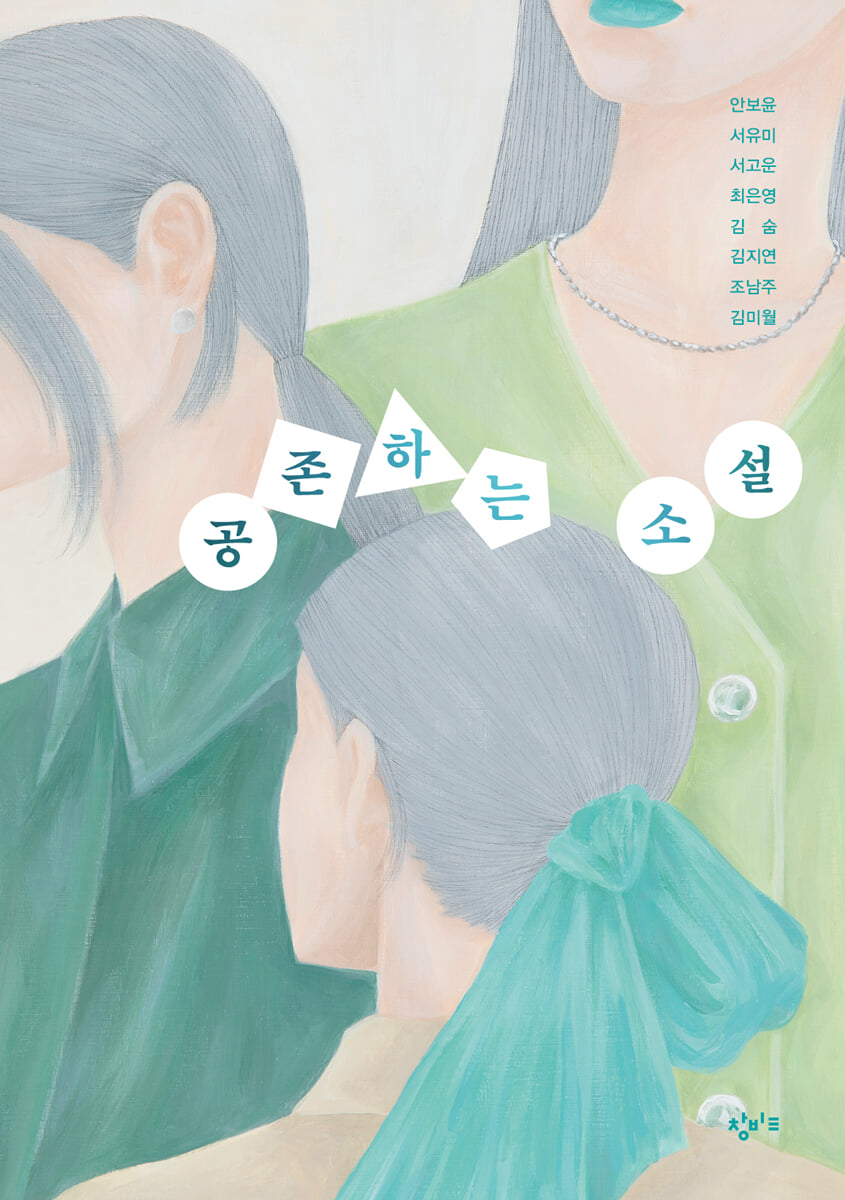
Coexisting novels
 |
Description
Book Introduction
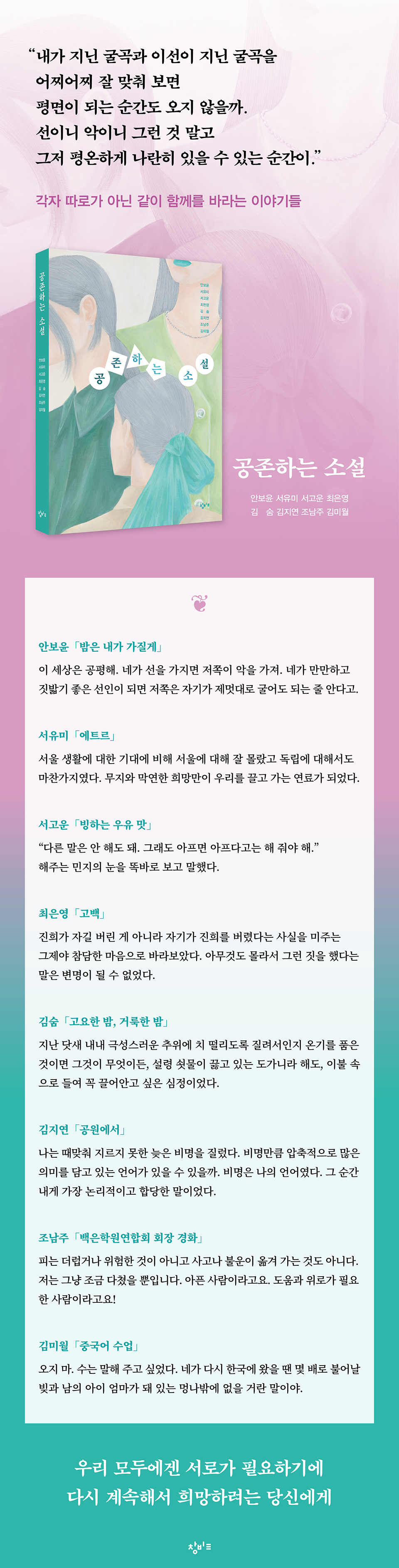
“If I somehow manage to align the curves I have with the curves of this line, won’t there come a moment when they become flat?
“A moment where we can just be peacefully side by side, without any thoughts of good or evil.”
Stories about wanting to be together, not apart
『Coexisting Novels』, a collection of eight short stories on the theme of the socially disadvantaged, has been published.
The collection of short stories contains stories about children, the disabled, and the elderly written by Ahn Bo-yoon, Seo Yu-mi, Seo Go-un, Choi Eun-young, Kim Soom, Kim Ji-yeon, Jo Nam-joo, and Kim Mi-wol.
The COVID-19 pandemic over the past three years has exposed just how precarious and precarious the situation of the socially vulnerable, whom we have been neglecting, is.
Even words of hatred that would normally not be easily expressed towards them poured out without hesitation.
The way the socially disadvantaged live serves as a yardstick for gauging a country's standard of living, and ominous signs are detected everywhere in our society these days.
In times of crisis, the importance of connection and solidarity is bound to grow.
Perhaps, ‘coexistence’ is the only way to create an inclusive and tolerant world where we can live in peace.
We cannot fully understand others.
However, literature leads us into the lives of others and expands the realm of empathy and understanding for others.
I hope that as readers read the stories in 『Coexisting Novels』, they will question and contemplate the world we dream of, and that this will become an opportunity for them to change themselves.
This book is the tenth in the Changbi Education Theme Novel series, and follows the works “Sweating Novel” on the topic of labor, “Remembering Novel” on the topic of disaster, and “Breathing Novel” on the topic of ecology and the environment.
“A moment where we can just be peacefully side by side, without any thoughts of good or evil.”
Stories about wanting to be together, not apart
『Coexisting Novels』, a collection of eight short stories on the theme of the socially disadvantaged, has been published.
The collection of short stories contains stories about children, the disabled, and the elderly written by Ahn Bo-yoon, Seo Yu-mi, Seo Go-un, Choi Eun-young, Kim Soom, Kim Ji-yeon, Jo Nam-joo, and Kim Mi-wol.
The COVID-19 pandemic over the past three years has exposed just how precarious and precarious the situation of the socially vulnerable, whom we have been neglecting, is.
Even words of hatred that would normally not be easily expressed towards them poured out without hesitation.
The way the socially disadvantaged live serves as a yardstick for gauging a country's standard of living, and ominous signs are detected everywhere in our society these days.
In times of crisis, the importance of connection and solidarity is bound to grow.
Perhaps, ‘coexistence’ is the only way to create an inclusive and tolerant world where we can live in peace.
We cannot fully understand others.
However, literature leads us into the lives of others and expands the realm of empathy and understanding for others.
I hope that as readers read the stories in 『Coexisting Novels』, they will question and contemplate the world we dream of, and that this will become an opportunity for them to change themselves.
This book is the tenth in the Changbi Education Theme Novel series, and follows the works “Sweating Novel” on the topic of labor, “Remembering Novel” on the topic of disaster, and “Breathing Novel” on the topic of ecology and the environment.
- You can preview some of the book's contents.
Preview
index
Foreword: For an Open Community of Welcoming and Solidarity
An Bo-yoon: I'll take the night
Seo Yu-mi and Etre
Seogoun ㆍ Bingha tastes like milk
Choi Eun-young ㆍ Confession
Kim Soom - Silent Night, Holy Night
Kim Ji-yeon ㆍ In the park
Jo Nam-joo and Gyeong-hwa, Chairman of the Baek Eun Academy Association
Kim Mi-wol, Chinese class
Commentary: The cries that barely reach us
An Bo-yoon: I'll take the night
Seo Yu-mi and Etre
Seogoun ㆍ Bingha tastes like milk
Choi Eun-young ㆍ Confession
Kim Soom - Silent Night, Holy Night
Kim Ji-yeon ㆍ In the park
Jo Nam-joo and Gyeong-hwa, Chairman of the Baek Eun Academy Association
Kim Mi-wol, Chinese class
Commentary: The cries that barely reach us
Detailed image
Into the book
“If I somehow manage to align the curves I have with the curves of this line, won’t there come a moment when they become flat?
A moment where we can just be peacefully side by side, without any thoughts of good or evil.
“Just be kind, like nothing.”
---From "An Bo-yoon, I'll Take the Night"
“Compared to my expectations of living in Seoul, I didn’t know much about the city, and the same goes for independence.
Ignorance and vague hope are the only fuel that drives us forward.
When I turned off the lights and lay down before going to bed, the fatigue ran down to my toes and the soles of my feet felt sore.
We stared at the ceiling and quietly poured out our frustrations and hardships of the day.”
---From "Seo Yu-mi, Etre"
“You don’t have to say anything else.
But if it hurts, you have to say it hurts.”
He looked straight into Minji's eyes and said.
He told me that I could pretend to fall and my knees would hurt like this, and that I could pretend to wipe away tears and my heart would hurt like this.
Minji was also quietly looking into Haeju’s eyes.”
---From "Seo Go-un, the glacier tastes like milk"
“If I could turn back time and go to a certain moment, I would want to go back to that moment,” Miju thought earnestly.
If I could go back then, I would thank you for talking to me, I would tell you that I was on your side, and I wouldn't make you feel so lonely and hurt.
But at that time, Miju stuttered and ended up not being able to say anything properly.”
---From "Choi Eun-young, Confession"
“They said it would be the coldest night of the winter so far.
Perhaps it was because I had been shivering from the extreme cold for the past five days that I felt like hugging anything that held warmth, even a cauldron of boiling molten iron, under the covers.
Even that dog… … Rather than hugging that dog, I’d rather have a rice cooker… … ”
---From "Kim Soom, Silent Night, Holy Night"
“I let out a late scream that I couldn’t quite put out.
Could there be any language that packs as much meaning into a single word as a scream?
Screaming was my language.
At that moment, it was the most logical and reasonable thing to say to me.
“I was speaking with all my might.”
---From "Kim Ji-yeon, In the Park"
“Blood is not dirty or dangerous, nor does it carry accidents or bad luck.
I was just a little hurt.
He's a sick person.
He was someone who needed help and comfort! Kyunghwa felt wronged and sad.
And I felt ashamed because my heart was shameless.”
---From "Cho Nam-joo, Chairman of the Baek Eun Academy Association, Gyeonghwa"
“Don’t come.
I wanted to tell you something.
When you come back to Korea, you'll only have debt that's multiplied several times and a mother who's become someone else's child.
Of course, even if I said that, Tsuong wouldn't have been able to understand properly.
Su said his final goodbyes in his native language.
It's so annoying.
As she left the interview room, she added to herself.
Really goodbye.
“I don’t mean to say let’s meet again.”
A moment where we can just be peacefully side by side, without any thoughts of good or evil.
“Just be kind, like nothing.”
---From "An Bo-yoon, I'll Take the Night"
“Compared to my expectations of living in Seoul, I didn’t know much about the city, and the same goes for independence.
Ignorance and vague hope are the only fuel that drives us forward.
When I turned off the lights and lay down before going to bed, the fatigue ran down to my toes and the soles of my feet felt sore.
We stared at the ceiling and quietly poured out our frustrations and hardships of the day.”
---From "Seo Yu-mi, Etre"
“You don’t have to say anything else.
But if it hurts, you have to say it hurts.”
He looked straight into Minji's eyes and said.
He told me that I could pretend to fall and my knees would hurt like this, and that I could pretend to wipe away tears and my heart would hurt like this.
Minji was also quietly looking into Haeju’s eyes.”
---From "Seo Go-un, the glacier tastes like milk"
“If I could turn back time and go to a certain moment, I would want to go back to that moment,” Miju thought earnestly.
If I could go back then, I would thank you for talking to me, I would tell you that I was on your side, and I wouldn't make you feel so lonely and hurt.
But at that time, Miju stuttered and ended up not being able to say anything properly.”
---From "Choi Eun-young, Confession"
“They said it would be the coldest night of the winter so far.
Perhaps it was because I had been shivering from the extreme cold for the past five days that I felt like hugging anything that held warmth, even a cauldron of boiling molten iron, under the covers.
Even that dog… … Rather than hugging that dog, I’d rather have a rice cooker… … ”
---From "Kim Soom, Silent Night, Holy Night"
“I let out a late scream that I couldn’t quite put out.
Could there be any language that packs as much meaning into a single word as a scream?
Screaming was my language.
At that moment, it was the most logical and reasonable thing to say to me.
“I was speaking with all my might.”
---From "Kim Ji-yeon, In the Park"
“Blood is not dirty or dangerous, nor does it carry accidents or bad luck.
I was just a little hurt.
He's a sick person.
He was someone who needed help and comfort! Kyunghwa felt wronged and sad.
And I felt ashamed because my heart was shameless.”
---From "Cho Nam-joo, Chairman of the Baek Eun Academy Association, Gyeonghwa"
“Don’t come.
I wanted to tell you something.
When you come back to Korea, you'll only have debt that's multiplied several times and a mother who's become someone else's child.
Of course, even if I said that, Tsuong wouldn't have been able to understand properly.
Su said his final goodbyes in his native language.
It's so annoying.
As she left the interview room, she added to herself.
Really goodbye.
“I don’t mean to say let’s meet again.”
---From "Kim Mi-wol, Chinese Class"
Publisher's Review
Things that clearly show the current state of our society
There is a novel that allows us to look into the faces of the weak floating between you and me.
Everywhere there are people who are at a disadvantage for their own reasons.
It is the fundamental role of the state to help them overcome this and live happily together with other members.
If the socially disadvantaged are unable to live with dignity, it can be concluded that the national system is not functioning properly and the spirit of the Constitution is not being properly implemented.
So, the way the socially disadvantaged live becomes a yardstick for measuring the standard of a country.
Looking at our society recently, ominous signs are detected everywhere.
Hate speech that hurts the socially vulnerable, such as ‘food addicts,’ ‘decision-makers,’ ‘ju-rin-i,’ ‘kimchi girl,’ ‘ttak-ttak,’ and ‘jjang-gae,’ is overflowing online, and subway protests to guarantee the right to mobility for the disabled are plagued by unspeakable insults and hate speech.
There are also voices calling for the abolition of the Student Human Rights Ordinance, which prohibits discrimination based on sexual orientation, on the grounds that it promotes homosexuality, abortion, and gender reassignment.
South Korea's refugee recognition rate remains among the lowest in the world, even after more than a decade of the Refugee Act, when attempts to build mosques and facilities for the disabled were met with fierce opposition.
The anti-discrimination law, which was proposed to prevent discrimination and hatred, has been stuck in the National Assembly for years and has not been passed.
All of this clearly shows the level of our society today.
Still, there is some consolation.
Even in this perilous world, the quality of our novels has never declined.
Today, too, the novel discovers small beings crouching low, and strives to quietly listen to their cries.
Through novels, we are able to quietly look into the faces of the weak floating between you and me, and only then do we connect with the world.
We believe that the character '小' in 'novel' comes from the novel's attitude of embracing small beings.
“I can’t leave a crying person alone.”
The cries that are barely conveyed through the novel
Faces of small beings
The 'he' in "Silent Night, Holy Night" (Kim Soom) is an authoritarian man who "gets angry and even slaps his wife, who is almost seventy."
The “look of disgust” he gave his wife also extends without hesitation to the dog she brought home.
But even that 'he' becomes an economically weak person who "makes a living by collecting waste paper" when he leaves the house.
'He' is a low-income person and a single elderly person who lost his wife, so he has an overlapping identity as a socially disadvantaged person.
In fact, South Korea has the highest elderly poverty rate among OECD member countries.
What's even more depressing is the projection that by 2085, when infants born in 2020 will be elderly, three out of ten elderly people will still be living in poverty.
Ultimately, the topic of 'poor elderly people' becomes a problem that affects everyone, regardless of generation.
The 'I' in "Etre" (Seo Yu-mi) also lives as a socially disadvantaged person in various forms.
'I' and his younger brother came up to Seoul to prepare for employment.
Many aspects of Korean society, including politics, economy, culture, and education, revolve around the capital city of Seoul, and power and capital are naturally concentrated in Seoul. As such, so-called "locals" like me head to Seoul to seek more opportunities.
“Paying rent is difficult, but since most jobs are concentrated in Seoul,” I have to somehow survive in Seoul.
And that's not all.
I am a young person who has not yet found a proper job, and I am definitely at a disadvantage compared to the older generation.
Many things that older generations take for granted are not at all taken for granted by young people.
It seems that young people now have nothing left to give up.
When a small being meets a small being
'Soo' from "Chinese Class" (Kim Mi-wol) teaches Korean to foreigners at university.
In fact, for the foreign students taught by 'Soo', studying Korean is an afterthought.
The reason why I paid expensive tuition fees to enroll in a language school and obtain a student visa is because I wanted to work illegally.
Their labor is inherently 'illegal' and is therefore subject to crackdown.
However, from the government's perspective, it is difficult to unconditionally apply the law.
This is because the work they do is mostly work that Koreans avoid.
If we were to crack down on all of these individuals and force them out of the country as the law stipulates, someone would have to fill the 417,852 positions. Is that even possible? Those who are labeled "illegal" and subjected to all kinds of hate are in fact essential workers responsible for a significant portion of our economy.
Despite this, our society still fails to provide adequate compensation and treatment.
Minji from "The Glacier Tastes Like Milk" (Seo Go-woon) has difficulty communicating.
Usually, around 10 months, babies start saying their first words like 'Mom' and 'Dad', but since they are 42 months old and still not speaking properly, their language development is quite slow.
Given this situation, it seems natural that Aunt Hae-joo would be worried that she might need to go to a “hospital or counseling center.”
'Hae-joo' feels sad as she takes care of 'Min-ji' while her mother, 'Seon-hwa', is away.
'Haejoo' also remembers being very shy as a child and being told by her mother, of all people, that she was "not normal."
Haejoo repeatedly teaches Minji that when she is sick, she should say “It hurts!”
If it's hard to speak, at least cover your forehead.
Later, when ‘Minji’ “covered her forehead with Haeju’s and took a deep breath,” the two continued without saying a word.
The series of events that the young 'Joo Seung-i' experiences in "I'll Take the Night" (Ahn Bo-yoon) reminds us of the incident in October 2020 when 'Jeong In-i', who was only 16 months old, died from parental abuse.
'Joo Seung-i' was abused by his mother and grandfather, and he "curls up like a bean worm" at the mere touch of a hand.
“He doesn’t hang out with or talk to other kids.”
Eventually, 'I' reported it to the police, and only then was 'Joo Seung' able to escape the relentless violence.
However, I am not entirely satisfied with the praise from those around me, saying, “Thanks to the teacher for looking into it carefully and reporting it immediately.”
This is because I usually thought that “daycare teachers are in the childcare service industry.”
But even in my heart, which was as cold as ice, warmth slowly seeped in.
It started after my sister suddenly came into my daily life.
My older sister, who was usually a nuisance to me, volunteered at a shelter for abandoned dogs, and then she ended up saying she would bring a poor dog home, which made me even angrier.
But, knowingly or unknowingly, this behavior of my sister causes a crack in my heart.
As I confirmed the movement of my heart that had arisen within me, I took the abandoned dog into my home, and my pitiful older sister gradually began to understand me.
The various forms of body and mind
Our bodies and minds each have their own shape.
However, there are people who have to endure inconveniences and hardships in life because they are different from others.
In "Baek Eun Academy Association President Gyeong-hwa" (Jo Nam-ju), a sick and old body makes people feel uncomfortable.
This is because of the news that the old commercial building next to the 'Baek Eun Building' will disappear and a nursing home will be built in its place.
The moment the news is heard, the sick and old body becomes a headache and an object of hatred for Seo Young-dong.
However, a significant change occurs in the attitude of 'Kyunghwa', who had been opposing the nursing home.
My mother's "situation changed" when she was "diagnosed with cognitive decline" at a dementia care center.
When she finds herself in the position of having to take care of her mother, Kyung-hwa feels “pathetic, frustrated, and ashamed” of herself for having opposed the nursing home.
'Kyunghwa', who unexpectedly turned to the side of the socially disadvantaged, is clearly two-faced and selfish.
But the unexpected realization he gained was not light.
'Sujin' from 'In the Park' (Kim Ji-yeon) is a woman who is often mistaken for a man because of her appearance.
'Soojin' had to hear things like "grow your hair long, wear makeup, and wear more feminine clothes" because she didn't fit the world's stereotype of what a woman should be.
Ironically, Sujin, who felt safer when mistaken for a man, becomes a target of violence when she is 'discovered' to be a woman.
If she hadn't met a child trying to comfort a crying stranger at the park she had returned to, 'Sujin' would not have been able to stop crying.
In "Confession" (Choi Eun-young), Mi-ju reveals her childhood to Jong-eun, who has converted to Catholicism and become a monk, as if she is making a confession.
‘Miju’ met ‘Juna’ and ‘Jinhee’ “in the same class when we were in the first year of high school.”
The three were close enough to be more than “just friends”; they “really liked each other.”
However, in front of Jinhee, who confessed that she was a lesbian, Joona said, “It’s really disgusting,” and “Miju didn’t know what to say.”
Jinhee felt like the world was turning its back on her, and in the end, she found no other way than to turn her back on the world herself.
The relationship between the three people is completely ruined.
There is no 'Jinhee' in the world anymore.
Before greater difficulties arise, we should remember the wise words of "Confessions" such as "Thank you for telling me" and "I am on your side."
I hope this book will help raise awareness of the disadvantaged members of our society and help us strive for an open, welcoming, and inclusive community, rather than an exclusive one.
While aiming for ‘being together’ rather than ‘being separate’.
What we need now is an attitude of ‘again, continuing, and hoping.’
There is a novel that allows us to look into the faces of the weak floating between you and me.
Everywhere there are people who are at a disadvantage for their own reasons.
It is the fundamental role of the state to help them overcome this and live happily together with other members.
If the socially disadvantaged are unable to live with dignity, it can be concluded that the national system is not functioning properly and the spirit of the Constitution is not being properly implemented.
So, the way the socially disadvantaged live becomes a yardstick for measuring the standard of a country.
Looking at our society recently, ominous signs are detected everywhere.
Hate speech that hurts the socially vulnerable, such as ‘food addicts,’ ‘decision-makers,’ ‘ju-rin-i,’ ‘kimchi girl,’ ‘ttak-ttak,’ and ‘jjang-gae,’ is overflowing online, and subway protests to guarantee the right to mobility for the disabled are plagued by unspeakable insults and hate speech.
There are also voices calling for the abolition of the Student Human Rights Ordinance, which prohibits discrimination based on sexual orientation, on the grounds that it promotes homosexuality, abortion, and gender reassignment.
South Korea's refugee recognition rate remains among the lowest in the world, even after more than a decade of the Refugee Act, when attempts to build mosques and facilities for the disabled were met with fierce opposition.
The anti-discrimination law, which was proposed to prevent discrimination and hatred, has been stuck in the National Assembly for years and has not been passed.
All of this clearly shows the level of our society today.
Still, there is some consolation.
Even in this perilous world, the quality of our novels has never declined.
Today, too, the novel discovers small beings crouching low, and strives to quietly listen to their cries.
Through novels, we are able to quietly look into the faces of the weak floating between you and me, and only then do we connect with the world.
We believe that the character '小' in 'novel' comes from the novel's attitude of embracing small beings.
“I can’t leave a crying person alone.”
The cries that are barely conveyed through the novel
Faces of small beings
The 'he' in "Silent Night, Holy Night" (Kim Soom) is an authoritarian man who "gets angry and even slaps his wife, who is almost seventy."
The “look of disgust” he gave his wife also extends without hesitation to the dog she brought home.
But even that 'he' becomes an economically weak person who "makes a living by collecting waste paper" when he leaves the house.
'He' is a low-income person and a single elderly person who lost his wife, so he has an overlapping identity as a socially disadvantaged person.
In fact, South Korea has the highest elderly poverty rate among OECD member countries.
What's even more depressing is the projection that by 2085, when infants born in 2020 will be elderly, three out of ten elderly people will still be living in poverty.
Ultimately, the topic of 'poor elderly people' becomes a problem that affects everyone, regardless of generation.
The 'I' in "Etre" (Seo Yu-mi) also lives as a socially disadvantaged person in various forms.
'I' and his younger brother came up to Seoul to prepare for employment.
Many aspects of Korean society, including politics, economy, culture, and education, revolve around the capital city of Seoul, and power and capital are naturally concentrated in Seoul. As such, so-called "locals" like me head to Seoul to seek more opportunities.
“Paying rent is difficult, but since most jobs are concentrated in Seoul,” I have to somehow survive in Seoul.
And that's not all.
I am a young person who has not yet found a proper job, and I am definitely at a disadvantage compared to the older generation.
Many things that older generations take for granted are not at all taken for granted by young people.
It seems that young people now have nothing left to give up.
When a small being meets a small being
'Soo' from "Chinese Class" (Kim Mi-wol) teaches Korean to foreigners at university.
In fact, for the foreign students taught by 'Soo', studying Korean is an afterthought.
The reason why I paid expensive tuition fees to enroll in a language school and obtain a student visa is because I wanted to work illegally.
Their labor is inherently 'illegal' and is therefore subject to crackdown.
However, from the government's perspective, it is difficult to unconditionally apply the law.
This is because the work they do is mostly work that Koreans avoid.
If we were to crack down on all of these individuals and force them out of the country as the law stipulates, someone would have to fill the 417,852 positions. Is that even possible? Those who are labeled "illegal" and subjected to all kinds of hate are in fact essential workers responsible for a significant portion of our economy.
Despite this, our society still fails to provide adequate compensation and treatment.
Minji from "The Glacier Tastes Like Milk" (Seo Go-woon) has difficulty communicating.
Usually, around 10 months, babies start saying their first words like 'Mom' and 'Dad', but since they are 42 months old and still not speaking properly, their language development is quite slow.
Given this situation, it seems natural that Aunt Hae-joo would be worried that she might need to go to a “hospital or counseling center.”
'Hae-joo' feels sad as she takes care of 'Min-ji' while her mother, 'Seon-hwa', is away.
'Haejoo' also remembers being very shy as a child and being told by her mother, of all people, that she was "not normal."
Haejoo repeatedly teaches Minji that when she is sick, she should say “It hurts!”
If it's hard to speak, at least cover your forehead.
Later, when ‘Minji’ “covered her forehead with Haeju’s and took a deep breath,” the two continued without saying a word.
The series of events that the young 'Joo Seung-i' experiences in "I'll Take the Night" (Ahn Bo-yoon) reminds us of the incident in October 2020 when 'Jeong In-i', who was only 16 months old, died from parental abuse.
'Joo Seung-i' was abused by his mother and grandfather, and he "curls up like a bean worm" at the mere touch of a hand.
“He doesn’t hang out with or talk to other kids.”
Eventually, 'I' reported it to the police, and only then was 'Joo Seung' able to escape the relentless violence.
However, I am not entirely satisfied with the praise from those around me, saying, “Thanks to the teacher for looking into it carefully and reporting it immediately.”
This is because I usually thought that “daycare teachers are in the childcare service industry.”
But even in my heart, which was as cold as ice, warmth slowly seeped in.
It started after my sister suddenly came into my daily life.
My older sister, who was usually a nuisance to me, volunteered at a shelter for abandoned dogs, and then she ended up saying she would bring a poor dog home, which made me even angrier.
But, knowingly or unknowingly, this behavior of my sister causes a crack in my heart.
As I confirmed the movement of my heart that had arisen within me, I took the abandoned dog into my home, and my pitiful older sister gradually began to understand me.
The various forms of body and mind
Our bodies and minds each have their own shape.
However, there are people who have to endure inconveniences and hardships in life because they are different from others.
In "Baek Eun Academy Association President Gyeong-hwa" (Jo Nam-ju), a sick and old body makes people feel uncomfortable.
This is because of the news that the old commercial building next to the 'Baek Eun Building' will disappear and a nursing home will be built in its place.
The moment the news is heard, the sick and old body becomes a headache and an object of hatred for Seo Young-dong.
However, a significant change occurs in the attitude of 'Kyunghwa', who had been opposing the nursing home.
My mother's "situation changed" when she was "diagnosed with cognitive decline" at a dementia care center.
When she finds herself in the position of having to take care of her mother, Kyung-hwa feels “pathetic, frustrated, and ashamed” of herself for having opposed the nursing home.
'Kyunghwa', who unexpectedly turned to the side of the socially disadvantaged, is clearly two-faced and selfish.
But the unexpected realization he gained was not light.
'Sujin' from 'In the Park' (Kim Ji-yeon) is a woman who is often mistaken for a man because of her appearance.
'Soojin' had to hear things like "grow your hair long, wear makeup, and wear more feminine clothes" because she didn't fit the world's stereotype of what a woman should be.
Ironically, Sujin, who felt safer when mistaken for a man, becomes a target of violence when she is 'discovered' to be a woman.
If she hadn't met a child trying to comfort a crying stranger at the park she had returned to, 'Sujin' would not have been able to stop crying.
In "Confession" (Choi Eun-young), Mi-ju reveals her childhood to Jong-eun, who has converted to Catholicism and become a monk, as if she is making a confession.
‘Miju’ met ‘Juna’ and ‘Jinhee’ “in the same class when we were in the first year of high school.”
The three were close enough to be more than “just friends”; they “really liked each other.”
However, in front of Jinhee, who confessed that she was a lesbian, Joona said, “It’s really disgusting,” and “Miju didn’t know what to say.”
Jinhee felt like the world was turning its back on her, and in the end, she found no other way than to turn her back on the world herself.
The relationship between the three people is completely ruined.
There is no 'Jinhee' in the world anymore.
Before greater difficulties arise, we should remember the wise words of "Confessions" such as "Thank you for telling me" and "I am on your side."
I hope this book will help raise awareness of the disadvantaged members of our society and help us strive for an open, welcoming, and inclusive community, rather than an exclusive one.
While aiming for ‘being together’ rather than ‘being separate’.
What we need now is an attitude of ‘again, continuing, and hoping.’
GOODS SPECIFICS
- Date of issue: September 1, 2023
- Page count, weight, size: 272 pages | 148*210*20mm
- ISBN13: 9791165702236
- ISBN10: 1165702231
You may also like
카테고리
korean


korean

![GQ KOREA Mark (Monthly): December [2025]](http://librairie.coreenne.fr/cdn/shop/files/8ef265dbbfbf186523ed75ba7319009d.jpg?v=1765340328&width=3840)


