

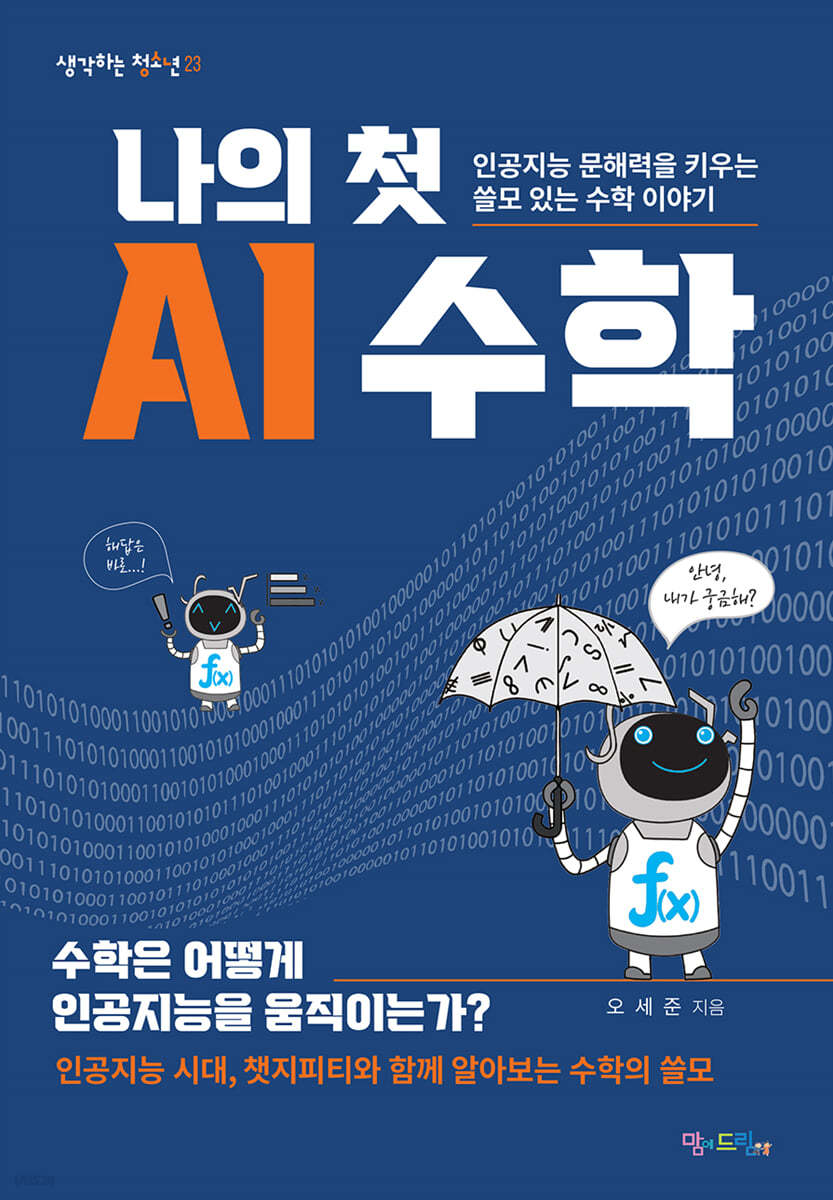
My first AI math
 |
Description
Book Introduction
Artificial intelligence, or AI, is growing at a frightening rate day by day and is increasingly penetrating into our lives.
In particular, the surprising performance of generative artificial intelligence such as ChatGPiT has heightened anxiety and even a sense of crisis.
For example, issues related to artificial intelligence, such as the imminent disappearance of human jobs and the possibility of its misuse in various crimes, have emerged as social problems.
In times like these, we need AI literacy to correctly understand the true nature of AI and utilize it wisely, as well as mathematical thinking to enhance flexible problem-solving skills.
In the future, humanity will collaborate with artificial intelligence in various major decision-making processes and rely on artificial intelligence for a significant portion of its daily life.
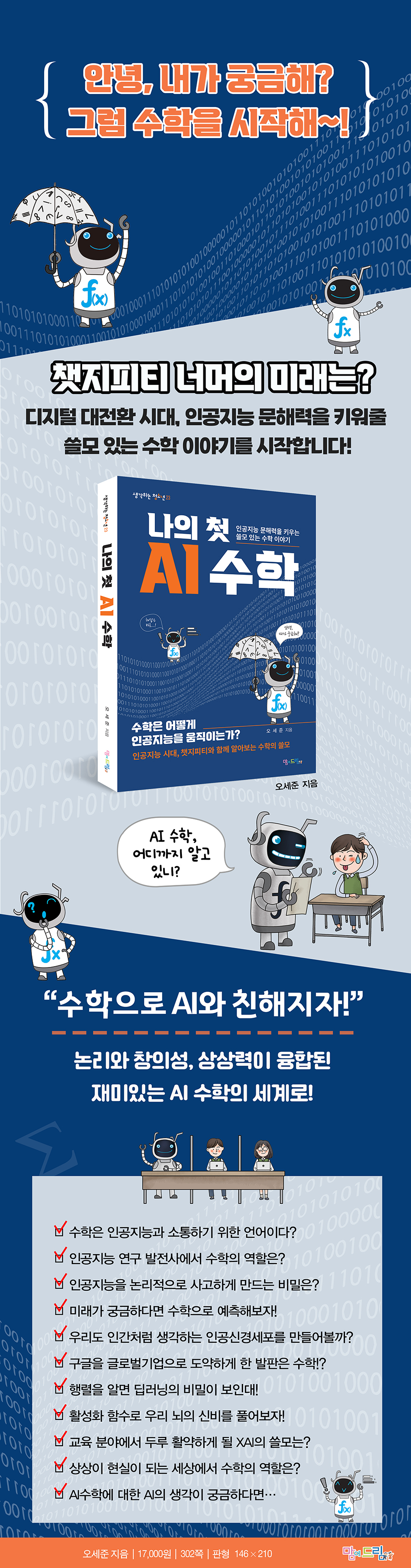
This book examines the mechanisms of artificial intelligence from a mathematical perspective and provides an opportunity to become intimately familiar with artificial intelligence through the language of mathematics.
It explains the history of artificial intelligence development and the role mathematics plays in various decision-making and problem-solving processes of artificial intelligence, with various examples.
You will discover fun and useful math stories that will help you develop the literacy and critical thinking skills essential in the digital transformation era.
In particular, the surprising performance of generative artificial intelligence such as ChatGPiT has heightened anxiety and even a sense of crisis.
For example, issues related to artificial intelligence, such as the imminent disappearance of human jobs and the possibility of its misuse in various crimes, have emerged as social problems.
In times like these, we need AI literacy to correctly understand the true nature of AI and utilize it wisely, as well as mathematical thinking to enhance flexible problem-solving skills.
In the future, humanity will collaborate with artificial intelligence in various major decision-making processes and rely on artificial intelligence for a significant portion of its daily life.
This book examines the mechanisms of artificial intelligence from a mathematical perspective and provides an opportunity to become intimately familiar with artificial intelligence through the language of mathematics.
It explains the history of artificial intelligence development and the role mathematics plays in various decision-making and problem-solving processes of artificial intelligence, with various examples.
You will discover fun and useful math stories that will help you develop the literacy and critical thinking skills essential in the digital transformation era.
- You can preview some of the book's contents.
Preview
index
Prologue) Before starting the AI math story
Chapter 1: AI Mathematics and Data
Find my name!
01 Growth Engine in the Digital Transformation Era - Data is the New ○○
02 The Big Data Era - Countless data are accumulating rapidly every second.
03 Mathematical Models - Mathematics, giving meaning and rules to data
04 DB Structuring - Pay Attention to Correlations Between Data!
Chapter 2 Data Input and Output
What kind of data can artificial intelligence process?
01 The first step in data conversion - MBTI is a four-dimensional vector?
02 Similarity - How similar are they?
03 Pixels and Resolution - Representing Images as Matrices!
04 Set and Fuzzy Theory - A Mathematical Approach to Problems with Ambiguous Criteria
05 Soft Label - AI doesn't make rash decisions!
06 The Truth About MBTI Compatibility Charts - Are You and I Soulmates?
Chapter 3 Intelligence and Mathematics
What is 'intelligence' in artificial intelligence?
01 Intelligence and Artificial Intelligence - I want to create a machine that resembles human intelligence!
02 The Cruel History of Artificial Intelligence - Why Do Thinking Machines and Expert Systems Fail?
03 Machine Learning and Learning - You don't have to be a bird to fly, right?
04 Variables and Learning - Artificial Intelligence, Finding the Optimal Weights!
05 Constants and Models - Studying is over, start predicting!
Chapter 4: Deep Learning and Mathematics
Mission: Mimic the brain with math!
01 How Cerebral Nerves Work - Unraveling the Mysteries of Our Brain with Activation Functions
02 Various Activation Functions - How Mathematics Drives Artificial Intelligence
03 Weighting and Stimulus - No two responses are the same under the sun.
04 Logical Thinking in Artificial Intelligence - Creating an Artificial Neuron That Thinks Like a Human
05 XOR problem and multilayer perceptron - Brain cells do not make decisions alone!
06 The Usefulness of Matrices - Looking at Matrices Again, Deep Learning Comes to Light!
Chapter 5 Functions and Differentiation
Mission: Increase the predictive power of artificial intelligence!
01 Mathematical Modeling - Curious about the future? Ask math, not fortune-telling!
02 Actual and predicted values - Mission, reduce errors!
03 Linear Regression Analysis and Representative Values - How Artificial Intelligence Finds Functions
04 Gradient Descent and Differentiation - How to Descend a Mountain on a Pitch-Dark Night
Chapter 6: Artificial Intelligence Literacy
If you can't read it, it's just a bunch of meaningless numbers.
01 Literacy in the Age of AI - I told you the results, so why can't you read them?
02 Conditional Probability and Similarity - What should I display next to baby diapers to sell them well?
03 PageRank - The formula that gave birth to today's Google
04 Quantum Computers - Your Thoughts Will Soon Become Reality!
Chapter 7 Explainable Artificial Intelligence
Dissect the unknown black box!
01 XAI and Applications - On the Usefulness of Explainable Artificial Intelligence
02 Shapley Value and Explainability - I don't know where you are, but I know where you are.
03 Importance - How do you know? Just look at it!
04 Distillation of Knowledge - Change to a model that is easy to interpret
Epilogue) Asking ChatGPiTi About AI Mathematics
References
Chapter 1: AI Mathematics and Data
Find my name!
01 Growth Engine in the Digital Transformation Era - Data is the New ○○
02 The Big Data Era - Countless data are accumulating rapidly every second.
03 Mathematical Models - Mathematics, giving meaning and rules to data
04 DB Structuring - Pay Attention to Correlations Between Data!
Chapter 2 Data Input and Output
What kind of data can artificial intelligence process?
01 The first step in data conversion - MBTI is a four-dimensional vector?
02 Similarity - How similar are they?
03 Pixels and Resolution - Representing Images as Matrices!
04 Set and Fuzzy Theory - A Mathematical Approach to Problems with Ambiguous Criteria
05 Soft Label - AI doesn't make rash decisions!
06 The Truth About MBTI Compatibility Charts - Are You and I Soulmates?
Chapter 3 Intelligence and Mathematics
What is 'intelligence' in artificial intelligence?
01 Intelligence and Artificial Intelligence - I want to create a machine that resembles human intelligence!
02 The Cruel History of Artificial Intelligence - Why Do Thinking Machines and Expert Systems Fail?
03 Machine Learning and Learning - You don't have to be a bird to fly, right?
04 Variables and Learning - Artificial Intelligence, Finding the Optimal Weights!
05 Constants and Models - Studying is over, start predicting!
Chapter 4: Deep Learning and Mathematics
Mission: Mimic the brain with math!
01 How Cerebral Nerves Work - Unraveling the Mysteries of Our Brain with Activation Functions
02 Various Activation Functions - How Mathematics Drives Artificial Intelligence
03 Weighting and Stimulus - No two responses are the same under the sun.
04 Logical Thinking in Artificial Intelligence - Creating an Artificial Neuron That Thinks Like a Human
05 XOR problem and multilayer perceptron - Brain cells do not make decisions alone!
06 The Usefulness of Matrices - Looking at Matrices Again, Deep Learning Comes to Light!
Chapter 5 Functions and Differentiation
Mission: Increase the predictive power of artificial intelligence!
01 Mathematical Modeling - Curious about the future? Ask math, not fortune-telling!
02 Actual and predicted values - Mission, reduce errors!
03 Linear Regression Analysis and Representative Values - How Artificial Intelligence Finds Functions
04 Gradient Descent and Differentiation - How to Descend a Mountain on a Pitch-Dark Night
Chapter 6: Artificial Intelligence Literacy
If you can't read it, it's just a bunch of meaningless numbers.
01 Literacy in the Age of AI - I told you the results, so why can't you read them?
02 Conditional Probability and Similarity - What should I display next to baby diapers to sell them well?
03 PageRank - The formula that gave birth to today's Google
04 Quantum Computers - Your Thoughts Will Soon Become Reality!
Chapter 7 Explainable Artificial Intelligence
Dissect the unknown black box!
01 XAI and Applications - On the Usefulness of Explainable Artificial Intelligence
02 Shapley Value and Explainability - I don't know where you are, but I know where you are.
03 Importance - How do you know? Just look at it!
04 Distillation of Knowledge - Change to a model that is easy to interpret
Epilogue) Asking ChatGPiTi About AI Mathematics
References
Detailed image
Into the book
Artificial intelligence (AI) technology relies heavily on mathematical concepts and methods, so it is no exaggeration to say that it is a collection of mathematics.
--- p.8
Comparing the value and importance of data today to that of traditional energy source oil suggests that data is a valuable resource essential for extraction, refinement, and powering a wide range of applications and technologies.
--- p.21
In a world where all kinds of information can be shared, everything that happens every moment, including the trivial details of an individual's daily life, is transformed into data.
As a result, even the daily actions that we repeat without realizing it are accumulated as data.
--- p.28
Mathematics is about finding connections between countless pieces of data and giving them meaning.
--- p.33
AI's correlation analysis capabilities have now reached a level where they can uncover relationships between seemingly unrelated entities.
--- p.42
Through this book, I want to emphasize to you the importance of developing your mathematical thinking skills beyond simply understanding mathematical principles and concepts.
Especially in today's rapidly changing era of artificial intelligence, mathematical thinking will empower you in a variety of problem-solving situations.
--- p.83
At first, artificial intelligence researchers tried to create machines that thought like humans.
A typical example is the Turing test.
--- p.91
Research on artificial intelligence, which had been through its first cold spell, began to become active again when people began to approach intelligence from a different perspective.
--- p.95
The process by which artificial intelligence studies is very similar to the process by which we study mathematics.
--- p.103
Ultimately, the reason artificial intelligence learns (trains) is to obtain a single model that fits the purpose.
Because if we just find this function, we can predict the desired result.
--- p.119
Don't you think mathematics is a truly beautiful and wonderful discipline in that it can express the operating principles of neurons in a single formula, a single function?
--- p.127
Just as our bodies react differently depending on the type of stimulus, 'weights' are mathematical values that allow artificial intelligence to recognize these differences in response.
--- p.140
However, since artificial intelligence is not a real person, we have no choice but to borrow the power of mathematics to make it think logically.
In fact, mathematics is nothing more than a collection of logic.
--- p.145
The XOR problem, which could not be solved with a single artificial neuron, can now be solved with an artificial neural network, and this has changed the paradigm of artificial intelligence research.
--- p.167
If you're curious about the future, using mathematical modeling to make predictions or estimates based on available data is a good approach.
--- p.184
Starting with Galton's research, linear regression analysis is an analysis method for identifying relationships between independent and dependent variables, and is still widely used today in the age of artificial intelligence.
--- p.198
The goal of artificial intelligence is to find a straight line that minimizes the representative error.
--- p.209
Finding the data we need from a vast amount of data is called data mining.
Mining means extracting minerals from a mine.
Now, it has become important to extract the data we need from the vast amount of data that is piled up like a mine.
--- p.235
AI models predict what content a user prefers based on what videos they've previously watched.
--- p.247
PageRank is literally the ranking of a page.
More specifically, it ranks pages based on their influence.
--- p.253
Explainable AI, or XAI, is a technology that provides humans with the reason for the judgment results of artificial intelligence (AI) so that they can understand them.
--- p.266
Of course, among AI models, there are models that allow humans to easily understand all of the AI's decision-making processes.
The problem, however, is that explainability and AI performance are currently inversely proportional.
--- p.270
Contribution is also important for AI predictions.
In reality, artificial intelligence calculates by replacing the independent variable whose contribution we want to know.
--- p.281
In this way, artificial intelligence and mathematics have grown and developed together, and will continue to do so in the future.
And through this collaborative growth, our influence will rapidly expand into more and more diverse fields.
--- p.8
Comparing the value and importance of data today to that of traditional energy source oil suggests that data is a valuable resource essential for extraction, refinement, and powering a wide range of applications and technologies.
--- p.21
In a world where all kinds of information can be shared, everything that happens every moment, including the trivial details of an individual's daily life, is transformed into data.
As a result, even the daily actions that we repeat without realizing it are accumulated as data.
--- p.28
Mathematics is about finding connections between countless pieces of data and giving them meaning.
--- p.33
AI's correlation analysis capabilities have now reached a level where they can uncover relationships between seemingly unrelated entities.
--- p.42
Through this book, I want to emphasize to you the importance of developing your mathematical thinking skills beyond simply understanding mathematical principles and concepts.
Especially in today's rapidly changing era of artificial intelligence, mathematical thinking will empower you in a variety of problem-solving situations.
--- p.83
At first, artificial intelligence researchers tried to create machines that thought like humans.
A typical example is the Turing test.
--- p.91
Research on artificial intelligence, which had been through its first cold spell, began to become active again when people began to approach intelligence from a different perspective.
--- p.95
The process by which artificial intelligence studies is very similar to the process by which we study mathematics.
--- p.103
Ultimately, the reason artificial intelligence learns (trains) is to obtain a single model that fits the purpose.
Because if we just find this function, we can predict the desired result.
--- p.119
Don't you think mathematics is a truly beautiful and wonderful discipline in that it can express the operating principles of neurons in a single formula, a single function?
--- p.127
Just as our bodies react differently depending on the type of stimulus, 'weights' are mathematical values that allow artificial intelligence to recognize these differences in response.
--- p.140
However, since artificial intelligence is not a real person, we have no choice but to borrow the power of mathematics to make it think logically.
In fact, mathematics is nothing more than a collection of logic.
--- p.145
The XOR problem, which could not be solved with a single artificial neuron, can now be solved with an artificial neural network, and this has changed the paradigm of artificial intelligence research.
--- p.167
If you're curious about the future, using mathematical modeling to make predictions or estimates based on available data is a good approach.
--- p.184
Starting with Galton's research, linear regression analysis is an analysis method for identifying relationships between independent and dependent variables, and is still widely used today in the age of artificial intelligence.
--- p.198
The goal of artificial intelligence is to find a straight line that minimizes the representative error.
--- p.209
Finding the data we need from a vast amount of data is called data mining.
Mining means extracting minerals from a mine.
Now, it has become important to extract the data we need from the vast amount of data that is piled up like a mine.
--- p.235
AI models predict what content a user prefers based on what videos they've previously watched.
--- p.247
PageRank is literally the ranking of a page.
More specifically, it ranks pages based on their influence.
--- p.253
Explainable AI, or XAI, is a technology that provides humans with the reason for the judgment results of artificial intelligence (AI) so that they can understand them.
--- p.266
Of course, among AI models, there are models that allow humans to easily understand all of the AI's decision-making processes.
The problem, however, is that explainability and AI performance are currently inversely proportional.
--- p.270
Contribution is also important for AI predictions.
In reality, artificial intelligence calculates by replacing the independent variable whose contribution we want to know.
--- p.281
In this way, artificial intelligence and mathematics have grown and developed together, and will continue to do so in the future.
And through this collaborative growth, our influence will rapidly expand into more and more diverse fields.
--- p.298
Publisher's Review
Math that breaks through textbooks,
Move artificial intelligence!
How far has artificial intelligence developed?
The Ins and Outs of Artificial Intelligence Through Mathematics
As the saying goes, "an era of great transformation," we are living in a time of great social change, each with a mixture of expectations and anxieties.
Among them, what catches the eye is the terrifying growth of AI, or artificial intelligence.
AlphaGo, which had already defeated human Go prodigies in the Go match of the century in 2016, was enough to imprint the amazing performance of artificial intelligence on the public's mind.
In the years since, artificial intelligence has been growing rapidly.
They learn at an incredible pace without rest, quickly reaching a level of expertise that humans would struggle to achieve in years, analyzing massive amounts of data to uncover correlations, and even making reliable predictions.
It even seems to be overlooking the creative field that we have been proud of as a unique human ability.
Some experts predict that the emergence of superintelligence in the near future will provide solutions to global challenges that humanity has been unable to solve, such as climate disasters, environmental pollution, and various incurable diseases that threaten the quality of life and survival.
On the other hand, fears and anxieties related to artificial intelligence are being excessively promoted.
There are even rumors running rampant that most human jobs will disappear or that human society will ultimately be destroyed, and many people are even expressing antipathy towards artificial intelligence research itself.
In times like these, rather than being swayed by vague speculations and unsubstantiated rumors, perhaps we should strive to understand the mechanisms of artificial intelligence. This book is a story about AI mathematics for young people living in the era of digital transformation.
Let's look at artificial intelligence from a mathematical perspective, examine the problem-solving process, and develop mathematical thinking.
The era of artificial intelligence,
Useful Math Stories to Know
How does mathematics power artificial intelligence?
Just as computers, the Internet, and smartphones have brought about massive social changes, artificial intelligence is also changing the world's paradigm.
The various controversies surrounding artificial intelligence are also evidence of the public's keen interest.
In fact, ChatGP, which appeared 7 years after AlphaGo, surpassed 1 million users in just 5 days after its release, and achieved the feat of securing 100 million users in just 2 months.
Recently, the news spread that artificial intelligence was re-serializing the work of a late cartoonist, sparking a controversy over 'desecration of the deceased.'
Regardless of the controversy, it is surprising how far artificial intelligence has grown, reaching a level where it can learn the art style and storytelling of the deceased and create creative works based on that.
In fact, the rapid growth of artificial intelligence is the result of implementing human self-directed learning processes into artificial intelligence systems, and mathematics is at the foundation of this.
AI technology relies heavily on mathematical concepts and methods, and can be viewed as a holistic approach to mathematics. AI algorithms and systems are based on mathematical models and theories, and mathematical operations and calculations are utilized for various predictions and decision-making.
In other words, mathematics is the force that makes artificial intelligence move logically.
The increasingly powerful capabilities of artificial intelligence are both a source of awe and fear.
And the more we cannot grasp the reality, the more our vague fears become maximized.
This book explores the ins and outs of artificial intelligence through the language of 'mathematics'.
In particular, attention was paid to the problem-solving process of artificial intelligence.
As you communicate with AI through the language of mathematics, fear will gradually turn into intimacy, and you will be able to become a little closer to AI.
Moreover, in the gloomy reality of our country's education system, where students are overflowing with dropouts, wouldn't it be possible to discover the charm of mathematics while also finding individual reasons why we should study mathematics in the age of artificial intelligence?
Let's develop AI literacy and mathematical thinking!
Mathematics and artificial intelligence have grown and developed together, and will continue to do so in the future.
Furthermore, through this kind of shared growth, it is expected to expand its influence and become more active throughout society.
And as artificial intelligence becomes more active, it will penetrate deeper into our daily lives.
Just as it is difficult to imagine our daily lives without smartphones today, it will become difficult to imagine our daily lives without artificial intelligence in the future.
Just as today's seniors who are not familiar with smartphones are called digital illiterate, it has become increasingly important to develop AI literacy so that we do not live as AI illiterate in the future.
Literacy is not simply the ability to read, or decode.
It refers to a comprehensive ability that encompasses definition, understanding, interpretation, creation, communication, and calculation.
The same thing should apply to fostering AI literacy.
There is also one more thing that is important in the age of artificial intelligence.
It is mathematical thinking.
In this age of hyper-technology, where the convergence of vast amounts of information and creative knowledge creates new synergies, it is more important to cultivate the ability to creatively restructure knowledge and flexibly integrate and apply it to problem-solving than to simply acquire knowledge itself.
Mathematical thinking is closely related to the ability to creatively restructure knowledge beyond passive learning and freely integrate it into real-world problem solving.
This book emphasizes that "mathematical thinking" is the foundation of artificial intelligence development, as well as explaining the various mathematical concepts used in artificial intelligence decision-making.
This book stimulates readers' interest by appropriately introducing various images and opinions implemented by ChatGPTI throughout the content. It goes beyond understanding the principles and concepts of AI mathematics and guides readers to develop mathematical thinking and creative problem-solving skills in various problem situations.
In the age of artificial intelligence, mathematics will shed its label as a difficult and uncomfortable subject that causes many test-takers to feel uneasy, and will be rebranded as a useful discipline that helps them grow into creative, convergent future talents.
Move artificial intelligence!
How far has artificial intelligence developed?
The Ins and Outs of Artificial Intelligence Through Mathematics
As the saying goes, "an era of great transformation," we are living in a time of great social change, each with a mixture of expectations and anxieties.
Among them, what catches the eye is the terrifying growth of AI, or artificial intelligence.
AlphaGo, which had already defeated human Go prodigies in the Go match of the century in 2016, was enough to imprint the amazing performance of artificial intelligence on the public's mind.
In the years since, artificial intelligence has been growing rapidly.
They learn at an incredible pace without rest, quickly reaching a level of expertise that humans would struggle to achieve in years, analyzing massive amounts of data to uncover correlations, and even making reliable predictions.
It even seems to be overlooking the creative field that we have been proud of as a unique human ability.
Some experts predict that the emergence of superintelligence in the near future will provide solutions to global challenges that humanity has been unable to solve, such as climate disasters, environmental pollution, and various incurable diseases that threaten the quality of life and survival.
On the other hand, fears and anxieties related to artificial intelligence are being excessively promoted.
There are even rumors running rampant that most human jobs will disappear or that human society will ultimately be destroyed, and many people are even expressing antipathy towards artificial intelligence research itself.
In times like these, rather than being swayed by vague speculations and unsubstantiated rumors, perhaps we should strive to understand the mechanisms of artificial intelligence. This book is a story about AI mathematics for young people living in the era of digital transformation.
Let's look at artificial intelligence from a mathematical perspective, examine the problem-solving process, and develop mathematical thinking.
The era of artificial intelligence,
Useful Math Stories to Know
How does mathematics power artificial intelligence?
Just as computers, the Internet, and smartphones have brought about massive social changes, artificial intelligence is also changing the world's paradigm.
The various controversies surrounding artificial intelligence are also evidence of the public's keen interest.
In fact, ChatGP, which appeared 7 years after AlphaGo, surpassed 1 million users in just 5 days after its release, and achieved the feat of securing 100 million users in just 2 months.
Recently, the news spread that artificial intelligence was re-serializing the work of a late cartoonist, sparking a controversy over 'desecration of the deceased.'
Regardless of the controversy, it is surprising how far artificial intelligence has grown, reaching a level where it can learn the art style and storytelling of the deceased and create creative works based on that.
In fact, the rapid growth of artificial intelligence is the result of implementing human self-directed learning processes into artificial intelligence systems, and mathematics is at the foundation of this.
AI technology relies heavily on mathematical concepts and methods, and can be viewed as a holistic approach to mathematics. AI algorithms and systems are based on mathematical models and theories, and mathematical operations and calculations are utilized for various predictions and decision-making.
In other words, mathematics is the force that makes artificial intelligence move logically.
The increasingly powerful capabilities of artificial intelligence are both a source of awe and fear.
And the more we cannot grasp the reality, the more our vague fears become maximized.
This book explores the ins and outs of artificial intelligence through the language of 'mathematics'.
In particular, attention was paid to the problem-solving process of artificial intelligence.
As you communicate with AI through the language of mathematics, fear will gradually turn into intimacy, and you will be able to become a little closer to AI.
Moreover, in the gloomy reality of our country's education system, where students are overflowing with dropouts, wouldn't it be possible to discover the charm of mathematics while also finding individual reasons why we should study mathematics in the age of artificial intelligence?
Let's develop AI literacy and mathematical thinking!
Mathematics and artificial intelligence have grown and developed together, and will continue to do so in the future.
Furthermore, through this kind of shared growth, it is expected to expand its influence and become more active throughout society.
And as artificial intelligence becomes more active, it will penetrate deeper into our daily lives.
Just as it is difficult to imagine our daily lives without smartphones today, it will become difficult to imagine our daily lives without artificial intelligence in the future.
Just as today's seniors who are not familiar with smartphones are called digital illiterate, it has become increasingly important to develop AI literacy so that we do not live as AI illiterate in the future.
Literacy is not simply the ability to read, or decode.
It refers to a comprehensive ability that encompasses definition, understanding, interpretation, creation, communication, and calculation.
The same thing should apply to fostering AI literacy.
There is also one more thing that is important in the age of artificial intelligence.
It is mathematical thinking.
In this age of hyper-technology, where the convergence of vast amounts of information and creative knowledge creates new synergies, it is more important to cultivate the ability to creatively restructure knowledge and flexibly integrate and apply it to problem-solving than to simply acquire knowledge itself.
Mathematical thinking is closely related to the ability to creatively restructure knowledge beyond passive learning and freely integrate it into real-world problem solving.
This book emphasizes that "mathematical thinking" is the foundation of artificial intelligence development, as well as explaining the various mathematical concepts used in artificial intelligence decision-making.
This book stimulates readers' interest by appropriately introducing various images and opinions implemented by ChatGPTI throughout the content. It goes beyond understanding the principles and concepts of AI mathematics and guides readers to develop mathematical thinking and creative problem-solving skills in various problem situations.
In the age of artificial intelligence, mathematics will shed its label as a difficult and uncomfortable subject that causes many test-takers to feel uneasy, and will be rebranded as a useful discipline that helps them grow into creative, convergent future talents.
GOODS SPECIFICS
- Date of issue: July 20, 2023
- Page count, weight, size: 302 pages | 430g | 146*210*18mm
- ISBN13: 9791189404871
- ISBN10: 1189404877
You may also like
카테고리
korean


korean

![GQ KOREA Mark (Monthly): December [2025]](http://librairie.coreenne.fr/cdn/shop/files/8ef265dbbfbf186523ed75ba7319009d.jpg?v=1765340328&width=3840)


