

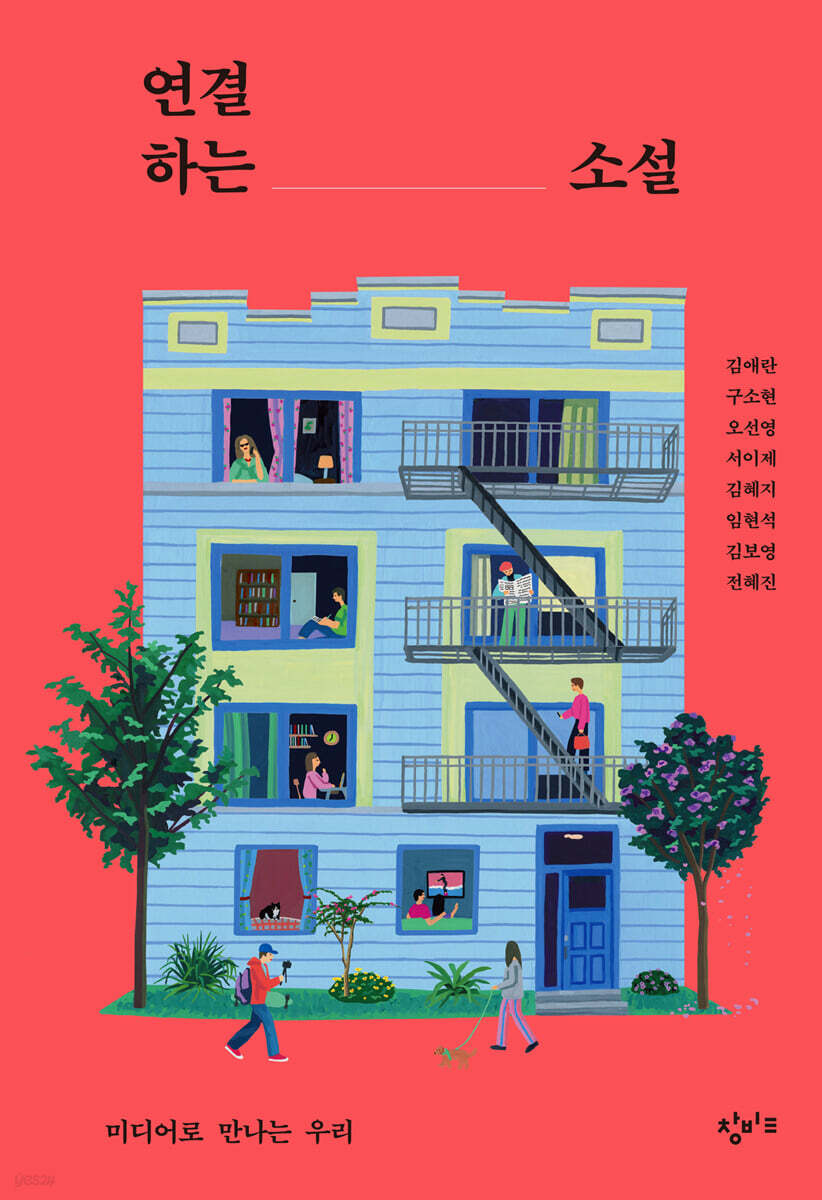
Connecting Novels
 |
Description
Book Introduction
What story would you like to share now?
A media story as natural as air, but never light.
『Connecting Novels: Us Meet Through Media』, a collection of eight short stories on the theme of media, has been published.
The collection of short stories contains media stories drawn by authors Kim Ae-ran, Gu So-hyeon, Oh Seon-yeong, Seo I-je, Kim Hye-ji, Lim Hyeon-seok, Kim Bo-yeong, and Jeon Hye-jin, covering everything from the essence of media to communication through media and media literacy.
Because 'media' has become so natural in our daily lives, there are times when even the word itself feels cliché.
Since it is a media that we use 'unconsciously' as if we are breathing, we need to think about ways to utilize it more wisely.
As we read "The Connecting Novel," we can think about another aspect of media that we haven't thought deeply about, and the intentions of media users that we've been missing.
Now, we can understand and feel each other vividly, even without meeting or experiencing each other in person, as long as we have media.
This book offers a fresh perspective on media and a deeper understanding of it for young people and readers in their 20s and 30s, who are still using media somewhere today and for whom sharing their stories is no longer unfamiliar.
Moreover, it helps readers who have limited their understanding of media to social media and mass media to recall the existence of primitive media such as 'words,' 'writing,' and 'books,' and ask the fundamental question, "What is media?"
This book is the ninth in the series of themed novels published by Changbi Education, and is a follow-up to 『Sweating Novel』 on the topic of labor, 『Breathing Novel』 on the topic of the environment, and 『Traveling Novel』 on the topic of travel.
A media story as natural as air, but never light.
『Connecting Novels: Us Meet Through Media』, a collection of eight short stories on the theme of media, has been published.
The collection of short stories contains media stories drawn by authors Kim Ae-ran, Gu So-hyeon, Oh Seon-yeong, Seo I-je, Kim Hye-ji, Lim Hyeon-seok, Kim Bo-yeong, and Jeon Hye-jin, covering everything from the essence of media to communication through media and media literacy.
Because 'media' has become so natural in our daily lives, there are times when even the word itself feels cliché.
Since it is a media that we use 'unconsciously' as if we are breathing, we need to think about ways to utilize it more wisely.
As we read "The Connecting Novel," we can think about another aspect of media that we haven't thought deeply about, and the intentions of media users that we've been missing.
Now, we can understand and feel each other vividly, even without meeting or experiencing each other in person, as long as we have media.
This book offers a fresh perspective on media and a deeper understanding of it for young people and readers in their 20s and 30s, who are still using media somewhere today and for whom sharing their stories is no longer unfamiliar.
Moreover, it helps readers who have limited their understanding of media to social media and mass media to recall the existence of primitive media such as 'words,' 'writing,' and 'books,' and ask the fundamental question, "What is media?"
This book is the ninth in the series of themed novels published by Changbi Education, and is a follow-up to 『Sweating Novel』 on the topic of labor, 『Breathing Novel』 on the topic of the environment, and 『Traveling Novel』 on the topic of travel.
- You can preview some of the book's contents.
Preview
index
Preface: Have you ever imagined a life without 'media'?
Kim Ae-ran, The Future of Silence
Gu So-hyun and Citron Horror
Oh Seon-yeong ㆍ Sponsorship Statement
Seo Yije ㆍ Wishlist ♥
Kim Hye-ji and Jiatube
Lim Hyeon-seok, Free Sharing Conversation Method
Kim Bo-young, Silent Age
Jeon Hye-jin, Bicentennial Bibliophile
A word from the editor: To you who dreams of a slightly special communication
Kim Ae-ran, The Future of Silence
Gu So-hyun and Citron Horror
Oh Seon-yeong ㆍ Sponsorship Statement
Seo Yije ㆍ Wishlist ♥
Kim Hye-ji and Jiatube
Lim Hyeon-seok, Free Sharing Conversation Method
Kim Bo-young, Silent Age
Jeon Hye-jin, Bicentennial Bibliophile
A word from the editor: To you who dreams of a slightly special communication
Detailed image
.jpg)
Into the book
He spent most of his life yearning for words.
It's not something you say alone, it's something you say with two people, it's even better with three people, and it's even more fun when five people share it.
Noisy and useless talk.
Words that tempt, deceive, joke, get angry, comfort, criticize, make excuses, and appeal… … .
---From "The Future of Silence"
She felt a certain intimacy between the book and herself.
Every letter spoke solely to me.
She had a one-on-one conversation with the book about the afterlife.
For her, who had not been able to talk to people for a long time, the stimulation that reading gave her was greater than she had expected.
Through this mysterious and secret conversation, she came to know.
Ghosts were also vessels that could contain something.
---From "Citron Horror"
The main writer persuaded Yunmi by saying that the more shiny and worn out her school uniform skirt was and the flatter the heels of her sneakers were, the better the drawing would be.
It's said that viewers at home, eating Christmas cakes drizzled with whipped cream like snow, are more likely to pick up the phone and send donations.
It shouldn't have been revealed through Yoonmi's mouth that she was a 'non-existent person', but if it had been revealed through the media, the result would have been clearly different.
---From the "Sponsorship Statement"
Moonho, do you dream of becoming a power blogger? No.
Hey, be honest.
That's not true.
I also refuse all advertising and sponsorships.
"Then why do you blog so diligently?" I asked, and he answered with great sincerity.
Because people like it.
---From "Wishlist ♥"
I just liked playing with my dad, so I did what I do best.
When Jia acts well, her dad likes it, and the number of views and subscribers goes up, and then even her mom gets excited.
Because the people that Jia loves the most in the world, and the people that love Jia the most, are her mom and dad.
So, Dad quit his job to spend more time with Gia.
Then I started the company Jiatube.
But everyone keeps saying weird things.
---From "Giatube"
I don't need to know the other person's every detail, and I don't want to know either.
If the conditions are not met, the conversation should be stopped.
Really, all I wanted to know was if I could take it now.
Is it possible? Yes, it is possible.
This is how a free sharing conversation should be.
---From "Free Sharing Conversation Method"
Thoughts are expressed in language.
But if the next generation does not use language as a tool for thought, if there is no longer a need for vessels, where will the human mind be contained in the future?
---From "The Silent Age"
“If the human lifespan is 80 years, how many more books will I be able to read?”
Don't so easily admit that he and I are actually similar.
“I wasn’t that scared of dying someday.
What I was afraid of was that there was a limit to the number of books I could read, even if I devoted the rest of my life to it.
“I want to know more and read more….”
It's not something you say alone, it's something you say with two people, it's even better with three people, and it's even more fun when five people share it.
Noisy and useless talk.
Words that tempt, deceive, joke, get angry, comfort, criticize, make excuses, and appeal… … .
---From "The Future of Silence"
She felt a certain intimacy between the book and herself.
Every letter spoke solely to me.
She had a one-on-one conversation with the book about the afterlife.
For her, who had not been able to talk to people for a long time, the stimulation that reading gave her was greater than she had expected.
Through this mysterious and secret conversation, she came to know.
Ghosts were also vessels that could contain something.
---From "Citron Horror"
The main writer persuaded Yunmi by saying that the more shiny and worn out her school uniform skirt was and the flatter the heels of her sneakers were, the better the drawing would be.
It's said that viewers at home, eating Christmas cakes drizzled with whipped cream like snow, are more likely to pick up the phone and send donations.
It shouldn't have been revealed through Yoonmi's mouth that she was a 'non-existent person', but if it had been revealed through the media, the result would have been clearly different.
---From the "Sponsorship Statement"
Moonho, do you dream of becoming a power blogger? No.
Hey, be honest.
That's not true.
I also refuse all advertising and sponsorships.
"Then why do you blog so diligently?" I asked, and he answered with great sincerity.
Because people like it.
---From "Wishlist ♥"
I just liked playing with my dad, so I did what I do best.
When Jia acts well, her dad likes it, and the number of views and subscribers goes up, and then even her mom gets excited.
Because the people that Jia loves the most in the world, and the people that love Jia the most, are her mom and dad.
So, Dad quit his job to spend more time with Gia.
Then I started the company Jiatube.
But everyone keeps saying weird things.
---From "Giatube"
I don't need to know the other person's every detail, and I don't want to know either.
If the conditions are not met, the conversation should be stopped.
Really, all I wanted to know was if I could take it now.
Is it possible? Yes, it is possible.
This is how a free sharing conversation should be.
---From "Free Sharing Conversation Method"
Thoughts are expressed in language.
But if the next generation does not use language as a tool for thought, if there is no longer a need for vessels, where will the human mind be contained in the future?
---From "The Silent Age"
“If the human lifespan is 80 years, how many more books will I be able to read?”
Don't so easily admit that he and I are actually similar.
“I wasn’t that scared of dying someday.
What I was afraid of was that there was a limit to the number of books I could read, even if I devoted the rest of my life to it.
“I want to know more and read more….”
---From "Bicentennial Bibliophile"
Publisher's Review
Would you like to communicate now?
『Connecting Novels: Us Meet Through Media』, a collection of eight short stories on the theme of media, has been published.
The collection of short stories contains media stories drawn by authors Kim Ae-ran, Gu So-hyeon, Oh Seon-yeong, Seo I-je, Kim Hye-ji, Lim Hyeon-seok, Kim Bo-yeong, and Jeon Hye-jin, covering everything from the essence of media to communication through media and media literacy.
Today, too, we meet the world through media.
Videos and news watched on the way to school or work in the morning, messenger conversations with colleagues discussing what to eat for lunch, photos and hashtags shared in real time on social media of food that tasted particularly delicious, and even a book read in a short while before going to bed.
Sometimes we reveal our own stories, sometimes we peek into others' stories, and we are connected to someone 24 hours a day.
Because 'media' has become so natural in our daily lives, there are times when even the word itself feels cliché.
However, media is not as simple or light a subject as one might think.
Since it is a media that we use 'unconsciously' as if we are breathing, we need to think about ways to utilize it more wisely.
As we read "The Connecting Novel," we can think about another aspect of media that we haven't thought deeply about, and the intentions of media users that we've been missing.
As times change, media has evolved beyond simply conveying information to taking on the role of connecting people.
Even if we don't meet in person or experience it, we can understand each other and feel it vividly as long as we have media.
This book offers a fresh perspective on media and a deeper understanding of it for young people and readers in their 20s and 30s, who are still using media somewhere today and for whom sharing their stories is no longer unfamiliar.
Moreover, it helps readers who have limited their understanding of media to social media and mass media to recall the existence of primitive media such as 'words,' 'writing,' and 'books,' and ask the fundamental question, "What is media?"
What if one day you couldn't talk to anyone in the world?
The story of those who wander like ghosts, thirsting for connection.
Even if I just tell my story or listen to other people's stories, something feels off.
Wouldn't a 'true conversation' be established when we can share our own stories while listening to the other person's story?
I hope you enjoy the following works while thinking back on the last time you had such a full conversation.
Kim Ae-ran's "The Future of Silence" is set in a "Minority Language Museum" that exhibits only the last speakers of disappearing languages.
What if everyone in the world who spoke your language disappeared, leaving you unable to communicate with anyone? It would be utterly desolate and terrifying.
As if lamenting, “Anyone can be left alone in the world and become the last speaker, but it just so happens to be me” (p. 19).
The 'I' in the work is "a spirit made up of the breath and energy that escaped from a language that disappeared from the world" (p. 16).
This 'I' is reminiscent of the old man who "spoke in the only language in the world and met the only death in the world" (p. 17), and his last speaker.
The old man, who had spent “most of his life yearning for words” (p. 34), desperately wished before he closed his eyes that “there would be at least one person by his side who would understand him” (p. 18).
What would it be like to long for those "words" that make me feel connected to the world? The anxiety evoked by the absence of "words" as a medium is more profound than the appropriateness of the content contained within them.
Gu So-hyun's "Citron Horror" shows the special affection that "Gongseon," a ten-year-old ghost, has for "books," the only window through which she can communicate with the world.
Because Gongseon was a ghost, “she could do anything, go anywhere, but no one knew what she was doing, and she was never seen anywhere” (p. 45).
Even though I am such a sad and lonely ghost, when I read a book, I feel that “every word is speaking only to me” (p. 46).
“The stimulation that reading gave her, who had not been able to talk to people for a long time, was greater than expected” (p. 46).
Gongseon watches with interest a college student's novel writing club.
When the members of the group critique Hyoju's original novel, they want to "stop talking nonsense and participate in the conversation" (p. 55).
Anyone who has ever encountered a new world through 'writing' and 'books' will be able to more easily empathize with Gongseon's desperate desire to communicate.
In communication tools like 'applications' where nonverbal expressions like facial expressions and gestures cannot be detected, more careful and delicate conversations are required to avoid unexpected misunderstandings.
In Lim Hyeon-seok's "Free Sharing Conversation Method," the 'I' is a character who experiences a change in his communication style after sharing for free through a second-hand transaction app.
Many people contacted me, but there was only one condition.
That you have to come and get it yourself.
For me, who believes that “if the conditions are not right, we should stop the conversation” (p. 141), free sharing conversations had to be dry and concise, like “Is it possible? It is possible.” (p. 141).
'I' began to have genuine conversations with the young people who came to collect the items to be shared, and experienced genuine conversations for the first time.
I, who usually spoke indifferently even to my family, felt the need for someone to talk to right now after sharing for free.
“Now I want to hear the story of my wife that I heard back then” (page 159).
Looking at myself, who has made small changes in communication, I wonder if we too can peel back the layers of things that have tightly wrapped us and try to have a transparent conversation without any prejudice or embellishment.
Jeon Hye-jin's "Bicentennial Bibliophile" is set in 2194, a future filled with "people who entrust almost everything to the assistance of artificial intelligence" (p. 205).
In the era leading up to the 23rd century, there are no longer only “people who do not read, do not write, do not think, and simply search, reacting to everything as others have already reacted” (p. 205).
One day, professional librarian 'Yoon Hyun' meets 'Hwang Jae Yoon', who has extended his life by over 200 years by relying solely on a prosthesis due to his obsession with knowledge.
Hwang Jae-yoon, who asks, “If the human lifespan is 80 years, how many more books will I be able to read in the future?” (p. 230), insists on reading between the lines with his eyes, and his appearance is so bizarre that it frightens Yun-hyeon.
However, Yun Hyeon, who has been proud of his job, which “allows him to meet, work with, and converse with countless intelligent, brilliant, and great minds who build and cultivate the world of books” (p. 216), sees a glimpse of himself in Hwang Jae-yoon.
In a world where there are more people who do not read books, Yoon Hyun and Hwang Jae-yoon, who seek knowledge and learning from books, seem to have a lot in common.
Even though Hwang Jae-yoon is no longer human because he relies on a body, his attitude of never stopping trying to connect with a wider and more diverse world through 'books' seems somewhat familiar to us who seek to continuously connect through media.
These days, I only want to see what I want to see and hear what I want to hear.
Are you ready to open your eyes wide and look at 'Media' again?
Sometimes, I can't even believe what I see with my own two eyes.
So, what do you say when you hear something from someone or see something through someone?
We are exposed to countless amounts of information every day.
Some of the information comes from direct experience, but most of it is information that allows for indirect experience.
Have you ever wondered how reliable the information we so easily and quickly accept is?
'Yunmi' in Oh Seon-yeong's "Sponsorship Statement" was once a sponsored child who received support through a TV program, but now works at a child welfare foundation.
Yunmi, a middle school student who liked Hermann Hesse's 『Demian』, is asked before the broadcast to answer a question about her favorite novel, "Daddy-Long-Legs"" (page 78).
The direction of the program was decided regardless of young Yunmi's wishes.
The program official said, “The more worn and shiny Yoonmi’s school uniform skirt is, and the flatter the heels of her sneakers are” (page 78), the more donations she can receive from viewers.
After becoming an adult and working at a welfare foundation, Yoon-mi is confused when she meets a sponsored child who, unlike her, is honest about his emotions and knows how to speak up for himself.
This story of Yoon-mi makes us reflect on how the media hides the truth for the sake of seeming plausible, and how we, too, turn a blind eye to things that seem plausible.
'Worrying only delays delivery.'
This is a phrase that anyone who has ever had a headache when purchasing something online will likely relate to.
To make 'relatively' rational purchases online, we compare the products we want with other products and consider the various usefulness of the products.
The problem is that we end up buying unnecessary things because of the nagging algorithm's whispers.
My online shopping cart in Seo Yije's "Wishlist ♥" is never empty.
Actually, a full shopping cart itself is not a problem.
Because I don't buy everything I put in my cart.
But isn't the constant act of filling something ultimately proving that you don't know what you truly want and that you have a psychological deficiency that makes you want to keep filling something (whether it's online or offline)?
In the work, the 'I' suddenly thinks that the act of consuming something, "at that moment, I feel that I need something I don't need, and that I feel that I lack something I don't lack" (p. 106), is quite impulsive. This makes us wonder if we can ever be free from the media that shouts 'recommendation,' 'recommendation,' and more 'recommendation' even when buying something very trivial.
Kim Hye-ji's "Jiatube" is a letter sent by "Jia," who runs a popular children's YouTube channel with her father, to "Sister Hee-jin," who was once a writer for the channel.
Young Ji-ah resents Hee-jin for posting on the internet, “‘Exposing the Truth About the Famous Kids YouTube Channel, Ji-aTube’” (p. 125), which has changed the way her friends look at her and her relationship with her parents.
Although there were difficult days while filming YouTube videos full of intention and decoration, Jia could not stop filming because she thought, “If I act well, my dad will like it, and the number of views and subscribers will go up, and then even my mom will be happy” (p. 128).
Heejin, who truly understood and cared for Ji-ah, reveals on the internet that Ji-ah is stressed out from unwanted filming.
As young Jia is constantly exposed to the gaze and evaluation of an unspecified number of people in order to generate revenue from her videos, and is overly conscious of others in every word and action, we cannot help but think about the dark side of 'one-person media.'
If you put up a "Do Not Run" sign in an elementary school hallway, wouldn't the children really run? Kim Bo-young's "The Silent Age" answers that children wouldn't even pay attention to the sign.
“It’s not because the children are rascals or troublemakers, but because they don’t know what to do ‘but run’” (p. 170).
“The negative is not conveyed” (page 170), and in the end, only the expression that was not intended to be emphasized ends up being emphasized.
Cognitive linguist Shin Young-hee received a request from a ruling party member ahead of the presidential election: “Please create a single phrase that will bring down a certain person” (p. 168).
Shin Young-hee begins to “pick out all the flaws and faults of the person” (p. 190) and “produce empty, context-less language that only causes disgust” (p. 190).
The language in the media is amplified and reproduced, and ultimately, controversy creates controversy.
I wonder in what context the issues in society that we had overlooked became topics of conversation.
I hope you'll read the work to the end to see if Shin Young-hee, who believes in the power of language more than anyone else and emphasizes and combines language, can truly achieve victory in the presidential election.
Editor's Note
Novels are a 'media' that allows us to look into and reflect on the lives of individuals and the times.
As librarians who teach students how to read and utilize information from various media, we believe in the power of "storytelling" over textbook-style "teaching."
I hope that many who read the eight stories will find their own way through reflection, following the resonance in their hearts.
For those of you living in a world where it's difficult to imagine a life without media, I hope the eight stories in this book, connecting "me," "others," and "the world," will serve as a stepping stone toward a better life in the future.
In a world surrounded by media, I encourage you to never be consumed by it, but to interpret and produce wisely, and to live your life responsibly.
Furthermore, I hope that sometimes we can open the window called 'media' and willingly enter the lives of others, fostering solidarity through genuine communication and living together.
『Connecting Novels: Us Meet Through Media』, a collection of eight short stories on the theme of media, has been published.
The collection of short stories contains media stories drawn by authors Kim Ae-ran, Gu So-hyeon, Oh Seon-yeong, Seo I-je, Kim Hye-ji, Lim Hyeon-seok, Kim Bo-yeong, and Jeon Hye-jin, covering everything from the essence of media to communication through media and media literacy.
Today, too, we meet the world through media.
Videos and news watched on the way to school or work in the morning, messenger conversations with colleagues discussing what to eat for lunch, photos and hashtags shared in real time on social media of food that tasted particularly delicious, and even a book read in a short while before going to bed.
Sometimes we reveal our own stories, sometimes we peek into others' stories, and we are connected to someone 24 hours a day.
Because 'media' has become so natural in our daily lives, there are times when even the word itself feels cliché.
However, media is not as simple or light a subject as one might think.
Since it is a media that we use 'unconsciously' as if we are breathing, we need to think about ways to utilize it more wisely.
As we read "The Connecting Novel," we can think about another aspect of media that we haven't thought deeply about, and the intentions of media users that we've been missing.
As times change, media has evolved beyond simply conveying information to taking on the role of connecting people.
Even if we don't meet in person or experience it, we can understand each other and feel it vividly as long as we have media.
This book offers a fresh perspective on media and a deeper understanding of it for young people and readers in their 20s and 30s, who are still using media somewhere today and for whom sharing their stories is no longer unfamiliar.
Moreover, it helps readers who have limited their understanding of media to social media and mass media to recall the existence of primitive media such as 'words,' 'writing,' and 'books,' and ask the fundamental question, "What is media?"
What if one day you couldn't talk to anyone in the world?
The story of those who wander like ghosts, thirsting for connection.
Even if I just tell my story or listen to other people's stories, something feels off.
Wouldn't a 'true conversation' be established when we can share our own stories while listening to the other person's story?
I hope you enjoy the following works while thinking back on the last time you had such a full conversation.
Kim Ae-ran's "The Future of Silence" is set in a "Minority Language Museum" that exhibits only the last speakers of disappearing languages.
What if everyone in the world who spoke your language disappeared, leaving you unable to communicate with anyone? It would be utterly desolate and terrifying.
As if lamenting, “Anyone can be left alone in the world and become the last speaker, but it just so happens to be me” (p. 19).
The 'I' in the work is "a spirit made up of the breath and energy that escaped from a language that disappeared from the world" (p. 16).
This 'I' is reminiscent of the old man who "spoke in the only language in the world and met the only death in the world" (p. 17), and his last speaker.
The old man, who had spent “most of his life yearning for words” (p. 34), desperately wished before he closed his eyes that “there would be at least one person by his side who would understand him” (p. 18).
What would it be like to long for those "words" that make me feel connected to the world? The anxiety evoked by the absence of "words" as a medium is more profound than the appropriateness of the content contained within them.
Gu So-hyun's "Citron Horror" shows the special affection that "Gongseon," a ten-year-old ghost, has for "books," the only window through which she can communicate with the world.
Because Gongseon was a ghost, “she could do anything, go anywhere, but no one knew what she was doing, and she was never seen anywhere” (p. 45).
Even though I am such a sad and lonely ghost, when I read a book, I feel that “every word is speaking only to me” (p. 46).
“The stimulation that reading gave her, who had not been able to talk to people for a long time, was greater than expected” (p. 46).
Gongseon watches with interest a college student's novel writing club.
When the members of the group critique Hyoju's original novel, they want to "stop talking nonsense and participate in the conversation" (p. 55).
Anyone who has ever encountered a new world through 'writing' and 'books' will be able to more easily empathize with Gongseon's desperate desire to communicate.
In communication tools like 'applications' where nonverbal expressions like facial expressions and gestures cannot be detected, more careful and delicate conversations are required to avoid unexpected misunderstandings.
In Lim Hyeon-seok's "Free Sharing Conversation Method," the 'I' is a character who experiences a change in his communication style after sharing for free through a second-hand transaction app.
Many people contacted me, but there was only one condition.
That you have to come and get it yourself.
For me, who believes that “if the conditions are not right, we should stop the conversation” (p. 141), free sharing conversations had to be dry and concise, like “Is it possible? It is possible.” (p. 141).
'I' began to have genuine conversations with the young people who came to collect the items to be shared, and experienced genuine conversations for the first time.
I, who usually spoke indifferently even to my family, felt the need for someone to talk to right now after sharing for free.
“Now I want to hear the story of my wife that I heard back then” (page 159).
Looking at myself, who has made small changes in communication, I wonder if we too can peel back the layers of things that have tightly wrapped us and try to have a transparent conversation without any prejudice or embellishment.
Jeon Hye-jin's "Bicentennial Bibliophile" is set in 2194, a future filled with "people who entrust almost everything to the assistance of artificial intelligence" (p. 205).
In the era leading up to the 23rd century, there are no longer only “people who do not read, do not write, do not think, and simply search, reacting to everything as others have already reacted” (p. 205).
One day, professional librarian 'Yoon Hyun' meets 'Hwang Jae Yoon', who has extended his life by over 200 years by relying solely on a prosthesis due to his obsession with knowledge.
Hwang Jae-yoon, who asks, “If the human lifespan is 80 years, how many more books will I be able to read in the future?” (p. 230), insists on reading between the lines with his eyes, and his appearance is so bizarre that it frightens Yun-hyeon.
However, Yun Hyeon, who has been proud of his job, which “allows him to meet, work with, and converse with countless intelligent, brilliant, and great minds who build and cultivate the world of books” (p. 216), sees a glimpse of himself in Hwang Jae-yoon.
In a world where there are more people who do not read books, Yoon Hyun and Hwang Jae-yoon, who seek knowledge and learning from books, seem to have a lot in common.
Even though Hwang Jae-yoon is no longer human because he relies on a body, his attitude of never stopping trying to connect with a wider and more diverse world through 'books' seems somewhat familiar to us who seek to continuously connect through media.
These days, I only want to see what I want to see and hear what I want to hear.
Are you ready to open your eyes wide and look at 'Media' again?
Sometimes, I can't even believe what I see with my own two eyes.
So, what do you say when you hear something from someone or see something through someone?
We are exposed to countless amounts of information every day.
Some of the information comes from direct experience, but most of it is information that allows for indirect experience.
Have you ever wondered how reliable the information we so easily and quickly accept is?
'Yunmi' in Oh Seon-yeong's "Sponsorship Statement" was once a sponsored child who received support through a TV program, but now works at a child welfare foundation.
Yunmi, a middle school student who liked Hermann Hesse's 『Demian』, is asked before the broadcast to answer a question about her favorite novel, "Daddy-Long-Legs"" (page 78).
The direction of the program was decided regardless of young Yunmi's wishes.
The program official said, “The more worn and shiny Yoonmi’s school uniform skirt is, and the flatter the heels of her sneakers are” (page 78), the more donations she can receive from viewers.
After becoming an adult and working at a welfare foundation, Yoon-mi is confused when she meets a sponsored child who, unlike her, is honest about his emotions and knows how to speak up for himself.
This story of Yoon-mi makes us reflect on how the media hides the truth for the sake of seeming plausible, and how we, too, turn a blind eye to things that seem plausible.
'Worrying only delays delivery.'
This is a phrase that anyone who has ever had a headache when purchasing something online will likely relate to.
To make 'relatively' rational purchases online, we compare the products we want with other products and consider the various usefulness of the products.
The problem is that we end up buying unnecessary things because of the nagging algorithm's whispers.
My online shopping cart in Seo Yije's "Wishlist ♥" is never empty.
Actually, a full shopping cart itself is not a problem.
Because I don't buy everything I put in my cart.
But isn't the constant act of filling something ultimately proving that you don't know what you truly want and that you have a psychological deficiency that makes you want to keep filling something (whether it's online or offline)?
In the work, the 'I' suddenly thinks that the act of consuming something, "at that moment, I feel that I need something I don't need, and that I feel that I lack something I don't lack" (p. 106), is quite impulsive. This makes us wonder if we can ever be free from the media that shouts 'recommendation,' 'recommendation,' and more 'recommendation' even when buying something very trivial.
Kim Hye-ji's "Jiatube" is a letter sent by "Jia," who runs a popular children's YouTube channel with her father, to "Sister Hee-jin," who was once a writer for the channel.
Young Ji-ah resents Hee-jin for posting on the internet, “‘Exposing the Truth About the Famous Kids YouTube Channel, Ji-aTube’” (p. 125), which has changed the way her friends look at her and her relationship with her parents.
Although there were difficult days while filming YouTube videos full of intention and decoration, Jia could not stop filming because she thought, “If I act well, my dad will like it, and the number of views and subscribers will go up, and then even my mom will be happy” (p. 128).
Heejin, who truly understood and cared for Ji-ah, reveals on the internet that Ji-ah is stressed out from unwanted filming.
As young Jia is constantly exposed to the gaze and evaluation of an unspecified number of people in order to generate revenue from her videos, and is overly conscious of others in every word and action, we cannot help but think about the dark side of 'one-person media.'
If you put up a "Do Not Run" sign in an elementary school hallway, wouldn't the children really run? Kim Bo-young's "The Silent Age" answers that children wouldn't even pay attention to the sign.
“It’s not because the children are rascals or troublemakers, but because they don’t know what to do ‘but run’” (p. 170).
“The negative is not conveyed” (page 170), and in the end, only the expression that was not intended to be emphasized ends up being emphasized.
Cognitive linguist Shin Young-hee received a request from a ruling party member ahead of the presidential election: “Please create a single phrase that will bring down a certain person” (p. 168).
Shin Young-hee begins to “pick out all the flaws and faults of the person” (p. 190) and “produce empty, context-less language that only causes disgust” (p. 190).
The language in the media is amplified and reproduced, and ultimately, controversy creates controversy.
I wonder in what context the issues in society that we had overlooked became topics of conversation.
I hope you'll read the work to the end to see if Shin Young-hee, who believes in the power of language more than anyone else and emphasizes and combines language, can truly achieve victory in the presidential election.
Editor's Note
Novels are a 'media' that allows us to look into and reflect on the lives of individuals and the times.
As librarians who teach students how to read and utilize information from various media, we believe in the power of "storytelling" over textbook-style "teaching."
I hope that many who read the eight stories will find their own way through reflection, following the resonance in their hearts.
For those of you living in a world where it's difficult to imagine a life without media, I hope the eight stories in this book, connecting "me," "others," and "the world," will serve as a stepping stone toward a better life in the future.
In a world surrounded by media, I encourage you to never be consumed by it, but to interpret and produce wisely, and to live your life responsibly.
Furthermore, I hope that sometimes we can open the window called 'media' and willingly enter the lives of others, fostering solidarity through genuine communication and living together.
GOODS SPECIFICS
- Date of issue: June 23, 2023
- Page count, weight, size: 252 pages | 382g | 148*210*12mm
- ISBN13: 9791165702175
- ISBN10: 1165702177
You may also like
카테고리
korean


korean

![GQ KOREA Mark (Monthly): December [2025]](http://librairie.coreenne.fr/cdn/shop/files/8ef265dbbfbf186523ed75ba7319009d.jpg?v=1765340328&width=3840)


