

Pilgrimage to India and Nepal
 |
Description
Book Introduction
As the COVID-19 era seems unlikely to end anytime soon, days continue with a heavy heart.
If you want to change your life in the shortest amount of time, go on a trip.
Indeed, nothing breathes new life into our hamster-wheel-like daily routine and fills us with happiness quite like travel.
But what should we do in a situation where traveling is not even a dream due to the coronavirus?
One of the travel alternatives in the COVID-19 era is a trip from home or a trip from the library.
Because pilgrimage through books is possible anytime, anywhere.
A book that is perfect for the COVID-19 era has been published and is receiving love from readers.
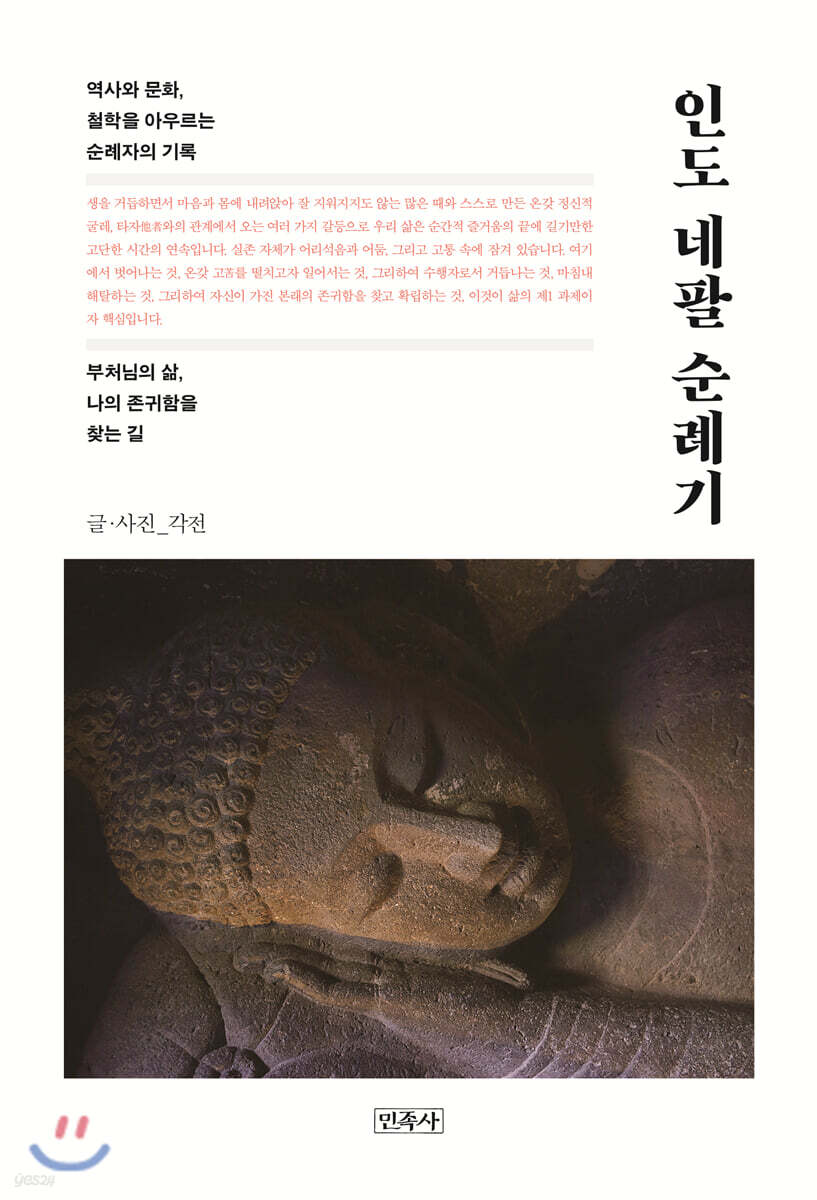
"Pilgrimage to India and Nepal" is the book that is the topic of conversation.
This book vividly depicts the journey of enlightenment and the pilgrimage to holy places in India and Nepal that the monk Gakjeon, who practices in the Seonbang, went on as an extension of his asceticism during the holiday season, along with his own photos.
As the subtitle of this book suggests, “Buddha’s Life, the Path to Finding My Nobility,” if you read this book and go on a pilgrimage to India and Nepal with a monk, you will be able to fundamentally change your life through this book, just as travel changes your life.
If you want to change your life in the shortest amount of time, go on a trip.
Indeed, nothing breathes new life into our hamster-wheel-like daily routine and fills us with happiness quite like travel.
But what should we do in a situation where traveling is not even a dream due to the coronavirus?
One of the travel alternatives in the COVID-19 era is a trip from home or a trip from the library.
Because pilgrimage through books is possible anytime, anywhere.
A book that is perfect for the COVID-19 era has been published and is receiving love from readers.
"Pilgrimage to India and Nepal" is the book that is the topic of conversation.
This book vividly depicts the journey of enlightenment and the pilgrimage to holy places in India and Nepal that the monk Gakjeon, who practices in the Seonbang, went on as an extension of his asceticism during the holiday season, along with his own photos.
As the subtitle of this book suggests, “Buddha’s Life, the Path to Finding My Nobility,” if you read this book and go on a pilgrimage to India and Nepal with a monk, you will be able to fundamentally change your life through this book, just as travel changes your life.
- You can preview some of the book's contents.
Preview
index
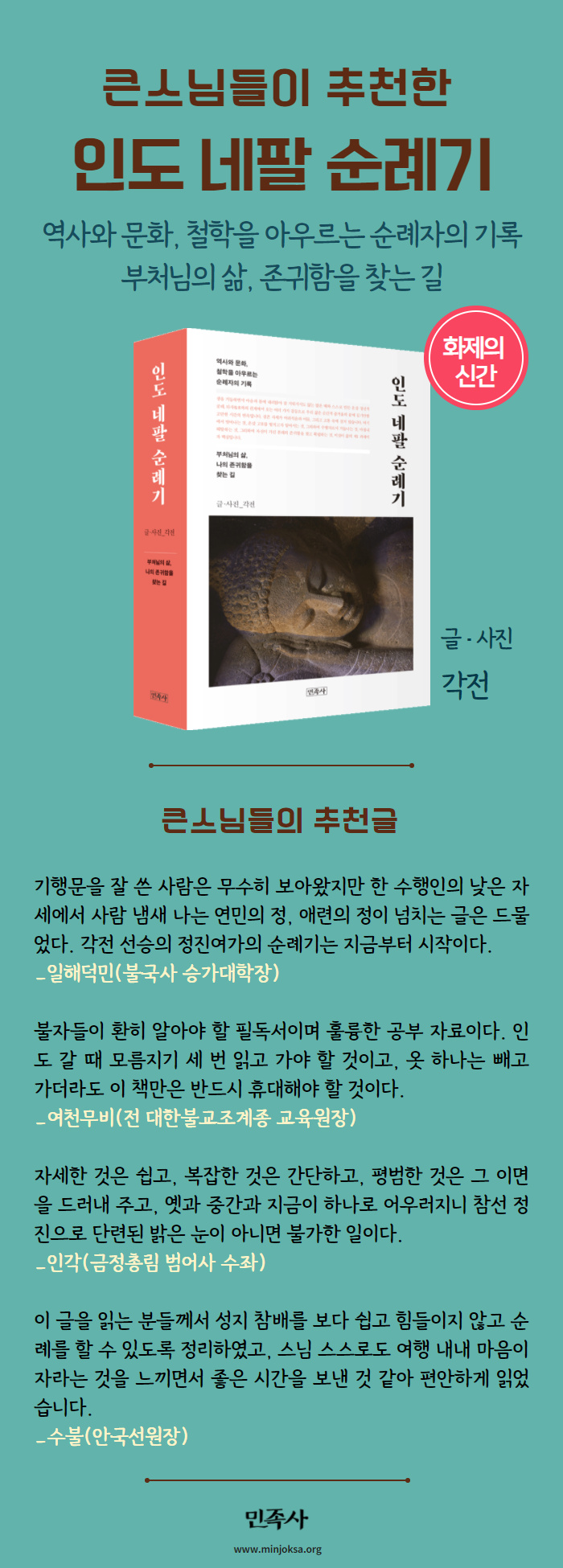
Recommendation
Iljinhwa 一塵話 _ Ilhae Deokmin 004
A must-read for all Buddhists _ Yeocheon Movie 007
The past, the middle, and the present are all blended together _ Ingak 008
I felt my heart grow throughout the trip _ Subul 009
Opening Remarks | Praising and Respecting the Buddha 011
References | 665
Faith blossoms like lotus petals in the morning sunlight
Chapter 1 | Delhi, the Religious Center of India
Encountering Different Cultures and Unfamiliar Streets 031
Delhi in Buddhist scriptures? Kuru 033
A Religious Hub? Delhi 035
The capital of India? Delhi 037
Buddha's Relics from the Delhi Museum 041
Aurangabad and Maharashtra 047
Bibika Makbara 050
The Buddha who left for the world of nirvana but still remains in Saha
Chapter 2 | The Marvelous Ajanta Caves
Finally, to the Ajanta Caves 055
The pinnacle of ancient murals? Cave 1, 065
Similar murals? Cave 2, 079
Maximum oyster? 4th oyster 086
The only two-story cave? Cave 6, 088
The First Buddhist Temple Cave? Cave 10, 090
A similar-looking temple? Cave 9, No. 095
The 16th Cavern of Regret 098
A treasure trove of murals? Cave 17, 110
A treasure trove of fragments? Cave 26, 123
The most beautiful carved oyster? Cave 19, 136
Other caves 144
A variety of flowers come together to create a beautiful flower bed.
Chapter 3 | Ellora Caves: Where Three Religions Coexist
Ellora Buddhist Caves 159
Hindu caves? Kailasanatha 173
Jain Cave 181
189 on the way to Manmad Station
Under the protection of heaven and gods, abundant vitality arises.
Chapter 4 | Sanchi Great Pagoda with Beautiful Reliefs on the Top Gate
199 Towards Sanchi Great Pagoda
About the tower gate of the first tower of Sanchi 210
North Gate of Sanchi First Pagoda 213
East Gate 234 of Sanchi First Pagoda
South Gate of Sanchi First Pagoda 247
West Gate of Sanchi First Pagoda 260
279 Ruins around Sanchi Pagoda
289 from Bhopal to Agra
India's cultural pride is the driving force behind its cultural identity.
Chapter 5 | Agra, the Ancient Capital of the Last Dynasty
Agra, the ancient capital of the Mughal Empire? 307
India's Romeo and Juliet? Taj Mahal 308
Residence of past emperors? Agra Fort 315
The Pillar of the Royal Family? Itimad-ud-Daulah 321
Agra at Night 323
The first afterlife! Bhikkhus, abandon the two extremes.
Chapter 6 | The First Sermon: Sarnath and the Ganges
Night train 329 from Tundala Station to Varanasi
The City of Spiritual Light? Varanasi 334
Sarnath's Stupa 336
Sarnath Museum 340
The First Dharma Wheel? Nokyawon 346
Day and Night on the Ganges 355
Enter the world of enlightenment where all discrimination is extinguished.
Chapter 7 | Bodhgaya of Enlightenment
Board of Enlightenment 371
Entering the Selection Under the Bodhi Tree 375
History of the Mahabodhi Temple 383
Relics of the Mahabodhi Temple 388
India → Song → Goryeo 393
Jeonjeonggaksan Mountain and Yuyeonggul Cave 397
400 three-step bows at Mahabodhi Temple
Sujata Offering Tower 402
The Buddha's law continues and connects back to me.
Chapter 8 | Rajgir, Where the Wheel of Dharma Rolls
The capital of Magadha? Rajgir 409
Yeongchuksan Mountain Range Law Group 412
King Bimbisara's Prison Site 416
The First Collection of Sutras? Seven-Leaf Cave 420
The first temple? Jukrimjeongsa 430
The Largest Buddhist University? Nalanda 435
Overcoming the epidemic with cleanliness, faith, charity, and compassion
Chapter 9 | Vaishali, the First Women's Ordination
Emperor Ashoka's capital? Patna 463
Vaishali 469, ahead of its time
One of the Eight Fundamental Pagodas? Fundamental Buddha Pagoda 477
A central lecture hall in a large forest? Daerimjeongsa 482
The Buddha's Shaved Head? Kesarya Stupa 491
Indian Wedding Culture 497
Don't neglect your work and accomplish everything you need to do.
Chapter 10 | Kushinagar, the Land of Nirvana
The City of the Wheel-Turning King? Kushinagar 505
Last Trend 507
Parinirvana in Kushinagar 511
Ruins of Kushinagar 514
Offering of Garas at Nirvana Hall 518
The Buddha's Cremation? Ramavar Tower 521
All rewards are meaningless, so don't settle for anything.
Chapter 11 | The Diamond Sutra's Dharma Place, Shravasti
Route 529 to Shravasti
The capital of Kosala? Shravasti 536
Origin of the Joseon Dynasty, 538
Angulimala Stupa and Sudatta Stupa 545
Shravasti's Great Temple and Surrounding Ruins 548
550 on the way to Lumbini
Above heaven and beneath heaven, I alone am honored.
Chapter 12 | The Birth of Lumbini
559 across the India-Nepal border
The Origin of the Sakya Family? Kapilavastu 561
Buddha's Birthplace? Lumbini 577
Mayadevi Temple 581
Asoka's Law of Ruminday 586
The purifying power of the vast, pure white nature
Chapter 13 | Nepal's Buddhist Cultural Heritage
Into the Himalayas 593
Nepal's History, Religion, and Culture 609
Cultural Heritage Sites in Kathmandu 614
Nepal's Buddhist Culture and the Sakya Family 629
Nepal's first temple? Swayambhu Nath 647
Himalayas 662 as seen from an airplane
Iljinhwa 一塵話 _ Ilhae Deokmin 004
A must-read for all Buddhists _ Yeocheon Movie 007
The past, the middle, and the present are all blended together _ Ingak 008
I felt my heart grow throughout the trip _ Subul 009
Opening Remarks | Praising and Respecting the Buddha 011
References | 665
Faith blossoms like lotus petals in the morning sunlight
Chapter 1 | Delhi, the Religious Center of India
Encountering Different Cultures and Unfamiliar Streets 031
Delhi in Buddhist scriptures? Kuru 033
A Religious Hub? Delhi 035
The capital of India? Delhi 037
Buddha's Relics from the Delhi Museum 041
Aurangabad and Maharashtra 047
Bibika Makbara 050
The Buddha who left for the world of nirvana but still remains in Saha
Chapter 2 | The Marvelous Ajanta Caves
Finally, to the Ajanta Caves 055
The pinnacle of ancient murals? Cave 1, 065
Similar murals? Cave 2, 079
Maximum oyster? 4th oyster 086
The only two-story cave? Cave 6, 088
The First Buddhist Temple Cave? Cave 10, 090
A similar-looking temple? Cave 9, No. 095
The 16th Cavern of Regret 098
A treasure trove of murals? Cave 17, 110
A treasure trove of fragments? Cave 26, 123
The most beautiful carved oyster? Cave 19, 136
Other caves 144
A variety of flowers come together to create a beautiful flower bed.
Chapter 3 | Ellora Caves: Where Three Religions Coexist
Ellora Buddhist Caves 159
Hindu caves? Kailasanatha 173
Jain Cave 181
189 on the way to Manmad Station
Under the protection of heaven and gods, abundant vitality arises.
Chapter 4 | Sanchi Great Pagoda with Beautiful Reliefs on the Top Gate
199 Towards Sanchi Great Pagoda
About the tower gate of the first tower of Sanchi 210
North Gate of Sanchi First Pagoda 213
East Gate 234 of Sanchi First Pagoda
South Gate of Sanchi First Pagoda 247
West Gate of Sanchi First Pagoda 260
279 Ruins around Sanchi Pagoda
289 from Bhopal to Agra
India's cultural pride is the driving force behind its cultural identity.
Chapter 5 | Agra, the Ancient Capital of the Last Dynasty
Agra, the ancient capital of the Mughal Empire? 307
India's Romeo and Juliet? Taj Mahal 308
Residence of past emperors? Agra Fort 315
The Pillar of the Royal Family? Itimad-ud-Daulah 321
Agra at Night 323
The first afterlife! Bhikkhus, abandon the two extremes.
Chapter 6 | The First Sermon: Sarnath and the Ganges
Night train 329 from Tundala Station to Varanasi
The City of Spiritual Light? Varanasi 334
Sarnath's Stupa 336
Sarnath Museum 340
The First Dharma Wheel? Nokyawon 346
Day and Night on the Ganges 355
Enter the world of enlightenment where all discrimination is extinguished.
Chapter 7 | Bodhgaya of Enlightenment
Board of Enlightenment 371
Entering the Selection Under the Bodhi Tree 375
History of the Mahabodhi Temple 383
Relics of the Mahabodhi Temple 388
India → Song → Goryeo 393
Jeonjeonggaksan Mountain and Yuyeonggul Cave 397
400 three-step bows at Mahabodhi Temple
Sujata Offering Tower 402
The Buddha's law continues and connects back to me.
Chapter 8 | Rajgir, Where the Wheel of Dharma Rolls
The capital of Magadha? Rajgir 409
Yeongchuksan Mountain Range Law Group 412
King Bimbisara's Prison Site 416
The First Collection of Sutras? Seven-Leaf Cave 420
The first temple? Jukrimjeongsa 430
The Largest Buddhist University? Nalanda 435
Overcoming the epidemic with cleanliness, faith, charity, and compassion
Chapter 9 | Vaishali, the First Women's Ordination
Emperor Ashoka's capital? Patna 463
Vaishali 469, ahead of its time
One of the Eight Fundamental Pagodas? Fundamental Buddha Pagoda 477
A central lecture hall in a large forest? Daerimjeongsa 482
The Buddha's Shaved Head? Kesarya Stupa 491
Indian Wedding Culture 497
Don't neglect your work and accomplish everything you need to do.
Chapter 10 | Kushinagar, the Land of Nirvana
The City of the Wheel-Turning King? Kushinagar 505
Last Trend 507
Parinirvana in Kushinagar 511
Ruins of Kushinagar 514
Offering of Garas at Nirvana Hall 518
The Buddha's Cremation? Ramavar Tower 521
All rewards are meaningless, so don't settle for anything.
Chapter 11 | The Diamond Sutra's Dharma Place, Shravasti
Route 529 to Shravasti
The capital of Kosala? Shravasti 536
Origin of the Joseon Dynasty, 538
Angulimala Stupa and Sudatta Stupa 545
Shravasti's Great Temple and Surrounding Ruins 548
550 on the way to Lumbini
Above heaven and beneath heaven, I alone am honored.
Chapter 12 | The Birth of Lumbini
559 across the India-Nepal border
The Origin of the Sakya Family? Kapilavastu 561
Buddha's Birthplace? Lumbini 577
Mayadevi Temple 581
Asoka's Law of Ruminday 586
The purifying power of the vast, pure white nature
Chapter 13 | Nepal's Buddhist Cultural Heritage
Into the Himalayas 593
Nepal's History, Religion, and Culture 609
Cultural Heritage Sites in Kathmandu 614
Nepal's Buddhist Culture and the Sakya Family 629
Nepal's first temple? Swayambhu Nath 647
Himalayas 662 as seen from an airplane
Detailed image
Into the book
As we go through life after life, we are burdened with countless stains that settle on our minds and bodies and are not easily erased, with all sorts of mental shackles we create ourselves, and with various conflicts that arise from our relationships with all others, including sentient and insentient beings. Our lives are a series of long, arduous periods of time, punctuated by fleeting moments of pleasure.
Existence itself is immersed in foolishness, darkness, and suffering.
And soon there is the end called death.
To escape from here, to rise up to shake off all suffering, to be reborn as a practitioner, to finally achieve liberation, and to find and establish one's own inherent nobility—this is the first and foremost task of life, to awaken the mind to this.
Because we are inherently noble beings.
This is the truth that the Buddha proclaimed as soon as he came to this earth: “I am the only one who is honored in heaven and on earth.”
This is what the Buddha meant by urgency.
How could it not be desperate?
--- p.13
Travel seems to be a conversation.
Traveling is about unfamiliar environments, unfamiliar streets, unfamiliar times, and conversations with unfamiliar people! Unfamiliar beings take me to unfamiliar places, and before I know it, through these unfamiliar encounters, I, too, become a stranger.
So the journey is enjoyable and joyful.
Pilgrimage seems to further reinforce this character.
The ruins of the pilgrimage site itself, the traces of the ancient ancestors, the changes in color left by time, the taste and atmosphere of the air, and the impressions of the people I met there all speak to me.
I think I am thinking about something, but in reality, I think it is the words that the objects are telling me.
Travel is like a friend.
Every being that speaks to me becomes a new friend.
That friend takes me to unfamiliar places, opens up and broadens the horizons of my life.
There is no need to say more, as the new friends you will meet on your pilgrimage include the Buddha and his great disciples.
We retrace their footsteps and breathe the air they breathed.
From the big to the small, from the great to the trivial, we condense the flow of time, feel it again with our bodies and caress it with our hearts.
--- p.13~14
To breathe life into the stories that travel tells me, to give a new sense of presence to the clusters of stacked bricks, to make the hazy images of the past activities of the Buddha and his disciples come alive and breathe in the present, as if we had flown back in time to that era, and thus pour a waterfall of confidence into our faith, which is always shaken and needs to be re-established, and to multiply the driving force of our ceaseless advance on the path toward enlightenment – these were the most important considerations in writing this book.
The breakthrough to solve this problem was the life story and birth stories of Buddha contained in the various murals and reliefs painted in the Ajanta-Ellora Caves and the Great Stupa at Sanchi.
The ancient colors of the murals and the exposed irregularities of the stone reliefs transcend the time span of 2,500 years ago, break the mold of the letters trapped in books, and make us feel the devotion and artistic spirit of the painters and artisans who left behind such works. They are grafted onto the hearts of our pilgrims who traveled far away, and the lives of the characters in the works intrude into our modern lives.
--- p.14~15
These stories begin at Sarnath, the first turning point of the Dharma Wheel, and as we continue our pilgrimage to the remaining holy sites, we visit the places where these stories took place and encounter the relics they left behind, deepening the density of the conversations that this pilgrimage offers.
In addition, by sufficiently quoting the travelogues of Monk Beophyeon from the early 5th century, Monk Hyeonjang from the mid-7th century, Monk Uijeong from the late 7th century, and Monk Hyecho from the early 8th century, we were able to empathize with the emotions of the monks who recorded the scenes from 1,600 to 1,300 years ago.
Moreover, the unexpected encounter in Kathmandu with the Shakya (Shakya) tribe, which had perished during the Buddha's lifetime, allowed the conversation, which began with stories of the Buddha's past lives and life, to reveal the profound meaning of the impermanence of all things.
A more magnificent finale to a journey is unlikely to be found easily.
--- p.15
India is, above all, the country where Buddha lived.
This alone makes India a romantic destination for Buddhists.
As a disciple of Buddha, going on a pilgrimage to the Buddha's holy sites is, in a way, a natural thing to do and something I most want to experience.
No matter how much you read in books and hear from others, how can it replace direct experience?
The pilgrimage to the four major holy sites has been passed down through the long history of Buddhism since the Buddha himself spoke of it.
In the 4th century, the Chinese Buddhist monk Faxian wrote in his pilgrimage book, “Records of Buddhist Countries,” “Even after the Buddha entered nirvana, the locations of the four great pagodas were passed down without interruption.
The Four Great Pagodas are the places where the Tathagata was born, where he attained enlightenment, where he turned the wheel of the law, and where he entered nirvana.”
--- p.31~32
The total number of caves in India is over 1,200, and about 75% of them are Buddhist caves.
BCE
1st century CE
Electric caves excavated in the 2nd century CE
It is largely divided into the later caves excavated in the 5th to 8th centuries. The former caves are closely related to the Satavahana dynasty and are mostly Buddhist caves, while the later caves are from the Gupta dynasty and the period thereafter, and in addition to Buddhist caves, there are many Hindu caves.
Jain caves are few in number but exist from both periods.
There are over 1,000 caves, most of which are concentrated in Maharashtra, the southwestern tip of the Deccan Plateau that runs east to west through the middle of the Indian subcontinent.
It exists only partially in Bihar, Orissa on the east coast, and Andhra Pradesh.
The Deccan cave temples can be said to be the center of Buddhist architecture.
Among them, the Ajanta Caves are the first and largest of the later Buddhist caves to be excavated, and are the pinnacle of ancient Indian culture and art, apart from Buddhism.
--- p.56
Today's pilgrimage site, the Ellora Caves, are 34 caves dug across a 2km stretch on the eastern slope of a long rocky mountain 34km northwest of Aurangabad.
They are numbered sequentially from the south, and caves 1 to 12 are Buddhist caves excavated between the 6th and 8th centuries.
Caves 13 to 29, which follow here, are Hindu caves, excavated mainly between the 6th and 8th centuries, with some dating back as late as the 10th century.
The five northernmost caves (Caves 30-34) are Jain caves built between the late 8th and 10th centuries.
Ellora Caves 10, 16, 29, and 32 are considered excellent.
Cave 10 is a Buddhist cave, caves 16 and 29 are Hindu caves, and cave 32 is a Jain cave.
It is generally believed that Buddhist caves 1 to 5 were built first, but some say that cave 6 was the first.
--- p.159
Historically, Hinduism has evolved by absorbing many different ideas.
Not only did it absorb indigenous beliefs of non-Aryan origins such as phallic worship, Yaksha, and Yakshi, but it also exerted its enormous power of attraction, absorbing the great ideas of Buddhism and CE.
In the 5th century, the Six Schools of Philosophy emerged, establishing a sophisticated and high-level theoretical system and confirming various Hindu scriptures.
This gained further strength when Hinduism was recognized as the state religion by the newly emerged Gupta emperors.
Hinduism did not stop at this ideological absorption, but attempted to absorb and dissolve the Buddhist order itself by naming Sakyamuni Buddha as the ninth incarnation of Vishnu.
At this time, the Islamic army took advantage of this and destroyed Buddhist temples, and Buddhism was wiped out in India.
--- p.179
Looking at the auxiliary reliefs by theme, the Bodhi tree, the pagoda, and the wheel of the law symbolize Buddha, the heavenly realm and Yaksha symbolize the protection and universality of Buddhism, the animals symbolize the majesty of Buddhism and the followers, the Yeouido vine and flower patterns symbolize vitality, and the Yakshi bathing pattern symbolizes abundance.
If you count the number of symbols of Buddha, such as the Bodhi tree, the pagoda, the Dharma wheel, and the Vajra throne, it is a large number exceeding 120 points (since there are 66 in the symbol map and 61 in the content map, and each point has at least one Buddha symbol).
These numbers can be seen as a condensation of the desire to express the Buddha, even though it was an era without statues of the Buddha, when the Buddha was not represented in human form.
In fact, the Shwedagon Pagoda in Yangon, Myanmar, which can be said to be the Myanmar version of the Sanchi Great Stupa and the world's largest Buddhist stupa, also has a shrine-type hall in the four cardinal directions of the Sanchi Great Stupa and houses many Buddhist statues. In addition, the numerous Buddhist statues are enshrined in the many halls formed around the corridor-style front yard surrounding the pagoda, which can be said to be a historical development of this strong desire to express Buddhist statues.
--- p.300
A general term for tea beverages made in India.
So, if you ask for chai in an Indian hotel, they will give you black tea or black tea with milk.
It is a simple milk tea that does not contain masala spices and does not boil the milk properly.
If you want to drink masala chai, you have to ask the hotel staff for it separately.
Of course it's free.
If you go to a street chai shop in India and ask for chai, they will give you masala chai.
Masala chai is a drink made by boiling black tea, milk, and Indian spices together.
Those Indian spices are called masala.
Masala is a term for a mixture of spices used in Indian cooking, with the four basic ingredients being turmeric, ginger, kalapeno, and coriander, and seems to have virtually the same meaning as curry.
Masala chai, a street food of the common people of India, was introduced to Korea, and when we say chai, we mean masala chai.
--- p.325
Arriving at the Dashashwamedh Ghat on the banks of the Ganges, we see sadhus with long hair and colorful horizontal lines drawn all over their foreheads, people receiving blessings from Brahmins with long hair, people with their hair shaved except for a few strands at the crown of their heads, people bathing, beggars, etc…
The appearance of the gate is no different from two years ago.
Regarding their appearance, the “Great Tang Records of the Western Regions” states, “Most of them believe in the Great Taoist Heaven and practice asceticism, hoping to escape the cycle of life and death.
Some believers cut their hair, some grow it very long, and some practice it with difficulty, naked and with ashes on their bodies,” it said.
When the monk Hyecho arrived in Varanasi, he wrote that those who served Shiva did not wear clothes and applied ashes to their bodies.
They look the same now as they did 1,300 years ago.
--- p.364
Bodh Gaya (B?hgay?) is located 11km away from Gaya city. It belongs to Gaya, but it is called Bodh Gaya in honor of the saint Buddha.
In ancient times, Bodh Gaya was known as Uruvilv?Pali: Uruvel?, and in the Middle Ages it was popularly known by the name Mahabodhi.
The name Mahabodhi appears in inscriptions and records of Buddhist monks from the 7th to 9th centuries.
The 2nd century Bodhisattva Mahāmī called the Vajra Seat of Mahabodhi the navel of the world, the only place where one can endure the profound meditation of 'achieving enlightenment'.
--- p.371
Magadha (BCE)
684~BCE
Rajgir (R?ag?ha, 王舍城), the capital of 321), is currently a rural village with a population of about 42,000 (2011).
BCE
Although it is an old city, with pottery dating back to the 10th century being discovered, historical records date back to BCE in Buddhist scriptures.
During the 6th to 5th centuries BCE, Bimbisara (reigned
543~BCE
494) King and his son Ajatashatru (reigned BCE)
494~BCE
461) and the remains of the old castle (40km of outer wall and 7km of inner wall) and the new castle that they each built were discovered.*
The old castle (Old Palace) built by King Bimbisara is the oldest castle in India, and due to lack of water for irrigation, it was destroyed by King Udayabhadra, son of King Ajatashatru (reigned BCE)
461~BCE
444) Rajgir appears to have declined with the transfer of its capital to Patna.
--- p.409
Vaishali is located on the banks of the Gandak River, which flows into the Ganges River from Patna in the south, in the present-day Basarh and Kolhua regions.* It is said that during the time of the Buddha, it was the capital of the Vajji kingdom, a bustling city with abundant food and a very prosperous city.
It had 7,707 playgrounds and a matching number of lotus ponds, and it was a place where the courtesan Amrapali was famous for her beauty.
Vaishali is also the hometown of Mahavira (Nigantha Natapudda), the founder of Jainism.
Regarding Vaishali, the Great Tang Records of the Western Regions states as follows:
--- p.470
As the sun set, painting the sky crimson, and the trees used for paint were left bare, their branches cut off, silhouetted against the dark blue sky, we were greeted by the bright lights of the Pokhara Grand Hotel at around 7:30 PM on a pitch-black Himalayan night.
Pokhara is a resort city with an estimated population of approximately 520,000 (as of 2020) and is located at an altitude of 827 meters above sea level.
After finishing the evening meal, at 10 p.m., some of the group and I called a bongo taxi for 100 rupees per person one way and stopped by a cafe in Pokhara to enjoy the romance of this world-class resort by candlelight.
Existence itself is immersed in foolishness, darkness, and suffering.
And soon there is the end called death.
To escape from here, to rise up to shake off all suffering, to be reborn as a practitioner, to finally achieve liberation, and to find and establish one's own inherent nobility—this is the first and foremost task of life, to awaken the mind to this.
Because we are inherently noble beings.
This is the truth that the Buddha proclaimed as soon as he came to this earth: “I am the only one who is honored in heaven and on earth.”
This is what the Buddha meant by urgency.
How could it not be desperate?
--- p.13
Travel seems to be a conversation.
Traveling is about unfamiliar environments, unfamiliar streets, unfamiliar times, and conversations with unfamiliar people! Unfamiliar beings take me to unfamiliar places, and before I know it, through these unfamiliar encounters, I, too, become a stranger.
So the journey is enjoyable and joyful.
Pilgrimage seems to further reinforce this character.
The ruins of the pilgrimage site itself, the traces of the ancient ancestors, the changes in color left by time, the taste and atmosphere of the air, and the impressions of the people I met there all speak to me.
I think I am thinking about something, but in reality, I think it is the words that the objects are telling me.
Travel is like a friend.
Every being that speaks to me becomes a new friend.
That friend takes me to unfamiliar places, opens up and broadens the horizons of my life.
There is no need to say more, as the new friends you will meet on your pilgrimage include the Buddha and his great disciples.
We retrace their footsteps and breathe the air they breathed.
From the big to the small, from the great to the trivial, we condense the flow of time, feel it again with our bodies and caress it with our hearts.
--- p.13~14
To breathe life into the stories that travel tells me, to give a new sense of presence to the clusters of stacked bricks, to make the hazy images of the past activities of the Buddha and his disciples come alive and breathe in the present, as if we had flown back in time to that era, and thus pour a waterfall of confidence into our faith, which is always shaken and needs to be re-established, and to multiply the driving force of our ceaseless advance on the path toward enlightenment – these were the most important considerations in writing this book.
The breakthrough to solve this problem was the life story and birth stories of Buddha contained in the various murals and reliefs painted in the Ajanta-Ellora Caves and the Great Stupa at Sanchi.
The ancient colors of the murals and the exposed irregularities of the stone reliefs transcend the time span of 2,500 years ago, break the mold of the letters trapped in books, and make us feel the devotion and artistic spirit of the painters and artisans who left behind such works. They are grafted onto the hearts of our pilgrims who traveled far away, and the lives of the characters in the works intrude into our modern lives.
--- p.14~15
These stories begin at Sarnath, the first turning point of the Dharma Wheel, and as we continue our pilgrimage to the remaining holy sites, we visit the places where these stories took place and encounter the relics they left behind, deepening the density of the conversations that this pilgrimage offers.
In addition, by sufficiently quoting the travelogues of Monk Beophyeon from the early 5th century, Monk Hyeonjang from the mid-7th century, Monk Uijeong from the late 7th century, and Monk Hyecho from the early 8th century, we were able to empathize with the emotions of the monks who recorded the scenes from 1,600 to 1,300 years ago.
Moreover, the unexpected encounter in Kathmandu with the Shakya (Shakya) tribe, which had perished during the Buddha's lifetime, allowed the conversation, which began with stories of the Buddha's past lives and life, to reveal the profound meaning of the impermanence of all things.
A more magnificent finale to a journey is unlikely to be found easily.
--- p.15
India is, above all, the country where Buddha lived.
This alone makes India a romantic destination for Buddhists.
As a disciple of Buddha, going on a pilgrimage to the Buddha's holy sites is, in a way, a natural thing to do and something I most want to experience.
No matter how much you read in books and hear from others, how can it replace direct experience?
The pilgrimage to the four major holy sites has been passed down through the long history of Buddhism since the Buddha himself spoke of it.
In the 4th century, the Chinese Buddhist monk Faxian wrote in his pilgrimage book, “Records of Buddhist Countries,” “Even after the Buddha entered nirvana, the locations of the four great pagodas were passed down without interruption.
The Four Great Pagodas are the places where the Tathagata was born, where he attained enlightenment, where he turned the wheel of the law, and where he entered nirvana.”
--- p.31~32
The total number of caves in India is over 1,200, and about 75% of them are Buddhist caves.
BCE
1st century CE
Electric caves excavated in the 2nd century CE
It is largely divided into the later caves excavated in the 5th to 8th centuries. The former caves are closely related to the Satavahana dynasty and are mostly Buddhist caves, while the later caves are from the Gupta dynasty and the period thereafter, and in addition to Buddhist caves, there are many Hindu caves.
Jain caves are few in number but exist from both periods.
There are over 1,000 caves, most of which are concentrated in Maharashtra, the southwestern tip of the Deccan Plateau that runs east to west through the middle of the Indian subcontinent.
It exists only partially in Bihar, Orissa on the east coast, and Andhra Pradesh.
The Deccan cave temples can be said to be the center of Buddhist architecture.
Among them, the Ajanta Caves are the first and largest of the later Buddhist caves to be excavated, and are the pinnacle of ancient Indian culture and art, apart from Buddhism.
--- p.56
Today's pilgrimage site, the Ellora Caves, are 34 caves dug across a 2km stretch on the eastern slope of a long rocky mountain 34km northwest of Aurangabad.
They are numbered sequentially from the south, and caves 1 to 12 are Buddhist caves excavated between the 6th and 8th centuries.
Caves 13 to 29, which follow here, are Hindu caves, excavated mainly between the 6th and 8th centuries, with some dating back as late as the 10th century.
The five northernmost caves (Caves 30-34) are Jain caves built between the late 8th and 10th centuries.
Ellora Caves 10, 16, 29, and 32 are considered excellent.
Cave 10 is a Buddhist cave, caves 16 and 29 are Hindu caves, and cave 32 is a Jain cave.
It is generally believed that Buddhist caves 1 to 5 were built first, but some say that cave 6 was the first.
--- p.159
Historically, Hinduism has evolved by absorbing many different ideas.
Not only did it absorb indigenous beliefs of non-Aryan origins such as phallic worship, Yaksha, and Yakshi, but it also exerted its enormous power of attraction, absorbing the great ideas of Buddhism and CE.
In the 5th century, the Six Schools of Philosophy emerged, establishing a sophisticated and high-level theoretical system and confirming various Hindu scriptures.
This gained further strength when Hinduism was recognized as the state religion by the newly emerged Gupta emperors.
Hinduism did not stop at this ideological absorption, but attempted to absorb and dissolve the Buddhist order itself by naming Sakyamuni Buddha as the ninth incarnation of Vishnu.
At this time, the Islamic army took advantage of this and destroyed Buddhist temples, and Buddhism was wiped out in India.
--- p.179
Looking at the auxiliary reliefs by theme, the Bodhi tree, the pagoda, and the wheel of the law symbolize Buddha, the heavenly realm and Yaksha symbolize the protection and universality of Buddhism, the animals symbolize the majesty of Buddhism and the followers, the Yeouido vine and flower patterns symbolize vitality, and the Yakshi bathing pattern symbolizes abundance.
If you count the number of symbols of Buddha, such as the Bodhi tree, the pagoda, the Dharma wheel, and the Vajra throne, it is a large number exceeding 120 points (since there are 66 in the symbol map and 61 in the content map, and each point has at least one Buddha symbol).
These numbers can be seen as a condensation of the desire to express the Buddha, even though it was an era without statues of the Buddha, when the Buddha was not represented in human form.
In fact, the Shwedagon Pagoda in Yangon, Myanmar, which can be said to be the Myanmar version of the Sanchi Great Stupa and the world's largest Buddhist stupa, also has a shrine-type hall in the four cardinal directions of the Sanchi Great Stupa and houses many Buddhist statues. In addition, the numerous Buddhist statues are enshrined in the many halls formed around the corridor-style front yard surrounding the pagoda, which can be said to be a historical development of this strong desire to express Buddhist statues.
--- p.300
A general term for tea beverages made in India.
So, if you ask for chai in an Indian hotel, they will give you black tea or black tea with milk.
It is a simple milk tea that does not contain masala spices and does not boil the milk properly.
If you want to drink masala chai, you have to ask the hotel staff for it separately.
Of course it's free.
If you go to a street chai shop in India and ask for chai, they will give you masala chai.
Masala chai is a drink made by boiling black tea, milk, and Indian spices together.
Those Indian spices are called masala.
Masala is a term for a mixture of spices used in Indian cooking, with the four basic ingredients being turmeric, ginger, kalapeno, and coriander, and seems to have virtually the same meaning as curry.
Masala chai, a street food of the common people of India, was introduced to Korea, and when we say chai, we mean masala chai.
--- p.325
Arriving at the Dashashwamedh Ghat on the banks of the Ganges, we see sadhus with long hair and colorful horizontal lines drawn all over their foreheads, people receiving blessings from Brahmins with long hair, people with their hair shaved except for a few strands at the crown of their heads, people bathing, beggars, etc…
The appearance of the gate is no different from two years ago.
Regarding their appearance, the “Great Tang Records of the Western Regions” states, “Most of them believe in the Great Taoist Heaven and practice asceticism, hoping to escape the cycle of life and death.
Some believers cut their hair, some grow it very long, and some practice it with difficulty, naked and with ashes on their bodies,” it said.
When the monk Hyecho arrived in Varanasi, he wrote that those who served Shiva did not wear clothes and applied ashes to their bodies.
They look the same now as they did 1,300 years ago.
--- p.364
Bodh Gaya (B?hgay?) is located 11km away from Gaya city. It belongs to Gaya, but it is called Bodh Gaya in honor of the saint Buddha.
In ancient times, Bodh Gaya was known as Uruvilv?Pali: Uruvel?, and in the Middle Ages it was popularly known by the name Mahabodhi.
The name Mahabodhi appears in inscriptions and records of Buddhist monks from the 7th to 9th centuries.
The 2nd century Bodhisattva Mahāmī called the Vajra Seat of Mahabodhi the navel of the world, the only place where one can endure the profound meditation of 'achieving enlightenment'.
--- p.371
Magadha (BCE)
684~BCE
Rajgir (R?ag?ha, 王舍城), the capital of 321), is currently a rural village with a population of about 42,000 (2011).
BCE
Although it is an old city, with pottery dating back to the 10th century being discovered, historical records date back to BCE in Buddhist scriptures.
During the 6th to 5th centuries BCE, Bimbisara (reigned
543~BCE
494) King and his son Ajatashatru (reigned BCE)
494~BCE
461) and the remains of the old castle (40km of outer wall and 7km of inner wall) and the new castle that they each built were discovered.*
The old castle (Old Palace) built by King Bimbisara is the oldest castle in India, and due to lack of water for irrigation, it was destroyed by King Udayabhadra, son of King Ajatashatru (reigned BCE)
461~BCE
444) Rajgir appears to have declined with the transfer of its capital to Patna.
--- p.409
Vaishali is located on the banks of the Gandak River, which flows into the Ganges River from Patna in the south, in the present-day Basarh and Kolhua regions.* It is said that during the time of the Buddha, it was the capital of the Vajji kingdom, a bustling city with abundant food and a very prosperous city.
It had 7,707 playgrounds and a matching number of lotus ponds, and it was a place where the courtesan Amrapali was famous for her beauty.
Vaishali is also the hometown of Mahavira (Nigantha Natapudda), the founder of Jainism.
Regarding Vaishali, the Great Tang Records of the Western Regions states as follows:
--- p.470
As the sun set, painting the sky crimson, and the trees used for paint were left bare, their branches cut off, silhouetted against the dark blue sky, we were greeted by the bright lights of the Pokhara Grand Hotel at around 7:30 PM on a pitch-black Himalayan night.
Pokhara is a resort city with an estimated population of approximately 520,000 (as of 2020) and is located at an altitude of 827 meters above sea level.
After finishing the evening meal, at 10 p.m., some of the group and I called a bongo taxi for 100 rupees per person one way and stopped by a cafe in Pokhara to enjoy the romance of this world-class resort by candlelight.
--- p.597
Publisher's Review
A pilgrim's record encompassing history, culture, and philosophy
The Buddha's Life: The Path to Nobility
Pilgrimage to India and Nepal
As the COVID-19 era seems unlikely to end anytime soon, days continue with a heavy heart.
If you want to change your life in the shortest amount of time, go on a trip.
Indeed, nothing breathes new life into our hamster-wheel-like daily routine and fills us with happiness quite like travel.
But what should we do in a situation where traveling is not even a dream due to the coronavirus?
One of the travel alternatives in the COVID-19 era is a trip from home or a trip from the library.
Because pilgrimage through books is possible anytime, anywhere.
A book that is perfect for the COVID-19 era has been published and is receiving love from readers.
"Pilgrimage to India and Nepal" is the book that is the topic of conversation.
This book vividly depicts the journey of enlightenment and the pilgrimage to holy places in India and Nepal that the monk Gakjeon, who practices in the Seonbang, went on as an extension of his asceticism during the holiday season, along with his own photos.
As the subtitle of this book suggests, “Buddha’s Life, the Path to Finding My Nobility,” if you read this book and go on a pilgrimage to India and Nepal with a monk, you will be able to fundamentally change your life through this book, just as travel changes your life.
A pilgrim's record encompassing history, culture, and philosophy
“I read the pilgrimage of Venerable Kakjeon to the holy places of India and shed tears of enlightenment and inspiration.
“The journey from the Ajanta Caves to the last Shakyamuni Buddha was like the boy Sudhana seeking a wise man, without losing the spirit of a practitioner, and was a striving for a direct encounter with the Buddha and Bodhisattva in the darkness that was fading away and becoming extinct.” (_From the recommendation of Monk Deokmin)
668 pages, a rather voluminous book that makes it impossible to put down.
The moment you read this book, you too become a pilgrim and follow Monk Gakjeon on his journey to enlightenment, step by step.
Monk Gakjeon explains in detail what we must feel, love, and cherish on the path to truth.
The monk holds the wrinkled hand of an Indian child and instills in him a warm sense of compassion, and he speaks warmly about the people, relics, and lives he has met throughout India and Nepal.
While numerous pilgrimages to India and Nepal have been published, it is no exaggeration to say that this book is the first to record the people of this era, as well as the pilgrims' history, culture, and philosophy.
“As can be seen in the preface, which says, “To breathe life into the stories that travel tells me, to give a new sense of presence to the clusters of piled up bricks, to make the hazy images of the past activities of the Buddha and his disciples come alive and breathe in the present as if we were flying back in time to that era, and thus pouring a waterfall of confidence into our faith that is always shaken and needs to be re-established, and to multiply the driving force of our ceaseless advance on the path toward enlightenment – these are the things that were given the most consideration in writing this book.” This book explains in detail the scriptures and sayings so that even a layman can understand them.
This book is one that, as you listen to the stories of the monks, you will at some point encounter your true self deep within yourself, and feel as if truly beautiful happiness is flowing out.
A book that opens your eyes to ancient Buddhist art in India.
“The detailed is easy, the complex is simple, the ordinary reveals its hidden side, and the past, the middle, and the present are all blended together. This is something that cannot be achieved without the clear eyes trained through Zen meditation.
It is truly refreshing and yet refreshing to see that wherever you follow in the Buddha's footsteps, your powers of observation will find every nook and cranny that needs to be addressed.
“It is truly amazing how they were able to name, illustrate, and explain all the reliefs on the gates of the Sanchi Great Pagoda and compare them with the murals of Ajanta from hundreds of years later.” (_In-gak (Head of Beomeosa Temple, Geumjeongchongnim))
Another charm of this book is that it opens one's eyes to ancient Indian Buddhist art while allowing one to connect with the nature and people of India and Nepal, and to empathize with history and art, while taking photos and writing with all one's heart while on a pilgrimage.
On the other hand, as praised by Monk In-gak, this book can be said to be a pilgrimage book made possible by a practitioner of Seonbang who has been trained through meditation.
It is worth owning just for the fact that it is the first book in Korea to explain and analyze all the murals of the Ajanta Caves (Caves 1, 2, 16, and 17) and to compare and analyze them with the reliefs of the Sanchi Great Stupa.
In addition, it contains numerous touching stories, including the first introduction in Korea of the appearance and lifestyle of the Shakyamuni family, the blood relatives of the Buddha.
The Buddha's Life: The Path to Finding My Own Nobility
The story embedded in the journey of the Venerable Kakjeon's pilgrimage from India to Nepal is a consistent story that shows us how to restore our own dignity by following the Buddha's life on a pilgrimage.
In this book, from beginning to end, Monk Gakjeon reminds us that “the first task and core of life is to rise up to shake off all suffering, thus being reborn as a practitioner, and finally to achieve liberation, thus finding and establishing one’s own inherent nobility.”
For those who want to make a turning point in their lives through travel, a life that is truly difficult and a life that is tired of the mundane routine, the pilgrimage to India and Nepal by Venerable Kakjeon is a greater enlightenment than travel itself. Therefore, Venerable Mubi, who served as the director of the Education Center of the Jogye Order of Korean Buddhism, said, “This is a must-read for Buddhists and an excellent study material.”
He must have strongly recommended this book, saying, “When you go to India, you must read it three times, and even if you leave out one piece of clothing, you must take this book with you.”
The Buddha's Life: The Path to Nobility
Pilgrimage to India and Nepal
As the COVID-19 era seems unlikely to end anytime soon, days continue with a heavy heart.
If you want to change your life in the shortest amount of time, go on a trip.
Indeed, nothing breathes new life into our hamster-wheel-like daily routine and fills us with happiness quite like travel.
But what should we do in a situation where traveling is not even a dream due to the coronavirus?
One of the travel alternatives in the COVID-19 era is a trip from home or a trip from the library.
Because pilgrimage through books is possible anytime, anywhere.
A book that is perfect for the COVID-19 era has been published and is receiving love from readers.
"Pilgrimage to India and Nepal" is the book that is the topic of conversation.
This book vividly depicts the journey of enlightenment and the pilgrimage to holy places in India and Nepal that the monk Gakjeon, who practices in the Seonbang, went on as an extension of his asceticism during the holiday season, along with his own photos.
As the subtitle of this book suggests, “Buddha’s Life, the Path to Finding My Nobility,” if you read this book and go on a pilgrimage to India and Nepal with a monk, you will be able to fundamentally change your life through this book, just as travel changes your life.
A pilgrim's record encompassing history, culture, and philosophy
“I read the pilgrimage of Venerable Kakjeon to the holy places of India and shed tears of enlightenment and inspiration.
“The journey from the Ajanta Caves to the last Shakyamuni Buddha was like the boy Sudhana seeking a wise man, without losing the spirit of a practitioner, and was a striving for a direct encounter with the Buddha and Bodhisattva in the darkness that was fading away and becoming extinct.” (_From the recommendation of Monk Deokmin)
668 pages, a rather voluminous book that makes it impossible to put down.
The moment you read this book, you too become a pilgrim and follow Monk Gakjeon on his journey to enlightenment, step by step.
Monk Gakjeon explains in detail what we must feel, love, and cherish on the path to truth.
The monk holds the wrinkled hand of an Indian child and instills in him a warm sense of compassion, and he speaks warmly about the people, relics, and lives he has met throughout India and Nepal.
While numerous pilgrimages to India and Nepal have been published, it is no exaggeration to say that this book is the first to record the people of this era, as well as the pilgrims' history, culture, and philosophy.
“As can be seen in the preface, which says, “To breathe life into the stories that travel tells me, to give a new sense of presence to the clusters of piled up bricks, to make the hazy images of the past activities of the Buddha and his disciples come alive and breathe in the present as if we were flying back in time to that era, and thus pouring a waterfall of confidence into our faith that is always shaken and needs to be re-established, and to multiply the driving force of our ceaseless advance on the path toward enlightenment – these are the things that were given the most consideration in writing this book.” This book explains in detail the scriptures and sayings so that even a layman can understand them.
This book is one that, as you listen to the stories of the monks, you will at some point encounter your true self deep within yourself, and feel as if truly beautiful happiness is flowing out.
A book that opens your eyes to ancient Buddhist art in India.
“The detailed is easy, the complex is simple, the ordinary reveals its hidden side, and the past, the middle, and the present are all blended together. This is something that cannot be achieved without the clear eyes trained through Zen meditation.
It is truly refreshing and yet refreshing to see that wherever you follow in the Buddha's footsteps, your powers of observation will find every nook and cranny that needs to be addressed.
“It is truly amazing how they were able to name, illustrate, and explain all the reliefs on the gates of the Sanchi Great Pagoda and compare them with the murals of Ajanta from hundreds of years later.” (_In-gak (Head of Beomeosa Temple, Geumjeongchongnim))
Another charm of this book is that it opens one's eyes to ancient Indian Buddhist art while allowing one to connect with the nature and people of India and Nepal, and to empathize with history and art, while taking photos and writing with all one's heart while on a pilgrimage.
On the other hand, as praised by Monk In-gak, this book can be said to be a pilgrimage book made possible by a practitioner of Seonbang who has been trained through meditation.
It is worth owning just for the fact that it is the first book in Korea to explain and analyze all the murals of the Ajanta Caves (Caves 1, 2, 16, and 17) and to compare and analyze them with the reliefs of the Sanchi Great Stupa.
In addition, it contains numerous touching stories, including the first introduction in Korea of the appearance and lifestyle of the Shakyamuni family, the blood relatives of the Buddha.
The Buddha's Life: The Path to Finding My Own Nobility
The story embedded in the journey of the Venerable Kakjeon's pilgrimage from India to Nepal is a consistent story that shows us how to restore our own dignity by following the Buddha's life on a pilgrimage.
In this book, from beginning to end, Monk Gakjeon reminds us that “the first task and core of life is to rise up to shake off all suffering, thus being reborn as a practitioner, and finally to achieve liberation, thus finding and establishing one’s own inherent nobility.”
For those who want to make a turning point in their lives through travel, a life that is truly difficult and a life that is tired of the mundane routine, the pilgrimage to India and Nepal by Venerable Kakjeon is a greater enlightenment than travel itself. Therefore, Venerable Mubi, who served as the director of the Education Center of the Jogye Order of Korean Buddhism, said, “This is a must-read for Buddhists and an excellent study material.”
He must have strongly recommended this book, saying, “When you go to India, you must read it three times, and even if you leave out one piece of clothing, you must take this book with you.”
GOODS SPECIFICS
- Publication date: December 10, 2020
- Page count, weight, size: 668 pages | 944g | 150*220*35mm
- ISBN13: 9791189269760
- ISBN10: 1189269767
You may also like
카테고리
korean


korean

![ELLE 엘르 스페셜 에디션 A형 : 12월 [2025]](http://librairie.coreenne.fr/cdn/shop/files/b8e27a3de6c9538896439686c6b0e8fb.jpg?v=1766436872&width=3840)


