

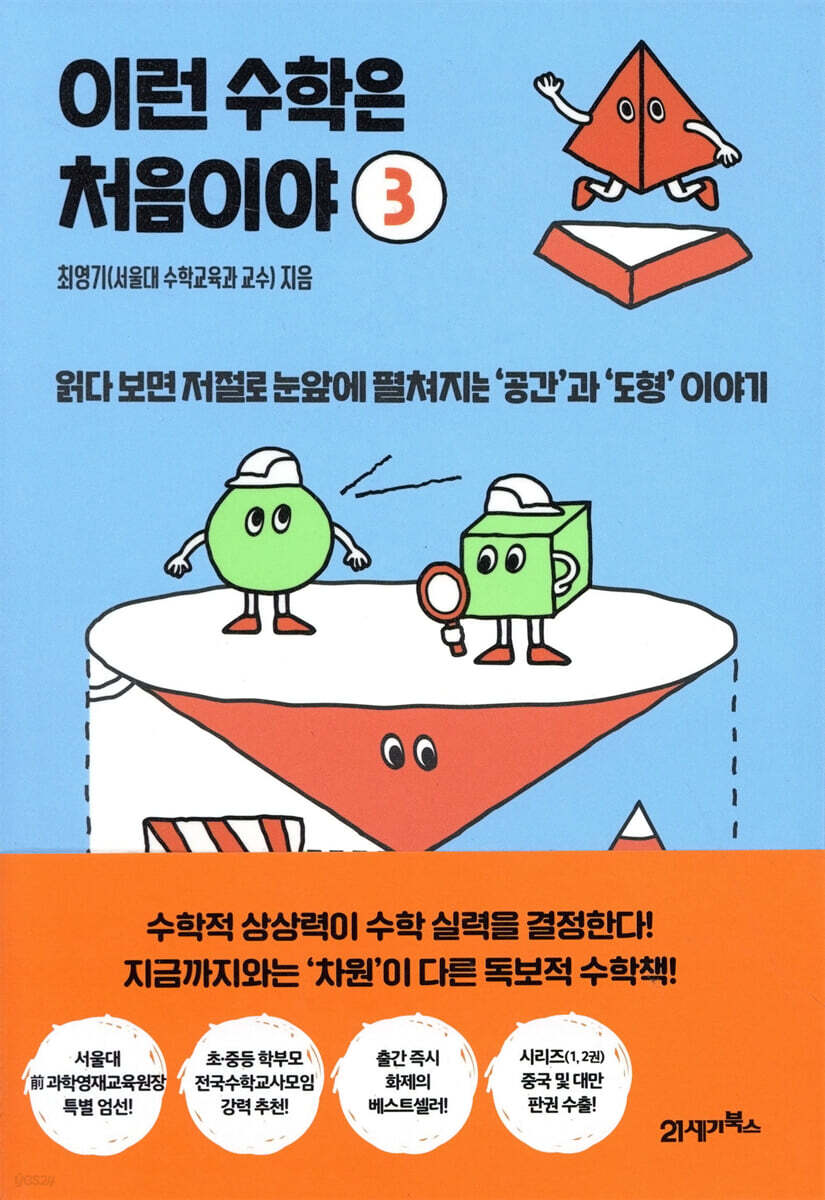
This is my first time doing math like this 3
 |
Description
Book Introduction
If you learn math like math, everything will be solved! The popular "This is my first time seeing math like this" series presented by a professor of mathematics education at Seoul National University! “How great would it be if math classes were this fun!” “I was so touched by the sincerity shown towards children!” The bestseller, which received endless praise from teachers and parents immediately after its publication and was exported to China and Taiwan with rave reviews, has returned with the third volume, “Solid Figures,” following the first volume, “Plane Figures,” and the second volume, “Numbers.” An exciting adventure of shapes that leave the plane and venture into space, the infinitely transforming 'polyhedrons' and 'horns' that show off their diverse charms, and even the mysterious story of the perfect 'sphere'. In this book, Professor Choi Young-gi of Seoul National University's Department of Mathematics Education unfolds a unique and original story unlike anything seen before, using powerful and explosive mathematical imagination to awaken children's latent mathematical talent. "Solid shapes" are a subject that many students drop out of because it's impossible to understand the structures and principles behind visible phenomena through mathematical formulas and memorization alone! Professor Choi Young-ki, who has spent his life researching and contemplating "real math education" for children, carefully selects essential math concepts based on the middle school curriculum and unravels solid shapes using the most mathematically accurate methods. Through this book, children will have an amazing experience of becoming interested in mathematics and discovering its true value. |
- You can preview some of the book's contents.
Preview
Detailed image
.jpg)
Into the book
Students who feel even a little bit of the true value of mathematics are given strong and proper motivation to study mathematics, which increases their creative problem-solving skills and improves their mathematical skills.
Ultimately, you will develop an attitude that allows you to transfer creative mathematical thinking to other fields, thereby positioning yourself in the direction that future society demands.
I hope that this book will not only help you improve your mathematical skills, but also cultivate a mathematical vision that can be applied to other fields.
I also hope that through this book, students will develop an interest in mathematics and that this interest will continue into the classroom.
--- p.6~7
Unlike a plane, space has a direction called 'up-down'.
Because there are so many directions, many wonderful things happen and there are many good things that a flat surface cannot have, but many people give up on understanding it because it is difficult.
I believe you guys won't do that.
We usually say that a straight line is one-dimensional, a plane is two-dimensional, and space is three-dimensional, right? The numbers 1, 2, and 3 used here refer to the number of directions.
The first dimension has a directionality along a straight line, right-left.
Two-dimensional is something that happens on a plane, with two directions: right-left, front-back.
3D refers to space with three directions: right-left, front-back, and up-down.
The world we see with our eyes is this three-dimensional space.
--- p.14~15
If a mother elephant has a baby elephant that's about a third the size of the mother elephant, how much larger is the baby elephant? Three times, perhaps? And if so, does the mother elephant eat three times as much as the baby elephant?
The elephant is a complex shape, so let's think of it as a three-dimensional figure. You can make three-dimensional figures look like it, after all.
How do you do it?
You can enlarge or reduce a solid figure by a certain ratio.
This will create shapes that are the same shape but different sizes.
At this time, the two solid figures are said to be in a similar relationship.
Also, two solid figures that are similar to each other are called similar figures.
When enlarging or reducing, a certain ratio must be maintained to make the shapes similar, so this ratio is called the similarity ratio.
--- p.77~78
Dew and soap bubbles do not have a film.
So when you look at it in sunlight, you can see rainbow colors because of this film.
This membrane is elastic, which allows it to pull on the water or air inside it while retaining it, ultimately resulting in the smallest possible surface area.
The water or air inside occupies a certain volume, and the shape with the smallest surface area among the three-dimensional shapes with the same volume is a sphere, so dew or soap bubbles take the shape of a sphere.
Should I say it's economical or efficient?
Should I do that?
If dew and soap bubbles could talk, this is what they would say.
“I don’t want to lose the water inside.
To avoid being stolen, we need to minimize the surface area that allows water to evaporate, so let's shape it like a ball."
How about it? Natural phenomena also utilize mathematical rationality in their own way, don't they?
Ultimately, you will develop an attitude that allows you to transfer creative mathematical thinking to other fields, thereby positioning yourself in the direction that future society demands.
I hope that this book will not only help you improve your mathematical skills, but also cultivate a mathematical vision that can be applied to other fields.
I also hope that through this book, students will develop an interest in mathematics and that this interest will continue into the classroom.
--- p.6~7
Unlike a plane, space has a direction called 'up-down'.
Because there are so many directions, many wonderful things happen and there are many good things that a flat surface cannot have, but many people give up on understanding it because it is difficult.
I believe you guys won't do that.
We usually say that a straight line is one-dimensional, a plane is two-dimensional, and space is three-dimensional, right? The numbers 1, 2, and 3 used here refer to the number of directions.
The first dimension has a directionality along a straight line, right-left.
Two-dimensional is something that happens on a plane, with two directions: right-left, front-back.
3D refers to space with three directions: right-left, front-back, and up-down.
The world we see with our eyes is this three-dimensional space.
--- p.14~15
If a mother elephant has a baby elephant that's about a third the size of the mother elephant, how much larger is the baby elephant? Three times, perhaps? And if so, does the mother elephant eat three times as much as the baby elephant?
The elephant is a complex shape, so let's think of it as a three-dimensional figure. You can make three-dimensional figures look like it, after all.
How do you do it?
You can enlarge or reduce a solid figure by a certain ratio.
This will create shapes that are the same shape but different sizes.
At this time, the two solid figures are said to be in a similar relationship.
Also, two solid figures that are similar to each other are called similar figures.
When enlarging or reducing, a certain ratio must be maintained to make the shapes similar, so this ratio is called the similarity ratio.
--- p.77~78
Dew and soap bubbles do not have a film.
So when you look at it in sunlight, you can see rainbow colors because of this film.
This membrane is elastic, which allows it to pull on the water or air inside it while retaining it, ultimately resulting in the smallest possible surface area.
The water or air inside occupies a certain volume, and the shape with the smallest surface area among the three-dimensional shapes with the same volume is a sphere, so dew or soap bubbles take the shape of a sphere.
Should I say it's economical or efficient?
Should I do that?
If dew and soap bubbles could talk, this is what they would say.
“I don’t want to lose the water inside.
To avoid being stolen, we need to minimize the surface area that allows water to evaporate, so let's shape it like a ball."
How about it? Natural phenomena also utilize mathematical rationality in their own way, don't they?
--- p.106~107
Publisher's Review
Mathematical imagination determines mathematical ability!
A magical math book that immerses you in space and shapes!
What made mathematics so profound? Thousands of years ago, in ancient Greece, the Platonic Solids, which successfully mapped the universe to mathematical forms, survived the eras of Kepler, Galileo, and Newton, and still shine today, appearing in our school mathematics textbooks as the mathematical concept of "regular polyhedron."
Professor Choi Young-ki, a professor of mathematics education at Seoul National University and former director of the Seoul National University Science Gifted Education Center, discovers the value of mathematics here.
The author finds the usefulness of mathematics in its theoretical usefulness, that is, in its pursuit of essence.
Beyond simply helping with real-life situations and problem-solving, mathematics can help us develop the ability to see the world more deeply.
This value has a meaning that will not change over time.
The author recommends that when studying mathematics, one should look at it from a different perspective, outside of one's experience or frame of mind.
This is why we need to learn three-dimensional figures.
Compared to the 'Plane Figures' in Volume 1 and 'Numbers' in Volume 2, the topic of three-dimensional figures covered in this book may seem relatively difficult.
Plane figures can be drawn directly on two-dimensional paper, so they can be explained visually, but three-dimensional figures have areas that cannot be seen, and this can only be imagined.
Even if you explain it by drawing an imaginary dotted line all the way to the back of the shape, the viewer will only be able to fully understand it if they can draw their own three-dimensional shape in their head.
So, although it is difficult, it is also a topic that you can sufficiently practice imagining in your head.
As you learn about three-dimensional shapes, your ability to naturally estimate and imagine invisible spaces and your ability to imagine logically will develop.
Of course, spatial perception is developed.
“If you can’t grasp solids, you can’t grasp math!”
From minimal solids to non-Euclidean geometry,
A world of infinite space and shapes!
This book consists of three lectures.
First, in the first lecture, we will learn about the definition and characteristics of polyhedrons, starting with the characteristics of three-dimensional space that are different from one- and two-dimensional space.
Three-dimensional figures created in space, such as tetrahedrons and hexahedrons, appear and explore the world of space by asking questions such as, “What kind of figure am I?” and “What are my unique characteristics that distinguish me from other figures?”
In the second lecture, the polyhedra become more curious about themselves.
“What is my true size?”, “Is it surface area? Is it volume?”, “How can I find these?” It poses rational questions and infers from the perspective of polyhedrons, drawing readers into the geometric world of polyhedrons.
After completing the second lecture, you will have a thorough understanding of the surface area and volume of polyhedrons.
The last three lectures cover spheres.
The book slowly unravels the differences between spheres and other solids, encouraging readers' imagination.
It may seem difficult because it requires a variety of complex abilities to properly understand three-dimensional shapes.
But if you want to study mathematics properly, you can't leave solids as difficult.
This book solves three-dimensional figures in a 'fun' yet 'mathematical' way through storytelling and characters, so as you follow the story, you will naturally open your eyes to mathematical thinking.
For example, when explaining the relationship between the volume of a cylinder and the volume of a cone, it is often explained by pouring water into a model.
However, this book explains the volume of a cone by encouraging us to “imagine that the base is cut off infinitely.”
Even though it is a somewhat difficult principle, you can visualize countless cutting shapes in your head.
This book kindly helps readers to imagine mathematically without giving up.
So, if you follow the story this book tells step by step, you will be able to see the mysterious and profound value of mathematics more clearly.
You will be able to fully experience the thrilling sense of accomplishment, the joy of knowledge, and even pleasure.
A magical math book that immerses you in space and shapes!
What made mathematics so profound? Thousands of years ago, in ancient Greece, the Platonic Solids, which successfully mapped the universe to mathematical forms, survived the eras of Kepler, Galileo, and Newton, and still shine today, appearing in our school mathematics textbooks as the mathematical concept of "regular polyhedron."
Professor Choi Young-ki, a professor of mathematics education at Seoul National University and former director of the Seoul National University Science Gifted Education Center, discovers the value of mathematics here.
The author finds the usefulness of mathematics in its theoretical usefulness, that is, in its pursuit of essence.
Beyond simply helping with real-life situations and problem-solving, mathematics can help us develop the ability to see the world more deeply.
This value has a meaning that will not change over time.
The author recommends that when studying mathematics, one should look at it from a different perspective, outside of one's experience or frame of mind.
This is why we need to learn three-dimensional figures.
Compared to the 'Plane Figures' in Volume 1 and 'Numbers' in Volume 2, the topic of three-dimensional figures covered in this book may seem relatively difficult.
Plane figures can be drawn directly on two-dimensional paper, so they can be explained visually, but three-dimensional figures have areas that cannot be seen, and this can only be imagined.
Even if you explain it by drawing an imaginary dotted line all the way to the back of the shape, the viewer will only be able to fully understand it if they can draw their own three-dimensional shape in their head.
So, although it is difficult, it is also a topic that you can sufficiently practice imagining in your head.
As you learn about three-dimensional shapes, your ability to naturally estimate and imagine invisible spaces and your ability to imagine logically will develop.
Of course, spatial perception is developed.
“If you can’t grasp solids, you can’t grasp math!”
From minimal solids to non-Euclidean geometry,
A world of infinite space and shapes!
This book consists of three lectures.
First, in the first lecture, we will learn about the definition and characteristics of polyhedrons, starting with the characteristics of three-dimensional space that are different from one- and two-dimensional space.
Three-dimensional figures created in space, such as tetrahedrons and hexahedrons, appear and explore the world of space by asking questions such as, “What kind of figure am I?” and “What are my unique characteristics that distinguish me from other figures?”
In the second lecture, the polyhedra become more curious about themselves.
“What is my true size?”, “Is it surface area? Is it volume?”, “How can I find these?” It poses rational questions and infers from the perspective of polyhedrons, drawing readers into the geometric world of polyhedrons.
After completing the second lecture, you will have a thorough understanding of the surface area and volume of polyhedrons.
The last three lectures cover spheres.
The book slowly unravels the differences between spheres and other solids, encouraging readers' imagination.
It may seem difficult because it requires a variety of complex abilities to properly understand three-dimensional shapes.
But if you want to study mathematics properly, you can't leave solids as difficult.
This book solves three-dimensional figures in a 'fun' yet 'mathematical' way through storytelling and characters, so as you follow the story, you will naturally open your eyes to mathematical thinking.
For example, when explaining the relationship between the volume of a cylinder and the volume of a cone, it is often explained by pouring water into a model.
However, this book explains the volume of a cone by encouraging us to “imagine that the base is cut off infinitely.”
Even though it is a somewhat difficult principle, you can visualize countless cutting shapes in your head.
This book kindly helps readers to imagine mathematically without giving up.
So, if you follow the story this book tells step by step, you will be able to see the mysterious and profound value of mathematics more clearly.
You will be able to fully experience the thrilling sense of accomplishment, the joy of knowledge, and even pleasure.
GOODS SPECIFICS
- Publication date: July 13, 2022
- Page count, weight, size: 160 pages | 290g | 135*197*13mm
- ISBN13: 9788950906184
- ISBN10: 895090618X
You may also like
카테고리
korean


korean

![GQ KOREA Mark (Monthly): December [2025]](http://librairie.coreenne.fr/cdn/shop/files/8ef265dbbfbf186523ed75ba7319009d.jpg?v=1765340328&width=3840)


