

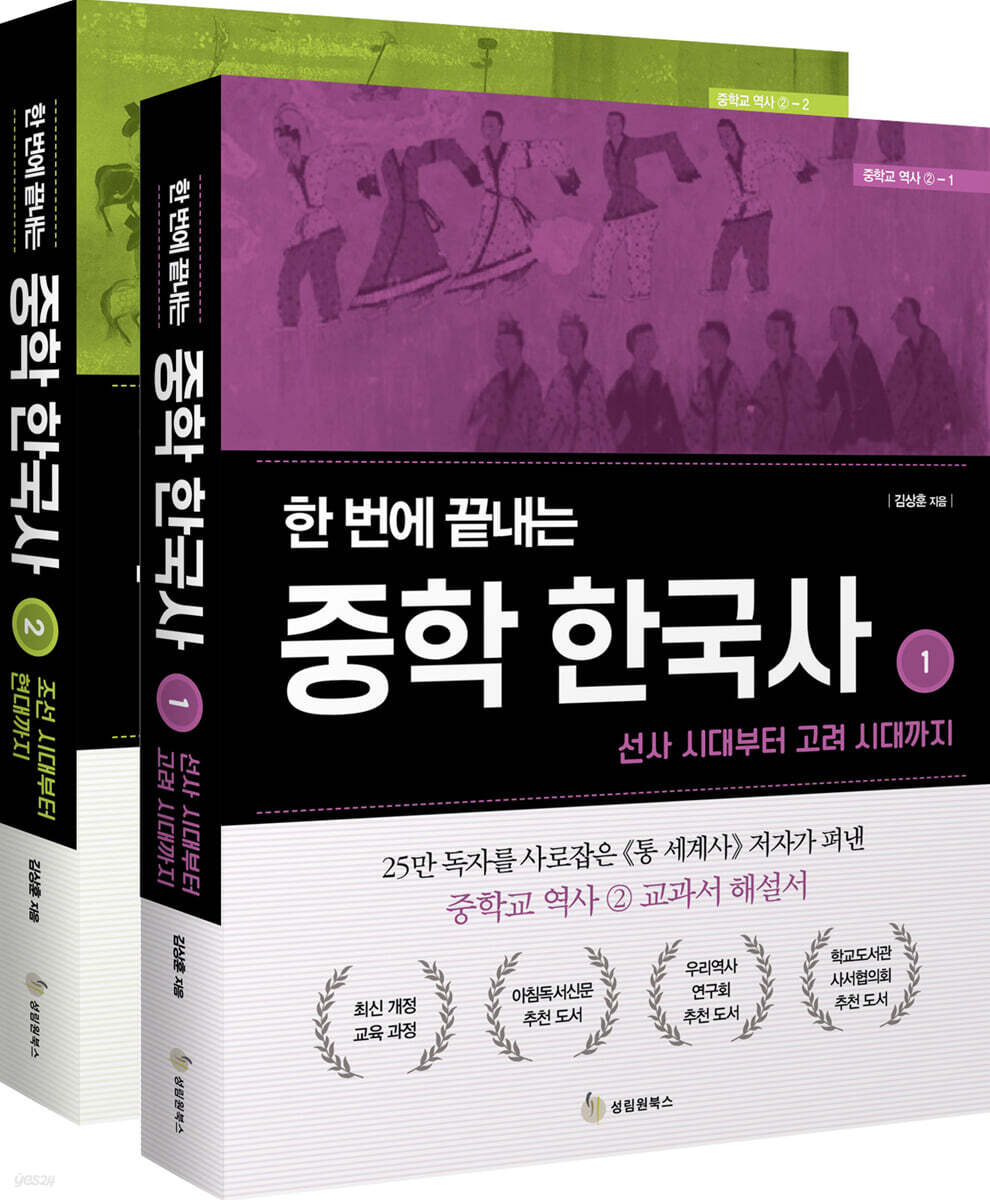
A set of Korean history books for middle school students that you can finish in one go
 |
Description
Book Introduction
Korean history, a required subject for the college entrance exam, must be completed by middle school students!
Middle School History ② The only textbook commentary that perfectly captures the curriculum
Why should we study history? First, it provides a perspective that allows us to diagnose the present and predict the future through past events.
History has a certain direction, and by examining past history, we can understand the meaning of events happening in the world today and gauge the direction of the future.
The second is to realize the identity of ‘me’ and ‘we’.
It makes me think about the meaning of my existence and our existence as an extension of development and change that lasts from hundreds to thousands of years, and as a starting point toward some point in the future.
Third, it helps us understand the hidden roots of the ever-changing international situation and relationships between countries.
By understanding the historical background behind the constant conflict and cooperation, we can develop a global perspective.
Although history is a wonderful subject that broadens one's perspective on the world and provides wisdom for life, it is often perceived as an incredibly difficult subject by middle and high school students.
In a word, disgusting! The portion of the exam that counts for it is small, yet the amount of material you have to study is enormous.
Moreover, the burden is bound to be even greater for Korean history, which is a required subject for the college entrance exam.
Even if you try to study a little bit before the entrance exam, you don't know where to start.
So, the national rule is that when it comes to Korean history, you should build a foundation in elementary school when you have relatively more time, and complete it in middle school.
But what if you didn't build a solid foundation in elementary school? "Middle School Korean History in One Go" is the answer.
Even if you lack prior knowledge, you can study Korean history easily and enjoyably.
Because it sufficiently explains the background of historical events that textbooks and reference books do not provide, you can understand the causal relationships of why those events occurred at that time.
It helps to gradually build up the flow of Korean history in your head.
This book will be the perfect guide for those who have given up on history and have been unable to find their way through the vast ocean of Korean history, as well as for intermediate learners who want to delve deeper into Korean history.
Middle School History ② The only textbook commentary that perfectly captures the curriculum
Why should we study history? First, it provides a perspective that allows us to diagnose the present and predict the future through past events.
History has a certain direction, and by examining past history, we can understand the meaning of events happening in the world today and gauge the direction of the future.
The second is to realize the identity of ‘me’ and ‘we’.
It makes me think about the meaning of my existence and our existence as an extension of development and change that lasts from hundreds to thousands of years, and as a starting point toward some point in the future.
Third, it helps us understand the hidden roots of the ever-changing international situation and relationships between countries.
By understanding the historical background behind the constant conflict and cooperation, we can develop a global perspective.
Although history is a wonderful subject that broadens one's perspective on the world and provides wisdom for life, it is often perceived as an incredibly difficult subject by middle and high school students.
In a word, disgusting! The portion of the exam that counts for it is small, yet the amount of material you have to study is enormous.
Moreover, the burden is bound to be even greater for Korean history, which is a required subject for the college entrance exam.
Even if you try to study a little bit before the entrance exam, you don't know where to start.
So, the national rule is that when it comes to Korean history, you should build a foundation in elementary school when you have relatively more time, and complete it in middle school.
But what if you didn't build a solid foundation in elementary school? "Middle School Korean History in One Go" is the answer.
Even if you lack prior knowledge, you can study Korean history easily and enjoyably.
Because it sufficiently explains the background of historical events that textbooks and reference books do not provide, you can understand the causal relationships of why those events occurred at that time.
It helps to gradually build up the flow of Korean history in your head.
This book will be the perfect guide for those who have given up on history and have been unable to find their way through the vast ocean of Korean history, as well as for intermediate learners who want to delve deeper into Korean history.
- You can preview some of the book's contents.
Preview
index
Volume 1
We'll help you solve your problems with history textbooks by starting this book.
I recommend this book, a middle school history guide that is more textbook-like than the textbook itself.
Ⅰ Prehistoric culture and the formation of ancient states
: Finding the roots of our people
1 Prehistoric Culture and Gojoseon
: Establish the first nation
Why were mammoth fossils discovered on the Korean Peninsula? _ The Paleolithic Age in Manchuria and the Korean Peninsula · | What does carbonized millet mean? _ The Neolithic Age in Manchuria and the Korean Peninsula | Why were huge dolmens built? _ The Bronze Age in Manchuria and the Korean Peninsula | Was Gojoseon founded in 2333 BC? _ The founding of Gojoseon | What country was Wiman from? _ The rise and fall of Gojoseon
Unit Summary Notes
1.
Paleolithic Manchuria and the Korean Peninsula | 2.
The appearance of Manchuria and the Korean Peninsula in the Neolithic Age | The appearance of Manchuria and the Korean Peninsula in the Bronze Age | Representative characteristics of the Bronze Age | 5.
The Founding and Fall of Gojoseon | 6.
Some facts revealed by Gojoseon relics | 7.
Our history book on Gojoseon | 8.
Historical Facts Revealed in the Dangun Myth | Gojoseon Society as Seen Through the Three Articles of the Eight Articles of Law
2.
Growth in many countries
: The Korean Peninsula Enters the Kingdom Era
What do you call a tomb made of two jars? _ Iron Age culture in Manchuria and the Korean Peninsula | What were the events of Jecheon and Dongmaeng? _ The growth of Buyeo and Goguryeo in Manchuria | Why can't criminals be arrested if they enter Sodo? _ The development of Okjeo, Dongye, and Samhan on the Korean Peninsula
Unit Summary Notes
1.
Changes in life after the spread of iron | 2.
Overview of Buyeo and Early Goguryeo | 3.
Okjeo, Dongye, and an overview of the Three Han
3.
The establishment and development of the Three Kingdoms
: Three countries fight for the world
Why did Goguryeo move its capital to Gungnae-seong? _ Goguryeo's system reorganization (1st-4th centuries) | Why are Baekje and Goguryeo tombs similar? _ Baekje's system reorganization and expansion (3rd-4th centuries) | What did they call the king in Silla? _ Silla's system reorganization | Were the nobles stronger, or the king? _ The political system of the Three Kingdoms and Silla's bone rank system | If Gaya existed, wouldn't the Four Kingdoms period be correct? _ The establishment of the Gaya confederacy and the fall of Buyeo | Did King Geunchogo really advance into Chinese territory? _ Baekje, the first to strike | Why did Later Yan in China fall? _ King Gwanggaeto's territorial expansion (5th century) | Why was King Jangsu's temple name Jangsu King? _ King Jangsu of Goguryeo's southward expansion policy (5th century) | Why did Baekje change its name to Nambuyeo? _ Baekje's revival efforts and second revival (5th-6th centuries) | Who was the king who made Ulleungdo and Dokdo our territory? _ Silla's system reorganization and expansion (6th century) | Why did Gaya and Buyeo fail to grow and fall? _ The rise and fall of later Gaya
Unit Summary Notes
1.
The process of strengthening royal authority and establishing a centralized system | 2.
Genealogy and major achievements of Goguryeo kings (1st century BC to late 5th century) | 3.
Genealogy and Major Achievements of Baekje Kings (1st Century BC to Mid-5th Century) | 4.
Genealogy and Major Achievements of the Kings of Silla (1st Century BC to Mid-5th Century AD)
4.
Culture and foreign exchange of the Three Kingdoms
: Diverse cultures develop
What is the difference between kimchi from the Three Kingdoms period and today's kimchi? _ Food, clothing, and shelter culture of the Three Kingdoms period | Why do pagoda names end with '~ji'? _ The development of Buddhist art in the Three Kingdoms | Why were history books compiled in the Three Kingdoms period? _ The development of Confucianism and Taoism and art in the Three Kingdoms period | Why is the study of ancient tombs important? _ Characteristics and changes in ancient tombs of the Three Kingdoms | Why do people from the Western Regions appear in wrestling? _ Overseas exchanges and expansion into Japan by the Three Kingdoms
Unit Summary Notes
1.
The period of the founding of the Three Kingdoms, recognition of Buddhism, and promulgation of the Code of Edicts | 2.
Rules for naming Buddhist statues and pagodas | 3.
The Role of Buddhism, Confucianism, and Taoism | 4.
Changes in the form of tombs of the Three Kingdoms and Gaya | 5.
The foreign relations of the three countries as revealed through relics and ruins
Ⅱ Development of the North-South States Period
: Two countries grow in the North and South
5.
Silla's unification of the three kingdoms and the founding of Balhae
: Laying the foundation for the development of national culture
Why did the Sui Dynasty fall in China? _ The Sui invasion and the Battle of Salsu | What is the significance of the victory in the Battle of Ansi Fortress? _ The Tang invasion and the Battle of Ansi Fortress | Why did Japanese ships appear in the Geumgang River after the fall of Baekje? _ The fall of Baekje and the revival movement | Why could the Tang Dynasty not easily conquer Goguryeo? _ The fall of Goguryeo and the revival movement | What was the name of the country established in Iksan by Goguryeo refugees? _ The significance and limitations of the unification of the Three Kingdoms | Why did Balhae use its own era name? _ The founding of Balhae
Unit Summary Notes
1.
The alliance between the three countries according to the situation on the Korean Peninsula | 2.
Two perspectives on Silla's unification of the three kingdoms | 3.
The process of Balhae's founding | 4.
Facts that prove that Balhae was our nation's nation.
6.
Development and change in North and South Korea
: Silla and Balhae, making their names known
Why did the Hwabaek Council weaken? _ Strengthening of royal authority and reorganization of the system in Unified Silla | Why did Balhae end its confrontation with Tang? _ Reorganization and growth of Balhae's political system | The average reign of a king was 7 years and 6 months _ The power struggles of nobles and peasant uprisings | Who became a powerful clan? _ The emergence of powerful clans and the popularity of Seon Buddhism | Why did Gung Ye become a tyrant? _ The establishment of the Later Three Kingdoms | Did the spirit of Balhae completely disappear? _ The fall of Balhae
Unit Summary Notes
1.
Genealogy of the Kings of the Late Silla and Unified Silla | 2.
The Newspaper King's Reforms | 3.
Genealogy of the Kings of Balhae
7.
Culture and foreign relations between North and South Korea
: Buddhism, Blossoming Brightly
What is the Amitabha faith? _ The development of Buddhist thought in Unified Silla | What science is hidden in Seokguram Grotto? _ The development of Buddhist architecture and art | Why were Idu made? _ The development of Confucianism in Unified Silla | In what style were Balhae roof tiles and Buddhist statues made? _ The culture of Balhae | How far did active trade extend? _ Unified Silla's foreign exchanges | What was the original purpose of Balhae's exchanges with Japan? _ Balhae's foreign exchanges
Unit Summary Notes
1.
Characteristics of Unified Silla Culture | 2.
Characteristics of Balhae culture | 3.
Unified Silla's Foreign Exchanges | 4.
Balhae's foreign exchanges
Ⅲ The Establishment and Transformation of Goryeo
: Raising the reputation of 'Korea'
8.
The founding of Goryeo and political changes
: Creating a new foundation for national culture
How did the game of Chajeon Nori begin? _ Goryeo's unification of the Later Three Kingdoms | Why did Wang Geon have 29 wives? _ Taejo's unification policy promotion | Why did the nobles oppose the civil service examination system? _ Gwangjong's policy of strengthening royal authority | Why was land given to people of good character? _ Reform of the land system and implementation of Jeonsigwa | Why was Confucianism promoted in a Buddhist country? _ System reorganization in the early Goryeo period | Myocheong and Kim Bu-sik, who is right? _ Lee Ja-gyeom's Rebellion and Myocheong's Rebellion | Is the pen stronger or the sword? _ Military coup and establishment of a military regime | Why was the Jungseomunhasung weakened? _ Establishment of the Choi regime | What was the purpose of the Manjeok uprising? _ Uprising of peasants and commoners
Unit Summary Notes
1.
Background of the start of the Later Three Kingdoms period | 2.
Comparison of the policies of King Taejo of Goryeo and King Gwangjong | 3.
Changes in the Goryeo land system | 4.
Goryeo's ruling system
9.
Goryeo's foreign relations
: Spreading the word about Korea
What land did Seohee obtain through diplomatic negotiations? _ The Khitan invasion and repulsion | Why did Yun Gwan organize the Byeolmuban? _ The rise of the Jurchen and the construction of nine northeastern fortresses | Making Korea known to the world _ Active foreign exchanges in the early Goryeo period
Unit Summary Notes
The situation between the Goryeo kings and China from the founding of the nation to the military coup
10.
Mongol intervention and Goryeo reforms
: Goryeo, proudly regaining independence
Why was the victory in the Battle of Cheoinseong significant? _ The Mongol invasion and the development of the resistance against the Mongols | What do the Mongol style and Goryeo style mean? _ The Yuan's interference in internal affairs and the growth of powerful families | Why was the Jeonmin Byeonjeongdogam created? _ King Gongmin's independent reforms and their results | Who will fall when the new literati gain power? _ The emergence of the new literati at the end of Goryeo | Why did Yi Seong-gye oppose the conquest of Liaodong? _ The fall of Goryeo and the establishment of Joseon
Unit Summary Notes
1.
Mongol invasion and Goryeo's resistance | 2.
Changes in the ruling power of Goryeo | 3.
Genealogy of the Goryeo Kings after the Military Coup | 4.
A state established by a nomadic Chinese people during the Goryeo period
11.
Life and culture of Goryeo
: Boasting a mature culture without gender discrimination
Why was Park Yu-ga criticized by people? _ Goryeo's family system and customs | Why were Buddhist statues from the early Goryeo period so large? _ The development of Buddhist art in the Goryeo Dynasty | What was the most famous private school in the Goryeo Dynasty? _ The development of Buddhist thought, Confucianism, and Taoism | What is the oldest metal movable type printed book in the world? _ The development of printing technology and the compilation of history books | What is the secret of Goryeo celadon that astonishes the world? _ Goryeo celadon and Goryeo crafts
Unit Summary Notes
1.
Goryeo's family system | 2.
The changing consciousness of the Goryeo people and the era depicted in Buddhist statues | 3.
Goryeo's printing technology
Volume 2
We'll help you solve your problems with history textbooks by starting this book.
I recommend this book, a middle school history guide that is more textbook-like than the textbook itself.
Ⅳ The Establishment and Development of Joseon
: Our national culture is in full bloom
12.
Government system and foreign relations
: Joseon, laying the foundation for the nation
Why did Joseon choose Hanyang as its capital? _ The founding of Joseon and the relocation of the capital to Hanyang | Why did Taejong implement the Hopae Law? _ Establishing the foundation of Joseon's state | Why did the king debate with his subjects? _ Reorganization of the ruling system: central and local organizations | Were peasants also able to take the civil service examination? _ Military organization, tax system, and official selection system | Did women also inherit their parents' property? _ Joseon society as depicted in the Gyeongguk Daejeon | Why did Sejong open Sampo to the Japanese? _ Joseon's foreign policy and foreign exchanges
Unit Summary Notes
1.
Genealogy of the Joseon Dynasty (Taejo - Seongjong) | 2.
Central government organization in the early Joseon Dynasty | 3.
Administrative districts of the early Joseon Dynasty | 4.
Joseon Dynasty's Official Selection System | 5.
Joseon's class system and reality as depicted in the Gyeongguk Daejeon
13.
Sarim power and political change
: All people must follow the order of Seongrihak.
Why did King Seongjong select Sarim? _ The emergence of Sarim | Why are there no Annals of King Yeonsangun? _ The conflict between Hungu and Sarim and the four major purges | Why are women and men not equal in Seongrihak? _ The spread of Seongrihak order through Seowon and Hyangyak | How did Sarim split into Dongin and Seoin? _ Sarim's rise to power and the beginning of factional politics
Unit Summary Notes
1.
Background and content of the four major purges | 2.
The change in power among Joseon Confucian scholars
14.
Cultural development and social change
: Create the most original language
Why did King Sejong entrust the regency to the crown prince? _ Creation of Hunminjeongeum | Why did he discard the Sacho after creating the Annals? _ Compilation of various books | Why did King Sejong order the creation of Chiljeongsan? _ Scientific development in the early Joseon Dynasty | Why is the Sejong era called the Joseon Renaissance _ Development of the yangban culture in the early Joseon Dynasty
Unit Summary Notes
King Sejong, the 'Great King' recognized worldwide
15.
The outbreak and impact of the Manchu invasion
: How did we overcome the war?
Why did Japan demand the Jeongmyeong Road? _ The outbreak and development of the Imjin War | Why did Japan start the Jeongyu War? _ Joseon's counterattack and the end of the war | Why did King Gwanghae implement the Daedong Law? _ The impact of the Imjin War and changes in Joseon | Why did King Gwanghae pursue 'neutral diplomacy'? _ The outbreak of the Byeongja War | What battle did Joseon's musket unit win against Russia? _ The promotion and results of the Northern Expedition
Unit Summary Notes
1.
Causes and consequences of the Imjin War | 2.
Causes and consequences of the outbreak of the Byeongja Horan | 3.
Genealogy of the Joseon Dynasty (Yeonsangun - Hyojong)
V. Changes in Joseon society
: The winds of change blow in Joseon
16.
Political changes in the late Joseon Dynasty
: The country will survive only if reform succeeds.
Why was the Ministry of War unable to oversee national defense affairs? _ Reorganization of the tax system and ruling system | Why is the period of mourning important? _ The deterioration of rites and factional politics | Why did King Sukjong frequently change the ruling faction? _ King Sukjong's return to the country | Why did King Yeongjo issue a prohibition order? _ King Yeongjo's Tangpyeong reform | Why was Hwaseong Fortress built in Suwon? _ King Jeongjo's political reform | Why did a woodcutter from Ganghwa Island become king? _ The establishment and development of the politics of the powerful
Unit Summary Notes
1.
Changes in the tax system in the late Joseon Dynasty | 2.
Military organization in the late Joseon Dynasty | 3.
Political factions and the return of the country in the late Joseon Dynasty | 4.
Genealogy of the Joseon Dynasty (Hyeonjong to Cheoljong)
17.
Social change and peasant uprisings
: Why did the peasant uprising occur in the late Joseon Dynasty?
Why did the yangban class hoard Sangpyeong Tongbo? _ The development of a commodity currency economy | Why did the government sell Gongmyeongcheop? _ The fall of the yangban class and the unrest of the caste system | Why did Choi Je-woo found Donghak? _ The corruption of the three governments and the spread of Catholicism and Donghak | Why did all peasant rebellions fail? _ Hong Gyeong-rae's Rebellion and the Imjin Peasant Uprising
Unit Summary Notes
1.
The appearance of late Joseon society | 2.
The Harmful Effects of Sedo Politics and Peasant Uprisings
18.
New directions in scholarship and art
: The late Joseon Dynasty, pursuing an independent culture
Why did Japan request Joseon to send a delegation? _ Dispatch of diplomatic envoys and envoys | What was the secret to significantly shortening the construction period of Hwaseong? _ The spread of Western learning and the development of science | Why did the Silhak reform fail? _ The development and limitations of Silhak | Why was Balhae not studied in the early Joseon Dynasty? _ The development of national studies and the compilation of an encyclopedia | Why did Heo Saeng throw away all the money he earned? _ Literature and art in the late Joseon Dynasty
Unit Summary Notes
1.
Changes in perception due to maps and new civilizations | 2.
What is Silhak?
19.
New aspects of life and culture
: Common people's culture blossoms
Why did the eldest son inherit most of the property? _ Changes in family systems and customs | Why do tigers appear so often in folk paintings? _ The development of common culture
Unit Summary Notes
1.
Family system and social appearance in the late Joseon Dynasty | 2.
Common people's culture in the late Joseon Dynasty
Ⅵ Development of modern and contemporary society
: For future glory
20.
Establishment of a nation-state
: The Republic of Korea is a democratic republic.
Why was the Ganghwa Island Treaty an unequal treaty? _ The reign of Heungseon Daewongun and the Ganghwa Island Treaty | Why did the old-fashioned soldiers rebel? _ The promotion of the enlightenment policy and the Imo Incident | Why did the Gapsin Coup not receive the support of the peasants? _ The division of the enlightenment faction and the Gapsin Coup | What was the name of the organization that realized peasant autonomy? _ The Donghak Peasant Revolution and the Sino-Japanese War | When was the class discrimination between the yangban and the cheonmin abolished? _ The promotion and significance of the Gabo Reform and the Eulmi Reform | Why was the Independence Gate built on the site of the Yeongeun Gate? _ The birth of the Korean Empire and the activities of the Independence Association | Why was the Korea-Japan Annexation Treaty invalid? _ The crisis of the Korean Empire and the forced annexation of Korea by Japan | Why did the anti-Japanese volunteer army move to Manchuria? _ Anti-Japanese armed struggle and patriotic enlightenment movement | Why is Dokdo Day on October 25th? _ Japan's claim to Dokdo and distortion of history | Why did the Japanese Empire deprive Koreans of educational opportunities? _ Military rule and the March 1st Movement | Why was the provisional government in Shanghai? _ Establishment of the provisional government of the Republic of Korea | What slogans did the Gwangju students chant? _ Domestic nationalist movements in the 1920s | Why did Japan commit the Gando Massacre? _ Armed independence struggles abroad in the 1920s | Why is the word "elementary school" a remnant of Japanese colonial rule? _ Domestic and international nationalist movements in the 1930s and 1940s | Why did the Korean Liberation Army plan a domestic invasion operation? _ Efforts for liberation and establishment of a government | Why were general elections held only in South Korea? _ Establishment of the government of the Republic of Korea
Unit Summary Notes
1.
The process of Joseon's opening of ports | 2.
Major events from Gojong's accession to the throne to the loss of national sovereignty | 3.
The significance of the March 1st Movement | 4.
Our people's anti-Japanese resistance movement | 5.
World War II and Korea's Liberation | 6.
Major events from liberation to the establishment of the Republic of Korea government
21.
Capitalism and Social Change
: A country where economic growth and cultural development coexist
Why did men quit drinking and smoking in the 1900s? _ Foreign economic invasion and economic national salvation movements after the opening of ports | Why did Korean farmers decline even though rice production increased? _ Economic exploitation during the Japanese colonial period | Why did Amtaedo farmers refuse to harvest? _ Economic struggles and various social movements during the Japanese colonial period | What does the term 'Miracle on the Han River' mean? _ Economic development plans and the growth of the Korean economy | Why did Jeon Tae-il burn himself with a law book? _ Social problems resulting from economic growth | Why was the song "Morning Dew" banned? _ The development of popular culture
Unit Summary Notes
1.
Modern landscape during the Japanese colonial period | 2.
Our people's movement against economic exploitation by Japan and Western powers | 3.
Our country's economic development process
22.
The development of democracy
: Towards a mature democratic nation!
Why was the Special Committee on Anti-National Activities Failed to Perform Its Function? _ The Dictatorship of the Syngman Rhee Government | Why Was the Constitution Amended to a Cabinet Responsibility System After the April 19 Revolution? _ The April 19 Revolution and the May 16 Military Coup | Why Were Korean Troops Deployed to the Vietnam War? _ The Dictatorship of the Park Chung-hee Government and the People's Resistance | Why is 1980 Called the Spring of Seoul? _ The New Military Government and the May 18 Democratization Movement | Why Did the People Want a Constitutional Amendment to a Direct Election System? _ The Establishment of the Chun Doo-hwan Government and the June Democracy Movement | Why Was the Real-Name Financial Transaction System Implemented? _ The Development of Democracy Since the 1990s
Unit Summary Notes
Former Presidents of the Republic of Korea
23.
Efforts for peaceful unification
: Unification is our mission.
Why didn't the Syngman Rhee government sign the armistice agreement? _ The division of North and South Korea and the outbreak of the Korean War | What are the three unification principles of the July 4th North-South Joint Statement? _ Inter-Korean exchanges and efforts toward unification
Unit Summary Notes
Efforts for unification
We'll help you solve your problems with history textbooks by starting this book.
I recommend this book, a middle school history guide that is more textbook-like than the textbook itself.
Ⅰ Prehistoric culture and the formation of ancient states
: Finding the roots of our people
1 Prehistoric Culture and Gojoseon
: Establish the first nation
Why were mammoth fossils discovered on the Korean Peninsula? _ The Paleolithic Age in Manchuria and the Korean Peninsula · | What does carbonized millet mean? _ The Neolithic Age in Manchuria and the Korean Peninsula | Why were huge dolmens built? _ The Bronze Age in Manchuria and the Korean Peninsula | Was Gojoseon founded in 2333 BC? _ The founding of Gojoseon | What country was Wiman from? _ The rise and fall of Gojoseon
Unit Summary Notes
1.
Paleolithic Manchuria and the Korean Peninsula | 2.
The appearance of Manchuria and the Korean Peninsula in the Neolithic Age | The appearance of Manchuria and the Korean Peninsula in the Bronze Age | Representative characteristics of the Bronze Age | 5.
The Founding and Fall of Gojoseon | 6.
Some facts revealed by Gojoseon relics | 7.
Our history book on Gojoseon | 8.
Historical Facts Revealed in the Dangun Myth | Gojoseon Society as Seen Through the Three Articles of the Eight Articles of Law
2.
Growth in many countries
: The Korean Peninsula Enters the Kingdom Era
What do you call a tomb made of two jars? _ Iron Age culture in Manchuria and the Korean Peninsula | What were the events of Jecheon and Dongmaeng? _ The growth of Buyeo and Goguryeo in Manchuria | Why can't criminals be arrested if they enter Sodo? _ The development of Okjeo, Dongye, and Samhan on the Korean Peninsula
Unit Summary Notes
1.
Changes in life after the spread of iron | 2.
Overview of Buyeo and Early Goguryeo | 3.
Okjeo, Dongye, and an overview of the Three Han
3.
The establishment and development of the Three Kingdoms
: Three countries fight for the world
Why did Goguryeo move its capital to Gungnae-seong? _ Goguryeo's system reorganization (1st-4th centuries) | Why are Baekje and Goguryeo tombs similar? _ Baekje's system reorganization and expansion (3rd-4th centuries) | What did they call the king in Silla? _ Silla's system reorganization | Were the nobles stronger, or the king? _ The political system of the Three Kingdoms and Silla's bone rank system | If Gaya existed, wouldn't the Four Kingdoms period be correct? _ The establishment of the Gaya confederacy and the fall of Buyeo | Did King Geunchogo really advance into Chinese territory? _ Baekje, the first to strike | Why did Later Yan in China fall? _ King Gwanggaeto's territorial expansion (5th century) | Why was King Jangsu's temple name Jangsu King? _ King Jangsu of Goguryeo's southward expansion policy (5th century) | Why did Baekje change its name to Nambuyeo? _ Baekje's revival efforts and second revival (5th-6th centuries) | Who was the king who made Ulleungdo and Dokdo our territory? _ Silla's system reorganization and expansion (6th century) | Why did Gaya and Buyeo fail to grow and fall? _ The rise and fall of later Gaya
Unit Summary Notes
1.
The process of strengthening royal authority and establishing a centralized system | 2.
Genealogy and major achievements of Goguryeo kings (1st century BC to late 5th century) | 3.
Genealogy and Major Achievements of Baekje Kings (1st Century BC to Mid-5th Century) | 4.
Genealogy and Major Achievements of the Kings of Silla (1st Century BC to Mid-5th Century AD)
4.
Culture and foreign exchange of the Three Kingdoms
: Diverse cultures develop
What is the difference between kimchi from the Three Kingdoms period and today's kimchi? _ Food, clothing, and shelter culture of the Three Kingdoms period | Why do pagoda names end with '~ji'? _ The development of Buddhist art in the Three Kingdoms | Why were history books compiled in the Three Kingdoms period? _ The development of Confucianism and Taoism and art in the Three Kingdoms period | Why is the study of ancient tombs important? _ Characteristics and changes in ancient tombs of the Three Kingdoms | Why do people from the Western Regions appear in wrestling? _ Overseas exchanges and expansion into Japan by the Three Kingdoms
Unit Summary Notes
1.
The period of the founding of the Three Kingdoms, recognition of Buddhism, and promulgation of the Code of Edicts | 2.
Rules for naming Buddhist statues and pagodas | 3.
The Role of Buddhism, Confucianism, and Taoism | 4.
Changes in the form of tombs of the Three Kingdoms and Gaya | 5.
The foreign relations of the three countries as revealed through relics and ruins
Ⅱ Development of the North-South States Period
: Two countries grow in the North and South
5.
Silla's unification of the three kingdoms and the founding of Balhae
: Laying the foundation for the development of national culture
Why did the Sui Dynasty fall in China? _ The Sui invasion and the Battle of Salsu | What is the significance of the victory in the Battle of Ansi Fortress? _ The Tang invasion and the Battle of Ansi Fortress | Why did Japanese ships appear in the Geumgang River after the fall of Baekje? _ The fall of Baekje and the revival movement | Why could the Tang Dynasty not easily conquer Goguryeo? _ The fall of Goguryeo and the revival movement | What was the name of the country established in Iksan by Goguryeo refugees? _ The significance and limitations of the unification of the Three Kingdoms | Why did Balhae use its own era name? _ The founding of Balhae
Unit Summary Notes
1.
The alliance between the three countries according to the situation on the Korean Peninsula | 2.
Two perspectives on Silla's unification of the three kingdoms | 3.
The process of Balhae's founding | 4.
Facts that prove that Balhae was our nation's nation.
6.
Development and change in North and South Korea
: Silla and Balhae, making their names known
Why did the Hwabaek Council weaken? _ Strengthening of royal authority and reorganization of the system in Unified Silla | Why did Balhae end its confrontation with Tang? _ Reorganization and growth of Balhae's political system | The average reign of a king was 7 years and 6 months _ The power struggles of nobles and peasant uprisings | Who became a powerful clan? _ The emergence of powerful clans and the popularity of Seon Buddhism | Why did Gung Ye become a tyrant? _ The establishment of the Later Three Kingdoms | Did the spirit of Balhae completely disappear? _ The fall of Balhae
Unit Summary Notes
1.
Genealogy of the Kings of the Late Silla and Unified Silla | 2.
The Newspaper King's Reforms | 3.
Genealogy of the Kings of Balhae
7.
Culture and foreign relations between North and South Korea
: Buddhism, Blossoming Brightly
What is the Amitabha faith? _ The development of Buddhist thought in Unified Silla | What science is hidden in Seokguram Grotto? _ The development of Buddhist architecture and art | Why were Idu made? _ The development of Confucianism in Unified Silla | In what style were Balhae roof tiles and Buddhist statues made? _ The culture of Balhae | How far did active trade extend? _ Unified Silla's foreign exchanges | What was the original purpose of Balhae's exchanges with Japan? _ Balhae's foreign exchanges
Unit Summary Notes
1.
Characteristics of Unified Silla Culture | 2.
Characteristics of Balhae culture | 3.
Unified Silla's Foreign Exchanges | 4.
Balhae's foreign exchanges
Ⅲ The Establishment and Transformation of Goryeo
: Raising the reputation of 'Korea'
8.
The founding of Goryeo and political changes
: Creating a new foundation for national culture
How did the game of Chajeon Nori begin? _ Goryeo's unification of the Later Three Kingdoms | Why did Wang Geon have 29 wives? _ Taejo's unification policy promotion | Why did the nobles oppose the civil service examination system? _ Gwangjong's policy of strengthening royal authority | Why was land given to people of good character? _ Reform of the land system and implementation of Jeonsigwa | Why was Confucianism promoted in a Buddhist country? _ System reorganization in the early Goryeo period | Myocheong and Kim Bu-sik, who is right? _ Lee Ja-gyeom's Rebellion and Myocheong's Rebellion | Is the pen stronger or the sword? _ Military coup and establishment of a military regime | Why was the Jungseomunhasung weakened? _ Establishment of the Choi regime | What was the purpose of the Manjeok uprising? _ Uprising of peasants and commoners
Unit Summary Notes
1.
Background of the start of the Later Three Kingdoms period | 2.
Comparison of the policies of King Taejo of Goryeo and King Gwangjong | 3.
Changes in the Goryeo land system | 4.
Goryeo's ruling system
9.
Goryeo's foreign relations
: Spreading the word about Korea
What land did Seohee obtain through diplomatic negotiations? _ The Khitan invasion and repulsion | Why did Yun Gwan organize the Byeolmuban? _ The rise of the Jurchen and the construction of nine northeastern fortresses | Making Korea known to the world _ Active foreign exchanges in the early Goryeo period
Unit Summary Notes
The situation between the Goryeo kings and China from the founding of the nation to the military coup
10.
Mongol intervention and Goryeo reforms
: Goryeo, proudly regaining independence
Why was the victory in the Battle of Cheoinseong significant? _ The Mongol invasion and the development of the resistance against the Mongols | What do the Mongol style and Goryeo style mean? _ The Yuan's interference in internal affairs and the growth of powerful families | Why was the Jeonmin Byeonjeongdogam created? _ King Gongmin's independent reforms and their results | Who will fall when the new literati gain power? _ The emergence of the new literati at the end of Goryeo | Why did Yi Seong-gye oppose the conquest of Liaodong? _ The fall of Goryeo and the establishment of Joseon
Unit Summary Notes
1.
Mongol invasion and Goryeo's resistance | 2.
Changes in the ruling power of Goryeo | 3.
Genealogy of the Goryeo Kings after the Military Coup | 4.
A state established by a nomadic Chinese people during the Goryeo period
11.
Life and culture of Goryeo
: Boasting a mature culture without gender discrimination
Why was Park Yu-ga criticized by people? _ Goryeo's family system and customs | Why were Buddhist statues from the early Goryeo period so large? _ The development of Buddhist art in the Goryeo Dynasty | What was the most famous private school in the Goryeo Dynasty? _ The development of Buddhist thought, Confucianism, and Taoism | What is the oldest metal movable type printed book in the world? _ The development of printing technology and the compilation of history books | What is the secret of Goryeo celadon that astonishes the world? _ Goryeo celadon and Goryeo crafts
Unit Summary Notes
1.
Goryeo's family system | 2.
The changing consciousness of the Goryeo people and the era depicted in Buddhist statues | 3.
Goryeo's printing technology
Volume 2
We'll help you solve your problems with history textbooks by starting this book.
I recommend this book, a middle school history guide that is more textbook-like than the textbook itself.
Ⅳ The Establishment and Development of Joseon
: Our national culture is in full bloom
12.
Government system and foreign relations
: Joseon, laying the foundation for the nation
Why did Joseon choose Hanyang as its capital? _ The founding of Joseon and the relocation of the capital to Hanyang | Why did Taejong implement the Hopae Law? _ Establishing the foundation of Joseon's state | Why did the king debate with his subjects? _ Reorganization of the ruling system: central and local organizations | Were peasants also able to take the civil service examination? _ Military organization, tax system, and official selection system | Did women also inherit their parents' property? _ Joseon society as depicted in the Gyeongguk Daejeon | Why did Sejong open Sampo to the Japanese? _ Joseon's foreign policy and foreign exchanges
Unit Summary Notes
1.
Genealogy of the Joseon Dynasty (Taejo - Seongjong) | 2.
Central government organization in the early Joseon Dynasty | 3.
Administrative districts of the early Joseon Dynasty | 4.
Joseon Dynasty's Official Selection System | 5.
Joseon's class system and reality as depicted in the Gyeongguk Daejeon
13.
Sarim power and political change
: All people must follow the order of Seongrihak.
Why did King Seongjong select Sarim? _ The emergence of Sarim | Why are there no Annals of King Yeonsangun? _ The conflict between Hungu and Sarim and the four major purges | Why are women and men not equal in Seongrihak? _ The spread of Seongrihak order through Seowon and Hyangyak | How did Sarim split into Dongin and Seoin? _ Sarim's rise to power and the beginning of factional politics
Unit Summary Notes
1.
Background and content of the four major purges | 2.
The change in power among Joseon Confucian scholars
14.
Cultural development and social change
: Create the most original language
Why did King Sejong entrust the regency to the crown prince? _ Creation of Hunminjeongeum | Why did he discard the Sacho after creating the Annals? _ Compilation of various books | Why did King Sejong order the creation of Chiljeongsan? _ Scientific development in the early Joseon Dynasty | Why is the Sejong era called the Joseon Renaissance _ Development of the yangban culture in the early Joseon Dynasty
Unit Summary Notes
King Sejong, the 'Great King' recognized worldwide
15.
The outbreak and impact of the Manchu invasion
: How did we overcome the war?
Why did Japan demand the Jeongmyeong Road? _ The outbreak and development of the Imjin War | Why did Japan start the Jeongyu War? _ Joseon's counterattack and the end of the war | Why did King Gwanghae implement the Daedong Law? _ The impact of the Imjin War and changes in Joseon | Why did King Gwanghae pursue 'neutral diplomacy'? _ The outbreak of the Byeongja War | What battle did Joseon's musket unit win against Russia? _ The promotion and results of the Northern Expedition
Unit Summary Notes
1.
Causes and consequences of the Imjin War | 2.
Causes and consequences of the outbreak of the Byeongja Horan | 3.
Genealogy of the Joseon Dynasty (Yeonsangun - Hyojong)
V. Changes in Joseon society
: The winds of change blow in Joseon
16.
Political changes in the late Joseon Dynasty
: The country will survive only if reform succeeds.
Why was the Ministry of War unable to oversee national defense affairs? _ Reorganization of the tax system and ruling system | Why is the period of mourning important? _ The deterioration of rites and factional politics | Why did King Sukjong frequently change the ruling faction? _ King Sukjong's return to the country | Why did King Yeongjo issue a prohibition order? _ King Yeongjo's Tangpyeong reform | Why was Hwaseong Fortress built in Suwon? _ King Jeongjo's political reform | Why did a woodcutter from Ganghwa Island become king? _ The establishment and development of the politics of the powerful
Unit Summary Notes
1.
Changes in the tax system in the late Joseon Dynasty | 2.
Military organization in the late Joseon Dynasty | 3.
Political factions and the return of the country in the late Joseon Dynasty | 4.
Genealogy of the Joseon Dynasty (Hyeonjong to Cheoljong)
17.
Social change and peasant uprisings
: Why did the peasant uprising occur in the late Joseon Dynasty?
Why did the yangban class hoard Sangpyeong Tongbo? _ The development of a commodity currency economy | Why did the government sell Gongmyeongcheop? _ The fall of the yangban class and the unrest of the caste system | Why did Choi Je-woo found Donghak? _ The corruption of the three governments and the spread of Catholicism and Donghak | Why did all peasant rebellions fail? _ Hong Gyeong-rae's Rebellion and the Imjin Peasant Uprising
Unit Summary Notes
1.
The appearance of late Joseon society | 2.
The Harmful Effects of Sedo Politics and Peasant Uprisings
18.
New directions in scholarship and art
: The late Joseon Dynasty, pursuing an independent culture
Why did Japan request Joseon to send a delegation? _ Dispatch of diplomatic envoys and envoys | What was the secret to significantly shortening the construction period of Hwaseong? _ The spread of Western learning and the development of science | Why did the Silhak reform fail? _ The development and limitations of Silhak | Why was Balhae not studied in the early Joseon Dynasty? _ The development of national studies and the compilation of an encyclopedia | Why did Heo Saeng throw away all the money he earned? _ Literature and art in the late Joseon Dynasty
Unit Summary Notes
1.
Changes in perception due to maps and new civilizations | 2.
What is Silhak?
19.
New aspects of life and culture
: Common people's culture blossoms
Why did the eldest son inherit most of the property? _ Changes in family systems and customs | Why do tigers appear so often in folk paintings? _ The development of common culture
Unit Summary Notes
1.
Family system and social appearance in the late Joseon Dynasty | 2.
Common people's culture in the late Joseon Dynasty
Ⅵ Development of modern and contemporary society
: For future glory
20.
Establishment of a nation-state
: The Republic of Korea is a democratic republic.
Why was the Ganghwa Island Treaty an unequal treaty? _ The reign of Heungseon Daewongun and the Ganghwa Island Treaty | Why did the old-fashioned soldiers rebel? _ The promotion of the enlightenment policy and the Imo Incident | Why did the Gapsin Coup not receive the support of the peasants? _ The division of the enlightenment faction and the Gapsin Coup | What was the name of the organization that realized peasant autonomy? _ The Donghak Peasant Revolution and the Sino-Japanese War | When was the class discrimination between the yangban and the cheonmin abolished? _ The promotion and significance of the Gabo Reform and the Eulmi Reform | Why was the Independence Gate built on the site of the Yeongeun Gate? _ The birth of the Korean Empire and the activities of the Independence Association | Why was the Korea-Japan Annexation Treaty invalid? _ The crisis of the Korean Empire and the forced annexation of Korea by Japan | Why did the anti-Japanese volunteer army move to Manchuria? _ Anti-Japanese armed struggle and patriotic enlightenment movement | Why is Dokdo Day on October 25th? _ Japan's claim to Dokdo and distortion of history | Why did the Japanese Empire deprive Koreans of educational opportunities? _ Military rule and the March 1st Movement | Why was the provisional government in Shanghai? _ Establishment of the provisional government of the Republic of Korea | What slogans did the Gwangju students chant? _ Domestic nationalist movements in the 1920s | Why did Japan commit the Gando Massacre? _ Armed independence struggles abroad in the 1920s | Why is the word "elementary school" a remnant of Japanese colonial rule? _ Domestic and international nationalist movements in the 1930s and 1940s | Why did the Korean Liberation Army plan a domestic invasion operation? _ Efforts for liberation and establishment of a government | Why were general elections held only in South Korea? _ Establishment of the government of the Republic of Korea
Unit Summary Notes
1.
The process of Joseon's opening of ports | 2.
Major events from Gojong's accession to the throne to the loss of national sovereignty | 3.
The significance of the March 1st Movement | 4.
Our people's anti-Japanese resistance movement | 5.
World War II and Korea's Liberation | 6.
Major events from liberation to the establishment of the Republic of Korea government
21.
Capitalism and Social Change
: A country where economic growth and cultural development coexist
Why did men quit drinking and smoking in the 1900s? _ Foreign economic invasion and economic national salvation movements after the opening of ports | Why did Korean farmers decline even though rice production increased? _ Economic exploitation during the Japanese colonial period | Why did Amtaedo farmers refuse to harvest? _ Economic struggles and various social movements during the Japanese colonial period | What does the term 'Miracle on the Han River' mean? _ Economic development plans and the growth of the Korean economy | Why did Jeon Tae-il burn himself with a law book? _ Social problems resulting from economic growth | Why was the song "Morning Dew" banned? _ The development of popular culture
Unit Summary Notes
1.
Modern landscape during the Japanese colonial period | 2.
Our people's movement against economic exploitation by Japan and Western powers | 3.
Our country's economic development process
22.
The development of democracy
: Towards a mature democratic nation!
Why was the Special Committee on Anti-National Activities Failed to Perform Its Function? _ The Dictatorship of the Syngman Rhee Government | Why Was the Constitution Amended to a Cabinet Responsibility System After the April 19 Revolution? _ The April 19 Revolution and the May 16 Military Coup | Why Were Korean Troops Deployed to the Vietnam War? _ The Dictatorship of the Park Chung-hee Government and the People's Resistance | Why is 1980 Called the Spring of Seoul? _ The New Military Government and the May 18 Democratization Movement | Why Did the People Want a Constitutional Amendment to a Direct Election System? _ The Establishment of the Chun Doo-hwan Government and the June Democracy Movement | Why Was the Real-Name Financial Transaction System Implemented? _ The Development of Democracy Since the 1990s
Unit Summary Notes
Former Presidents of the Republic of Korea
23.
Efforts for peaceful unification
: Unification is our mission.
Why didn't the Syngman Rhee government sign the armistice agreement? _ The division of North and South Korea and the outbreak of the Korean War | What are the three unification principles of the July 4th North-South Joint Statement? _ Inter-Korean exchanges and efforts toward unification
Unit Summary Notes
Efforts for unification
Detailed image

Publisher's Review
It is only when you know the reason why such an event occurred that you fully understand it!
: A friendly commentary that meticulously explains the causal relationships of history.
Goryeo could not be free from the powerful influence of the Mongols (Yuan), who built the largest empire in world history.
After the first Mongol invasion in 1231, our people resisted tenaciously, but in 1273, Goryeo effectively surrendered, and the Yuan and Goryeo established a vassal relationship.
From 1274 to 1351, the six kings of Goryeo (from the 25th King Chungnyeol to the 30th King Chungjeong) had to use the word 'Chung' (loyalty) in their posthumous titles to signify their loyalty to Yuan.
However, King Gongmin, who ascended to the throne in 1351, refused to accept ‘loyalty.’
King Gongmin not only openly resisted the Yuan Dynasty, but also began to drive out the powerful families who had been acting as Yuan's lackeys and enjoying power.
How could King Gongmin make such a bold decision? To understand, we must turn our gaze to China.
This is because the Han Chinese, who were under the rule of the Yuan Dynasty established by the Mongols, staged a massive rebellion, established the Ming Dynasty, and confronted the Yuan Dynasty.
King Gongmin took advantage of the war between the Ming and Yuan dynasties in China to implement reform policies to free himself from the rule of the Yuan dynasty.
A history book for young people written by the author of "A Complete History of the World," which sold 250,000 copies!
Historical events do not happen by chance.
Current events are necessarily influenced by previous events, and the present in turn influences the future.
The saying, "When studying history, you must understand the flow" means that you must properly grasp cause-and-effect relationships to fully understand the content of history.
Studying only individual events is not very helpful in preparing for modern Korean history exams.
The most important aspect of “Korean History for Middle School Students in One Go” is this “flow.”
Explain in detail why this happened.
It creates a big picture of Korean history in your mind, and the small events that occurred within it are connected to each other in a tangled pattern.
It leads to a clear understanding of the context of Korean history, from Gojoseon to the Three Kingdoms period, Goryeo, Joseon, the Korean Empire, and the Republic of Korea.
The goal is to make children memorize the main plot lines of Korean history, just as they can recite the plots of comic books and novels that children enjoy.
It's OK even if you don't have the basics or lack prior knowledge!
: Middle School History ② A commentary that explains the textbook in an easy and fun way
Current history textbooks and reference books compress vast amounts of information into just a few lines.
This narrative style may be helpful for those with some prior knowledge and background in history to organize history in an easy-to-understand manner, but it can be a significant barrier to entry for young people who lack a foundation in history.
So, from elementary school, we try to become familiar with history by reading various educational comics.
So, should young people who didn't lay the groundwork for history in elementary school give up on Korean history? Should they invest a lot of time in catching up on it later? There's no need for that.
《Middle School Korean History in One Go》 solves this problem.
You can master Korean history just by reading it page by page calmly.
Because it was written with consideration for young people with low literacy skills from the beginning, the content is easy and fun to understand.
No matter how much I looked through textbooks and reference books, parts that I couldn't understand were easily explained.
For beginners in Korean history, it is the best starting point, and for intermediate learners, it opens the way to completing Korean history through further study and in-depth study.
Since it is structured in the exact order of the middle school history curriculum, you can expect good results by simply reading the relevant section 2-3 times during the exam period.
: A friendly commentary that meticulously explains the causal relationships of history.
Goryeo could not be free from the powerful influence of the Mongols (Yuan), who built the largest empire in world history.
After the first Mongol invasion in 1231, our people resisted tenaciously, but in 1273, Goryeo effectively surrendered, and the Yuan and Goryeo established a vassal relationship.
From 1274 to 1351, the six kings of Goryeo (from the 25th King Chungnyeol to the 30th King Chungjeong) had to use the word 'Chung' (loyalty) in their posthumous titles to signify their loyalty to Yuan.
However, King Gongmin, who ascended to the throne in 1351, refused to accept ‘loyalty.’
King Gongmin not only openly resisted the Yuan Dynasty, but also began to drive out the powerful families who had been acting as Yuan's lackeys and enjoying power.
How could King Gongmin make such a bold decision? To understand, we must turn our gaze to China.
This is because the Han Chinese, who were under the rule of the Yuan Dynasty established by the Mongols, staged a massive rebellion, established the Ming Dynasty, and confronted the Yuan Dynasty.
King Gongmin took advantage of the war between the Ming and Yuan dynasties in China to implement reform policies to free himself from the rule of the Yuan dynasty.
A history book for young people written by the author of "A Complete History of the World," which sold 250,000 copies!
Historical events do not happen by chance.
Current events are necessarily influenced by previous events, and the present in turn influences the future.
The saying, "When studying history, you must understand the flow" means that you must properly grasp cause-and-effect relationships to fully understand the content of history.
Studying only individual events is not very helpful in preparing for modern Korean history exams.
The most important aspect of “Korean History for Middle School Students in One Go” is this “flow.”
Explain in detail why this happened.
It creates a big picture of Korean history in your mind, and the small events that occurred within it are connected to each other in a tangled pattern.
It leads to a clear understanding of the context of Korean history, from Gojoseon to the Three Kingdoms period, Goryeo, Joseon, the Korean Empire, and the Republic of Korea.
The goal is to make children memorize the main plot lines of Korean history, just as they can recite the plots of comic books and novels that children enjoy.
It's OK even if you don't have the basics or lack prior knowledge!
: Middle School History ② A commentary that explains the textbook in an easy and fun way
Current history textbooks and reference books compress vast amounts of information into just a few lines.
This narrative style may be helpful for those with some prior knowledge and background in history to organize history in an easy-to-understand manner, but it can be a significant barrier to entry for young people who lack a foundation in history.
So, from elementary school, we try to become familiar with history by reading various educational comics.
So, should young people who didn't lay the groundwork for history in elementary school give up on Korean history? Should they invest a lot of time in catching up on it later? There's no need for that.
《Middle School Korean History in One Go》 solves this problem.
You can master Korean history just by reading it page by page calmly.
Because it was written with consideration for young people with low literacy skills from the beginning, the content is easy and fun to understand.
No matter how much I looked through textbooks and reference books, parts that I couldn't understand were easily explained.
For beginners in Korean history, it is the best starting point, and for intermediate learners, it opens the way to completing Korean history through further study and in-depth study.
Since it is structured in the exact order of the middle school history curriculum, you can expect good results by simply reading the relevant section 2-3 times during the exam period.
GOODS SPECIFICS
- Publication date: November 26, 2021
- Page count, weight, size: 700 pages | 1,206g | 173*225*43mm
- ISBN13: 9791188762330
- ISBN10: 1188762338
You may also like
카테고리
korean


korean

![GQ KOREA Mark (Monthly): December [2025]](http://librairie.coreenne.fr/cdn/shop/files/8ef265dbbfbf186523ed75ba7319009d.jpg?v=1765340328&width=3840)


