

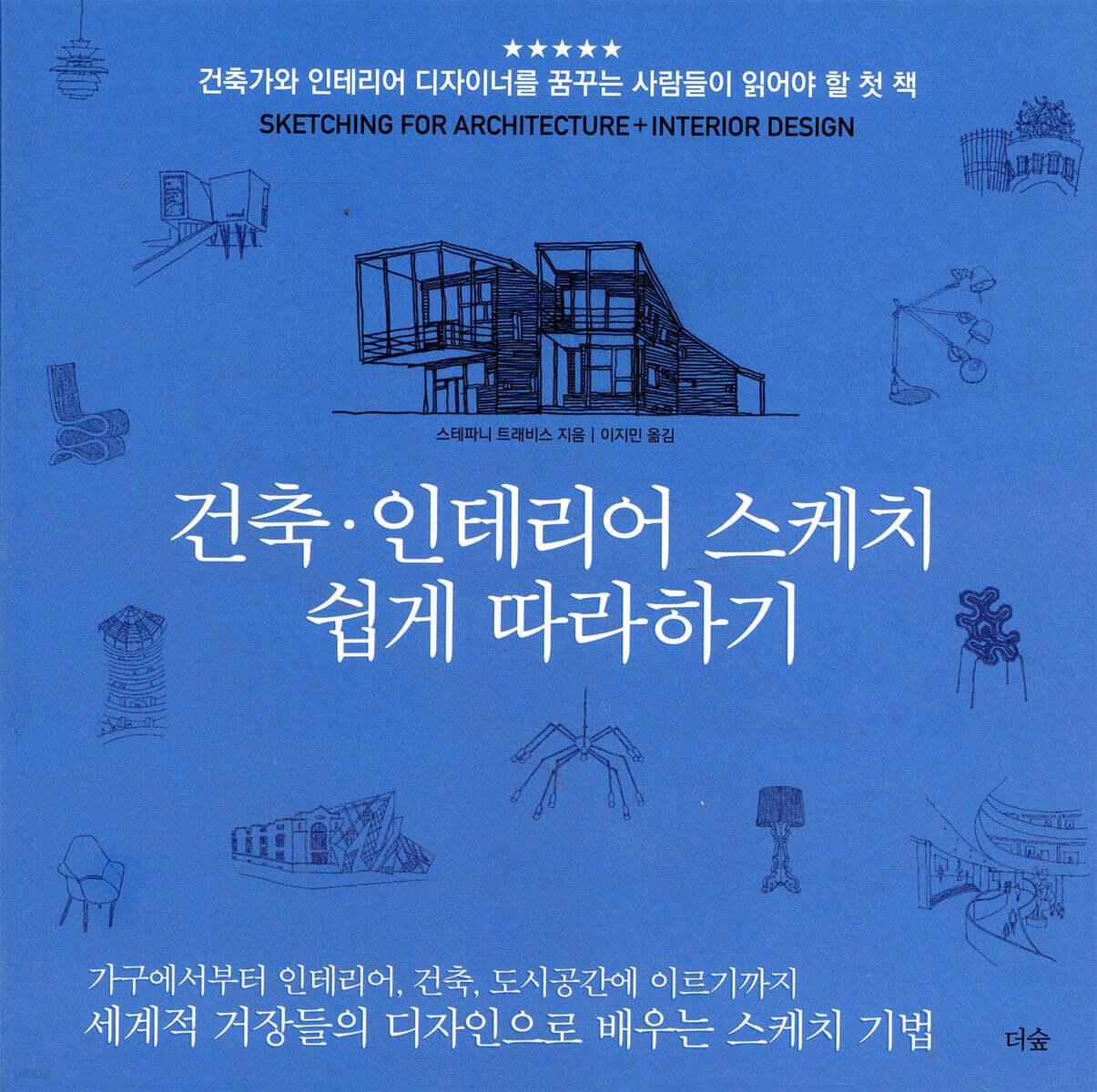
Easy-to-follow architectural and interior sketches
 |
Description
Book Introduction
The first book aspiring architects and interior designers must read!
From furniture to interior design, architecture, and urban spaces
Easily follow architectural sketches designed by world-renowned masters!
As we live in the digital age, CAD and SketchUp programs are mainly used for architectural and interior design these days.
However, 'freehand sketching', which involves observing and understanding directly through the eyes and head and then giving form to something, can be seen as the most important starting point of design.
The recently published 『Easy to Follow Architecture and Interior Sketching』 is a book by Laurence King, a British art, architecture, and design publisher that created a worldwide coloring book craze. It is the optimal introductory book for those starting out in architecture and interior design.
It contains only the essentials needed to perfectly observe and sketch objects, so that both major students and those interested in free sketching can easily follow along.
The author has simplified the 'sketching techniques' required for architecture and interior design by eliminating as much technical terminology as possible, thereby thoroughly introducing the drawing process from furniture to interior design and architecture at a level that is accessible to beginners.
From furniture to interior design, architecture, and urban spaces
Easily follow architectural sketches designed by world-renowned masters!
As we live in the digital age, CAD and SketchUp programs are mainly used for architectural and interior design these days.
However, 'freehand sketching', which involves observing and understanding directly through the eyes and head and then giving form to something, can be seen as the most important starting point of design.
The recently published 『Easy to Follow Architecture and Interior Sketching』 is a book by Laurence King, a British art, architecture, and design publisher that created a worldwide coloring book craze. It is the optimal introductory book for those starting out in architecture and interior design.
It contains only the essentials needed to perfectly observe and sketch objects, so that both major students and those interested in free sketching can easily follow along.
The author has simplified the 'sketching techniques' required for architecture and interior design by eliminating as much technical terminology as possible, thereby thoroughly introducing the drawing process from furniture to interior design and architecture at a level that is accessible to beginners.
- You can preview some of the book's contents.
Preview
index
introduction
Before you start sketching
- Selecting materials
- Pen Preparation Practice: Drawing Lines
- Marker Preparation Exercise: Understanding Concentration
Chapter 1.
Furniture + Lighting
Basic Exercise: Drawing Lighting Fixtures
Drawing abstractions
Negative Practice: Understanding Empty Space
Positive Practice: Understanding Real Space
Drawing a reflected image
Drawing a baseline
Layers: Expressing layers
Basic principles of perspective
Expressing planes, elevations, and 3D
Draw a circle
Multi-Perspective: A Fresh Look
Applying a pattern
Applying integrated patterns
Shading
Composition: Arrangement of Objects
Chapter 2.
Interior
Drawing a one-point perspective drawing
Drawing a two-point perspective drawing
Drawing a one-point abstraction
Drawing a two-point abstraction
Expressing transition space
Drawing indoor and outdoor spaces
Drawing a window frame
Drawing repetitive elements
Drawing continuous lines
Drawing sculptural elements
Drawing People: The Scale of Perspective
Understanding the Perspective of Indoor Space
Foreground and background
Draw in enlarged size
indoor shadows
Chapter 3.
building
Practicing symmetry and patterns
Puzzle Piece: Building Abstraction
negative space
Expressing in various ways
building materials
Peeling away building layers
Tall buildings and horizontal floors
Left-right viewpoint
Drawing building curves
Drawing multi-point perspective
Peripheral viewpoint
Open and closed
Drawing trees
Expressing building shadows
Final practice
Before you start sketching
- Selecting materials
- Pen Preparation Practice: Drawing Lines
- Marker Preparation Exercise: Understanding Concentration
Chapter 1.
Furniture + Lighting
Basic Exercise: Drawing Lighting Fixtures
Drawing abstractions
Negative Practice: Understanding Empty Space
Positive Practice: Understanding Real Space
Drawing a reflected image
Drawing a baseline
Layers: Expressing layers
Basic principles of perspective
Expressing planes, elevations, and 3D
Draw a circle
Multi-Perspective: A Fresh Look
Applying a pattern
Applying integrated patterns
Shading
Composition: Arrangement of Objects
Chapter 2.
Interior
Drawing a one-point perspective drawing
Drawing a two-point perspective drawing
Drawing a one-point abstraction
Drawing a two-point abstraction
Expressing transition space
Drawing indoor and outdoor spaces
Drawing a window frame
Drawing repetitive elements
Drawing continuous lines
Drawing sculptural elements
Drawing People: The Scale of Perspective
Understanding the Perspective of Indoor Space
Foreground and background
Draw in enlarged size
indoor shadows
Chapter 3.
building
Practicing symmetry and patterns
Puzzle Piece: Building Abstraction
negative space
Expressing in various ways
building materials
Peeling away building layers
Tall buildings and horizontal floors
Left-right viewpoint
Drawing building curves
Drawing multi-point perspective
Peripheral viewpoint
Open and closed
Drawing trees
Expressing building shadows
Final practice
Detailed image
.jpg)
Into the book
Every drawing process always begins with observing an object, whether it be a chair, an interior, or an entire building.
This is about drawing what you see, not what you think you see, or what you already know - a chair, interior, building, etc.
Imagine seeing the subject you are drawing for the first time.
All of these exercises deal with different aspects of the concept of 'seeing'.
As you work through the various steps of each exercise, you'll see every subject from a new perspective, gaining the confidence and experience to create your own unique paintings.
---From "Seeing and Drawing from a New Perspective"
Each exercise presented in this book becomes progressively larger and more complex as it progresses.
Chapter 1 (Furniture + Lighting) begins with small objects, Chapter 2 (Interiors) expands to more complex spaces, and Chapter 3 (Buildings) focuses on large-scale buildings.
These three chapters feature numerous sketches of contemporary design, furniture, lighting, interiors, and architectural examples from renowned contemporary designers and architects.
At the end of each exercise, we provide information about the name of the object, interior or building, the architect or designer, the year it was built, and the location of the interior or building.
Objects can appear three-dimensional (in real life) or two-dimensional (in photographs, publications, etc.).
It is important to choose one of these that inspires and challenges you.
This is about drawing what you see, not what you think you see, or what you already know - a chair, interior, building, etc.
Imagine seeing the subject you are drawing for the first time.
All of these exercises deal with different aspects of the concept of 'seeing'.
As you work through the various steps of each exercise, you'll see every subject from a new perspective, gaining the confidence and experience to create your own unique paintings.
---From "Seeing and Drawing from a New Perspective"
Each exercise presented in this book becomes progressively larger and more complex as it progresses.
Chapter 1 (Furniture + Lighting) begins with small objects, Chapter 2 (Interiors) expands to more complex spaces, and Chapter 3 (Buildings) focuses on large-scale buildings.
These three chapters feature numerous sketches of contemporary design, furniture, lighting, interiors, and architectural examples from renowned contemporary designers and architects.
At the end of each exercise, we provide information about the name of the object, interior or building, the architect or designer, the year it was built, and the location of the interior or building.
Objects can appear three-dimensional (in real life) or two-dimensional (in photographs, publications, etc.).
It is important to choose one of these that inspires and challenges you.
---From "How to Use This Book"
Publisher's Review
The first book aspiring architects and interior designers must read!
From furniture to interior design, architecture, and urban spaces
Easily follow architectural sketches designed by world-renowned masters!
As we live in the digital age, CAD and SketchUp programs are mainly used for architectural and interior design these days.
However, 'freehand sketching', which involves observing and understanding directly through the eyes and head and then giving form to something, can be seen as the most important starting point of design.
The recently published 『Easy to Follow Architecture and Interior Sketching』 is a book by Laurence King, a British art, architecture, and design publisher that created a worldwide coloring book craze. It is the optimal introductory book for those starting out in architecture and interior design.
It contains only the essentials needed to perfectly observe and sketch objects, so that both major students and those interested in free sketching can easily follow along.
The author has simplified the 'sketching techniques' required for architecture and interior design by eliminating as much technical terminology as possible, thereby thoroughly introducing the drawing process from furniture to interior design and architecture at a level that is accessible to beginners.
Another attraction of this book is that you can see and draw the designs of over 80 world-renowned masters through beautiful sketches drawn by the author himself.
You can encounter famous works by numerous contemporary designers, including Frank Lloyd Wright, one of the world's three greatest architectural masters, as well as modernist masters Philip Johnson, Rem Koolhaas, Jacques Herzog and Pierre de Meuron, Ieoh Ming Pei, and Tadao Ando, as well as furniture/minimalist designer John Pawson and industrial designer Philippe Starck, and express them in your own sketches.
Those just beginning their careers in architecture and interior design will be able to acquire a methodology for observing objects and expressing them in their own new way through the practice of sketching the representative modernist works introduced as examples in the book.
From basic principles such as layers, perspective, and shading to perspective drawing and abstraction.
Mastering Architectural and Interior Design Sketching in 45 Steps
“As your sketching skills improve, spaces begin to appear more detailed.
You'll start to notice important features you might not have noticed before.
“The sketching process is a means of enhancing your creativity and awakening your senses.” (Page 6, from [Why Sketch?])
As your sketching skills improve, you will be able to properly understand 'space', which is the most important thing in architecture and interior design.
Rather than instilling the difficult concept of 'space' from the beginning, the author helps beginners in design to naturally draw pictures with their own individuality through sketch exercises structured sequentially over 45 steps.
In particular, by first introducing essentials such as tool selection, line drawing, and understanding density before starting sketching, it lowers the threshold for this difficult major and teaches the basics step by step.
In this book, each exercise subject gradually becomes larger in scale and more complex in composition as it progresses.
First, in Chapter 1, you will begin sketching small and simple three-dimensional objects such as furniture and lighting fixtures, and learn the basic principles of sketching such as negative and positive practice, layering, perspective, patterns, and shading.
In Chapter 2, you can understand the three-dimensional characteristics of interior design based on perspective drawing and abstraction according to vanishing points, understanding transitional space and indoor/outdoor space, etc. In addition to techniques such as repetition, enlargement, and shadows that are most important in expressing interior space, you can expand the sketch subject to a more complex space through step-by-step practical practice of drawing window frames, solid lines, people, and sculptural elements.
Chapter 3, the final chapter, applies the basic principles of Chapters 1 and 2, but utilizes additional elements. It helps you sketch buildings that are realistic and beautiful while also considering the surrounding environment by practicing symmetry, pattern, negative space, building layers, multi-point perspective, peripheral viewpoints, and trees.
What matters is not perfect professional drafting skills,
Learning your own methodology for observing and expressing visible objects!
Sketching is the most basic task of observing and expressing the object we see, and it allows us to look at objects at a higher level by considering elements such as shape, style, texture, composition, and light.
In the preface, the author states that all the sketches he drew in the book were done in ink, and recommends that readers practice with ink at first, as mistakes made in ink cannot be easily erased, and thus the subject of the drawing can be observed more closely.
Actually, it's not that difficult to look at it and draw it the same way.
For those who dream of architecture and interior design, the essential sketching practice is to observe carefully and express it in a way and to what extent.
Also, to do that, you need to see a lot of beautiful and cool designs and become familiar with their composition and techniques.
This is also why the author included many famous modernist works by world-renowned masters in the book.
To complete a truly unique sketch by 'choosing something that inspires and challenges you'.
This book, which helps you develop your own unique design sketching methodology, will serve as a foundation for future great architectural and interior designers.
From furniture to interior design, architecture, and urban spaces
Easily follow architectural sketches designed by world-renowned masters!
As we live in the digital age, CAD and SketchUp programs are mainly used for architectural and interior design these days.
However, 'freehand sketching', which involves observing and understanding directly through the eyes and head and then giving form to something, can be seen as the most important starting point of design.
The recently published 『Easy to Follow Architecture and Interior Sketching』 is a book by Laurence King, a British art, architecture, and design publisher that created a worldwide coloring book craze. It is the optimal introductory book for those starting out in architecture and interior design.
It contains only the essentials needed to perfectly observe and sketch objects, so that both major students and those interested in free sketching can easily follow along.
The author has simplified the 'sketching techniques' required for architecture and interior design by eliminating as much technical terminology as possible, thereby thoroughly introducing the drawing process from furniture to interior design and architecture at a level that is accessible to beginners.
Another attraction of this book is that you can see and draw the designs of over 80 world-renowned masters through beautiful sketches drawn by the author himself.
You can encounter famous works by numerous contemporary designers, including Frank Lloyd Wright, one of the world's three greatest architectural masters, as well as modernist masters Philip Johnson, Rem Koolhaas, Jacques Herzog and Pierre de Meuron, Ieoh Ming Pei, and Tadao Ando, as well as furniture/minimalist designer John Pawson and industrial designer Philippe Starck, and express them in your own sketches.
Those just beginning their careers in architecture and interior design will be able to acquire a methodology for observing objects and expressing them in their own new way through the practice of sketching the representative modernist works introduced as examples in the book.
From basic principles such as layers, perspective, and shading to perspective drawing and abstraction.
Mastering Architectural and Interior Design Sketching in 45 Steps
“As your sketching skills improve, spaces begin to appear more detailed.
You'll start to notice important features you might not have noticed before.
“The sketching process is a means of enhancing your creativity and awakening your senses.” (Page 6, from [Why Sketch?])
As your sketching skills improve, you will be able to properly understand 'space', which is the most important thing in architecture and interior design.
Rather than instilling the difficult concept of 'space' from the beginning, the author helps beginners in design to naturally draw pictures with their own individuality through sketch exercises structured sequentially over 45 steps.
In particular, by first introducing essentials such as tool selection, line drawing, and understanding density before starting sketching, it lowers the threshold for this difficult major and teaches the basics step by step.
In this book, each exercise subject gradually becomes larger in scale and more complex in composition as it progresses.
First, in Chapter 1, you will begin sketching small and simple three-dimensional objects such as furniture and lighting fixtures, and learn the basic principles of sketching such as negative and positive practice, layering, perspective, patterns, and shading.
In Chapter 2, you can understand the three-dimensional characteristics of interior design based on perspective drawing and abstraction according to vanishing points, understanding transitional space and indoor/outdoor space, etc. In addition to techniques such as repetition, enlargement, and shadows that are most important in expressing interior space, you can expand the sketch subject to a more complex space through step-by-step practical practice of drawing window frames, solid lines, people, and sculptural elements.
Chapter 3, the final chapter, applies the basic principles of Chapters 1 and 2, but utilizes additional elements. It helps you sketch buildings that are realistic and beautiful while also considering the surrounding environment by practicing symmetry, pattern, negative space, building layers, multi-point perspective, peripheral viewpoints, and trees.
What matters is not perfect professional drafting skills,
Learning your own methodology for observing and expressing visible objects!
Sketching is the most basic task of observing and expressing the object we see, and it allows us to look at objects at a higher level by considering elements such as shape, style, texture, composition, and light.
In the preface, the author states that all the sketches he drew in the book were done in ink, and recommends that readers practice with ink at first, as mistakes made in ink cannot be easily erased, and thus the subject of the drawing can be observed more closely.
Actually, it's not that difficult to look at it and draw it the same way.
For those who dream of architecture and interior design, the essential sketching practice is to observe carefully and express it in a way and to what extent.
Also, to do that, you need to see a lot of beautiful and cool designs and become familiar with their composition and techniques.
This is also why the author included many famous modernist works by world-renowned masters in the book.
To complete a truly unique sketch by 'choosing something that inspires and challenges you'.
This book, which helps you develop your own unique design sketching methodology, will serve as a foundation for future great architectural and interior designers.
GOODS SPECIFICS
- Date of issue: October 30, 2015
- Page count, weight, size: 128 pages | 418g | 220*220*12mm
- ISBN13: 9791186900000
- ISBN10: 1186900008
You may also like
카테고리
korean


korean

![GQ KOREA Mark (Monthly): December [2025]](http://librairie.coreenne.fr/cdn/shop/files/8ef265dbbfbf186523ed75ba7319009d.jpg?v=1765340328&width=3840)


