

Music Letters from Hanover
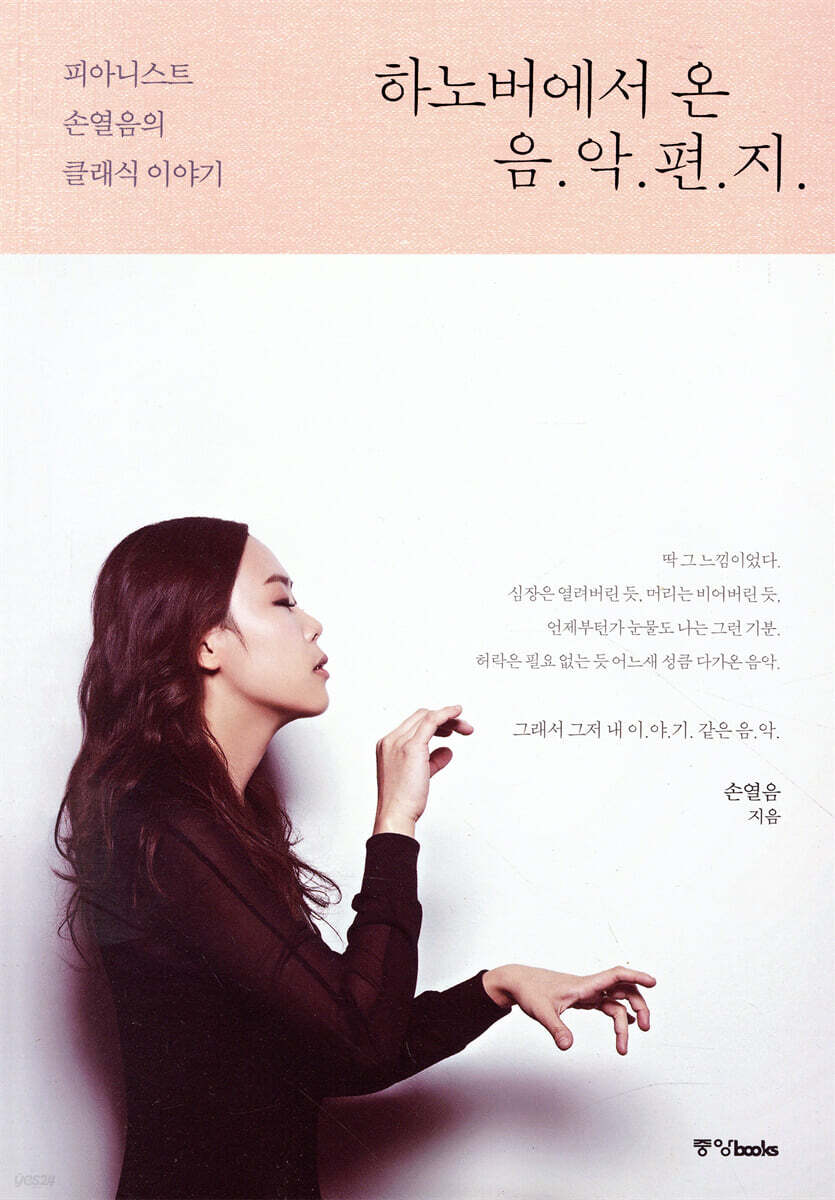 |
Description
Book Introduction
This book by Son Yeol-eum has three distinct features that set it apart from other introductory books to classical music.
First, it is an easy-to-read yet dense text that can be read by anyone who loves music, not just classical music enthusiasts.
Second, it introduces a way to look at music through the eyes of the performer, including the eyes of the audience.
And finally, the fact that he is honestly and candidly confessing about the secret area that the public has always been curious about, 'the life of a performer'.
First, it is an easy-to-read yet dense text that can be read by anyone who loves music, not just classical music enthusiasts.
Second, it introduces a way to look at music through the eyes of the performer, including the eyes of the audience.
And finally, the fact that he is honestly and candidly confessing about the secret area that the public has always been curious about, 'the life of a performer'.
- You can preview some of the book's contents.
Preview
index
congratulatory message
Introduction_For the one person who reads my writing and feels their heart pounding
Chapter 1 Piano and Music
The most musical and human instrument, the piano/absolute pitch vs.
Relative pitch/What moves us, rhythm/How was your performance today?/What fills the artist's soul first, second, and third is love/Come, sweet sorrow/Trot, a friend who shared the nation's fate/Music without melody or harmony?/Conditions of memorization/Salt and pepper on the piano, pedal/Encore time, the real concert starts now/440Hz 'Do'
Chapter 2: Always, the Classics by Our Side
Ah, tempo, into that sweet dream I don't want to wake up from_Robert Schumann/Music of the homing instinct_Sergei Prokofiev/Apology for music_Dmitri Shostakovich/Revolution of materials_Ludwig van Beethoven/Polar conjoined twins_Schumann and Brahms/“I am a vulgar fellow, but my music is not”_Wolfgang Amadeus Mozart/A person who is too difficult for us_Franz Schubert/The most beautiful love letter in the world/The genius musician who died under the Talmud/A final farewell to my only hometown_Sergei Rachmaninoff/A song that is just like my story_Rachmaninoff Concerto No. 2/A shocking classic of 100 years old_Igor Stravinsky's Rite of Spring
Chapter 3: The Inspiration of My Life
First Lesson with Arie Vardi/My Eternal Prometheus_Michael Rabin/Pianist who mastered inner acting_Alexis Weissenberg/The first genius in my life_Yin Qingzhong/If his sound were mine_Wang Xiaohan/If it weren't for him, I would be_Lee Kang-sook/The one and only superhero_Ben Cliburn/To me, he is Russia_Yakob Kassmann/Music by my side 1_Rabin, Schubert, Kraus/Music by my side 1_Song Spring and `Schmaltzy` folder/Music by my side 3_Music of my daily life
Chapter 4: Music of Our Time
Where are the Beethoven and Schubert of our time? / A society that risks its life for competitions / It's also your music / The reality of music education in South Korea / The end of the handmade piano / The world's most perfect audience / Russia, a country where people buy concert tickets with the money they earn for food / Korea, a violin powerhouse / Genius is not born alone
Chapter 5: Applause, and
Concert Pianist / Why I Make Music / On the Way to Grandma's House / My Hometown, Gangwon-do / The One Who Delivered Beauty / Mom and Tea / My Writing / The Pianist Is Alone
Acknowledgements
Introduction_For the one person who reads my writing and feels their heart pounding
Chapter 1 Piano and Music
The most musical and human instrument, the piano/absolute pitch vs.
Relative pitch/What moves us, rhythm/How was your performance today?/What fills the artist's soul first, second, and third is love/Come, sweet sorrow/Trot, a friend who shared the nation's fate/Music without melody or harmony?/Conditions of memorization/Salt and pepper on the piano, pedal/Encore time, the real concert starts now/440Hz 'Do'
Chapter 2: Always, the Classics by Our Side
Ah, tempo, into that sweet dream I don't want to wake up from_Robert Schumann/Music of the homing instinct_Sergei Prokofiev/Apology for music_Dmitri Shostakovich/Revolution of materials_Ludwig van Beethoven/Polar conjoined twins_Schumann and Brahms/“I am a vulgar fellow, but my music is not”_Wolfgang Amadeus Mozart/A person who is too difficult for us_Franz Schubert/The most beautiful love letter in the world/The genius musician who died under the Talmud/A final farewell to my only hometown_Sergei Rachmaninoff/A song that is just like my story_Rachmaninoff Concerto No. 2/A shocking classic of 100 years old_Igor Stravinsky's Rite of Spring
Chapter 3: The Inspiration of My Life
First Lesson with Arie Vardi/My Eternal Prometheus_Michael Rabin/Pianist who mastered inner acting_Alexis Weissenberg/The first genius in my life_Yin Qingzhong/If his sound were mine_Wang Xiaohan/If it weren't for him, I would be_Lee Kang-sook/The one and only superhero_Ben Cliburn/To me, he is Russia_Yakob Kassmann/Music by my side 1_Rabin, Schubert, Kraus/Music by my side 1_Song Spring and `Schmaltzy` folder/Music by my side 3_Music of my daily life
Chapter 4: Music of Our Time
Where are the Beethoven and Schubert of our time? / A society that risks its life for competitions / It's also your music / The reality of music education in South Korea / The end of the handmade piano / The world's most perfect audience / Russia, a country where people buy concert tickets with the money they earn for food / Korea, a violin powerhouse / Genius is not born alone
Chapter 5: Applause, and
Concert Pianist / Why I Make Music / On the Way to Grandma's House / My Hometown, Gangwon-do / The One Who Delivered Beauty / Mom and Tea / My Writing / The Pianist Is Alone
Acknowledgements
Into the book
On a piano, you just press a key once and it's done.
The ability to imagine the direction of a sound before pressing it, combined with the muscles trained over a long period of time, can only infinitely change its properties.
_Among the 'most musical and humane instruments, the piano'
Even among people who think they have absolute pitch, definitive absolute pitch is quite rare.
In my view, absolute pitch is when you can identify a note regardless of whether it is familiar or not, distinguish between harmonics, which are combinations of notes, and when you can imagine the note in your head without hearing it.
_'Absolute Pitch vs.
Among the 'relative pitch'
I think Schubert is somewhere in the middle between Beethoven and Mozart.
His music is so indescribable that it is impossible to describe it without using the keyword of sadness. Except for a very few songs, all of his works are imbued with a unique sadness._From 'Come, Sweet Sorrow'
The problem is that this encore performance is much more difficult for the performer than expected.
Of course, there is no performer who would not want to respond to an audience cheering for their performance.
But the main performance just ended, the tension was released, emotions were extremely high, and at the same time, the muscles were at their most tired.
This encore time is truly the time when the body, head, and mind all play separately.
_From 'Encore Time, the real concert starts now'
If you look at the seventh movement of this man's work, David's Alliance Dances, Op. 6, you will see that 'ritardando' appears a whopping fourteen times over two pages, but 'a tempo' is nowhere to be found.
(Omitted) His other love was children.
It's not a rash guess just because he and his wife Clara have eight children.
Traces of this are engraved in the album for children, Op. 68.
The 'three stars' mark, which he used to put only on his own songs that he had a special affection for, was put only on albums for children.
_From 'Ah Tempo, into that sweet dream I don't want to wake up from/Robert Schumann'
If I were to make those contents into a single 'keyword' from my own perspective... Beethoven would be 'the conquest of freedom', Schubert would be 'hope in despair', Schumann would be 'love', Chopin would be 'longing', Brahms would be 'deficiency', Tchaikovsky would be 'dream', and Shostakovich would be... 'accusation'.
They sublimated each of these keywords into art throughout their lives.
And I would say that the keyword of this composer, Sergei Sergeevich Prokofiev (1891-1953), is 'homing instinct'. _From 'Music of the Homing Instinct/Sergei Prokofiev'
I have yet to meet a single pianist or violinist who can play Schubert without his hands getting tangled.
The problem with these songs is that the scale is irregular, making it impossible to get used to them, and the harmonic progression is so strange that it's difficult to even remember them in your head. This is a completely different situation for the listener.
His music, which simply transcribes the rising thoughts into sheet music, cannot possibly sound difficult. _From 'A Man Too Difficult for Us/Franz Schubert'
Bruch's Concerto No. 1, which captures the live performance, is so vivid from the introduction that it is heartbreaking to the point of burning his artistic spirit to the end.
The vibrato, which has become even thicker than before, seems to squeeze out all the hardships of life that music can portray.
But despite these brilliant performances in his later years, he never blossomed again.
Instead, in 1972, he was found dead at the age of thirty-five.
The cause of death was speculated to be drug intoxication, suicide, concussion, shock, etc., but in the end, the exact cause was never determined.
_From 'My Eternal Prometheus/Michael Ravin'
It's been half a century since winning five or six of the world's most important competitions guaranteed a comfortable life as a professional musician.
Performance agencies are no longer interested in the one out of 300 contest winners, and competition organizers are having an increasingly difficult time persuading such agencies.
_From 'A Society That Risks Its Lives for Concours'
The law in South Korea that prohibits university professors from providing private tutoring is strictly applied to the music field as well.
Unfortunately, this is an issue that is even less realistic in the domestic music industry.
In Korea, where there are no professional musicians who only perform, and where top-level musicians usually teach at universities, this means that, in principle, all music students in Korea cannot access the highest level of education before entering university.
Since early education is a critical area, many young students who fail to overcome it end up going abroad to study. _From 'The Reality of Music Education in Korea'
The fact that I have no family, no friends, no phone, no sheet music, nothing by my side, and yet I have to keep going without stopping.
What makes this fact all the more brutal is that it is so similar to 'living'.
Everyone who is thrown onto the stage of life is alone.
So there's nothing we can do about it.
That was the title of a movie episode of an animation I used to like.
“You are (not) alone.”_From ‘The Pianist is Alone’
The ability to imagine the direction of a sound before pressing it, combined with the muscles trained over a long period of time, can only infinitely change its properties.
_Among the 'most musical and humane instruments, the piano'
Even among people who think they have absolute pitch, definitive absolute pitch is quite rare.
In my view, absolute pitch is when you can identify a note regardless of whether it is familiar or not, distinguish between harmonics, which are combinations of notes, and when you can imagine the note in your head without hearing it.
_'Absolute Pitch vs.
Among the 'relative pitch'
I think Schubert is somewhere in the middle between Beethoven and Mozart.
His music is so indescribable that it is impossible to describe it without using the keyword of sadness. Except for a very few songs, all of his works are imbued with a unique sadness._From 'Come, Sweet Sorrow'
The problem is that this encore performance is much more difficult for the performer than expected.
Of course, there is no performer who would not want to respond to an audience cheering for their performance.
But the main performance just ended, the tension was released, emotions were extremely high, and at the same time, the muscles were at their most tired.
This encore time is truly the time when the body, head, and mind all play separately.
_From 'Encore Time, the real concert starts now'
If you look at the seventh movement of this man's work, David's Alliance Dances, Op. 6, you will see that 'ritardando' appears a whopping fourteen times over two pages, but 'a tempo' is nowhere to be found.
(Omitted) His other love was children.
It's not a rash guess just because he and his wife Clara have eight children.
Traces of this are engraved in the album for children, Op. 68.
The 'three stars' mark, which he used to put only on his own songs that he had a special affection for, was put only on albums for children.
_From 'Ah Tempo, into that sweet dream I don't want to wake up from/Robert Schumann'
If I were to make those contents into a single 'keyword' from my own perspective... Beethoven would be 'the conquest of freedom', Schubert would be 'hope in despair', Schumann would be 'love', Chopin would be 'longing', Brahms would be 'deficiency', Tchaikovsky would be 'dream', and Shostakovich would be... 'accusation'.
They sublimated each of these keywords into art throughout their lives.
And I would say that the keyword of this composer, Sergei Sergeevich Prokofiev (1891-1953), is 'homing instinct'. _From 'Music of the Homing Instinct/Sergei Prokofiev'
I have yet to meet a single pianist or violinist who can play Schubert without his hands getting tangled.
The problem with these songs is that the scale is irregular, making it impossible to get used to them, and the harmonic progression is so strange that it's difficult to even remember them in your head. This is a completely different situation for the listener.
His music, which simply transcribes the rising thoughts into sheet music, cannot possibly sound difficult. _From 'A Man Too Difficult for Us/Franz Schubert'
Bruch's Concerto No. 1, which captures the live performance, is so vivid from the introduction that it is heartbreaking to the point of burning his artistic spirit to the end.
The vibrato, which has become even thicker than before, seems to squeeze out all the hardships of life that music can portray.
But despite these brilliant performances in his later years, he never blossomed again.
Instead, in 1972, he was found dead at the age of thirty-five.
The cause of death was speculated to be drug intoxication, suicide, concussion, shock, etc., but in the end, the exact cause was never determined.
_From 'My Eternal Prometheus/Michael Ravin'
It's been half a century since winning five or six of the world's most important competitions guaranteed a comfortable life as a professional musician.
Performance agencies are no longer interested in the one out of 300 contest winners, and competition organizers are having an increasingly difficult time persuading such agencies.
_From 'A Society That Risks Its Lives for Concours'
The law in South Korea that prohibits university professors from providing private tutoring is strictly applied to the music field as well.
Unfortunately, this is an issue that is even less realistic in the domestic music industry.
In Korea, where there are no professional musicians who only perform, and where top-level musicians usually teach at universities, this means that, in principle, all music students in Korea cannot access the highest level of education before entering university.
Since early education is a critical area, many young students who fail to overcome it end up going abroad to study. _From 'The Reality of Music Education in Korea'
The fact that I have no family, no friends, no phone, no sheet music, nothing by my side, and yet I have to keep going without stopping.
What makes this fact all the more brutal is that it is so similar to 'living'.
Everyone who is thrown onto the stage of life is alone.
So there's nothing we can do about it.
That was the title of a movie episode of an animation I used to like.
“You are (not) alone.”_From ‘The Pianist is Alone’
___From the text
Publisher's Review
“What makes Son Yeol-eum so great is that he reads the heat with coolness.
“That’s how you get something really hot.” - From a line by Oh Hye-won in the drama Secret Love Affair
Oh Hye-won, a character in the drama Secret Love Affair, praised pianist Son Yeol-eum as a “performer who can read passion with coolness.”
Although he seems to easily capture the hearts of the audience with his passionate performances, it is probably because he himself does not get carried away by his passion and instead conducts his own performances with intensity until the very end through thorough preparation.
Son Yeol-eum, who is called a young master and genius pianist, but is also a 'performer in progress' who wants to remain a consistent performer forever, has published his first music essay, Music Letters from Hanover.
This book is a compilation of articles written over five years as a music columnist, rewritten and reorganized.
Son Yeol-eum's music column has been greatly loved by the general public, including music lovers, for its interpretations that reflect his deep musical expertise and his writing skills that are second to none.
Born in Wonju, Gangwon Province in 1986, Son Yeol-eum began learning the piano at the age of five and has raised the international status of the Korean piano world by winning second place at the Tchaikovsky Youth Competition at the age of eleven, becoming the youngest first place winner at the Viotti International Competition in Italy in 2002, and winning second place and the Mozart Concerto Special Prize and the Designated Contemporary Piece Special Prize at the Tchaikovsky International Competition in 2011.
Lee Kang-sook, Korea's first musicologist and former president of the Korea National University of Arts, wrote in a congratulatory message, "I cried when I heard that Soon-guk-san won first place in an international competition," and praised him as "a person who left his mark on the history of Korean piano performance."
Differentiation from general classical introductory books
Listen to music from pianist Son Yeol-eum, and hear stories from musicians.
This book by Son Yeol-eum has three distinct features that set it apart from other introductory books to classical music.
First, it is an easy-to-read yet dense text that can be read by anyone who loves music, not just classical music enthusiasts.
Second, it introduces a way to look at music through the eyes of the performer, including the eyes of the audience.
And finally, the fact that he is honestly and candidly confessing about the secret area that the public has always been curious about, 'the life of a performer'.
First, Chapter 1 begins lightly with the piano, an instrument that is familiar to the public but also holds a great deal of awe, and stories about music that the public has always been curious about.
Chapter 2 introduces the lives and anecdotes of classical masters who are familiar to the public but also cherished by pianist Son Yeol-eum, including Robert Schumann, Sergei Prokofiev, Dmitri Shostakovich, Ludwig van Beethoven, Brahms and Schumann, Wolfgang Amadeus Kozart, Franz Schubert, Charles Valentin Alcan, and Sergei Rachmaninoff.
At the same time, it presents various interpretations and stories about their music through the eyes of Son Yeol-eum.
Chapter 3 is even more interesting because it contains stories about performers that Son Yeol-eum particularly loves.
Michael Levine, his favorite violinist.
Son Yeol-eum introduces him as her 'eternal Prometheus'.
The author praises him as the only violinist who can portray Tchaikovsky's precious memories of his time with such poignancy and complete abandon of sentimentality, and says that Rabin, with his unique tone and near-mysterious technique, may be either an angel incarnate or a devil incarnate.
Rabin, who died at the age of thirty-five, is said to be like Prometheus, who possessed the 'flame' that kept Son Yeol-eum alive.
In addition, it will reveal the charms of pianist Alexis Weissenberg, who has mastered inner acting; Yin Chengzhong, who he considers the first genius pianist in his life; Wang Xiaohan, who possesses an enviable tone; Lee Kang-sook, former president of the Korea National University of Arts, who helped Son Yeol-eum become a Korean pianist; Van Cliburn, who is remembered as an American hero; and Jacob Kasmann, the pianist from Russia itself.
Chapter 4, under the theme of 'Music of Our Time', discusses the hardships artists face in a 'marketing-obsessed society' and what a true attitude of love for art is.
It also criticizes the society that risks its life for competitions and the reality of music education in Korea.
The final chapter contains personal and honest confessions about his life as a concert pianist and why he continues to make music.
This book contains not only the musical stories that the public has wanted to hear from pianist Son Yeol-eum, but also her wish to remain an eternal performer. Through this book, readers will be able to meet both the pianist Son Yeol-eum and the person Son Yeol-eum at the same time.
“That’s how you get something really hot.” - From a line by Oh Hye-won in the drama Secret Love Affair
Oh Hye-won, a character in the drama Secret Love Affair, praised pianist Son Yeol-eum as a “performer who can read passion with coolness.”
Although he seems to easily capture the hearts of the audience with his passionate performances, it is probably because he himself does not get carried away by his passion and instead conducts his own performances with intensity until the very end through thorough preparation.
Son Yeol-eum, who is called a young master and genius pianist, but is also a 'performer in progress' who wants to remain a consistent performer forever, has published his first music essay, Music Letters from Hanover.
This book is a compilation of articles written over five years as a music columnist, rewritten and reorganized.
Son Yeol-eum's music column has been greatly loved by the general public, including music lovers, for its interpretations that reflect his deep musical expertise and his writing skills that are second to none.
Born in Wonju, Gangwon Province in 1986, Son Yeol-eum began learning the piano at the age of five and has raised the international status of the Korean piano world by winning second place at the Tchaikovsky Youth Competition at the age of eleven, becoming the youngest first place winner at the Viotti International Competition in Italy in 2002, and winning second place and the Mozart Concerto Special Prize and the Designated Contemporary Piece Special Prize at the Tchaikovsky International Competition in 2011.
Lee Kang-sook, Korea's first musicologist and former president of the Korea National University of Arts, wrote in a congratulatory message, "I cried when I heard that Soon-guk-san won first place in an international competition," and praised him as "a person who left his mark on the history of Korean piano performance."
Differentiation from general classical introductory books
Listen to music from pianist Son Yeol-eum, and hear stories from musicians.
This book by Son Yeol-eum has three distinct features that set it apart from other introductory books to classical music.
First, it is an easy-to-read yet dense text that can be read by anyone who loves music, not just classical music enthusiasts.
Second, it introduces a way to look at music through the eyes of the performer, including the eyes of the audience.
And finally, the fact that he is honestly and candidly confessing about the secret area that the public has always been curious about, 'the life of a performer'.
First, Chapter 1 begins lightly with the piano, an instrument that is familiar to the public but also holds a great deal of awe, and stories about music that the public has always been curious about.
Chapter 2 introduces the lives and anecdotes of classical masters who are familiar to the public but also cherished by pianist Son Yeol-eum, including Robert Schumann, Sergei Prokofiev, Dmitri Shostakovich, Ludwig van Beethoven, Brahms and Schumann, Wolfgang Amadeus Kozart, Franz Schubert, Charles Valentin Alcan, and Sergei Rachmaninoff.
At the same time, it presents various interpretations and stories about their music through the eyes of Son Yeol-eum.
Chapter 3 is even more interesting because it contains stories about performers that Son Yeol-eum particularly loves.
Michael Levine, his favorite violinist.
Son Yeol-eum introduces him as her 'eternal Prometheus'.
The author praises him as the only violinist who can portray Tchaikovsky's precious memories of his time with such poignancy and complete abandon of sentimentality, and says that Rabin, with his unique tone and near-mysterious technique, may be either an angel incarnate or a devil incarnate.
Rabin, who died at the age of thirty-five, is said to be like Prometheus, who possessed the 'flame' that kept Son Yeol-eum alive.
In addition, it will reveal the charms of pianist Alexis Weissenberg, who has mastered inner acting; Yin Chengzhong, who he considers the first genius pianist in his life; Wang Xiaohan, who possesses an enviable tone; Lee Kang-sook, former president of the Korea National University of Arts, who helped Son Yeol-eum become a Korean pianist; Van Cliburn, who is remembered as an American hero; and Jacob Kasmann, the pianist from Russia itself.
Chapter 4, under the theme of 'Music of Our Time', discusses the hardships artists face in a 'marketing-obsessed society' and what a true attitude of love for art is.
It also criticizes the society that risks its life for competitions and the reality of music education in Korea.
The final chapter contains personal and honest confessions about his life as a concert pianist and why he continues to make music.
This book contains not only the musical stories that the public has wanted to hear from pianist Son Yeol-eum, but also her wish to remain an eternal performer. Through this book, readers will be able to meet both the pianist Son Yeol-eum and the person Son Yeol-eum at the same time.
GOODS SPECIFICS
- Date of issue: May 20, 2015
- Page count, weight, size: 232 pages | 579g | 153*224*20mm
- ISBN13: 9788927806424
- ISBN10: 8927806425
You may also like
카테고리
korean


korean

![GQ KOREA Mark (Monthly): December [2025]](http://librairie.coreenne.fr/cdn/shop/files/8ef265dbbfbf186523ed75ba7319009d.jpg?v=1765340328&width=3840)


