

Acting One
 |
Description
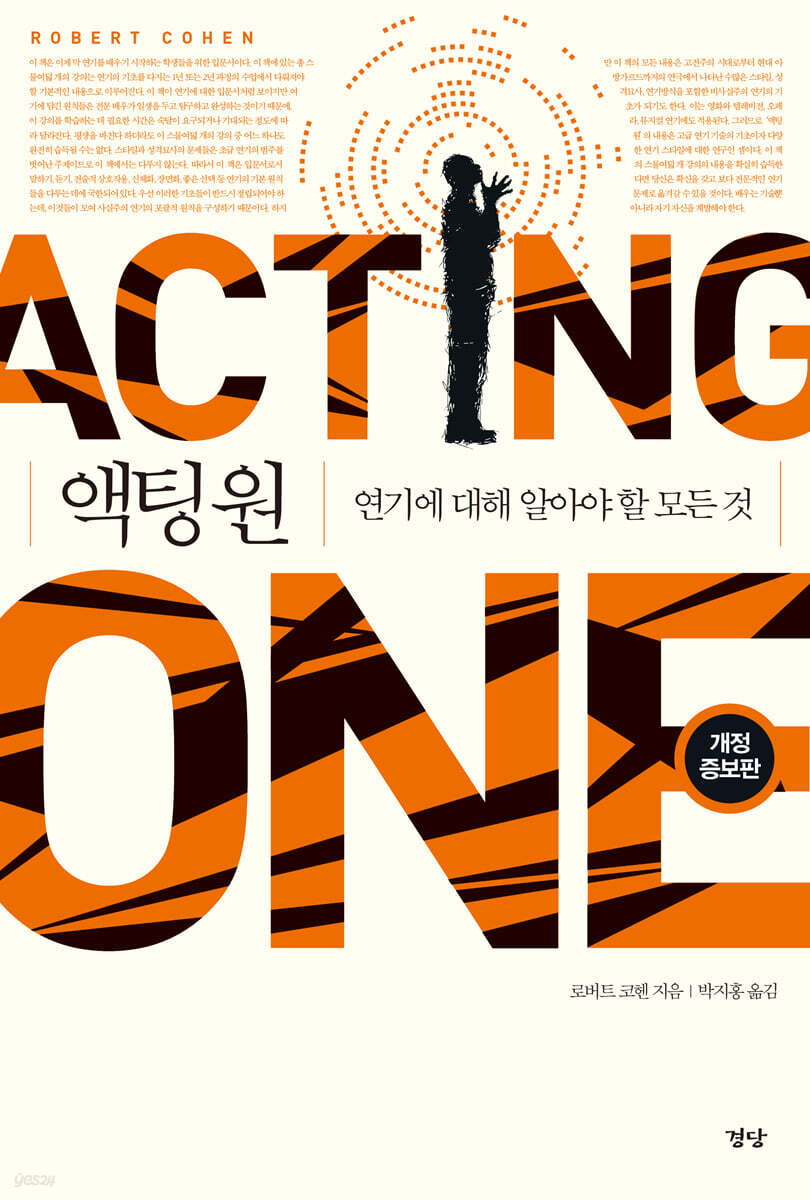
Book Introduction
The bible of acting that both beginners and professional actors must learn.
This is a textbook that will be of great help not only to theater and film students who want to learn basic acting skills, but also to countless professional actors working on stage and film sets.
The 28 lectures in 5 parts cover the basics that should be covered in a one- or two-year course that lays the foundation for acting.
This book, written in a realistic lecture style, guides you through the fundamentals of acting step by step, helping you grow as an actor.
This revised edition more vividly expresses and explains key concepts such as "imagination" and "creativity" that actors need, and sensitively reflects the flow of the times by replacing practice scripts with more recent works.
Useful advice and counsel from outstanding actors such as Susan Sarandon, James Caan, and Meryl Streep, as well as critic Walter Kerr and playwright and director George Bernard Shaw, will also provide additional acting wisdom.
This is a textbook that will be of great help not only to theater and film students who want to learn basic acting skills, but also to countless professional actors working on stage and film sets.
The 28 lectures in 5 parts cover the basics that should be covered in a one- or two-year course that lays the foundation for acting.
This book, written in a realistic lecture style, guides you through the fundamentals of acting step by step, helping you grow as an actor.
This revised edition more vividly expresses and explains key concepts such as "imagination" and "creativity" that actors need, and sensitively reflects the flow of the times by replacing practice scripts with more recent works.
Useful advice and counsel from outstanding actors such as Susan Sarandon, James Caan, and Meryl Streep, as well as critic Walter Kerr and playwright and director George Bernard Shaw, will also provide additional acting wisdom.
- You can preview some of the book's contents.
Preview
index
Recommendation
preface
Acknowledgements
[Preparation for Acting Part 1]
Lesson 1: Preparing for Acting
Relaxation | Trust | Fullness | Discipline | Criticism | Playful Attitude | Freedom | Preparation | Summary
Lecture 2: What is Acting?
summation
[Part 2: The Actor's Approach]
Lesson 3: Goals and Obstacles
Basic Laws | Self-Consciousness | Projection | Summary
Lesson 4: Acting with Others
Other People | Interaction Dynamics | Characters | Tactics | Monologue | Summary
Lesson 5: The Beginning of Acting
Scene without content | Augmentation | Embodiment | Summary
Lesson 6: Tactics
Punishments and Rewards | Tactical Use | Alternating Tactics | Intermediate Category | Summary
Lesson 7 Expectations
Expectations for the Goal | Clear Goals | Eye Contact | Summary
Lesson 8 GOTE
Basic Tips | Determining a Character's GOTE | Summary
[Part 3: Actor's Mission]
Lesson 9: Preparing for the Role
Finding Roles | Finding "Characters" | Editing Scenes | Memorization Methods | Cues: Action Cues and Dialogue Cues | Studying Dialogue | Summary
Lesson 10 Rehearsal
Rehearsal | Undirected Rehearsal | Alternatives to Rehearsal | Summary
Scene 11: Staging
Stage Directions | Creating the Scene | Movement and Stage Routines | Interesting Postures | Approaching the Audience | Summary
Lesson 12 Selection
The Need for Choice | A Good Choice | Summary
Lecture 13 Performance
Stage Fright | Classroom Performance | Acting for Results? Inside the Characters! | Summary
Lesson 14: Evaluation and Improvement
Beneficial Criticism | Rework | Summary
[Part 4: Actor's Tools]
Lesson 15: The Actor's Voice
Breathing | Vocalization: Creating Sound | Resonance | Pitch | Stage-Friendly Voice | Summary
Lesson 16: Stage Speaking
Good Pronunciation | Short Consonants | Summary
Lesson 17: Use of Voice
Liberation | Purpose | Summary
Lesson 18: The Actor's Body
Agility | Coordination | Walking | Sitting and Standing | Speed: Acceleration, Deceleration, and Constant Speed | Balance | Dynamics of Movement | Summary
Lesson 19: Voice and Body Integration
Coordination | Direction | Tempo | Actors with Disabilities | Summary
Lesson 20: Imagination and Creativity
Imagination | Creativity | Creativity and Imagination | Using Fantasy | Summary
Lesson 21: Emotions and Acting Theory
Self-consciousness | Summary
[Part 5: Actor's Technique]
Lesson 22 Grammar
Pronunciation | Speaking with an Open Mouth | Developing Pronunciation | Emphasis | Intonation | Grammar | Summary
Lesson 23: Getting Started
First Words | Physical Initiation | Taking the Turn | Preparing for a Strong Initiation | Summary
Lesson 24: Execution
Fishhook | Interrogative sentence as question | Statement as question | Statement as statement | Disappearing dialogue | Summary
Lesson 25: The Connection of Ambassadors
Analyzing Conversations | Rising Final Intonation | Falling Final Intonation | Onset Intonation | Intervals | Long Dialogues | Applications of Dialogue Connections | Summary
Lesson 26: Scene Structure
Script Analysis | Selecting Scenes for Class | Structural Features | Transitions | Scene Analysis | Summary
Lesson 27: Building a Surface
Stacking and Covering | Cutting Back | Conquering | Controlling the Speed of Construction | Complex Construction | Summary
Lesson 28: The Creation of Monologue
Doing it alone | Talking to someone else | Ambivalence | Acting a monologue or ambivalence | Summary
Conclusion
Dictionary of Acting Terms
Translator's Note
Search
preface
Acknowledgements
[Preparation for Acting Part 1]
Lesson 1: Preparing for Acting
Relaxation | Trust | Fullness | Discipline | Criticism | Playful Attitude | Freedom | Preparation | Summary
Lecture 2: What is Acting?
summation
[Part 2: The Actor's Approach]
Lesson 3: Goals and Obstacles
Basic Laws | Self-Consciousness | Projection | Summary
Lesson 4: Acting with Others
Other People | Interaction Dynamics | Characters | Tactics | Monologue | Summary
Lesson 5: The Beginning of Acting
Scene without content | Augmentation | Embodiment | Summary
Lesson 6: Tactics
Punishments and Rewards | Tactical Use | Alternating Tactics | Intermediate Category | Summary
Lesson 7 Expectations
Expectations for the Goal | Clear Goals | Eye Contact | Summary
Lesson 8 GOTE
Basic Tips | Determining a Character's GOTE | Summary
[Part 3: Actor's Mission]
Lesson 9: Preparing for the Role
Finding Roles | Finding "Characters" | Editing Scenes | Memorization Methods | Cues: Action Cues and Dialogue Cues | Studying Dialogue | Summary
Lesson 10 Rehearsal
Rehearsal | Undirected Rehearsal | Alternatives to Rehearsal | Summary
Scene 11: Staging
Stage Directions | Creating the Scene | Movement and Stage Routines | Interesting Postures | Approaching the Audience | Summary
Lesson 12 Selection
The Need for Choice | A Good Choice | Summary
Lecture 13 Performance
Stage Fright | Classroom Performance | Acting for Results? Inside the Characters! | Summary
Lesson 14: Evaluation and Improvement
Beneficial Criticism | Rework | Summary
[Part 4: Actor's Tools]
Lesson 15: The Actor's Voice
Breathing | Vocalization: Creating Sound | Resonance | Pitch | Stage-Friendly Voice | Summary
Lesson 16: Stage Speaking
Good Pronunciation | Short Consonants | Summary
Lesson 17: Use of Voice
Liberation | Purpose | Summary
Lesson 18: The Actor's Body
Agility | Coordination | Walking | Sitting and Standing | Speed: Acceleration, Deceleration, and Constant Speed | Balance | Dynamics of Movement | Summary
Lesson 19: Voice and Body Integration
Coordination | Direction | Tempo | Actors with Disabilities | Summary
Lesson 20: Imagination and Creativity
Imagination | Creativity | Creativity and Imagination | Using Fantasy | Summary
Lesson 21: Emotions and Acting Theory
Self-consciousness | Summary
[Part 5: Actor's Technique]
Lesson 22 Grammar
Pronunciation | Speaking with an Open Mouth | Developing Pronunciation | Emphasis | Intonation | Grammar | Summary
Lesson 23: Getting Started
First Words | Physical Initiation | Taking the Turn | Preparing for a Strong Initiation | Summary
Lesson 24: Execution
Fishhook | Interrogative sentence as question | Statement as question | Statement as statement | Disappearing dialogue | Summary
Lesson 25: The Connection of Ambassadors
Analyzing Conversations | Rising Final Intonation | Falling Final Intonation | Onset Intonation | Intervals | Long Dialogues | Applications of Dialogue Connections | Summary
Lesson 26: Scene Structure
Script Analysis | Selecting Scenes for Class | Structural Features | Transitions | Scene Analysis | Summary
Lesson 27: Building a Surface
Stacking and Covering | Cutting Back | Conquering | Controlling the Speed of Construction | Complex Construction | Summary
Lesson 28: The Creation of Monologue
Doing it alone | Talking to someone else | Ambivalence | Acting a monologue or ambivalence | Summary
Conclusion
Dictionary of Acting Terms
Translator's Note
Search
Into the book
Lesson 1: Preparing for Acting
Open your heart and enjoy
I've always enjoyed acting quite a bit, and I think that for an actor, the stage is always an open, playful, listening, and exploratory space.
Susan Sarandon on what inspired her to act---p.38
Lesson 7 Expectations
Eye contact
Where do you look when acting? There's no definitive answer to this question, but generally, the most desirable place is your acting partner's eyes.
This is because in very dramatic scenes you seek goals with or from the 'other' character you are interacting with, your opponent.
Therefore, direct eye contact with the other person is the best way to determine the possibility of achieving your goals, as it is the most reliable way to read the other person's unique reactions.
Eye contact also conveys confidence—a confident expectation that you will achieve what you set out to do.
It is an effective tactic that goes further to elicit trust and respect from the other party.
The brilliant actor Michael Caine even advises actors not to blink (“Blinking makes the character look weak”) in order to enhance their acting skills through direct eye contact. ---p.110-111
Lesson 20: Imagination and Creativity
Exercise 20-4: Facing Love
Memorize the following lines from Juliet from "Romeo and Juliet."
“My generosity is endless like the sea,
My love is as deep as the sea.
So the more I give to you,
I have more.
“Because both are infinite.”
At this moment in the play, Romeo has just made his first 'pledge to love' to Juliet, and asks her to make the same promise in return.
Pass this line on to a fictional Romeo, then to another Romeo, and then to another Romeo, regardless of your or your Romeo's gender.
Instead of trying to imitate what you think Juliet is like, deliver your lines as yourself, to a real person you actually love or wish to love, or to someone you wish to love.
Next, imagine that the object of your love is a god, a spirit, or an animal.
Open your heart and enjoy
I've always enjoyed acting quite a bit, and I think that for an actor, the stage is always an open, playful, listening, and exploratory space.
Susan Sarandon on what inspired her to act---p.38
Lesson 7 Expectations
Eye contact
Where do you look when acting? There's no definitive answer to this question, but generally, the most desirable place is your acting partner's eyes.
This is because in very dramatic scenes you seek goals with or from the 'other' character you are interacting with, your opponent.
Therefore, direct eye contact with the other person is the best way to determine the possibility of achieving your goals, as it is the most reliable way to read the other person's unique reactions.
Eye contact also conveys confidence—a confident expectation that you will achieve what you set out to do.
It is an effective tactic that goes further to elicit trust and respect from the other party.
The brilliant actor Michael Caine even advises actors not to blink (“Blinking makes the character look weak”) in order to enhance their acting skills through direct eye contact. ---p.110-111
Lesson 20: Imagination and Creativity
Exercise 20-4: Facing Love
Memorize the following lines from Juliet from "Romeo and Juliet."
“My generosity is endless like the sea,
My love is as deep as the sea.
So the more I give to you,
I have more.
“Because both are infinite.”
At this moment in the play, Romeo has just made his first 'pledge to love' to Juliet, and asks her to make the same promise in return.
Pass this line on to a fictional Romeo, then to another Romeo, and then to another Romeo, regardless of your or your Romeo's gender.
Instead of trying to imitate what you think Juliet is like, deliver your lines as yourself, to a real person you actually love or wish to love, or to someone you wish to love.
Next, imagine that the object of your love is a god, a spirit, or an animal.
---p.273-274
Publisher's Review
Can acting really be learned?
Can acting really be learned from books? Yes.
Acting can certainly be learned, and in fact, the explosion of actor training in the United States over the past 30 years has transformed the field of acting.
But the key element in acting lessons is the teacher.
The author of this book, Robert Cohen, is a professor who founded the Department of Theater at the University of California, Irvine, and regularly trains actors and conducts acting workshops.
Because of this, he has chosen an open and suggestive teaching method rather than a restrictive and directive one, drawing on his extensive experience to ensure that this book can be stimulating without compromising the important work in the classroom.
In his closing remarks, he said, “The lectures in this book can be completed in a one-year course.
However, it is advisable to study more deeply over a one and a half or two year course while working on the scene.
“Some of these lectures will contribute to the improvement of actors’ acting skills on set, and undoubtedly, for some actors, some of the areas covered here will remain as lifelong challenges to be addressed,” he said.
This book is comprised of fundamental acting exercises with a strong practical application and solid theories that require constant exploration and evolution.
Acting and actor training are individual arts within the realm of collective and collaborative technical processes.
Actors must strive to develop both technique and themselves, the two components of the art of theatre.
This book does not take into account the individual characteristics of each reader, but its true value is revealed depending on how the actor or teacher interprets and implements it.
Cohen, who teaches master classes for actors and conducts acting workshops in theaters and drama schools around the world, has written numerous books and academic articles on theater, and translated plays and operas, has composed this book in a lecture-style that is rich in presence.
There are many textbooks on acting, but few books teach the fundamentals of acting in a sequential manner, helping actors grow and realize their potential.
This book is a perfect, up-to-date textbook that will be of lasting help not only to theater and film students who are learning basic acting skills, but also to countless professional actors working on stage.
An essential acting textbook for both beginners and professional actors.
This book is an introductory book for students who are just beginning to learn acting.
The 28 lectures in five parts in this book cover the fundamentals of acting that should be covered in a one- or two-year course.
Although this book may seem like an introduction to acting, its lessons are principles that professional actors spend a lifetime exploring and perfecting.
Therefore, this book constantly presents challenges that must be learned throughout one's life.
Since its first publication in 1984, Acting One has been revised four times: in 1992, 1998, 2002, and 2008.
This revised and expanded edition is a new edition that has been revised and supplemented from the 5th edition.
Since this book is primarily aimed at English-speaking readers, there are some parts that are difficult to directly apply to our reality, and the fact that the word order of Korean and English is different was also a major obstacle.
However, since the translator has modified it to best suit our circumstances, actors and instructors can appropriately modify and utilize the contents related to pronunciation and speaking, including practice.
"Preparing for Acting Part 1" The fact that you can teach acting is the beginning of the art of acting.
These teachings go beyond simply pointing out the stage and imposing written rules and regulations.
And it's a way to help actors make the most of themselves and train their acting tools, including their voice and body, to become more useful and active tools.
"Part 2: The Actor's Approach" The actor's approach is a series of steps that an actor must go through in the process.
They are steps of exploring, feeling, trying, and doing, which together create one holistic experience.
Everyone, from beginners to seasoned professional actors, goes through this process.
Every actor recreates the process of acting through every performance.
Therefore, an actor's approach is a process of self-transformation that involves breaking away from oneself and elevating the role one takes on to the realm of art.
"Part 3: The Actor's Duties" presents practical methods to help prepare roles for rehearsal scenes in class or presentations in theater performances.
While your instructor or director may provide you with some specific techniques, advice, and guidance for your work, it is ultimately up to you to develop a basic working method for preparing your roles.
"Part 4: The Actor's Tools" The acting tools are made up of the actor's personal characteristics and abilities, such as appearance, language and movement skills, emotional depth, intelligence, mental and physical harmony, sense of timing, sense of drama, and performance skills.
No one can have the tools of a professional actor in a few hours or months, and even if you want to be able to act beyond a beginner level, it won't give you much more than an outline of what you'll be working on.
As you learn how to 'play' your tools, you will want to have better tools.
"Part 5: The Actor's Technique" An actor's technique should be part of the entire acting experience, not a final polish or "technique" added at the end of rehearsal.
Technique is a part of life itself, helping us achieve our goals not only on stage but in life as well.
Much of what we know as acting techniques is simply effective human behavior: more economical actions, more specific gestures, more precise and powerful lines.
Learning to become a more technically proficient actor is learning to become a more effective communicator in everyday life.
Features of this book
1.
Basic exercises are placed in the front, and many exercises and discussions, especially those related to technique, are added to the back throughout the book.
2.
A total of 28 lectures in 5 parts are arranged sequentially to provide an efficient learning method for learning acting.
Additionally, each lecture ends with a "Summary" that briefly explains the lecture, adding to its convenience.
3.
Several new warm-up exercises and Cohen's trademark "Pledge of Allegiance" exercise appear throughout the first half of the book.
4.
Useful advice and tips from famous actors and directors are scattered throughout the book.
5.
Numerous new exercises and discussions on a variety of techniques are presented in a lively manner.
6.
At the end of the book, we have included a "Dictionary of Acting Terms" so that you can easily look up basic acting terms that appear in this book, as well as words that you will encounter repeatedly while studying acting.
Can acting really be learned from books? Yes.
Acting can certainly be learned, and in fact, the explosion of actor training in the United States over the past 30 years has transformed the field of acting.
But the key element in acting lessons is the teacher.
The author of this book, Robert Cohen, is a professor who founded the Department of Theater at the University of California, Irvine, and regularly trains actors and conducts acting workshops.
Because of this, he has chosen an open and suggestive teaching method rather than a restrictive and directive one, drawing on his extensive experience to ensure that this book can be stimulating without compromising the important work in the classroom.
In his closing remarks, he said, “The lectures in this book can be completed in a one-year course.
However, it is advisable to study more deeply over a one and a half or two year course while working on the scene.
“Some of these lectures will contribute to the improvement of actors’ acting skills on set, and undoubtedly, for some actors, some of the areas covered here will remain as lifelong challenges to be addressed,” he said.
This book is comprised of fundamental acting exercises with a strong practical application and solid theories that require constant exploration and evolution.
Acting and actor training are individual arts within the realm of collective and collaborative technical processes.
Actors must strive to develop both technique and themselves, the two components of the art of theatre.
This book does not take into account the individual characteristics of each reader, but its true value is revealed depending on how the actor or teacher interprets and implements it.
Cohen, who teaches master classes for actors and conducts acting workshops in theaters and drama schools around the world, has written numerous books and academic articles on theater, and translated plays and operas, has composed this book in a lecture-style that is rich in presence.
There are many textbooks on acting, but few books teach the fundamentals of acting in a sequential manner, helping actors grow and realize their potential.
This book is a perfect, up-to-date textbook that will be of lasting help not only to theater and film students who are learning basic acting skills, but also to countless professional actors working on stage.
An essential acting textbook for both beginners and professional actors.
This book is an introductory book for students who are just beginning to learn acting.
The 28 lectures in five parts in this book cover the fundamentals of acting that should be covered in a one- or two-year course.
Although this book may seem like an introduction to acting, its lessons are principles that professional actors spend a lifetime exploring and perfecting.
Therefore, this book constantly presents challenges that must be learned throughout one's life.
Since its first publication in 1984, Acting One has been revised four times: in 1992, 1998, 2002, and 2008.
This revised and expanded edition is a new edition that has been revised and supplemented from the 5th edition.
Since this book is primarily aimed at English-speaking readers, there are some parts that are difficult to directly apply to our reality, and the fact that the word order of Korean and English is different was also a major obstacle.
However, since the translator has modified it to best suit our circumstances, actors and instructors can appropriately modify and utilize the contents related to pronunciation and speaking, including practice.
"Preparing for Acting Part 1" The fact that you can teach acting is the beginning of the art of acting.
These teachings go beyond simply pointing out the stage and imposing written rules and regulations.
And it's a way to help actors make the most of themselves and train their acting tools, including their voice and body, to become more useful and active tools.
"Part 2: The Actor's Approach" The actor's approach is a series of steps that an actor must go through in the process.
They are steps of exploring, feeling, trying, and doing, which together create one holistic experience.
Everyone, from beginners to seasoned professional actors, goes through this process.
Every actor recreates the process of acting through every performance.
Therefore, an actor's approach is a process of self-transformation that involves breaking away from oneself and elevating the role one takes on to the realm of art.
"Part 3: The Actor's Duties" presents practical methods to help prepare roles for rehearsal scenes in class or presentations in theater performances.
While your instructor or director may provide you with some specific techniques, advice, and guidance for your work, it is ultimately up to you to develop a basic working method for preparing your roles.
"Part 4: The Actor's Tools" The acting tools are made up of the actor's personal characteristics and abilities, such as appearance, language and movement skills, emotional depth, intelligence, mental and physical harmony, sense of timing, sense of drama, and performance skills.
No one can have the tools of a professional actor in a few hours or months, and even if you want to be able to act beyond a beginner level, it won't give you much more than an outline of what you'll be working on.
As you learn how to 'play' your tools, you will want to have better tools.
"Part 5: The Actor's Technique" An actor's technique should be part of the entire acting experience, not a final polish or "technique" added at the end of rehearsal.
Technique is a part of life itself, helping us achieve our goals not only on stage but in life as well.
Much of what we know as acting techniques is simply effective human behavior: more economical actions, more specific gestures, more precise and powerful lines.
Learning to become a more technically proficient actor is learning to become a more effective communicator in everyday life.
Features of this book
1.
Basic exercises are placed in the front, and many exercises and discussions, especially those related to technique, are added to the back throughout the book.
2.
A total of 28 lectures in 5 parts are arranged sequentially to provide an efficient learning method for learning acting.
Additionally, each lecture ends with a "Summary" that briefly explains the lecture, adding to its convenience.
3.
Several new warm-up exercises and Cohen's trademark "Pledge of Allegiance" exercise appear throughout the first half of the book.
4.
Useful advice and tips from famous actors and directors are scattered throughout the book.
5.
Numerous new exercises and discussions on a variety of techniques are presented in a lively manner.
6.
At the end of the book, we have included a "Dictionary of Acting Terms" so that you can easily look up basic acting terms that appear in this book, as well as words that you will encounter repeatedly while studying acting.
GOODS SPECIFICS
- Date of issue: March 5, 2012
- Page count, weight, size: 408 pages | 602g | 152*225*30mm
- ISBN13: 9788986377446
- ISBN10: 8986377446
You may also like
카테고리
korean


korean

![GQ KOREA Mark (Monthly): December [2025]](http://librairie.coreenne.fr/cdn/shop/files/8ef265dbbfbf186523ed75ba7319009d.jpg?v=1765340328&width=3840)


