

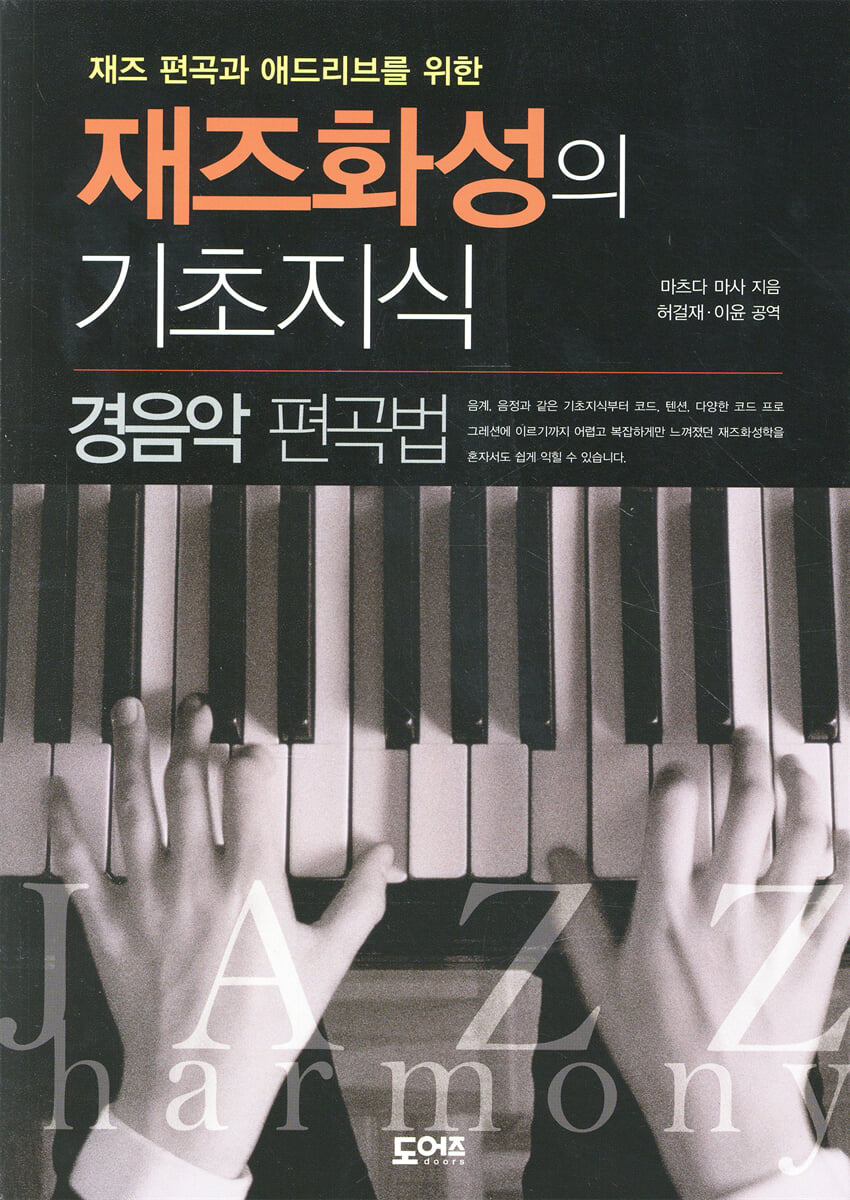
Basic knowledge of jazz harmony
 |
Description
Book Introduction
This is a jazz harmony textbook that helps students of practical music achieve a higher level of arrangement and performance.
From basic knowledge such as scales and intervals to chords, tensions, and various chord progressions, jazz harmony, which was once perceived as difficult and complex, can be easily learned through conversations between teachers and students.
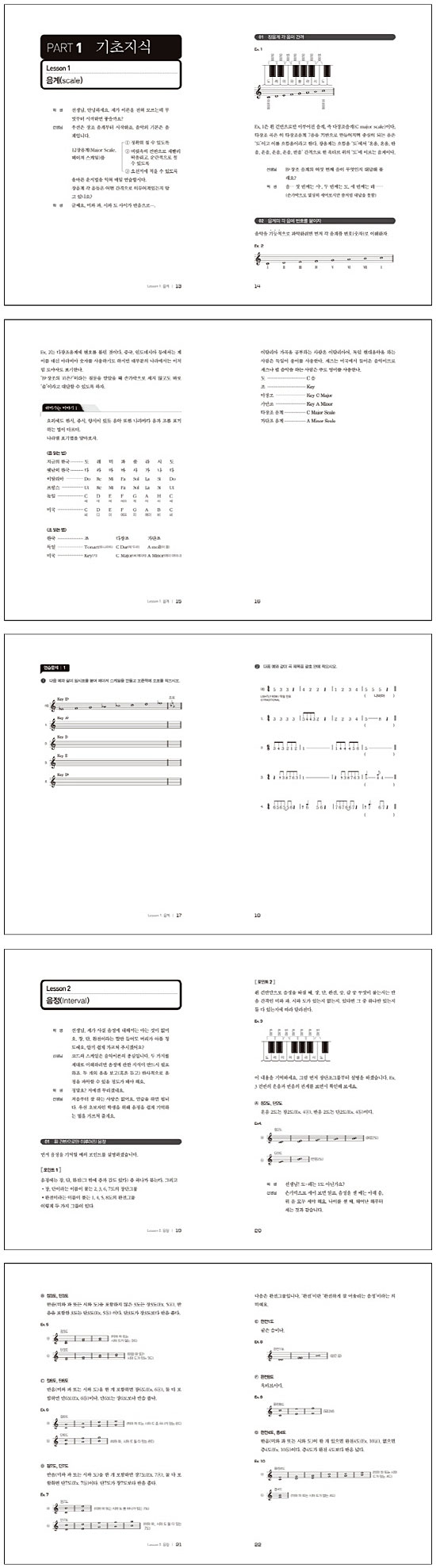
In addition, examples of sheet music are attached after sentence explanations so that you can learn it with both your hands and ears at the same time, and practice problems are included at the end of each unit so that you can check for yourself whether you have properly understood the content.
From basic knowledge such as scales and intervals to chords, tensions, and various chord progressions, jazz harmony, which was once perceived as difficult and complex, can be easily learned through conversations between teachers and students.
In addition, examples of sheet music are attached after sentence explanations so that you can learn it with both your hands and ears at the same time, and practice problems are included at the end of each unit so that you can check for yourself whether you have properly understood the content.
index
Part 1 Basic Knowledge
Lesson 1 Scale
Lesson 2 Interval
Lesson 3 Chord
Part 2 Code Progression 1
Lesson 4 Diatonic scale chords
Lesson 5: Tonic and Dominant, Dominant Motion
Lesson 6: Subdominant
Lesson 7: Connecting Tonic, Subdominant, and Dominant
Lesson 8 Secondary Dominant Seventh
Lesson 9 IIm7-V7 (Two Five)
Lesson 10: Substitute Chord of Dominant 7th
Lesson 11: Subdominant Minor and Substitute Chords
Lesson 12: Substitute Chord of Tonic
Lesson 13: Using Diminished Chords
Lesson 14 Chord Pattern
Part 3 Forging
Lesson 15: Minor Scale and Minor Chord Progression
Part 4 Tension
Lesson 16 Non-Chord Tones
Lesson 17 Tension
Lesson 18: Cliche
Part 5 Code Progression 2
Lesson 19: Extension of Dominant Sevenths
Lesson 20: Evolution of Code Patterns
Lesson 21: Deceptive Cadence
Lesson 22: Changing the order of 209
Lesson 23: Available Note Scale
Part 6 Code Progression 3
Lesson 24 Pedal Point (Sustained Sound)
Lesson 25: Various Fraction Chords - On Chord
Lesson 26: Turn Back
Part 7 Blues
Lesson 27: Blues and Blue Notes
Part 8 Summary
Part 9 Practice Problem Answers
Lesson 1 Scale
Lesson 2 Interval
Lesson 3 Chord
Part 2 Code Progression 1
Lesson 4 Diatonic scale chords
Lesson 5: Tonic and Dominant, Dominant Motion
Lesson 6: Subdominant
Lesson 7: Connecting Tonic, Subdominant, and Dominant
Lesson 8 Secondary Dominant Seventh
Lesson 9 IIm7-V7 (Two Five)
Lesson 10: Substitute Chord of Dominant 7th
Lesson 11: Subdominant Minor and Substitute Chords
Lesson 12: Substitute Chord of Tonic
Lesson 13: Using Diminished Chords
Lesson 14 Chord Pattern
Part 3 Forging
Lesson 15: Minor Scale and Minor Chord Progression
Part 4 Tension
Lesson 16 Non-Chord Tones
Lesson 17 Tension
Lesson 18: Cliche
Part 5 Code Progression 2
Lesson 19: Extension of Dominant Sevenths
Lesson 20: Evolution of Code Patterns
Lesson 21: Deceptive Cadence
Lesson 22: Changing the order of 209
Lesson 23: Available Note Scale
Part 6 Code Progression 3
Lesson 24 Pedal Point (Sustained Sound)
Lesson 25: Various Fraction Chords - On Chord
Lesson 26: Turn Back
Part 7 Blues
Lesson 27: Blues and Blue Notes
Part 8 Summary
Part 9 Practice Problem Answers
Detailed image
Publisher's Review
The Essential Guide to Jazz Arranging and Ad-Libbing
This book is a jazz harmony textbook that helps students of practical music achieve a higher level of arrangement and performance.
From basic knowledge such as scales and intervals to chords, tensions, and various chord progressions, jazz harmony, which was once perceived as difficult and complex, can be easily learned through conversations between teachers and students.
In addition, examples of sheet music are attached after sentence explanations so that you can learn it with both your hands and ears at the same time, and practice problems are included at the end of each unit so that you can check for yourself whether you have properly understood the content.
If you play the book's music scores yourself and gradually learn the content with your hands and ears, you will soon be able to find your own musical style.
There are many people who want to study arrangement and ad-lib.
This book was written to help such people understand music functionally and expand the possibilities of melody and chords, allowing them to make music more freely and enjoyably.
This book is organized so that you can choose the parts that are right for your level.
One thing I hope you will do is to play the sheet music and exercises presented as examples in this book on your instrument and confirm with your ears and hands.
I sincerely hope that readers will master this book and find their own musical style.
This book is a jazz harmony textbook that helps students of practical music achieve a higher level of arrangement and performance.
From basic knowledge such as scales and intervals to chords, tensions, and various chord progressions, jazz harmony, which was once perceived as difficult and complex, can be easily learned through conversations between teachers and students.
In addition, examples of sheet music are attached after sentence explanations so that you can learn it with both your hands and ears at the same time, and practice problems are included at the end of each unit so that you can check for yourself whether you have properly understood the content.
If you play the book's music scores yourself and gradually learn the content with your hands and ears, you will soon be able to find your own musical style.
There are many people who want to study arrangement and ad-lib.
This book was written to help such people understand music functionally and expand the possibilities of melody and chords, allowing them to make music more freely and enjoyably.
This book is organized so that you can choose the parts that are right for your level.
One thing I hope you will do is to play the sheet music and exercises presented as examples in this book on your instrument and confirm with your ears and hands.
I sincerely hope that readers will master this book and find their own musical style.
GOODS SPECIFICS
- Date of issue: June 7, 2011
- Page count, weight, size: 326 pages | 611g | 210*297*30mm
- ISBN13: 9788996607236
- ISBN10: 8996607231
You may also like
카테고리
korean


korean

![GQ KOREA Mark (Monthly): December [2025]](http://librairie.coreenne.fr/cdn/shop/files/8ef265dbbfbf186523ed75ba7319009d.jpg?v=1765340328&width=3840)


