

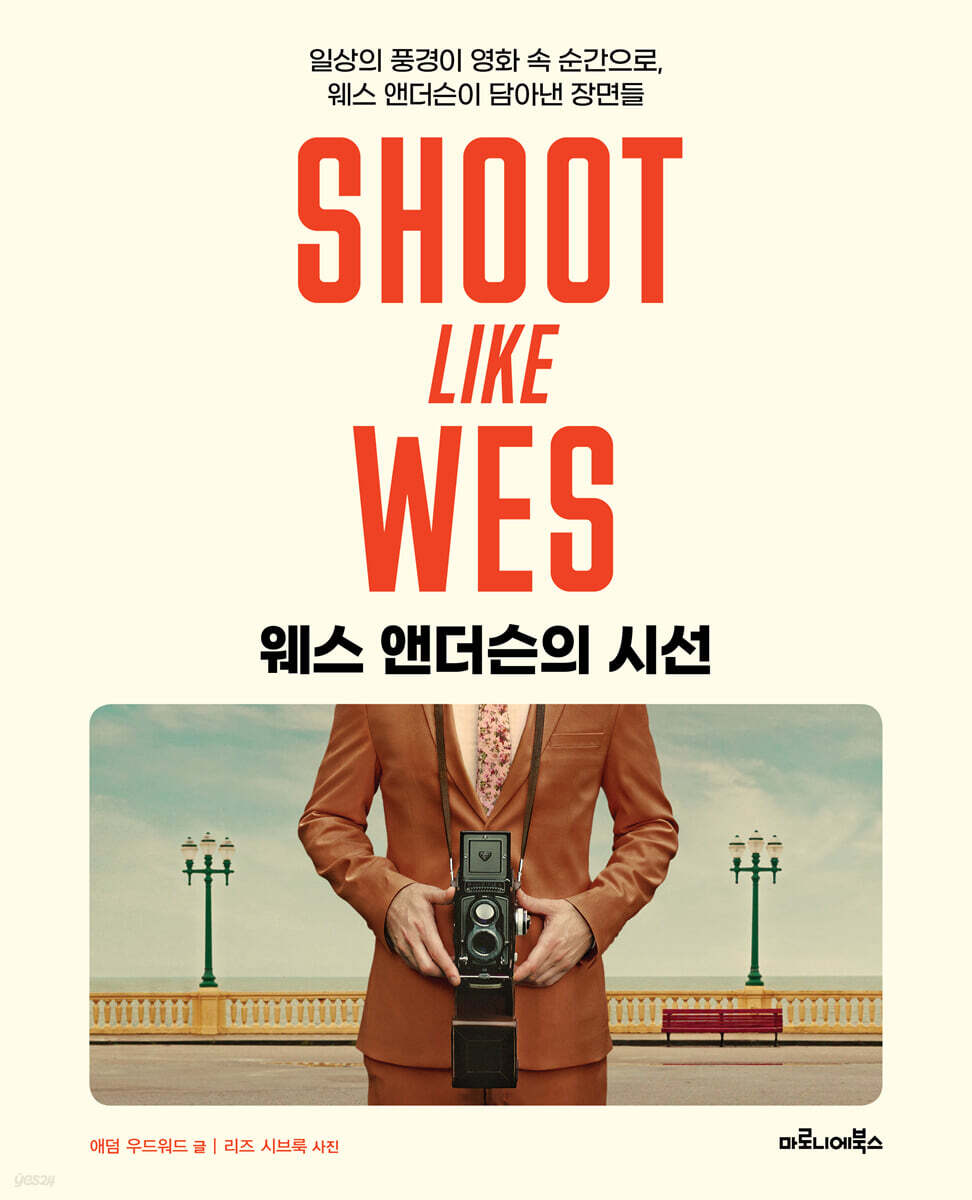
Wes Anderson's gaze
 |
Description
Book Introduction
Wes Anderson, a director beloved for his sensual visual beauty and storytelling
His aesthetics as seen through the images and filming techniques in his films.
Soft pastel colors, cute props, and people in neat compositions.
When looking at these elements, there is a person who naturally comes to mind.
That's film director Wes Anderson.
Known for films such as The Phoenician Scheme, The Grand Budapest Hotel, and Moonrise Kingdom, he is widely loved for his delicate and beautiful film style.
"Wes Anderson's Gaze" is a book that examines the aesthetics of Wes Anderson, who has become a byword, through his films and filming techniques.
Beginning with his feature-length debut, Bottle Rocket, the series introduces 11 films one by one, delving into the images and filming techniques used in each film.
At the end of each chapter, there are step-by-step 'photography exercises' that allow readers to practice photography techniques by taking their own photos.
We've also included a list of useful photography and filming terms and image-related programs, so anyone interested in Wes Anderson's style can try their hand at shooting and editing.
Through scenes from Wes Anderson's films contained in this book, you can learn how he creates images and what effects certain directing techniques have.
And by taking and editing photos with your own camera, you can personally experience the format and content that make up his film world.
This is an excellent guide to creating your own Wes Anderson world, where even ordinary scenery becomes a movie moment.
His aesthetics as seen through the images and filming techniques in his films.
Soft pastel colors, cute props, and people in neat compositions.
When looking at these elements, there is a person who naturally comes to mind.
That's film director Wes Anderson.
Known for films such as The Phoenician Scheme, The Grand Budapest Hotel, and Moonrise Kingdom, he is widely loved for his delicate and beautiful film style.
"Wes Anderson's Gaze" is a book that examines the aesthetics of Wes Anderson, who has become a byword, through his films and filming techniques.
Beginning with his feature-length debut, Bottle Rocket, the series introduces 11 films one by one, delving into the images and filming techniques used in each film.
At the end of each chapter, there are step-by-step 'photography exercises' that allow readers to practice photography techniques by taking their own photos.
We've also included a list of useful photography and filming terms and image-related programs, so anyone interested in Wes Anderson's style can try their hand at shooting and editing.
Through scenes from Wes Anderson's films contained in this book, you can learn how he creates images and what effects certain directing techniques have.
And by taking and editing photos with your own camera, you can personally experience the format and content that make up his film world.
This is an excellent guide to creating your own Wes Anderson world, where even ordinary scenery becomes a movie moment.
- You can preview some of the book's contents.
Preview
index
Recommendation - Robert Yeoman
Recommendation - Laura Wilson
introduction
Things to consider before shooting
1.
Bottle Rocket - How to Use Natural Light
Photography Practice: Magic Hour Photography
2.
Max Falls in Love - How to Use Color
Photography Practice: Color Composition
3.
The Royal Tenenbaums - How to Use Omniscient Point of View
Photography Practice: Shooting Overhead Shots
4.
The Life Aquatic with Steve Zissou - How to Widen the Frame
Photography Practice: Deep Focus
5.
Dazzling Co. - How to Take Group Portrait Photos
Photography Practice: Group Portraits
6.
Fantastic Mr.
Fox - How to Shoot from a Low Angle
Photography Practice: Hero Shot
7.
Moonrise Kingdom - How to Shoot Close-Ups
Photography Practice: Framing Faces
8.
The Grand Budapest Hotel - How to Create Symmetry
Photography Practice: Short - Reverse Shot
9.
Isle of Dogs - How to Use First-Person View
Photography Practice: First-Person Perspective
10.
French Dispatch - How to Use Props
Photography Practice: Andersonian Arrangement
11.
Asteroid City - How to Photograph Buildings
Photography Practice: Wide-Angle Exterior Shots
Other materials
Recommended list
Filmography
Search
brief history
Acknowledgements
Recommendation - Laura Wilson
introduction
Things to consider before shooting
1.
Bottle Rocket - How to Use Natural Light
Photography Practice: Magic Hour Photography
2.
Max Falls in Love - How to Use Color
Photography Practice: Color Composition
3.
The Royal Tenenbaums - How to Use Omniscient Point of View
Photography Practice: Shooting Overhead Shots
4.
The Life Aquatic with Steve Zissou - How to Widen the Frame
Photography Practice: Deep Focus
5.
Dazzling Co. - How to Take Group Portrait Photos
Photography Practice: Group Portraits
6.
Fantastic Mr.
Fox - How to Shoot from a Low Angle
Photography Practice: Hero Shot
7.
Moonrise Kingdom - How to Shoot Close-Ups
Photography Practice: Framing Faces
8.
The Grand Budapest Hotel - How to Create Symmetry
Photography Practice: Short - Reverse Shot
9.
Isle of Dogs - How to Use First-Person View
Photography Practice: First-Person Perspective
10.
French Dispatch - How to Use Props
Photography Practice: Andersonian Arrangement
11.
Asteroid City - How to Photograph Buildings
Photography Practice: Wide-Angle Exterior Shots
Other materials
Recommended list
Filmography
Search
brief history
Acknowledgements
Detailed image

Into the book
In Wes' vibrant cinematic world, color shapes not only visual aesthetics but also the language of emotion.
The director's second feature film, Max and the Boys in Love, is a testament to this, with its primary red and blue color palette helping to set the mood and express the characters' various emotions.
--- p.31, from "Max Falls in Love - How to Use Color"
Whenever Wes uses an overhead shot, he wants to convey important information about the character or plot to the audience.
For example, the prologue to The Royal Tenenbaums offers a glimpse into the extraordinary lives of the three Tenenbaum siblings through an overhead shot sequence in which the narrator (Alec Baldwin) lists their remarkable accomplishments.
--- p.45, from “The Royal Tenenbaums - How to Use Omniscient Point of View”
Wide-angle shots are an essential element of Wes' film toolbox.
Cinematographer Robert Yeoman frequently uses anamorphic lenses to create scenes with deep depth and panoramic backgrounds that capture multiple characters.
Since most of the story in "The Life Aquatic with Steve Zissou" takes place at sea, it's only natural that Wess would actively use wide-angle shots throughout the film to capture the vastness of the open ocean.
--- p.57, from "Life Underwater with Steve Zissou - How to Broaden the Frame"
Wes' signature style reaches new heights in Dazzling Limited.
In this film, he explores themes of brotherhood, identity and belonging against a colorful and hectic backdrop.
At the heart of Wes' visual storytelling is his unique group portrait photography technique.
This technique serves as a lens through which to examine family dynamics and the complexities of human relationships.
--- p.69, from "Dazzling Co., Ltd. - How to Take Group Portrait Photos"
A coming-of-age romance about young lovers on the run, Moonrise Kingdom is filled with intimate moments that highlight the innocence and vulnerability of its early-teenage protagonists.
Wes's use of close-ups reveals Sam (Jared Gilman) and Susie's (Kara Hayward) devotion to one another, connecting the characters and the audience on a deep emotional level as they journey across the fictional island of New Pen Zance.
--- p.93, from "Moonrise Kingdom - Close-up Photography Method"
Of Wes' stylistic grammar, symmetry is perhaps the most well-known yet least understood element.
In his films, Wes Anderson's meticulous composition creates an overall sense of balance and order, which serves as a counterpoint to the story's unpredictability.
--- p.105, from “The Grand Budapest Hotel - How to Create Symmetry”
Wes uses a first-person perspective early in Isle of Dogs when two rival packs of dogs fight over a pile of rotting food.
In most cases, he prefers to shoot from a first-person perspective, looking down on the subject, which is captured in the frame as if looking at the subject from the character's perspective.
This technique allows for a lot of information to be conveyed in one scene, and in Isle of Dogs it also serves as a way to show off the elaborate handcrafted props used in the film - things like trash bags and severed ears.
--- p.119, from “Isle of Dogs - How to Use the First-Person Point of View”
In "The French Dispatch," Wes shows how powerful props can be in world-building.
Props range from handmade graphic elements that appear in the background to physical objects with their own narrative.
The director's second feature film, Max and the Boys in Love, is a testament to this, with its primary red and blue color palette helping to set the mood and express the characters' various emotions.
--- p.31, from "Max Falls in Love - How to Use Color"
Whenever Wes uses an overhead shot, he wants to convey important information about the character or plot to the audience.
For example, the prologue to The Royal Tenenbaums offers a glimpse into the extraordinary lives of the three Tenenbaum siblings through an overhead shot sequence in which the narrator (Alec Baldwin) lists their remarkable accomplishments.
--- p.45, from “The Royal Tenenbaums - How to Use Omniscient Point of View”
Wide-angle shots are an essential element of Wes' film toolbox.
Cinematographer Robert Yeoman frequently uses anamorphic lenses to create scenes with deep depth and panoramic backgrounds that capture multiple characters.
Since most of the story in "The Life Aquatic with Steve Zissou" takes place at sea, it's only natural that Wess would actively use wide-angle shots throughout the film to capture the vastness of the open ocean.
--- p.57, from "Life Underwater with Steve Zissou - How to Broaden the Frame"
Wes' signature style reaches new heights in Dazzling Limited.
In this film, he explores themes of brotherhood, identity and belonging against a colorful and hectic backdrop.
At the heart of Wes' visual storytelling is his unique group portrait photography technique.
This technique serves as a lens through which to examine family dynamics and the complexities of human relationships.
--- p.69, from "Dazzling Co., Ltd. - How to Take Group Portrait Photos"
A coming-of-age romance about young lovers on the run, Moonrise Kingdom is filled with intimate moments that highlight the innocence and vulnerability of its early-teenage protagonists.
Wes's use of close-ups reveals Sam (Jared Gilman) and Susie's (Kara Hayward) devotion to one another, connecting the characters and the audience on a deep emotional level as they journey across the fictional island of New Pen Zance.
--- p.93, from "Moonrise Kingdom - Close-up Photography Method"
Of Wes' stylistic grammar, symmetry is perhaps the most well-known yet least understood element.
In his films, Wes Anderson's meticulous composition creates an overall sense of balance and order, which serves as a counterpoint to the story's unpredictability.
--- p.105, from “The Grand Budapest Hotel - How to Create Symmetry”
Wes uses a first-person perspective early in Isle of Dogs when two rival packs of dogs fight over a pile of rotting food.
In most cases, he prefers to shoot from a first-person perspective, looking down on the subject, which is captured in the frame as if looking at the subject from the character's perspective.
This technique allows for a lot of information to be conveyed in one scene, and in Isle of Dogs it also serves as a way to show off the elaborate handcrafted props used in the film - things like trash bags and severed ears.
--- p.119, from “Isle of Dogs - How to Use the First-Person Point of View”
In "The French Dispatch," Wes shows how powerful props can be in world-building.
Props range from handmade graphic elements that appear in the background to physical objects with their own narrative.
--- p.131, from "French Dispatch - How to Use Props"
Publisher's Review
From the characters and props to the light and background
Wes Anderson's Cinematic World Unraveled Through Filming Techniques
This book focuses on the core cinematographic techniques of Wes Anderson's films.
A variety of techniques are introduced, from shooting using natural light to capturing buildings and backgrounds.
For example, 'magic hour photography', 'deep focus', 'low angle photography', 'framing faces', 'color composition', 'storytelling with props', 'group portraits', 'first-person perspective', 'overhead shots', 'utilizing symmetry', and 'wide-angle exterior shots'.
Wes Anderson doesn't just use these techniques as tools to look cool.
This is used to create a natural connection between form and content.
For example, in “The Grand Budapest Hotel,” the film frequently uses a symmetrical composition that places characters side by side, and extends this to the film’s structure.
The story unfolds in a 'story within a story within a story' structure, and each story is directed to be symmetrical to the other.
In this way, the symmetrical composition seen in one scene is repeated in the structure of the film, conveying the message of the story more powerfully.
Wes Anderson's films are intricately interwoven with each element, creating new meaning as the form and story continue.
This book helps you discover these elements through his signature filming techniques, deepening your understanding and appreciation of Wes Anderson's world.
A gaze that transforms even ordinary scenery into a cinematic moment
Let's try our own take on Wes Anderson's sensibility.
There's something special about scenes captured through Wes Anderson's eyes.
Since he first unveiled his work to the world, audiences have shown a special affection for Wes Anderson's signature beautiful mise-en-scène and resonant stories.
This is not something that happens by chance.
He transforms ordinary landscapes into cinematic moments by incorporating dense frame composition, distinctive retro costumes and set design, and neatly composed shots into the characters and story at the right time.
This book goes beyond simply analyzing films; it's a hands-on, hands-on format that allows readers to take photos like Wes Anderson.
This tutorial uses minimal technical jargon, can be done on a smartphone, and is guided step-by-step, making it easy for anyone interested in Wes Anderson's style.
By following the techniques in the book, selecting locations, decorating sets, and shooting people and landscapes, you can experience Wes Anderson's sensuous gaze and visual beauty firsthand.
In this process, you will come to realize what kind of intention and meaning can be contained in even a single photograph.
“Let’s take a camera in hand, reminisce about Wes Anderson, and transform ordinary moments into cinematic scenes.”
Wes Anderson's Cinematic World Unraveled Through Filming Techniques
This book focuses on the core cinematographic techniques of Wes Anderson's films.
A variety of techniques are introduced, from shooting using natural light to capturing buildings and backgrounds.
For example, 'magic hour photography', 'deep focus', 'low angle photography', 'framing faces', 'color composition', 'storytelling with props', 'group portraits', 'first-person perspective', 'overhead shots', 'utilizing symmetry', and 'wide-angle exterior shots'.
Wes Anderson doesn't just use these techniques as tools to look cool.
This is used to create a natural connection between form and content.
For example, in “The Grand Budapest Hotel,” the film frequently uses a symmetrical composition that places characters side by side, and extends this to the film’s structure.
The story unfolds in a 'story within a story within a story' structure, and each story is directed to be symmetrical to the other.
In this way, the symmetrical composition seen in one scene is repeated in the structure of the film, conveying the message of the story more powerfully.
Wes Anderson's films are intricately interwoven with each element, creating new meaning as the form and story continue.
This book helps you discover these elements through his signature filming techniques, deepening your understanding and appreciation of Wes Anderson's world.
A gaze that transforms even ordinary scenery into a cinematic moment
Let's try our own take on Wes Anderson's sensibility.
There's something special about scenes captured through Wes Anderson's eyes.
Since he first unveiled his work to the world, audiences have shown a special affection for Wes Anderson's signature beautiful mise-en-scène and resonant stories.
This is not something that happens by chance.
He transforms ordinary landscapes into cinematic moments by incorporating dense frame composition, distinctive retro costumes and set design, and neatly composed shots into the characters and story at the right time.
This book goes beyond simply analyzing films; it's a hands-on, hands-on format that allows readers to take photos like Wes Anderson.
This tutorial uses minimal technical jargon, can be done on a smartphone, and is guided step-by-step, making it easy for anyone interested in Wes Anderson's style.
By following the techniques in the book, selecting locations, decorating sets, and shooting people and landscapes, you can experience Wes Anderson's sensuous gaze and visual beauty firsthand.
In this process, you will come to realize what kind of intention and meaning can be contained in even a single photograph.
“Let’s take a camera in hand, reminisce about Wes Anderson, and transform ordinary moments into cinematic scenes.”
GOODS SPECIFICS
- Date of issue: September 17, 2025
- Format: Hardcover book binding method guide
- Page count, weight, size: 160 pages | 185*230*20mm
- ISBN13: 9788960536739
- ISBN10: 8960536733
You may also like
카테고리
korean


korean

![GQ KOREA Mark (Monthly): December [2025]](http://librairie.coreenne.fr/cdn/shop/files/8ef265dbbfbf186523ed75ba7319009d.jpg?v=1765340328&width=3840)


