

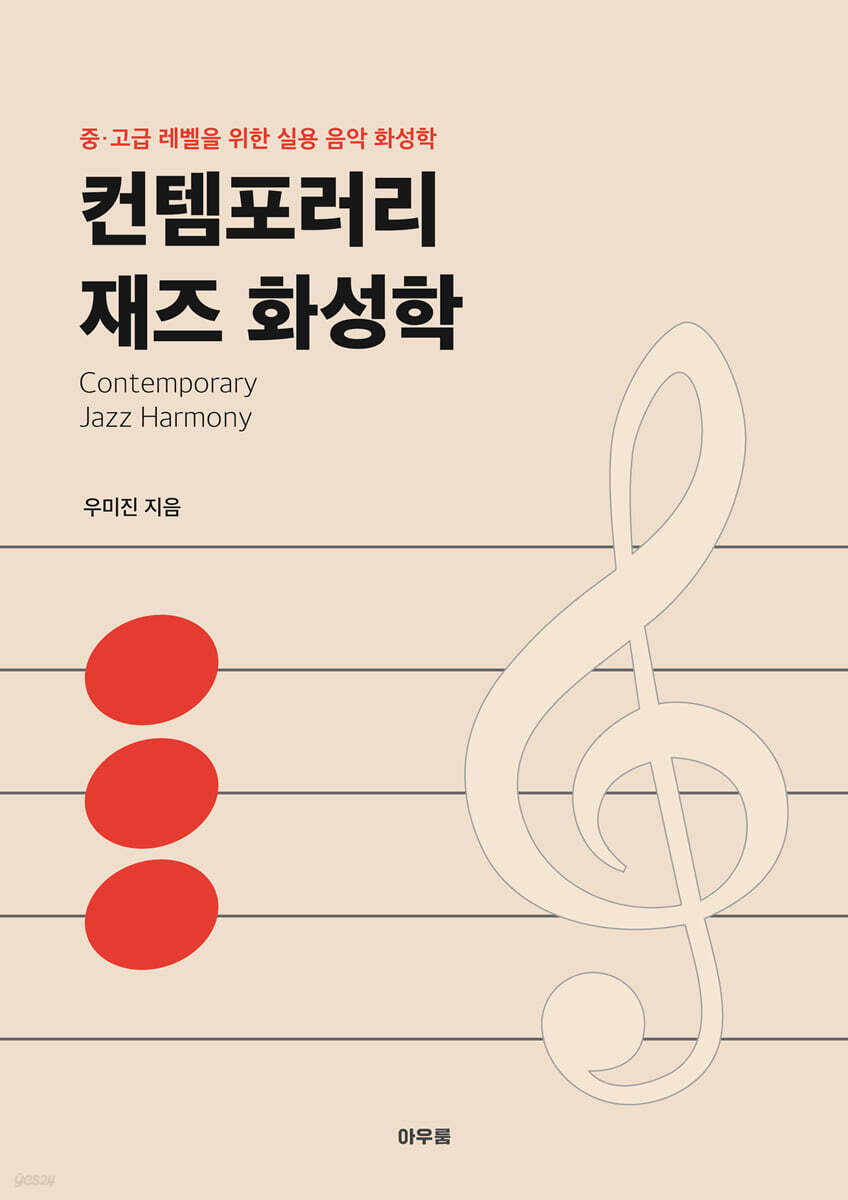
Contemporary Jazz Harmony
 |
Description
Book Introduction
A practical theory book that guides you into the deeper world of jazz harmony.
This book is a practical theory book written by the author, a performer and educator, based on the know-how he has accumulated while teaching jazz harmony at a university level for a long time.
After learning basic harmony, we have selected and organized the essential content for learners who want to systematically learn more advanced jazz harmony concepts.
The focus was on creating a contemporary jazz sound, with practical musical applications in mind, including composition, arrangement, and improvisation.
Each chapter clearly and systematically explains concepts that make tonal music ambiguous, such as harmonic progression, chord voicing, rhythm and beat, and modulation, and helps learners understand through various sheet music examples and tables.
Additionally, practice problems and answer guides are included at the end of each chapter to help you learn the theory and check it yourself.
In addition to its usability as a college textbook, it provides a three-dimensional learning experience by providing lecture videos and problem explanations in conjunction with the YouTube channel “Jazzgraphy.”
This book is a practical theory book written by the author, a performer and educator, based on the know-how he has accumulated while teaching jazz harmony at a university level for a long time.
After learning basic harmony, we have selected and organized the essential content for learners who want to systematically learn more advanced jazz harmony concepts.
The focus was on creating a contemporary jazz sound, with practical musical applications in mind, including composition, arrangement, and improvisation.
Each chapter clearly and systematically explains concepts that make tonal music ambiguous, such as harmonic progression, chord voicing, rhythm and beat, and modulation, and helps learners understand through various sheet music examples and tables.
Additionally, practice problems and answer guides are included at the end of each chapter to help you learn the theory and check it yourself.
In addition to its usability as a college textbook, it provides a three-dimensional learning experience by providing lecture videos and problem explanations in conjunction with the YouTube channel “Jazzgraphy.”
- You can preview some of the book's contents.
Preview
index
Prologue_3
Before entering the book _ 4
Four Areas of Harmony _ 6
Chapter 1.
Deceptive Resolution
Deceptive Resolution of 01Ⅴ7 ...14
02 False Resolution of Secondary Dominant...18
03 False Resolution of Extended Dominant...31
04 Contiguous Harmonic Pattern ...34
Practice Problem ...37
Chapter 2.
Modal Interchange
01 Diatonic Harmony ...42
02 Other modes ...48
03 Diatonic Chord Scale ...52
04 Types of Modal Interchanges ...55
Practice Problem ...58
Chapter 3.
Multi-Functional Harmony
01 Hybrid Code (Hybrids) ...64
02 Sus4 code ...76
03 Incomplete Chord ...80
Practice Problem ...82
Chapter 4.
Harmonic Rhythm
01 Fast Harmonic Rhythm ...86
02 Slow Harmonic Rhythm ...88
03 Application of Harmonic Rhythm...90
Practice Problem ...92
Chapter 5.
Diminished Chord
01 Properties of Diminished Codes ...96
02 Types of Diminished Chords ...99
03 Diminished Chord Scale ...105
04 Examples and Applications ...111
Practice Problem ...113
Chapter 6.
Metric Modulation
01 If the length of one word is maintained...118
02 If the length of a single word is not maintained...122
03 Example Analysis ...126
Practice Problems ...128
Chapter 7.
Modulation
01 Key Relationship...132
02 Types of Modulation Recognition ...141
Practice Problem ...153
Chapter 8.
Constant Structure
01 Constant Cycle ...156
02 Tonic System ...158
03 Harmonic Motive ...163
04 The Relationship Between Melody and Chords...167
Practice Problems ...169
Chapter 9.
Multi-Tonic System
01 3 Tonic System ...174
02 4 Tonic System ...182
03 6 Tonic System ...187
04 Random Tonic System ...190
Practice Problems...192
Chapter 10.
Contemporary Chord Voicing Techniques
01 Upper Structure Voicings ...196
02 Modal Voicings and Pandiatonic Harmony ...202
03 Polychords ...207
04 Application of Contemporary Chord Voicing ...213
Practice Problem ...215
Epilogue: Concluding the Book _ 217
Practice Problem Answer Guide _ 219
Before entering the book _ 4
Four Areas of Harmony _ 6
Chapter 1.
Deceptive Resolution
Deceptive Resolution of 01Ⅴ7 ...14
02 False Resolution of Secondary Dominant...18
03 False Resolution of Extended Dominant...31
04 Contiguous Harmonic Pattern ...34
Practice Problem ...37
Chapter 2.
Modal Interchange
01 Diatonic Harmony ...42
02 Other modes ...48
03 Diatonic Chord Scale ...52
04 Types of Modal Interchanges ...55
Practice Problem ...58
Chapter 3.
Multi-Functional Harmony
01 Hybrid Code (Hybrids) ...64
02 Sus4 code ...76
03 Incomplete Chord ...80
Practice Problem ...82
Chapter 4.
Harmonic Rhythm
01 Fast Harmonic Rhythm ...86
02 Slow Harmonic Rhythm ...88
03 Application of Harmonic Rhythm...90
Practice Problem ...92
Chapter 5.
Diminished Chord
01 Properties of Diminished Codes ...96
02 Types of Diminished Chords ...99
03 Diminished Chord Scale ...105
04 Examples and Applications ...111
Practice Problem ...113
Chapter 6.
Metric Modulation
01 If the length of one word is maintained...118
02 If the length of a single word is not maintained...122
03 Example Analysis ...126
Practice Problems ...128
Chapter 7.
Modulation
01 Key Relationship...132
02 Types of Modulation Recognition ...141
Practice Problem ...153
Chapter 8.
Constant Structure
01 Constant Cycle ...156
02 Tonic System ...158
03 Harmonic Motive ...163
04 The Relationship Between Melody and Chords...167
Practice Problems ...169
Chapter 9.
Multi-Tonic System
01 3 Tonic System ...174
02 4 Tonic System ...182
03 6 Tonic System ...187
04 Random Tonic System ...190
Practice Problems...192
Chapter 10.
Contemporary Chord Voicing Techniques
01 Upper Structure Voicings ...196
02 Modal Voicings and Pandiatonic Harmony ...202
03 Polychords ...207
04 Application of Contemporary Chord Voicing ...213
Practice Problem ...215
Epilogue: Concluding the Book _ 217
Practice Problem Answer Guide _ 219
Detailed image

Publisher's Review
"Contemporary Jazz Harmony" is a specialized textbook that delves into the essence of jazz harmony and guides readers beyond conventional functional harmony into a creative and expanded world of harmony.
This book goes beyond simple theoretical explanations and comprehensively covers advanced harmonic techniques such as Deceptive Resolution, Modal Interchange, Multi-Tonic System, Metric Modulation, and Constant Structure, which reflect the actual flow of modern music.
In particular, the various example analyses and practical exercises provided in each chapter are designed to help learners internalize the theory and immediately apply it to composing, arranging, and reharmonizing.
The greatest strength of this book is its perfect balance of theory and practice.
Moving beyond simply listing concepts, it vividly demonstrates how harmonic techniques work within music through analysis of actual pieces spanning classical and jazz.
For example, examples of reharmonization in Beethoven's 'Pathetique Sonata' or examples of harmonic patterns in the jazz standard 'Giant Steps' clearly show the reader how tradition and modernity are connected and varied.
This is not simply a transfer of knowledge, but a training that expands musical thinking.
Author Woomi Jin studied at Berklee College of Music and Manhattan School of Music, and wrote this book based on her solid practical experience gained through releasing numerous regular albums and giving lectures both domestically and internationally.
The author's expertise, currently teaching jazz harmony at a university level, is fully reflected in the systematic yet practical learning structure.
Each chapter is carefully designed to allow learners to progress step by step, with the structure of core concept explanation → theoretical analysis → real music examples → application practice problems.
Through this book, readers can expect the following learning effects:
- Systematic acquisition of modern musical grammar: starting from functional harmony and gradually expanding to non-functional harmony and post-tonal harmony.
- Improve creative composition and arrangement skills: Practical use of contemporary voicing techniques such as Upper Structure Voicing, Polychord, and Hybrid Chord.
- Strengthen analytical skills: Practical exercises that apply advanced harmonic patterns to music, providing insights directly related to composition and performance.
This book is highly recommended for the following readers:
- Applied Music/Jazz Majors: College students and professional musicians who want to learn modern harmonic language beyond traditional theory.
- Composers, arrangers, and aspiring arrangers: Creators who want to explore new sounds and reharmonization.
- Preparatory and advanced learners: Self-taught students who are looking for a more advanced textbook after completing basic Mars studies.
"Contemporary Jazz Harmony" is more than just a textbook; it's an intellectual journey to learn the creative language of contemporary music.
If you want to break away from traditional functional harmony and explore a more free and sophisticated musical world, this book will perfectly guide you on your journey.
If the Mars we've learned so far was 'basic grammar,' this book is the definitive edition that goes beyond grammar and teaches 'freedom of expression.'
This book goes beyond simple theoretical explanations and comprehensively covers advanced harmonic techniques such as Deceptive Resolution, Modal Interchange, Multi-Tonic System, Metric Modulation, and Constant Structure, which reflect the actual flow of modern music.
In particular, the various example analyses and practical exercises provided in each chapter are designed to help learners internalize the theory and immediately apply it to composing, arranging, and reharmonizing.
The greatest strength of this book is its perfect balance of theory and practice.
Moving beyond simply listing concepts, it vividly demonstrates how harmonic techniques work within music through analysis of actual pieces spanning classical and jazz.
For example, examples of reharmonization in Beethoven's 'Pathetique Sonata' or examples of harmonic patterns in the jazz standard 'Giant Steps' clearly show the reader how tradition and modernity are connected and varied.
This is not simply a transfer of knowledge, but a training that expands musical thinking.
Author Woomi Jin studied at Berklee College of Music and Manhattan School of Music, and wrote this book based on her solid practical experience gained through releasing numerous regular albums and giving lectures both domestically and internationally.
The author's expertise, currently teaching jazz harmony at a university level, is fully reflected in the systematic yet practical learning structure.
Each chapter is carefully designed to allow learners to progress step by step, with the structure of core concept explanation → theoretical analysis → real music examples → application practice problems.
Through this book, readers can expect the following learning effects:
- Systematic acquisition of modern musical grammar: starting from functional harmony and gradually expanding to non-functional harmony and post-tonal harmony.
- Improve creative composition and arrangement skills: Practical use of contemporary voicing techniques such as Upper Structure Voicing, Polychord, and Hybrid Chord.
- Strengthen analytical skills: Practical exercises that apply advanced harmonic patterns to music, providing insights directly related to composition and performance.
This book is highly recommended for the following readers:
- Applied Music/Jazz Majors: College students and professional musicians who want to learn modern harmonic language beyond traditional theory.
- Composers, arrangers, and aspiring arrangers: Creators who want to explore new sounds and reharmonization.
- Preparatory and advanced learners: Self-taught students who are looking for a more advanced textbook after completing basic Mars studies.
"Contemporary Jazz Harmony" is more than just a textbook; it's an intellectual journey to learn the creative language of contemporary music.
If you want to break away from traditional functional harmony and explore a more free and sophisticated musical world, this book will perfectly guide you on your journey.
If the Mars we've learned so far was 'basic grammar,' this book is the definitive edition that goes beyond grammar and teaches 'freedom of expression.'
GOODS SPECIFICS
- Date of issue: July 31, 2025
- Page count, weight, size: 242 pages | 210*297*20mm
- ISBN13: 9791191184846
- ISBN10: 1191184846
You may also like
카테고리
korean


korean

![GQ KOREA Mark (Monthly): December [2025]](http://librairie.coreenne.fr/cdn/shop/files/8ef265dbbfbf186523ed75ba7319009d.jpg?v=1765340328&width=3840)


