

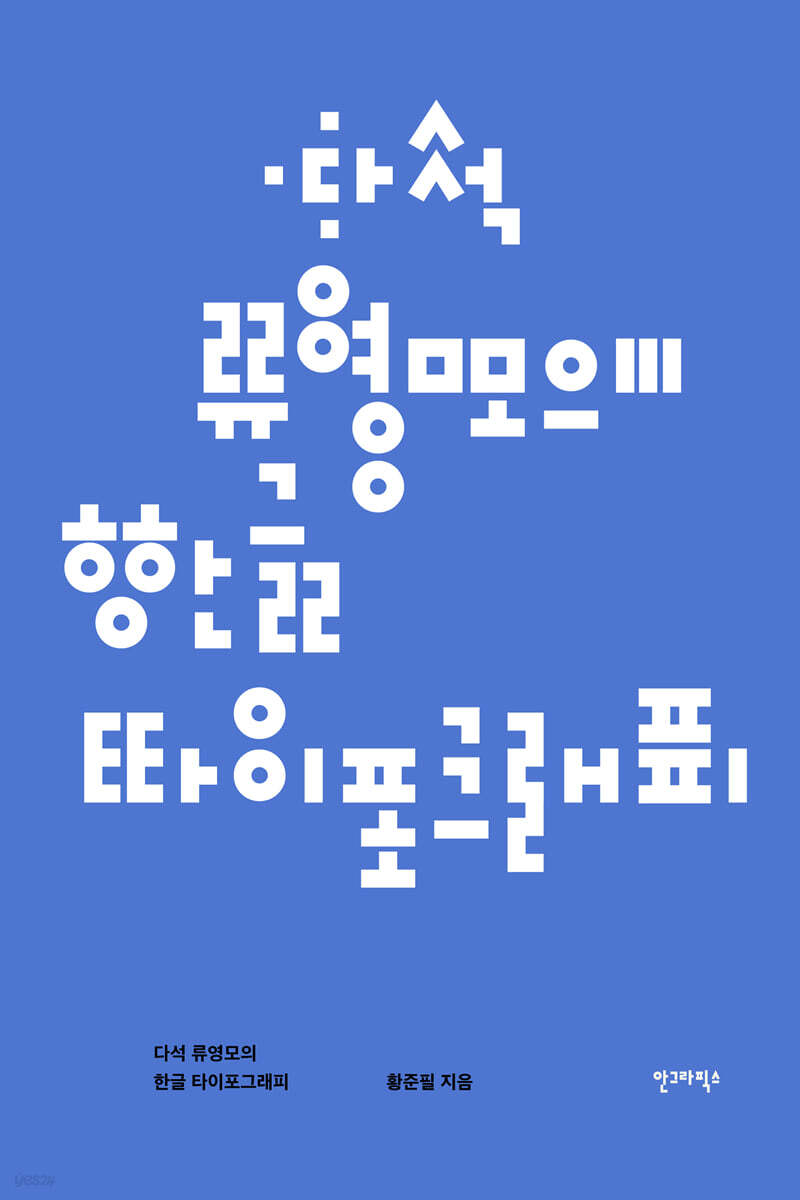
Korean typography by Dasuk Ryu Yeong-mo
 |
Description
Book Introduction
Ryu Yeong-mo (1890-1981) was a great thinker, philosopher, and religious figure in Korea. He was well-versed in Eastern and Western religions and philosophies, including Christianity, Buddhism, and Confucianism, and he combined them to create an original system of thought.
He is known as the first thinker to philosophize in our language and writing, and left behind 『Daseok Ilji』, a diary in which he recorded his thoughts and daily enlightenment.
This book interprets the meaning contained in the letters of Daseok, who attempted to explain the world using Hangul as a material, through typography, including the font design and font images.
Through this, the expressive scope of Hangul expands, and Hangul typography becomes the language of philosophy.
He is known as the first thinker to philosophize in our language and writing, and left behind 『Daseok Ilji』, a diary in which he recorded his thoughts and daily enlightenment.
This book interprets the meaning contained in the letters of Daseok, who attempted to explain the world using Hangul as a material, through typography, including the font design and font images.
Through this, the expressive scope of Hangul expands, and Hangul typography becomes the language of philosophy.
- You can preview some of the book's contents.
Preview
index
Recommended articles
Opening remarks
1. Top. Head.
2 See.R.G.L.Si.P.E.N.Y.
Meaning. Made. Note.
Add. Additional. Letter.
Letter. In. Letter.
Meaning. Picture. Text.
Layer. Meaning. Text.
Right. Same. Letter.
Bbang. Tang. Letter.
Round. Letter.
3. Welcome to the Seok-al Festival.
4 letters. Cool.
5 Korean.
Concluding remarks
References
annotation
Opening remarks
1. Top. Head.
2 See.R.G.L.Si.P.E.N.Y.
Meaning. Made. Note.
Add. Additional. Letter.
Letter. In. Letter.
Meaning. Picture. Text.
Layer. Meaning. Text.
Right. Same. Letter.
Bbang. Tang. Letter.
Round. Letter.
3. Welcome to the Seok-al Festival.
4 letters. Cool.
5 Korean.
Concluding remarks
References
annotation
Detailed image

Into the book
The purpose of this book is to help readers understand the content by appreciating each piece individually.
The Korean story serves as a way to open the mind and make it easier to appreciate the work and get inspired.
You can read it, or you can skip it.
However, if you go through several sentences, it will be easier to write the work.
You can enjoy it.
---From the "Opening Remarks"
『Daseok Ilji』 consists of approximately 1,300 Chinese poems, 1,700 sijo poems, and Korean typography works that are open to various interpretations.
Dasok recorded his thoughts every day like a logbook.
After the discovery of the Hunminjeongeum Haeryebon, Ryu Yeong-mo of Da-seok was educated in Chinese classics and was well-versed in various types of scriptures, to the extent that he asked Da-seok to interpret the Chinese characters during the first interpretation process.
Chinese characters also appear in many parts of 『Daseok Ilji』.
As you progress through the latter part of 『Daseok Ilji』, the use of Chinese characters decreases and the use of Korean increases.
Chinese characters alone would not have been enough for Daseok to express his thoughts.
It must have been considered that Hangul was suitable as an ideal and conceptual symbol to describe the universe, the world, and humanity.
Compared to Chinese characters, which are pictographic characters, Hangul, which was created based on philosophical principles, allows for easier and more diverse changes in meaning.
When Korean letters come together, combinations of letters can be created that create new meanings.
It is a semantic representation system that structurally allows for semantic design.
---From "Chapter 1 - Sot-al. Head."
Among the words that describe people, there is 'geut'.
The point that is drawn is called the end, and the end is the point that is gathered at the end.
The letter G is a mental line that falls from the long horizontal sky and is drawn vertically.
When this spirit meets the world, a person is born.
It means that humans are the beings created when the spirit of heaven meets the world.
Man is the essence of thought, the spirit, life, and the path to eternity.
The image of a person who receives a spirit from heaven and lives in this world is contained in 'Geut'.
If 'ㄱㆍㄴ' expresses humans between the sky and the earth, between time and space, '그' expresses humans as spiritual beings.
In this way, Daseok added his own thoughts to the unique philosophical meaning of Hangul.
He creates, pastes, or changes letters to convey his own philosophical meaning.
---From "Chapter 2 - Seeds. Letters. Pieces. Pieces."
Dasok believed that the writing method of the time of Hunminjeongeum, which allowed letters to be written without restrictions by preserving the original language, was more suitable for conveying meaning than the revised spelling system.
I thought it was right to preserve the original meaning of the letters rather than the linguistic universal validity of the letters.
In Korean, a single letter often becomes the core of a word and conveys meaning.
In many cases, Korean was used with a single letter as the center, such as '아, 어, 한, 소리,있다,없', which are the seeds of core nouns and verbs.
Because the meaning is clear and can be clearly interpreted when other consonants or vowels are attached, it is also easy to expand the meaning by attaching a consonant.
Adjectives, adverbs, verbs, and particles, which were considered unnecessary for intuitively expressing meaning, were gradually reduced in use.
---From "Chapter 2 - Seeds. Letters. Pieces. Pieces."
The meaning of a word is determined by its form and position, and the meaning of a sentence is determined by its position.
It is a method of developing ideas by combining the positions of letters.
The meaning of each letter and the meaning created by the structure of these letters became a picture that visually explained the philosophy of Dasok, which is difficult to explain in general sentences.
Dasok was sometimes written in a combination of horizontal and vertical writing, and sentences appeared depending on the reading method or order, expanding the meaning. By arranging the letters in a circle, it was often used to express the meaning of infinite rotation.
The text of Da Seok expands the structure of sentences that must be read from the beginning into space.
Depending on the location (up, down, right, left, inside, outside), the meaning changes and is emphasized, creating a more three-dimensional and implicit meaning change structure.
---From "Chapter 2 - Seeds. Letters. Pieces. Pieces."
Moderation is philosophy.
The being that exists between heaven and earth is human, the path that human beings walk is the 'true path', and the thoughts contained within it are the 'inner thoughts'.
The process of knowing, the process of welcoming ‘knowledge’ is appropriate.
It is the act of opening one's mind and heart to welcome knowledge in order to fill it.
Only when you take it into your heart do you truly understand it, and when you know it, you approach the truth.
It fits.
---From "Chapter 3 - Tea Ceremony. Almaji."
ㅁ is a form made up of ㄱ and ㄴ.
I thought of this as a gathering and gathering, a coming together.
'ㅁ,ㅁ' has two ㅁs.
The upper one symbolizes the gathering of the heavens, and the other symbolizes the gathering of the earth.
Among them, · is used to express a person.
That's the body.
Our body gathers heaven and earth and connects them.
So, the body of our language, humans, become beings that connect heaven and earth and complete them.
This is the world that Daseok thinks about.
It seems like the world and the universe are contained in the letters.
As time passes, the number of Chinese characters in 『Daseok Ilji』 decreases and the number of places where the meaning is explained through Korean pictures increases.
For us who were born, live, and think here on this land, our language is the perfect philosophy for our lives.
King Sejong and Ryu Yeong-mo showed us that there is a philosophy that can explain the universe and all things in our everyday language.
---From "Chapter 3 - The Welcome of the Tea Ceremony"
The Korean alphabet on the stone tablet at the end of the road ironically has the characteristics of modern typography.
There are several ways to climb to the top of the mountain.
There are paths that follow the ridge, easy paths, and rough paths.
Sometimes it goes back, and sometimes it goes forward.
Dasok climbed to the top of the typography mountain in a different way from the West.
The shape or position of the letters was changed, or the meaning was emphasized by repetition.
By leaving room for various interpretations of the text, the meaning is enriched, and new meanings are created by repeating letters.
The letters were rearranged according to intention, and beyond being symbols for writing our language, the letters became patterns or images with their own meanings.
Dasok experimented with the form of Hangul to express his own thoughts, using the profound philosophical ideas of the Korean language and the writing ability of Hangul as symbols, namely the meaning of consonants, vowels, and individual letters.
I thought and thought again about how to express the philosophy and cosmic worldview contained within the Korean people in concrete Korean.
I sat in a dignified posture and drew out the thoughts that broke the world and reached enlightenment, one by one.
---From "Chapter 4 - Letters. Cool. Writing."
We realized that our language contained our philosophy that could illuminate the universe, and we valued the word.
There is speech and writing follows.
The phrase 'words and writing' is used a lot, but the phrase 'writing and words' is not used.
Since it is the sound notation method that most intuitively visualizes ‘speaking,’ it must have been named ‘Hunminjeongeum’ rather than ‘Hunminjungle.’
King Sejong said about Hunminjeongeum, “All human sounds have the principle of yin and yang, but looking back, people just haven’t looked into it.
Now, the creation of ‘Jeong-eum (Hangeul)’ was not accomplished with wisdom or effort from the beginning, but was simply done by following the sound and following its principles. Since the principles are no longer two, how could it not be used (functioned) together with heaven, earth, and spirits?”
He said he was able to discover something that just existed.
Just as finding the cycle of the rising and setting of the sun and moon was a discovery, so too was finding letters that could express the great principles by which the universe flows.
The Korean story serves as a way to open the mind and make it easier to appreciate the work and get inspired.
You can read it, or you can skip it.
However, if you go through several sentences, it will be easier to write the work.
You can enjoy it.
---From the "Opening Remarks"
『Daseok Ilji』 consists of approximately 1,300 Chinese poems, 1,700 sijo poems, and Korean typography works that are open to various interpretations.
Dasok recorded his thoughts every day like a logbook.
After the discovery of the Hunminjeongeum Haeryebon, Ryu Yeong-mo of Da-seok was educated in Chinese classics and was well-versed in various types of scriptures, to the extent that he asked Da-seok to interpret the Chinese characters during the first interpretation process.
Chinese characters also appear in many parts of 『Daseok Ilji』.
As you progress through the latter part of 『Daseok Ilji』, the use of Chinese characters decreases and the use of Korean increases.
Chinese characters alone would not have been enough for Daseok to express his thoughts.
It must have been considered that Hangul was suitable as an ideal and conceptual symbol to describe the universe, the world, and humanity.
Compared to Chinese characters, which are pictographic characters, Hangul, which was created based on philosophical principles, allows for easier and more diverse changes in meaning.
When Korean letters come together, combinations of letters can be created that create new meanings.
It is a semantic representation system that structurally allows for semantic design.
---From "Chapter 1 - Sot-al. Head."
Among the words that describe people, there is 'geut'.
The point that is drawn is called the end, and the end is the point that is gathered at the end.
The letter G is a mental line that falls from the long horizontal sky and is drawn vertically.
When this spirit meets the world, a person is born.
It means that humans are the beings created when the spirit of heaven meets the world.
Man is the essence of thought, the spirit, life, and the path to eternity.
The image of a person who receives a spirit from heaven and lives in this world is contained in 'Geut'.
If 'ㄱㆍㄴ' expresses humans between the sky and the earth, between time and space, '그' expresses humans as spiritual beings.
In this way, Daseok added his own thoughts to the unique philosophical meaning of Hangul.
He creates, pastes, or changes letters to convey his own philosophical meaning.
---From "Chapter 2 - Seeds. Letters. Pieces. Pieces."
Dasok believed that the writing method of the time of Hunminjeongeum, which allowed letters to be written without restrictions by preserving the original language, was more suitable for conveying meaning than the revised spelling system.
I thought it was right to preserve the original meaning of the letters rather than the linguistic universal validity of the letters.
In Korean, a single letter often becomes the core of a word and conveys meaning.
In many cases, Korean was used with a single letter as the center, such as '아, 어, 한, 소리,있다,없', which are the seeds of core nouns and verbs.
Because the meaning is clear and can be clearly interpreted when other consonants or vowels are attached, it is also easy to expand the meaning by attaching a consonant.
Adjectives, adverbs, verbs, and particles, which were considered unnecessary for intuitively expressing meaning, were gradually reduced in use.
---From "Chapter 2 - Seeds. Letters. Pieces. Pieces."
The meaning of a word is determined by its form and position, and the meaning of a sentence is determined by its position.
It is a method of developing ideas by combining the positions of letters.
The meaning of each letter and the meaning created by the structure of these letters became a picture that visually explained the philosophy of Dasok, which is difficult to explain in general sentences.
Dasok was sometimes written in a combination of horizontal and vertical writing, and sentences appeared depending on the reading method or order, expanding the meaning. By arranging the letters in a circle, it was often used to express the meaning of infinite rotation.
The text of Da Seok expands the structure of sentences that must be read from the beginning into space.
Depending on the location (up, down, right, left, inside, outside), the meaning changes and is emphasized, creating a more three-dimensional and implicit meaning change structure.
---From "Chapter 2 - Seeds. Letters. Pieces. Pieces."
Moderation is philosophy.
The being that exists between heaven and earth is human, the path that human beings walk is the 'true path', and the thoughts contained within it are the 'inner thoughts'.
The process of knowing, the process of welcoming ‘knowledge’ is appropriate.
It is the act of opening one's mind and heart to welcome knowledge in order to fill it.
Only when you take it into your heart do you truly understand it, and when you know it, you approach the truth.
It fits.
---From "Chapter 3 - Tea Ceremony. Almaji."
ㅁ is a form made up of ㄱ and ㄴ.
I thought of this as a gathering and gathering, a coming together.
'ㅁ,ㅁ' has two ㅁs.
The upper one symbolizes the gathering of the heavens, and the other symbolizes the gathering of the earth.
Among them, · is used to express a person.
That's the body.
Our body gathers heaven and earth and connects them.
So, the body of our language, humans, become beings that connect heaven and earth and complete them.
This is the world that Daseok thinks about.
It seems like the world and the universe are contained in the letters.
As time passes, the number of Chinese characters in 『Daseok Ilji』 decreases and the number of places where the meaning is explained through Korean pictures increases.
For us who were born, live, and think here on this land, our language is the perfect philosophy for our lives.
King Sejong and Ryu Yeong-mo showed us that there is a philosophy that can explain the universe and all things in our everyday language.
---From "Chapter 3 - The Welcome of the Tea Ceremony"
The Korean alphabet on the stone tablet at the end of the road ironically has the characteristics of modern typography.
There are several ways to climb to the top of the mountain.
There are paths that follow the ridge, easy paths, and rough paths.
Sometimes it goes back, and sometimes it goes forward.
Dasok climbed to the top of the typography mountain in a different way from the West.
The shape or position of the letters was changed, or the meaning was emphasized by repetition.
By leaving room for various interpretations of the text, the meaning is enriched, and new meanings are created by repeating letters.
The letters were rearranged according to intention, and beyond being symbols for writing our language, the letters became patterns or images with their own meanings.
Dasok experimented with the form of Hangul to express his own thoughts, using the profound philosophical ideas of the Korean language and the writing ability of Hangul as symbols, namely the meaning of consonants, vowels, and individual letters.
I thought and thought again about how to express the philosophy and cosmic worldview contained within the Korean people in concrete Korean.
I sat in a dignified posture and drew out the thoughts that broke the world and reached enlightenment, one by one.
---From "Chapter 4 - Letters. Cool. Writing."
We realized that our language contained our philosophy that could illuminate the universe, and we valued the word.
There is speech and writing follows.
The phrase 'words and writing' is used a lot, but the phrase 'writing and words' is not used.
Since it is the sound notation method that most intuitively visualizes ‘speaking,’ it must have been named ‘Hunminjeongeum’ rather than ‘Hunminjungle.’
King Sejong said about Hunminjeongeum, “All human sounds have the principle of yin and yang, but looking back, people just haven’t looked into it.
Now, the creation of ‘Jeong-eum (Hangeul)’ was not accomplished with wisdom or effort from the beginning, but was simply done by following the sound and following its principles. Since the principles are no longer two, how could it not be used (functioned) together with heaven, earth, and spirits?”
He said he was able to discover something that just existed.
Just as finding the cycle of the rising and setting of the sun and moon was a discovery, so too was finding letters that could express the great principles by which the universe flows.
---From "Chapter 5 - Hangul"
Publisher's Review
A typographic interpretation of the Korean alphabet drawn by Ryu Yeong-mo, a painter of the Korean alphabet.
Philosopher Daseok Ryu Yeong-mo, who devoted his life to trying to explain the principles of life, enlightenment, and the universe in Korean, used Korean as a tool to develop his unique ideas.
Dasok added the philosophy of heaven, earth, and man and the five elements of yin and yang to the Korean alphabet, and expressed the principles of humans, the universe, time, and existence through the shape of the letters themselves.
In 『Daseok Ilji』, which he wrote in diary format, you can find Korean drawings that Daseok drew as if adding annotations while recording his thoughts and philosophy.
He left behind a blueprint of meaning that expresses his philosophical thoughts that are difficult to explain in words and difficult to convey in sentences alone.
This book interprets these multi-colored Hangul paintings from the perspective of ‘typographic design.’
Dasok's Hangul paintings reconstruct the principles of Hangul's creation, using the visual nature of letters as a device to explain meaning.
If Western typography acquired 'letterhood' through formative experimentation, Daseok's typography created a new form of Hangul by incorporating his own enlightenment and meaning into the Hangul's I Ching (易) philosophy.
While linear sentences convey verbal content, visual images can convey more information beyond verbal meaning.
Dasok's Hangul illustrations are not only visual and modern, but can also be interpreted in a unique typographic way.
The author interprets the Hangul paintings of Daseok and seeks to expand them typographically by considering elements such as the visual overlapping of letters that deviate from the linear structure, the free composition that mixes horizontal and vertical writing, the implied meaning according to the reading method or order, the three-dimensional change according to the position, and the letter space through the arrangement of words.
The philosophy and thoughts of Daseok, which can be easily perceived as difficult, were reconstructed into sentences that are easy to understand by focusing on ‘typography’, and the philosophical implications were extracted from Daseok’s Korean drawings and explained using the formative language of Korean typography.
This perspective, which sees Daseok's Hangul paintings as an aesthetic endeavor that crosses the boundaries between philosophy and design, record and interpretation, expands the world of typography.
Philosopher Daseok Ryu Yeong-mo, who devoted his life to trying to explain the principles of life, enlightenment, and the universe in Korean, used Korean as a tool to develop his unique ideas.
Dasok added the philosophy of heaven, earth, and man and the five elements of yin and yang to the Korean alphabet, and expressed the principles of humans, the universe, time, and existence through the shape of the letters themselves.
In 『Daseok Ilji』, which he wrote in diary format, you can find Korean drawings that Daseok drew as if adding annotations while recording his thoughts and philosophy.
He left behind a blueprint of meaning that expresses his philosophical thoughts that are difficult to explain in words and difficult to convey in sentences alone.
This book interprets these multi-colored Hangul paintings from the perspective of ‘typographic design.’
Dasok's Hangul paintings reconstruct the principles of Hangul's creation, using the visual nature of letters as a device to explain meaning.
If Western typography acquired 'letterhood' through formative experimentation, Daseok's typography created a new form of Hangul by incorporating his own enlightenment and meaning into the Hangul's I Ching (易) philosophy.
While linear sentences convey verbal content, visual images can convey more information beyond verbal meaning.
Dasok's Hangul illustrations are not only visual and modern, but can also be interpreted in a unique typographic way.
The author interprets the Hangul paintings of Daseok and seeks to expand them typographically by considering elements such as the visual overlapping of letters that deviate from the linear structure, the free composition that mixes horizontal and vertical writing, the implied meaning according to the reading method or order, the three-dimensional change according to the position, and the letter space through the arrangement of words.
The philosophy and thoughts of Daseok, which can be easily perceived as difficult, were reconstructed into sentences that are easy to understand by focusing on ‘typography’, and the philosophical implications were extracted from Daseok’s Korean drawings and explained using the formative language of Korean typography.
This perspective, which sees Daseok's Hangul paintings as an aesthetic endeavor that crosses the boundaries between philosophy and design, record and interpretation, expands the world of typography.
GOODS SPECIFICS
- Date of issue: June 26, 2025
- Page count, weight, size: 240 pages | 470g | 152*226*20mm
- ISBN13: 9791168231078
- ISBN10: 1168231078
You may also like
카테고리
korean


korean

![GQ KOREA Mark (Monthly): December [2025]](http://librairie.coreenne.fr/cdn/shop/files/8ef265dbbfbf186523ed75ba7319009d.jpg?v=1765340328&width=3840)


