

How a masterpiece is born
 |
Description
Book Introduction
Why a Masterpiece Becomes a Masterpiece
Professor Yang Jeong-moo, Korea's Gombrich, responds.
A captivating masterpiece class that follows in the footsteps of "The Embarrassing Story of Art"!
Professor Yang Jeong-mu, who set a new standard for art education books with “Awkward Stories of Art,” has returned.
"How a Masterpiece is Born" is a book that dissects works that everyone praises as masterpieces and asks us what art really is.
To this end, the author traces the clues to beauty from cave paintings drawn by Paleolithic people about 15,000 years ago.
Afterwards, we will explore the conditions for a masterpiece by visiting Seokguram Grotto, the Pantheon, the Sistine Chapel murals, and the paintings of Géricault and Monet.
Furthermore, we will select the works of Kim Hwan-ki and Nam June Paik as masterpieces of today and examine what commonalities their works have with the masterpieces of the past.
The author confidently calls this book a "book that complements the syntactically oriented history of art."
Unlike 『The Embarrassing Story of Art』, which is narrated while strictly adhering to the axis of time, this work illuminates each work beyond time and space.
Readers who enjoyed 『The Embarrassing Story of Art』 will enjoy reading this book twice as much.
Let's encounter the sharp, honed gaze of an art historian responding to masterpieces through "How Are Masterpieces Born?"
Professor Yang Jeong-moo, Korea's Gombrich, responds.
A captivating masterpiece class that follows in the footsteps of "The Embarrassing Story of Art"!
Professor Yang Jeong-mu, who set a new standard for art education books with “Awkward Stories of Art,” has returned.
"How a Masterpiece is Born" is a book that dissects works that everyone praises as masterpieces and asks us what art really is.
To this end, the author traces the clues to beauty from cave paintings drawn by Paleolithic people about 15,000 years ago.
Afterwards, we will explore the conditions for a masterpiece by visiting Seokguram Grotto, the Pantheon, the Sistine Chapel murals, and the paintings of Géricault and Monet.
Furthermore, we will select the works of Kim Hwan-ki and Nam June Paik as masterpieces of today and examine what commonalities their works have with the masterpieces of the past.
The author confidently calls this book a "book that complements the syntactically oriented history of art."
Unlike 『The Embarrassing Story of Art』, which is narrated while strictly adhering to the axis of time, this work illuminates each work beyond time and space.
Readers who enjoyed 『The Embarrassing Story of Art』 will enjoy reading this book twice as much.
Let's encounter the sharp, honed gaze of an art historian responding to masterpieces through "How Are Masterpieces Born?"
index
Chapter 1
What is art?
Chapter 2
How a masterpiece is born
Seokguram Grotto and the Pantheon
Chapter 3
A Wounded Masterpiece
Michelangelo's Sistine Chapel ceiling
Chapter 4
A masterpiece of horror and thrill
The Raft of the Medusa by Théodore Géricault
Chapter 5
A masterpiece of 'super gap'
Monet's Water Lilies series
Chapter 6
In search of 20th century Korean masterpieces
Kim Hwan-ki's Universe and Nam June Paik's Dadaikseon
What is art?
Chapter 2
How a masterpiece is born
Seokguram Grotto and the Pantheon
Chapter 3
A Wounded Masterpiece
Michelangelo's Sistine Chapel ceiling
Chapter 4
A masterpiece of horror and thrill
The Raft of the Medusa by Théodore Géricault
Chapter 5
A masterpiece of 'super gap'
Monet's Water Lilies series
Chapter 6
In search of 20th century Korean masterpieces
Kim Hwan-ki's Universe and Nam June Paik's Dadaikseon
Into the book
Interestingly, modern immersive exhibitions produce exhibition effects quite similar to those of prehistoric cave paintings.
Caves like Lascaux and Altamira are filled with paintings on all sides.
In caves like this, the animal drawings on the rugged rock would have appeared more mysterious and vivid as they were illuminated by the flickering light.
If a shamanic ritual had been performed here, wouldn't the sound have been added to the images, creating a more intense and immersive experience than today's exhibitions?
Just as modern people are drawn into immersive exhibitions, perhaps Homo sapiens experienced art in caves tens of thousands of years ago in a similarly immersive way.
--- From Chapter 1, “What is Art?”
The first definition of art I came up with is this:
'Art is composed of images and materials.' Many people think of art primarily in terms of images.
The visual world constructed with images such as photographs, videos, or any images we imagine is considered art.
However, artists such as painters and sculptors transform it into material.
Of course, these days, the concept of materiality has become broader than in the past due to the use of various materials and the transition to digital, but in any case, artists must create concrete forms by putting images into materials.
--- From Chapter 2, “How Are Masterpieces Born?”
Uneven plaster, scratches, and rough brushstrokes can be disappointing for those expecting perfect ceiling painting techniques.
But I think there is a greater emotion here.
Because this ceiling painting approaches us in a human way.
It is true that the surface texture and drawing are rough, and the positions of the body parts are awkward.
It may seem sloppy, but it seems to vividly convey Michelangelo's painstaking work and the human anguish he must have felt during the process.
--- From Chapter 3, “The Wounded Masterpiece”
In particular, masterpieces are not simply given to us; they are destined to conflict with the times and confront the challenges of time.
When a masterpiece overcomes time, it gains another narrative.
The story of the numerous renovations that Seokguram Grotto has undergone is very interesting in itself.
But here, even masterpieces suffer the fate of ups and downs and reevaluation, and thus their significance is all the more valuable because they survive to this day, overcoming the unpredictable vicissitudes of history and oblivion.
--- From Chapter 3, “The Wounded Masterpiece”
When discussing the two masters of modern Korean art, this civilizational perspective is something that should not be left out.
When we define the beauty of art as something suggestive, mysterious, and awe-inspiring, I believe Kim Hwan-ki's work fully deserves that evaluation.
Or, I think we need to reexamine and shed light on the work by asking similar questions.
The same applies when asking whether Kim Hwan-ki's paintings are masterpieces.
So, what if we were to ask whether Nam June Paik's "Dadaikseon" is a masterpiece? For instance, we might consider whether the same emotions we felt while viewing Seokguram Grotto can be experienced in a new way through "Dadaikseon."
If that is possible, then Dadaikseon becomes a masterpiece.
Caves like Lascaux and Altamira are filled with paintings on all sides.
In caves like this, the animal drawings on the rugged rock would have appeared more mysterious and vivid as they were illuminated by the flickering light.
If a shamanic ritual had been performed here, wouldn't the sound have been added to the images, creating a more intense and immersive experience than today's exhibitions?
Just as modern people are drawn into immersive exhibitions, perhaps Homo sapiens experienced art in caves tens of thousands of years ago in a similarly immersive way.
--- From Chapter 1, “What is Art?”
The first definition of art I came up with is this:
'Art is composed of images and materials.' Many people think of art primarily in terms of images.
The visual world constructed with images such as photographs, videos, or any images we imagine is considered art.
However, artists such as painters and sculptors transform it into material.
Of course, these days, the concept of materiality has become broader than in the past due to the use of various materials and the transition to digital, but in any case, artists must create concrete forms by putting images into materials.
--- From Chapter 2, “How Are Masterpieces Born?”
Uneven plaster, scratches, and rough brushstrokes can be disappointing for those expecting perfect ceiling painting techniques.
But I think there is a greater emotion here.
Because this ceiling painting approaches us in a human way.
It is true that the surface texture and drawing are rough, and the positions of the body parts are awkward.
It may seem sloppy, but it seems to vividly convey Michelangelo's painstaking work and the human anguish he must have felt during the process.
--- From Chapter 3, “The Wounded Masterpiece”
In particular, masterpieces are not simply given to us; they are destined to conflict with the times and confront the challenges of time.
When a masterpiece overcomes time, it gains another narrative.
The story of the numerous renovations that Seokguram Grotto has undergone is very interesting in itself.
But here, even masterpieces suffer the fate of ups and downs and reevaluation, and thus their significance is all the more valuable because they survive to this day, overcoming the unpredictable vicissitudes of history and oblivion.
--- From Chapter 3, “The Wounded Masterpiece”
When discussing the two masters of modern Korean art, this civilizational perspective is something that should not be left out.
When we define the beauty of art as something suggestive, mysterious, and awe-inspiring, I believe Kim Hwan-ki's work fully deserves that evaluation.
Or, I think we need to reexamine and shed light on the work by asking similar questions.
The same applies when asking whether Kim Hwan-ki's paintings are masterpieces.
So, what if we were to ask whether Nam June Paik's "Dadaikseon" is a masterpiece? For instance, we might consider whether the same emotions we felt while viewing Seokguram Grotto can be experienced in a new way through "Dadaikseon."
If that is possible, then Dadaikseon becomes a masterpiece.
--- From Chapter 6, "In Search of Korean Masterpieces"
Publisher's Review
A masterpiece that still evokes admiration after hundreds of years.
Explore the conditions of a masterpiece and rethink the essence of art!
Even today, famous art museums overseas are packed with people from all over the world.
It is common to show off your taste by setting the work of a famous artist as your phone wallpaper or posting it on social media.
Our applause for masterpieces never ceases, but people never ask why masterpieces are masterpieces.
Crushed by the authority of the masterpiece, we don't even dare to question it.
Rather, wouldn't you consider it fortunate that such a masterpiece is not ignored and ignored?
“Why do masterpieces become masterpieces?” Art historian Yang Jeong-mu sets out to answer this question.
"How a Masterpiece is Born" is the ambitious new work of Professor Yang Jeong-mu, who received the love of 400,000 readers with "The Embarrassing Story of Art."
Unlike 『The Difficult Story of Art』, which unfolds the entire history of Western art in chronological order, this book illuminates another realm of art by naming individual works of art that are difficult to approach in a holistic manner.
If "The Embarrassing Story of Art" is a long journey with a suitcase full of luggage, "How a Masterpiece is Born" is more like a light outing, empty-handed.
As you turn the pages with a relaxed mind, you will soon find yourself asking important questions in the midst of art.
Art should be beautiful?
The conditions for a masterpiece that breaks convention
Although it is a small book that can be held in one hand, the subject matter contained in this book is surprisingly not light.
In “The Embarrassing Story of Art,” author Yang Jeong-mu breaks away from the objective attitude of a professor and fully utilizes his identity as an art historian to reconsider the definition of art.
In this process, the common notions about art that we have taken for granted are challenged one by one.
For example, does art have to be beautiful? The author says no.
Beauty is not the essence of art.
Aside from beauty, a work of art that awakens deep human emotions is what makes it a masterpiece.
Among these, the author cites mystery and awe as the core emotions of art.
In short, it is argued that beauty is an emotion that goes beyond beauty and can be a state of spiritual elevation, that is, a purified state of mind of a higher dimension.
Cave paintings created by Paleolithic people for magical rituals can be defined as art not because they are beautiful, but because they evoke transcendental emotions inherent in humans.
In that sense, masterpieces inevitably take us to a world that transcends time and space.
To achieve this goal, art needs to present itself to us as concrete and vivid a material as possible.
The author says that art is not simply an image that comes to mind, but is composed of images and materials.
The reason Seokguram is a masterpiece is that it transforms the awe of Buddha into material and that it stirs our emotions.
If the cave paintings from 15,000 years ago and the works of Nam June Paik from the 20th century share something in common as masterpieces, it is because they both convey the same emotions through material manifestation.
Seokguram Grotto and the Pantheon: Great Because They Are Unstable
The Sistine Chapel's frescoes, a masterpiece insulted
The Raft of the Medusa: There is no greater tragedy than this.
Monet's Water Lily Pond, a different level of difference
Kim Hwan-ki and Nam June Paik Create a New Universe
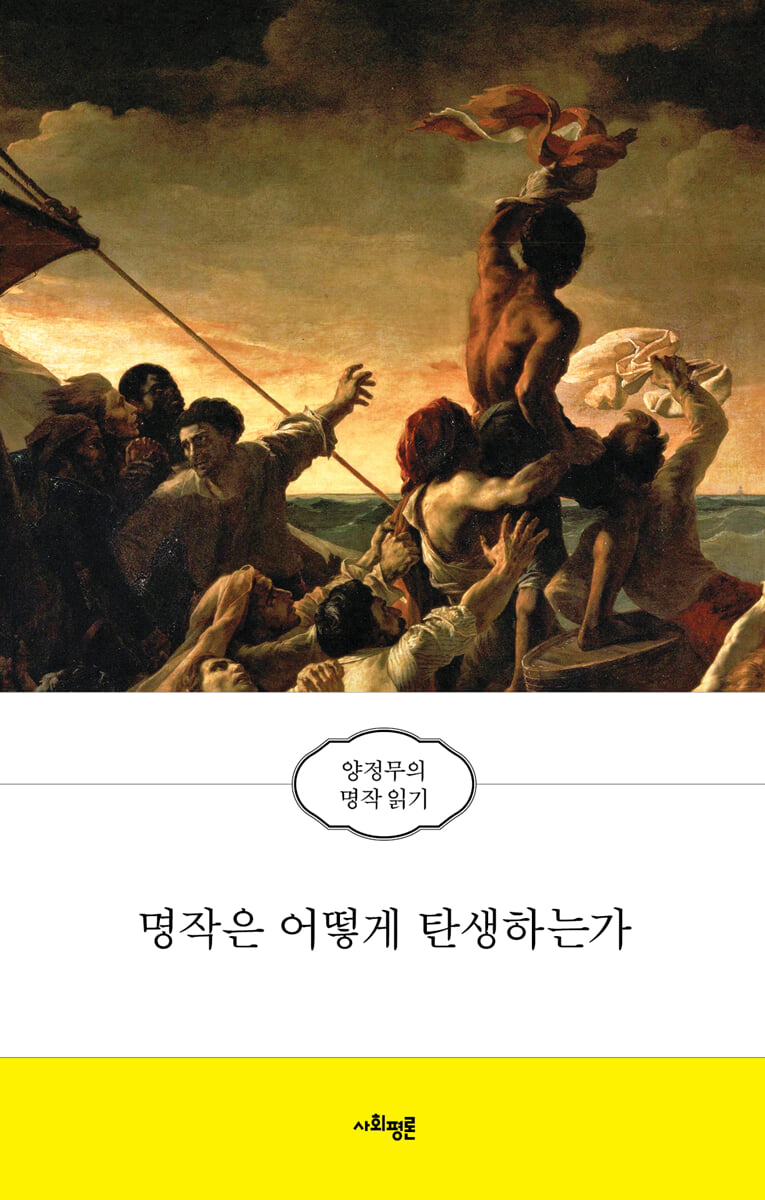
The Raft of the Medusa by Théodore Géricault, one of the masterpieces selected by the author, also makes us realize that art does not only show us a beautiful and good world.
This work depicts the shipwreck of the Medusa in France in 1816, depicting people desperately dying in the middle of the sea while relying on a small raft.
Géricault's raw portrayal of this tragic event shocked French society at the time.
In fact, the horrific scenes in the painting are so realistic that they evoke feelings of despair and pain in the viewer.
But because of that, we can see in this work the strong will and hope of people facing death.
In this way, both positive and negative forces coexist in masterpieces.
Light and darkness, good and evil collide.
Because of this, masterpieces are always at the center of controversy.
And sometimes you get insulted.
Michelangelo's Sistine Chapel frescoes are one such example.
Although it is now a masterpiece recognized by everyone, the Last Judgment in the Sistine Chapel was once criticized as a blasphemous work.
Eventually, the original painting by Michelangelo was damaged as the nude Jesus and saints were restored to appear clothed.
Because masterpieces are controversial, they can also lead to misunderstanding and distrust of the times.
But in the end, he achieves a destiny that will not fade away in time.
Is a masterpiece perfect?
The light and darkness in a masterpiece
There's a reason why masterpieces have endured for so long.
In terms of technique, expressiveness, subject matter, and creativity, a masterpiece surpasses all other works.
In other words, a masterpiece has a difference that other works cannot match.
For example, we can't help but exclaim in awe at the magnificent paintings that fill the Sistine Chapel.
Monet's water lilies series, completed with an indomitable will even as he was losing his eyesight, demonstrate an artistry of a different level.
Through masterpieces, we can witness the great struggle and genius of artists who overcome human limitations.
Gericault is like that, Michelangelo is like that, and Monet's work is like that.
Their works do not fade easily over time.
But this does not mean that a masterpiece is perfect.
The true emotion that a masterpiece gives lies in the traces of hesitation and pain that are melted into the brilliance of the masterpiece.
What catches our attention as much as the perfect face of the main Buddha statue of Seokguram Grotto is its unfinished back.
The awkward hand gestures and blotchy marks from repeated overpaintings on the Sistine Chapel frescoes reveal that the artist who painted these paintings was a troubled and error-prone human being.
A masterpiece embodies humanity within its transcendent greatness.
A masterpiece is great because it is unstable.
This book illuminates the light and darkness contained in masterpieces, returning us to the fundamental question, “What is art?”
Explore the conditions of a masterpiece and rethink the essence of art!
Even today, famous art museums overseas are packed with people from all over the world.
It is common to show off your taste by setting the work of a famous artist as your phone wallpaper or posting it on social media.
Our applause for masterpieces never ceases, but people never ask why masterpieces are masterpieces.
Crushed by the authority of the masterpiece, we don't even dare to question it.
Rather, wouldn't you consider it fortunate that such a masterpiece is not ignored and ignored?
“Why do masterpieces become masterpieces?” Art historian Yang Jeong-mu sets out to answer this question.
"How a Masterpiece is Born" is the ambitious new work of Professor Yang Jeong-mu, who received the love of 400,000 readers with "The Embarrassing Story of Art."
Unlike 『The Difficult Story of Art』, which unfolds the entire history of Western art in chronological order, this book illuminates another realm of art by naming individual works of art that are difficult to approach in a holistic manner.
If "The Embarrassing Story of Art" is a long journey with a suitcase full of luggage, "How a Masterpiece is Born" is more like a light outing, empty-handed.
As you turn the pages with a relaxed mind, you will soon find yourself asking important questions in the midst of art.
Art should be beautiful?
The conditions for a masterpiece that breaks convention
Although it is a small book that can be held in one hand, the subject matter contained in this book is surprisingly not light.
In “The Embarrassing Story of Art,” author Yang Jeong-mu breaks away from the objective attitude of a professor and fully utilizes his identity as an art historian to reconsider the definition of art.
In this process, the common notions about art that we have taken for granted are challenged one by one.
For example, does art have to be beautiful? The author says no.
Beauty is not the essence of art.
Aside from beauty, a work of art that awakens deep human emotions is what makes it a masterpiece.
Among these, the author cites mystery and awe as the core emotions of art.
In short, it is argued that beauty is an emotion that goes beyond beauty and can be a state of spiritual elevation, that is, a purified state of mind of a higher dimension.
Cave paintings created by Paleolithic people for magical rituals can be defined as art not because they are beautiful, but because they evoke transcendental emotions inherent in humans.
In that sense, masterpieces inevitably take us to a world that transcends time and space.
To achieve this goal, art needs to present itself to us as concrete and vivid a material as possible.
The author says that art is not simply an image that comes to mind, but is composed of images and materials.
The reason Seokguram is a masterpiece is that it transforms the awe of Buddha into material and that it stirs our emotions.
If the cave paintings from 15,000 years ago and the works of Nam June Paik from the 20th century share something in common as masterpieces, it is because they both convey the same emotions through material manifestation.
Seokguram Grotto and the Pantheon: Great Because They Are Unstable
The Sistine Chapel's frescoes, a masterpiece insulted
The Raft of the Medusa: There is no greater tragedy than this.
Monet's Water Lily Pond, a different level of difference
Kim Hwan-ki and Nam June Paik Create a New Universe
The Raft of the Medusa by Théodore Géricault, one of the masterpieces selected by the author, also makes us realize that art does not only show us a beautiful and good world.
This work depicts the shipwreck of the Medusa in France in 1816, depicting people desperately dying in the middle of the sea while relying on a small raft.
Géricault's raw portrayal of this tragic event shocked French society at the time.
In fact, the horrific scenes in the painting are so realistic that they evoke feelings of despair and pain in the viewer.
But because of that, we can see in this work the strong will and hope of people facing death.
In this way, both positive and negative forces coexist in masterpieces.
Light and darkness, good and evil collide.
Because of this, masterpieces are always at the center of controversy.
And sometimes you get insulted.
Michelangelo's Sistine Chapel frescoes are one such example.
Although it is now a masterpiece recognized by everyone, the Last Judgment in the Sistine Chapel was once criticized as a blasphemous work.
Eventually, the original painting by Michelangelo was damaged as the nude Jesus and saints were restored to appear clothed.
Because masterpieces are controversial, they can also lead to misunderstanding and distrust of the times.
But in the end, he achieves a destiny that will not fade away in time.
Is a masterpiece perfect?
The light and darkness in a masterpiece
There's a reason why masterpieces have endured for so long.
In terms of technique, expressiveness, subject matter, and creativity, a masterpiece surpasses all other works.
In other words, a masterpiece has a difference that other works cannot match.
For example, we can't help but exclaim in awe at the magnificent paintings that fill the Sistine Chapel.
Monet's water lilies series, completed with an indomitable will even as he was losing his eyesight, demonstrate an artistry of a different level.
Through masterpieces, we can witness the great struggle and genius of artists who overcome human limitations.
Gericault is like that, Michelangelo is like that, and Monet's work is like that.
Their works do not fade easily over time.
But this does not mean that a masterpiece is perfect.
The true emotion that a masterpiece gives lies in the traces of hesitation and pain that are melted into the brilliance of the masterpiece.
What catches our attention as much as the perfect face of the main Buddha statue of Seokguram Grotto is its unfinished back.
The awkward hand gestures and blotchy marks from repeated overpaintings on the Sistine Chapel frescoes reveal that the artist who painted these paintings was a troubled and error-prone human being.
A masterpiece embodies humanity within its transcendent greatness.
A masterpiece is great because it is unstable.
This book illuminates the light and darkness contained in masterpieces, returning us to the fundamental question, “What is art?”
GOODS SPECIFICS
- Date of issue: June 10, 2025
- Format: Hardcover book binding method guide
- Page count, weight, size: 200 pages | 300g | 120*190*15mm
- ISBN13: 9791162733554
- ISBN10: 1162733551
You may also like
카테고리
korean


korean

![GQ KOREA Mark (Monthly): December [2025]](http://librairie.coreenne.fr/cdn/shop/files/8ef265dbbfbf186523ed75ba7319009d.jpg?v=1765340328&width=3840)


