

39 Novels Middle School Students Should Read, Chosen by Korean Language Teachers
 |
Description
Book Introduction
Contains works essential for the learning and culture of prospective and middle school students.
A must-read for teenagers preparing for the CSAT essay exam, selected by a Korean language teacher!
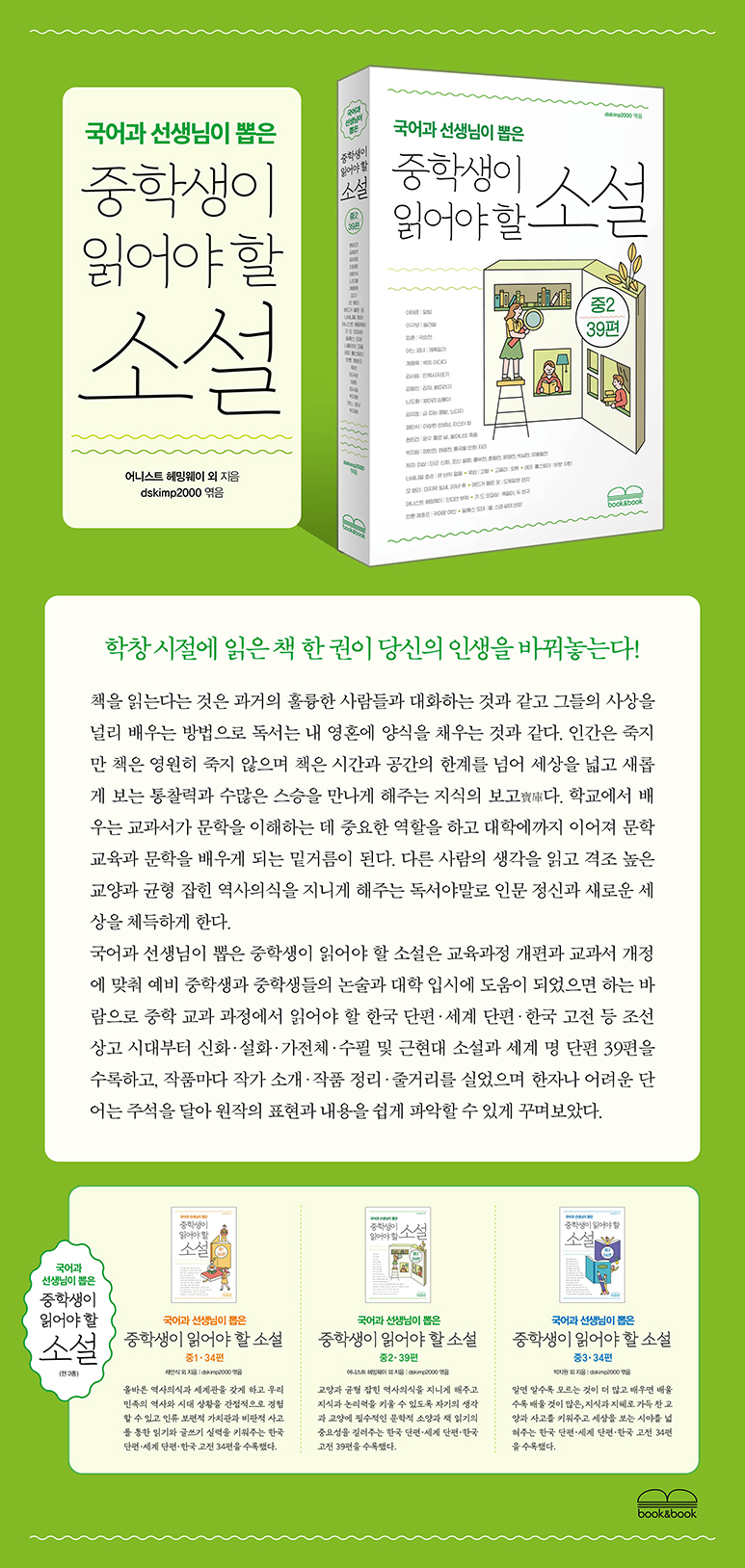
The novels that middle school students should read, selected by Korean language teachers, are in line with the curriculum reform and textbook revision, and are hoped to help middle school students with their essays and college entrance exams. They include world literature and Korean literature that foster liberal arts and thinking filled with knowledge and wisdom and broaden their perspective on the world, as well as Korean short stories, world short stories, and Korean classics that must be read in the middle school curriculum that are frequently tested on the college entrance exam or mock exams, as well as myths, folktales, family poems, essays, modern and contemporary novels, and 39 famous short stories from around the world from the ancient Joseon Dynasty.
For each work, an introduction to the author, a summary of the work, and a synopsis are included, and Chinese characters and difficult words are annotated to help readers easily understand the original work's expressions and content.
Just as a single book you read during your school days can change your noble life, reading is like nourishing my soul.
Reading books is like talking to great people from the past and learning about their thoughts.
People die, but books never die.
Books are a treasure trove of knowledge that transcends the limitations of time and space, giving us new and expansive insights into the world and meeting countless teachers. Reading books changes our way of thinking and behavior, and fosters ideas and creativity.
The textbooks we learn at school play an important role in understanding literature, and they serve as the foundation for literary education and the study of literature all the way to university.
Reading, which allows us to understand the thoughts of others and acquire a refined culture and a balanced sense of history, is what allows us to acquire the spirit of humanity and a new world.
This book contains works that should be read in the middle school curriculum, such as A Lucky Day, Potato, Necklace, The Last Leaf, The Tale of a Yangban, and The Tale of Heosaeng, which foster the importance of reading and literary literacy essential to one's thoughts and culture, so that knowledge and logical thinking can be developed.
A must-read for teenagers preparing for the CSAT essay exam, selected by a Korean language teacher!
The novels that middle school students should read, selected by Korean language teachers, are in line with the curriculum reform and textbook revision, and are hoped to help middle school students with their essays and college entrance exams. They include world literature and Korean literature that foster liberal arts and thinking filled with knowledge and wisdom and broaden their perspective on the world, as well as Korean short stories, world short stories, and Korean classics that must be read in the middle school curriculum that are frequently tested on the college entrance exam or mock exams, as well as myths, folktales, family poems, essays, modern and contemporary novels, and 39 famous short stories from around the world from the ancient Joseon Dynasty.
For each work, an introduction to the author, a summary of the work, and a synopsis are included, and Chinese characters and difficult words are annotated to help readers easily understand the original work's expressions and content.
Just as a single book you read during your school days can change your noble life, reading is like nourishing my soul.
Reading books is like talking to great people from the past and learning about their thoughts.
People die, but books never die.
Books are a treasure trove of knowledge that transcends the limitations of time and space, giving us new and expansive insights into the world and meeting countless teachers. Reading books changes our way of thinking and behavior, and fosters ideas and creativity.
The textbooks we learn at school play an important role in understanding literature, and they serve as the foundation for literary education and the study of literature all the way to university.
Reading, which allows us to understand the thoughts of others and acquire a refined culture and a balanced sense of history, is what allows us to acquire the spirit of humanity and a new world.
This book contains works that should be read in the middle school curriculum, such as A Lucky Day, Potato, Necklace, The Last Leaf, The Tale of a Yangban, and The Tale of Heosaeng, which foster the importance of reading and literary literacy essential to one's thoughts and culture, so that knowledge and logical thinking can be developed.
- You can preview some of the book's contents.
Preview
index
Introduction 4
Commentary 6
Lucky Day / Hyun Jin-geon 14
Grandmother's Death / Hyun Jin-geon 28
Potato / Kim Dong-in 41
Baetaragi / Kim Dong-in 52
Golden Bean Field / Kim Yu-jeong 69
Nodaji / Kim Yu-jeong 84
Moonlight / Lee Tae-jun 97
The Strange Teacher / Lee Tae-jun 109
Mr. Bang / Chae Man-sik 119
Mute Samryong / Na Do-hyang 134
Idiot Adada / Gye Yong-muk 149
My Wish / Kim Gu 166
The Last Leaf / O. Henry 182
Twenty Years Later / O. Henry 192
The Purloined Letter / Edgar Allan Poe 199
The Great Stone Face / Nathaniel Hawthorne 220
Indian Village / Ernest Hemingway 237
Necklace / Guy de Maupassant 244
Two Friends / Guy de Maupassant 256
Star/Alphonse Daudet 267
The Goat of Monsieur Seguin / Alphonse Daudet 275
The Overcoat / Nikolai Gogol 282
The Fool Ivan / Leo Tolstoy 325
The Pretty Woman / Anton Chekhov 359
Hometown / Lu Xun 377
Dangun Myth / Author unknown 390
The Tale of the Chosin / Author unknown 394
Theory of Slendynia / Lee Gyu-bo 399
Guksunjeon / Imchun 403
The Tale of Heungbu and Nolbu / Author unknown 410
Chunhyangjeon / Author unknown 425
Operation / Author unknown 453
Manboksa Temple's Destruction / Kim Si-seup 470
Yangbanjeon / Park Ji-won 479
The Tale of Heo Saeng / Park Ji-won 486
Park's Story / Author unknown 494
The Story of Yu Chung-ryeol / Author unknown 507
Gyechuk Diary / A Palace Maid 524
A Place to Cry / Park Ji-won 540
Commentary 6
Lucky Day / Hyun Jin-geon 14
Grandmother's Death / Hyun Jin-geon 28
Potato / Kim Dong-in 41
Baetaragi / Kim Dong-in 52
Golden Bean Field / Kim Yu-jeong 69
Nodaji / Kim Yu-jeong 84
Moonlight / Lee Tae-jun 97
The Strange Teacher / Lee Tae-jun 109
Mr. Bang / Chae Man-sik 119
Mute Samryong / Na Do-hyang 134
Idiot Adada / Gye Yong-muk 149
My Wish / Kim Gu 166
The Last Leaf / O. Henry 182
Twenty Years Later / O. Henry 192
The Purloined Letter / Edgar Allan Poe 199
The Great Stone Face / Nathaniel Hawthorne 220
Indian Village / Ernest Hemingway 237
Necklace / Guy de Maupassant 244
Two Friends / Guy de Maupassant 256
Star/Alphonse Daudet 267
The Goat of Monsieur Seguin / Alphonse Daudet 275
The Overcoat / Nikolai Gogol 282
The Fool Ivan / Leo Tolstoy 325
The Pretty Woman / Anton Chekhov 359
Hometown / Lu Xun 377
Dangun Myth / Author unknown 390
The Tale of the Chosin / Author unknown 394
Theory of Slendynia / Lee Gyu-bo 399
Guksunjeon / Imchun 403
The Tale of Heungbu and Nolbu / Author unknown 410
Chunhyangjeon / Author unknown 425
Operation / Author unknown 453
Manboksa Temple's Destruction / Kim Si-seup 470
Yangbanjeon / Park Ji-won 479
The Tale of Heo Saeng / Park Ji-won 486
Park's Story / Author unknown 494
The Story of Yu Chung-ryeol / Author unknown 507
Gyechuk Diary / A Palace Maid 524
A Place to Cry / Park Ji-won 540
Detailed image
Publisher's Review
introduction
Just as a single book you read during your school days can change your noble life, reading is like nourishing my soul.
Reading books is like talking to great people from the past and learning about their thoughts.
People die, but books never die.
Books are a treasure trove of knowledge that transcends the limitations of time and space, giving us new insights into the world and meeting countless teachers. Reading books changes our way of thinking and behavior, and fosters ideas and creativity.
The textbooks we learn at school play an important role in understanding literature, and they serve as the foundation for literary education and the study of literature all the way to university.
Reading, which allows us to understand the thoughts of others, cultivate a refined culture and a balanced historical awareness, and cultivate a culture and mindset filled with knowledge and wisdom, is what allows us to acquire the spirit of the humanities and a new world.
All learning begins with reading, and reading in youth has the power to change a person's destiny.
Reading a book is not about taking a test or getting ahead in life. It is the best way to encounter a world I have never experienced, understand the concerns of each era, learn expressions and vocabulary that are difficult to encounter in everyday life, and develop a perspective on life and cultivate one's own life for the better, rather than just a fragmentary knowledge of the work. The importance of reading cannot be overemphasized.
Those who read a lot of books lead the future, and there is no character education more fundamental than reading books.
Reading allows us to experience indirectly the thoughts and ideas of many people and develops our ability to empathize.
When we talk about classics, we often think of them as outdated and out of date.
However, as the saying goes, “learning from the past to know the new” (溫故知新), the past has meaning as the past, and the present is a creation based on the past, so today’s classics should always be recognized as new.
We must cultivate the ability to meet our predecessors one by one and raise them as our own by keeping them by our bedside every morning and night.
Books are like ships that cross the vast sea of time, and books that contain all the knowledge in the world become guides for life.
The more you know, the more you realize you don't know, and the more you learn, the more there is to learn. This fosters a correct historical awareness and worldview through universal human values and critical thinking.
Reading the works of the world's greatest intellectuals is like conversing with the greatest minds of their time who lived hundreds of years ago.
A book is a condensation of knowledge and culture that an author of exceptional intelligence has painstakingly acquired over several decades.
In order to develop the character and culture of growing youth, they must invest a lot of time and experience through teaching and learning to develop excellent intellect.
Excellence is not something you are born with, but something you develop through repeated effort and good habits.
Reading is the foundation for cultivating good character and intelligence, so we should develop the habit of reading the works of world-renowned authors to cultivate the literary literacy and writing skills essential to our own thinking and culture.
Just as a single book you read during your school days can change your noble life, reading is like nourishing my soul.
Reading books is like talking to great people from the past and learning about their thoughts.
People die, but books never die.
Books are a treasure trove of knowledge that transcends the limitations of time and space, giving us new insights into the world and meeting countless teachers. Reading books changes our way of thinking and behavior, and fosters ideas and creativity.
The textbooks we learn at school play an important role in understanding literature, and they serve as the foundation for literary education and the study of literature all the way to university.
Reading, which allows us to understand the thoughts of others, cultivate a refined culture and a balanced historical awareness, and cultivate a culture and mindset filled with knowledge and wisdom, is what allows us to acquire the spirit of the humanities and a new world.
All learning begins with reading, and reading in youth has the power to change a person's destiny.
Reading a book is not about taking a test or getting ahead in life. It is the best way to encounter a world I have never experienced, understand the concerns of each era, learn expressions and vocabulary that are difficult to encounter in everyday life, and develop a perspective on life and cultivate one's own life for the better, rather than just a fragmentary knowledge of the work. The importance of reading cannot be overemphasized.
Those who read a lot of books lead the future, and there is no character education more fundamental than reading books.
Reading allows us to experience indirectly the thoughts and ideas of many people and develops our ability to empathize.
When we talk about classics, we often think of them as outdated and out of date.
However, as the saying goes, “learning from the past to know the new” (溫故知新), the past has meaning as the past, and the present is a creation based on the past, so today’s classics should always be recognized as new.
We must cultivate the ability to meet our predecessors one by one and raise them as our own by keeping them by our bedside every morning and night.
Books are like ships that cross the vast sea of time, and books that contain all the knowledge in the world become guides for life.
The more you know, the more you realize you don't know, and the more you learn, the more there is to learn. This fosters a correct historical awareness and worldview through universal human values and critical thinking.
Reading the works of the world's greatest intellectuals is like conversing with the greatest minds of their time who lived hundreds of years ago.
A book is a condensation of knowledge and culture that an author of exceptional intelligence has painstakingly acquired over several decades.
In order to develop the character and culture of growing youth, they must invest a lot of time and experience through teaching and learning to develop excellent intellect.
Excellence is not something you are born with, but something you develop through repeated effort and good habits.
Reading is the foundation for cultivating good character and intelligence, so we should develop the habit of reading the works of world-renowned authors to cultivate the literary literacy and writing skills essential to our own thinking and culture.
GOODS SPECIFICS
- Date of issue: June 15, 2023
- Page count, weight, size: 544 pages | 670g | 152*224*21mm
- ISBN13: 9791186649770
- ISBN10: 1186649771
You may also like
카테고리
korean


korean

![GQ KOREA Mark (Monthly): December [2025]](http://librairie.coreenne.fr/cdn/shop/files/8ef265dbbfbf186523ed75ba7319009d.jpg?v=1765340328&width=3840)


