

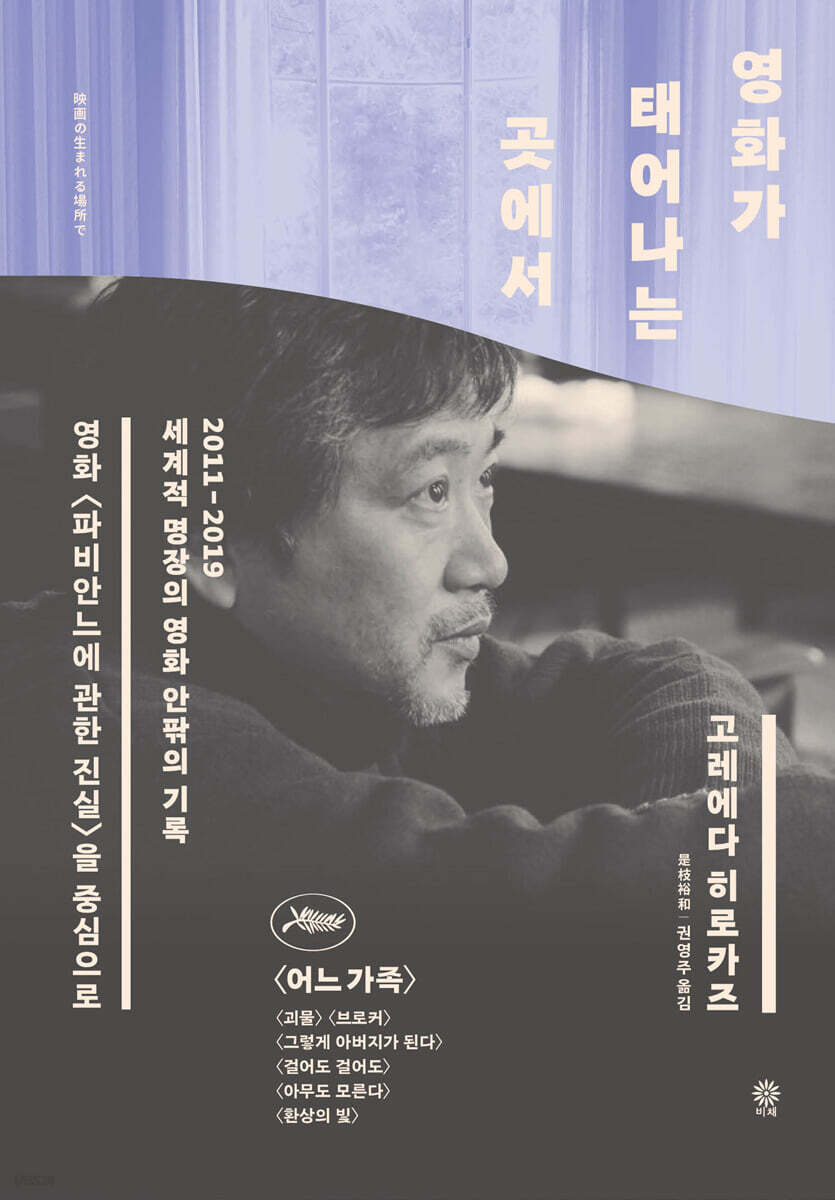
Where movies are born
 |
Description
Book Introduction
The universe of Hirokazu Koreeda, beloved by the world
Contains the author's thoughts, attitude towards life, and daily life inside and outside of the film.
Hirokazu Koreeda's Film Essay
《Where Cinema is Born》 is a record of the film [The Truth About Fabianne], which was screened as the opening film in the competition section of the 76th Venice Film Festival, and is also a film theory and autobiographical film essay that captures the world of director Kore-eda.
From 2011 to 2019, over eight years, director Koreeda spent every minute of his time preparing and making the film, including casting actors, scouting filming locations, writing the script, drawing storyboards, and planning the filming route.
From on-site sketch photos taken by himself, to New Year's cards sent to the staff during filming, a diary filled with his worries of a certain day, and episodes related to the movies [A Certain Family], [Broker], and [The Host], Director Koreeda's voice is heard as it is.
It's also fun to discover the master's thoughts on film, both inside and out, as well as a list of books and films that have served as sources of inspiration.
It will be a good bible for all creators in the world who create or want to create something.
Contains the author's thoughts, attitude towards life, and daily life inside and outside of the film.
Hirokazu Koreeda's Film Essay
《Where Cinema is Born》 is a record of the film [The Truth About Fabianne], which was screened as the opening film in the competition section of the 76th Venice Film Festival, and is also a film theory and autobiographical film essay that captures the world of director Kore-eda.
From 2011 to 2019, over eight years, director Koreeda spent every minute of his time preparing and making the film, including casting actors, scouting filming locations, writing the script, drawing storyboards, and planning the filming route.
From on-site sketch photos taken by himself, to New Year's cards sent to the staff during filming, a diary filled with his worries of a certain day, and episodes related to the movies [A Certain Family], [Broker], and [The Host], Director Koreeda's voice is heard as it is.
It's also fun to discover the master's thoughts on film, both inside and out, as well as a list of books and films that have served as sources of inspiration.
It will be a good bible for all creators in the world who create or want to create something.
- You can preview some of the book's contents.
Preview
index
Illustration Ⅰ
Prologue: A Cold Night in Paris (2023)
Introduction
From "A Rainy Day Like This" to "Catherine in the Hall"
Running Together - Producer Miyuki Fukuma
Illustration II
From "Catherine of Truth" to "Truth"
In Closing (2019)
Author's Note: A Cold February in Tokyo (2023)
Prologue: A Cold Night in Paris (2023)
Introduction
From "A Rainy Day Like This" to "Catherine in the Hall"
Running Together - Producer Miyuki Fukuma
Illustration II
From "Catherine of Truth" to "Truth"
In Closing (2019)
Author's Note: A Cold February in Tokyo (2023)
Detailed image

Into the book
May 21, 2018
Ethan Hawke arrived at the restaurant a little late for the appointment.
Stand up and shake hands.
"sorry.
I was a little late because I had to feed the kids dinner and put them to bed.
And congratulations.
“It’s hard to refuse an offer at this timing… ….” At that moment, I felt for the first time the weight of the Palme d’Or, which had been unrealistic for a long time.
Lee Sun, who had just finished dinner, happily talked about the filming episodes of the 'Before' series and 'Boyhood' while drinking whiskey with oysters.
--- p.33~34
9/4
Participation in the Venice Film Festival.
With Mr. Fukuyama, Mr. Yakusho, and Suzu.
[Light of Fantasy] It's been twenty-two years since then.
Unlike Khan, he is laid-back, for better or for worse.
It's a little reassuring that the sleep-deprived reporters and cameramen aren't creating a tense atmosphere.
The film festival's 'philosophy' is clearly revealed in the fact that the red carpet is a daily routine with no differences in height.
Say hello to Takeshi Kitano in the hotel lobby.
A white shirt suits you well.
I always feel this way when I see him at the Tokyo Sports Film Awards ceremony. Unlike the Beat Takeshi I see on TV, he is really quiet and has a serious attitude towards movies, which really moves me.
Seeing a large crowd of fans holding photos of Takeshi outside the hotel entrance, I realized just how popular Takeshi really is.
The atmosphere in the lobby was the same as it was twenty-two years ago.
If you go out the back door to the sandy beach, you're right at the sea.
Old memories came flooding back.
In between reporting and screenings, I watched DVDs of Deneuve's films in my hotel room.
The Mermaid of Mississippi
In Truffaut's last interview, Truffaut himself said JP
Belmondo admits that he was miscast, and I agree.
Truffaut's review of Deneuve.
'She can deliver her most important lines cleanly in scenes where she turns her back to the camera and walks away.'
--- p.39~40
11/13
A scene where Lumir, who thought she had her mother back but was taken away by the 'movie', cries and talks to Hank.
In the morning, Lee Sun is called to the bedroom that will be the stage for today.
“Today’s scene….” Did they catch me thinking of him as a cut candidate? I felt a sudden chill.
"I think I have too many lines..." "Really?" "Director, you wrote a haiku in your last letter, right? You said you describe the scenery or objects you see as they are, without putting your feelings directly into words.
I feel like there's a bit of a lack of spirit here... ... Maybe I should just quietly smile, hug, and kiss her? That's what I would do... ... ." I was simply amazed by the sharp observation.
I came back right away and shortened the dialogue.
Finally, he changed it to tapping the bed next to him as if to say 'come here' to the crying Lumir.
I really appreciate it when the staff and cast give me feedback on the script.
This is evidence that a parallel relationship, neither a superior-subordinate nor a vertical relationship, exists organically around the work.
Ethan Hawke arrived at the restaurant a little late for the appointment.
Stand up and shake hands.
"sorry.
I was a little late because I had to feed the kids dinner and put them to bed.
And congratulations.
“It’s hard to refuse an offer at this timing… ….” At that moment, I felt for the first time the weight of the Palme d’Or, which had been unrealistic for a long time.
Lee Sun, who had just finished dinner, happily talked about the filming episodes of the 'Before' series and 'Boyhood' while drinking whiskey with oysters.
--- p.33~34
9/4
Participation in the Venice Film Festival.
With Mr. Fukuyama, Mr. Yakusho, and Suzu.
[Light of Fantasy] It's been twenty-two years since then.
Unlike Khan, he is laid-back, for better or for worse.
It's a little reassuring that the sleep-deprived reporters and cameramen aren't creating a tense atmosphere.
The film festival's 'philosophy' is clearly revealed in the fact that the red carpet is a daily routine with no differences in height.
Say hello to Takeshi Kitano in the hotel lobby.
A white shirt suits you well.
I always feel this way when I see him at the Tokyo Sports Film Awards ceremony. Unlike the Beat Takeshi I see on TV, he is really quiet and has a serious attitude towards movies, which really moves me.
Seeing a large crowd of fans holding photos of Takeshi outside the hotel entrance, I realized just how popular Takeshi really is.
The atmosphere in the lobby was the same as it was twenty-two years ago.
If you go out the back door to the sandy beach, you're right at the sea.
Old memories came flooding back.
In between reporting and screenings, I watched DVDs of Deneuve's films in my hotel room.
The Mermaid of Mississippi
In Truffaut's last interview, Truffaut himself said JP
Belmondo admits that he was miscast, and I agree.
Truffaut's review of Deneuve.
'She can deliver her most important lines cleanly in scenes where she turns her back to the camera and walks away.'
--- p.39~40
11/13
A scene where Lumir, who thought she had her mother back but was taken away by the 'movie', cries and talks to Hank.
In the morning, Lee Sun is called to the bedroom that will be the stage for today.
“Today’s scene….” Did they catch me thinking of him as a cut candidate? I felt a sudden chill.
"I think I have too many lines..." "Really?" "Director, you wrote a haiku in your last letter, right? You said you describe the scenery or objects you see as they are, without putting your feelings directly into words.
I feel like there's a bit of a lack of spirit here... ... Maybe I should just quietly smile, hug, and kiss her? That's what I would do... ... ." I was simply amazed by the sharp observation.
I came back right away and shortened the dialogue.
Finally, he changed it to tapping the bed next to him as if to say 'come here' to the crying Lumir.
I really appreciate it when the staff and cast give me feedback on the script.
This is evidence that a parallel relationship, neither a superior-subordinate nor a vertical relationship, exists organically around the work.
--- p.252
Publisher's Review
2011-2019,
Starring Catherine Deneuve, Juliette Binoche, and Ethan Hawke
An eight-year record leading up to the film [The Truth About Fabianne]
“I wrote about various things I experienced and found them interesting in my own way.
“I hope that film directors will think, even just a little, that making movies is hard work, but it’s fun.”
_Hirokazu Koreeda (from the prologue)
The origins of the film [The Truth About Fabienne] (2019) date back to 2003, when it was originally a story intended to be staged at the Parco Theater in Shibuya, Tokyo.
The first title is 'On a Rainy Day Like This'.
It is the story of an elderly actress in her final years, and the setting is the dressing room before and after the stage on the day of her last performance.
The title also comes from the actor's line, "I wonder if anyone would come to see a play on a rainy day like this..."
The work he is performing is Raymond Carver's [Cathedral].
The theme is same-sex friendship.
An actor who has never had any friends before faces his last day without a good understanding of the stage.
But usually, about a week after the curtain rose on stage, fan letters containing acting advice would arrive, but this time, for some reason, no letters arrived until the very end.
After the performance, an old woman who is the wife of a storage clerk comes to the dressing room to see the actor.
In fact, an old lady who had been a fan of the actor sent a letter to her husband asking him to write it for her after seeing the performance, but the story goes that her husband passed away the day before the performance began.
And this was the story of how friendship between women began.
The elderly actress was Ayako Wakao, and the wife of the storage worker was the late Kirin Kiki.
Fifteen years have passed since then, and the scenario has been reborn with a new title, setting, theme, and cast.
《Where Films Are Born》 is a record of that process.
The play [On a Rainy Day Like This] was born as the film [The Truth] starring Catherine Deneuve, Juliette Binoche, and Ethan Hawke.
"I don't have any particular intention of experimenting with my work, but what is the 'Kore-eda-ness' that my films possess, the sense that people perceive them to possess? Is it something that remains even after I leave the country where I was born and raised and my native language, Japanese? With these questions in mind, I embarked on [The Truth About Fabianne] and [The Broker].
Those who saw both works expressed conflicting impressions.
“There are opinions that you wouldn’t have known it was Koreeda’s work if you hadn’t seen the end credits, and opinions that no matter where you looked, it was Koreeda’s film.”
_Hirokazu Koreeda (from the author's note)
Movie storyboards, hand-taken sketch photos, filming diaries, casting letters…
What the world-renowned director Hirokazu Koreeda thinks about film AZ
Hirokazu Koreeda raises the question of what is 'Kore-eda-ness'.
Where does it come from?
Could it be that this stems from the fact that [Light of Fantasy], [Nobody Knows], and [Sea Village Diary] contain the lives of those left behind after loss?
Is it because of the process of depicting the salvation of a family that was accidentally combined, such as in [A Certain Family], [Like Father, Like Son], and [Broker], or is it because of the flavor that comes from the country where I was born and raised and my native language, Japanese?
Could it be a team color created with staff who have been working together for a long time?
[The Truth About Fabianne] is Hirokazu Koreeda's first overseas project.
If [The Broker] is a Korean-made location film starring Korean actors, [The Truth About Fabianne] is a French-made location film starring French/American actors.
Sending love calls to the lead actors who will lead the film, coordinating details through interviews with each person, finding a house in Paris that will be the main stage, and casting supporting actors considering the combination of the picture and the balance of voices, and adjusting the scenario such as the length of the lines based on all of this composition… … 《Where Movies Are Born》 is filled with everything that director Hirokazu Koreeda thought about films.
Hirokazu Koreeda is meticulous and affectionate, whether it's an interview with the French actress Catherine Deneuve, whom he met with great excitement, a handwritten letter to Ethan Hawke after a script reading, or a New Year's card he sent to all the staff during filming to welcome the new year.
Koreeda is diligent and passionate, taking meticulous on-site sketches, drawing storyboards himself, staying in the house that will be the set to adjust the length of lines to fit the location, listening to the actors' interpretations and modifying scenes, and watching movies and reading books in his spare time to learn about film and study humanity.
In addition to working on [The Truth About Fabianne], you can also see various aspects of Hirokazu Koreeda both on and off the set of his films, such as stories of him visiting film festivals around the world, including the Venice Film Festival, the Yokohama Film Festival, the Sanchez Film Festival, and the Cannes Film Festival, to continue work on his works, including [The Third Murder] and [A Certain Family], and an anecdote about how he was at a loss when he heard the news of his best comrade and respected actor Kirin Kiki's illness, and had to stop his schedule in France to return to Tokyo for a while to deliver a letter.
What about the movie [The Truth About Fabienne]?
After [A Certain Family] (Japanese original title: Shoplifters), this is director Koreeda's first ambitious overseas project, and it has garnered attention for its stellar cast and location in France.
As legendary actress Fabienne (Catherine Deneuve) publishes her memoirs?
The film begins with a scene where her daughter Lumir (Juliette Binoche), son-in-law Hank (Ethan Hawke), and young granddaughter Charlotte visit Fabienne's house after a long time.
The happy reunion between mother and daughter is short-lived. Lumir, having read her mother's memoir, discovers that the book is full of lies and lashes out at her mother.
“Mom, there’s no truth in this book.” This book contains misunderstandings, conflicts, jealousy, and reconciliation between Fabienne, who pursued only the life of a good actress despite being a bad mother, a bad wife, and a bad friend, and Lumir, who had a childhood filled with painful wounds as the daughter of a mother with such an attitude toward life.
A book containing Hirokazu Koreeda's most recent thoughts was completed, with a prologue and author's note written in 2023 added to the filming diary and daily thoughts from 2011 to 2019.
As always, Koreeda wrote about his thoughts on each day in an honest and calm manner, including his thoughts on [Broker], which was filmed in Korea, and his expectations for his latest work, [The Host].
In the meantime, numerous proper nouns of actors and movies appear here and there, but to help readers understand, about 350 short footnotes have been added.
Hirokazura Koreeda hopes that his journey through space will be accompanied only by love and joy.
Starring Catherine Deneuve, Juliette Binoche, and Ethan Hawke
An eight-year record leading up to the film [The Truth About Fabianne]
“I wrote about various things I experienced and found them interesting in my own way.
“I hope that film directors will think, even just a little, that making movies is hard work, but it’s fun.”
_Hirokazu Koreeda (from the prologue)
The origins of the film [The Truth About Fabienne] (2019) date back to 2003, when it was originally a story intended to be staged at the Parco Theater in Shibuya, Tokyo.
The first title is 'On a Rainy Day Like This'.
It is the story of an elderly actress in her final years, and the setting is the dressing room before and after the stage on the day of her last performance.
The title also comes from the actor's line, "I wonder if anyone would come to see a play on a rainy day like this..."
The work he is performing is Raymond Carver's [Cathedral].
The theme is same-sex friendship.
An actor who has never had any friends before faces his last day without a good understanding of the stage.
But usually, about a week after the curtain rose on stage, fan letters containing acting advice would arrive, but this time, for some reason, no letters arrived until the very end.
After the performance, an old woman who is the wife of a storage clerk comes to the dressing room to see the actor.
In fact, an old lady who had been a fan of the actor sent a letter to her husband asking him to write it for her after seeing the performance, but the story goes that her husband passed away the day before the performance began.
And this was the story of how friendship between women began.
The elderly actress was Ayako Wakao, and the wife of the storage worker was the late Kirin Kiki.
Fifteen years have passed since then, and the scenario has been reborn with a new title, setting, theme, and cast.
《Where Films Are Born》 is a record of that process.
The play [On a Rainy Day Like This] was born as the film [The Truth] starring Catherine Deneuve, Juliette Binoche, and Ethan Hawke.
"I don't have any particular intention of experimenting with my work, but what is the 'Kore-eda-ness' that my films possess, the sense that people perceive them to possess? Is it something that remains even after I leave the country where I was born and raised and my native language, Japanese? With these questions in mind, I embarked on [The Truth About Fabianne] and [The Broker].
Those who saw both works expressed conflicting impressions.
“There are opinions that you wouldn’t have known it was Koreeda’s work if you hadn’t seen the end credits, and opinions that no matter where you looked, it was Koreeda’s film.”
_Hirokazu Koreeda (from the author's note)
Movie storyboards, hand-taken sketch photos, filming diaries, casting letters…
What the world-renowned director Hirokazu Koreeda thinks about film AZ
Hirokazu Koreeda raises the question of what is 'Kore-eda-ness'.
Where does it come from?
Could it be that this stems from the fact that [Light of Fantasy], [Nobody Knows], and [Sea Village Diary] contain the lives of those left behind after loss?
Is it because of the process of depicting the salvation of a family that was accidentally combined, such as in [A Certain Family], [Like Father, Like Son], and [Broker], or is it because of the flavor that comes from the country where I was born and raised and my native language, Japanese?
Could it be a team color created with staff who have been working together for a long time?
[The Truth About Fabianne] is Hirokazu Koreeda's first overseas project.
If [The Broker] is a Korean-made location film starring Korean actors, [The Truth About Fabianne] is a French-made location film starring French/American actors.
Sending love calls to the lead actors who will lead the film, coordinating details through interviews with each person, finding a house in Paris that will be the main stage, and casting supporting actors considering the combination of the picture and the balance of voices, and adjusting the scenario such as the length of the lines based on all of this composition… … 《Where Movies Are Born》 is filled with everything that director Hirokazu Koreeda thought about films.
Hirokazu Koreeda is meticulous and affectionate, whether it's an interview with the French actress Catherine Deneuve, whom he met with great excitement, a handwritten letter to Ethan Hawke after a script reading, or a New Year's card he sent to all the staff during filming to welcome the new year.
Koreeda is diligent and passionate, taking meticulous on-site sketches, drawing storyboards himself, staying in the house that will be the set to adjust the length of lines to fit the location, listening to the actors' interpretations and modifying scenes, and watching movies and reading books in his spare time to learn about film and study humanity.
In addition to working on [The Truth About Fabianne], you can also see various aspects of Hirokazu Koreeda both on and off the set of his films, such as stories of him visiting film festivals around the world, including the Venice Film Festival, the Yokohama Film Festival, the Sanchez Film Festival, and the Cannes Film Festival, to continue work on his works, including [The Third Murder] and [A Certain Family], and an anecdote about how he was at a loss when he heard the news of his best comrade and respected actor Kirin Kiki's illness, and had to stop his schedule in France to return to Tokyo for a while to deliver a letter.
What about the movie [The Truth About Fabienne]?
After [A Certain Family] (Japanese original title: Shoplifters), this is director Koreeda's first ambitious overseas project, and it has garnered attention for its stellar cast and location in France.
As legendary actress Fabienne (Catherine Deneuve) publishes her memoirs?
The film begins with a scene where her daughter Lumir (Juliette Binoche), son-in-law Hank (Ethan Hawke), and young granddaughter Charlotte visit Fabienne's house after a long time.
The happy reunion between mother and daughter is short-lived. Lumir, having read her mother's memoir, discovers that the book is full of lies and lashes out at her mother.
“Mom, there’s no truth in this book.” This book contains misunderstandings, conflicts, jealousy, and reconciliation between Fabienne, who pursued only the life of a good actress despite being a bad mother, a bad wife, and a bad friend, and Lumir, who had a childhood filled with painful wounds as the daughter of a mother with such an attitude toward life.
A book containing Hirokazu Koreeda's most recent thoughts was completed, with a prologue and author's note written in 2023 added to the filming diary and daily thoughts from 2011 to 2019.
As always, Koreeda wrote about his thoughts on each day in an honest and calm manner, including his thoughts on [Broker], which was filmed in Korea, and his expectations for his latest work, [The Host].
In the meantime, numerous proper nouns of actors and movies appear here and there, but to help readers understand, about 350 short footnotes have been added.
Hirokazura Koreeda hopes that his journey through space will be accompanied only by love and joy.
GOODS SPECIFICS
- Date of issue: May 15, 2025
- Page count, weight, size: 304 pages | 410g | 136*191*20mm
- ISBN13: 9791173321825
- ISBN10: 1173321829
You may also like
카테고리
korean


korean

![GQ KOREA Mark (Monthly): December [2025]](http://librairie.coreenne.fr/cdn/shop/files/8ef265dbbfbf186523ed75ba7319009d.jpg?v=1765340328&width=3840)


