

Theory of Knowledge
 |
Description
Book Introduction
'Theory of Knowledge (TOK)' is literally a theory about knowledge, and is a required subject of the IB Diploma, an IB curriculum for high school students.
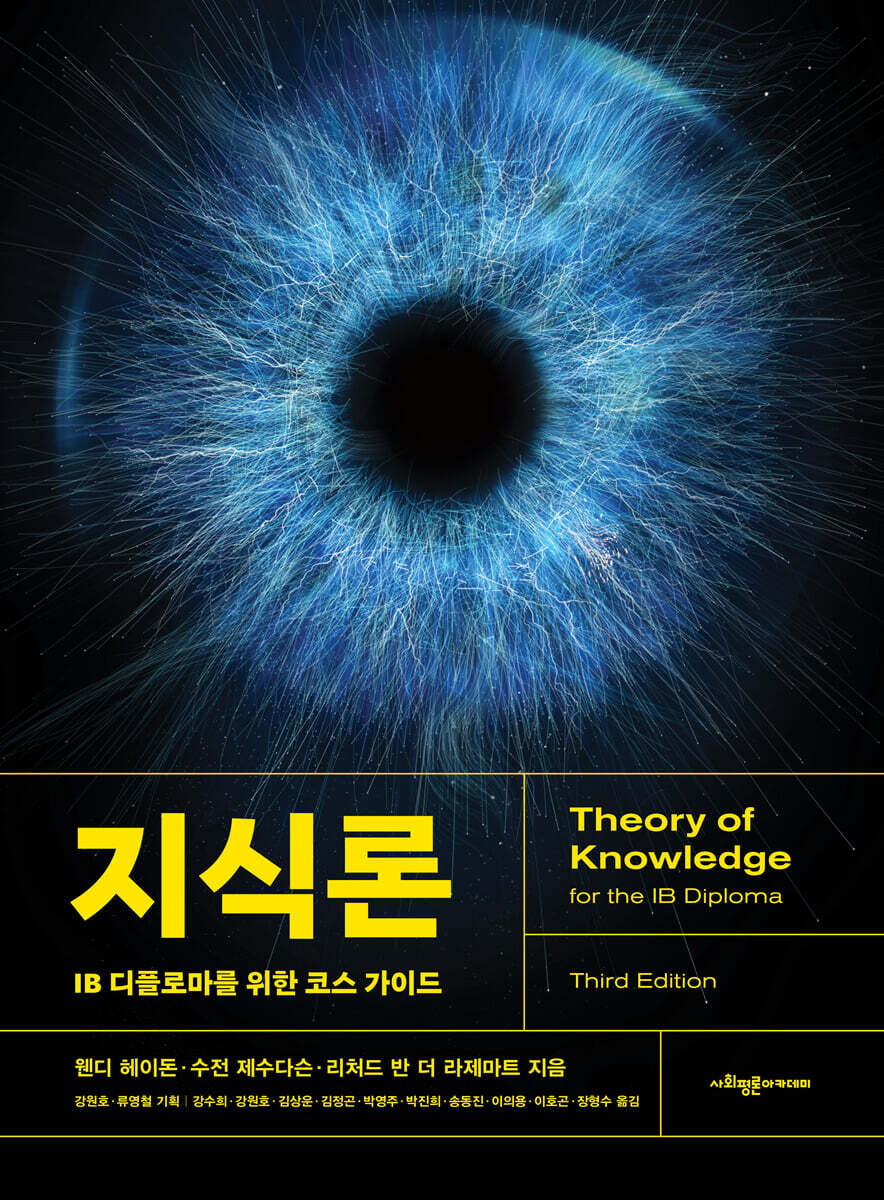
『Theory of Knowledge: A Course Guide for the IB Diploma』(hereafter referred to as 『Theory of Knowledge』) is the first textbook on the theory of knowledge published in Korea and is a translation of the Theory of Knowledge for the IB Diploma (Revised 3rd Edition) published by Cambridge University Press in the UK in 2020.
The theory of knowledge subject does not cover knowledge from each subject such as language, mathematics, or science.
Instead, we reflect on how we learn knowledge, how knowledge is distinguished from facts, opinions, and beliefs, what justifies interpretations, what makes explanations more persuasive, and what problems arise from being confident in our own knowledge.
"Theory of Knowledge," which poses questions about knowledge itself, is an essential guide for learners who wish to develop the ability to discern errors and biases in the deluge of information, the ability to think independently, the fresh perspectives that ask good questions, critical thinking skills, and a sense of humanity and ethics.
『Theory of Knowledge: A Course Guide for the IB Diploma』(hereafter referred to as 『Theory of Knowledge』) is the first textbook on the theory of knowledge published in Korea and is a translation of the Theory of Knowledge for the IB Diploma (Revised 3rd Edition) published by Cambridge University Press in the UK in 2020.
The theory of knowledge subject does not cover knowledge from each subject such as language, mathematics, or science.
Instead, we reflect on how we learn knowledge, how knowledge is distinguished from facts, opinions, and beliefs, what justifies interpretations, what makes explanations more persuasive, and what problems arise from being confident in our own knowledge.
"Theory of Knowledge," which poses questions about knowledge itself, is an essential guide for learners who wish to develop the ability to discern errors and biases in the deluge of information, the ability to think independently, the fresh perspectives that ask good questions, critical thinking skills, and a sense of humanity and ethics.
- You can preview some of the book's contents.
Preview
index
Recommendation
Note
How to use this book
Entering
Part 1: Knowing and Knowing
Chapter 1 Who is the Knower?
Chapter 2: The Problem of Knowledge
Chapter 3 Knowledge Questions and Knowledge Frameworks
Chapter 4: Truth and Wisdom
Part 2 Selected Topics
Chapter 5 Knowledge and Technology
Chapter 6 Knowledge and Language
Chapter 7 Knowledge and Politics
Chapter 8 Knowledge and Religion
Chapter 9 Knowledge and Indigenous Societies
Part 3 Knowledge Areas
Chapter 10 History
Chapter 11 Art
Chapter 12 Mathematics
Chapter 13 Natural Sciences
Chapter 14: Human Sciences
Part 4 Evaluation
Chapter 15: Theory of Knowledge Exhibition
Chapter 16: Essay on the Theory of Knowledge
Glossary of Terms
Acknowledgements
Translator's Note
Image source
Search
Translator's Introduction
Note
How to use this book
Entering
Part 1: Knowing and Knowing
Chapter 1 Who is the Knower?
Chapter 2: The Problem of Knowledge
Chapter 3 Knowledge Questions and Knowledge Frameworks
Chapter 4: Truth and Wisdom
Part 2 Selected Topics
Chapter 5 Knowledge and Technology
Chapter 6 Knowledge and Language
Chapter 7 Knowledge and Politics
Chapter 8 Knowledge and Religion
Chapter 9 Knowledge and Indigenous Societies
Part 3 Knowledge Areas
Chapter 10 History
Chapter 11 Art
Chapter 12 Mathematics
Chapter 13 Natural Sciences
Chapter 14: Human Sciences
Part 4 Evaluation
Chapter 15: Theory of Knowledge Exhibition
Chapter 16: Essay on the Theory of Knowledge
Glossary of Terms
Acknowledgements
Translator's Note
Image source
Search
Translator's Introduction
Detailed image

Into the book
We are a unique combination of our DNA, our life experiences, the time and place we live in, the tribes and knowledge communities we belong to, the languages we speak, the way we see the world around us and the way we describe it.
(...) As people who know, we need to be more aware of our own assumptions and perspectives.
You also need to strike a balance between the following two:
One is that we are open to new ideas that challenge our current way of thinking, and the other is that humans are gullible creatures, sometimes willing to believe strange things based on flimsy evidence.
To ensure the increase of human knowledge, there must be a greater resistance to deception.
---From "Who is Knowing?"
Because knowledge is so important, we need to raise the question of how we know, the question of knowing, and especially how to avoid mistakes in knowing.
To do so, we must consider what knowledge is, how it is distinguished from facts, opinions, and beliefs, and what the problem is with our confidence in our knowledge as knowers.
---From "The Problem of Knowledge"
Your knowledge is like a map.
Your mental map can help you understand the real world and find your way.
Moreover, knowledge, like a map, is a representation of the world.
Just as a map is not an accurate representation of reality, knowledge is not identical to the real world.
Knowledge, like maps, is partly a product of education, society, and culture at a particular point in history.
(...) We all have what is called a mental map of reality, which contains our ideas about what is true and what is false, what is rational and what is irrational, what is right and what is wrong.
---From "Knowledge Questions and Knowledge Framework"
'Technology' refers to practical tools invented by people to do certain things.
What we mean by 'knowledge' and 'knowing' is distinct from 'information' or 'data'.
(...) Our online search experience may seem neutral at first glance, but there is tremendous complexity behind the technologies and algorithms that make it possible.
We might question what appears in an Internet search and how it is filtered and arranged on the screen.
---From "Knowledge and Technology"
One of the characteristics of language is that, thanks to the rules of grammar and vocabulary, it is possible to construct a nearly infinite number of grammatically correct sentences.
Every sentence we speak is in some sense original.
Language is a product of grammatical rules you've learned over time, but you are the creator and innovator of language in terms of meaning and expression.
You can create and understand new sentences that no one has ever written or spoken before.
For example, you've probably never heard a sentence like this:
“From the chrysalis of ignorance, IB Diploma Program students (metamorphose) emerge as butterflies, knowledgeable, principled, and reflective.” But you will have no trouble understanding the metaphor contained in this sentence and coming up with an image to match it.
---From "Knowledge and Language"
Mathematics is the study of numbers, shapes, arrangements, and the relationships between them.
It is a formal system used to recognize, classify, and utilize patterns and properties of the world around us.
Therefore, it is concerned not only with everyday phenomena but also with profound questions about the nature of the universe and the laws that govern it.
Most people perceive mathematics as a subject that primarily deals with numbers.
(...)
The history of mathematics is a long and fascinating journey that spans the globe.
Today, we can't imagine a world without zero or a world where numbers are represented in base 60.
In fact, the sexagesimal system is used to some extent in our lives.
(1 minute is 60 seconds, 1 hour is 60 minutes, and the central angle of a circle is 6 times 60 degrees.
(Again, 1 degree is 60 minutes.) To understand how mathematical knowledge has developed and grown throughout human history, it is useful to glimpse a little of that journey.
---From "Mathematics"
Writing a theory of knowledge essay is not so much about answering questions as it is about illuminating knowledge questions.
That's what you need to work on.
You need to be somewhat humble, because the odds of you coming up with a definitive answer are slim.
Because epistemology essays deal with open and controversial questions, the personal element is important.
Although you can learn from similar explorations by others, it's important that your essay emphasizes your opinions and arguments, and acknowledges your perspectives and assumptions as an informed reader.
(...) As people who know, we need to be more aware of our own assumptions and perspectives.
You also need to strike a balance between the following two:
One is that we are open to new ideas that challenge our current way of thinking, and the other is that humans are gullible creatures, sometimes willing to believe strange things based on flimsy evidence.
To ensure the increase of human knowledge, there must be a greater resistance to deception.
---From "Who is Knowing?"
Because knowledge is so important, we need to raise the question of how we know, the question of knowing, and especially how to avoid mistakes in knowing.
To do so, we must consider what knowledge is, how it is distinguished from facts, opinions, and beliefs, and what the problem is with our confidence in our knowledge as knowers.
---From "The Problem of Knowledge"
Your knowledge is like a map.
Your mental map can help you understand the real world and find your way.
Moreover, knowledge, like a map, is a representation of the world.
Just as a map is not an accurate representation of reality, knowledge is not identical to the real world.
Knowledge, like maps, is partly a product of education, society, and culture at a particular point in history.
(...) We all have what is called a mental map of reality, which contains our ideas about what is true and what is false, what is rational and what is irrational, what is right and what is wrong.
---From "Knowledge Questions and Knowledge Framework"
'Technology' refers to practical tools invented by people to do certain things.
What we mean by 'knowledge' and 'knowing' is distinct from 'information' or 'data'.
(...) Our online search experience may seem neutral at first glance, but there is tremendous complexity behind the technologies and algorithms that make it possible.
We might question what appears in an Internet search and how it is filtered and arranged on the screen.
---From "Knowledge and Technology"
One of the characteristics of language is that, thanks to the rules of grammar and vocabulary, it is possible to construct a nearly infinite number of grammatically correct sentences.
Every sentence we speak is in some sense original.
Language is a product of grammatical rules you've learned over time, but you are the creator and innovator of language in terms of meaning and expression.
You can create and understand new sentences that no one has ever written or spoken before.
For example, you've probably never heard a sentence like this:
“From the chrysalis of ignorance, IB Diploma Program students (metamorphose) emerge as butterflies, knowledgeable, principled, and reflective.” But you will have no trouble understanding the metaphor contained in this sentence and coming up with an image to match it.
---From "Knowledge and Language"
Mathematics is the study of numbers, shapes, arrangements, and the relationships between them.
It is a formal system used to recognize, classify, and utilize patterns and properties of the world around us.
Therefore, it is concerned not only with everyday phenomena but also with profound questions about the nature of the universe and the laws that govern it.
Most people perceive mathematics as a subject that primarily deals with numbers.
(...)
The history of mathematics is a long and fascinating journey that spans the globe.
Today, we can't imagine a world without zero or a world where numbers are represented in base 60.
In fact, the sexagesimal system is used to some extent in our lives.
(1 minute is 60 seconds, 1 hour is 60 minutes, and the central angle of a circle is 6 times 60 degrees.
(Again, 1 degree is 60 minutes.) To understand how mathematical knowledge has developed and grown throughout human history, it is useful to glimpse a little of that journey.
---From "Mathematics"
Writing a theory of knowledge essay is not so much about answering questions as it is about illuminating knowledge questions.
That's what you need to work on.
You need to be somewhat humble, because the odds of you coming up with a definitive answer are slim.
Because epistemology essays deal with open and controversial questions, the personal element is important.
Although you can learn from similar explorations by others, it's important that your essay emphasizes your opinions and arguments, and acknowledges your perspectives and assumptions as an informed reader.
---From "Essays on the Theory of Knowledge"
Publisher's Review
First Korean translation! "Theory of Knowledge," a required IB Diploma subject.
'Theory of Knowledge (TOK)' is one of the required subjects in the IB Diploma, an IB curriculum for high school students.
Theory of Knowledge is considered the subject that contributes most to improving IB learners' creativity and critical thinking skills.
Meanwhile, the International Baccalaureate Organization (IBO, a Swiss non-profit organization that operates the IB curriculum) has not adopted an official textbook for the subject of theory of knowledge, so leading overseas publishers such as Cambridge University Press, Oxford University Press, Pearson, and Hodder Education have been publishing books to serve as guides.
However, not a single book was translated into Korean.
Recently, IB education has been introduced in some regions of Korea, and discussions are actively underway to expand it. However, the irony is that there are no books on the market that deeply address the knowledge and learning that IB education pursues.
『Theory of Knowledge: A Course Guide for the IB Diploma』(hereafter referred to as 『Theory of Knowledge』) is the first textbook on the theory of knowledge published in Korea and is a translation of the Theory of Knowledge for the IB Diploma (Revised 3rd Edition) published by Cambridge University Press in the UK in 2020.
Cambridge University Press published the first edition of this book in 2005 and has the advantage of continually accumulating feedback from teachers through its website (thepanel.cambridge.org) for a network of IB tutors.
The text is composed of high-quality content that students will find challenging, and each chapter contains over 60 boxes filled with novel questions, discussion topics, and a variety of activities that foster critical thinking.
It also contains a practical manual for preparing exhibitions, essays, and dissertations, which are assessment tasks for the theory of knowledge.
"Theory of Knowledge" will be a welcome and useful book for teachers, students, parents, and educational institutions interested in the IB curriculum.
What does the theory of knowledge teach?
It is rare for a country to teach the theory of knowledge as a compulsory subject in primary and secondary education.
The theory of knowledge is an unfamiliar subject even to Korean students and educators.
The average modern person would be familiar with the subjects they learned in elementary, middle, and high school, such as Korean, English, math, and science.
And you may have wondered why you are learning these subjects and whether these contents are truly meaningful to your life.
The theory of knowledge is literally a theory about knowledge, and does not deal with knowledge of each subject such as language, mathematics, or science.
Instead, we reflect on how we learn knowledge, how knowledge is distinguished from facts, opinions, and beliefs, what justifies interpretations, what makes explanations more persuasive, and what problems arise from being confident in our own knowledge.
In short, it is an 'introduction to learning' that teaches us how to know the truth and how we can become wise.
For example, Chapter 12, “Mathematics,” of “Theory of Knowledge” explores questions such as “What is mathematical knowledge?”, “Was mathematics invented or discovered?”, and “In what ways can mathematics be considered a creative art, science, or language?”
Students studying Chapter 10, "History," also discuss with their peers topics such as, "How should we define history?", "How does history differ from the past?", "How far can we go in acquiring certain knowledge about the past?", and "What methods do historians use to acquire reliable knowledge?"
These questions are questions about knowledge and constitute part of the theory of knowledge.
There is no easy answer and no set answer.
It is open to discussion and debate, and requires analysis from different perspectives, personal reflection, and sound judgment.
By constantly presenting questions, topics for discussion, and activities that connect knowledge to everyday experiences, the theory of knowledge helps students think critically, developing their own unique thoughts and perspectives rather than passively accepting the material they are studying.
Introduction to Learning: Developing the Skills Needed for the AI Era
Chat GPT is an era of artificial intelligence that brings awe and wonder to people.
In a split second, with a single click of the mouse, artificial intelligence delivers outstanding results.
How should we view the "knowledge" thus created? Can it truly be called knowledge? How can we distinguish fact from fiction? Can artificial intelligence become the subject of knowledge activities and cognition? Theory of Knowledge is a subject that trains individuals to explore these topics on their own.
This is why world-renowned universities prefer new students who have completed an IB education.
In this information overload, it's more important than ever to have the ability to discern errors and biases, the ability to think independently, the fresh perspectives that ask good questions, critical thinking skills, and a sense of humanity and ethics.
These competencies are essential not only for IB learners, but also for modern people facing the Fourth Industrial Revolution and the climate crisis.
"Theory of Knowledge" will serve as a helpful guide for learners and educators interested in IB education, as well as anyone seeking to develop the skills to meet the challenges of the AI era.
'Theory of Knowledge (TOK)' is one of the required subjects in the IB Diploma, an IB curriculum for high school students.
Theory of Knowledge is considered the subject that contributes most to improving IB learners' creativity and critical thinking skills.
Meanwhile, the International Baccalaureate Organization (IBO, a Swiss non-profit organization that operates the IB curriculum) has not adopted an official textbook for the subject of theory of knowledge, so leading overseas publishers such as Cambridge University Press, Oxford University Press, Pearson, and Hodder Education have been publishing books to serve as guides.
However, not a single book was translated into Korean.
Recently, IB education has been introduced in some regions of Korea, and discussions are actively underway to expand it. However, the irony is that there are no books on the market that deeply address the knowledge and learning that IB education pursues.
『Theory of Knowledge: A Course Guide for the IB Diploma』(hereafter referred to as 『Theory of Knowledge』) is the first textbook on the theory of knowledge published in Korea and is a translation of the Theory of Knowledge for the IB Diploma (Revised 3rd Edition) published by Cambridge University Press in the UK in 2020.
Cambridge University Press published the first edition of this book in 2005 and has the advantage of continually accumulating feedback from teachers through its website (thepanel.cambridge.org) for a network of IB tutors.
The text is composed of high-quality content that students will find challenging, and each chapter contains over 60 boxes filled with novel questions, discussion topics, and a variety of activities that foster critical thinking.
It also contains a practical manual for preparing exhibitions, essays, and dissertations, which are assessment tasks for the theory of knowledge.
"Theory of Knowledge" will be a welcome and useful book for teachers, students, parents, and educational institutions interested in the IB curriculum.
What does the theory of knowledge teach?
It is rare for a country to teach the theory of knowledge as a compulsory subject in primary and secondary education.
The theory of knowledge is an unfamiliar subject even to Korean students and educators.
The average modern person would be familiar with the subjects they learned in elementary, middle, and high school, such as Korean, English, math, and science.
And you may have wondered why you are learning these subjects and whether these contents are truly meaningful to your life.
The theory of knowledge is literally a theory about knowledge, and does not deal with knowledge of each subject such as language, mathematics, or science.
Instead, we reflect on how we learn knowledge, how knowledge is distinguished from facts, opinions, and beliefs, what justifies interpretations, what makes explanations more persuasive, and what problems arise from being confident in our own knowledge.
In short, it is an 'introduction to learning' that teaches us how to know the truth and how we can become wise.
For example, Chapter 12, “Mathematics,” of “Theory of Knowledge” explores questions such as “What is mathematical knowledge?”, “Was mathematics invented or discovered?”, and “In what ways can mathematics be considered a creative art, science, or language?”
Students studying Chapter 10, "History," also discuss with their peers topics such as, "How should we define history?", "How does history differ from the past?", "How far can we go in acquiring certain knowledge about the past?", and "What methods do historians use to acquire reliable knowledge?"
These questions are questions about knowledge and constitute part of the theory of knowledge.
There is no easy answer and no set answer.
It is open to discussion and debate, and requires analysis from different perspectives, personal reflection, and sound judgment.
By constantly presenting questions, topics for discussion, and activities that connect knowledge to everyday experiences, the theory of knowledge helps students think critically, developing their own unique thoughts and perspectives rather than passively accepting the material they are studying.
Introduction to Learning: Developing the Skills Needed for the AI Era
Chat GPT is an era of artificial intelligence that brings awe and wonder to people.
In a split second, with a single click of the mouse, artificial intelligence delivers outstanding results.
How should we view the "knowledge" thus created? Can it truly be called knowledge? How can we distinguish fact from fiction? Can artificial intelligence become the subject of knowledge activities and cognition? Theory of Knowledge is a subject that trains individuals to explore these topics on their own.
This is why world-renowned universities prefer new students who have completed an IB education.
In this information overload, it's more important than ever to have the ability to discern errors and biases, the ability to think independently, the fresh perspectives that ask good questions, critical thinking skills, and a sense of humanity and ethics.
These competencies are essential not only for IB learners, but also for modern people facing the Fourth Industrial Revolution and the climate crisis.
"Theory of Knowledge" will serve as a helpful guide for learners and educators interested in IB education, as well as anyone seeking to develop the skills to meet the challenges of the AI era.
GOODS SPECIFICS
- Date of issue: March 15, 2023
- Page count, weight, size: 750 pages | 1,852g | 210*285*35mm
- ISBN13: 9791167070968
- ISBN10: 1167070968
You may also like
카테고리
korean


korean

![GQ KOREA Mark (Monthly): December [2025]](http://librairie.coreenne.fr/cdn/shop/files/8ef265dbbfbf186523ed75ba7319009d.jpg?v=1765340328&width=3840)


