

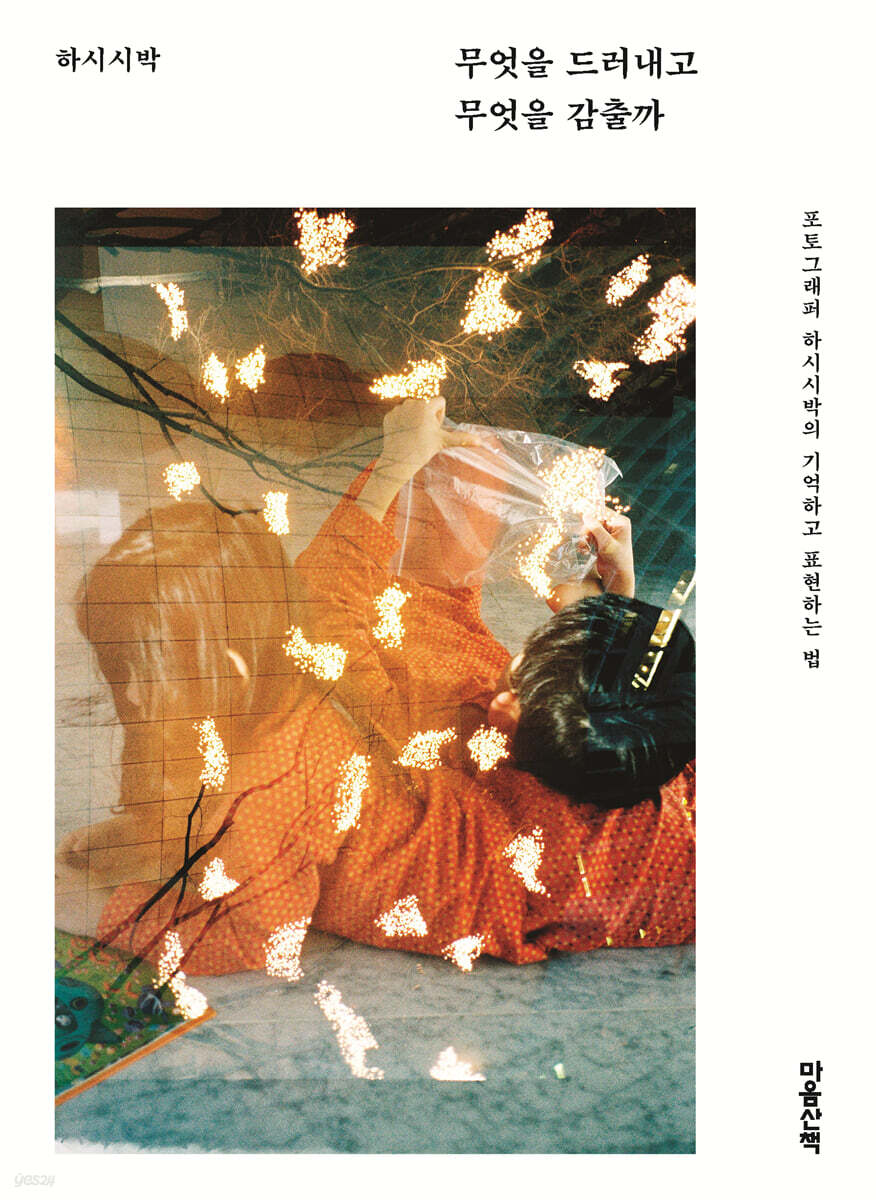
What to reveal and what to hide
 |
Description
Book Introduction
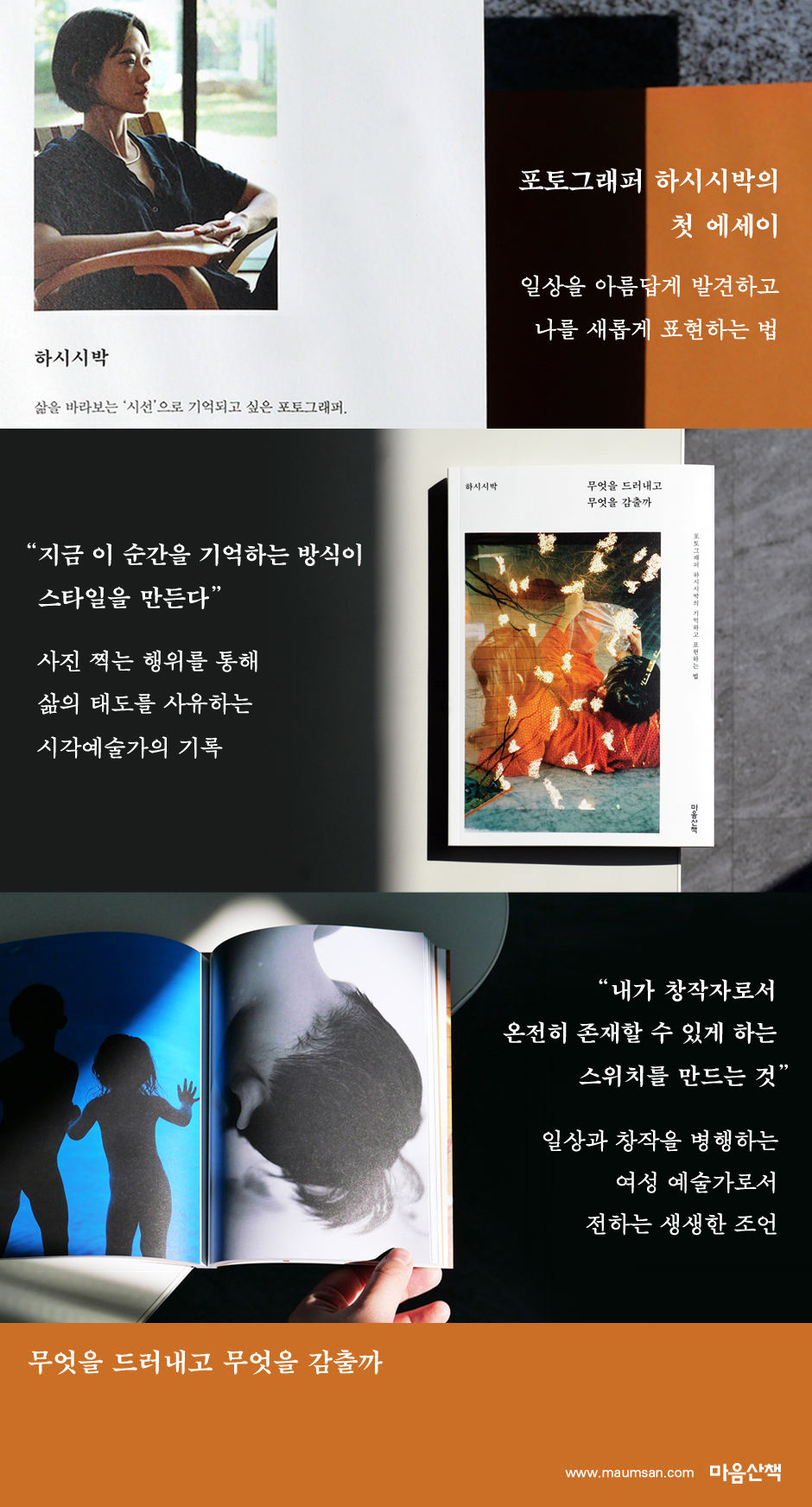
“The way you remember this moment creates your style.”
Photographer Hasisi Park talks
How to discover beauty in everyday life and express yourself in a new way
Photographer Hasisi Park, who is attracting attention from the younger generation for her unique world of work and sensuous lifestyle, has published her first essay, "What to Reveal and What to Hide."
This book is based on two lectures held at the Maumsanchaek Maumpoljak Hall in 2024, and is richly filled with vivid conversations with readers and deeper stories that could not be fully conveyed on site.
Author Hasisi Park, who publishes her first book, shares her thoughts on 'work' and 'daily life' in her own unique way as a working mother, a female artist who balances caregiving and creative work, and an expert who has established a distinct presence in her field.
This book, which includes for the first time the solo exhibition [Casual Pieces] that has been ongoing since 2009, as well as projects in collaboration with various global brands, provides visual satisfaction by including illustrations carefully selected by the artist himself.
Photographer Hasisi Park talks
How to discover beauty in everyday life and express yourself in a new way
Photographer Hasisi Park, who is attracting attention from the younger generation for her unique world of work and sensuous lifestyle, has published her first essay, "What to Reveal and What to Hide."
This book is based on two lectures held at the Maumsanchaek Maumpoljak Hall in 2024, and is richly filled with vivid conversations with readers and deeper stories that could not be fully conveyed on site.
Author Hasisi Park, who publishes her first book, shares her thoughts on 'work' and 'daily life' in her own unique way as a working mother, a female artist who balances caregiving and creative work, and an expert who has established a distinct presence in her field.
This book, which includes for the first time the solo exhibition [Casual Pieces] that has been ongoing since 2009, as well as projects in collaboration with various global brands, provides visual satisfaction by including illustrations carefully selected by the artist himself.
- You can preview some of the book's contents.
Preview
index
1
Switch for me
There is no feedback
The body is the first button
Casual Pieces
What to reveal and what to hide
Questions
2
How to build a relationship
My own style
Commercial Work
How to work
Questions
Epilogue
Switch for me
There is no feedback
The body is the first button
Casual Pieces
What to reveal and what to hide
Questions
2
How to build a relationship
My own style
Commercial Work
How to work
Questions
Epilogue
Detailed image
Into the book
Whether it's doing everyday activities, using Instagram, taking selfies, or having a conversation with someone, I find myself constantly thinking about it.
What to reveal and what to hide.
When I'm alone, I seem to just be myself.
I don't have to be conscious of other people's gaze, so I can exist completely as myself.
The moment I become conscious of others, I must express myself.
I have an intention to convey something and I want to look good.
This goes beyond personal relationships and extends to the creative realm as well.
The problem is that when I'm creative, I try to express myself as someone I'm not.
There's a desire to present ourselves as a better person, a more blatantly plausible person.
This is the beginning.
If this desire is realized in a good way, it can become a driving force for the creator while working, but if it is set in the wrong direction, it can lead to living a life chasing a fake self.
How can we pursue the image of a better person, a growing creator?
I looked back at the way I work.
--- p.12~13
As a creator, I think the most important thing is the switch.
I'm creating a switch that I can turn on and off whenever I want.
Creating a state where I can fully exist as a creator.
This is my first important mission.
--- p.13
“I thought about how I view the future and what kind of photographer I want to be.”
I don't want to be remembered as a photographer who takes pictures of 'what'.
Instead, I want to be a photographer who is remembered for a certain 'gaze'.
(…) I’m often asked if I want to have one photograph that is remembered as my masterpiece, but more than that, I want to be a photographer who is remembered for my attitude towards life.
--- p.26
All photos are like that.
All work is possible because it is done right now, in that moment.
That's the charm of photography.
So, there's no need to worry.
All you have to do is take a lot of pictures and take action.
--- p.47
I think it's really important to go at my own pace, to look at things, so that my soul can rest, as long as it doesn't harm others.
You're doing it for me.
By expressing myself as no one else, I find stability, and I become my own driving force, moving and repeating.
You can't say whether something is right or wrong, good or bad, just by marking some indicator in the flow or process.
What I choose to express and what I choose to hide depends on my own identity, inclinations, and style.
--- p.160
Among photographers, there are many who worry about how to create their own style, and even if it is not necessarily through photography, how to express their tastes and unique style.
As a photographer, I believe that the way you remember the present moment creates your style.
How I remember the situation I am facing now is an important question.
That's what 'gaze' is.
--- p.182
The truth is that most of the time when we are filming, the given conditions are not perfect.
In those cases, if I move just a little bit, many things can be solved.
Because a photograph is an angle, and what I choose to show within that angle is ultimately my choice.
I think the same is true in life.
--- p.191
The most important thing I consider when taking photos is that we are communicating, even if we are not talking.
When I hold a camera and take a picture of you, it means that you and I are communicating.
This is a point that many people often forget, but I think it's especially important these days.
For example, you shouldn't objectify others in public places or take pictures of them without permission.
Because we must assume that the act of taking pictures is communication.
What to reveal and what to hide.
When I'm alone, I seem to just be myself.
I don't have to be conscious of other people's gaze, so I can exist completely as myself.
The moment I become conscious of others, I must express myself.
I have an intention to convey something and I want to look good.
This goes beyond personal relationships and extends to the creative realm as well.
The problem is that when I'm creative, I try to express myself as someone I'm not.
There's a desire to present ourselves as a better person, a more blatantly plausible person.
This is the beginning.
If this desire is realized in a good way, it can become a driving force for the creator while working, but if it is set in the wrong direction, it can lead to living a life chasing a fake self.
How can we pursue the image of a better person, a growing creator?
I looked back at the way I work.
--- p.12~13
As a creator, I think the most important thing is the switch.
I'm creating a switch that I can turn on and off whenever I want.
Creating a state where I can fully exist as a creator.
This is my first important mission.
--- p.13
“I thought about how I view the future and what kind of photographer I want to be.”
I don't want to be remembered as a photographer who takes pictures of 'what'.
Instead, I want to be a photographer who is remembered for a certain 'gaze'.
(…) I’m often asked if I want to have one photograph that is remembered as my masterpiece, but more than that, I want to be a photographer who is remembered for my attitude towards life.
--- p.26
All photos are like that.
All work is possible because it is done right now, in that moment.
That's the charm of photography.
So, there's no need to worry.
All you have to do is take a lot of pictures and take action.
--- p.47
I think it's really important to go at my own pace, to look at things, so that my soul can rest, as long as it doesn't harm others.
You're doing it for me.
By expressing myself as no one else, I find stability, and I become my own driving force, moving and repeating.
You can't say whether something is right or wrong, good or bad, just by marking some indicator in the flow or process.
What I choose to express and what I choose to hide depends on my own identity, inclinations, and style.
--- p.160
Among photographers, there are many who worry about how to create their own style, and even if it is not necessarily through photography, how to express their tastes and unique style.
As a photographer, I believe that the way you remember the present moment creates your style.
How I remember the situation I am facing now is an important question.
That's what 'gaze' is.
--- p.182
The truth is that most of the time when we are filming, the given conditions are not perfect.
In those cases, if I move just a little bit, many things can be solved.
Because a photograph is an angle, and what I choose to show within that angle is ultimately my choice.
I think the same is true in life.
--- p.191
The most important thing I consider when taking photos is that we are communicating, even if we are not talking.
When I hold a camera and take a picture of you, it means that you and I are communicating.
This is a point that many people often forget, but I think it's especially important these days.
For example, you shouldn't objectify others in public places or take pictures of them without permission.
Because we must assume that the act of taking pictures is communication.
--- p.206~207
Publisher's Review
Thinking about one's attitude toward life through the act of taking pictures
Visual Artist's Record
Artist Hasisi Park has steadily expanded his scope of work by crossing genres and borders through collaborations with various artists and global brands.
In an era where everyone is interested in self-branding, many people are looking to emulate him for his natural yet unique self-expression.
His first solo book, What to Reveal and What to Hide, is filled with the important choices he made in his life: from his teenage years when he dropped out of school and went to India to study what he truly wanted to learn, to his twenties when he traveled the world, witnessed diverse lifestyles, and explored his career path, to his current life where he has reached a new turning point by forming a family with his loved one and raising children.
The records of 'Photographer Hasisi Park', who, as he went through the journey of life, changed his perspective on people and nature, and gained a more flexible perspective and a much broader perspective, fully show the growth of a person.
The photographer's realization that "If I don't move, nothing happens" and "The way we look at and approach our subjects is ultimately no different from how we approach life" resonates with readers struggling in their own respective fields.
The truth is that most of the time when we are filming, the given conditions are not perfect.
In those cases, if I move just a little bit, many things can be solved.
Because a photograph is an angle, and what I choose to show within that angle is ultimately my choice.
I think the same is true in life.
_In the text
As a female artist who balances daily life and creative work,
Vivid advice
In the book, the author not only reflects as a creator, but also offers specific advice as a professional who has established himself in his field.
Hasisi Park, who started out as a photographer in London, continues to work actively overseas, collaborating with magazines such as [Vice] and [DOR to Melbourne], as well as global brands such as Aesop and Airbnb.
His project with Philips brought his photographs to light, with displays in New York's Times Square and at international airports and bus stops across the United States.
Based on his experience, artist Hasisi Park emphasizes the importance of maintaining identity and finding a balance that satisfies both the client and the artist, even when commissioned for commercial photography.
We've included useful information that freelancers should keep in mind, even if it's not limited to the photography field, such as writing contracts, revising the results, coordinating work costs, and exchanging business emails.
The most important thing I consider when taking photos is that we are communicating, even if we are not talking.
When I hold a camera and take a picture of you, it means that you and I are communicating.
This is a point that many people often forget, but I think it's especially important these days.
For example, you shouldn't objectify others in public places or take pictures of them without permission.
Because we must assume that the act of taking pictures is communication.
_In the text
"What to Reveal and What to Hide" asks Hasisi Park questions readers have been curious about, from professional questions about photography to love and family life, tastes, and fashion styling.
Hasisi Park shares candid insights into photographers she admires, artists who inspire her, spaces she loves in Seoul, and the moment when she decided to press the shutter as a photographer.
She candidly shares her struggles as a working mom balancing work and childcare, her criteria for networking and financial income as a freelancer, and her thoughts as a creator on how people consume images on social media.
Simple tips that can be applied immediately in real life, such as how to direct a scene the way you want even in a space with shooting restrictions, and tips for breathing life into your photos when they feel boring, are also eye-catching.
Sending messages to society through photography, thinking about the public nature of art that contributes to the public good, and the ethical approach required when taking pictures in public places provide food for thought for both photographers and viewers in the age of images and media.
“I hope this opportunity will inspire you a little more.
It's also good to give to yourself.”
Artist Hasisi Park's 'double exposure technique' of manually rewinding the film to capture images twice resembles his life, which crosses the boundaries between everyday life and art.
As a photographer, model, professional, and mother, Hashishi Park's advice on finding her own balance provides inspiration to readers living in the same era.
The author's confession that while traveling in Iceland, he was moved by the beauty of glaciers layered with tens of thousands of years of time, and realized that the ordinary routines he had accumulated over the years were not meaningless at all, brings comfort to us who live similar days.
Author's Note
One day, I'll look at you all grown up with my camera in my hand and think, thank you for being with me.
Thank you for shining beautifully in the daily life of this difficult journey.
Not by my power, but by your beauty, by your very being.
―From the “Epilogue”
Visual Artist's Record
Artist Hasisi Park has steadily expanded his scope of work by crossing genres and borders through collaborations with various artists and global brands.
In an era where everyone is interested in self-branding, many people are looking to emulate him for his natural yet unique self-expression.
His first solo book, What to Reveal and What to Hide, is filled with the important choices he made in his life: from his teenage years when he dropped out of school and went to India to study what he truly wanted to learn, to his twenties when he traveled the world, witnessed diverse lifestyles, and explored his career path, to his current life where he has reached a new turning point by forming a family with his loved one and raising children.
The records of 'Photographer Hasisi Park', who, as he went through the journey of life, changed his perspective on people and nature, and gained a more flexible perspective and a much broader perspective, fully show the growth of a person.
The photographer's realization that "If I don't move, nothing happens" and "The way we look at and approach our subjects is ultimately no different from how we approach life" resonates with readers struggling in their own respective fields.
The truth is that most of the time when we are filming, the given conditions are not perfect.
In those cases, if I move just a little bit, many things can be solved.
Because a photograph is an angle, and what I choose to show within that angle is ultimately my choice.
I think the same is true in life.
_In the text
As a female artist who balances daily life and creative work,
Vivid advice
In the book, the author not only reflects as a creator, but also offers specific advice as a professional who has established himself in his field.
Hasisi Park, who started out as a photographer in London, continues to work actively overseas, collaborating with magazines such as [Vice] and [DOR to Melbourne], as well as global brands such as Aesop and Airbnb.
His project with Philips brought his photographs to light, with displays in New York's Times Square and at international airports and bus stops across the United States.
Based on his experience, artist Hasisi Park emphasizes the importance of maintaining identity and finding a balance that satisfies both the client and the artist, even when commissioned for commercial photography.
We've included useful information that freelancers should keep in mind, even if it's not limited to the photography field, such as writing contracts, revising the results, coordinating work costs, and exchanging business emails.
The most important thing I consider when taking photos is that we are communicating, even if we are not talking.
When I hold a camera and take a picture of you, it means that you and I are communicating.
This is a point that many people often forget, but I think it's especially important these days.
For example, you shouldn't objectify others in public places or take pictures of them without permission.
Because we must assume that the act of taking pictures is communication.
_In the text
"What to Reveal and What to Hide" asks Hasisi Park questions readers have been curious about, from professional questions about photography to love and family life, tastes, and fashion styling.
Hasisi Park shares candid insights into photographers she admires, artists who inspire her, spaces she loves in Seoul, and the moment when she decided to press the shutter as a photographer.
She candidly shares her struggles as a working mom balancing work and childcare, her criteria for networking and financial income as a freelancer, and her thoughts as a creator on how people consume images on social media.
Simple tips that can be applied immediately in real life, such as how to direct a scene the way you want even in a space with shooting restrictions, and tips for breathing life into your photos when they feel boring, are also eye-catching.
Sending messages to society through photography, thinking about the public nature of art that contributes to the public good, and the ethical approach required when taking pictures in public places provide food for thought for both photographers and viewers in the age of images and media.
“I hope this opportunity will inspire you a little more.
It's also good to give to yourself.”
Artist Hasisi Park's 'double exposure technique' of manually rewinding the film to capture images twice resembles his life, which crosses the boundaries between everyday life and art.
As a photographer, model, professional, and mother, Hashishi Park's advice on finding her own balance provides inspiration to readers living in the same era.
The author's confession that while traveling in Iceland, he was moved by the beauty of glaciers layered with tens of thousands of years of time, and realized that the ordinary routines he had accumulated over the years were not meaningless at all, brings comfort to us who live similar days.
Author's Note
One day, I'll look at you all grown up with my camera in my hand and think, thank you for being with me.
Thank you for shining beautifully in the daily life of this difficult journey.
Not by my power, but by your beauty, by your very being.
―From the “Epilogue”
GOODS SPECIFICS
- Date of issue: May 1, 2025
- Page count, weight, size: 228 pages | 152*208*12mm
- ISBN13: 9788960909311
You may also like
카테고리
korean


korean

![GQ KOREA Mark (Monthly): December [2025]](http://librairie.coreenne.fr/cdn/shop/files/8ef265dbbfbf186523ed75ba7319009d.jpg?v=1765340328&width=3840)


