

Embarrassing Stories of Oriental Art 4
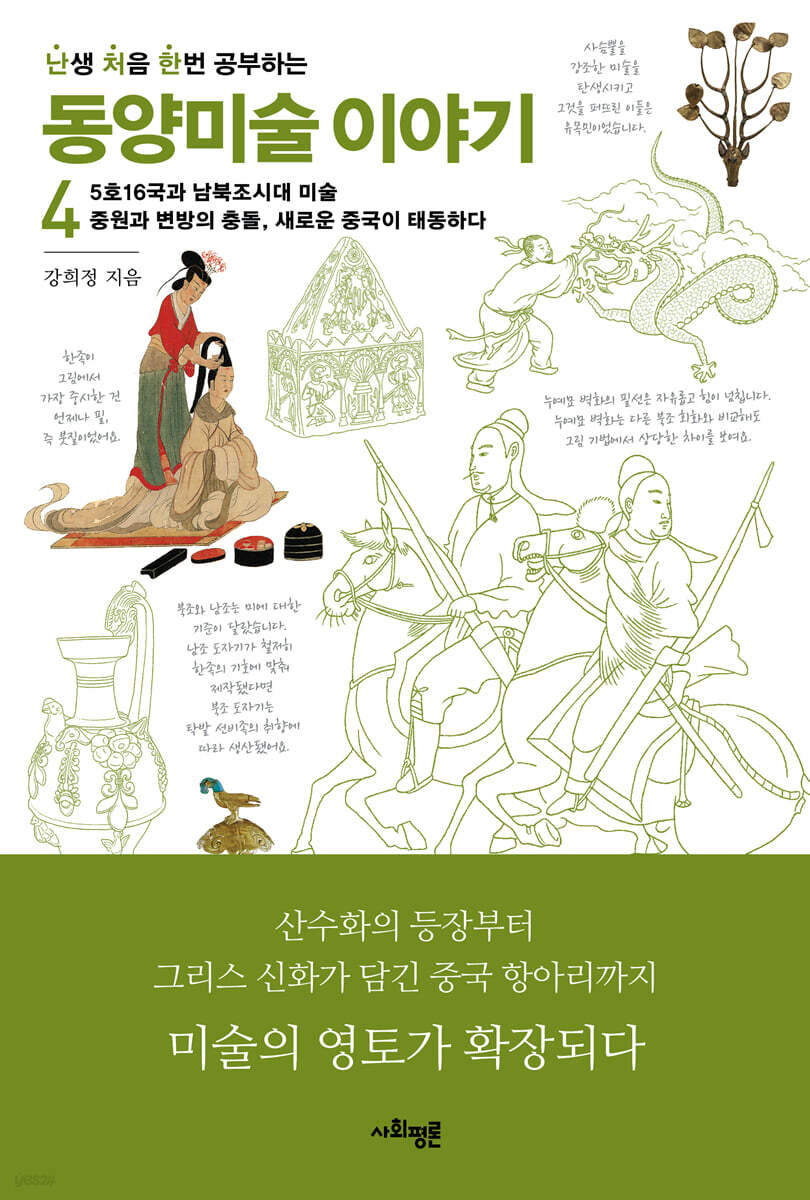 |
Description
Book Introduction
A new curtain rises on art in China during the Five Dynasties and Sixteen Kingdoms and the Southern and Northern Dynasties!
The "Embarrassing Oriental Art" series, which introduced the hidden world of Oriental art by traveling between ancient India (Volume 1), ancient China (Volume 2), and the Silk Road (Volume 3), has returned with a richer art story.
In Volume 4, the stage moves back to China and examines Chinese art from the 3rd to 6th centuries, which is considered the so-called 'age of division.'
During this period, China faced great turmoil due to invasions by northern nomads, the great migration of the Han Chinese, and the influx of foreign cultures.
In the process, Chinese art also achieved unprecedented innovation through the collision and fusion of heterogeneous elements.
Volume 4 of "The Embarrassing Story of Oriental Art" illuminates how the turmoil of the times actually brought new spirit and creative energy to Chinese society.
In today's world, where hatred and rejection of those different from us are rampant, it is time to pay attention to the new possibilities that Chinese art from the Five Hus and Sixteen Kingdoms and the Northern and Southern Dynasties periods offers us.
The "Embarrassing Oriental Art" series, which introduced the hidden world of Oriental art by traveling between ancient India (Volume 1), ancient China (Volume 2), and the Silk Road (Volume 3), has returned with a richer art story.
In Volume 4, the stage moves back to China and examines Chinese art from the 3rd to 6th centuries, which is considered the so-called 'age of division.'
During this period, China faced great turmoil due to invasions by northern nomads, the great migration of the Han Chinese, and the influx of foreign cultures.
In the process, Chinese art also achieved unprecedented innovation through the collision and fusion of heterogeneous elements.
Volume 4 of "The Embarrassing Story of Oriental Art" illuminates how the turmoil of the times actually brought new spirit and creative energy to Chinese society.
In today's world, where hatred and rejection of those different from us are rampant, it is time to pay attention to the new possibilities that Chinese art from the Five Hus and Sixteen Kingdoms and the Northern and Southern Dynasties periods offers us.
- You can preview some of the book's contents.
Preview
index
Preface: The Age of Pioneering, the Leaping Art
Ⅰ Two Worlds Colliding
-The era of the 16 nations begins
01.
Memories of the Prairie
02.
The arrival of northern nomads
03.
On the way to China
04.
From heaven to earth, from earth to heaven
Ⅱ The Threatener and the Threatened
-The Southern and Northern Dynasties Period: Art of the Southern and Northern Dynasties
01.
A heart playing in a bamboo forest
02.
The moment the dragon flew away
03.
Two pictures
04.
Ho is Han's hat, Ho is Han's hat
05.
Alchemy of Earth and Fire
Ⅲ Honey in your mouth, glue in your hand
-Sogdians of China
01.
Silk Road Trendsetter
02.
fire worshippers
03.
A new stranger in the Central Plains
Ⅰ Two Worlds Colliding
-The era of the 16 nations begins
01.
Memories of the Prairie
02.
The arrival of northern nomads
03.
On the way to China
04.
From heaven to earth, from earth to heaven
Ⅱ The Threatener and the Threatened
-The Southern and Northern Dynasties Period: Art of the Southern and Northern Dynasties
01.
A heart playing in a bamboo forest
02.
The moment the dragon flew away
03.
Two pictures
04.
Ho is Han's hat, Ho is Han's hat
05.
Alchemy of Earth and Fire
Ⅲ Honey in your mouth, glue in your hand
-Sogdians of China
01.
Silk Road Trendsetter
02.
fire worshippers
03.
A new stranger in the Central Plains
Detailed image

Into the book
For Siberians, deer antlers were seen as a medium connecting heaven and earth.
Deer antlers, which continue to grow even after being cut, symbolize infinite vitality.
This belief was passed down to the nomads of the steppes, giving rise to the deer ornamentation with its emphasized antlers.
Artworks of this type are found throughout the Eurasian steppe.
---From "Part 1, Chapter 1, 'Memories of the Prairie'"
The Han Chinese funerary art tradition is deeply connected to the Han Chinese's unique view of the afterlife.
The ancient Chinese believed that the human soul was made up of the soul (魂) and the spirit (魄).
It was believed that while alive, the soul and body were in harmony, but upon death, the soul and body separated, the soul going to heaven and the body remaining on earth.
The funeral customs of the Han people were ceremonies to pray for the separated souls and the deceased to depart safely on their own paths.
So the Han people built large and splendid tombs for the hundred people left on earth.
It meant that Baek should not bother the living and should live well in his own grave.
---From "Part 1, Chapter 3, 'The Road to China'"
Ultimately, the discussion of painting is about the painting itself.
Honestly, the drawing itself is of no use in real life.
What else can you do with a painting? At best, you can use it as kindling in a furnace. In short, we can live without it.
Still, why do we need paintings? What is a painting? Why does that artist paint in that way? Why is this painting good, and that painting bad? You might ask these questions.
The Chinese answer to this is Hua-ron.
---From "Part 2, Chapter 1, 'The Heart Playing in the Bamboo Forest'"
After losing their homeland, the Central Plains, to the northern barbarians, the people of the Southern Dynasties suffered from frustration and anxiety, and expressed their weakened hearts through art.
But it was precisely this fragility that gave Southern Dynasty paintings their subtle and delicate beauty.
In Southern Dynasty paintings, loss, sadness, and beauty intersect.
Meanwhile, freedom and love, stubbornness and pride are also intertwined.
Southern Dynasty paintings, which dreamed of beautiful art while preserving tradition, also have a bamboo-like uprightness.
---From "Part 2, Chapter 2, 'The Moment the Dragon Flies'"
In Northern Dynasty paintings, filling in the surface with color was more important than anything else.
Coloring was effective in highlighting the surface and creating a sense of three-dimensionality.
But the people of the Southern Dynasty were different from those of the Northern Dynasty.
I didn't like densely colored drawings without outlines.
The thing that the Han people valued most in painting was always the brush, or brushstrokes.
Moreover, in the Southern Dynasties, when coloring, the intensity of the ink was adjusted to create an overall transparent feeling.
Look at the Southern Dynasties picture below.
Lightly color the background color so that it shows through.
It feels like watercolor.
On the other hand, the Northern Dynasty paintings give an opaque feeling, as if they were painted with crayons.
---From "Part 2, Chapter 2, 'Two Pictures'"
During the Northern and Southern Dynasties period, most of the people who consumed foreign culture were the ruling class.
Just as Chinese silk was sold at exorbitant prices in Rome and Persia, the cultural artifacts that reached China via the Silk Road were also expensive.
Seo Hyun-su, a high-ranking official of the Northern Qi Dynasty, also lived a luxurious life surrounded by foreign culture.
There is an artifact right next to it that shows that evidence.
The ring was found near the tomb owner's coffin.
At first glance, it looks exotic and is presumed to be an ornament made in Iran or Central Asia.
It appears to have been created under the influence of Greek culture.
The idea that the image engraved on the sapphire was Hercules became more convincing.
---From "Part 2, Chapter 4, 'Ho wears Han's hat, Han wears Ho's hat'"
The word ‘Ho-pung’ is a combination of the character ‘ho’ (胡) meaning barbarian and the character ‘pung’ (風) meaning customs, meaning barbarian customs.
Here, barbarians refer to all ethnic groups other than the Han Chinese.
There were two main types of fashion that were popular during the Northern and Southern Dynasties.
These are the customs of the nomads who occupied northern China and the culture of the Western immigrant peoples transmitted through the Silk Road.
Western culture refers to the culture transmitted from the western region of the Silk Road, such as Greece, Rome, Persia, India, and Central Asia, based on China.
The reason why the shape of pottery became elongated during the Northern and Southern Dynasties was also due to the influence of Western culture.
---From "Part 2, Chapter 5, 'Alchemy of Earth and Fire'"
The Sogdians, who were active mainly in Central Asia, dominated the Silk Road from the 3rd to the 8th century and led the fashion.
He grew into the greatest merchant on the Silk Road, the route from Rome to China, and played a leading role in spreading not only goods from the East and the West, but also culture and art.
The wind of prosperity that blew through China around this time was 80% thanks to the activities of Sogdian merchants.
The Sogdians' influence influenced all aspects of the Chinese people, from their clothing to their thoughts and daily necessities.
---From "Part 3, Chapter 1, 'Trendsetters of the Silk Road'"
Of course, it is true that the Sogdians were under Persian rule at certain times.
It is also true that Persian art had a great influence on the Sogdians.
But the Sogdians were a people who created their own culture and art separately.
The Sogdians even had their own unique writing system and language.
However, Sogdian art in Central Asia has long been treated as a subcategory of Persian art and has not received proper attention.
Recent archaeological excavations in Central Asia and Xinjiang have revealed that Sogdian art was not a subculture of Persia.
Some art styles that were vaguely called Persian art are now being renamed Sogdian art.
---From "Part 3, Chapter 1, 'Trendsetters of the Silk Road'"
The 3rd to 6th centuries in China can be seen as a time of change and innovation, nourished by the chaos of the times.
The Chinese immigrants were the main characters who in an instant turned the land of China, which the Han people had tightly embraced, into a new land.
One of the fruits of this is the art of this era.
At that time, Ho and Han's duet created a colorful melody that had never been heard before.
And their performances continued into the next era, eventually resonating throughout the world as a magnificent orchestra called Tang Dynasty art.
Deer antlers, which continue to grow even after being cut, symbolize infinite vitality.
This belief was passed down to the nomads of the steppes, giving rise to the deer ornamentation with its emphasized antlers.
Artworks of this type are found throughout the Eurasian steppe.
---From "Part 1, Chapter 1, 'Memories of the Prairie'"
The Han Chinese funerary art tradition is deeply connected to the Han Chinese's unique view of the afterlife.
The ancient Chinese believed that the human soul was made up of the soul (魂) and the spirit (魄).
It was believed that while alive, the soul and body were in harmony, but upon death, the soul and body separated, the soul going to heaven and the body remaining on earth.
The funeral customs of the Han people were ceremonies to pray for the separated souls and the deceased to depart safely on their own paths.
So the Han people built large and splendid tombs for the hundred people left on earth.
It meant that Baek should not bother the living and should live well in his own grave.
---From "Part 1, Chapter 3, 'The Road to China'"
Ultimately, the discussion of painting is about the painting itself.
Honestly, the drawing itself is of no use in real life.
What else can you do with a painting? At best, you can use it as kindling in a furnace. In short, we can live without it.
Still, why do we need paintings? What is a painting? Why does that artist paint in that way? Why is this painting good, and that painting bad? You might ask these questions.
The Chinese answer to this is Hua-ron.
---From "Part 2, Chapter 1, 'The Heart Playing in the Bamboo Forest'"
After losing their homeland, the Central Plains, to the northern barbarians, the people of the Southern Dynasties suffered from frustration and anxiety, and expressed their weakened hearts through art.
But it was precisely this fragility that gave Southern Dynasty paintings their subtle and delicate beauty.
In Southern Dynasty paintings, loss, sadness, and beauty intersect.
Meanwhile, freedom and love, stubbornness and pride are also intertwined.
Southern Dynasty paintings, which dreamed of beautiful art while preserving tradition, also have a bamboo-like uprightness.
---From "Part 2, Chapter 2, 'The Moment the Dragon Flies'"
In Northern Dynasty paintings, filling in the surface with color was more important than anything else.
Coloring was effective in highlighting the surface and creating a sense of three-dimensionality.
But the people of the Southern Dynasty were different from those of the Northern Dynasty.
I didn't like densely colored drawings without outlines.
The thing that the Han people valued most in painting was always the brush, or brushstrokes.
Moreover, in the Southern Dynasties, when coloring, the intensity of the ink was adjusted to create an overall transparent feeling.
Look at the Southern Dynasties picture below.
Lightly color the background color so that it shows through.
It feels like watercolor.
On the other hand, the Northern Dynasty paintings give an opaque feeling, as if they were painted with crayons.
---From "Part 2, Chapter 2, 'Two Pictures'"
During the Northern and Southern Dynasties period, most of the people who consumed foreign culture were the ruling class.
Just as Chinese silk was sold at exorbitant prices in Rome and Persia, the cultural artifacts that reached China via the Silk Road were also expensive.
Seo Hyun-su, a high-ranking official of the Northern Qi Dynasty, also lived a luxurious life surrounded by foreign culture.
There is an artifact right next to it that shows that evidence.
The ring was found near the tomb owner's coffin.
At first glance, it looks exotic and is presumed to be an ornament made in Iran or Central Asia.
It appears to have been created under the influence of Greek culture.
The idea that the image engraved on the sapphire was Hercules became more convincing.
---From "Part 2, Chapter 4, 'Ho wears Han's hat, Han wears Ho's hat'"
The word ‘Ho-pung’ is a combination of the character ‘ho’ (胡) meaning barbarian and the character ‘pung’ (風) meaning customs, meaning barbarian customs.
Here, barbarians refer to all ethnic groups other than the Han Chinese.
There were two main types of fashion that were popular during the Northern and Southern Dynasties.
These are the customs of the nomads who occupied northern China and the culture of the Western immigrant peoples transmitted through the Silk Road.
Western culture refers to the culture transmitted from the western region of the Silk Road, such as Greece, Rome, Persia, India, and Central Asia, based on China.
The reason why the shape of pottery became elongated during the Northern and Southern Dynasties was also due to the influence of Western culture.
---From "Part 2, Chapter 5, 'Alchemy of Earth and Fire'"
The Sogdians, who were active mainly in Central Asia, dominated the Silk Road from the 3rd to the 8th century and led the fashion.
He grew into the greatest merchant on the Silk Road, the route from Rome to China, and played a leading role in spreading not only goods from the East and the West, but also culture and art.
The wind of prosperity that blew through China around this time was 80% thanks to the activities of Sogdian merchants.
The Sogdians' influence influenced all aspects of the Chinese people, from their clothing to their thoughts and daily necessities.
---From "Part 3, Chapter 1, 'Trendsetters of the Silk Road'"
Of course, it is true that the Sogdians were under Persian rule at certain times.
It is also true that Persian art had a great influence on the Sogdians.
But the Sogdians were a people who created their own culture and art separately.
The Sogdians even had their own unique writing system and language.
However, Sogdian art in Central Asia has long been treated as a subcategory of Persian art and has not received proper attention.
Recent archaeological excavations in Central Asia and Xinjiang have revealed that Sogdian art was not a subculture of Persia.
Some art styles that were vaguely called Persian art are now being renamed Sogdian art.
---From "Part 3, Chapter 1, 'Trendsetters of the Silk Road'"
The 3rd to 6th centuries in China can be seen as a time of change and innovation, nourished by the chaos of the times.
The Chinese immigrants were the main characters who in an instant turned the land of China, which the Han people had tightly embraced, into a new land.
One of the fruits of this is the art of this era.
At that time, Ho and Han's duet created a colorful melody that had never been heard before.
And their performances continued into the next era, eventually resonating throughout the world as a magnificent orchestra called Tang Dynasty art.
---From "Part 3, Chapter 3, 'The New Stranger in the Central Plains'"
Publisher's Review
Finally, we have an Oriental art textbook!
Richer in series, more practical in single volumes
Readers' interest in art is always hot.
The art corner of the bookstore is filled with new books every day.
However, most of these books focus on Western art.
From introductory to academic books, you can choose and read books at the level you want.
In comparison, the spectrum of books on oriental art available on the market is not wide.
It's either a simple interest book or a specialized book with dense small print.
The series “Embarrassing Oriental Art” started from a sense of this problem.
This book, which catches two birds with one stone—interest and depth—is the textbook on Oriental art that has finally arrived.
It is best to read the series sequentially, but the content is organized so that you can easily understand the book by selecting a country or period of art that interests you.
If you are a beginner who wants to properly understand oriental art, there is ample reason to open this book.
The first foreign dynasty in Chinese history to occupy the Central Plains,
An era of great change has begun, shaking up the Han-centered worldview!
Not many people can immediately recall what China was like in the 3rd to 6th centuries.
Then, how about explaining it this way? It was a period of upheaval between the Three Kingdoms period, a time of chaotic heroes, and the Tang Dynasty, a golden age of culture.
In fact, this period had not received much attention in Chinese academic circles for a long time.
It is usually lumped together as a dark or chaotic period in China, or it is sometimes devalued as a time of humiliation when China was trampled by foreigners.
But is that really the case? Volume 4 of "The Embarrassing Story of Oriental Art" offers a completely different answer.
Around the 4th century, when even the heroes of the Romance of the Three Kingdoms had disappeared, the northern nomads who invaded China occupied half of the Chinese territory and shook Chinese society to its core.
The repercussions this reality had on the Han people were enormous.
The long-held belief that 'China is the center of the world, and the center of China is the Han people' has been shattered.
Until recently, the Han Chinese considered the area outside the Central Plains to be their borders, and all non-Han peoples were called barbarians and looked down on.
But now he had to watch with a heavy heart as the barbarians from the border established a dynasty on his land.
Coming down from the stage of the Central Plains, he was faced with the reality of having to rebuild his identity with a weakened mind.
However, the borders broken down by the foreigners demanded a change in mindset in the closed Han Chinese society, and instead breathed into China an unprecedentedly brilliant vitality and new spirit.
Art was also under its sphere of influence.
The 3rd to 6th centuries were a period in Chinese art history when more diverse and innovative art was created than at any other time.
Go Gae-ji, the painter who opened the curtain on Chinese painting,
Nuye Myo murals, born from the fusion of Han Chinese and foreign cultures
Metal tools from Central Asia transmitted through Sogdian merchants,
Moonstone celadon, perfected with cutting-edge technology
From the emergence of landscape paintings to Chinese jars containing Greek mythology!
One of them is Buddhist art.
The nomads who established a country in northern China accepted Buddhism in the process of consolidating their royal authority in order to end their long nomadic life and live as settled people.
Until the Han Dynasty, Buddhism was unable to properly permeate Chinese society because it was blocked by traditional Chinese ideologies such as Confucianism and Taoism.
However, in China, which was ruled by a foreign dynasty, Buddhism quickly became the dominant religion.
The spread of Buddhism is not simply the spread of religion.
With the construction of grottoes and Buddhist statues along the Hexi Corridor, a road connecting the Western Regions and the Central Plains, art from India and the Western Regions was able to flow into inland China.
In this way, China's immigrant dynasties boldly accepted foreign cultures with the openness characteristic of nomads, and this brought a wind of innovation unlike anything before to China.
A new era in art has opened.
Among those who led this change were the Sogdians of China.
By this time, the Sogdians had settled in large numbers in northern China, which was ruled by a barbarian dynasty, and were exercising influence no less than that of nomads.
Most of them worked as Silk Road merchants, but some rose to high positions and enjoyed considerable power, interfering with Chinese politics and economy.
Western civilization, transmitted through the Sogdians of China, caught the eyes and ears of the ruling class of China at the time and ignited their interest in foreign civilizations from Greece, Rome, and Persia.
Eventually, Western artistic styles were transmitted to China, leading to the creation of Chinese jars depicting Greek mythology.
Meanwhile, the Han Chinese in southern China, who were driven out of the Central Plains, created art that pushed Han Chinese traditions to the extreme.
The celadon produced in southern China at that time represents the pinnacle of ceramics-making technology that the Han people had honed over a long period of time.
The tradition of Chinese painting, which emphasized brush strokes, also developed to a higher level around this time, thanks to the emergence of full-fledged painting theory.
At the center of it all are the legendary Southern Dynasty painter Go Gae-ji, Jong Byeong who gave birth to the theory of landscape painting, and Sa Hyeok who perfected the six rules for evaluating paintings.
These are the people who formed the foundation of Chinese painting, and are the names that represent Chinese painting during the Northern and Southern Dynasties.
Their reflections on the painting will serve as a fundamental guide to understanding not only Chinese painting but also Oriental painting as a whole.
The age of brilliant division,
Meet the vibrant art just before it blooms!
The Chinese art of the Five Dynasties and Sixteen Kingdoms and the Northern and Southern Dynasties periods differed as much as the cultural differences between the northern part of China, ruled by a foreign dynasty, and the southern part, ruled by a Han dynasty.
However, the art they created in their respective positions either pushed tradition to its limits or mercilessly surpassed it, each opening up a new realm of art.
Furthermore, in this process, the Han Chinese and the foreign ethnic groups gradually break down the boundaries between their art and finally begin to face each other.
This was due to the consistent efforts of the Northern Zhou Dynasty to achieve unification between the Han Chinese and other ethnic groups.
In this way, they prepare to open a new China together called the Tang Dynasty.
If we were to describe Chinese art from the 3rd to 6th centuries in one word, it would be like a flower just before it blooms.
Here is art, vibrant and full of explosive potential, on the verge of blossoming.
The art of this era beautifully decorated the path to a new China by bursting into bloom with various flower buds.
It celebrated a new era ushered in by the Han Chinese and other ethnic groups with unprecedented fragrance and rare splendor.
In Volume 4 of "The Embarrassing Story of Oriental Art," let's experience the dazzling feast of art created during a chaotic era, the art of that wondrous moment.
Richer in series, more practical in single volumes
Readers' interest in art is always hot.
The art corner of the bookstore is filled with new books every day.
However, most of these books focus on Western art.
From introductory to academic books, you can choose and read books at the level you want.
In comparison, the spectrum of books on oriental art available on the market is not wide.
It's either a simple interest book or a specialized book with dense small print.
The series “Embarrassing Oriental Art” started from a sense of this problem.
This book, which catches two birds with one stone—interest and depth—is the textbook on Oriental art that has finally arrived.
It is best to read the series sequentially, but the content is organized so that you can easily understand the book by selecting a country or period of art that interests you.
If you are a beginner who wants to properly understand oriental art, there is ample reason to open this book.
The first foreign dynasty in Chinese history to occupy the Central Plains,
An era of great change has begun, shaking up the Han-centered worldview!
Not many people can immediately recall what China was like in the 3rd to 6th centuries.
Then, how about explaining it this way? It was a period of upheaval between the Three Kingdoms period, a time of chaotic heroes, and the Tang Dynasty, a golden age of culture.
In fact, this period had not received much attention in Chinese academic circles for a long time.
It is usually lumped together as a dark or chaotic period in China, or it is sometimes devalued as a time of humiliation when China was trampled by foreigners.
But is that really the case? Volume 4 of "The Embarrassing Story of Oriental Art" offers a completely different answer.
Around the 4th century, when even the heroes of the Romance of the Three Kingdoms had disappeared, the northern nomads who invaded China occupied half of the Chinese territory and shook Chinese society to its core.
The repercussions this reality had on the Han people were enormous.
The long-held belief that 'China is the center of the world, and the center of China is the Han people' has been shattered.
Until recently, the Han Chinese considered the area outside the Central Plains to be their borders, and all non-Han peoples were called barbarians and looked down on.
But now he had to watch with a heavy heart as the barbarians from the border established a dynasty on his land.
Coming down from the stage of the Central Plains, he was faced with the reality of having to rebuild his identity with a weakened mind.
However, the borders broken down by the foreigners demanded a change in mindset in the closed Han Chinese society, and instead breathed into China an unprecedentedly brilliant vitality and new spirit.
Art was also under its sphere of influence.
The 3rd to 6th centuries were a period in Chinese art history when more diverse and innovative art was created than at any other time.
Go Gae-ji, the painter who opened the curtain on Chinese painting,
Nuye Myo murals, born from the fusion of Han Chinese and foreign cultures
Metal tools from Central Asia transmitted through Sogdian merchants,
Moonstone celadon, perfected with cutting-edge technology
From the emergence of landscape paintings to Chinese jars containing Greek mythology!
One of them is Buddhist art.
The nomads who established a country in northern China accepted Buddhism in the process of consolidating their royal authority in order to end their long nomadic life and live as settled people.
Until the Han Dynasty, Buddhism was unable to properly permeate Chinese society because it was blocked by traditional Chinese ideologies such as Confucianism and Taoism.
However, in China, which was ruled by a foreign dynasty, Buddhism quickly became the dominant religion.
The spread of Buddhism is not simply the spread of religion.
With the construction of grottoes and Buddhist statues along the Hexi Corridor, a road connecting the Western Regions and the Central Plains, art from India and the Western Regions was able to flow into inland China.
In this way, China's immigrant dynasties boldly accepted foreign cultures with the openness characteristic of nomads, and this brought a wind of innovation unlike anything before to China.
A new era in art has opened.
Among those who led this change were the Sogdians of China.
By this time, the Sogdians had settled in large numbers in northern China, which was ruled by a barbarian dynasty, and were exercising influence no less than that of nomads.
Most of them worked as Silk Road merchants, but some rose to high positions and enjoyed considerable power, interfering with Chinese politics and economy.
Western civilization, transmitted through the Sogdians of China, caught the eyes and ears of the ruling class of China at the time and ignited their interest in foreign civilizations from Greece, Rome, and Persia.
Eventually, Western artistic styles were transmitted to China, leading to the creation of Chinese jars depicting Greek mythology.
Meanwhile, the Han Chinese in southern China, who were driven out of the Central Plains, created art that pushed Han Chinese traditions to the extreme.
The celadon produced in southern China at that time represents the pinnacle of ceramics-making technology that the Han people had honed over a long period of time.
The tradition of Chinese painting, which emphasized brush strokes, also developed to a higher level around this time, thanks to the emergence of full-fledged painting theory.
At the center of it all are the legendary Southern Dynasty painter Go Gae-ji, Jong Byeong who gave birth to the theory of landscape painting, and Sa Hyeok who perfected the six rules for evaluating paintings.
These are the people who formed the foundation of Chinese painting, and are the names that represent Chinese painting during the Northern and Southern Dynasties.
Their reflections on the painting will serve as a fundamental guide to understanding not only Chinese painting but also Oriental painting as a whole.
The age of brilliant division,
Meet the vibrant art just before it blooms!
The Chinese art of the Five Dynasties and Sixteen Kingdoms and the Northern and Southern Dynasties periods differed as much as the cultural differences between the northern part of China, ruled by a foreign dynasty, and the southern part, ruled by a Han dynasty.
However, the art they created in their respective positions either pushed tradition to its limits or mercilessly surpassed it, each opening up a new realm of art.
Furthermore, in this process, the Han Chinese and the foreign ethnic groups gradually break down the boundaries between their art and finally begin to face each other.
This was due to the consistent efforts of the Northern Zhou Dynasty to achieve unification between the Han Chinese and other ethnic groups.
In this way, they prepare to open a new China together called the Tang Dynasty.
If we were to describe Chinese art from the 3rd to 6th centuries in one word, it would be like a flower just before it blooms.
Here is art, vibrant and full of explosive potential, on the verge of blossoming.
The art of this era beautifully decorated the path to a new China by bursting into bloom with various flower buds.
It celebrated a new era ushered in by the Han Chinese and other ethnic groups with unprecedented fragrance and rare splendor.
In Volume 4 of "The Embarrassing Story of Oriental Art," let's experience the dazzling feast of art created during a chaotic era, the art of that wondrous moment.
GOODS SPECIFICS
- Date of issue: April 8, 2025
- Page count, weight, size: 536 pages | 806g | 153*225*32mm
- ISBN13: 9791162733417
- ISBN10: 1162733411
You may also like
카테고리
korean


korean

![GQ KOREA Mark (Monthly): December [2025]](http://librairie.coreenne.fr/cdn/shop/files/8ef265dbbfbf186523ed75ba7319009d.jpg?v=1765340328&width=3840)


