

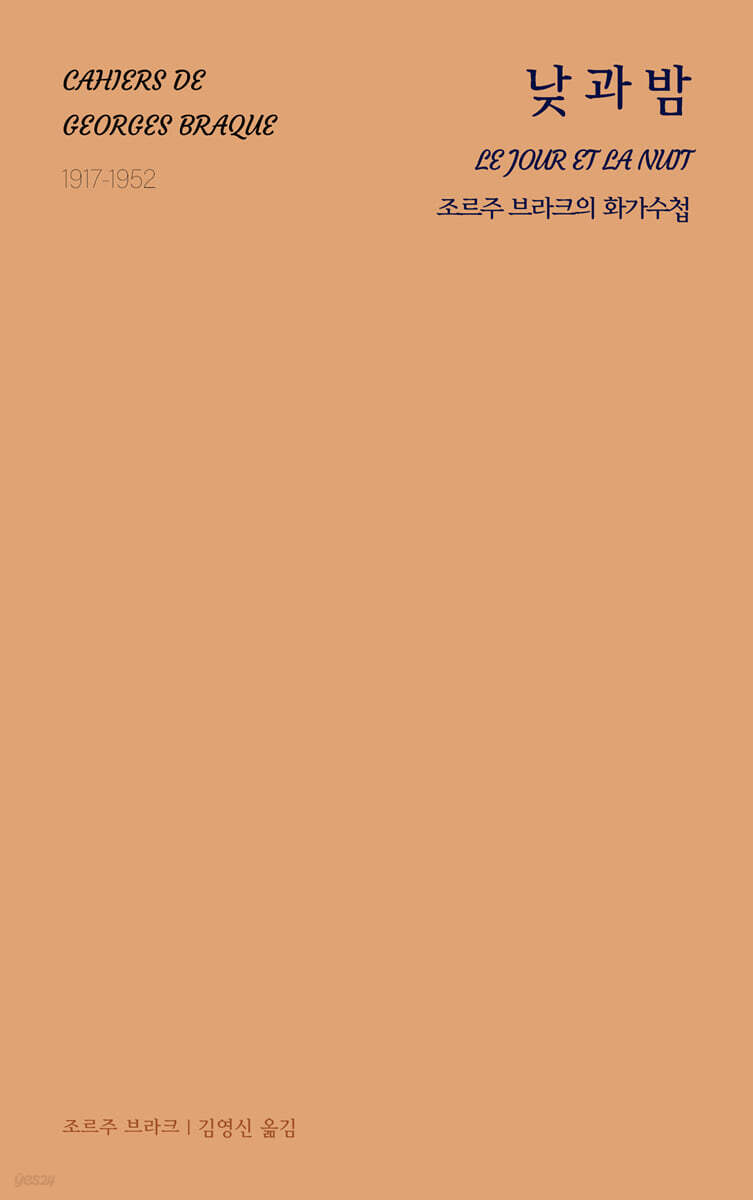
Day and night
 |
Description
Book Introduction
Georges Braque, the founder of Cubism and a pioneer of modern art
A profound exploration of art and perception
[Day and Night] is a special book that provides a glimpse into the artistic thinking and philosophical depth that Georges Braque pursued.
Braque's short sentences, full of originality and sharp insight, speak of his outlook on art and life.
This valuable resource provides a glimpse into the secrets of Braque's art. Braque's symbolic contrasts between light and darkness, existence and nothingness, life and death, and his profound reflections on art and life are a fierce record that delves into the essence of human perception and art.
Moreover, the philosophical and aesthetic reflections on the balance between the oppositions that constitute our worldview—nature and humanity, reality and ideas, reality and imagination—will be a great inspiration to all who seek to explore the essence of art and life.
A profound exploration of art and perception
[Day and Night] is a special book that provides a glimpse into the artistic thinking and philosophical depth that Georges Braque pursued.
Braque's short sentences, full of originality and sharp insight, speak of his outlook on art and life.
This valuable resource provides a glimpse into the secrets of Braque's art. Braque's symbolic contrasts between light and darkness, existence and nothingness, life and death, and his profound reflections on art and life are a fierce record that delves into the essence of human perception and art.
Moreover, the philosophical and aesthetic reflections on the balance between the oppositions that constitute our worldview—nature and humanity, reality and ideas, reality and imagination—will be a great inspiration to all who seek to explore the essence of art and life.
- You can preview some of the book's contents.
Preview
index
Recommendation
Topic Table of Contents
The order of the conflicting topics
Day and night
Translator's Note
About the painter Georges Braque
Topic Table of Contents
The order of the conflicting topics
Day and night
Translator's Note
About the painter Georges Braque
Detailed image
.jpg)
Into the book
Emotions cannot be added or imitated.
Emotions are embryos, works are hatchings.
--- p.23
An artist's individuality is not formed by his repetitive expressive techniques.
--- p.25
What makes an artist heroic is the instability of his work.
--- p.32
Critics choose to condemn when they cannot apply outdated vocabulary.
--- p.34
You have to choose one.
Something cannot be true and appear to be true at the same time.
--- p.51
Freedom can be obtained, but it does not give oneself away.
Freedom in the community is the free exercise of habits, but for us freedom is going beyond taboos.
Freedom is not open to all, and for many it exists between control and approval.
Emotions are embryos, works are hatchings.
--- p.23
An artist's individuality is not formed by his repetitive expressive techniques.
--- p.25
What makes an artist heroic is the instability of his work.
--- p.32
Critics choose to condemn when they cannot apply outdated vocabulary.
--- p.34
You have to choose one.
Something cannot be true and appear to be true at the same time.
--- p.51
Freedom can be obtained, but it does not give oneself away.
Freedom in the community is the free exercise of habits, but for us freedom is going beyond taboos.
Freedom is not open to all, and for many it exists between control and approval.
--- p.74
Publisher's Review
You must always have two thoughts, one to destroy the other.
This is a special book that allows you to encounter the art and philosophy pursued by Cubist painter Georges Braque.
The fragments recorded in Georges Braque's notebooks from 1917 to 1952 provide deep insight into the creative act and art, and serve as an important starting point for understanding his world of work.
These short notes, filled with fierce self-reflection as a creator and the artist's sharp thinking on how to perceive and express the world around him, explore the boundaries between reality and imagination and view the world's contradictions and conflicts with rigorous intellect.
This philosophical and aesthetic reflection on finding a balance between the conflicts that constitute our worldview—nature and humanity, reality and conception, reality and imagination—will be a great inspiration to all who explore art and life.
In particular, it deals with the complex relationship between objects and their representations, which is a central theme of Cubism, and the problem of the perception and transformation of objects in space and time, through the opposition of poetic and philosophical, artistic and metaphysical concepts.
The art he pursued was one that, through the destruction and reconstruction of form, raised fundamental questions about how we relate to the world and how we perceive ourselves, and these notes document that intense process.
This record seems to be Braque's inner journey to find stability in a constantly changing world, facing the turmoil of World War I, the artistic transformation of Cubism, and then again World War II in a chaotic Europe.
Through these notes, Braque continues his reflections on the dualities and oppositions that constitute the world: day and night, light and darkness, art and science, evolution and progress, reason and spirituality, hope and ideals, faith and conviction, power and resistance.
The beauty of the world lies in the uneasy balance between constant opposition and interdependence, and in a desolate world, this contrast, oscillating between hope and despair, clarity and confusion, becomes a metaphor for human existence itself.
Through reflections on the duality and contrast of objects, the interplay between essence and phenomenon, idea and reality, light and shadow, he explores how we perceive reality, ultimately moving beyond artistic expression to address existential questions about humanity.
Braque argues that these opposing concepts define and complement each other, emphasizing that light and darkness, life and death, hope and despair are all interdependent.
This opposition serves as an important principle that constantly changes and interacts in Braque's art.
Ultimately, Braque explores the possibilities of how art can reflect the inner self of human beings and provide a new perspective on the world.
In poetic and philosophical prose, the artist is a being who captures and embodies the fleeting sensations of light and shadow, the sense of time and space, which can only be captured with profound subjectivity.
He shows how these sensations can be artistically expressed not as simple geometric forms, but as moments of profound awareness, how such contrasts play a crucial role in artistic expression, and how human perception reflects external changes and inner experiences.
[Day and Night] goes beyond mere aesthetic reflection, exploring the boundaries between reality and imagination while simultaneously demonstrating the endless game of perception that unfolds when reality and imagination meet.
Braque invites the reader to perceive and explore the opposition that constitutes the world.
Braque initially depicted reality through figurative expressions, but gradually transformed into abstract and geometric forms, and tried to find new meaning in them.
Braque's art always focused on process and change.
Braque's artistic growth and transformation can also be inferred through this book.
Rather than pursuing a finished form or perfect aesthetic, he sought to reflect the complexity and change of life through the ever-changing interplay of lines and colors.
Even in [Day and Night], his thoughts, even with the same vocabulary, conflict or contain contradictions depending on the flow of time, situation, or context. However, this may be a will to avoid being confined to a single thought, unrelated to the arbitrary use of language.
Because what is important and absolute to him is the truth.
In truth there are no contradictions, no opposites, no contradictions.
Truth is absolute only in itself.
Braque's notes speak to the very essence of art he pursued: a process of constant change and evolution.
This notebook can be said to be a process of his continuous exploration of the depths of his inner self and his efforts to sublimate universal human experiences into art.
Braque makes it clear that painting is more than just drawing a picture.
Art itself becomes a new window through which to view the world, a means of exploring psychological and ontological truths that exist beyond the everyday, physical world.
His notes are concise, but the contrasts and contradictions they contain add depth and three-dimensionality to the meaning, offering the possibility of diverse interpretations on multiple levels.
In this respect, the contrast symbolized by 'day and night' appears as an important medium for expressing our inner emotional conflicts, psychological changes, and shifts in perception.
These contrasts are always intertwined and mutually defining.
What he is trying to say through his work is that these two are not separate, and that each is in the process of becoming complete as one.
Art is not simply about depicting reality, but about revealing the truth that lies beyond reality and is invisible.
Braque's intention to expand understanding of the self and the world through art and to present diverse perspectives on the world is also clearly revealed in this note.
[Day and Night] is an artistically and philosophically significant work, and remains to this day a work that urges deep reflection on human existence and art.
Braque's texts themselves have poetic and metaphorical qualities.
While he explains his artistic world through language, the layers of concepts he chooses show that he is not just an artist, but a philosopher of art.
Braque's notes, which are highly abstract and sometimes express the flow of emotions and thoughts in his own language, will serve as a sufficient forum for understanding his artistic world and intellectual discussion.
Above all, readers will be able to embark on a journey to find their own interpretation of his concise and philosophical message.
Thus, I hope this book will serve as a window that broadens your perspective on art, opening your eyes, stimulating your senses, and realizing that art has the power to expand your understanding of the world.
[About the painter Georges Braque]
Braque was born on May 13, 1882, in Argenteuil, near Paris, France.
His father was a construction painting businessman and painter, and he showed an interest in art from an early age.
He studied at the night classes of the Academy of Fine Arts in Le Havre, but dropped out midway and returned to Paris to help his father with his work and entered the Académie Umberto Umberto in Paris.
There he meets Marie Laurencin and Francis Picabia.
In his early years, Braque was influenced by the Fauvism of Henri Matisse and André Derain and used strong colors, but in the summer of 1907, he took a new path with his paintings of the landscape of l'Estaque with its cube-shaped houses, which Matisse called "Cubism", especially [Maisons à l'Estaquel'Estaque], and Braque's work became more abstract and geometric.
From 1906, he entered the period called Cubism (1911-1914) through a systematic study of Paul Cézanne's outlines and a break with classical perspective.
Braque and Picasso: The Birth of Cubism
“What is Cubism? It is, of course, the Braque-Picasso school,” a critic said in 1911.
Braque's meeting with Pablo Picasso marked a major turning point in his artistic life.
The two artists first met in 1907 and together founded the revolutionary art movement known as Cubism.
Cubism rejected traditional perspective and methods of representing objects, and proposed a method of decomposing and recombining forms and compositions through multiple viewpoints.
War and Postwar Changes
When World War I broke out, Braque volunteered for the French army and was seriously wounded during combat.
After the war, Braque moved away from the decomposition and dissolution of form and began to pursue soft, organic forms using simplified lines and colors.
His work gradually became more emotional and personal.
As a true thinker of Cubism, he re-established the laws of perspective and color.
Focusing on still life, he focused on the transformation of geometric forms and the way objects are viewed from multiple perspectives through color, line, and texture.
The discovery of new techniques such as using geometric shapes in still lifes, introducing stenciled letters into paintings, utilizing collage techniques such as pasting fragments of advertising flyers onto canvas, and mixing pigments with sand to elicit tactile sensations in space from flat images had a great influence on several art movements, including 20th-century abstract art and surrealism.
Braque's art was not limited to mere technical innovation; it completely redefined art by raising deep philosophical questions about the essence and existence of art.
He will be remembered as a significant artist who expanded the boundaries of art through constant experimentation and exploration, and provided a new perspective on the essence of art.
Braque's creative philosophy and artistic approach
For Braque, art can be said to be a continuation of process and exploration.
Rather than viewing his work as a finished product, he placed greater value on the inspiration and ideas he gained during the process of creating and experimenting with his work.
For him, art was about evolving through imperfection and experimentation, as evident in his sketchbooks and personal notes.
Braque valued the emotions and thoughts that came with his work rather than perfectly organized paintings.
Braque's art is not simply a visual work, but also an expression of philosophical thought.
He sought to raise existential questions through form and color, and to reveal human emotions and inner changes.
Using the language of shape and color, his art conveys a depth that cannot be expressed in words, attempting to express the complex psychological and philosophical states of human existence, that is, the human inner world and perception of the world.
His aesthetic stance, which sought to elevate art that explores the essence of existence and the complexity of human emotions through the dismantling of form and the transformation of color, into a universal truth, is expressed briefly and concisely in his creative notes, [Day and Night].
His notes make it clear that Braque's art is not simply a visual representation, but a significant philosophical journey exploring human existence and the inner self.
Braque's work did not reflect the artistic trends of his time, but rather suggested the direction of modern art.
He went beyond the form of art and explored the essential meaning of art, creating a new visual language.
The techniques and ideas he used have had a profound influence on painters today.
This is a special book that allows you to encounter the art and philosophy pursued by Cubist painter Georges Braque.
The fragments recorded in Georges Braque's notebooks from 1917 to 1952 provide deep insight into the creative act and art, and serve as an important starting point for understanding his world of work.
These short notes, filled with fierce self-reflection as a creator and the artist's sharp thinking on how to perceive and express the world around him, explore the boundaries between reality and imagination and view the world's contradictions and conflicts with rigorous intellect.
This philosophical and aesthetic reflection on finding a balance between the conflicts that constitute our worldview—nature and humanity, reality and conception, reality and imagination—will be a great inspiration to all who explore art and life.
In particular, it deals with the complex relationship between objects and their representations, which is a central theme of Cubism, and the problem of the perception and transformation of objects in space and time, through the opposition of poetic and philosophical, artistic and metaphysical concepts.
The art he pursued was one that, through the destruction and reconstruction of form, raised fundamental questions about how we relate to the world and how we perceive ourselves, and these notes document that intense process.
This record seems to be Braque's inner journey to find stability in a constantly changing world, facing the turmoil of World War I, the artistic transformation of Cubism, and then again World War II in a chaotic Europe.
Through these notes, Braque continues his reflections on the dualities and oppositions that constitute the world: day and night, light and darkness, art and science, evolution and progress, reason and spirituality, hope and ideals, faith and conviction, power and resistance.
The beauty of the world lies in the uneasy balance between constant opposition and interdependence, and in a desolate world, this contrast, oscillating between hope and despair, clarity and confusion, becomes a metaphor for human existence itself.
Through reflections on the duality and contrast of objects, the interplay between essence and phenomenon, idea and reality, light and shadow, he explores how we perceive reality, ultimately moving beyond artistic expression to address existential questions about humanity.
Braque argues that these opposing concepts define and complement each other, emphasizing that light and darkness, life and death, hope and despair are all interdependent.
This opposition serves as an important principle that constantly changes and interacts in Braque's art.
Ultimately, Braque explores the possibilities of how art can reflect the inner self of human beings and provide a new perspective on the world.
In poetic and philosophical prose, the artist is a being who captures and embodies the fleeting sensations of light and shadow, the sense of time and space, which can only be captured with profound subjectivity.
He shows how these sensations can be artistically expressed not as simple geometric forms, but as moments of profound awareness, how such contrasts play a crucial role in artistic expression, and how human perception reflects external changes and inner experiences.
[Day and Night] goes beyond mere aesthetic reflection, exploring the boundaries between reality and imagination while simultaneously demonstrating the endless game of perception that unfolds when reality and imagination meet.
Braque invites the reader to perceive and explore the opposition that constitutes the world.
Braque initially depicted reality through figurative expressions, but gradually transformed into abstract and geometric forms, and tried to find new meaning in them.
Braque's art always focused on process and change.
Braque's artistic growth and transformation can also be inferred through this book.
Rather than pursuing a finished form or perfect aesthetic, he sought to reflect the complexity and change of life through the ever-changing interplay of lines and colors.
Even in [Day and Night], his thoughts, even with the same vocabulary, conflict or contain contradictions depending on the flow of time, situation, or context. However, this may be a will to avoid being confined to a single thought, unrelated to the arbitrary use of language.
Because what is important and absolute to him is the truth.
In truth there are no contradictions, no opposites, no contradictions.
Truth is absolute only in itself.
Braque's notes speak to the very essence of art he pursued: a process of constant change and evolution.
This notebook can be said to be a process of his continuous exploration of the depths of his inner self and his efforts to sublimate universal human experiences into art.
Braque makes it clear that painting is more than just drawing a picture.
Art itself becomes a new window through which to view the world, a means of exploring psychological and ontological truths that exist beyond the everyday, physical world.
His notes are concise, but the contrasts and contradictions they contain add depth and three-dimensionality to the meaning, offering the possibility of diverse interpretations on multiple levels.
In this respect, the contrast symbolized by 'day and night' appears as an important medium for expressing our inner emotional conflicts, psychological changes, and shifts in perception.
These contrasts are always intertwined and mutually defining.
What he is trying to say through his work is that these two are not separate, and that each is in the process of becoming complete as one.
Art is not simply about depicting reality, but about revealing the truth that lies beyond reality and is invisible.
Braque's intention to expand understanding of the self and the world through art and to present diverse perspectives on the world is also clearly revealed in this note.
[Day and Night] is an artistically and philosophically significant work, and remains to this day a work that urges deep reflection on human existence and art.
Braque's texts themselves have poetic and metaphorical qualities.
While he explains his artistic world through language, the layers of concepts he chooses show that he is not just an artist, but a philosopher of art.
Braque's notes, which are highly abstract and sometimes express the flow of emotions and thoughts in his own language, will serve as a sufficient forum for understanding his artistic world and intellectual discussion.
Above all, readers will be able to embark on a journey to find their own interpretation of his concise and philosophical message.
Thus, I hope this book will serve as a window that broadens your perspective on art, opening your eyes, stimulating your senses, and realizing that art has the power to expand your understanding of the world.
[About the painter Georges Braque]
Braque was born on May 13, 1882, in Argenteuil, near Paris, France.
His father was a construction painting businessman and painter, and he showed an interest in art from an early age.
He studied at the night classes of the Academy of Fine Arts in Le Havre, but dropped out midway and returned to Paris to help his father with his work and entered the Académie Umberto Umberto in Paris.
There he meets Marie Laurencin and Francis Picabia.
In his early years, Braque was influenced by the Fauvism of Henri Matisse and André Derain and used strong colors, but in the summer of 1907, he took a new path with his paintings of the landscape of l'Estaque with its cube-shaped houses, which Matisse called "Cubism", especially [Maisons à l'Estaquel'Estaque], and Braque's work became more abstract and geometric.
From 1906, he entered the period called Cubism (1911-1914) through a systematic study of Paul Cézanne's outlines and a break with classical perspective.
Braque and Picasso: The Birth of Cubism
“What is Cubism? It is, of course, the Braque-Picasso school,” a critic said in 1911.
Braque's meeting with Pablo Picasso marked a major turning point in his artistic life.
The two artists first met in 1907 and together founded the revolutionary art movement known as Cubism.
Cubism rejected traditional perspective and methods of representing objects, and proposed a method of decomposing and recombining forms and compositions through multiple viewpoints.
War and Postwar Changes
When World War I broke out, Braque volunteered for the French army and was seriously wounded during combat.
After the war, Braque moved away from the decomposition and dissolution of form and began to pursue soft, organic forms using simplified lines and colors.
His work gradually became more emotional and personal.
As a true thinker of Cubism, he re-established the laws of perspective and color.
Focusing on still life, he focused on the transformation of geometric forms and the way objects are viewed from multiple perspectives through color, line, and texture.
The discovery of new techniques such as using geometric shapes in still lifes, introducing stenciled letters into paintings, utilizing collage techniques such as pasting fragments of advertising flyers onto canvas, and mixing pigments with sand to elicit tactile sensations in space from flat images had a great influence on several art movements, including 20th-century abstract art and surrealism.
Braque's art was not limited to mere technical innovation; it completely redefined art by raising deep philosophical questions about the essence and existence of art.
He will be remembered as a significant artist who expanded the boundaries of art through constant experimentation and exploration, and provided a new perspective on the essence of art.
Braque's creative philosophy and artistic approach
For Braque, art can be said to be a continuation of process and exploration.
Rather than viewing his work as a finished product, he placed greater value on the inspiration and ideas he gained during the process of creating and experimenting with his work.
For him, art was about evolving through imperfection and experimentation, as evident in his sketchbooks and personal notes.
Braque valued the emotions and thoughts that came with his work rather than perfectly organized paintings.
Braque's art is not simply a visual work, but also an expression of philosophical thought.
He sought to raise existential questions through form and color, and to reveal human emotions and inner changes.
Using the language of shape and color, his art conveys a depth that cannot be expressed in words, attempting to express the complex psychological and philosophical states of human existence, that is, the human inner world and perception of the world.
His aesthetic stance, which sought to elevate art that explores the essence of existence and the complexity of human emotions through the dismantling of form and the transformation of color, into a universal truth, is expressed briefly and concisely in his creative notes, [Day and Night].
His notes make it clear that Braque's art is not simply a visual representation, but a significant philosophical journey exploring human existence and the inner self.
Braque's work did not reflect the artistic trends of his time, but rather suggested the direction of modern art.
He went beyond the form of art and explored the essential meaning of art, creating a new visual language.
The techniques and ideas he used have had a profound influence on painters today.
GOODS SPECIFICS
- Date of issue: February 1, 2025
- Page count, weight, size: 128 pages | 168g | 118*188*10mm
- ISBN13: 9791198870032
- ISBN10: 1198870036
You may also like
카테고리
korean


korean

![GQ KOREA Mark (Monthly): December [2025]](http://librairie.coreenne.fr/cdn/shop/files/8ef265dbbfbf186523ed75ba7319009d.jpg?v=1765340328&width=3840)


