

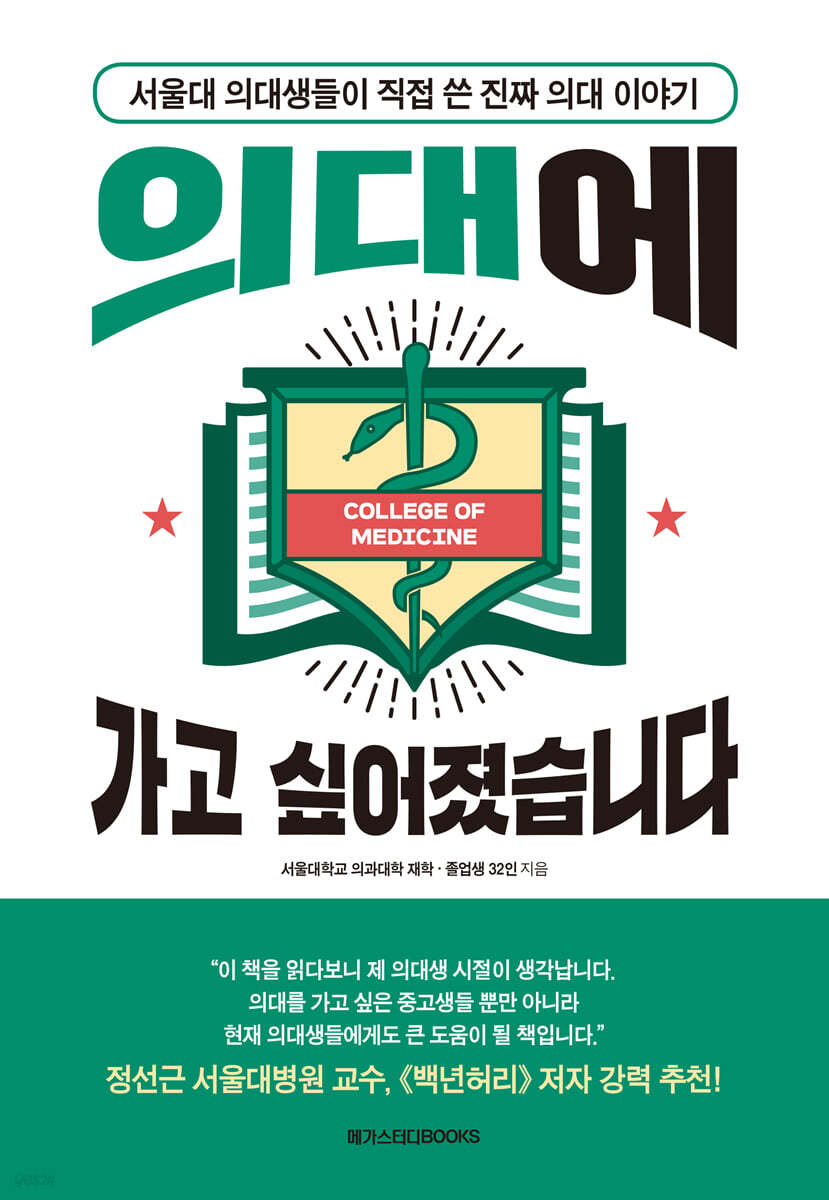
I want to go to medical school
 |
Description
Book Introduction
From undergraduate students to seniors in various fields, 32 students from Seoul National University College of Medicine tell us Things You Must Know Before Going to Medical School Going to medical school is one of the most attractive goals for many students and their parents. Many people are curious about how students who were accepted to medical school studied in middle and high school, what motivated them, and what difficulties they faced on the path to becoming a doctor after entering medical school. The 32 current and former students of Seoul National University College of Medicine who came together for this book candidly share their experiences, thoughts, and growth. Among them, some are from regular high schools, some are from specialized high schools, some treat patients and teach juniors at university hospitals, and some choose to become businessmen rather than doctors after graduation. But what they all have in common is that they are still doing their best, thinking hard today, toward the direction of life they chose after attending the top university, Seoul National University College of Medicine. Hoping to be of some help to juniors who share the same dream, each author honestly and candidly recorded the stories of life as a doctor that they wish someone had told them about when they were younger, and the process of finding various directions after graduating from medical school. |
- You can preview some of the book's contents.
Preview
index
Preface: Medical School and Beyond
Introduction to each department of the university hospital
Part 1.
The Story Behind Accepting Seoul National University Medical School
Frustration doesn't help.
An Ordinary High School Student, a Dragon Born from Streams
With those grades, you can't get into Seoul National University Medical School.
My studies changed when I dreamed of going to medical school.
If you dream of becoming a doctor, invest three years.
Ordinary effort does not produce extraordinary results.
Mind control, focus, and passion
*Asked Seoul National University Medical School Students 1
Part 2.
From preparatory course to main course, and even the medical exam
Survival of Preparatory Students in the Non-Face-to-Face Era
Facing the infamous Bon and study
It's already been three years since I started my degree, and I'm starting to feel like a doctor.
My National Exam Challenge
* Encouraging messages from seniors for incoming freshmen
*Sample of the 4-year curriculum of Seoul National University College of Medicine
*Asked Seoul National University Medical School Students 2
Part 3.
The path of a doctor who cares for patients
Carpenter No! Sculptor Yes!
“Hey, you can do it too.
“Thoracic surgery, that’s pretty cool, isn’t it?”
The path of a psychiatrist chosen to explore the mind
Internal Medicine, the Center of Medicine
Pilots in the operating room and control tower
Accompanying women from birth to death
The Great Surgeon, Surgery
Five Holes, Various Charms, Otolaryngology
Time to prepare for the future as a military doctor
*Asked Seoul National University Medical School Students 3
Part 4.
Taking a different path after graduating from medical school
Until it becomes not ordinary
Investing in a healthy future brought about by digital healthcare.
Becoming a Neurologist in the United States
Pharmaceutical medicine that can save tens of thousands of lives
Do you dream of becoming a relief worker?
Surviving as a Hematologist-Oncologist in the United States
The rewards of research as a professor in the field of basic medicine
*Asked Seoul National University Medical School students 4
Part 5.
Living as a doctor
What kind of doctor did I want to be?
Become a doctor who gives new happiness
I am a cardiologist.
The driving force of my life, 'Why?'
My Life as a Pediatric Orthopedic Surgeon
*Asked Seoul National University Medical School Students 5
People who contributed to this book
Introduction to each department of the university hospital
Part 1.
The Story Behind Accepting Seoul National University Medical School
Frustration doesn't help.
An Ordinary High School Student, a Dragon Born from Streams
With those grades, you can't get into Seoul National University Medical School.
My studies changed when I dreamed of going to medical school.
If you dream of becoming a doctor, invest three years.
Ordinary effort does not produce extraordinary results.
Mind control, focus, and passion
*Asked Seoul National University Medical School Students 1
Part 2.
From preparatory course to main course, and even the medical exam
Survival of Preparatory Students in the Non-Face-to-Face Era
Facing the infamous Bon and study
It's already been three years since I started my degree, and I'm starting to feel like a doctor.
My National Exam Challenge
* Encouraging messages from seniors for incoming freshmen
*Sample of the 4-year curriculum of Seoul National University College of Medicine
*Asked Seoul National University Medical School Students 2
Part 3.
The path of a doctor who cares for patients
Carpenter No! Sculptor Yes!
“Hey, you can do it too.
“Thoracic surgery, that’s pretty cool, isn’t it?”
The path of a psychiatrist chosen to explore the mind
Internal Medicine, the Center of Medicine
Pilots in the operating room and control tower
Accompanying women from birth to death
The Great Surgeon, Surgery
Five Holes, Various Charms, Otolaryngology
Time to prepare for the future as a military doctor
*Asked Seoul National University Medical School Students 3
Part 4.
Taking a different path after graduating from medical school
Until it becomes not ordinary
Investing in a healthy future brought about by digital healthcare.
Becoming a Neurologist in the United States
Pharmaceutical medicine that can save tens of thousands of lives
Do you dream of becoming a relief worker?
Surviving as a Hematologist-Oncologist in the United States
The rewards of research as a professor in the field of basic medicine
*Asked Seoul National University Medical School students 4
Part 5.
Living as a doctor
What kind of doctor did I want to be?
Become a doctor who gives new happiness
I am a cardiologist.
The driving force of my life, 'Why?'
My Life as a Pediatric Orthopedic Surgeon
*Asked Seoul National University Medical School Students 5
People who contributed to this book
Detailed image

Into the book
* I was a student who entered Seoul National University Medical School 12 years after graduating from our high school.
In recent years, our school's medical school entrance exam system was not developed to the extent that none of our seniors were accepted to medical school through the comprehensive student admission process.
Other people thought that I, who was the top student in the whole school, would have the full support of the school, but that wasn't the case.
Rather, teachers were very skeptical about students going to medical school through the general student admission process from an ordinary high school.
The view that says, 'You're good at it, but you still can't go to medical school'
Should I say that it was subtly hidden?”
--- From "My studies changed with the dream of becoming a medical school"
* “There are a lot more sheep in the second year than in the first year, but the first year is a bit more difficult.”
When I first heard this in my freshman year, my first thought was, "How can it be less difficult when there's more?" My second thought was, "How can there be more than this?"
But humans are creatures of adaptation, and within a few months of saying this, I could see myself, who usually plays around, cramming for an exam.
Ultimately, the important thing was how to adapt to this system.
And at least everyone who came to this school was prepared to adapt to this system.
--- From "Facing the Notorious Book and Study"
* I doubt if this is the person who just went through that situation with me.
The resident professor tapped my shoulder with a peaceful smile.
“Teacher, it’s okay.
Breathe.
“Your oxygen level will be lower than the patient’s.”
Why was that?
The moment I heard his generous consolation, I was proud of what I had been doing.
The white gown on my shoulders felt so heavy that it felt like a burden that needed to be put down immediately.
Since that day, I had a thought in my heart, 'No matter which department I go to, I'll have to stay at the university hospital for four years.
At least during that period, you can calmly deal with an emergency like today.
The thought of 'I want to become a doctor' took hold
--- "Hey, you can do it too.
“Thoracic surgery, isn’t it pretty cool?”
* I hear these two questions most often from people around me.
“What don’t you say at home?”, “Why did you quit being a doctor?”, the questions I pondered.
If you think about it, the question is not why everyone does this job, but why they don't become doctors.
I was curious at first.
Maybe you think being a doctor is a really good job
That must be why.
(…) After experiencing the vastness of the world and the influence of technology,
It made me think again about my life as a doctor.
I began to worry about something completely different from the previous worries I had about whether to pursue academia or open a practice.
--- From "Until It Became Unordinary"
* 'Why do you want to be a doctor?' and 'What kind of doctor do you want to be?'
This question requires serious consideration.
Just make a lot of money,
It is possible to maintain a certain level of social status, and it is stable because it is professional.
With the thought that 'other students who are good at studying are going, so I should go too'
I hope you haven't decided to go to medical school.
The intense worries I had before entering medical school 20 years ago are now vague, but
The questions, 'Why do you want to be a doctor?' and 'What kind of doctor do you want to be?'
It still holds true for me today, having treated countless sick children all day long.
In recent years, our school's medical school entrance exam system was not developed to the extent that none of our seniors were accepted to medical school through the comprehensive student admission process.
Other people thought that I, who was the top student in the whole school, would have the full support of the school, but that wasn't the case.
Rather, teachers were very skeptical about students going to medical school through the general student admission process from an ordinary high school.
The view that says, 'You're good at it, but you still can't go to medical school'
Should I say that it was subtly hidden?”
--- From "My studies changed with the dream of becoming a medical school"
* “There are a lot more sheep in the second year than in the first year, but the first year is a bit more difficult.”
When I first heard this in my freshman year, my first thought was, "How can it be less difficult when there's more?" My second thought was, "How can there be more than this?"
But humans are creatures of adaptation, and within a few months of saying this, I could see myself, who usually plays around, cramming for an exam.
Ultimately, the important thing was how to adapt to this system.
And at least everyone who came to this school was prepared to adapt to this system.
--- From "Facing the Notorious Book and Study"
* I doubt if this is the person who just went through that situation with me.
The resident professor tapped my shoulder with a peaceful smile.
“Teacher, it’s okay.
Breathe.
“Your oxygen level will be lower than the patient’s.”
Why was that?
The moment I heard his generous consolation, I was proud of what I had been doing.
The white gown on my shoulders felt so heavy that it felt like a burden that needed to be put down immediately.
Since that day, I had a thought in my heart, 'No matter which department I go to, I'll have to stay at the university hospital for four years.
At least during that period, you can calmly deal with an emergency like today.
The thought of 'I want to become a doctor' took hold
--- "Hey, you can do it too.
“Thoracic surgery, isn’t it pretty cool?”
* I hear these two questions most often from people around me.
“What don’t you say at home?”, “Why did you quit being a doctor?”, the questions I pondered.
If you think about it, the question is not why everyone does this job, but why they don't become doctors.
I was curious at first.
Maybe you think being a doctor is a really good job
That must be why.
(…) After experiencing the vastness of the world and the influence of technology,
It made me think again about my life as a doctor.
I began to worry about something completely different from the previous worries I had about whether to pursue academia or open a practice.
--- From "Until It Became Unordinary"
* 'Why do you want to be a doctor?' and 'What kind of doctor do you want to be?'
This question requires serious consideration.
Just make a lot of money,
It is possible to maintain a certain level of social status, and it is stable because it is professional.
With the thought that 'other students who are good at studying are going, so I should go too'
I hope you haven't decided to go to medical school.
The intense worries I had before entering medical school 20 years ago are now vague, but
The questions, 'Why do you want to be a doctor?' and 'What kind of doctor do you want to be?'
It still holds true for me today, having treated countless sick children all day long.
--- From "What Kind of Doctor Did I Want to Become?"
Publisher's Review
*Highly recommended by Professor Jeong Seon-geun of the Department of Rehabilitation Medicine at Seoul National University Hospital, author of “100-Year Waist”!
*Reasons for applying to medical school & preparation process during middle and high school
*The intense daily lives of undergraduate students who, after being accepted to medical school, are faced with a massive amount of study and another challenge.
*Characteristics of each stage of preparatory course, main course, internship, and residency, and concerns and episodes from the field
*Why I Chose This Department: What Each Resident Says
ㆍStories of seniors who chose a path other than becoming clinical doctors after graduating from medical school
ㆍReal answers from actual students to various questions about medical school & introduction to each major
This book, consisting of five parts, contains almost all stories related to medical school, from the process of preparing for medical school entrance exams to the thoughts and feelings felt while working as a doctor at Seoul National University Hospital for several decades.
Part 1 is about how students currently enrolled in the Seoul National University College of Medicine prepared for admission to Seoul National University College of Medicine, including how they studied in middle and high school, how they prepared for college and medical school interviews, and what the process of retaking the exam was like.
Part 2 details medical students' experiences with the notorious medical school curriculum, which is notorious for its enormous workload, how they cope with studying, how to relieve stress, and the process of preparing for the national medical licensing exam.
Part 3, written by residents at Seoul National University College of Medicine, shares vivid stories from the field about why they chose their specialty, the rewards they feel from saving patients' lives, and the process of growing as doctors.
Part 4 tells the stories of seniors who are active in fields other than typical clinical doctors, such as starting a technology business, working for large IT companies, working for international volunteer organizations, and working at overseas medical institutions after obtaining a medical license. Part 5 tells the stories of the hardships and rewards felt as a doctor who works with patients and as a senior who raises juniors, as well as honest reflections on their time as a doctor.
Those who participated in this book all agree that people should not choose medical school for vague and simple reasons like, "All the good kids go there," "It pays well," or "People think well of it."
The path of becoming a doctor is not an easy one to endure on its own, and I know from experience that saving people's lives in the field requires having something greater in your heart to make both yourself and your patients happy.
I heartily advise you to invest even a small portion of your academic effort into reflecting on your own inclinations, characteristics, and values regarding the world, and then, after such reflection, confidently choose the path of medicine. This path will allow you to use your talents in the most sublime way.
You can feel the honest feelings of seniors who hope that this book will be of some help in the process throughout its contents.
In addition, you can also find helpful tips full of real-life experiences for students and parents dreaming of medical school, such as 'Introduction to the Department of Medical School' written directly by residents of each department, 'Asked Seoul National University Medical School Students' where students directly answered the questions they are most curious about about medical school, the 4-year curriculum schedule for the Seoul National University College of Medicine, and messages of encouragement sent by seniors to their juniors who have just entered the department.
The heartwarming recommendations sent to prospective medical students by respected seniors, such as Professor Jeong Seon-geun of the Department of Rehabilitation Medicine at Seoul National University Hospital, famous for his best-selling book “100-Year Back,” and Professor Jeon Jong-gwan of the Department of Obstetrics and Gynecology at Seoul National University Hospital, who gained attention after appearing on the “Medical Doctor” episode of “You Quiz on the Block,” also attract attention.
*Reasons for applying to medical school & preparation process during middle and high school
*The intense daily lives of undergraduate students who, after being accepted to medical school, are faced with a massive amount of study and another challenge.
*Characteristics of each stage of preparatory course, main course, internship, and residency, and concerns and episodes from the field
*Why I Chose This Department: What Each Resident Says
ㆍStories of seniors who chose a path other than becoming clinical doctors after graduating from medical school
ㆍReal answers from actual students to various questions about medical school & introduction to each major
This book, consisting of five parts, contains almost all stories related to medical school, from the process of preparing for medical school entrance exams to the thoughts and feelings felt while working as a doctor at Seoul National University Hospital for several decades.
Part 1 is about how students currently enrolled in the Seoul National University College of Medicine prepared for admission to Seoul National University College of Medicine, including how they studied in middle and high school, how they prepared for college and medical school interviews, and what the process of retaking the exam was like.
Part 2 details medical students' experiences with the notorious medical school curriculum, which is notorious for its enormous workload, how they cope with studying, how to relieve stress, and the process of preparing for the national medical licensing exam.
Part 3, written by residents at Seoul National University College of Medicine, shares vivid stories from the field about why they chose their specialty, the rewards they feel from saving patients' lives, and the process of growing as doctors.
Part 4 tells the stories of seniors who are active in fields other than typical clinical doctors, such as starting a technology business, working for large IT companies, working for international volunteer organizations, and working at overseas medical institutions after obtaining a medical license. Part 5 tells the stories of the hardships and rewards felt as a doctor who works with patients and as a senior who raises juniors, as well as honest reflections on their time as a doctor.
Those who participated in this book all agree that people should not choose medical school for vague and simple reasons like, "All the good kids go there," "It pays well," or "People think well of it."
The path of becoming a doctor is not an easy one to endure on its own, and I know from experience that saving people's lives in the field requires having something greater in your heart to make both yourself and your patients happy.
I heartily advise you to invest even a small portion of your academic effort into reflecting on your own inclinations, characteristics, and values regarding the world, and then, after such reflection, confidently choose the path of medicine. This path will allow you to use your talents in the most sublime way.
You can feel the honest feelings of seniors who hope that this book will be of some help in the process throughout its contents.
In addition, you can also find helpful tips full of real-life experiences for students and parents dreaming of medical school, such as 'Introduction to the Department of Medical School' written directly by residents of each department, 'Asked Seoul National University Medical School Students' where students directly answered the questions they are most curious about about medical school, the 4-year curriculum schedule for the Seoul National University College of Medicine, and messages of encouragement sent by seniors to their juniors who have just entered the department.
The heartwarming recommendations sent to prospective medical students by respected seniors, such as Professor Jeong Seon-geun of the Department of Rehabilitation Medicine at Seoul National University Hospital, famous for his best-selling book “100-Year Back,” and Professor Jeon Jong-gwan of the Department of Obstetrics and Gynecology at Seoul National University Hospital, who gained attention after appearing on the “Medical Doctor” episode of “You Quiz on the Block,” also attract attention.
GOODS SPECIFICS
- Publication date: November 15, 2022
- Page count, weight, size: 372 pages | 145*210*30mm
- ISBN13: 9791129708427
- ISBN10: 112970842X
You may also like
카테고리
korean


korean

![GQ KOREA Mark (Monthly): December [2025]](http://librairie.coreenne.fr/cdn/shop/files/8ef265dbbfbf186523ed75ba7319009d.jpg?v=1765340328&width=3840)


