

Refresh Western Art History 3
 |
Description
Book Introduction
Beyond disintegration and subversion, towards new connections
The most frequently mentioned words in 20th century art were 'deconstruction' and 'subversion'.
This was not simply a process of denying the existing system, but rather a process of seeking new 'connections'.
The world is neither a reality full of problems nor an ideal state with all problems completely resolved.
As one problem is solved, another one appears or arises, and the cycle continues.
The world is never complete; it is constantly changing and creating new connections.
『Refreshing Western Art History 3』 illuminates contemporary art and explores the changing face of humanity.
In this book, humans are not isolated individuals, but rather central beings in a new era that pursues sustainable living and connection.
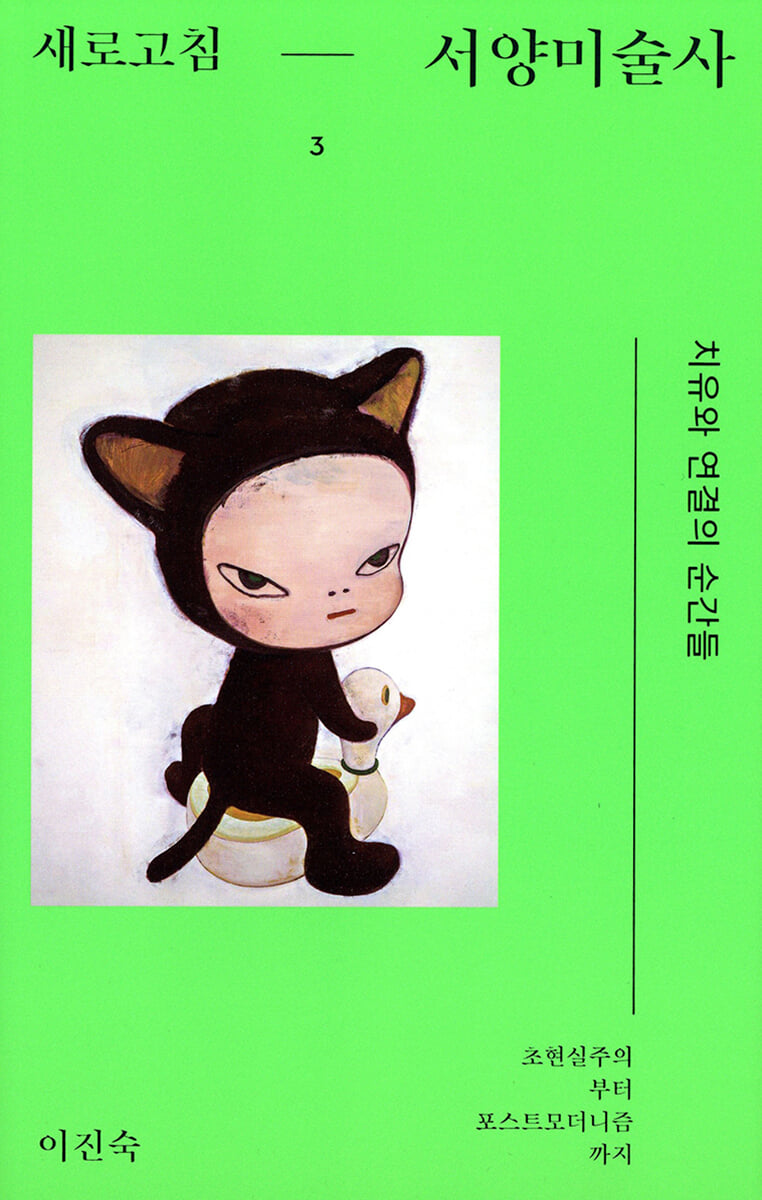
The image of Yoshitomo Nara's child used on the cover symbolizes new beginnings and possibilities, like the 'child' mentioned by Nietzsche.
This child dreams of a future where all beings can be connected, beyond healing wounds.
Let's embark on an artistic journey that connects the past and present and imagines the future with "Refreshing Western Art History."
The most frequently mentioned words in 20th century art were 'deconstruction' and 'subversion'.
This was not simply a process of denying the existing system, but rather a process of seeking new 'connections'.
The world is neither a reality full of problems nor an ideal state with all problems completely resolved.
As one problem is solved, another one appears or arises, and the cycle continues.
The world is never complete; it is constantly changing and creating new connections.
『Refreshing Western Art History 3』 illuminates contemporary art and explores the changing face of humanity.
In this book, humans are not isolated individuals, but rather central beings in a new era that pursues sustainable living and connection.
The image of Yoshitomo Nara's child used on the cover symbolizes new beginnings and possibilities, like the 'child' mentioned by Nietzsche.
This child dreams of a future where all beings can be connected, beyond healing wounds.
Let's embark on an artistic journey that connects the past and present and imagines the future with "Refreshing Western Art History."
- You can preview some of the book's contents.
Preview
index
Introduction - 101 Human Stories Encountered at the Art Museum
Starting the third book
I.
Surreal Reality - Dadaism, Surrealism, London School
68/101 Giorgio de Chirico - That straight line drives me crazy
69/101 René Magritte - I Don't Know You, But I Want to Kiss You
70/101 Salvador Dali - The Winner of the Dark Game
71/101 Frida Kahlo - Surreal for you, real for me
72/101 Marc Chagall - Poetry exists even in a harsh world.
73/101 Marcel Duchamp - Eros, That's Life
74/101 Georgia O'Keeffe - A Journal of Liberation Written in the Desert
75/101 Edward Hopper - Blue Evening, He Was a Clown
76/101 Alberto Giacometti - The Most Successful Failure
77/101 Francis Bacon - I Have a Mouth.
And scream
78/101 Lucian Freud - A Very Tall Man and a Very Small Woman
II.
Between the Cold War and Passion - Abstract Expressionism, Pop Art, Nouveau Realism, Minimalism, Fluxus,
Conceptual art, land art, graffiti
79/101 Jackson Pollock - Untitled
80/101 Mark Rothko - Again on the Human Soul
81/101 Robert Rauschenberg, Jasper Johns - Shaking off the unbearable weight of existence
82/101 Andy Warhol - Great artists don't create images.
83/101 Yves Klein - Burning Blue
84/101 Niki de Saint Phalle - The Solution Through Joy
85/101 Donald Judd, Sol LeWitt - Minimalism That's Never Minimal
86/101 Bruce Nauman - Thinking About Thinking
87/101 Robert Smithson, Christo & Jean-Claude - Other Thoughts on the Blue Planet
88/101 Nam June Paik - The more the better
89/101 Joseph Beuys - The Warmth of the Spirit That Transforms Human Beings
90/101 Jean-Michel Basquiat, Keith Haring - On the Street
III.
Art Outside the Door - Postmodernism
91/101 Louise Bourgeois - That Piece of Flesh
92/101 Gerhard Richter - The Freedom That Comes When You Go Beyond the Frame
93/101 David Hockney - Eyes in Love, A Pleasure to See
94/101 Barbara Kruger, Jenny Holzer - Living Words
95/101 Anselm Kiefer - How to Remember History
96/101 Kiki Smith - Creating a Thick Present Together
97/101 Andrea Gursky - The Abstraction of Desire
98/101 Anish Kapoor - A piece of psychodrama that takes me to a place I don't know.
99/101 Jeff Koons - The special ability to find dogs anywhere
100/101 Damien Hirst, Marc Quinn - Skull and Blood
101/101 Yoshitomo Nara - The child grew up to be a good boy.
Reference book
Index of titles and names of works
Starting the third book
I.
Surreal Reality - Dadaism, Surrealism, London School
68/101 Giorgio de Chirico - That straight line drives me crazy
69/101 René Magritte - I Don't Know You, But I Want to Kiss You
70/101 Salvador Dali - The Winner of the Dark Game
71/101 Frida Kahlo - Surreal for you, real for me
72/101 Marc Chagall - Poetry exists even in a harsh world.
73/101 Marcel Duchamp - Eros, That's Life
74/101 Georgia O'Keeffe - A Journal of Liberation Written in the Desert
75/101 Edward Hopper - Blue Evening, He Was a Clown
76/101 Alberto Giacometti - The Most Successful Failure
77/101 Francis Bacon - I Have a Mouth.
And scream
78/101 Lucian Freud - A Very Tall Man and a Very Small Woman
II.
Between the Cold War and Passion - Abstract Expressionism, Pop Art, Nouveau Realism, Minimalism, Fluxus,
Conceptual art, land art, graffiti
79/101 Jackson Pollock - Untitled
80/101 Mark Rothko - Again on the Human Soul
81/101 Robert Rauschenberg, Jasper Johns - Shaking off the unbearable weight of existence
82/101 Andy Warhol - Great artists don't create images.
83/101 Yves Klein - Burning Blue
84/101 Niki de Saint Phalle - The Solution Through Joy
85/101 Donald Judd, Sol LeWitt - Minimalism That's Never Minimal
86/101 Bruce Nauman - Thinking About Thinking
87/101 Robert Smithson, Christo & Jean-Claude - Other Thoughts on the Blue Planet
88/101 Nam June Paik - The more the better
89/101 Joseph Beuys - The Warmth of the Spirit That Transforms Human Beings
90/101 Jean-Michel Basquiat, Keith Haring - On the Street
III.
Art Outside the Door - Postmodernism
91/101 Louise Bourgeois - That Piece of Flesh
92/101 Gerhard Richter - The Freedom That Comes When You Go Beyond the Frame
93/101 David Hockney - Eyes in Love, A Pleasure to See
94/101 Barbara Kruger, Jenny Holzer - Living Words
95/101 Anselm Kiefer - How to Remember History
96/101 Kiki Smith - Creating a Thick Present Together
97/101 Andrea Gursky - The Abstraction of Desire
98/101 Anish Kapoor - A piece of psychodrama that takes me to a place I don't know.
99/101 Jeff Koons - The special ability to find dogs anywhere
100/101 Damien Hirst, Marc Quinn - Skull and Blood
101/101 Yoshitomo Nara - The child grew up to be a good boy.
Reference book
Index of titles and names of works
Detailed image
.jpg)
Publisher's Review
Moments of Healing and Connection
- Ideals, loneliness, and the possibility of new connections
In 『Refreshing Western Art History 1』, we looked at how ideas about humanity were formed through works of art.
Here, humans are depicted as ideal and beautiful beings, and this is symbolically expressed by using Ingres' idealized woman as the cover image.
『Refreshing Western Art History 2』 illuminates the human being as a ‘free but lonely’ individual, and captures the social anxiety and division of the early 20th century through the man in Malevich’s “Bad Premonition.”
The final book in the series, "Refreshing Western Art History 3," explores the changing face of humanity by covering contemporary art from surrealism to postmodernism.
At the center is not the isolated individual, but the new era's human being, who pursues sustainable living and connection.
The child of Yoshitomo Nara used on the cover symbolizes new beginnings and possibilities, like the 'child' of which Nietzsche spoke.
This child dreams of a future where not only can wounds be healed, but where all beings can be connected beyond wounds.
We introduce an artistic journey that connects the past and present and dreams of the future.
From surrealism to postmodernism
- 20th-century art depicting the body, the unconscious, and the human interior
In 『Refreshing Western Art History 3』, you can meet artists such as Magritte, Salvador Dali, and Frida Kahlo, who explored the irrational and unconscious world and imagination, and presented expressions that crossed the line between reality and surrealism.
.
The human being discovered by 20th-century art was both a psychological and a physical being.
Surrealists, who focused on the human 'unconsciousness', treated the body in bizarre and innovative ways.
This stemmed from the recognition that the source of the unconscious ultimately lies in the body.
The generation that experienced two world wars witnessed the fleeting destruction of the human body and was horrified by its fragility.
That tragic reality is completely reflected in the work of art.
Since then, 20th-century writers have expressed the bodily existence of humans in various ways in all aspects of life, including birth, aging, illness, and death, discrimination, and consumption.
“The figures in the painting look like people, with mouths, teeth, ears, and hair, but they are not complete people.
(…) He only has a mouth.
A screaming mouth.
You can't shut that mouth.
“A scream of pain fills the world.” (Francis Bacon, ed., “I Have a Mouth”
And screams") Bacon portrayed the human existence crushed by pain and violence, and revealed the cruel scars of the times through the body.
The distorted shapes in his work are not simply intended to make the viewer uncomfortable, but rather to bring out the fundamental anxiety that resides within humans and force them to face reality.
Bacon's work forces us to ignore suffering, declaring that suffering is not something personal, but the essence of the times and of human existence.
“For me, art is a task to overcome fear” (Louise Bourgeois, ed., “That Piece of Flesh”).
Louise Bourgeois sought to confront and heal the deep wounds of domestic violence and the patriarchal oppressive structure through art.
Her work, “A Piece of Flesh,” is not simply a satire of male authority, but dismantles the excessive meaning and fiction of power bestowed by society through the message, “It’s just a piece of flesh.”
Through this, the book persuasively demonstrates that “art is a process of facing and healing wounds.”
From surrealism to postmodernism
- The expanded human image depicted by new media and gender theory
The development of various media such as photography, video, and film has opened up new possibilities beyond the traditional boundaries of art.
Artists such as Bruce Nauman, Nam June Paik, and Barbara Kruger, who are covered in 『Refreshing Western Art History 3』, are representative figures who led this change.
“Nam June Paik not only combined art and technology, but also revealed the important essence of art that people had not previously considered: that artworks were the most highly developed ‘media of information transmission,’ condensing the spirit of an era through beautiful forms and passing it on to future generations.” (Nam June Paik, ed., “The More the World, the Better”) Like Nam June Paik, artists imagined the future world ahead of scientific advancements and incorporated it into art to expand and transform the human image.
Here, gender theory, which developed since the 1970s, analyzed how sexual and racial discrimination operate intersectingly through hierarchical thinking, and contributed to establishing a new image of humanity.
This was more than a simple analysis; it was also a process of healing and cherishing the souls of people wounded in the process of modernization.
“If you look at Kruger’s masterpiece, Your Body is a Battlefield, the face, half of which is inverted and divided into black and white, shows at a glance that the female body itself is a battleground where fierce battles are fought.” (Barbara Kruger, “Living Words”) Barbara Kruger criticizes social oppression and discrimination centering on the female body, and through this, shows that it is a battleground where various battles unfold, from feminist debates surrounding racism and sexism to product marketing.
Popular courses at the Seoul Arts Center Academy, available in books
《Refreshing Western Art History》 was written based on the lecture experience and insights from the regular course of the Seoul Arts Center Humanities and Appreciation Academy, 《101 Artists Who Changed Art History》.
For the past 10 years, author Lee Jin-sook's lectures have sold out every large lecture hall with over 200 seats, establishing themselves as unrivaled popular courses at the Seoul Arts Center Academy.
This series is the result of a six-year writing process that summarizes the rich content covered in the lectures.
This book delves into the works, challenges of the times, creative responses, personal life trajectories, and unique artistic worlds of 101 creative artists who led the innovation of art history and wrote a new history of art.
It systematically illuminates the essence of art and its changes.
- Ideals, loneliness, and the possibility of new connections
In 『Refreshing Western Art History 1』, we looked at how ideas about humanity were formed through works of art.
Here, humans are depicted as ideal and beautiful beings, and this is symbolically expressed by using Ingres' idealized woman as the cover image.
『Refreshing Western Art History 2』 illuminates the human being as a ‘free but lonely’ individual, and captures the social anxiety and division of the early 20th century through the man in Malevich’s “Bad Premonition.”
The final book in the series, "Refreshing Western Art History 3," explores the changing face of humanity by covering contemporary art from surrealism to postmodernism.
At the center is not the isolated individual, but the new era's human being, who pursues sustainable living and connection.
The child of Yoshitomo Nara used on the cover symbolizes new beginnings and possibilities, like the 'child' of which Nietzsche spoke.
This child dreams of a future where not only can wounds be healed, but where all beings can be connected beyond wounds.
We introduce an artistic journey that connects the past and present and dreams of the future.
From surrealism to postmodernism
- 20th-century art depicting the body, the unconscious, and the human interior
In 『Refreshing Western Art History 3』, you can meet artists such as Magritte, Salvador Dali, and Frida Kahlo, who explored the irrational and unconscious world and imagination, and presented expressions that crossed the line between reality and surrealism.
.
The human being discovered by 20th-century art was both a psychological and a physical being.
Surrealists, who focused on the human 'unconsciousness', treated the body in bizarre and innovative ways.
This stemmed from the recognition that the source of the unconscious ultimately lies in the body.
The generation that experienced two world wars witnessed the fleeting destruction of the human body and was horrified by its fragility.
That tragic reality is completely reflected in the work of art.
Since then, 20th-century writers have expressed the bodily existence of humans in various ways in all aspects of life, including birth, aging, illness, and death, discrimination, and consumption.
“The figures in the painting look like people, with mouths, teeth, ears, and hair, but they are not complete people.
(…) He only has a mouth.
A screaming mouth.
You can't shut that mouth.
“A scream of pain fills the world.” (Francis Bacon, ed., “I Have a Mouth”
And screams") Bacon portrayed the human existence crushed by pain and violence, and revealed the cruel scars of the times through the body.
The distorted shapes in his work are not simply intended to make the viewer uncomfortable, but rather to bring out the fundamental anxiety that resides within humans and force them to face reality.
Bacon's work forces us to ignore suffering, declaring that suffering is not something personal, but the essence of the times and of human existence.
“For me, art is a task to overcome fear” (Louise Bourgeois, ed., “That Piece of Flesh”).
Louise Bourgeois sought to confront and heal the deep wounds of domestic violence and the patriarchal oppressive structure through art.
Her work, “A Piece of Flesh,” is not simply a satire of male authority, but dismantles the excessive meaning and fiction of power bestowed by society through the message, “It’s just a piece of flesh.”
Through this, the book persuasively demonstrates that “art is a process of facing and healing wounds.”
From surrealism to postmodernism
- The expanded human image depicted by new media and gender theory
The development of various media such as photography, video, and film has opened up new possibilities beyond the traditional boundaries of art.
Artists such as Bruce Nauman, Nam June Paik, and Barbara Kruger, who are covered in 『Refreshing Western Art History 3』, are representative figures who led this change.
“Nam June Paik not only combined art and technology, but also revealed the important essence of art that people had not previously considered: that artworks were the most highly developed ‘media of information transmission,’ condensing the spirit of an era through beautiful forms and passing it on to future generations.” (Nam June Paik, ed., “The More the World, the Better”) Like Nam June Paik, artists imagined the future world ahead of scientific advancements and incorporated it into art to expand and transform the human image.
Here, gender theory, which developed since the 1970s, analyzed how sexual and racial discrimination operate intersectingly through hierarchical thinking, and contributed to establishing a new image of humanity.
This was more than a simple analysis; it was also a process of healing and cherishing the souls of people wounded in the process of modernization.
“If you look at Kruger’s masterpiece, Your Body is a Battlefield, the face, half of which is inverted and divided into black and white, shows at a glance that the female body itself is a battleground where fierce battles are fought.” (Barbara Kruger, “Living Words”) Barbara Kruger criticizes social oppression and discrimination centering on the female body, and through this, shows that it is a battleground where various battles unfold, from feminist debates surrounding racism and sexism to product marketing.
Popular courses at the Seoul Arts Center Academy, available in books
《Refreshing Western Art History》 was written based on the lecture experience and insights from the regular course of the Seoul Arts Center Humanities and Appreciation Academy, 《101 Artists Who Changed Art History》.
For the past 10 years, author Lee Jin-sook's lectures have sold out every large lecture hall with over 200 seats, establishing themselves as unrivaled popular courses at the Seoul Arts Center Academy.
This series is the result of a six-year writing process that summarizes the rich content covered in the lectures.
This book delves into the works, challenges of the times, creative responses, personal life trajectories, and unique artistic worlds of 101 creative artists who led the innovation of art history and wrote a new history of art.
It systematically illuminates the essence of art and its changes.
GOODS SPECIFICS
- Date of issue: December 30, 2024
- Page count, weight, size: 492 pages | 902g | 152*235*30mm
- ISBN13: 9791194442011
- ISBN10: 1194442013
You may also like
카테고리
korean


korean

![GQ KOREA Mark (Monthly): December [2025]](http://librairie.coreenne.fr/cdn/shop/files/8ef265dbbfbf186523ed75ba7319009d.jpg?v=1765340328&width=3840)


