

Samaah
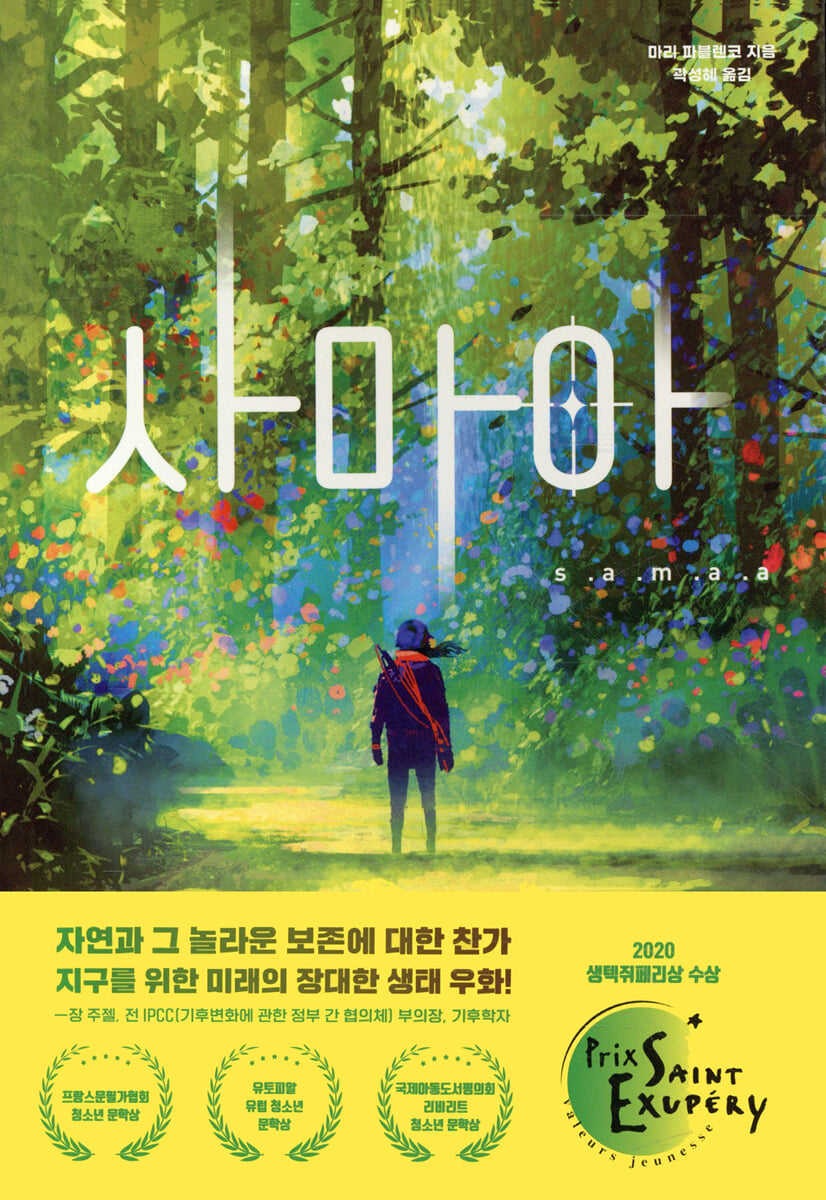 |
Description
Book Introduction
“Women can’t be hunters.”
A dystopia where sand swallows everything
The adventures of Samaa, a girl who sets out in search of the Tree of Life in a barren future world dominated by men!
Winner of the 2020 Saint-Exupéry Prize!
A dystopian story about a world where life has almost disappeared, where sand has swallowed everything.
The 'future primitive society' where only a small number of people live in tribes has once again become a patriarchal society where only survival and strength are valued.
But it is the two women who turn the fate of the tribe around: twelve-year-old Samaa and an old woman named Langxienne who has lived so long that no one knows her previous life, as if she had been a 'grandmother' from the beginning.
Can the two bring life back to a barren world ruled by men for generations?
The issue of the climate crisis is in full swing.
Schools need climate change books that are easy for teenagers to understand.
There are many educational books that cover this topic, but fiction (novels) that are easy to read and have an interesting story also have a great appeal to readers.
This book is a science fiction novel that has received acclaim in the European literary world as a philosophical fable on the themes of environment, ecology, women, and climate change.
This work possesses all the virtues of an ecological novel that can be read by students, teachers, and parents together.
The combination of a bleak future driven by environmental destruction, ecology, and a female narrative that saves the world is compelling in its own right, but the author's imagination and style in approaching this compelling subject matter are even more impressive.
Marie Pavlenko, the author of this book, a new French novelist who weaves these urgent and enormous topics into a single, captivating story, is a writer with exceptional imagination and writing style.
With this book, Samaa (2020), he received acclaim from the European literary world and won the Saint-Exupéry Prize that year, the Société des Lettres de France (SGDL) Youth Literature Prize, the European Youth Literature Prize at Utopiales, Europe's largest science fiction festival, and the Libbylit Youth Literature Prize hosted by the International Board on Books for Young People (IBBY) in 2021.
Around the world, young people of the Greta Thunberg generation are already taking action to address climate change.
This book is a work that shines even brighter amidst these climate change issues.
A dystopia where sand swallows everything
The adventures of Samaa, a girl who sets out in search of the Tree of Life in a barren future world dominated by men!
Winner of the 2020 Saint-Exupéry Prize!
A dystopian story about a world where life has almost disappeared, where sand has swallowed everything.
The 'future primitive society' where only a small number of people live in tribes has once again become a patriarchal society where only survival and strength are valued.
But it is the two women who turn the fate of the tribe around: twelve-year-old Samaa and an old woman named Langxienne who has lived so long that no one knows her previous life, as if she had been a 'grandmother' from the beginning.
Can the two bring life back to a barren world ruled by men for generations?
The issue of the climate crisis is in full swing.
Schools need climate change books that are easy for teenagers to understand.
There are many educational books that cover this topic, but fiction (novels) that are easy to read and have an interesting story also have a great appeal to readers.
This book is a science fiction novel that has received acclaim in the European literary world as a philosophical fable on the themes of environment, ecology, women, and climate change.
This work possesses all the virtues of an ecological novel that can be read by students, teachers, and parents together.
The combination of a bleak future driven by environmental destruction, ecology, and a female narrative that saves the world is compelling in its own right, but the author's imagination and style in approaching this compelling subject matter are even more impressive.
Marie Pavlenko, the author of this book, a new French novelist who weaves these urgent and enormous topics into a single, captivating story, is a writer with exceptional imagination and writing style.
With this book, Samaa (2020), he received acclaim from the European literary world and won the Saint-Exupéry Prize that year, the Société des Lettres de France (SGDL) Youth Literature Prize, the European Youth Literature Prize at Utopiales, Europe's largest science fiction festival, and the Libbylit Youth Literature Prize hosted by the International Board on Books for Young People (IBBY) in 2021.
Around the world, young people of the Greta Thunberg generation are already taking action to address climate change.
This book is a work that shines even brighter amidst these climate change issues.
- You can preview some of the book's contents.
Preview
Detailed image

Into the book
Hunting for wood is what feeds us.
When men bring lumber, that is, cut trees, to the big cities to sell, they return with water, machine-made food, canned goods, medicines, oxygen tanks, and also cloth and thread.
We all lasted several months with it.
On the other hand, if the hunters fail and cannot cut down any trees, we will be very thin.
The ribs stick out and the shoulders become pointed.
It becomes difficult to breathe and the tongue swells in the back of the throat, blocking the windpipe.
And then, we die.
--- p.17~18
“Women can’t be hunters.”
“I’m very agile.
It's quick to get to the top of the pole.
You know very well, right?”
It's true.
In the middle of the campsite there was a tall pole carved from materials brought from the big city, and I had been climbing it since I was very young.
It was thanks to my father taking my side even though my mother and Karlo were displeased.
So I'm better at it than most boys.
Solar wins too.
Well, I won.
I don't know if he'd win now that he's got a lot of muscle in his arms.
--- p.35~36
Hunters are numerous and carry a lot of equipment.
Stakes and stone-breaking tools.
They also tie ropes to carts or rocks, if any, and then climb up and down the ditch.
My father once told me a story about a group of hunters who were all trapped in a deep hole.
I don't remember why I was isolated.
Maybe the rope has come loose.
Anyway, they were trapped and unable to move.
--- p.159
I lunge at him, and he dodges my sword and steps back with a bewildered look on his face.
I dare.
I dared to attack the chief hunter.
Me, a little girl.
As the road opens and the drowsy men keep their distance, I shout.
“Come out! Tweeda, come out! Quickly!”
And as if he understood what I said, Tweeda jumped out of the hole and quickly threw himself over the cliff.
--- p.182
I am grateful to all the organizations and civic groups fighting to prevent the world from becoming a barren desert, devoid of beauty due to greed and foolishness, and to restore it to its former glory: a dazzling, rich, diverse, and vibrant place.
When men bring lumber, that is, cut trees, to the big cities to sell, they return with water, machine-made food, canned goods, medicines, oxygen tanks, and also cloth and thread.
We all lasted several months with it.
On the other hand, if the hunters fail and cannot cut down any trees, we will be very thin.
The ribs stick out and the shoulders become pointed.
It becomes difficult to breathe and the tongue swells in the back of the throat, blocking the windpipe.
And then, we die.
--- p.17~18
“Women can’t be hunters.”
“I’m very agile.
It's quick to get to the top of the pole.
You know very well, right?”
It's true.
In the middle of the campsite there was a tall pole carved from materials brought from the big city, and I had been climbing it since I was very young.
It was thanks to my father taking my side even though my mother and Karlo were displeased.
So I'm better at it than most boys.
Solar wins too.
Well, I won.
I don't know if he'd win now that he's got a lot of muscle in his arms.
--- p.35~36
Hunters are numerous and carry a lot of equipment.
Stakes and stone-breaking tools.
They also tie ropes to carts or rocks, if any, and then climb up and down the ditch.
My father once told me a story about a group of hunters who were all trapped in a deep hole.
I don't remember why I was isolated.
Maybe the rope has come loose.
Anyway, they were trapped and unable to move.
--- p.159
I lunge at him, and he dodges my sword and steps back with a bewildered look on his face.
I dare.
I dared to attack the chief hunter.
Me, a little girl.
As the road opens and the drowsy men keep their distance, I shout.
“Come out! Tweeda, come out! Quickly!”
And as if he understood what I said, Tweeda jumped out of the hole and quickly threw himself over the cliff.
--- p.182
I am grateful to all the organizations and civic groups fighting to prevent the world from becoming a barren desert, devoid of beauty due to greed and foolishness, and to restore it to its former glory: a dazzling, rich, diverse, and vibrant place.
--- From the author's note on p.199
Publisher's Review
★ 2020 Saint-Exupéry Award Winner! ★
“Women can’t be hunters.”
A dystopia where sand swallows everything
A barren future world dominated by men,
The adventures of Samaa, a girl who sets out in search of the Tree of Life!
2021 International Book Council on Young People (IBBY) Libirit Award for Young People
2020 Société des Writers de France Youth Literature Award, 2020 Utopia European Youth Literature Award
A "Best Book" Recommended by the Nobel Peace Prize-Winning Former Vice-Chair of the IPCC
“I swallowed this ecological fable” _Yan Bertrand (photographer, environmental activist)
Two nonconforming women, Samaa and Langsien
Twelve-year-old Samaa lives in a dystopia that may soon become the future of modern life for us.
A world where life has almost disappeared from the Earth, a world where sand has swallowed everything.
The nomadic Sama tribe survives through hunting.
But it's not the hunting we think of.
In a world where all animals have become extinct, hunters hunt the last remaining trees, cutting them down and selling them to the city to provide water, air, and food.
Samaa wants to become a hunter, following in the footsteps of his father who lost his life while hunting, but he cannot.
Because hunting is absolutely a man's domain.
One day, Sama, a stubborn and strong-willed man, breaks his tribe's taboo and secretly chases after hunters.
But when they get lost in the desert of a thousand faces and face a truth they never imagined, their tribe's fate ultimately takes a completely different turn.
The two central themes of this book are ecology and women's narratives.
In a world where civilization and ecosystems have almost disappeared and few people have experienced them, trees are another name for survival, and human life, which has returned to its primitive form, has once again become a patriarchal society where only survival and strength matter.
Ironically, it is two women who turn the tribe's fate around.
An old woman called Young Sama and Langxien, who has lived so long that no one knows her previous life, as if she had been a grandmother from the beginning.
Sama and Langsien are both rough around the edges and are not always well-loved within the tribe.
Samaa is always hated for her outrageous imaginations and actions toward hunting, which is a taboo area, and Langsien is despised by men for his outrageous anger at never cutting down trees.
But when the men who went out to hunt for wood return empty-handed, a brutal famine strikes the tribe and people begin to die.
Langsien tirelessly argues that the trees must be saved if life is to flourish again in this barren land, but as always, ultimate prosperity trumps immediate survival.
Samaa, awaken to a new world where everything is connected.
The story really begins when Samaa loses the hunters and becomes isolated in the middle of the desert.
Samaah is caught in a sandstorm and falls into a deep chasm surrounded by cliffs, almost dying. To make matters worse, he is injured, but unexpectedly discovers a huge 'prey': 'trees that hide in deep holes to avoid human eyes'.
The world Sama lives in is one where even the names of animals and plants have been almost forgotten, and living things are simply 'beasts', trees, or 'bushes'.
Many women, including Samaa, have never actually seen a living tree, except for the wood that hunters bring back.
Instead of drinking bottled water, they only drink jelly-like water bought from trees in the city, and they even buy air to drink to survive the dry sandstorms.
But the world inside the hole is different.
A small, tightly connected ecosystem operates around the beautiful tree.
Because there are trees, there is a spring, and because there are trees and a spring, insects and small animals also live there.
When there are insects, birds also fly.
Trees bear fruit, and within the fruit are seeds.
As Samaa discovers the mysterious harmonies and principles of nature that she has never seen or imagined in her life, she begins to sense that something is seriously wrong with the way they live.
However, Samaah, who has no way to climb up the high cliff with his injured body, barely survives on protein bars, spring water, aquatic plants, and tree bark he brought from the camp. When he is about to give up everything at the point where he can no longer endure, the men of the tribe who went out to hunt for wood come down to rescue Samaah.
However, these saviors clearly reveal their true identities as destroyers who mercilessly trample on the new ecosystem in the hole that Samaa 'discovered'.
An ecological fable exposing the era of climate crisis
This book symbolically portrays the relationship between humans and nature like a philosophical fable.
The tribe in the novel firmly believes that they have no choice but to cut down and sell trees to survive, but in reality, killing the few remaining trees is a suicidal act that will lead the remaining human race to destruction, and the only ones who still enjoy the privilege are the people of the big city who live on the high towers.
These ignorant future generations, with only a handful left, completely misunderstand the conditions for survival and continue to destroy the handful of remaining lives, thus destroying themselves in the same way as their already extinct ancestors.
Cloaked in the guise of science fiction and dystopia, this book sharply exposes the foolishness and violence of our generation living in an age of climate crisis.
Alone, enduring the scorching midday sun and the cold of the night, Samaa undergoes a very special internal and external rite of passage, much like the coming-of-age ceremony of an ancient Indian tribe. This arduous process of change is depicted in lengthy and delicate detail.
Then, when we suddenly reach the scene where the sacred sanctuary of Sama and her friends from nature is destroyed, the reality of the violence is contrasted with the dramatic and profound internal and external changes in Sama.
A message of hope for our generation dreaming of utopia.
It is very significant that another person who plays a crucial role in rebuilding the forest in this barren world is Lancien.
Although it is a somewhat mysterious setting, Lancien is the only person in the novel who has experienced modern civilization and is from 'our time'.
Not only does Langsien preach the gospel of life, enduring all kinds of ridicule like a prophet crying out in the wilderness, but he also teaches Samaah how to plant and care for trees.
Through Lancien, who holds hands with the young Sama, and the future utopia that has regained its forests, water, and air, the author leaves us, the older generation, with a message of hope and a heavy homework assignment.
By setting the protagonist Samaa as a twelve-year-old child, isn't the author ultimately saying that the fate of the future world lies with our children, the Greta Thunberg generation?
While it deals with a post-apocalyptic world, it is also a very sophisticated ecological fable.
-Le Monde (French leading newspaper)
What a wonderful story this is.
Marie Pavlenko's voice is captivating, and after turning the last page, your perspective on "The Tree" will be transformed! - Page des librairies (French literary magazine)
The writing style is surprisingly delicate.
It is such an elegant story, and reading it is truly a small happiness.
-France Inter (French public radio)
This book explores the rapidly growing trends of ecology, future forecasting, and reflection on the present world, and tells the stories of women who forge their own destiny while also listening to the stories of others.
-France Bleu (French regional public radio)
This is a great book to read with your teenage children.
Because, like Marie Pavlenko, we firmly believe in the rise of this Greta Thunberg generation.
-Gazelle (French women's magazine)
How can we best explain the climate crisis to younger generations? Marie Pavlenko seems to have found the answer.
-France 5 (public broadcasting)
“Women can’t be hunters.”
A dystopia where sand swallows everything
A barren future world dominated by men,
The adventures of Samaa, a girl who sets out in search of the Tree of Life!
2021 International Book Council on Young People (IBBY) Libirit Award for Young People
2020 Société des Writers de France Youth Literature Award, 2020 Utopia European Youth Literature Award
A "Best Book" Recommended by the Nobel Peace Prize-Winning Former Vice-Chair of the IPCC
“I swallowed this ecological fable” _Yan Bertrand (photographer, environmental activist)
Two nonconforming women, Samaa and Langsien
Twelve-year-old Samaa lives in a dystopia that may soon become the future of modern life for us.
A world where life has almost disappeared from the Earth, a world where sand has swallowed everything.
The nomadic Sama tribe survives through hunting.
But it's not the hunting we think of.
In a world where all animals have become extinct, hunters hunt the last remaining trees, cutting them down and selling them to the city to provide water, air, and food.
Samaa wants to become a hunter, following in the footsteps of his father who lost his life while hunting, but he cannot.
Because hunting is absolutely a man's domain.
One day, Sama, a stubborn and strong-willed man, breaks his tribe's taboo and secretly chases after hunters.
But when they get lost in the desert of a thousand faces and face a truth they never imagined, their tribe's fate ultimately takes a completely different turn.
The two central themes of this book are ecology and women's narratives.
In a world where civilization and ecosystems have almost disappeared and few people have experienced them, trees are another name for survival, and human life, which has returned to its primitive form, has once again become a patriarchal society where only survival and strength matter.
Ironically, it is two women who turn the tribe's fate around.
An old woman called Young Sama and Langxien, who has lived so long that no one knows her previous life, as if she had been a grandmother from the beginning.
Sama and Langsien are both rough around the edges and are not always well-loved within the tribe.
Samaa is always hated for her outrageous imaginations and actions toward hunting, which is a taboo area, and Langsien is despised by men for his outrageous anger at never cutting down trees.
But when the men who went out to hunt for wood return empty-handed, a brutal famine strikes the tribe and people begin to die.
Langsien tirelessly argues that the trees must be saved if life is to flourish again in this barren land, but as always, ultimate prosperity trumps immediate survival.
Samaa, awaken to a new world where everything is connected.
The story really begins when Samaa loses the hunters and becomes isolated in the middle of the desert.
Samaah is caught in a sandstorm and falls into a deep chasm surrounded by cliffs, almost dying. To make matters worse, he is injured, but unexpectedly discovers a huge 'prey': 'trees that hide in deep holes to avoid human eyes'.
The world Sama lives in is one where even the names of animals and plants have been almost forgotten, and living things are simply 'beasts', trees, or 'bushes'.
Many women, including Samaa, have never actually seen a living tree, except for the wood that hunters bring back.
Instead of drinking bottled water, they only drink jelly-like water bought from trees in the city, and they even buy air to drink to survive the dry sandstorms.
But the world inside the hole is different.
A small, tightly connected ecosystem operates around the beautiful tree.
Because there are trees, there is a spring, and because there are trees and a spring, insects and small animals also live there.
When there are insects, birds also fly.
Trees bear fruit, and within the fruit are seeds.
As Samaa discovers the mysterious harmonies and principles of nature that she has never seen or imagined in her life, she begins to sense that something is seriously wrong with the way they live.
However, Samaah, who has no way to climb up the high cliff with his injured body, barely survives on protein bars, spring water, aquatic plants, and tree bark he brought from the camp. When he is about to give up everything at the point where he can no longer endure, the men of the tribe who went out to hunt for wood come down to rescue Samaah.
However, these saviors clearly reveal their true identities as destroyers who mercilessly trample on the new ecosystem in the hole that Samaa 'discovered'.
An ecological fable exposing the era of climate crisis
This book symbolically portrays the relationship between humans and nature like a philosophical fable.
The tribe in the novel firmly believes that they have no choice but to cut down and sell trees to survive, but in reality, killing the few remaining trees is a suicidal act that will lead the remaining human race to destruction, and the only ones who still enjoy the privilege are the people of the big city who live on the high towers.
These ignorant future generations, with only a handful left, completely misunderstand the conditions for survival and continue to destroy the handful of remaining lives, thus destroying themselves in the same way as their already extinct ancestors.
Cloaked in the guise of science fiction and dystopia, this book sharply exposes the foolishness and violence of our generation living in an age of climate crisis.
Alone, enduring the scorching midday sun and the cold of the night, Samaa undergoes a very special internal and external rite of passage, much like the coming-of-age ceremony of an ancient Indian tribe. This arduous process of change is depicted in lengthy and delicate detail.
Then, when we suddenly reach the scene where the sacred sanctuary of Sama and her friends from nature is destroyed, the reality of the violence is contrasted with the dramatic and profound internal and external changes in Sama.
A message of hope for our generation dreaming of utopia.
It is very significant that another person who plays a crucial role in rebuilding the forest in this barren world is Lancien.
Although it is a somewhat mysterious setting, Lancien is the only person in the novel who has experienced modern civilization and is from 'our time'.
Not only does Langsien preach the gospel of life, enduring all kinds of ridicule like a prophet crying out in the wilderness, but he also teaches Samaah how to plant and care for trees.
Through Lancien, who holds hands with the young Sama, and the future utopia that has regained its forests, water, and air, the author leaves us, the older generation, with a message of hope and a heavy homework assignment.
By setting the protagonist Samaa as a twelve-year-old child, isn't the author ultimately saying that the fate of the future world lies with our children, the Greta Thunberg generation?
While it deals with a post-apocalyptic world, it is also a very sophisticated ecological fable.
-Le Monde (French leading newspaper)
What a wonderful story this is.
Marie Pavlenko's voice is captivating, and after turning the last page, your perspective on "The Tree" will be transformed! - Page des librairies (French literary magazine)
The writing style is surprisingly delicate.
It is such an elegant story, and reading it is truly a small happiness.
-France Inter (French public radio)
This book explores the rapidly growing trends of ecology, future forecasting, and reflection on the present world, and tells the stories of women who forge their own destiny while also listening to the stories of others.
-France Bleu (French regional public radio)
This is a great book to read with your teenage children.
Because, like Marie Pavlenko, we firmly believe in the rise of this Greta Thunberg generation.
-Gazelle (French women's magazine)
How can we best explain the climate crisis to younger generations? Marie Pavlenko seems to have found the answer.
-France 5 (public broadcasting)
GOODS SPECIFICS
- Date of issue: January 25, 2022
- Page count, weight, size: 200 pages | 272g | 140*205*13mm
- ISBN13: 9788972970224
- ISBN10: 8972970220
You may also like
카테고리
korean


korean

![GQ KOREA Mark (Monthly): December [2025]](http://librairie.coreenne.fr/cdn/shop/files/8ef265dbbfbf186523ed75ba7319009d.jpg?v=1765340328&width=3840)


