

An Artist's Journey
 |
Description
Book Introduction
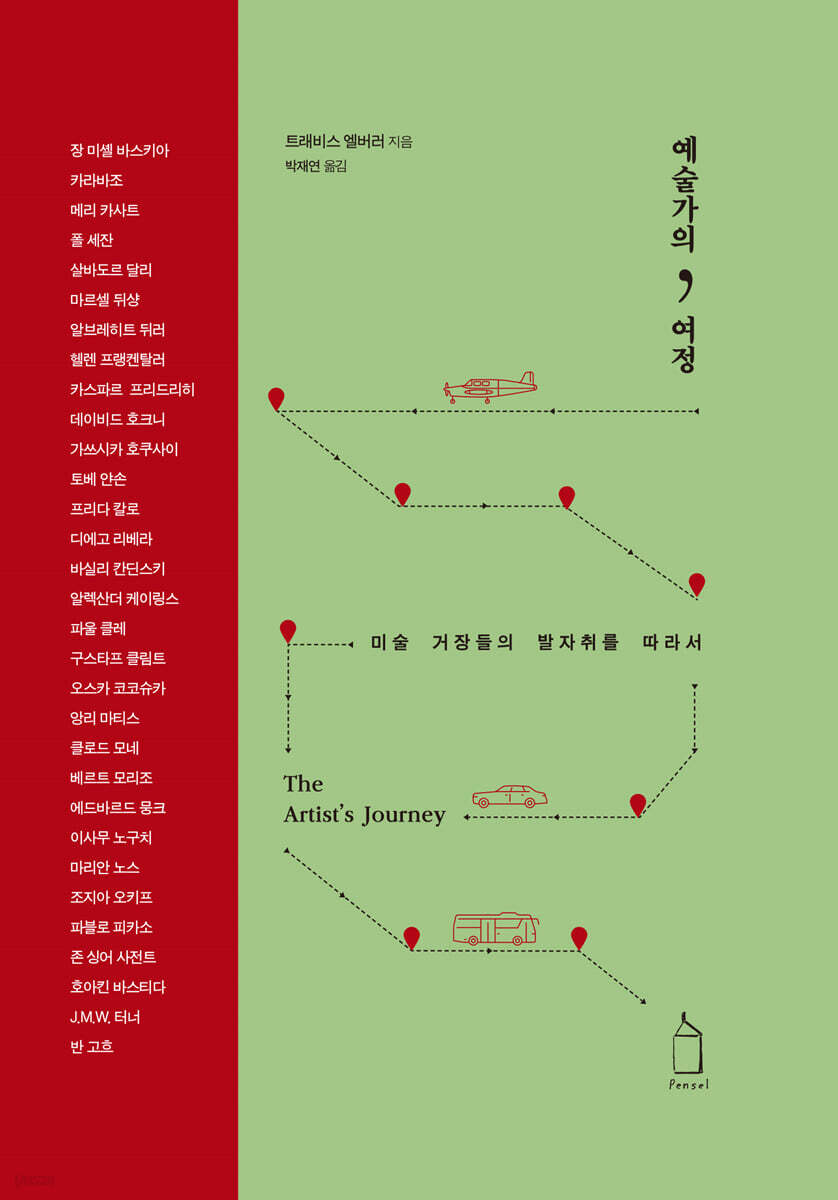
Follow in the footsteps of 31 of the greatest painters in history and delve into their world of art.
Where art and travel meet! Discover the stories behind the creation of great works.
- A book that provides insight into the artist and his world of art, as well as new inspiration at the intersection of art and travel.
Art is the product of the artist's experiences, emotions, and travel inspiration! This book highlights the journeys of 31 great artists, including David Hockney, Kandinsky, Salvador Dalí, Gustav Klimt, Henri Matisse, Pablo Picasso, and Van Gogh, and explores how their travel experiences influenced their lives and art.
Readers can experience the journey as if they were accompanying the artists through their travel journals, maps of their journeys, photographs of the places they visited, various visual materials, and the artists' diaries.
Through this, you will be able to directly feel the deep connection between art and travel.
Beyond mere documentation, The Artist's Journey tells the travel stories behind great works of art, presenting a fresh perspective on art criticism that connects art, travel, and life.
It delicately reveals how the artists' experiences and emotions create waves in the vast ocean of art, and how their journeys influence their work.
Weaving together art, travel, and the artist's life, The Artist's Journey offers readers new perspectives and insights.
This book will broaden your understanding of great artists and their artistic worlds, while also providing new inspiration for the intersection of travel and art.
Where art and travel meet! Discover the stories behind the creation of great works.
- A book that provides insight into the artist and his world of art, as well as new inspiration at the intersection of art and travel.
Art is the product of the artist's experiences, emotions, and travel inspiration! This book highlights the journeys of 31 great artists, including David Hockney, Kandinsky, Salvador Dalí, Gustav Klimt, Henri Matisse, Pablo Picasso, and Van Gogh, and explores how their travel experiences influenced their lives and art.
Readers can experience the journey as if they were accompanying the artists through their travel journals, maps of their journeys, photographs of the places they visited, various visual materials, and the artists' diaries.
Through this, you will be able to directly feel the deep connection between art and travel.
Beyond mere documentation, The Artist's Journey tells the travel stories behind great works of art, presenting a fresh perspective on art criticism that connects art, travel, and life.
It delicately reveals how the artists' experiences and emotions create waves in the vast ocean of art, and how their journeys influence their work.
Weaving together art, travel, and the artist's life, The Artist's Journey offers readers new perspectives and insights.
This book will broaden your understanding of great artists and their artistic worlds, while also providing new inspiration for the intersection of travel and art.
- You can preview some of the book's contents.
Preview
index
Entering
Jean-Michel Basquiat Finds Connections in Côte d'Ivoire and Benin
Caravaggio flees to Malta
Mary Cassatt Makes a Deep Impression in Paris
Paul Cézanne, suffering in Aix-en-Provence
Salvador Dali Takes Over Manhattan with Surrealism
Marcel Duchamp, obsessed with chess in Buenos Aires
Albrecht Dürer encounters a whale in the Netherlands
Helen Frankenthaler Falls in Love with Provincetown
Caspar David Friedrich replenishes himself in Rügen
David Hockney Finds La La Land in Los Angeles
Katsushika Hokusai Climbs Mount Fuji
Tove Jansson spends summer in the Pelinka Islands
Frida Kahlo and Diego Rivera honeymoon in Cuernavaca
Wassily Kandinsky finds his artistic calling in Vologda
Alexander Kerings, drawing the royal castles of Yorkshire and Scotland
Paul Klee's transformation in Tunisia
Gustav Klimt awakens to the Attersee landscape
Oskar Kokoschka takes refuge in Polperro
Henri Matisse, Taking Shelter from the Rain in Morocco
Claude Monet, deeply impressed by London
Berthe Morisot accepts a marriage proposal in Normandy
Edvard Munch, Summer at Osgorstrand Beach
Isamu Noguchi Embarks on a Monumental World Tour
Marian North heads south to paint Indian flora.
Georgia O'Keeffe, Going West
Pablo Picasso falls in love with the south of France
John Singer Sargent, Immersed in Venice
Joaquin Soyola y Bastida captures Spain on canvas
JMW
Turner embarks on his final Swiss trip.
Van Gogh spent quite a bit of time in Provence.
Key references: biographies and autobiographies
Search
Image Credits
Jean-Michel Basquiat Finds Connections in Côte d'Ivoire and Benin
Caravaggio flees to Malta
Mary Cassatt Makes a Deep Impression in Paris
Paul Cézanne, suffering in Aix-en-Provence
Salvador Dali Takes Over Manhattan with Surrealism
Marcel Duchamp, obsessed with chess in Buenos Aires
Albrecht Dürer encounters a whale in the Netherlands
Helen Frankenthaler Falls in Love with Provincetown
Caspar David Friedrich replenishes himself in Rügen
David Hockney Finds La La Land in Los Angeles
Katsushika Hokusai Climbs Mount Fuji
Tove Jansson spends summer in the Pelinka Islands
Frida Kahlo and Diego Rivera honeymoon in Cuernavaca
Wassily Kandinsky finds his artistic calling in Vologda
Alexander Kerings, drawing the royal castles of Yorkshire and Scotland
Paul Klee's transformation in Tunisia
Gustav Klimt awakens to the Attersee landscape
Oskar Kokoschka takes refuge in Polperro
Henri Matisse, Taking Shelter from the Rain in Morocco
Claude Monet, deeply impressed by London
Berthe Morisot accepts a marriage proposal in Normandy
Edvard Munch, Summer at Osgorstrand Beach
Isamu Noguchi Embarks on a Monumental World Tour
Marian North heads south to paint Indian flora.
Georgia O'Keeffe, Going West
Pablo Picasso falls in love with the south of France
John Singer Sargent, Immersed in Venice
Joaquin Soyola y Bastida captures Spain on canvas
JMW
Turner embarks on his final Swiss trip.
Van Gogh spent quite a bit of time in Provence.
Key references: biographies and autobiographies
Search
Image Credits
Detailed image

Into the book
Artists live bohemian lives on the fringes of society, often shocking people, but in their daily lives, they often behave surprisingly regularly.
Many people return to the same place over and over again like migratory birds.
Over time, the place may become synonymous with the artist himself or may be considered a place that characterizes the period in which a major work was created.
---From "Entering"
On the day of departure, Crosby, who had arranged to meet the Dalís on the connecting train, found Dalí curled up in a third-class compartment near the engine, bound with rope and wrapped in his canvas.
(Omitted) Nevertheless, upon arriving, Dalli planned to create a big buzz by distributing flyers that read, "New York salutes me!"
Crosby, who was as adept at marketing as she was at scandalous love affairs and outrageous fashion choices, attracted reporters who were hunting for social gossip.
When the reporters arrived, Darley was standing next to Crosby, wearing a sexy black velvet skirt and flanked by two black whippets.
---From "Salvador Dali Takes Over Manhattan with Surrealism"
The first painting Hockney completed in LA was Plastic Tree and City Hall.
In this painting, a skyscraper, a city landmark, is depicted alongside a palm tree of unknown origin.
The painting was completed in acrylic, a material he had previously tried in London without success.
However, Hockney soon discovered that American acrylic paints were of far superior quality and flexibility to British ones, and acrylics soon became his preferred medium.
Using acrylic paints, he immortalized cityscapes such as “Wilshire Boulevard,” “Pershing Square,” “The Forest of Buildings in Los Angeles,” and “California Art Collector.”
---From "David Hockney, Finding La La Land in Los Angeles"
Because of his habit of wandering alone through the forest with his paintbrush, Klimt earned the nickname Waldschrat (Forest Devil) from the locals.
Wet canvases were placed in the bushes to dry overnight and then taken out the next morning.
Klimt loved to paint landscapes outdoors, even going out on lakes with his easel and canvas in hand.
Emily sometimes accompanied us on these boat trips.
(Omitted) The seascape observed from Litzlberg Island, one of the small uninhabited islands in the lake where we rowed for an outdoor picnic, became the motif for “Attersee 1” and “Islands in Lake Attersee.”
---From "Gustav Klimt, Awakening to the Landscape of Attersee"
Van Gogh also painted local landmarks such as the landscape of the Crau Plain, the ruins of the Montmajour Abbey, and the Pont Langlois (Drawbridge with a Carriage and Drawbridge with a Woman with a Parasol), as well as butcher shops, cafes, and brothels.
He also painted portraits of local residents of Arles, including weather-beaten female farmers and Joseph Roulin, the postal worker with whom he had the longest conversations while searching for mail and sending letters. He also captured the seascapes he encountered during his trip to Saintes-Maries-de-la-Mer in the Mediterranean.
It seemed that nothing could stop the flow of creativity flowing from Van Gogh.
And like all good times, that time soon came to an end.
If Arles had not existed, Van Gogh might not have painted Sunflowers.
His early sunflowers, attempted while in Paris, pale in comparison to the works he completed after experiencing the scorching southern sun.
Many people return to the same place over and over again like migratory birds.
Over time, the place may become synonymous with the artist himself or may be considered a place that characterizes the period in which a major work was created.
---From "Entering"
On the day of departure, Crosby, who had arranged to meet the Dalís on the connecting train, found Dalí curled up in a third-class compartment near the engine, bound with rope and wrapped in his canvas.
(Omitted) Nevertheless, upon arriving, Dalli planned to create a big buzz by distributing flyers that read, "New York salutes me!"
Crosby, who was as adept at marketing as she was at scandalous love affairs and outrageous fashion choices, attracted reporters who were hunting for social gossip.
When the reporters arrived, Darley was standing next to Crosby, wearing a sexy black velvet skirt and flanked by two black whippets.
---From "Salvador Dali Takes Over Manhattan with Surrealism"
The first painting Hockney completed in LA was Plastic Tree and City Hall.
In this painting, a skyscraper, a city landmark, is depicted alongside a palm tree of unknown origin.
The painting was completed in acrylic, a material he had previously tried in London without success.
However, Hockney soon discovered that American acrylic paints were of far superior quality and flexibility to British ones, and acrylics soon became his preferred medium.
Using acrylic paints, he immortalized cityscapes such as “Wilshire Boulevard,” “Pershing Square,” “The Forest of Buildings in Los Angeles,” and “California Art Collector.”
---From "David Hockney, Finding La La Land in Los Angeles"
Because of his habit of wandering alone through the forest with his paintbrush, Klimt earned the nickname Waldschrat (Forest Devil) from the locals.
Wet canvases were placed in the bushes to dry overnight and then taken out the next morning.
Klimt loved to paint landscapes outdoors, even going out on lakes with his easel and canvas in hand.
Emily sometimes accompanied us on these boat trips.
(Omitted) The seascape observed from Litzlberg Island, one of the small uninhabited islands in the lake where we rowed for an outdoor picnic, became the motif for “Attersee 1” and “Islands in Lake Attersee.”
---From "Gustav Klimt, Awakening to the Landscape of Attersee"
Van Gogh also painted local landmarks such as the landscape of the Crau Plain, the ruins of the Montmajour Abbey, and the Pont Langlois (Drawbridge with a Carriage and Drawbridge with a Woman with a Parasol), as well as butcher shops, cafes, and brothels.
He also painted portraits of local residents of Arles, including weather-beaten female farmers and Joseph Roulin, the postal worker with whom he had the longest conversations while searching for mail and sending letters. He also captured the seascapes he encountered during his trip to Saintes-Maries-de-la-Mer in the Mediterranean.
It seemed that nothing could stop the flow of creativity flowing from Van Gogh.
And like all good times, that time soon came to an end.
If Arles had not existed, Van Gogh might not have painted Sunflowers.
His early sunflowers, attempted while in Paris, pale in comparison to the works he completed after experiencing the scorching southern sun.
---From "Van Gogh, Spending Long Time in Provence"
Publisher's Review
The travel stories of painters who became the source of great works of art.
- The stories behind the world's most famous works of art
- A new perspective on art criticism that connects art, travel, and the artist's life.
Travel provides artists with new perspectives and sometimes serves as an opportunity to overcome creative crises.
In this process, art acquires richer and more multi-layered meaning, which can lead to the creation of great works that will remain in history.
Especially when we look at the travel records of great artists, we can see that they were inspired by the cultures, nature, and human relationships they encountered while traveling, and reflected these in their works.
This process becomes an important key to exploring the deep meaning and story contained in each work of art.
"The Artist's Journey" follows the footsteps of world-renowned artists and delves deeply into how their journeys shaped and transformed their respective artistic worlds.
Beyond simply describing the artists' travels, it delves into how the diverse cultures and landscapes they experienced, and the people they met, inspired them with new perspectives and insights.
This book contains travel stories of various artists, from Jean-Michel Basquiat's African journey to Salvador Dali's surrealism in Manhattan, David Hockney's settlement in Los Angeles, and Tove Jansson's vacation that gave birth to the world-famous Moomins.
These journeys provided new inspiration to each artist, and the resulting works of art possessed timeless value.
The author, winner of the Edward Stanford Travel Writing Awards, offers fascinating insights into the stories behind some of the world's most famous works of art, including Henri Matisse's vibrant Moroccan paintings, David Hockney's swimming pool paintings, Katsushika Hokusai's famous series of woodblock prints of Mount Fuji, and Marian North's botanical illustrations from her year-long stay in India.
It also allows you to experience traveling with the artists through vivid photos of the places they visited and their emotional diaries and letters.
Through this book, readers will be able to experience firsthand how art and travel intersect to spark new creative sparks.
In this way, "The Artist's Journey" elevates our understanding of art by uncovering the stories hidden behind works of art.
As you read about how art and travel intersect and how new creative inspirations arise from that intersection, you will naturally realize that life, art, and travel are intertwined.
This book will serve as a valuable guide for those seeking new inspiration and insight through the intersection of art and travel.
- The stories behind the world's most famous works of art
- A new perspective on art criticism that connects art, travel, and the artist's life.
Travel provides artists with new perspectives and sometimes serves as an opportunity to overcome creative crises.
In this process, art acquires richer and more multi-layered meaning, which can lead to the creation of great works that will remain in history.
Especially when we look at the travel records of great artists, we can see that they were inspired by the cultures, nature, and human relationships they encountered while traveling, and reflected these in their works.
This process becomes an important key to exploring the deep meaning and story contained in each work of art.
"The Artist's Journey" follows the footsteps of world-renowned artists and delves deeply into how their journeys shaped and transformed their respective artistic worlds.
Beyond simply describing the artists' travels, it delves into how the diverse cultures and landscapes they experienced, and the people they met, inspired them with new perspectives and insights.
This book contains travel stories of various artists, from Jean-Michel Basquiat's African journey to Salvador Dali's surrealism in Manhattan, David Hockney's settlement in Los Angeles, and Tove Jansson's vacation that gave birth to the world-famous Moomins.
These journeys provided new inspiration to each artist, and the resulting works of art possessed timeless value.
The author, winner of the Edward Stanford Travel Writing Awards, offers fascinating insights into the stories behind some of the world's most famous works of art, including Henri Matisse's vibrant Moroccan paintings, David Hockney's swimming pool paintings, Katsushika Hokusai's famous series of woodblock prints of Mount Fuji, and Marian North's botanical illustrations from her year-long stay in India.
It also allows you to experience traveling with the artists through vivid photos of the places they visited and their emotional diaries and letters.
Through this book, readers will be able to experience firsthand how art and travel intersect to spark new creative sparks.
In this way, "The Artist's Journey" elevates our understanding of art by uncovering the stories hidden behind works of art.
As you read about how art and travel intersect and how new creative inspirations arise from that intersection, you will naturally realize that life, art, and travel are intertwined.
This book will serve as a valuable guide for those seeking new inspiration and insight through the intersection of art and travel.
GOODS SPECIFICS
- Date of issue: May 1, 2024
- Format: Hardcover book binding method guide
- Page count, weight, size: 224 pages | 836g | 177*242*30mm
- ISBN13: 9791198244949
- ISBN10: 1198244941
You may also like
카테고리
korean


korean

![GQ KOREA Mark (Monthly): December [2025]](http://librairie.coreenne.fr/cdn/shop/files/8ef265dbbfbf186523ed75ba7319009d.jpg?v=1765340328&width=3840)


