

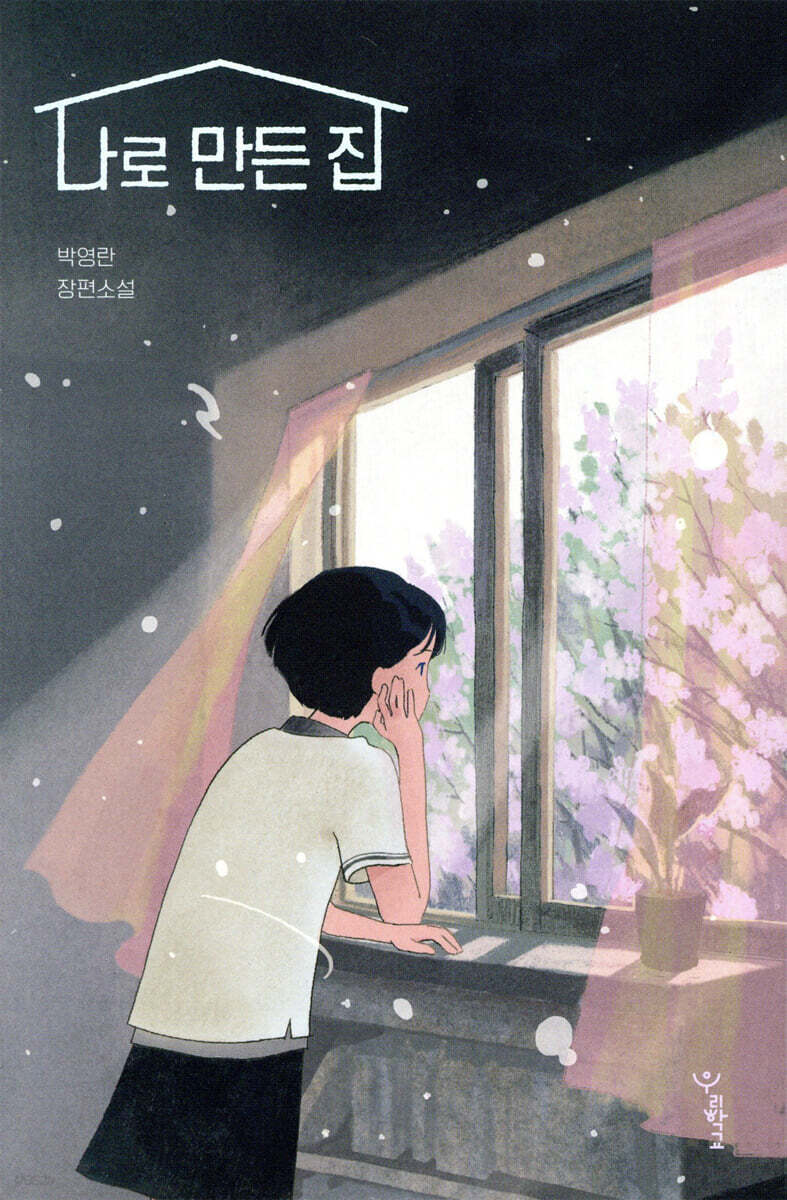
The house I made
 |
Description
Book Introduction
"The Feeling of Going to the Convenience Store" "Guesthouse Q"
Park Young-ran's new work captivates the heart with its special space.
'Seventeen, I have things to protect.'
Author Park Young-ran, who has captured the hearts of readers with special spaces such as 'Midnight Convenience Store', which embraces lonely and poor people, and 'Guesthouse', where slightly strange individuals come together to become us, has now opened the door to 'Two-Story House'.
The title itself arouses curiosity, and 『The House I Made』 is a work that depicts the crises, hardships, and growth experienced by a child who becomes the landlord at the age of seventeen, set in an old two-story house.
Through the author's signature style of simple yet lingering writing, the story unfolds as a child struggles to maintain his own order amidst increasing anxiety and tension.
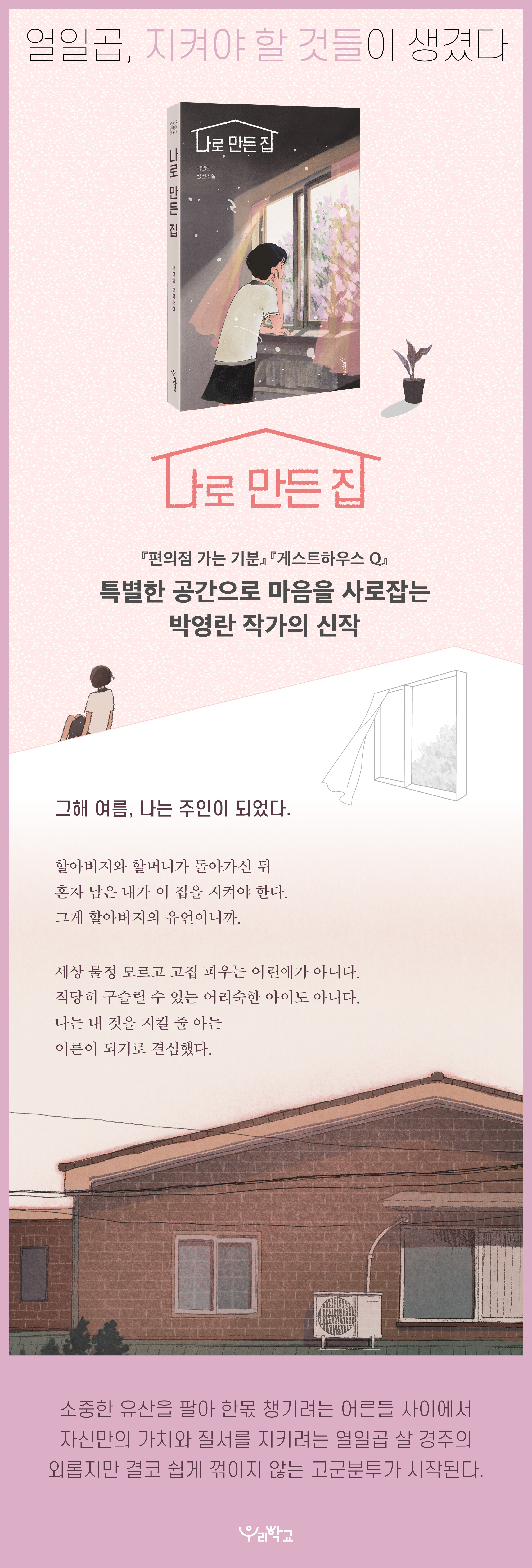
After her parents passed away at an early age, Gyeongju was raised by her grandparents. When both of them passed away, she was left alone in the two-story house.
Gyeongju, who inherited a house at the age of seventeen and became its owner, vows to protect the house where his grandfather, grandmother, and himself had their order.
However, the family, led by the uncle, begins to come to Gyeongju with the intention of selling the house and making a fortune.
Will Gyeongju, who stubbornly resists the persuasion, cajoling, and threats of adults, be able to protect her home until the end?
Park Young-ran's new work captivates the heart with its special space.
'Seventeen, I have things to protect.'
Author Park Young-ran, who has captured the hearts of readers with special spaces such as 'Midnight Convenience Store', which embraces lonely and poor people, and 'Guesthouse', where slightly strange individuals come together to become us, has now opened the door to 'Two-Story House'.
The title itself arouses curiosity, and 『The House I Made』 is a work that depicts the crises, hardships, and growth experienced by a child who becomes the landlord at the age of seventeen, set in an old two-story house.
Through the author's signature style of simple yet lingering writing, the story unfolds as a child struggles to maintain his own order amidst increasing anxiety and tension.
After her parents passed away at an early age, Gyeongju was raised by her grandparents. When both of them passed away, she was left alone in the two-story house.
Gyeongju, who inherited a house at the age of seventeen and became its owner, vows to protect the house where his grandfather, grandmother, and himself had their order.
However, the family, led by the uncle, begins to come to Gyeongju with the intention of selling the house and making a fortune.
Will Gyeongju, who stubbornly resists the persuasion, cajoling, and threats of adults, be able to protect her home until the end?
- You can preview some of the book's contents.
Preview
index
Chapter 1
Chapter 2
Chapter 3
Chapter 4
Author's Note
Chapter 2
Chapter 3
Chapter 4
Author's Note
Detailed image
Into the book
When a moment comes that is too difficult to handle alone, you should only say and do what is absolutely necessary.
Words should be spoken only when they are better than silence, and actions should clearly reveal intentions.
That summer, the only thing I could rely on was these words from my grandparents.
--- p.9
I am seventeen years old.
At this age, owning a home is a different matter from having the latest laptop or an expensive padded jacket that your peers might have glanced at at least once.
Home is not a laptop or a coat.
It is an asset.
And wealth is power.
--- p.41
The only way my uncle can do whatever he wants with this house is if I disappear.
In other words, only after I die can my uncle do whatever he wants with this house.
When I die, my uncle will inherit this house, and he can sell it as he pleases.
I wondered if my uncle was thinking that far ahead. For a moment, I felt a chill.
--- p.45
“How old are you?”
My uncle suddenly brought up my age.
I thought I knew what he meant when he said that.
So without hesitation I answered like this.
“You are old enough to know how to protect the legacy you have inherited.”
--- p.48
Now that I think about it, I feel like I'm too much of an adult.
It felt like there were two of me.
I was confused between myself as an adult and myself as a minor.
But if I had to choose one, I would choose to be an adult.
And you had to speak and act in a way that suited the side you chose.
--- p.171
Summer was in full swing all over the world.
Green leaves, shadows swaying beneath them, sparrows gathered together and chattering like fruit, the wind, the hot, dazzling sunlight breaking through the terrace railing, the sweet scent of grass rushing toward its peak… … .
They were all soft and tightly blended together.
I straightened my shoulders and puffed out my chest in the summer.
And I closed my eyes.
--- p.186~187
“Dad thought it was better that way.”
I answered Sunji's words.
“I did what I thought was better.”
Then Sunji smiled a little.
With that smile, I felt like I was able to shake off some of the frustration that had been deep in my heart.
--- p.215
My uncle and I slowly looked around the house and garden.
The house was being shrouded in darkness.
But it wasn't just a completely black darkness.
It was a darkness close to deep green.
That's right.
It wasn't darkness, it was the color of summer.
It was a moment of summer I had seen countless times since I was little.
Words should be spoken only when they are better than silence, and actions should clearly reveal intentions.
That summer, the only thing I could rely on was these words from my grandparents.
--- p.9
I am seventeen years old.
At this age, owning a home is a different matter from having the latest laptop or an expensive padded jacket that your peers might have glanced at at least once.
Home is not a laptop or a coat.
It is an asset.
And wealth is power.
--- p.41
The only way my uncle can do whatever he wants with this house is if I disappear.
In other words, only after I die can my uncle do whatever he wants with this house.
When I die, my uncle will inherit this house, and he can sell it as he pleases.
I wondered if my uncle was thinking that far ahead. For a moment, I felt a chill.
--- p.45
“How old are you?”
My uncle suddenly brought up my age.
I thought I knew what he meant when he said that.
So without hesitation I answered like this.
“You are old enough to know how to protect the legacy you have inherited.”
--- p.48
Now that I think about it, I feel like I'm too much of an adult.
It felt like there were two of me.
I was confused between myself as an adult and myself as a minor.
But if I had to choose one, I would choose to be an adult.
And you had to speak and act in a way that suited the side you chose.
--- p.171
Summer was in full swing all over the world.
Green leaves, shadows swaying beneath them, sparrows gathered together and chattering like fruit, the wind, the hot, dazzling sunlight breaking through the terrace railing, the sweet scent of grass rushing toward its peak… … .
They were all soft and tightly blended together.
I straightened my shoulders and puffed out my chest in the summer.
And I closed my eyes.
--- p.186~187
“Dad thought it was better that way.”
I answered Sunji's words.
“I did what I thought was better.”
Then Sunji smiled a little.
With that smile, I felt like I was able to shake off some of the frustration that had been deep in my heart.
--- p.215
My uncle and I slowly looked around the house and garden.
The house was being shrouded in darkness.
But it wasn't just a completely black darkness.
It was a darkness close to deep green.
That's right.
It wasn't darkness, it was the color of summer.
It was a moment of summer I had seen countless times since I was little.
--- p.219
Publisher's Review
That summer, I was walking through the thick darkness
The struggles of a child who becomes the master
“How old are you?”
“You are old enough to know how to protect the legacy you have inherited.”
There is a child who is having an unfamiliar and difficult summer.
My name is Gyeongju, I am seventeen years old, and I am a female.
My strong point is that I have a sturdy and strong body, and my appearance doesn't look easy.
The way he speaks when talking to adults is extremely stiff.
“The house is not for sale.” That summer, the phrase on Gyeongju’s lips was the most common.
There is a reason why we must be firm and clear in what we say and do.
After her grandmother and grandfather, who were her guardians, passed away, Gyeongju had to take care of the house she inherited alone.
Among the adults who are trying to sell the house by any means necessary, Gyeongju decides to keep the two-story house as per her grandfather's will.
Author Park Young-ran, who has captured readers' hearts with special spaces such as 'Midnight Convenience Store', which embraces lonely and poor people, and 'Guesthouse', where slightly strange individuals come together to become us, has now opened the door to 'Two-Story House'.
A house where lilacs, emitting their fragrance in May, form a colony on one side of the garden, a vegetable garden divided into small sections like puzzle pieces according to grandmother's plan, and a fluorescent star that became the dream of a growing Gyeongju is attached to the ceiling of a small room.
The house where the order of the race was permeated in every corner, including the grandfather and grandmother, is now the sole property of the race.
Having become the master at the age of seventeen, Gyeongju now decides to become an adult and maintain his own order.
Childish adults who try to destroy order,
Adult-like children who embrace everyone's order
“Adults will take care of that!”
“As far as that house is concerned, my uncle has no rights whatsoever.”
The determination that Gyeongju shows is greatly influenced by the words of advice left behind by his grandfather and grandmother.
It was an effort to protect Gyeongju from 'Uncle', a person who had been insisting that he was a victim but had turned into a perpetrator, a person who had been constantly demanding money from his grandparents.
To protect the house from her uncle, who spoke and acted like a child but was frighteningly persistent, and above all, to separate her uncle's fate from Gyeongju's, her grandmother and grandfather left the house to Gyeongju.
And he left the advice that you should know how to clearly state your rights.
Gyeongju begins to stand alone with pride, determined never to become a victim.
Gyeongju, who is still having a hard time enduring her grandmother's death, is pressured by her uncle to sell the house, even threatening and harassing her.
To such an uncle, Gyeongju sometimes feels disappointed, sometimes despairing, and sometimes afraid.
They see themselves as naive children and hope that they will be persuaded rationally rather than being unconditionally stubborn.
He also made up his mind not to let his uncle carelessly judge his grandfather's will, which contained his life story.
Adults who are struggling to sell their homes scold children, including Gyeongju, saying, "What do you know, you little one?"
But children try to see and understand the circumstances behind the adults.
In the midst of the clash of different orders, children learn about the order of the world while swallowing tears and fear, and at the same time build their own order.
A child who is not weak has built up
A solid 'house made of me'
“Dad thought it was better that way.”
“I did what I thought was better.”
Gyeongju's desperate efforts to keep his house from being sold were not simply motivated by a desire to keep his house and property from being taken away.
It is not something that can be dismissed as the stubbornness of a child who is ignorant of the ways of the world.
It is about maintaining the 'order' that has been built with loving family and that will support a person going forward.
It is also the chronicle of a child growing up while trying to keep himself from being consumed by sadness and fear.
The sight of a child struggling to keep his or her own order from being destroyed, clenching his or her teeth and persevering while being swayed by the stubbornness and greed of others, is both pitiful and noble.
In this world we live in, there are countless people who are willing to work hard for anything that affects their home value.
Among them, the child chose his own order and took steps toward a self-directed life.
For Gyeongju, a home is not simply an asset that can be converted into money, but a precious thing filled with unforgettable memories and an independent space where she can establish her own order.
The children who gather there still do not know how to behave when their respective orders collide.
I haven't decided yet.
However, as they watch the divorces, separations, and conflicts of adults, they come to understand and forgive the adults in their own ways.
The strength that helps readers persevere through the story to its conclusion, even amidst increasing anxiety and tension, comes from the courage and effort of these children.
As readers watch the growth of the seventeen-year-old racer who chooses to become an adult among childish adults, they will find themselves eagerly rooting for him to stand on his own two feet.
The struggles of a child who becomes the master
“How old are you?”
“You are old enough to know how to protect the legacy you have inherited.”
There is a child who is having an unfamiliar and difficult summer.
My name is Gyeongju, I am seventeen years old, and I am a female.
My strong point is that I have a sturdy and strong body, and my appearance doesn't look easy.
The way he speaks when talking to adults is extremely stiff.
“The house is not for sale.” That summer, the phrase on Gyeongju’s lips was the most common.
There is a reason why we must be firm and clear in what we say and do.
After her grandmother and grandfather, who were her guardians, passed away, Gyeongju had to take care of the house she inherited alone.
Among the adults who are trying to sell the house by any means necessary, Gyeongju decides to keep the two-story house as per her grandfather's will.
Author Park Young-ran, who has captured readers' hearts with special spaces such as 'Midnight Convenience Store', which embraces lonely and poor people, and 'Guesthouse', where slightly strange individuals come together to become us, has now opened the door to 'Two-Story House'.
A house where lilacs, emitting their fragrance in May, form a colony on one side of the garden, a vegetable garden divided into small sections like puzzle pieces according to grandmother's plan, and a fluorescent star that became the dream of a growing Gyeongju is attached to the ceiling of a small room.
The house where the order of the race was permeated in every corner, including the grandfather and grandmother, is now the sole property of the race.
Having become the master at the age of seventeen, Gyeongju now decides to become an adult and maintain his own order.
Childish adults who try to destroy order,
Adult-like children who embrace everyone's order
“Adults will take care of that!”
“As far as that house is concerned, my uncle has no rights whatsoever.”
The determination that Gyeongju shows is greatly influenced by the words of advice left behind by his grandfather and grandmother.
It was an effort to protect Gyeongju from 'Uncle', a person who had been insisting that he was a victim but had turned into a perpetrator, a person who had been constantly demanding money from his grandparents.
To protect the house from her uncle, who spoke and acted like a child but was frighteningly persistent, and above all, to separate her uncle's fate from Gyeongju's, her grandmother and grandfather left the house to Gyeongju.
And he left the advice that you should know how to clearly state your rights.
Gyeongju begins to stand alone with pride, determined never to become a victim.
Gyeongju, who is still having a hard time enduring her grandmother's death, is pressured by her uncle to sell the house, even threatening and harassing her.
To such an uncle, Gyeongju sometimes feels disappointed, sometimes despairing, and sometimes afraid.
They see themselves as naive children and hope that they will be persuaded rationally rather than being unconditionally stubborn.
He also made up his mind not to let his uncle carelessly judge his grandfather's will, which contained his life story.
Adults who are struggling to sell their homes scold children, including Gyeongju, saying, "What do you know, you little one?"
But children try to see and understand the circumstances behind the adults.
In the midst of the clash of different orders, children learn about the order of the world while swallowing tears and fear, and at the same time build their own order.
A child who is not weak has built up
A solid 'house made of me'
“Dad thought it was better that way.”
“I did what I thought was better.”
Gyeongju's desperate efforts to keep his house from being sold were not simply motivated by a desire to keep his house and property from being taken away.
It is not something that can be dismissed as the stubbornness of a child who is ignorant of the ways of the world.
It is about maintaining the 'order' that has been built with loving family and that will support a person going forward.
It is also the chronicle of a child growing up while trying to keep himself from being consumed by sadness and fear.
The sight of a child struggling to keep his or her own order from being destroyed, clenching his or her teeth and persevering while being swayed by the stubbornness and greed of others, is both pitiful and noble.
In this world we live in, there are countless people who are willing to work hard for anything that affects their home value.
Among them, the child chose his own order and took steps toward a self-directed life.
For Gyeongju, a home is not simply an asset that can be converted into money, but a precious thing filled with unforgettable memories and an independent space where she can establish her own order.
The children who gather there still do not know how to behave when their respective orders collide.
I haven't decided yet.
However, as they watch the divorces, separations, and conflicts of adults, they come to understand and forgive the adults in their own ways.
The strength that helps readers persevere through the story to its conclusion, even amidst increasing anxiety and tension, comes from the courage and effort of these children.
As readers watch the growth of the seventeen-year-old racer who chooses to become an adult among childish adults, they will find themselves eagerly rooting for him to stand on his own two feet.
GOODS SPECIFICS
- Publication date: December 6, 2021
- Page count, weight, size: 224 pages | 280g | 124*188*13mm
- ISBN13: 9791167550255
- ISBN10: 1167550250
You may also like
카테고리
korean


korean

![GQ KOREA Mark (Monthly): December [2025]](http://librairie.coreenne.fr/cdn/shop/files/8ef265dbbfbf186523ed75ba7319009d.jpg?v=1765340328&width=3840)


