

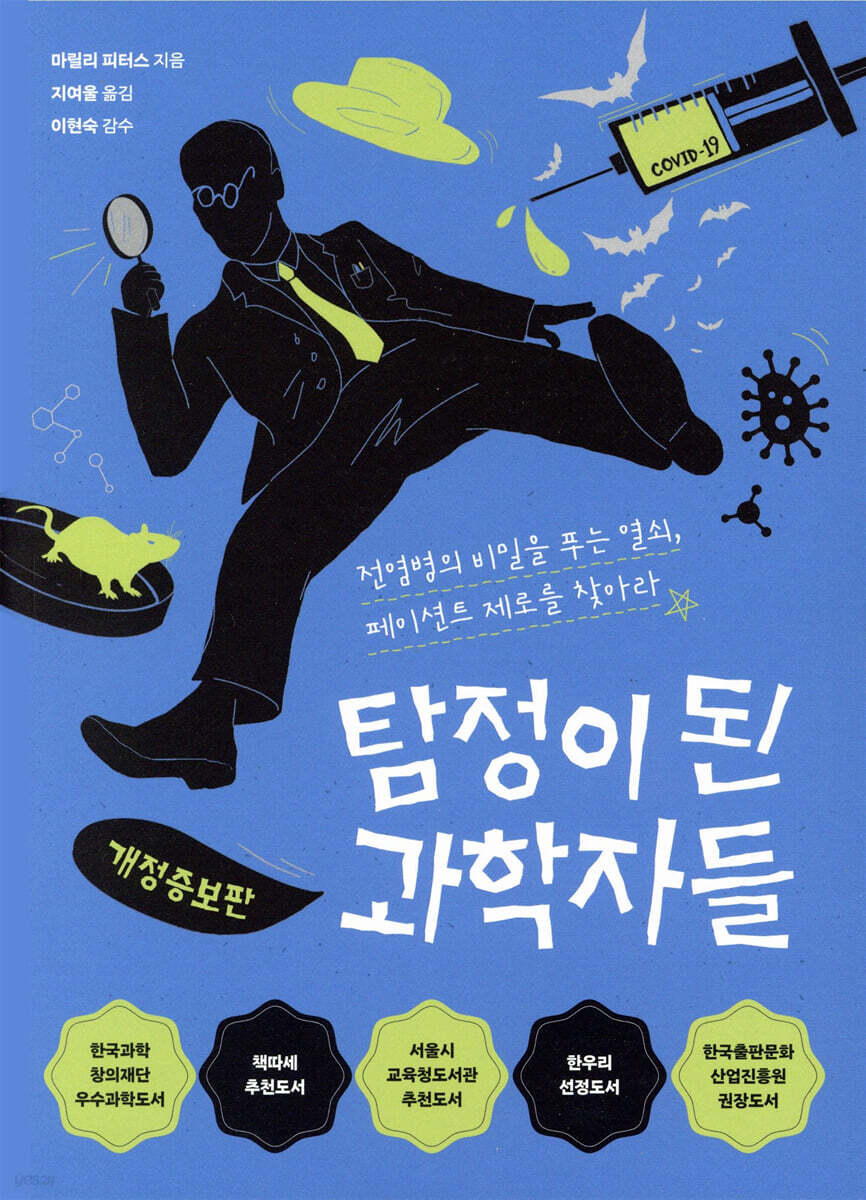
Scientists Who Became Detectives
 |
Description
Book Introduction
From the plague to COVID-19,
Scientists Solve the Mystery of the Plague
In the age of pandemics, making infectious disease knowledge accessible and fun.
There are people all over the world fighting against epidemics to save humanity from the never-ending war against infectious diseases.
They are epidemiologists.
When an epidemic begins to spread, they risk their lives to investigate.
Like a detective, you visit the 'crime scene' where the disease occurred and look for 'clues'.
Find the 'witness', ask numerous questions, talk to the 'victim', and collect 'evidence'.
Once we have collected information about the epidemic, we use the latest scientific and technological technologies to identify the epidemic.
They go wherever there is a clue that will reveal the identity of the epidemic.
"Scientists Become Detectives" is the story of epidemiologists who risked infection and public ridicule to uncover the secrets of infectious diseases.
The story unfolds like a detective novel, with epidemiologists tracking down "Patient Zero," the first person infected, to uncover the secrets of the epidemic.
It covers eight major epidemics that have threatened humanity, from the plague that swept through London in 1665 to the COVID-19 pandemic that spread worldwide in 2020.
This book contains eight epidemics that shook human history.
The plague in London in 1665, cholera in London in 1854, yellow fever in Cuba in 1900, typhoid in New York in 1906, the Spanish flu that swept the world in 1918, Ebola in Zaire in 1976, AIDS in the United States in 1980, and the COVID-19 pandemic in 2020.
In particular, the final chapter, which deals with COVID-19, has been reconstructed to make the story more realistic by updating it with the latest information that is constantly changing.
Scientists Solve the Mystery of the Plague
In the age of pandemics, making infectious disease knowledge accessible and fun.
There are people all over the world fighting against epidemics to save humanity from the never-ending war against infectious diseases.
They are epidemiologists.
When an epidemic begins to spread, they risk their lives to investigate.
Like a detective, you visit the 'crime scene' where the disease occurred and look for 'clues'.
Find the 'witness', ask numerous questions, talk to the 'victim', and collect 'evidence'.
Once we have collected information about the epidemic, we use the latest scientific and technological technologies to identify the epidemic.
They go wherever there is a clue that will reveal the identity of the epidemic.
"Scientists Become Detectives" is the story of epidemiologists who risked infection and public ridicule to uncover the secrets of infectious diseases.
The story unfolds like a detective novel, with epidemiologists tracking down "Patient Zero," the first person infected, to uncover the secrets of the epidemic.
It covers eight major epidemics that have threatened humanity, from the plague that swept through London in 1665 to the COVID-19 pandemic that spread worldwide in 2020.
This book contains eight epidemics that shook human history.
The plague in London in 1665, cholera in London in 1854, yellow fever in Cuba in 1900, typhoid in New York in 1906, the Spanish flu that swept the world in 1918, Ebola in Zaire in 1976, AIDS in the United States in 1980, and the COVID-19 pandemic in 2020.
In particular, the final chapter, which deals with COVID-19, has been reconstructed to make the story more realistic by updating it with the latest information that is constantly changing.
- You can preview some of the book's contents.
Preview
index
To the revised edition
Opening remarks: Disease detectives embark on a case investigation.
Chapter 1: Clues Left Behind by Death: The Plague in London, 1665
Signs of Misfortune | Bloodletting | Marks of the Plague | Interesting News | Clues in the Death Register | Amazing Discovery | The 'Sick Year' Hypothesis | Empty Streets | No Cure | Finding Answers in Hong Kong | The Plague Today
Chapter 2: The First Epidemic Map: Cholera in Soho, 1854
The Sewage Pit and the Water Pump | The Angel of Death Visits | The Streets Flowing with Silence | Is Poison the Cause of Cholera? | The Great Experiment | Expanding the Investigation | Can We Handle the Truth? | The Big Picture Uncovers | The Final Clue | The Dirty Truth | Cholera Today
Chapter 3: People Who Infected Themselves: Yellow Fever in Cuba, 1900
The Yellow Death Strikes Cuba | Researchers Assemble | Camp Columbia | Heading to Havana | Problems Mount | Human Guinea Pigs | Reed Returns | Quarantine Experiments and the $100 Gold Coin | Yellow Fever Today
Chapter 4: The Suspect's Arrest Operation_Typhoid Fever in New York, 1906
A Shameful Disease | Tracking the Suspect | Battle 2 | Battle 3 | Villain or Victim | Typhoid Fever Today
Chapter 5: Another World War: The Spanish Flu That Swept the World in 1918
Hospital wards fill up | First cases of the Spanish flu | Scientists summoned | Second wave of flu | Critical report | Frozen clues | Lessons from the Spanish flu | International cooperation begins
Chapter 6: Germ Hunters in the Jungle: Ebola in Zaire, 1976
Spreading Frighteningly | A Question Mark-Shaped Virus | On the Track | Gathering Clues | Perplexing Questions | The Sad Truth | Ebola Today | An Animal Disease Detective Sets the Case | The Link to Bats | The Path of Ebola
Chapter 7: Digging for the Truth and Breaking Down Prejudice: AIDS in America in 1980
A Mysterious Situation | Bad News | A Trend Revealed | Finding the Answer to the Mystery | The Nameless Epidemic | The Future of AIDS
Chapter 8: The Exposure That Saved the World: The 2020 COVID-19 Pandemic
Signs and Symptoms of the Disease | World Health Organization Research Team
Conclusion: The Future of Pandemics and Disease Detectives
The History of Infectious Diseases in Korea _ Lee Hyun-sook (Research Professor, Institute for the History of Medicine, Yonsei University)
Glossary
Curriculum Linkage Table
Search
Opening remarks: Disease detectives embark on a case investigation.
Chapter 1: Clues Left Behind by Death: The Plague in London, 1665
Signs of Misfortune | Bloodletting | Marks of the Plague | Interesting News | Clues in the Death Register | Amazing Discovery | The 'Sick Year' Hypothesis | Empty Streets | No Cure | Finding Answers in Hong Kong | The Plague Today
Chapter 2: The First Epidemic Map: Cholera in Soho, 1854
The Sewage Pit and the Water Pump | The Angel of Death Visits | The Streets Flowing with Silence | Is Poison the Cause of Cholera? | The Great Experiment | Expanding the Investigation | Can We Handle the Truth? | The Big Picture Uncovers | The Final Clue | The Dirty Truth | Cholera Today
Chapter 3: People Who Infected Themselves: Yellow Fever in Cuba, 1900
The Yellow Death Strikes Cuba | Researchers Assemble | Camp Columbia | Heading to Havana | Problems Mount | Human Guinea Pigs | Reed Returns | Quarantine Experiments and the $100 Gold Coin | Yellow Fever Today
Chapter 4: The Suspect's Arrest Operation_Typhoid Fever in New York, 1906
A Shameful Disease | Tracking the Suspect | Battle 2 | Battle 3 | Villain or Victim | Typhoid Fever Today
Chapter 5: Another World War: The Spanish Flu That Swept the World in 1918
Hospital wards fill up | First cases of the Spanish flu | Scientists summoned | Second wave of flu | Critical report | Frozen clues | Lessons from the Spanish flu | International cooperation begins
Chapter 6: Germ Hunters in the Jungle: Ebola in Zaire, 1976
Spreading Frighteningly | A Question Mark-Shaped Virus | On the Track | Gathering Clues | Perplexing Questions | The Sad Truth | Ebola Today | An Animal Disease Detective Sets the Case | The Link to Bats | The Path of Ebola
Chapter 7: Digging for the Truth and Breaking Down Prejudice: AIDS in America in 1980
A Mysterious Situation | Bad News | A Trend Revealed | Finding the Answer to the Mystery | The Nameless Epidemic | The Future of AIDS
Chapter 8: The Exposure That Saved the World: The 2020 COVID-19 Pandemic
Signs and Symptoms of the Disease | World Health Organization Research Team
Conclusion: The Future of Pandemics and Disease Detectives
The History of Infectious Diseases in Korea _ Lee Hyun-sook (Research Professor, Institute for the History of Medicine, Yonsei University)
Glossary
Curriculum Linkage Table
Search
Into the book
While Whitehead roamed the streets, Snow spent each night in his study, immersed in analyzing the material he had already collected.
But, disappointingly, there seemed to be nothing more to find out.
Then one night, Snow decided to try something new.
The doctor picked up a list of confirmed cholera patients and transferred the information onto a map of the Soho district.
A black line was drawn at each address where a cholera case was reported.
Soon a bundle of black lines stretched across the winding streets of the map.
Snow looked closely at the map, pondering what it showed and what it didn't show.
Then I picked up a pen and marked on a map the locations of all the public water pumps in the Soho neighborhood.
As he put down his pen, Dr. Snow was faced with a picture showing the nature of the epidemic.
The black lines radiating from the water pump on Broad Street testified to the fact that a deadly disease had spread from this polluted water source.
--- p.70~71, from “Chapter 2: The First Epidemic Map”
Frost realized that if he could identify the starting point of an epidemic, the first infected person, he could recreate the pattern of its spread.
If only epidemiologists could find the first case, they could figure out how the disease was transmitted, how contagious it was, and what factors made people more susceptible to getting sick.
Frost called the first infected person at the center of an epidemic the "index case."
Modern epidemiologists still use the term "index case" and the methods Frost developed to identify index cases.
Today, the index patient is also called 'patient zero'.
--- p.150, from “Chapter 5 Another World War”
“Dr. Lee! Dr. Lee, open the door!”
Li Wenliang woke up from a deep sleep to the sound of someone banging on the door and shouting.
He staggered out of bed and opened the door, forgetting to put on his glasses.
Because they weren't wearing glasses, the faces of the police officers standing outside the door were only visible as blurry outlines.
But from the police officers' harsh tone, I could guess that there was some urgent reason for them to come to my house at this late hour.
It was clear that he was in trouble.
But what on earth is the problem?
“Are you Dr. Li, working in the ophthalmology department of Wuhan Central Hospital?”
“Yes, but what on earth is going on?”
“I have to go to the police station now.
“I need to do some research on the rumors you’re spreading on the internet.”
Someone in Li Wenliang's WeChat group shared the doctor's post on a public website, and many people began to worry after reading the doctor's warning to his medical friends.
Rumors were already circulating that a new SARS outbreak had begun in Wuhan.
--- p.222, from “Chapter 8: The Revelation That Saved the World”
The reasons behind the return of diseases once thought to have disappeared, while new diseases continue to emerge, are complex.
Sometimes we rely so heavily on the miraculous effects of medications that we forget the simple way to prevent numerous viral infections: washing our hands with soap.
And on the other hand, humanity has been destroying nature at a rate unprecedented in history.
By cutting down forests and creating villages and farms, we have disrupted the ecosystems where wildlife and microorganisms have coexisted for thousands of years across the planet, ultimately leaving only humans behind.
It made us into beings cut off from nature.
When a pandemic strikes, we look for someone to blame and refuse to acknowledge that we are all connected.
They refused to acknowledge that everyone has a role to play and a responsibility to maintain the health of humanity and the health of the planet.
But, disappointingly, there seemed to be nothing more to find out.
Then one night, Snow decided to try something new.
The doctor picked up a list of confirmed cholera patients and transferred the information onto a map of the Soho district.
A black line was drawn at each address where a cholera case was reported.
Soon a bundle of black lines stretched across the winding streets of the map.
Snow looked closely at the map, pondering what it showed and what it didn't show.
Then I picked up a pen and marked on a map the locations of all the public water pumps in the Soho neighborhood.
As he put down his pen, Dr. Snow was faced with a picture showing the nature of the epidemic.
The black lines radiating from the water pump on Broad Street testified to the fact that a deadly disease had spread from this polluted water source.
--- p.70~71, from “Chapter 2: The First Epidemic Map”
Frost realized that if he could identify the starting point of an epidemic, the first infected person, he could recreate the pattern of its spread.
If only epidemiologists could find the first case, they could figure out how the disease was transmitted, how contagious it was, and what factors made people more susceptible to getting sick.
Frost called the first infected person at the center of an epidemic the "index case."
Modern epidemiologists still use the term "index case" and the methods Frost developed to identify index cases.
Today, the index patient is also called 'patient zero'.
--- p.150, from “Chapter 5 Another World War”
“Dr. Lee! Dr. Lee, open the door!”
Li Wenliang woke up from a deep sleep to the sound of someone banging on the door and shouting.
He staggered out of bed and opened the door, forgetting to put on his glasses.
Because they weren't wearing glasses, the faces of the police officers standing outside the door were only visible as blurry outlines.
But from the police officers' harsh tone, I could guess that there was some urgent reason for them to come to my house at this late hour.
It was clear that he was in trouble.
But what on earth is the problem?
“Are you Dr. Li, working in the ophthalmology department of Wuhan Central Hospital?”
“Yes, but what on earth is going on?”
“I have to go to the police station now.
“I need to do some research on the rumors you’re spreading on the internet.”
Someone in Li Wenliang's WeChat group shared the doctor's post on a public website, and many people began to worry after reading the doctor's warning to his medical friends.
Rumors were already circulating that a new SARS outbreak had begun in Wuhan.
--- p.222, from “Chapter 8: The Revelation That Saved the World”
The reasons behind the return of diseases once thought to have disappeared, while new diseases continue to emerge, are complex.
Sometimes we rely so heavily on the miraculous effects of medications that we forget the simple way to prevent numerous viral infections: washing our hands with soap.
And on the other hand, humanity has been destroying nature at a rate unprecedented in history.
By cutting down forests and creating villages and farms, we have disrupted the ecosystems where wildlife and microorganisms have coexisted for thousands of years across the planet, ultimately leaving only humans behind.
It made us into beings cut off from nature.
When a pandemic strikes, we look for someone to blame and refuse to acknowledge that we are all connected.
They refused to acknowledge that everyone has a role to play and a responsibility to maintain the health of humanity and the health of the planet.
--- p.245, from “Conclusion: Pandemics and the Future of Disease Detectives”
Publisher's Review
Revised and expanded edition published!
Added COVID-19 pandemic
★★★★★
Excellent Science Book from the Korea Foundation for the Advancement of Science and Creativity
Seoul Metropolitan Office of Education Library Recommended Books
Recommended books by the Korea Publication Industry Promotion Agency
Book Recommendations
Hanuri Selected Books
From the plague to COVID-19,
Scientists Solve the Mystery of the Plague
The COVID-19 pandemic, which began in December 2019, has completely changed humanity's daily lives.
Until the COVID-19 pandemic, it seemed as though science was slowly winning the war against disease.
Smallpox, polio, and tuberculosis, which once killed millions of people, have all but disappeared, and diseases like yellow fever and malaria have lost their effectiveness thanks to insecticides that keep mosquitoes at bay.
But the epidemic is coming back in another, more powerful form, threatening humanity.
There are people all over the world fighting against epidemics to save humanity from the never-ending war against infectious diseases.
They are epidemiologists.
When an epidemic begins to spread, they risk their lives to investigate.
Like a detective, you visit the 'crime scene' where the disease occurred and look for 'clues'.
Find the 'witness', ask numerous questions, talk to the 'victim', and collect 'evidence'.
Once we have collected information about the epidemic, we use the latest scientific and technological technologies to identify the epidemic.
They go wherever there is a clue that will reveal the identity of the epidemic.
《Scientists Become Detectives》 is the story of epidemiologists who risked infection and ridicule to uncover the secrets of infectious diseases.
The story unfolds like a detective novel, with epidemiologists tracking down "Patient Zero," the first person infected, to uncover the secrets of the epidemic.
It covers eight major epidemics that have threatened humanity, from the plague that swept through London in 1665 to the COVID-19 pandemic that spread worldwide in 2020.
In the pandemic era, knowledge of infectious diseases
Solve it easily and enjoyably
The book contains eight epidemics that shook human history.
The plague in London in 1665, cholera in London in 1854, yellow fever in Cuba in 1900, typhoid in New York in 1906, the Spanish flu that swept the world in 1918, Ebola in Zaire in 1976, AIDS in the United States in 1980, and the COVID-19 pandemic in 2020.
In particular, the final chapter, which deals with COVID-19, has been reconstructed to make the story more realistic by updating it with the latest information that is constantly changing.
By following the story of scientists who became detectives chasing down epidemics, you can learn about disease prevalence, infection routes, and prevention methods from an epidemiological perspective.
Epidemiology is the study of how diseases are transmitted and how to prevent epidemics.
Epidemiology is studied at public health organizations such as the Centers for Disease Control and Prevention (CDC), the World Health Organization (WHO), and the Public Health Agency of Canada (PHAC).
'Brief knowledge on epidemiology' is introduced here and there in the middle of the text.
It explains how epidemiology developed, how epidemiologists gather information, and where epidemiologists study epidemiology today.
This will help you learn basic knowledge about epidemiology.
From ancient plagues to K-quarantine,
Includes the history of infectious diseases in our country!
At the very end of “Scientists Became Detectives” is “History of Korean Infectious Diseases” written by Dr. Hyun-Sook Lee (Research Professor, Yonsei University Institute of Medical History), an authority on epidemiology.
We will briefly look at the infectious diseases that were prevalent in each era, such as the ancient plague, the plague and plague of the Goryeo Dynasty, cholera of the Joseon Dynasty, and AIDS, SARS, and MERS of modern times.
You can learn about how our country accepted infectious diseases in the past, what we did to prevent them, and how epidemiology developed through the study of infectious diseases.
Not only does it allow us to understand our history of infectious diseases from a global historical perspective, it also allows us to consider the role of epidemiology as a discipline that protects humanity today, when the world is bound together as a single community and the risk of infectious disease pandemics is greater.
*This book is a revised and expanded edition of “Scientists Who Became Detectives.”
Added COVID-19 pandemic
★★★★★
Excellent Science Book from the Korea Foundation for the Advancement of Science and Creativity
Seoul Metropolitan Office of Education Library Recommended Books
Recommended books by the Korea Publication Industry Promotion Agency
Book Recommendations
Hanuri Selected Books
From the plague to COVID-19,
Scientists Solve the Mystery of the Plague
The COVID-19 pandemic, which began in December 2019, has completely changed humanity's daily lives.
Until the COVID-19 pandemic, it seemed as though science was slowly winning the war against disease.
Smallpox, polio, and tuberculosis, which once killed millions of people, have all but disappeared, and diseases like yellow fever and malaria have lost their effectiveness thanks to insecticides that keep mosquitoes at bay.
But the epidemic is coming back in another, more powerful form, threatening humanity.
There are people all over the world fighting against epidemics to save humanity from the never-ending war against infectious diseases.
They are epidemiologists.
When an epidemic begins to spread, they risk their lives to investigate.
Like a detective, you visit the 'crime scene' where the disease occurred and look for 'clues'.
Find the 'witness', ask numerous questions, talk to the 'victim', and collect 'evidence'.
Once we have collected information about the epidemic, we use the latest scientific and technological technologies to identify the epidemic.
They go wherever there is a clue that will reveal the identity of the epidemic.
《Scientists Become Detectives》 is the story of epidemiologists who risked infection and ridicule to uncover the secrets of infectious diseases.
The story unfolds like a detective novel, with epidemiologists tracking down "Patient Zero," the first person infected, to uncover the secrets of the epidemic.
It covers eight major epidemics that have threatened humanity, from the plague that swept through London in 1665 to the COVID-19 pandemic that spread worldwide in 2020.
In the pandemic era, knowledge of infectious diseases
Solve it easily and enjoyably
The book contains eight epidemics that shook human history.
The plague in London in 1665, cholera in London in 1854, yellow fever in Cuba in 1900, typhoid in New York in 1906, the Spanish flu that swept the world in 1918, Ebola in Zaire in 1976, AIDS in the United States in 1980, and the COVID-19 pandemic in 2020.
In particular, the final chapter, which deals with COVID-19, has been reconstructed to make the story more realistic by updating it with the latest information that is constantly changing.
By following the story of scientists who became detectives chasing down epidemics, you can learn about disease prevalence, infection routes, and prevention methods from an epidemiological perspective.
Epidemiology is the study of how diseases are transmitted and how to prevent epidemics.
Epidemiology is studied at public health organizations such as the Centers for Disease Control and Prevention (CDC), the World Health Organization (WHO), and the Public Health Agency of Canada (PHAC).
'Brief knowledge on epidemiology' is introduced here and there in the middle of the text.
It explains how epidemiology developed, how epidemiologists gather information, and where epidemiologists study epidemiology today.
This will help you learn basic knowledge about epidemiology.
From ancient plagues to K-quarantine,
Includes the history of infectious diseases in our country!
At the very end of “Scientists Became Detectives” is “History of Korean Infectious Diseases” written by Dr. Hyun-Sook Lee (Research Professor, Yonsei University Institute of Medical History), an authority on epidemiology.
We will briefly look at the infectious diseases that were prevalent in each era, such as the ancient plague, the plague and plague of the Goryeo Dynasty, cholera of the Joseon Dynasty, and AIDS, SARS, and MERS of modern times.
You can learn about how our country accepted infectious diseases in the past, what we did to prevent them, and how epidemiology developed through the study of infectious diseases.
Not only does it allow us to understand our history of infectious diseases from a global historical perspective, it also allows us to consider the role of epidemiology as a discipline that protects humanity today, when the world is bound together as a single community and the risk of infectious disease pandemics is greater.
*This book is a revised and expanded edition of “Scientists Who Became Detectives.”
GOODS SPECIFICS
- Publication date: August 15, 2021
- Page count, weight, size: 264 pages | 444g | 152*210*16mm
- ISBN13: 9791156333913
- ISBN10: 1156333911
You may also like
카테고리
korean


korean

![GQ KOREA Mark (Monthly): December [2025]](http://librairie.coreenne.fr/cdn/shop/files/8ef265dbbfbf186523ed75ba7319009d.jpg?v=1765340328&width=3840)


