

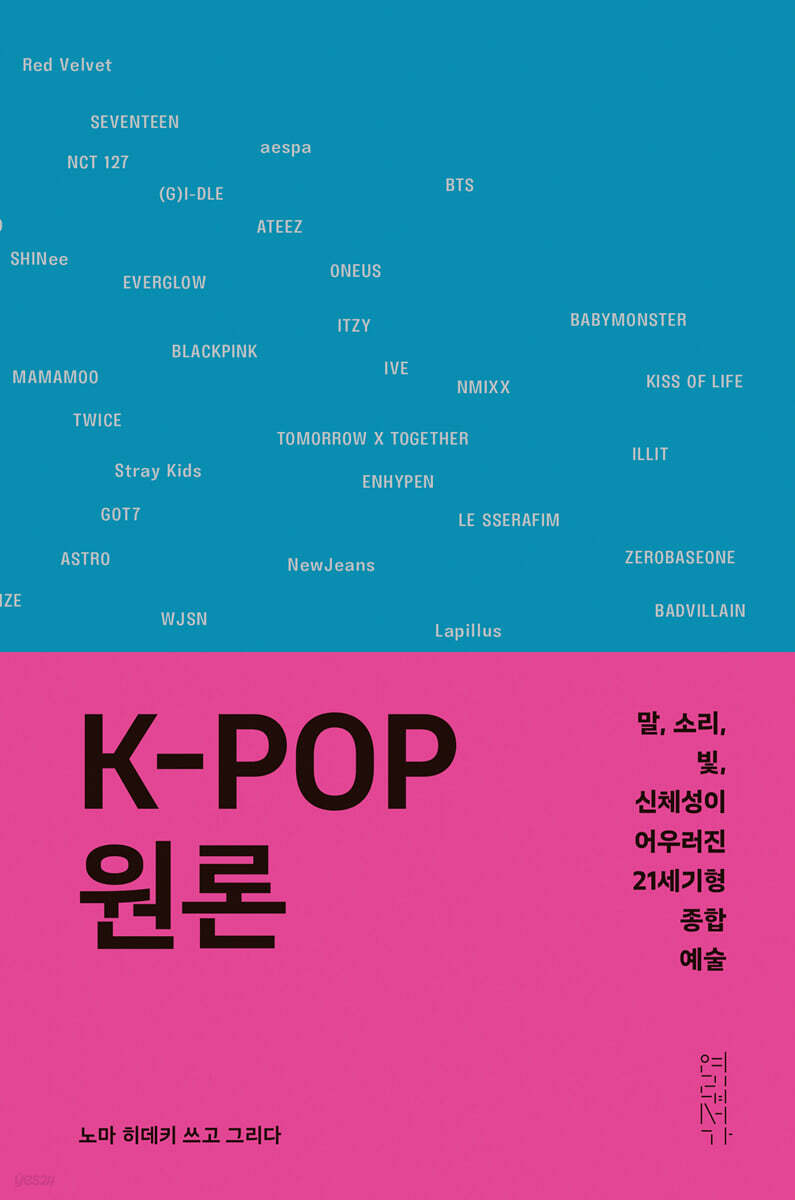
K-POP Principles
 |
Description
Book Introduction
In 2011, linguist Hideki Noma, who declared the 'birth of Hangul' a miracle in the history of world writing and a 'revolution of knowledge', returned this time with 'K-POP'.
The author redefines K-POP beyond the narrow realm of music as 'K-art' optimized for the 'LAVnet era' where language, audio, and visuals become one and fly at high speed across the internet.
And the 'Birth of K-Art' is positioned as a 'revolution in art' that transformed the form of artistic expression, the form of existence, and even the method of private ownership.
K-POP has come to us as a comprehensive art form, a "21st century global shared opera" that breaks down the boundaries between stage and audience and turns 24 hours into a theater.
The question that runs through the book is this:
“Why is the world crazy about K-POP?” The question goes beyond an optimistic outlook.
"How long will the K-pop craze last? Or will it collapse?" To find the answer, the author takes a straightforward approach: confronting the "works" themselves, the painstaking work of artists and creators.
The framework for analyzing K-Art works (=mainly MVs after the 3rd generation), which are world images that integrate 'language + sound + light (visual form) + physicality', is an aesthetics that utilizes linguistics, which is the author's major field, and his insight as a modern artist, which was his starting point. (Incidentally, the author also formed a folk group during his school days and was active as a guitarist.)
The QR codes for over 400 YouTube videos allow you to teleport directly to the author's commentary with your eyes and ears, providing a four-dimensional reading experience that engages all six senses.
As a long-time K-POP enthusiast, I have carefully selected 843 recommended MVs for each situation and taste, and the illustrations and diagrams drawn by me with my fandom based on my experience as a contemporary artist and designer are a gift to Korean readers and K-POP fans.
This is not a translated version of the book of the same title published in Japan in 2022, but was rewritten and added to in Korean by the author himself.
The author redefines K-POP beyond the narrow realm of music as 'K-art' optimized for the 'LAVnet era' where language, audio, and visuals become one and fly at high speed across the internet.
And the 'Birth of K-Art' is positioned as a 'revolution in art' that transformed the form of artistic expression, the form of existence, and even the method of private ownership.
K-POP has come to us as a comprehensive art form, a "21st century global shared opera" that breaks down the boundaries between stage and audience and turns 24 hours into a theater.
The question that runs through the book is this:
“Why is the world crazy about K-POP?” The question goes beyond an optimistic outlook.
"How long will the K-pop craze last? Or will it collapse?" To find the answer, the author takes a straightforward approach: confronting the "works" themselves, the painstaking work of artists and creators.
The framework for analyzing K-Art works (=mainly MVs after the 3rd generation), which are world images that integrate 'language + sound + light (visual form) + physicality', is an aesthetics that utilizes linguistics, which is the author's major field, and his insight as a modern artist, which was his starting point. (Incidentally, the author also formed a folk group during his school days and was active as a guitarist.)
The QR codes for over 400 YouTube videos allow you to teleport directly to the author's commentary with your eyes and ears, providing a four-dimensional reading experience that engages all six senses.
As a long-time K-POP enthusiast, I have carefully selected 843 recommended MVs for each situation and taste, and the illustrations and diagrams drawn by me with my fandom based on my experience as a contemporary artist and designer are a gift to Korean readers and K-POP fans.
This is not a translated version of the book of the same title published in Japan in 2022, but was rewritten and added to in Korean by the author himself.
- You can preview some of the book's contents.
Preview
index
At the beginning of the book
0th Movement Prelude: This is K-POP For an introduction to K-POP
0-1 K-POP is a 21st century comprehensive art form.
0-2 Experience it first! - Four videos for beginners
0-3 K-Art - Voice and Words, Sound and Light, and Physicality
1st Movement: Where is K-POP? Why YouTube? Why Music?
1-1 K-POP, the Stimulating Experience
1-2 K-POP is a form of music and art in the LAVnet era.
1-3 Why YouTube?
1-4 'K-Art' is transforming the world of art.
The World of K-POP MVs: Poetry, Image, and Physicality
2-1 Characteristics of K-POP MVs
2-2 It's not a 'worldview', it's a dazzling 'worldview'
2-3 The dream of virtual reality was shattered by the Fukushima 3/11 incident - so what about K-POP?
2-4 The Form of Existence Called 'Physicality' Breaks Down Walls - Dance and Antiques
2-5 'Dancing' Camera
From 2-6 pre K-POP to K-POP classic stage
2-7 New worldviews appearing
2-8 Voice, speech, image, and physicality, the forefront of a clear world view
3rd Movement: Between the Language of K-POP, 'Rap' and 'Labu'
3-1 Why I'm Hooked on Korean Rap
The internal structure of 3-2 syllables supports the aesthetics of Korean songs and rap.
3-3 The Power of Korean Consonants - K-POP Songs Make Your Sounds Pop
3-4 Glottal Stops Are Invisible Notes - The Secret to K-POP Singing
3-5 Korean Final Consonants - A Secret Not Found in English, French, or German
3-6 Korean as an 'Onomatopia' - A Utopia of Onomatopoeia
3-7 The Dream of Hangul, the Whirlwind of Chinese Characters
4th Movement: Polyphony and Multilingualism: The Ontology of Voice, Language, and Song
4-1 Polyphony
4-2 A Multilingual World - Multi-Ethnic
4-3 The Moment When Voice Becomes Song - The Ontology of Language and Song
4-4 Masterpieces of Pluralism
5th Movement K-Art's Time Change, Change, More Change
5-1 Eliminate Scheduled Harmony - The Pleasure of Change
5-2 K-Art, the aesthetics of color
5-3 K-Art's colors evolve and dance fiercely.
5-4 K-Art, Kaleidoscope of Colors
6th Movement: What Kind of Being is K-POP? A New Koreanesque Bricolage
6-1 'Words' and 'Story' - The Polarities of Lyrics
6-2 Pieces of Symbolic Poetry Accumulate - Words That Support Change
6-3 The Aesthetics of the 'New Koreanesque' - Voice, Words, Sound, Light, and Physicality
6-4 Ontological Voice and the DNA of Language - Pansori and Rap
6-5 High-Speed Bricolage of Words, Sound, Light, and Physicality - K-Art
Chapter 7: Will K-POP Collapse?
7-1 Is K-POP Collapsed? - When 'K-Art' Becomes 'Art'
7-2 Is K-POP Collapsed? - Art, J-Art, C-Art, S-Art... and K-Art
8th Movement For K-POP 'Now and Here'
8-1 For K-Art to be Shared Worldwide - Change and Diversity
8-2 For K-Art to be Shared Worldwide - Thought and Emotion
8-3 K-POP, the Joy and Sorrow of "Now and Here"
Glory to K-POP: The Form Farthest from War
Reviews of the Yeonrip Bookstore
Recommended MV list by situation and taste
References
Search
Hideki Noma, from contemporary art to linguistics, to declaring the "birth of K-art."
0th Movement Prelude: This is K-POP For an introduction to K-POP
0-1 K-POP is a 21st century comprehensive art form.
0-2 Experience it first! - Four videos for beginners
0-3 K-Art - Voice and Words, Sound and Light, and Physicality
1st Movement: Where is K-POP? Why YouTube? Why Music?
1-1 K-POP, the Stimulating Experience
1-2 K-POP is a form of music and art in the LAVnet era.
1-3 Why YouTube?
1-4 'K-Art' is transforming the world of art.
The World of K-POP MVs: Poetry, Image, and Physicality
2-1 Characteristics of K-POP MVs
2-2 It's not a 'worldview', it's a dazzling 'worldview'
2-3 The dream of virtual reality was shattered by the Fukushima 3/11 incident - so what about K-POP?
2-4 The Form of Existence Called 'Physicality' Breaks Down Walls - Dance and Antiques
2-5 'Dancing' Camera
From 2-6 pre K-POP to K-POP classic stage
2-7 New worldviews appearing
2-8 Voice, speech, image, and physicality, the forefront of a clear world view
3rd Movement: Between the Language of K-POP, 'Rap' and 'Labu'
3-1 Why I'm Hooked on Korean Rap
The internal structure of 3-2 syllables supports the aesthetics of Korean songs and rap.
3-3 The Power of Korean Consonants - K-POP Songs Make Your Sounds Pop
3-4 Glottal Stops Are Invisible Notes - The Secret to K-POP Singing
3-5 Korean Final Consonants - A Secret Not Found in English, French, or German
3-6 Korean as an 'Onomatopia' - A Utopia of Onomatopoeia
3-7 The Dream of Hangul, the Whirlwind of Chinese Characters
4th Movement: Polyphony and Multilingualism: The Ontology of Voice, Language, and Song
4-1 Polyphony
4-2 A Multilingual World - Multi-Ethnic
4-3 The Moment When Voice Becomes Song - The Ontology of Language and Song
4-4 Masterpieces of Pluralism
5th Movement K-Art's Time Change, Change, More Change
5-1 Eliminate Scheduled Harmony - The Pleasure of Change
5-2 K-Art, the aesthetics of color
5-3 K-Art's colors evolve and dance fiercely.
5-4 K-Art, Kaleidoscope of Colors
6th Movement: What Kind of Being is K-POP? A New Koreanesque Bricolage
6-1 'Words' and 'Story' - The Polarities of Lyrics
6-2 Pieces of Symbolic Poetry Accumulate - Words That Support Change
6-3 The Aesthetics of the 'New Koreanesque' - Voice, Words, Sound, Light, and Physicality
6-4 Ontological Voice and the DNA of Language - Pansori and Rap
6-5 High-Speed Bricolage of Words, Sound, Light, and Physicality - K-Art
Chapter 7: Will K-POP Collapse?
7-1 Is K-POP Collapsed? - When 'K-Art' Becomes 'Art'
7-2 Is K-POP Collapsed? - Art, J-Art, C-Art, S-Art... and K-Art
8th Movement For K-POP 'Now and Here'
8-1 For K-Art to be Shared Worldwide - Change and Diversity
8-2 For K-Art to be Shared Worldwide - Thought and Emotion
8-3 K-POP, the Joy and Sorrow of "Now and Here"
Glory to K-POP: The Form Farthest from War
Reviews of the Yeonrip Bookstore
Recommended MV list by situation and taste
References
Search
Hideki Noma, from contemporary art to linguistics, to declaring the "birth of K-art."
Into the book
When discussing K-pop in Japanese-speaking discourse, one often encounters statements like, “K-pop developed under state leadership” or “K-pop succeeded thanks to the power of the Korean government.”
The term ‘national policy’ also appears frequently in K-POP theory.
This jealous discourse is nothing more than a variant of a hidden nationalist ideology, and is an argument of little value.
Let me just add one thing.
The state does not write lyrics or compose songs.
He doesn't even bother interacting with his fans.
The country cannot sing or dance.
As symbolically expressed in the expressions we frequently encounter, such as “all of Korea” and “all of Japan,” the illusion of being immersed in concepts such as “nation” or “ethnicity” often becomes a great obstacle and blocks the gaze from looking at the work itself.
--- p.10
Let's also touch on the frighteningly outdated term 'idol' that has been dominating K-POP.
This book does not subscribe to the 'old idol theory' that confines K-pop stars within the narrow confines of the outdated concept of 'idol'.
People who are called that way are willing to accept the word 'idol' and say, "If you want to be called that, then go ahead.
As if to say, “We will do what we want,” he did not bother to directly oppose it.
For example, BTS overwhelms us by using the old idolist's thoughts and feelings in reverse by using the title "IDOL" and elevating it to a work of art (→page 392).
--- p.62
However, it is held up as if it were an absolute attribute of the individual artist, absolutized and fixed with the word 'visual'.
Even by assigning economic value to appearance, we exclude the driving force of ‘change’ that is involved in the essence of the perception of ‘beauty’.
Moreover, that 'beauty' is being separated from the artist=person as if it were an object.
In other words, they are peeling off a person's face and selling the skin under the product name of 'visual'.
This is truly the epitome of capitalist commercialization.
The phrase 'visual manager' contains such thoughts and emotions.
Oh my! Originally, "visual" meant "visual," that is, everything we encounter in the form of light.
For example, if you really want to talk about 'visuals' in a music video, you have to consider all the visual elements, from the artist's appearance to every corner of the screen, including the space behind the artist.
--- p.64
It is not the people who create the work who create the worldview that is the work.
People with a certain worldview create works based on that worldview.
The work does not have a worldview or ideology.
In the created work, we 'read = shape' the world view or ideology.
Therefore, the work is not a worldview.
It is not a subject that has a world view.
The subject is always us.
So, if a work isn't a worldview, what is it? There's a term that fits perfectly here.
It is the ‘world view’.
In German, it is Weltbild[?v?ltb?lt [Weltbild].
It is a word that means something like ‘picture of the world’ or ‘image of the world.’
It is people who create their own separate worldviews one by one through their works.
K-POP MVs create a new 'worldview' with each work.
Such countless worldviews make up the dazzling universe called K-POP.
The universe of K-POP is expanding tremendously.
This is also the basis of the aesthetics that this book talks about.
--- p.88
This is the 2022 work of IVE, a six-member girl group that debuted in 2021, and even before the exclamation “yes” at the beginning, a small vocal cord closure is already hidden.
The 'ni' at the beginning of Eugene's "I'm really curious about you" and the 'i' at the beginning of "this is enough" are typical examples of glottal closure.
In Korean, there is absolutely no need to insert glottal closure in such places, not only in normal speech but also in singing.
It is clearly being used consciously.
Perhaps many people around the world have heard this song and wondered at the strange tension that lies before 'ni' and 'i'.
“What is that? That strange staccato sound that is neither ‘ni’ nor ‘i’?” Then you will realize the beauty of that singing style all over again.
A vocal trainer might describe it as “a sound with an edge.”
--- p.235
Let us also pay attention to the temporal characteristics of sound.
This closure of the gates creates an extremely short, perhaps barely noticeable, gap.
Of course it's not blank.
Although it is not a consonant as a Korean phoneme, it is a clear 'voice' that has been solidified into a certain 'form' by cleverly extracting only the 'glottal closure' characteristic that is originally present in the Korean language sound.
For example, on the head of an eighth note, it is placed softly, as if in syncopation, yet very sharply.
Although the vocal cords are not visible, they are clearly 'invisible notes' that exist as 'voices'.
--- p.238
In the lyrics of Mamamoo's 2020 work "AYA", "Is it tears or rain?", you can finally enjoy the fun of rhetoric that utilizes the sounds of language.
The lyrics, which repeat the Korean “tuktuktuktuk” and the English onomatopoeic “drop drop drop drop drop drop”, are also exquisite.
Note that both are one-syllable words.
In Korean pronunciation, as mentioned earlier, the final /-p/ is a labial sound that is produced by sharply closing and closing both lips, but without opening them, that is, without bursting = opening them.
In Japanese loanwords, 'drop' becomes a four-beat sound like [do-ro-b-pu], so this sharp monosyllabic quality disappears.
--- p.275
Titles like 〈Egotistic: You or Me〉 and 〈Forever: Promise〉 mentioned above present two languages simultaneously, thereby attempting to create a new form of meaning that cannot be created with just one language.
Now, whether it's Google Translate, DeepL, or chatGPT, anyone can 'copy and paste' Korean text and get a rough idea of what it means.
If so, there is no reason to miss the opportunity to translate and create new meaning.
Thus, it was possible to move away from direct translations like “Promise” and move toward combinations that intentionally create distance between the two languages, like “Forever.”
At this time, rather than one item being a dependent explanation, the two languages are given equal weight.
I want you to remember this point clearly first.
Because this principle also applies to lyrics.
--- p.309
aespa's 2024 release, "Supernova," starts off with a scene of a person falling onto a car, surprising us, but the next scene shows Karina lying on top of the car, laughing nonchalantly.
This MV portrays each artist as a superhuman woman.
This is what happens when you maximize your physicality.
This concept is much more appealing than the digital fantasy route featuring avatars.
The camera work and editing are top-notch, as seen in scenes such as Winter spinning around while holding the transmission tower with one hand and laughing.
Just like the word 'nova' in the title, the costumes and video are very fresh.
--- p.354
Let's listen to Jennie's rap part in "BOOMBAYAH."
0:38, Jennie herself says, “I’m the one you’ve only heard about.”
Let's think about it.
Here, Jennie is in the story that is created in the language of rap within the MV.
From the level where Jenny is, we have moved outside the story, to the level of Jenny we are seeing here now, that is, to a higher level.
(…) At this time, Jenny is not a fictional person created within the story of rap, but is already Jenny as an artist.
Here, we see the nature of 'self-reference', where the artist refers to himself within his work.
--- p.334
There are many cases where fans in various language groups translate K-POP related videos or upload translations to websites.
There are many videos on the Internet that have been translated into Japanese in Japan.
What's interesting is that copyright holders don't strictly raise the issue of copyright infringement regarding these translations.
K-pop capital has been very tolerant of such unofficial translations and quotations.
Even if the amount is small, the process of recovering copyright royalties incurs significant costs.
So, rather than claiming copyright, we are well aware that the activities of people who translate into various languages are what really support K-POP, both practically and economically.
--- p.357
One trend in today's K-POP MVs is the idea of trying to supplement the monotony of the song and the planned harmony of its progression with video.
The monotonous introduction is covered with a stimulating image.
Let's stop doing that now.
First, let's discard the monotony of the song itself and start over with a new composition full of pre-arranged harmony.
Isn't this a huge disrespect to the artist who has practiced and practiced for the day he will stand in front of his fans?
After hearing the melody, the audience's expectations of what will happen next should be minimized.
Our expectations must always be overturned.
An unexpected encounter, the stimulation and pleasure that comes from it.
That's K-Art.
--- p.365
At 0:39 in “BOOMBAYA,” there was a symbolic phrase that clearly presented the artist’s “self-referentiality.”
“I’m Jennie, the girl you’ve only heard about.” This is the moment when Jennie herself raps, “Jennie.”
Where else has a work so vividly and provocatively imprinted the concept of "self-referentiality" in a mere second or two? It transcends the narrative layers within the work, metamorphosing them into the real-life life of the artist, a proper noun named "Jenny."
Moreover, surprisingly, it draws us, who are only familiar with K-art through the phrase ‘you’, ‘you’, into the world of K-art called 〈BOOMBAYAH〉.
--- p.503
Will K-pop, now fully realized as K-art, collapse in the near future? If so, it will likely collapse in one of three ways: (1) when LAVnet, especially YouTube, collapses; (2) when "K-art" becomes "art"; and (3) when K-art loses its power as a work of art.
--- p.509
Along with economic success, the second scenario of 'collapse', where 'K-Art' is diluted and becomes just 'art', is slowly unfolding.
Whether this situation is viewed positively or negatively will depend on which direction Korean music capital is headed before the fandom.
Music capital “doesn’t have to be ‘K-art’ anymore.
If you think, “Art is enough,” then you can never underestimate the power of capital.
It would be difficult for artists themselves to easily resist such a trend.
Because it is just as impossible for each of us to easily defeat capital.
--- p.523
I also want to make an important request to the artist.
This book also serves as a small encouragement and support to aspiring artists.
When I sing, please don't close your eyes! I swear, if you close your eyes, everyone's face will look the same.
Yes, like a death mask.
--- p.553
As the number of members in a group increases, the burden on artists and fans inevitably increases.
If there were four or five people, they might have grown into a great group with each person showing off their presence.
However, buried among the numerous members, his presence fades away, rather than making a mark.
Although he is an indispensable member in 'Knife Dance', if you look at the MV as a whole, his presence is very faint.
In order to compensate for each member's weaknesses and support the group, each artist must work hard and engage in various activities outside of the MV.
Or it requires financial or mental commitment and effort from fans.
--- p.562
Let's compare the 'ETA March' of five New Jeans, which lasted just over a second, to ITZY's masterpiece "Voltage" seen in 2-1.
The five-person 'Voltage March', shot with a wide-angle lens from a very low position, appears from 2:38 of the MV.
You can find interesting contrasts of different personalities in the choreography, body posture, costumes, the artists' gazes, the camera's position and movement, the artists being filmed and the artists filming, and even the thoughts within the work.
The delicate production of laying colored paper on the ground where the 'ETA March' was held is also impressive.
The 'Voltage March', which engraves each step into time with a sense of weight and strength, and the 'ETA March', which moves in an instant as if flowing, trying to precariously record the fleeting moments of time.
--- p.567
It's not just the Rising Sun.
The same goes for the so-called symbols of 'empire', such as the Union Jack of the British Empire, the American Stars and Stripes, and the French Tricolor.
The Rising Sun Flag and other 'imperial' flags are traumatizers that evoke memories of invasion and oppression, and in some cases, even cause trauma in people.
If artists had partially utilized this kind of iconography as fashion in K-POP MVs…
It's a terrible thing.
We often come across national flags in our daily fashion, and there are countless examples of flags being used in an easy-going manner on YouTube.
Surprisingly, there are quite a few that use the national flag as a symbol of a 'language' such as 'Korean' or 'Japanese'.
Country, people, and language do not coincide.
It is not an exceptional inconsistency, but an essential principle.
--- p.595
K-POP, like our lives, also 'ages'.
Anything precious will eventually break into tiny pieces.
We have called the thing that causes such a breakdown 'old age'.
Yes, it is a curse that everyone knows but never wants to say.
K-POP sings to the extreme and dances to the limit.
K-POP that sings and dances while looking beyond 'old age', or even 'death'.
It is only the joy of ‘here and now’, the longing and regret for ‘here and now’.
Could there be a shorter time in a person's life? Whatever the superficial theme of a work, it always embodies the exhilaration of the "here and now" passing by at breakneck speed, and the longing for the "here and now."
That's why K-POP has grabbed the hearts of people all over the world and won't let go.
The term ‘national policy’ also appears frequently in K-POP theory.
This jealous discourse is nothing more than a variant of a hidden nationalist ideology, and is an argument of little value.
Let me just add one thing.
The state does not write lyrics or compose songs.
He doesn't even bother interacting with his fans.
The country cannot sing or dance.
As symbolically expressed in the expressions we frequently encounter, such as “all of Korea” and “all of Japan,” the illusion of being immersed in concepts such as “nation” or “ethnicity” often becomes a great obstacle and blocks the gaze from looking at the work itself.
--- p.10
Let's also touch on the frighteningly outdated term 'idol' that has been dominating K-POP.
This book does not subscribe to the 'old idol theory' that confines K-pop stars within the narrow confines of the outdated concept of 'idol'.
People who are called that way are willing to accept the word 'idol' and say, "If you want to be called that, then go ahead.
As if to say, “We will do what we want,” he did not bother to directly oppose it.
For example, BTS overwhelms us by using the old idolist's thoughts and feelings in reverse by using the title "IDOL" and elevating it to a work of art (→page 392).
--- p.62
However, it is held up as if it were an absolute attribute of the individual artist, absolutized and fixed with the word 'visual'.
Even by assigning economic value to appearance, we exclude the driving force of ‘change’ that is involved in the essence of the perception of ‘beauty’.
Moreover, that 'beauty' is being separated from the artist=person as if it were an object.
In other words, they are peeling off a person's face and selling the skin under the product name of 'visual'.
This is truly the epitome of capitalist commercialization.
The phrase 'visual manager' contains such thoughts and emotions.
Oh my! Originally, "visual" meant "visual," that is, everything we encounter in the form of light.
For example, if you really want to talk about 'visuals' in a music video, you have to consider all the visual elements, from the artist's appearance to every corner of the screen, including the space behind the artist.
--- p.64
It is not the people who create the work who create the worldview that is the work.
People with a certain worldview create works based on that worldview.
The work does not have a worldview or ideology.
In the created work, we 'read = shape' the world view or ideology.
Therefore, the work is not a worldview.
It is not a subject that has a world view.
The subject is always us.
So, if a work isn't a worldview, what is it? There's a term that fits perfectly here.
It is the ‘world view’.
In German, it is Weltbild[?v?ltb?lt [Weltbild].
It is a word that means something like ‘picture of the world’ or ‘image of the world.’
It is people who create their own separate worldviews one by one through their works.
K-POP MVs create a new 'worldview' with each work.
Such countless worldviews make up the dazzling universe called K-POP.
The universe of K-POP is expanding tremendously.
This is also the basis of the aesthetics that this book talks about.
--- p.88
This is the 2022 work of IVE, a six-member girl group that debuted in 2021, and even before the exclamation “yes” at the beginning, a small vocal cord closure is already hidden.
The 'ni' at the beginning of Eugene's "I'm really curious about you" and the 'i' at the beginning of "this is enough" are typical examples of glottal closure.
In Korean, there is absolutely no need to insert glottal closure in such places, not only in normal speech but also in singing.
It is clearly being used consciously.
Perhaps many people around the world have heard this song and wondered at the strange tension that lies before 'ni' and 'i'.
“What is that? That strange staccato sound that is neither ‘ni’ nor ‘i’?” Then you will realize the beauty of that singing style all over again.
A vocal trainer might describe it as “a sound with an edge.”
--- p.235
Let us also pay attention to the temporal characteristics of sound.
This closure of the gates creates an extremely short, perhaps barely noticeable, gap.
Of course it's not blank.
Although it is not a consonant as a Korean phoneme, it is a clear 'voice' that has been solidified into a certain 'form' by cleverly extracting only the 'glottal closure' characteristic that is originally present in the Korean language sound.
For example, on the head of an eighth note, it is placed softly, as if in syncopation, yet very sharply.
Although the vocal cords are not visible, they are clearly 'invisible notes' that exist as 'voices'.
--- p.238
In the lyrics of Mamamoo's 2020 work "AYA", "Is it tears or rain?", you can finally enjoy the fun of rhetoric that utilizes the sounds of language.
The lyrics, which repeat the Korean “tuktuktuktuk” and the English onomatopoeic “drop drop drop drop drop drop”, are also exquisite.
Note that both are one-syllable words.
In Korean pronunciation, as mentioned earlier, the final /-p/ is a labial sound that is produced by sharply closing and closing both lips, but without opening them, that is, without bursting = opening them.
In Japanese loanwords, 'drop' becomes a four-beat sound like [do-ro-b-pu], so this sharp monosyllabic quality disappears.
--- p.275
Titles like 〈Egotistic: You or Me〉 and 〈Forever: Promise〉 mentioned above present two languages simultaneously, thereby attempting to create a new form of meaning that cannot be created with just one language.
Now, whether it's Google Translate, DeepL, or chatGPT, anyone can 'copy and paste' Korean text and get a rough idea of what it means.
If so, there is no reason to miss the opportunity to translate and create new meaning.
Thus, it was possible to move away from direct translations like “Promise” and move toward combinations that intentionally create distance between the two languages, like “Forever.”
At this time, rather than one item being a dependent explanation, the two languages are given equal weight.
I want you to remember this point clearly first.
Because this principle also applies to lyrics.
--- p.309
aespa's 2024 release, "Supernova," starts off with a scene of a person falling onto a car, surprising us, but the next scene shows Karina lying on top of the car, laughing nonchalantly.
This MV portrays each artist as a superhuman woman.
This is what happens when you maximize your physicality.
This concept is much more appealing than the digital fantasy route featuring avatars.
The camera work and editing are top-notch, as seen in scenes such as Winter spinning around while holding the transmission tower with one hand and laughing.
Just like the word 'nova' in the title, the costumes and video are very fresh.
--- p.354
Let's listen to Jennie's rap part in "BOOMBAYAH."
0:38, Jennie herself says, “I’m the one you’ve only heard about.”
Let's think about it.
Here, Jennie is in the story that is created in the language of rap within the MV.
From the level where Jenny is, we have moved outside the story, to the level of Jenny we are seeing here now, that is, to a higher level.
(…) At this time, Jenny is not a fictional person created within the story of rap, but is already Jenny as an artist.
Here, we see the nature of 'self-reference', where the artist refers to himself within his work.
--- p.334
There are many cases where fans in various language groups translate K-POP related videos or upload translations to websites.
There are many videos on the Internet that have been translated into Japanese in Japan.
What's interesting is that copyright holders don't strictly raise the issue of copyright infringement regarding these translations.
K-pop capital has been very tolerant of such unofficial translations and quotations.
Even if the amount is small, the process of recovering copyright royalties incurs significant costs.
So, rather than claiming copyright, we are well aware that the activities of people who translate into various languages are what really support K-POP, both practically and economically.
--- p.357
One trend in today's K-POP MVs is the idea of trying to supplement the monotony of the song and the planned harmony of its progression with video.
The monotonous introduction is covered with a stimulating image.
Let's stop doing that now.
First, let's discard the monotony of the song itself and start over with a new composition full of pre-arranged harmony.
Isn't this a huge disrespect to the artist who has practiced and practiced for the day he will stand in front of his fans?
After hearing the melody, the audience's expectations of what will happen next should be minimized.
Our expectations must always be overturned.
An unexpected encounter, the stimulation and pleasure that comes from it.
That's K-Art.
--- p.365
At 0:39 in “BOOMBAYA,” there was a symbolic phrase that clearly presented the artist’s “self-referentiality.”
“I’m Jennie, the girl you’ve only heard about.” This is the moment when Jennie herself raps, “Jennie.”
Where else has a work so vividly and provocatively imprinted the concept of "self-referentiality" in a mere second or two? It transcends the narrative layers within the work, metamorphosing them into the real-life life of the artist, a proper noun named "Jenny."
Moreover, surprisingly, it draws us, who are only familiar with K-art through the phrase ‘you’, ‘you’, into the world of K-art called 〈BOOMBAYAH〉.
--- p.503
Will K-pop, now fully realized as K-art, collapse in the near future? If so, it will likely collapse in one of three ways: (1) when LAVnet, especially YouTube, collapses; (2) when "K-art" becomes "art"; and (3) when K-art loses its power as a work of art.
--- p.509
Along with economic success, the second scenario of 'collapse', where 'K-Art' is diluted and becomes just 'art', is slowly unfolding.
Whether this situation is viewed positively or negatively will depend on which direction Korean music capital is headed before the fandom.
Music capital “doesn’t have to be ‘K-art’ anymore.
If you think, “Art is enough,” then you can never underestimate the power of capital.
It would be difficult for artists themselves to easily resist such a trend.
Because it is just as impossible for each of us to easily defeat capital.
--- p.523
I also want to make an important request to the artist.
This book also serves as a small encouragement and support to aspiring artists.
When I sing, please don't close your eyes! I swear, if you close your eyes, everyone's face will look the same.
Yes, like a death mask.
--- p.553
As the number of members in a group increases, the burden on artists and fans inevitably increases.
If there were four or five people, they might have grown into a great group with each person showing off their presence.
However, buried among the numerous members, his presence fades away, rather than making a mark.
Although he is an indispensable member in 'Knife Dance', if you look at the MV as a whole, his presence is very faint.
In order to compensate for each member's weaknesses and support the group, each artist must work hard and engage in various activities outside of the MV.
Or it requires financial or mental commitment and effort from fans.
--- p.562
Let's compare the 'ETA March' of five New Jeans, which lasted just over a second, to ITZY's masterpiece "Voltage" seen in 2-1.
The five-person 'Voltage March', shot with a wide-angle lens from a very low position, appears from 2:38 of the MV.
You can find interesting contrasts of different personalities in the choreography, body posture, costumes, the artists' gazes, the camera's position and movement, the artists being filmed and the artists filming, and even the thoughts within the work.
The delicate production of laying colored paper on the ground where the 'ETA March' was held is also impressive.
The 'Voltage March', which engraves each step into time with a sense of weight and strength, and the 'ETA March', which moves in an instant as if flowing, trying to precariously record the fleeting moments of time.
--- p.567
It's not just the Rising Sun.
The same goes for the so-called symbols of 'empire', such as the Union Jack of the British Empire, the American Stars and Stripes, and the French Tricolor.
The Rising Sun Flag and other 'imperial' flags are traumatizers that evoke memories of invasion and oppression, and in some cases, even cause trauma in people.
If artists had partially utilized this kind of iconography as fashion in K-POP MVs…
It's a terrible thing.
We often come across national flags in our daily fashion, and there are countless examples of flags being used in an easy-going manner on YouTube.
Surprisingly, there are quite a few that use the national flag as a symbol of a 'language' such as 'Korean' or 'Japanese'.
Country, people, and language do not coincide.
It is not an exceptional inconsistency, but an essential principle.
--- p.595
K-POP, like our lives, also 'ages'.
Anything precious will eventually break into tiny pieces.
We have called the thing that causes such a breakdown 'old age'.
Yes, it is a curse that everyone knows but never wants to say.
K-POP sings to the extreme and dances to the limit.
K-POP that sings and dances while looking beyond 'old age', or even 'death'.
It is only the joy of ‘here and now’, the longing and regret for ‘here and now’.
Could there be a shorter time in a person's life? Whatever the superficial theme of a work, it always embodies the exhilaration of the "here and now" passing by at breakneck speed, and the longing for the "here and now."
That's why K-POP has grabbed the hearts of people all over the world and won't let go.
--- p.627
Publisher's Review
Writing "Theory" with K-POP?! - K-POP: The more you know, the more you hear, and the more you see.
A fundamental theory, or a book describing such a theory.
The dictionary definition of 'principle' is as follows.
This phrase, which is often associated with academic fields like economics or education, has been linked to K-POP.
What is the fundamental theory of K-pop explained by linguist Hideki Noma, recipient of the Ju Si-kyung Academic Award and the Republic of Korea Culture Medal for his book "The Birth of Hangul"? Or is it really necessary to study K-pop theoretically? Before seeking an answer, let's first examine a few points of view from the author.
1) It does not cover the nature or behavior of the agency, which has recently emerged as a hot issue.
It is not in collusion with music industry capital.
2) Do not join the 'old idol theory' that confines K-POP officials within a narrow framework with the outdated concept of 'idol'.
I also express my clear opposition to the alienation of humanity contained in the term 'visual responsibility'.
3) Draw a line against the nationalistic ideology behind K-POP.
Therefore, let's put aside concerns that this might be a book full of 'nationalism' that shouts out the charm of K-POP from an outsider's perspective.
The 'K' in K-POP is not exclusive to the country 'Republic of Korea'.
It has now become so multi-ethnic that it is difficult to even say that it is 'Korean'.
“K” is something that no one can fully express, but everyone can relate to.
What is the foundation that supports it? The answer will be revealed later.
In any case, ‘K’ is a very strong identity, although it is surrounded by a vagueness and a faint veil that is difficult to strictly define.” The true nature of ‘K’ that the author speaks of is revealed through specific ‘works.’
『K-POP Principles』 does not rely on surrounding discourses such as sociology, marketing theory, media theory, and journalism, and instead pursues a 'work theory' that positions YouTube videos as independent works of art.
In other words, I view K-pop music videos as art of our time, as a representation of our world. The subjects of analysis within music videos are, of course, the lyrics, rap, melody, dance, and the visual imagery and colors.
Keyword 1 that shows the charm of K-POP - Physicality
The author notes that K-POP does not follow the digital and virtual reality world, but rather, while thoroughly utilizing the digital and LAVnet, it pursues the human 'body' to the extreme, which is the complete opposite.
It is said that an ecology of ‘sharing physicality’ rather than ‘the body itself’ has been realized.
This doesn't just mean the dazzling dances of artists like Kalgunmu.
They seek solidarity by sharing with fans even 'antiques', which refer to seemingly insignificant actions such as small gestures, pranks, jokes, and facial expressions made with the body.
In addition to artists and fans, it goes beyond a simple filming device and includes a 'dance together = embodied camera'.
The roar of a new physicality began with EXO's monumental performance of "Growl" at the 2013 MAMA and continued through BTS's "Airplane pt. 2" in 2018.
And it continues to evolve through generations, even to the point of aespa's [Supernova] (2024), which breaks away from the initial digital fantasy route that featured avatars.
Keyword 2 - Korean sounds: glottal closure, the power of final consonants, and the utopia of onomatopoeia.
The third movement, which analyzes the 'language' of K-POP, is the author's own 'killing point' that cannot be found in existing K-POP-related books.
The answer to the question, “Why are fans from all over the world so captivated by Korean voices and raps that they don’t even understand?” is revealed one by one.
What makes rap, once exclusive to English, not only possible in Korean but also advantageous over other languages, including Japanese? The secrets of Korean sounds, so familiar to us that we fail to perceive them, become both unfamiliar and fascinating to non-native speakers.
For example, the fluent use of glottal closure, which closes the glottis to block air from the lungs and thus cuts off vowels, and the complete closure of the seven consonants at the end of Korean syllables are prime examples. This vocal technique, which strikes from the very first verse of songs like IVE's "Love Dive," BTS's "Blood, Sweat & Tears," and Stray Kids' "Maniac," delivers an unparalleled sense of density and tension.
Korean is known as the language with the most onomatopoeia (sound and mimetic words) in the world, so K-POP is a utopia of onomatopoeia and mimetic words.
Keyword 3 - Pluralism
If there is a term that most broadly encompasses the expressive characteristics of K-POP selected by the author, it is 'pluralism'.
This personality is evident not only in the group's composition, but also in the melody and lyrics of the work itself.
It is based on a multi-ethnic, multi-cultural character that includes not only members of K-POP groups but also creators (composers, lyricists, choreographers, and producers) from all over the world.
These diverse groups aim for a non-totalitarianism and non-uniformity in which each emphasizes the presence of the other.
The lyrics also aim for plurilingualism, organically or playfully combining two or more languages, including Korean, English, Japanese, Chinese, and Spanish.
The sound is multi-tracked, blending multiple melodies and different 'ontological voices' to highlight polyphony.
In terms of lyric composition, not only the series that emphasizes narrative but also the series that builds up by accumulating fragments of symbolic verse support rich variation and diversity.
This is in line with Hideki Noma's definition of K-POP as bricolage, which is not simply collecting and arranging various objects such as sounds, melodies, words, objects, and images, but rather quickly transforming them to create new dynamic forms of sounds and images.
Keyword 4 - Koreanesque
Just as we refer to art historical schools like Impressionism, Realism, and Pop Art, this book uses the term “Koreanesque” to refer to K-POP’s unique style and expression.
It could be simply interpreted as 'Korean style', but it does not mean simply attaching 'something Korean' to it.
The '21st-century metamorphosis of tradition', represented by delicate, constantly transforming colors, can be seen through several video works.
A loving diagnosis and suggestions for K-POP
The author confesses his connection and love for Korean popular music, which began during his student days in the 1970s when he encountered resistance songs by artists like Kim Min-ki and Yang Hee-eun.
He says that the hip-hop revolution led by Seo Taiji and Deux in the early 1990s marked the dawn of K-POP, and begins the discussion in earnest from the era of LAVnet, which is linked to the growth of YouTube in the 2010s.
To be exact, the main characters of this book are artists from the 3rd generation, the 4th generation, and the 5th generation that is currently appearing simultaneously.
So, what is your outlook on the future of K-POP, which is now considered to have conquered the world?
Although he claims to be solely focused on the theory of works, the diagnosis and the following tasks of Hideki Noma, a humanist, artist, and passionate K-POP fan, will provide various implications in a field where K-POP crisis theories and various other noises are constantly occurring.
(a) “Change, change, and more change!
(b) Don't rely on artists and fandom!
(c) Break away from totalitarianism, collectivism and militarism!
A fundamental theory, or a book describing such a theory.
The dictionary definition of 'principle' is as follows.
This phrase, which is often associated with academic fields like economics or education, has been linked to K-POP.
What is the fundamental theory of K-pop explained by linguist Hideki Noma, recipient of the Ju Si-kyung Academic Award and the Republic of Korea Culture Medal for his book "The Birth of Hangul"? Or is it really necessary to study K-pop theoretically? Before seeking an answer, let's first examine a few points of view from the author.
1) It does not cover the nature or behavior of the agency, which has recently emerged as a hot issue.
It is not in collusion with music industry capital.
2) Do not join the 'old idol theory' that confines K-POP officials within a narrow framework with the outdated concept of 'idol'.
I also express my clear opposition to the alienation of humanity contained in the term 'visual responsibility'.
3) Draw a line against the nationalistic ideology behind K-POP.
Therefore, let's put aside concerns that this might be a book full of 'nationalism' that shouts out the charm of K-POP from an outsider's perspective.
The 'K' in K-POP is not exclusive to the country 'Republic of Korea'.
It has now become so multi-ethnic that it is difficult to even say that it is 'Korean'.
“K” is something that no one can fully express, but everyone can relate to.
What is the foundation that supports it? The answer will be revealed later.
In any case, ‘K’ is a very strong identity, although it is surrounded by a vagueness and a faint veil that is difficult to strictly define.” The true nature of ‘K’ that the author speaks of is revealed through specific ‘works.’
『K-POP Principles』 does not rely on surrounding discourses such as sociology, marketing theory, media theory, and journalism, and instead pursues a 'work theory' that positions YouTube videos as independent works of art.
In other words, I view K-pop music videos as art of our time, as a representation of our world. The subjects of analysis within music videos are, of course, the lyrics, rap, melody, dance, and the visual imagery and colors.
Keyword 1 that shows the charm of K-POP - Physicality
The author notes that K-POP does not follow the digital and virtual reality world, but rather, while thoroughly utilizing the digital and LAVnet, it pursues the human 'body' to the extreme, which is the complete opposite.
It is said that an ecology of ‘sharing physicality’ rather than ‘the body itself’ has been realized.
This doesn't just mean the dazzling dances of artists like Kalgunmu.
They seek solidarity by sharing with fans even 'antiques', which refer to seemingly insignificant actions such as small gestures, pranks, jokes, and facial expressions made with the body.
In addition to artists and fans, it goes beyond a simple filming device and includes a 'dance together = embodied camera'.
The roar of a new physicality began with EXO's monumental performance of "Growl" at the 2013 MAMA and continued through BTS's "Airplane pt. 2" in 2018.
And it continues to evolve through generations, even to the point of aespa's [Supernova] (2024), which breaks away from the initial digital fantasy route that featured avatars.
Keyword 2 - Korean sounds: glottal closure, the power of final consonants, and the utopia of onomatopoeia.
The third movement, which analyzes the 'language' of K-POP, is the author's own 'killing point' that cannot be found in existing K-POP-related books.
The answer to the question, “Why are fans from all over the world so captivated by Korean voices and raps that they don’t even understand?” is revealed one by one.
What makes rap, once exclusive to English, not only possible in Korean but also advantageous over other languages, including Japanese? The secrets of Korean sounds, so familiar to us that we fail to perceive them, become both unfamiliar and fascinating to non-native speakers.
For example, the fluent use of glottal closure, which closes the glottis to block air from the lungs and thus cuts off vowels, and the complete closure of the seven consonants at the end of Korean syllables are prime examples. This vocal technique, which strikes from the very first verse of songs like IVE's "Love Dive," BTS's "Blood, Sweat & Tears," and Stray Kids' "Maniac," delivers an unparalleled sense of density and tension.
Korean is known as the language with the most onomatopoeia (sound and mimetic words) in the world, so K-POP is a utopia of onomatopoeia and mimetic words.
Keyword 3 - Pluralism
If there is a term that most broadly encompasses the expressive characteristics of K-POP selected by the author, it is 'pluralism'.
This personality is evident not only in the group's composition, but also in the melody and lyrics of the work itself.
It is based on a multi-ethnic, multi-cultural character that includes not only members of K-POP groups but also creators (composers, lyricists, choreographers, and producers) from all over the world.
These diverse groups aim for a non-totalitarianism and non-uniformity in which each emphasizes the presence of the other.
The lyrics also aim for plurilingualism, organically or playfully combining two or more languages, including Korean, English, Japanese, Chinese, and Spanish.
The sound is multi-tracked, blending multiple melodies and different 'ontological voices' to highlight polyphony.
In terms of lyric composition, not only the series that emphasizes narrative but also the series that builds up by accumulating fragments of symbolic verse support rich variation and diversity.
This is in line with Hideki Noma's definition of K-POP as bricolage, which is not simply collecting and arranging various objects such as sounds, melodies, words, objects, and images, but rather quickly transforming them to create new dynamic forms of sounds and images.
Keyword 4 - Koreanesque
Just as we refer to art historical schools like Impressionism, Realism, and Pop Art, this book uses the term “Koreanesque” to refer to K-POP’s unique style and expression.
It could be simply interpreted as 'Korean style', but it does not mean simply attaching 'something Korean' to it.
The '21st-century metamorphosis of tradition', represented by delicate, constantly transforming colors, can be seen through several video works.
A loving diagnosis and suggestions for K-POP
The author confesses his connection and love for Korean popular music, which began during his student days in the 1970s when he encountered resistance songs by artists like Kim Min-ki and Yang Hee-eun.
He says that the hip-hop revolution led by Seo Taiji and Deux in the early 1990s marked the dawn of K-POP, and begins the discussion in earnest from the era of LAVnet, which is linked to the growth of YouTube in the 2010s.
To be exact, the main characters of this book are artists from the 3rd generation, the 4th generation, and the 5th generation that is currently appearing simultaneously.
So, what is your outlook on the future of K-POP, which is now considered to have conquered the world?
Although he claims to be solely focused on the theory of works, the diagnosis and the following tasks of Hideki Noma, a humanist, artist, and passionate K-POP fan, will provide various implications in a field where K-POP crisis theories and various other noises are constantly occurring.
(a) “Change, change, and more change!
(b) Don't rely on artists and fandom!
(c) Break away from totalitarianism, collectivism and militarism!
GOODS SPECIFICS
- Date of issue: September 30, 2024
- Page count, weight, size: 696 pages | 794g | 133*210*33mm
- ISBN13: 9791193598023
- ISBN10: 1193598028
You may also like
카테고리
korean


korean

![GQ KOREA Mark (Monthly): December [2025]](http://librairie.coreenne.fr/cdn/shop/files/8ef265dbbfbf186523ed75ba7319009d.jpg?v=1765340328&width=3840)


