

Mark Rothko, From Within
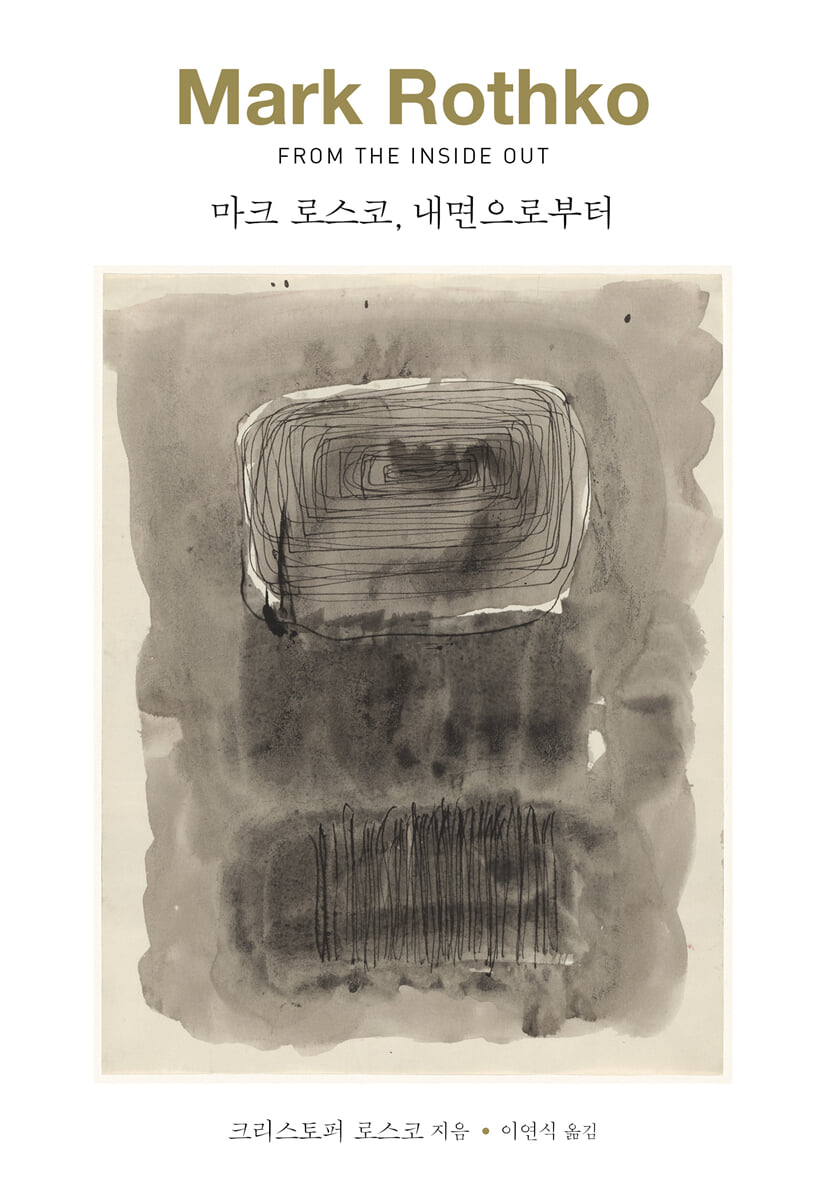 |
Description
Book Introduction
*Written by Christopher Rothko, the son and leading expert who has been planning Mark Rothko exhibitions for over 30 years!
*The popular exhibition “Correspondence: Lee Ufan and Mark Rothko” (Pace Gallery) includes 70 works, including previously unreleased major works!
“Mark Rothko’s work is a universe in itself.”
A philosopher on canvas who tried to convey the essence of humanity through painting.
The most complete and beautiful account of Mark Rothko.
The massive paintings of Mark Rothko, a master of color field abstraction, both overwhelm and confuse the viewer.
Are the intense reds and brilliant yellows expressions of joy? Do the black and gray canvases he painted before his suicide capture the artist's despair? Why did the artist paint only squares? Christopher Rothko, Mark Rothko's son and a lifelong explorer of his father's art, argues that any attempt to find meaning in color is futile.
Roscoe did not give meaning to the colors, and the rectangles in the canvas suggest that the painting is about 'you' who is looking at it.
Roscoe's paintings are not about 'something' in this world, but about 'everything' that exists inside you, and Rothko's color planes, which are translucent on the inside, are a window to the soul that allows you to look into your inner self.
The new book, Mark Rothko: From Within, is the most complete account of Mark Rothko's paintings and life, written by his son, Christopher Rothko, who has spent over 30 years managing his father's legacy, organizing exhibitions, and lecturing on his art world and how to appreciate his work.
The author, who lost his father at the age of six, has come to know Mark Rothko through his paintings for decades, with vague memories of him and an instinctive understanding and attachment to him.
This book is the culmination of the author's decades-long quest to understand his father, the great artist Mark Rothko.
This book explores the entirety of Mark Rothko's artistic world, from the 1920s and 1930s, when he depicted the bleak cityscapes and people of the Great Depression, to the surrealist period of the 1940s, which utilized mythological subjects, to the transitional period of 'multi-layered forms', and to the classicist period represented by 'color field abstraction', and discusses what Mark Rothko wanted to convey through his paintings.
At the same time, it reveals Mark Rothko, a great artist who 'painted the inexpressible', but also a human being who constantly doubted himself and sometimes showed a contradictory attitude.
*The popular exhibition “Correspondence: Lee Ufan and Mark Rothko” (Pace Gallery) includes 70 works, including previously unreleased major works!
“Mark Rothko’s work is a universe in itself.”
A philosopher on canvas who tried to convey the essence of humanity through painting.
The most complete and beautiful account of Mark Rothko.
The massive paintings of Mark Rothko, a master of color field abstraction, both overwhelm and confuse the viewer.
Are the intense reds and brilliant yellows expressions of joy? Do the black and gray canvases he painted before his suicide capture the artist's despair? Why did the artist paint only squares? Christopher Rothko, Mark Rothko's son and a lifelong explorer of his father's art, argues that any attempt to find meaning in color is futile.
Roscoe did not give meaning to the colors, and the rectangles in the canvas suggest that the painting is about 'you' who is looking at it.
Roscoe's paintings are not about 'something' in this world, but about 'everything' that exists inside you, and Rothko's color planes, which are translucent on the inside, are a window to the soul that allows you to look into your inner self.
The new book, Mark Rothko: From Within, is the most complete account of Mark Rothko's paintings and life, written by his son, Christopher Rothko, who has spent over 30 years managing his father's legacy, organizing exhibitions, and lecturing on his art world and how to appreciate his work.
The author, who lost his father at the age of six, has come to know Mark Rothko through his paintings for decades, with vague memories of him and an instinctive understanding and attachment to him.
This book is the culmination of the author's decades-long quest to understand his father, the great artist Mark Rothko.
This book explores the entirety of Mark Rothko's artistic world, from the 1920s and 1930s, when he depicted the bleak cityscapes and people of the Great Depression, to the surrealist period of the 1940s, which utilized mythological subjects, to the transitional period of 'multi-layered forms', and to the classicist period represented by 'color field abstraction', and discusses what Mark Rothko wanted to convey through his paintings.
At the same time, it reveals Mark Rothko, a great artist who 'painted the inexpressible', but also a human being who constantly doubted himself and sometimes showed a contradictory attitude.
- You can preview some of the book's contents.
Preview
index
Acknowledgements
prolog
Mark Rothko and the Inner World
This is not a refrigerator
The quiet dominance of form
The tyranny of size
The Artist's Reality: Mark Rothko's Crystal Ball
STACKED
Our Voices in the Silence of Roscoe Chapel
Seagram Murals Epics and Myths
Untitled
Mark Rothko and Music
Roscoe's humor
[Black and Gray] series
Outside the Paper Art Box
Van Gogh's Ear
Return to Dvinsk via Daugavpils
Ecstatic Mel
Mark Rothko and Christopher Rothko
Americas
index
List of images and sources
prolog
Mark Rothko and the Inner World
This is not a refrigerator
The quiet dominance of form
The tyranny of size
The Artist's Reality: Mark Rothko's Crystal Ball
STACKED
Our Voices in the Silence of Roscoe Chapel
Seagram Murals Epics and Myths
Untitled
Mark Rothko and Music
Roscoe's humor
[Black and Gray] series
Outside the Paper Art Box
Van Gogh's Ear
Return to Dvinsk via Daugavpils
Ecstatic Mel
Mark Rothko and Christopher Rothko
Americas
index
List of images and sources
Detailed image
.jpg)
Into the book
The journey to understanding Roscoe's paintings is ultimately a journey to understanding Roscoe.
This is because the work contains the entirety of Roscoe as a person.
However, conversely, historical, technical, and biographical knowledge about the human Roscoe does not help in understanding the painting.
In fact, approaching a work by focusing on what we know, or think we know, about its creator is the biggest obstacle to immersion in the work.
Ironically, this is precisely why your journey with Roscoe can ultimately be just as rewarding as mine, because the journey to understanding Roscoe is purely experiential.
'Knowledge' cannot tell us anything about Roscoe.
Because 'knowledge' will hold you back.
To have a conversation that awakens eternity, you must learn to speak Roscore.
---From the "Prologue"
Metaphors lead us from abstract to concrete images, and I like the metaphor of the window and find it a useful tool for appreciating a work of art.
But it is fundamentally a misunderstanding to view Roscoe's paintings as open windows.
Roscoe's paintings are not transparent, there is no light coming from another space, not even an outside.
The windows are closed and filled with the most sensual colors.
This is not a window that looks out, but a window that looks in.
Roscoe's Classical works capture our attention with their grand scale, confident declaration, and sensual allure, but they do not present landscapes.
Instead, it reflects the artist's inner world and returns to the audience the emotions and reactions they project onto the work.
These works are an invitation to turn our gaze inward rather than outward.
It's a kind of window to the soul, a place where you can look into your inner self better than anywhere else.
---From "Mark Rothko and the Inner World"
I believe that the content of Roscoe's work, or the 'truth' of the work, lies in the communication between the painting and the audience.
It could even be assumed that the suggestions or ideas expressed through colors, which are difficult to call a painting, have a specific meaning, that is, a personal meaning, only at the moment when the viewer and the painting interact.
Just as we may debate the same topic, even with the same arguments, but reach different conclusions depending on the person we are discussing, a painting (and ultimately the artist) engages in a unique dialogue with each individual viewer.
In Roscoe's work, a kind of chemical reaction, a primal communication before language, occurs between the artist and the audience through the medium of painting.
It's not that the painting is devoid of content; it conveys a lot of information, but communication only occurs when it meets the audience.
The audience brings their own content to interact with the painting, and meaning is created only when the content of the painting and the audience's content combine.
Paintings convey a universal and profound human language, but each viewer hears a different meaning through their own ears, a meaning that reflects their own inner world.
---From "Mark Rothko and the Inner World"
What makes Roscoe's paintings so evocative of existential dread is their simplicity and vast flatness, which suggest emptiness.
We often make fun of Roscoe's paintings by making them into nothing, into very ordinary objects, because nothing is so scary.
The idea that the painting is a blanket statement on the meaninglessness, the arbitrariness, the emptiness of life is deeply unsettling.
This is especially true if an art museum has deemed the work worthy of a prominent place in its exhibition hall.
Some audiences try desperately to fill that void with something of their own, while others simply slam the door.
But when we stare directly at the emptiness of Roscoe's paintings, their fullness becomes clearer.
There is no nihilistic element in any of his paintings, including his most monotonous late works.
These works are imbued with the human touch and spirit, and Roscoe makes this clear through the simple act of painting.
If you can feel it, you can more easily see that the painting is not empty, but actually suggests depth.
If we notice it, it becomes easier to say “it’s there” because the picture confirms “it’s here.”
This exercise, done while facing Roscoe's paintings, is actually an affirmation of the meaning of our existence, something we do on a daily basis in our lives.
When we stop frantically trying to fill our world with refrigerators and screen doors, TVs and sneakers, we realize that instead of filling the emptiness with something, we can become a part of something.
In reality, our existence creates something that exists.
To communicate with Roscoe's paintings is to feel the presence of something, to experience the essence of existence, that is, the essence of humanity.
Maybe it's not about seeing it, or saying it, or explaining it, but simply knowing that it's there.
This is a very abstract yet concrete process.
---From "This is not a refrigerator"
Roscoe's paintings, in different media and especially in different sizes, speak to the viewer in different ways.
Pictures of different sizes may not convey much of the same message, but the way they communicate can be quite different.
As we learn about other elements inherent in Roscoe's world, our understanding of scale will deepen as we spend time appreciating different types of work and learning their language.
A massive classical painting tells the viewer, “I am, in fact, human.
“If you join me, I will help you never forget all the reasons why you are human,” he says.
Smaller Classical paintings speak similarly, but the immersion into them is not as immediate.
But the massive late Roscoe paintings engage with the viewer in a slightly different way.
They say, "Are you really human? Look inside yourself and see what kind of person you are."
Whatever these later little pictures may evoke in us, it is unclear what kind of humanity they are pretending to be.
---From "The Tyranny of Size"
silence.
Both Feldman and Roscoe had a profound understanding of silence.
Silence, while existing in itself, reminds us of the absence of other beings.
True silence comes only when all noise ceases.
Then we can feel how rich that absence is, how much sound and music there is within us.
But it's so hard to hear that sound, and whenever we're interrupted from hearing it, we easily turn away.
This is why Roscoe Chapel is a gift to us, yet not everyone can embrace it.
Roscoe is dedicated to silence, creating silence, creating spaces that come to life only through silence.
That space offers a clarity that can only be found in silence, an opportunity to rethink everything within the context of experiences that are not fused with me.
The chapel enforces silence.
Just think how small our voices become the moment we enter the chapel.
If you stay in the chapel, accept the silence, and do not listen to the voice within, you will find nothing.
Before we can see anything, we must learn to listen or hear.
The chapel murals will show nothing until we find the fullness of silence.
This is by no means simple.
---From "Roscoe Chapel"
Roscoe believed that abstraction was the best means of capturing that which was difficult to describe or define, such as the concrete aspects of human experience.
Abstraction can be experienced as physical and sensory, as well as emotional and spiritual.
Music opens a path directly to an emotional level that precedes conscious thought.
Roscoe, through abstraction, sought to reach this realm, a realm that music reaches directly, a realm that can address the whole human being, inseparable from the various realms of the senses or ways of thinking.
When we fully immerse ourselves in a Roscoe painting, its impact is maximized, touching all our senses.
The viewer perceives the painting on a primal level, but if the viewer's visual receptors stop working, then the painting is not truly seen.
Like music, Roscoe's paintings offer a passage to the depths of the soul.
It evokes a visceral response, triggers emotions, captures the audience's heart, and provides something more valuable because it is recognizable to everyone.
It provides a human connection that is created at a primal level between artist and audience, and ultimately expands into a way of communicating with the world around us.
---From "Mark Rothko and Music"
The goals derived from his father's artistic philosophy are consistently evident throughout his work.
His desire to address the essence of human experience and to touch the core of emotion permeates all his work, from his earliest figurative drawings to the simplest abstractions.
These works reflect his understanding of human psychology and his perspective on the human condition, which he believed were essentially unchanging.
Society continues to change, and science and technology constantly "modernize" the world, but the core of human existence—being born, living, loving, working, and dying—remains constant.
Outward appearances may change, but this ultimate truth forms the basis of all experience and shapes our mental world, no matter how it appears in society.
Roscoe was interested in 'modernity' not as a 'particular time' but as a 'certain' modernity, that is, as a relative, communicable, real time frame that stands against eternity.
This is because the work contains the entirety of Roscoe as a person.
However, conversely, historical, technical, and biographical knowledge about the human Roscoe does not help in understanding the painting.
In fact, approaching a work by focusing on what we know, or think we know, about its creator is the biggest obstacle to immersion in the work.
Ironically, this is precisely why your journey with Roscoe can ultimately be just as rewarding as mine, because the journey to understanding Roscoe is purely experiential.
'Knowledge' cannot tell us anything about Roscoe.
Because 'knowledge' will hold you back.
To have a conversation that awakens eternity, you must learn to speak Roscore.
---From the "Prologue"
Metaphors lead us from abstract to concrete images, and I like the metaphor of the window and find it a useful tool for appreciating a work of art.
But it is fundamentally a misunderstanding to view Roscoe's paintings as open windows.
Roscoe's paintings are not transparent, there is no light coming from another space, not even an outside.
The windows are closed and filled with the most sensual colors.
This is not a window that looks out, but a window that looks in.
Roscoe's Classical works capture our attention with their grand scale, confident declaration, and sensual allure, but they do not present landscapes.
Instead, it reflects the artist's inner world and returns to the audience the emotions and reactions they project onto the work.
These works are an invitation to turn our gaze inward rather than outward.
It's a kind of window to the soul, a place where you can look into your inner self better than anywhere else.
---From "Mark Rothko and the Inner World"
I believe that the content of Roscoe's work, or the 'truth' of the work, lies in the communication between the painting and the audience.
It could even be assumed that the suggestions or ideas expressed through colors, which are difficult to call a painting, have a specific meaning, that is, a personal meaning, only at the moment when the viewer and the painting interact.
Just as we may debate the same topic, even with the same arguments, but reach different conclusions depending on the person we are discussing, a painting (and ultimately the artist) engages in a unique dialogue with each individual viewer.
In Roscoe's work, a kind of chemical reaction, a primal communication before language, occurs between the artist and the audience through the medium of painting.
It's not that the painting is devoid of content; it conveys a lot of information, but communication only occurs when it meets the audience.
The audience brings their own content to interact with the painting, and meaning is created only when the content of the painting and the audience's content combine.
Paintings convey a universal and profound human language, but each viewer hears a different meaning through their own ears, a meaning that reflects their own inner world.
---From "Mark Rothko and the Inner World"
What makes Roscoe's paintings so evocative of existential dread is their simplicity and vast flatness, which suggest emptiness.
We often make fun of Roscoe's paintings by making them into nothing, into very ordinary objects, because nothing is so scary.
The idea that the painting is a blanket statement on the meaninglessness, the arbitrariness, the emptiness of life is deeply unsettling.
This is especially true if an art museum has deemed the work worthy of a prominent place in its exhibition hall.
Some audiences try desperately to fill that void with something of their own, while others simply slam the door.
But when we stare directly at the emptiness of Roscoe's paintings, their fullness becomes clearer.
There is no nihilistic element in any of his paintings, including his most monotonous late works.
These works are imbued with the human touch and spirit, and Roscoe makes this clear through the simple act of painting.
If you can feel it, you can more easily see that the painting is not empty, but actually suggests depth.
If we notice it, it becomes easier to say “it’s there” because the picture confirms “it’s here.”
This exercise, done while facing Roscoe's paintings, is actually an affirmation of the meaning of our existence, something we do on a daily basis in our lives.
When we stop frantically trying to fill our world with refrigerators and screen doors, TVs and sneakers, we realize that instead of filling the emptiness with something, we can become a part of something.
In reality, our existence creates something that exists.
To communicate with Roscoe's paintings is to feel the presence of something, to experience the essence of existence, that is, the essence of humanity.
Maybe it's not about seeing it, or saying it, or explaining it, but simply knowing that it's there.
This is a very abstract yet concrete process.
---From "This is not a refrigerator"
Roscoe's paintings, in different media and especially in different sizes, speak to the viewer in different ways.
Pictures of different sizes may not convey much of the same message, but the way they communicate can be quite different.
As we learn about other elements inherent in Roscoe's world, our understanding of scale will deepen as we spend time appreciating different types of work and learning their language.
A massive classical painting tells the viewer, “I am, in fact, human.
“If you join me, I will help you never forget all the reasons why you are human,” he says.
Smaller Classical paintings speak similarly, but the immersion into them is not as immediate.
But the massive late Roscoe paintings engage with the viewer in a slightly different way.
They say, "Are you really human? Look inside yourself and see what kind of person you are."
Whatever these later little pictures may evoke in us, it is unclear what kind of humanity they are pretending to be.
---From "The Tyranny of Size"
silence.
Both Feldman and Roscoe had a profound understanding of silence.
Silence, while existing in itself, reminds us of the absence of other beings.
True silence comes only when all noise ceases.
Then we can feel how rich that absence is, how much sound and music there is within us.
But it's so hard to hear that sound, and whenever we're interrupted from hearing it, we easily turn away.
This is why Roscoe Chapel is a gift to us, yet not everyone can embrace it.
Roscoe is dedicated to silence, creating silence, creating spaces that come to life only through silence.
That space offers a clarity that can only be found in silence, an opportunity to rethink everything within the context of experiences that are not fused with me.
The chapel enforces silence.
Just think how small our voices become the moment we enter the chapel.
If you stay in the chapel, accept the silence, and do not listen to the voice within, you will find nothing.
Before we can see anything, we must learn to listen or hear.
The chapel murals will show nothing until we find the fullness of silence.
This is by no means simple.
---From "Roscoe Chapel"
Roscoe believed that abstraction was the best means of capturing that which was difficult to describe or define, such as the concrete aspects of human experience.
Abstraction can be experienced as physical and sensory, as well as emotional and spiritual.
Music opens a path directly to an emotional level that precedes conscious thought.
Roscoe, through abstraction, sought to reach this realm, a realm that music reaches directly, a realm that can address the whole human being, inseparable from the various realms of the senses or ways of thinking.
When we fully immerse ourselves in a Roscoe painting, its impact is maximized, touching all our senses.
The viewer perceives the painting on a primal level, but if the viewer's visual receptors stop working, then the painting is not truly seen.
Like music, Roscoe's paintings offer a passage to the depths of the soul.
It evokes a visceral response, triggers emotions, captures the audience's heart, and provides something more valuable because it is recognizable to everyone.
It provides a human connection that is created at a primal level between artist and audience, and ultimately expands into a way of communicating with the world around us.
---From "Mark Rothko and Music"
The goals derived from his father's artistic philosophy are consistently evident throughout his work.
His desire to address the essence of human experience and to touch the core of emotion permeates all his work, from his earliest figurative drawings to the simplest abstractions.
These works reflect his understanding of human psychology and his perspective on the human condition, which he believed were essentially unchanging.
Society continues to change, and science and technology constantly "modernize" the world, but the core of human existence—being born, living, loving, working, and dying—remains constant.
Outward appearances may change, but this ultimate truth forms the basis of all experience and shapes our mental world, no matter how it appears in society.
Roscoe was interested in 'modernity' not as a 'particular time' but as a 'certain' modernity, that is, as a relative, communicable, real time frame that stands against eternity.
---From "Mark Rothko and Christopher Rothko"
Publisher's Review
“Art is an adventure into the unknown,
“Only those who are willing to take risks can explore art.”
Exploring the inner unknown with Roscoe's paintings
Why did Roscoe fill his canvases with color? He didn't initially paint abstractly.
In the 1920s and 1930s, he was a realist painter who depicted people suffering from the Great Depression, and until the mid-1940s, he painted surrealist paintings based on mythological subjects.
However, what he wanted to convey through his paintings were universal human experiences and emotions such as “tragedy, ecstasy, and fate,” and realism and surrealism were merely means to convey this.
He realized that the shapes on his canvases—landscapes, figures, abstract forms—were all distracting from his goals.
People were only curious about what kind of real-world objects the 'images' he painted depicted, and were not interested in the universal experiences and emotions he was trying to convey.
He hoped that people would look at his paintings and reflect on their inner selves.
Because I believed that universal human emotions and experiences exist within everyone.
“I am not an abstractionist.
I'm not interested in color relationships or shapes or anything like that.
“I just wanted to express fundamental human emotions, things like tragedy, ecstasy, and destiny.”
Mark Rothko
He realized that only pure abstraction, which does not represent anything, can reach everyone equally and that the audience can appreciate it without any preconceived notions.
For him, abstraction was not a goal but a suitable tool of expression.
Roscoe erased all shapes and layered thin paint to create a color field that glowed from within, and with this “inner light,” he allowed the viewer to connect with the painting and look into their own inner self.
The audience who sheds tears in front of Roscoe's paintings has found emotion not in the paintings but in the unknown world within themselves.
Mark Rothko's color field abstractions have no meaning until someone looks at them.
The moment the painting connects with the viewer standing in front of it, the painting takes on a deeply personal yet universal meaning.
He believed that abstraction could be both nothing and everything to the viewer.
“A painting comes to life through companionship, and is expanded and energized by the gaze of a sensitive observer.
And for the same reason they die.”
Mark Rothko
“The journey to understand Roscoe’s paintings is the journey to understand Roscoe.
“Because the work contains the entirety of Roscoe as a person.”
About the ordinary people hidden behind great art
The author says that the painter Mark Rothko is always peeking out at the viewer from beyond his massive color field abstraction.
He was an artist who wanted to have a conversation with his audience about universal, timeless themes.
Rather than captivating the audience by drawing beautiful, eye-catching pictures, he was more interested in communicating with the audience and moving them through his paintings.
Roscoe, who became a painter because he wanted to make paintings as moving as music and poetry, was proud of the fact that viewers were moved to tears by his paintings.
Those who shed tears were communicating with the painting, discovering themselves in the painting, and Mark Rothko, the artist who painted the painting.
“Anyone who cries before my paintings is having the same religious experience I had when I painted them.”
Mark Rothko
Roscoe was thrilled and saddened by people's reactions, hoping that people would appreciate his paintings as he intended.
Rather than being an artist who flaunted his extraordinary talents, he was a human being who wanted to communicate with the public and be loved and respected.
He wanted his work to be displayed in the right way so that the audience could fully appreciate it, and he was always anxious when an exhibition opened.
However, as Roscoe became more famous, people began to misunderstand his artistic world by associating his words and actions with his work, and Roscoe expressed his hurt and frustration through harsh words and actions.
The author looks back on Roscoe's life to dispel the misunderstandings and prejudices surrounding him and his work.
The misunderstanding surrounding his suicide that reduces Rothko's paintings to symbols of 'despair' or 'depression', his second wife 'Mel' who gave Rothko artistic confidence, the Seagram mural incident that brought Rothko both deep frustration and a golden age, and the story of Jewish artist 'Marcus Lotkovich' (Mark Rothko's real name) who left Latvia at the age of ten and abandoned his Jewish name tell us exactly what kind of artist he was and how to appreciate his work.
Mark Rothko believed that all humans are ordinary, and that ordinary humans can create great art that transcends the ordinary, that transcends their imperfect existence.
Roscoe, who sought to capture universal human emotions, was also a very human person, and this was a condition for him to become a great artist.
The reason we love Mark Rothko today is probably because he, as an ordinary human being like us, left behind great art that transcended time.
“Only those who are willing to take risks can explore art.”
Exploring the inner unknown with Roscoe's paintings
Why did Roscoe fill his canvases with color? He didn't initially paint abstractly.
In the 1920s and 1930s, he was a realist painter who depicted people suffering from the Great Depression, and until the mid-1940s, he painted surrealist paintings based on mythological subjects.
However, what he wanted to convey through his paintings were universal human experiences and emotions such as “tragedy, ecstasy, and fate,” and realism and surrealism were merely means to convey this.
He realized that the shapes on his canvases—landscapes, figures, abstract forms—were all distracting from his goals.
People were only curious about what kind of real-world objects the 'images' he painted depicted, and were not interested in the universal experiences and emotions he was trying to convey.
He hoped that people would look at his paintings and reflect on their inner selves.
Because I believed that universal human emotions and experiences exist within everyone.
“I am not an abstractionist.
I'm not interested in color relationships or shapes or anything like that.
“I just wanted to express fundamental human emotions, things like tragedy, ecstasy, and destiny.”
Mark Rothko
He realized that only pure abstraction, which does not represent anything, can reach everyone equally and that the audience can appreciate it without any preconceived notions.
For him, abstraction was not a goal but a suitable tool of expression.
Roscoe erased all shapes and layered thin paint to create a color field that glowed from within, and with this “inner light,” he allowed the viewer to connect with the painting and look into their own inner self.
The audience who sheds tears in front of Roscoe's paintings has found emotion not in the paintings but in the unknown world within themselves.
Mark Rothko's color field abstractions have no meaning until someone looks at them.
The moment the painting connects with the viewer standing in front of it, the painting takes on a deeply personal yet universal meaning.
He believed that abstraction could be both nothing and everything to the viewer.
“A painting comes to life through companionship, and is expanded and energized by the gaze of a sensitive observer.
And for the same reason they die.”
Mark Rothko
“The journey to understand Roscoe’s paintings is the journey to understand Roscoe.
“Because the work contains the entirety of Roscoe as a person.”
About the ordinary people hidden behind great art
The author says that the painter Mark Rothko is always peeking out at the viewer from beyond his massive color field abstraction.
He was an artist who wanted to have a conversation with his audience about universal, timeless themes.
Rather than captivating the audience by drawing beautiful, eye-catching pictures, he was more interested in communicating with the audience and moving them through his paintings.
Roscoe, who became a painter because he wanted to make paintings as moving as music and poetry, was proud of the fact that viewers were moved to tears by his paintings.
Those who shed tears were communicating with the painting, discovering themselves in the painting, and Mark Rothko, the artist who painted the painting.
“Anyone who cries before my paintings is having the same religious experience I had when I painted them.”
Mark Rothko
Roscoe was thrilled and saddened by people's reactions, hoping that people would appreciate his paintings as he intended.
Rather than being an artist who flaunted his extraordinary talents, he was a human being who wanted to communicate with the public and be loved and respected.
He wanted his work to be displayed in the right way so that the audience could fully appreciate it, and he was always anxious when an exhibition opened.
However, as Roscoe became more famous, people began to misunderstand his artistic world by associating his words and actions with his work, and Roscoe expressed his hurt and frustration through harsh words and actions.
The author looks back on Roscoe's life to dispel the misunderstandings and prejudices surrounding him and his work.
The misunderstanding surrounding his suicide that reduces Rothko's paintings to symbols of 'despair' or 'depression', his second wife 'Mel' who gave Rothko artistic confidence, the Seagram mural incident that brought Rothko both deep frustration and a golden age, and the story of Jewish artist 'Marcus Lotkovich' (Mark Rothko's real name) who left Latvia at the age of ten and abandoned his Jewish name tell us exactly what kind of artist he was and how to appreciate his work.
Mark Rothko believed that all humans are ordinary, and that ordinary humans can create great art that transcends the ordinary, that transcends their imperfect existence.
Roscoe, who sought to capture universal human emotions, was also a very human person, and this was a condition for him to become a great artist.
The reason we love Mark Rothko today is probably because he, as an ordinary human being like us, left behind great art that transcended time.
GOODS SPECIFICS
- Date of issue: September 2, 2024
- Page count, weight, size: 512 pages | 876g | 148*215*30mm
- ISBN13: 9791167374615
- ISBN10: 1167374614
You may also like
카테고리
korean


korean

![GQ KOREA Mark (Monthly): December [2025]](http://librairie.coreenne.fr/cdn/shop/files/8ef265dbbfbf186523ed75ba7319009d.jpg?v=1765340328&width=3840)


