

Wow! I can clearly see the traditional Korean music.
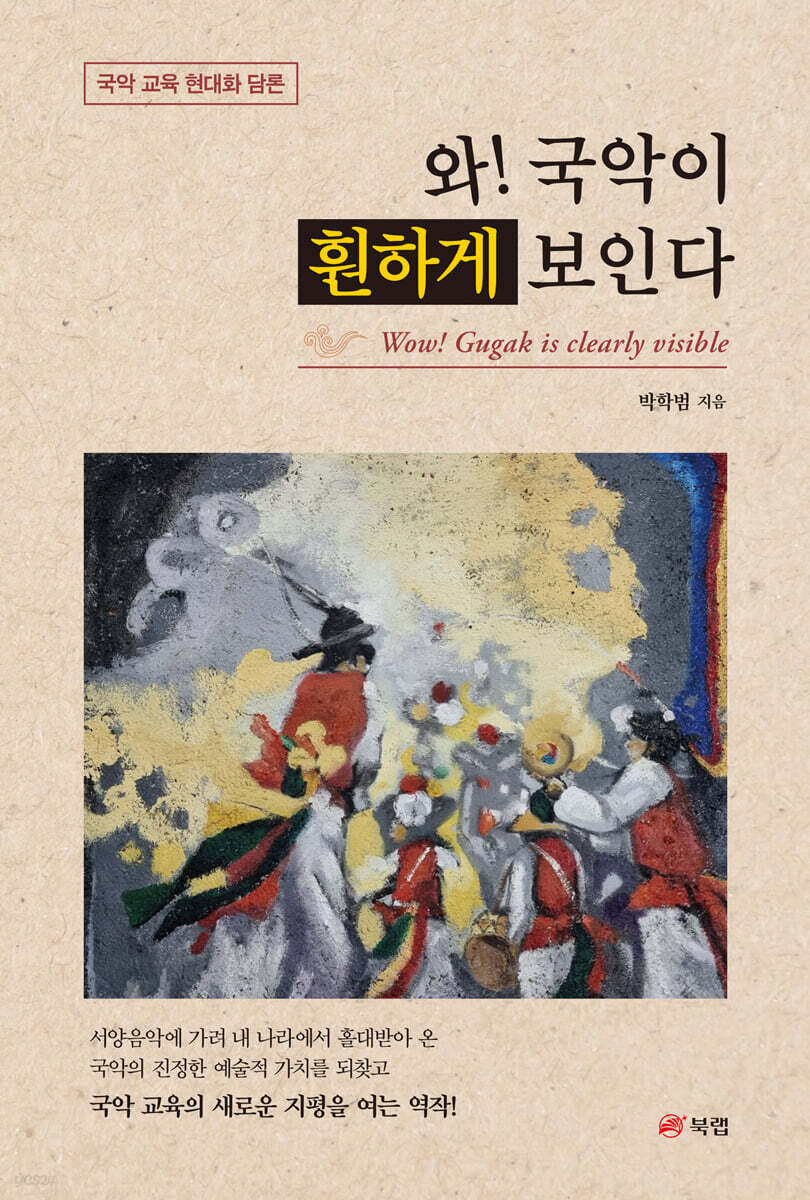 |
Description
Book Introduction
I have been neglected in my country because of Western music.
Restoring the true artistic value of Korean traditional music
A masterpiece that opens new horizons in Korean traditional music education!
Stop saying, “It’s difficult, I don’t know”
Korean traditional music that anyone can easily learn and enjoy
Enjoy the beauty of our music!
Written by a teacher with 40 years of experience, with a sense of calling
An Essential Guide to Modernizing Korean Traditional Music Education
This book is a discourse and guide to Korean traditional music education by an educator who taught music for 40 years and retired as an elementary school principal.
After attending lectures on Korean traditional music from several teachers, the author became skeptical of the school music education system, which was dominated by Western music.
From then on, I devoted myself to research on Korean traditional music education and compiled the results of that research into a book.
Until now, 'studying music' has mostly been considered as studying Western music.
This is because the theory of Western music has already been scientifically systematized to make it easy to 'learn'.
Relatively, traditional Korean music has been neglected in the educational field.
There must be a theoretical system for Korean traditional music, but the reality is that many educators have neglected to establish that system and have made excuses such as, “Korean traditional music is difficult,” “I don’t know what’s different about Korean traditional music,” and “There’s nothing to teach about Korean traditional music.”
The author believes that Korean traditional music, which embodies our soul and spirit, has a system comparable to the scientific theories of Western music, and has been researching the secrets hidden in Korean traditional music for decades.
All the theories of Korean traditional music that were explored to modernize Korean traditional music education were working wonderfully as elements that make up the beauty of our Korean traditional music.
This book will serve as an excellent guide and guide to Korean traditional music education for teachers who teach Korean traditional music in music education settings, as well as for all readers who love Korean traditional music.
Restoring the true artistic value of Korean traditional music
A masterpiece that opens new horizons in Korean traditional music education!
Stop saying, “It’s difficult, I don’t know”
Korean traditional music that anyone can easily learn and enjoy
Enjoy the beauty of our music!
Written by a teacher with 40 years of experience, with a sense of calling
An Essential Guide to Modernizing Korean Traditional Music Education
This book is a discourse and guide to Korean traditional music education by an educator who taught music for 40 years and retired as an elementary school principal.
After attending lectures on Korean traditional music from several teachers, the author became skeptical of the school music education system, which was dominated by Western music.
From then on, I devoted myself to research on Korean traditional music education and compiled the results of that research into a book.
Until now, 'studying music' has mostly been considered as studying Western music.
This is because the theory of Western music has already been scientifically systematized to make it easy to 'learn'.
Relatively, traditional Korean music has been neglected in the educational field.
There must be a theoretical system for Korean traditional music, but the reality is that many educators have neglected to establish that system and have made excuses such as, “Korean traditional music is difficult,” “I don’t know what’s different about Korean traditional music,” and “There’s nothing to teach about Korean traditional music.”
The author believes that Korean traditional music, which embodies our soul and spirit, has a system comparable to the scientific theories of Western music, and has been researching the secrets hidden in Korean traditional music for decades.
All the theories of Korean traditional music that were explored to modernize Korean traditional music education were working wonderfully as elements that make up the beauty of our Korean traditional music.
This book will serve as an excellent guide and guide to Korean traditional music education for teachers who teach Korean traditional music in music education settings, as well as for all readers who love Korean traditional music.
- You can preview some of the book's contents.
Preview
index
To begin with
Note
Part 1
Silence is not golden
1.
The Reality of Korean Traditional Music Education
Fact One: Art is a Love of Life | Fact Two: Our Voice | Fact Three: It Can't Be Done | Fact Four: Renaissance | Fact Five: Traditional Korean Music Has a Theory of Sound
2.
Korean traditional music education, the illusion
Illusion One: Ignorance of the Intellectuals | Illusion Two: The Establishment of a Nation in Poverty | Illusion Three: A Feast for the Blind | Illusion Four: Poverty of Diversity | Illusion Five: Difficult Theories | Illusion Six: Difficult Terms
3.
meter
Motivation 1: Short-form learning strategy | Motivation 2: Programmed appreciation learning strategy | Motivation 3: Special research teacher | Motivation 4: Professor Kim Young-woon | Motivation 5: Curiosity
4.
Silence is not golden
Courage | Upgrade Korean Traditional Music | Kodaly & Orff
5.
Kid's song
Three characteristics of children's songs | Words and songs learned naturally | Correct point | Let's call them 'children's songs' | Gugak, Korean music, traditional music, local music | Folk songs or songs | The origin of vocal art, children's songs | Characteristics of children's songs | Sky, Cheon, Tta Ji | Gomusin Taryeong | Theory of sound in our songs | A modern approach
6.
The Story of the Danso - A Four-Part, Four-Strand Instrument
Desperation and the Mastery of the Four-Note, Four-Strength Instrument | The Danso's Note System | Why Is Playing the Danso Difficult? | The Composure of Knowing How to Have Fun | Handholding Techniques | Can Western Music Be Played? | Is the Danso's Top Possible?
Part 2
Putting the 'rule' in its place
1.
The beautiful Korean word, 'Yul (律)'
Our Beautiful Word, Yul | Cultural Illusion | The Soft Melody, Yul | Music Education in Kindergarten | Find Yul
2.
'Mi', the sound of life
Aftertone | Introduction to the 5th note | Babbling is the fountain of song | The sound of a baby being lulled to sleep | Seo Taiji and Boys | The interval of the first note | Mom and Dad | A mother's love | The sound of life, 'Mi' | We are here too, 'Gaonda (C)'
3.
'Ra', the sound of consideration
The sound of the two-tone consonant | The sound of consideration, 'ra' | The concept of 'mi-ra' | The song of the gaze boat | The bald head
4.
'Do', the sound of completion
Childish? | Capsaicin | Tarutaru | 'Do', the sound of completion | Stem cell sound | From flexible thinking to scientific thinking | The process of discovery | The path to mastering pitch | Let's not neglect the sound of completion | Master singer Park Dong-jin | The sound of the organ | The resonance chamber of the unconscious
5.
It's important, 'Sol'
In children's songs | In adults' songs
6.
Let's do it together, 'Re'
In children's songs | In adults' songs
7.
A sound that seems to be absent but is there, 'poetry'
The sound of 'san' (生), the sound of 'si'
8.
The mystery of hidden sounds
Why? | When you die, you bear fruit | A precious being
9.
Let's give our sound a name
Why it should be so | Poor us | Justification | Profit or Justification?
Part 3
Jangdan - The Secret of the Dotted Quarter Note
1.
The Secret of the Dotted Quarter Note
triple rhythm | syncopation
2.
Take off Jinyangi's clothes
Jangdan | 'Jinyangi' is Jinyangjo | 'Kyeol-maetgo' | Changes in tempo are the current state of spirit | 'Jangdanggol' is leaving | Jangdanggol is a split rhythm (triple rhythm)
3.
Special Project, 5-note Festival
Pentatonic Scale Festival | A Brilliant Supporting Role | From the Song of Pungnyeon | From the Song of Hangangsu | Find the Clue | Soul and Hip-Hop, Also, the Emotion of "Han" | The Globalization of the Korean Wave
4.
The world of diversity
Gyeong tori | Yukjabaegi tori | Life sound, consideration sound, completion sound | Check it out | It's not even shown in the score | Three reasons why it trembles | Menari tori, 'me' is a mountain and 'nari' is a flower | Stem cell sound, here too | Stepping stone sound 'sol', take it | Let's do it together 're' | Two important characteristics | Two bonuses | A story about sigimsae and ornaments | What is sigimsae after all | A comparison of sigimsae and menari tori | Susimga tori | Examining the lyrics | 'si' must not be left out | Bridge sound ② 're' is also a stem cell sound | Consideration sound 'ra' trembles | Songs of Susimga tori | Other things to think about | 5-note structure
Part 4
Easy-to-understand flat and interface
1.
Pyeongjo and Gyeomyeonjo
Korean Traditional Music Scales as Seen in the Akhak Gwebeom (樂學軌範) | Korean Traditional Music Scales and Modes | Pitch & Tempo | Our Brand, Our Icon | Woojo | Break Free from Illusions | About Modes
2.
Kim Young-un, the messenger of the 'Gospel of Korean Traditional Music'
To avoid visual confusion | Distinguishing keys in folk songs | There are exceptions (1) | There are exceptions (2) | Pyeongjo and Gyeomyeonjo
3.
A few questions
The meaning of interface
4.
Nonsense
Growing up while fighting | There's a theory behind even forced arguments | From regular to irregular | From flat to level | From level to level | Judgment
5.
road sign
Find the Rule | Find the Road Sign | Precious Harvest | To the Odd One
6.
Transformation
National Children's Song | Transformation Taryeong | Attempt | Adding National Children's Song Lyrics to Pyeongjo | Adding National Children's Song Lyrics to Gye-myeonjo
7.
That's true (1) - The interface is different from the forging.
To the "Forgetful" Man | A Face Full of Curiosity | Scale | The Final Note Matters | Far From Being Sad, I'm So Happy | The Meaning of "Interface"
8.
That's true (2) - Let's call it 'interface love'
How about this opinion | This world is full of sorrow | Will it snow or rain | I wish it would be like this
Part 5
Korean Traditional Music Education Column
1.
Starting the series
2.
Korean Traditional Music Education, the Illusion (15): Unraveling Ornaments and Symbols
3.
Korean Traditional Music Education, the Illusion (31): (1×3), (1÷3)
4.
Korean Traditional Music Education, the Illusion (40): Breaking the Silence
5.
Concluding the series
In conclusion
References
Note
Part 1
Silence is not golden
1.
The Reality of Korean Traditional Music Education
Fact One: Art is a Love of Life | Fact Two: Our Voice | Fact Three: It Can't Be Done | Fact Four: Renaissance | Fact Five: Traditional Korean Music Has a Theory of Sound
2.
Korean traditional music education, the illusion
Illusion One: Ignorance of the Intellectuals | Illusion Two: The Establishment of a Nation in Poverty | Illusion Three: A Feast for the Blind | Illusion Four: Poverty of Diversity | Illusion Five: Difficult Theories | Illusion Six: Difficult Terms
3.
meter
Motivation 1: Short-form learning strategy | Motivation 2: Programmed appreciation learning strategy | Motivation 3: Special research teacher | Motivation 4: Professor Kim Young-woon | Motivation 5: Curiosity
4.
Silence is not golden
Courage | Upgrade Korean Traditional Music | Kodaly & Orff
5.
Kid's song
Three characteristics of children's songs | Words and songs learned naturally | Correct point | Let's call them 'children's songs' | Gugak, Korean music, traditional music, local music | Folk songs or songs | The origin of vocal art, children's songs | Characteristics of children's songs | Sky, Cheon, Tta Ji | Gomusin Taryeong | Theory of sound in our songs | A modern approach
6.
The Story of the Danso - A Four-Part, Four-Strand Instrument
Desperation and the Mastery of the Four-Note, Four-Strength Instrument | The Danso's Note System | Why Is Playing the Danso Difficult? | The Composure of Knowing How to Have Fun | Handholding Techniques | Can Western Music Be Played? | Is the Danso's Top Possible?
Part 2
Putting the 'rule' in its place
1.
The beautiful Korean word, 'Yul (律)'
Our Beautiful Word, Yul | Cultural Illusion | The Soft Melody, Yul | Music Education in Kindergarten | Find Yul
2.
'Mi', the sound of life
Aftertone | Introduction to the 5th note | Babbling is the fountain of song | The sound of a baby being lulled to sleep | Seo Taiji and Boys | The interval of the first note | Mom and Dad | A mother's love | The sound of life, 'Mi' | We are here too, 'Gaonda (C)'
3.
'Ra', the sound of consideration
The sound of the two-tone consonant | The sound of consideration, 'ra' | The concept of 'mi-ra' | The song of the gaze boat | The bald head
4.
'Do', the sound of completion
Childish? | Capsaicin | Tarutaru | 'Do', the sound of completion | Stem cell sound | From flexible thinking to scientific thinking | The process of discovery | The path to mastering pitch | Let's not neglect the sound of completion | Master singer Park Dong-jin | The sound of the organ | The resonance chamber of the unconscious
5.
It's important, 'Sol'
In children's songs | In adults' songs
6.
Let's do it together, 'Re'
In children's songs | In adults' songs
7.
A sound that seems to be absent but is there, 'poetry'
The sound of 'san' (生), the sound of 'si'
8.
The mystery of hidden sounds
Why? | When you die, you bear fruit | A precious being
9.
Let's give our sound a name
Why it should be so | Poor us | Justification | Profit or Justification?
Part 3
Jangdan - The Secret of the Dotted Quarter Note
1.
The Secret of the Dotted Quarter Note
triple rhythm | syncopation
2.
Take off Jinyangi's clothes
Jangdan | 'Jinyangi' is Jinyangjo | 'Kyeol-maetgo' | Changes in tempo are the current state of spirit | 'Jangdanggol' is leaving | Jangdanggol is a split rhythm (triple rhythm)
3.
Special Project, 5-note Festival
Pentatonic Scale Festival | A Brilliant Supporting Role | From the Song of Pungnyeon | From the Song of Hangangsu | Find the Clue | Soul and Hip-Hop, Also, the Emotion of "Han" | The Globalization of the Korean Wave
4.
The world of diversity
Gyeong tori | Yukjabaegi tori | Life sound, consideration sound, completion sound | Check it out | It's not even shown in the score | Three reasons why it trembles | Menari tori, 'me' is a mountain and 'nari' is a flower | Stem cell sound, here too | Stepping stone sound 'sol', take it | Let's do it together 're' | Two important characteristics | Two bonuses | A story about sigimsae and ornaments | What is sigimsae after all | A comparison of sigimsae and menari tori | Susimga tori | Examining the lyrics | 'si' must not be left out | Bridge sound ② 're' is also a stem cell sound | Consideration sound 'ra' trembles | Songs of Susimga tori | Other things to think about | 5-note structure
Part 4
Easy-to-understand flat and interface
1.
Pyeongjo and Gyeomyeonjo
Korean Traditional Music Scales as Seen in the Akhak Gwebeom (樂學軌範) | Korean Traditional Music Scales and Modes | Pitch & Tempo | Our Brand, Our Icon | Woojo | Break Free from Illusions | About Modes
2.
Kim Young-un, the messenger of the 'Gospel of Korean Traditional Music'
To avoid visual confusion | Distinguishing keys in folk songs | There are exceptions (1) | There are exceptions (2) | Pyeongjo and Gyeomyeonjo
3.
A few questions
The meaning of interface
4.
Nonsense
Growing up while fighting | There's a theory behind even forced arguments | From regular to irregular | From flat to level | From level to level | Judgment
5.
road sign
Find the Rule | Find the Road Sign | Precious Harvest | To the Odd One
6.
Transformation
National Children's Song | Transformation Taryeong | Attempt | Adding National Children's Song Lyrics to Pyeongjo | Adding National Children's Song Lyrics to Gye-myeonjo
7.
That's true (1) - The interface is different from the forging.
To the "Forgetful" Man | A Face Full of Curiosity | Scale | The Final Note Matters | Far From Being Sad, I'm So Happy | The Meaning of "Interface"
8.
That's true (2) - Let's call it 'interface love'
How about this opinion | This world is full of sorrow | Will it snow or rain | I wish it would be like this
Part 5
Korean Traditional Music Education Column
1.
Starting the series
2.
Korean Traditional Music Education, the Illusion (15): Unraveling Ornaments and Symbols
3.
Korean Traditional Music Education, the Illusion (31): (1×3), (1÷3)
4.
Korean Traditional Music Education, the Illusion (40): Breaking the Silence
5.
Concluding the series
In conclusion
References
Into the book
Korea's music art brand, 'Gugak', is a luxury product.
Luxury goods live up to their reputation in several aspects.
“It is an art form that contains a musical world imbued with soul, cherishes differentiated artistic value, and creates Korean people’s thoughts and emotions into a unique sound structure.”
That is why, even in the world of Western music that is pouring in like a flood, we have not lost our lives and have come this far.
And Korean traditional music is receiving praise from people around the world, and is recognized for its solid academic and artistic value that can extend to the world.
Why is that so? What is that substantive truth, and where can we find its identity?
The clue is not far away.
It just needs to find its place in Korean traditional music education.
--- p.28
There is one more unique aspect to Korean traditional vocal music.
I don't really like the 'si' sound of the Yangak Commandment.
It is a case of rejecting the handling of items.
So most people think that there is no 'si' note in our scale.
But this is a million words.
In short, the sound of 'si' clearly exists not only in traditional Korean music, but also in instrumental Korean music, and the same is true in traditional Korean music.
It survives in children's songs and also in adults' songs.
This sound is also alive in 'Yeongsanhoesan', a representative harmony of traditional Korean music.
--- p.191
How is it?
As a teacher who must consider the content (or 'subject') and methods to teach students in the field of Korean traditional music education, I believe it is necessary to actively seek out and explore these concerns.
In any case, the clear and definite fact is that the Korean dictionary's correspondence between the major and minor keys of Western music and the pyongjo and gyemyeonjo should be corrected.
As an elementary school teacher, I'm not in a position to convince people of my point, so I'm a bit disappointed, but I'm not worried.
If I can just make my thoughts known, and if there is even one person who agrees with me, that is enough.
Because I always keep in mind the law of nature that if you sow something, someone will eventually reap it.
Luxury goods live up to their reputation in several aspects.
“It is an art form that contains a musical world imbued with soul, cherishes differentiated artistic value, and creates Korean people’s thoughts and emotions into a unique sound structure.”
That is why, even in the world of Western music that is pouring in like a flood, we have not lost our lives and have come this far.
And Korean traditional music is receiving praise from people around the world, and is recognized for its solid academic and artistic value that can extend to the world.
Why is that so? What is that substantive truth, and where can we find its identity?
The clue is not far away.
It just needs to find its place in Korean traditional music education.
--- p.28
There is one more unique aspect to Korean traditional vocal music.
I don't really like the 'si' sound of the Yangak Commandment.
It is a case of rejecting the handling of items.
So most people think that there is no 'si' note in our scale.
But this is a million words.
In short, the sound of 'si' clearly exists not only in traditional Korean music, but also in instrumental Korean music, and the same is true in traditional Korean music.
It survives in children's songs and also in adults' songs.
This sound is also alive in 'Yeongsanhoesan', a representative harmony of traditional Korean music.
--- p.191
How is it?
As a teacher who must consider the content (or 'subject') and methods to teach students in the field of Korean traditional music education, I believe it is necessary to actively seek out and explore these concerns.
In any case, the clear and definite fact is that the Korean dictionary's correspondence between the major and minor keys of Western music and the pyongjo and gyemyeonjo should be corrected.
As an elementary school teacher, I'm not in a position to convince people of my point, so I'm a bit disappointed, but I'm not worried.
If I can just make my thoughts known, and if there is even one person who agrees with me, that is enough.
Because I always keep in mind the law of nature that if you sow something, someone will eventually reap it.
--- p.354
GOODS SPECIFICS
- Date of issue: August 5, 2024
- Page count, weight, size: 382 pages | 500g | 152*225*19mm
- ISBN13: 9791172241810
- ISBN10: 1172241813
You may also like
카테고리
korean


korean

![GQ KOREA Mark (Monthly): December [2025]](http://librairie.coreenne.fr/cdn/shop/files/8ef265dbbfbf186523ed75ba7319009d.jpg?v=1765340328&width=3840)


