

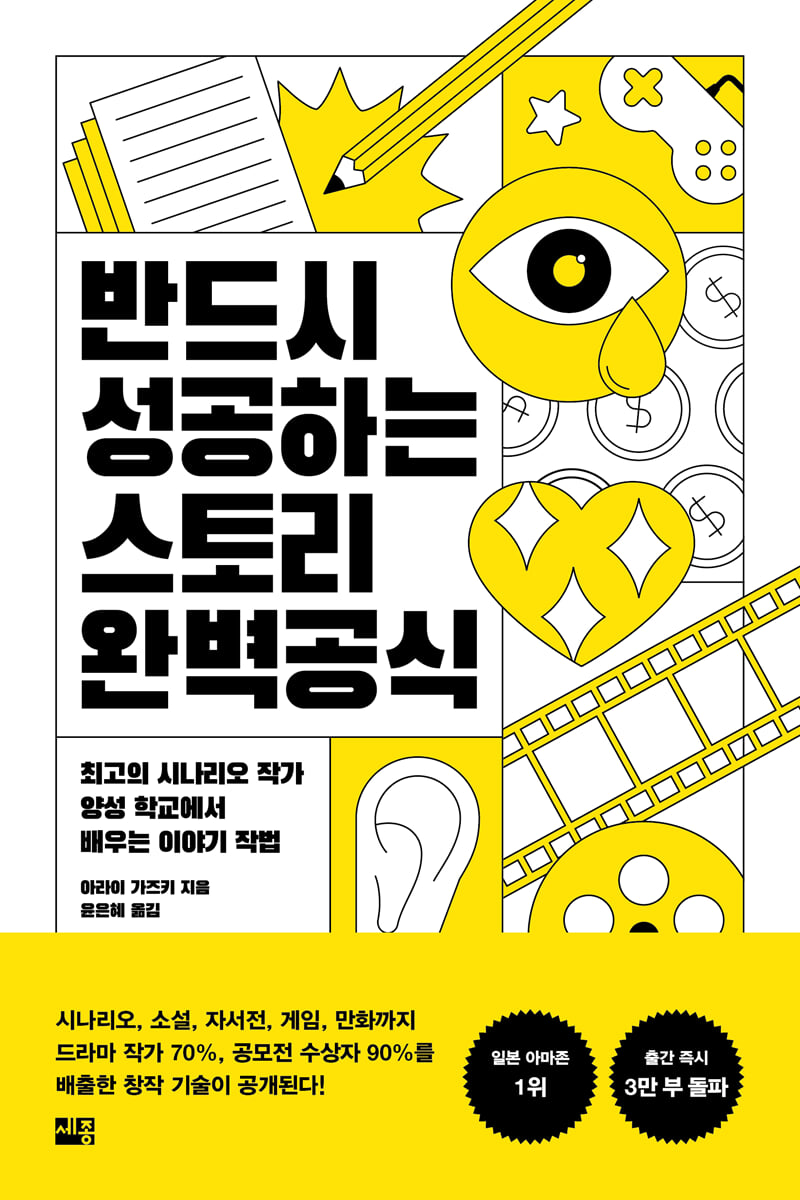
The Perfect Formula for a Successful Story
 |
Description
Book Introduction
#1 on Amazon Japan!
It sold over 30,000 copies immediately after publication!
From scenarios, novels, autobiographies, games, and even comics
The expressive skills needed to create all the stories in the world,
Anyone can learn it if they know the formula!
They say that in Japan, there is an academy that teaches storytelling like TOEIC.
This is the Scenario Center founded by Hajime Arai, who is called the "Father of Scenarios" and has written over 300 movie scenarios and 2,000 radio and TV drama scripts for Toho, Japan's largest film group.
This book encapsulates the creative techniques of the Scenario Center, which produces 70% of Japan's drama writers and 90% of contest winners.
Anyone who writes a story wonders, "Doesn't it take a complex, mysterious, genius-level ability to write a great story?"
However, the Scenario Center teaches that anyone can write a story that touches people's hearts if they know the formula for writing a story.
I just don't know how to think about what to do or how to do it properly to make the story interesting.
This book teaches you how to organize your creative ideas and refine them into stories.
It teaches you step-by-step how to find and develop compelling ideas, create a setting for your story, create compelling and vibrant characters, and create memorable scenes.
It also provides an easy-to-understand explanation of the structure of a story and how to create a story structure, which is a great help to creators who want to write a novel.
The core curriculum of the Scenario Center, boasting a 50-year tradition, has been condensed into a single volume so that even those who have never written a story can read it and follow it right away.
It's also packed with practical advice you can start with right away, including how to create a setting that you can start with even if you don't have a brilliant idea, how to structure a story that's both plausible and fun, how to establish points of appeal and resonance to create compelling characters, and how to use props to omit descriptive descriptions or dialogue.
Many of Japan's leading drama screenwriters, including Yoshikazu Okada, the screenwriter for the dramas "Now, I'll Meet You" and "Antique: An Antique Bakery," and Yoshiko Morishita, the screenwriter for "Crying Out Love, in the Center of the World," have graduated from the Scenario Center. Furthermore, Koji Suzuki, the author of the novel "Ring," which became a global phenomenon when made into a film, as well as writers responsible for the animation screenplays for "Sazae-san," "Doraemon," "One Piece," "Black Clover," and "Family of Spy" have also completed the center's lectures.
Anyone can create engaging stories by learning the core creative techniques taught by professional writers at the Scenario Center.
It sold over 30,000 copies immediately after publication!
From scenarios, novels, autobiographies, games, and even comics
The expressive skills needed to create all the stories in the world,
Anyone can learn it if they know the formula!
They say that in Japan, there is an academy that teaches storytelling like TOEIC.
This is the Scenario Center founded by Hajime Arai, who is called the "Father of Scenarios" and has written over 300 movie scenarios and 2,000 radio and TV drama scripts for Toho, Japan's largest film group.
This book encapsulates the creative techniques of the Scenario Center, which produces 70% of Japan's drama writers and 90% of contest winners.
Anyone who writes a story wonders, "Doesn't it take a complex, mysterious, genius-level ability to write a great story?"
However, the Scenario Center teaches that anyone can write a story that touches people's hearts if they know the formula for writing a story.
I just don't know how to think about what to do or how to do it properly to make the story interesting.
This book teaches you how to organize your creative ideas and refine them into stories.
It teaches you step-by-step how to find and develop compelling ideas, create a setting for your story, create compelling and vibrant characters, and create memorable scenes.
It also provides an easy-to-understand explanation of the structure of a story and how to create a story structure, which is a great help to creators who want to write a novel.
The core curriculum of the Scenario Center, boasting a 50-year tradition, has been condensed into a single volume so that even those who have never written a story can read it and follow it right away.
It's also packed with practical advice you can start with right away, including how to create a setting that you can start with even if you don't have a brilliant idea, how to structure a story that's both plausible and fun, how to establish points of appeal and resonance to create compelling characters, and how to use props to omit descriptive descriptions or dialogue.
Many of Japan's leading drama screenwriters, including Yoshikazu Okada, the screenwriter for the dramas "Now, I'll Meet You" and "Antique: An Antique Bakery," and Yoshiko Morishita, the screenwriter for "Crying Out Love, in the Center of the World," have graduated from the Scenario Center. Furthermore, Koji Suzuki, the author of the novel "Ring," which became a global phenomenon when made into a film, as well as writers responsible for the animation screenplays for "Sazae-san," "Doraemon," "One Piece," "Black Clover," and "Family of Spy" have also completed the center's lectures.
Anyone can create engaging stories by learning the core creative techniques taught by professional writers at the Scenario Center.
- You can preview some of the book's contents.
Preview
index
Starting off_The creative class for you begins
Get your hands on the map of the prologue's creation.
Creation is a question of what to write and how to write it.
Expressive techniques exist to portray humans.
Seven Problems That Occur When There Is No Creative Guidance
Chapter 1: Understanding the Form of a Story
The question of whether or not you have talent
Drama and story are different
What are the conditions for an interesting story?
Let's learn how to think properly
Let's draw a map of creation in our heads.
Chapter 2: Creating an Exciting Setting
Three components needed to set up a story
Theme: When the goal is clear, the story becomes clear.
Motif: Finding the Path to Your Goal
Material: Create new stories with colorful combinations.
Chapter 3: Creating Lively Characters
Audiences and readers want characters.
Once the characters are established, story creation becomes faster.
Audiences and readers empathize with compelling characters.
Let's give the characters some charm
How to Write a Proper Resume for a Character
Let's create human relationships between characters.
Let's classify and describe the characters.
Chapter 4: Let's structure the story logically.
If you want to break out of the mold, learn composition.
Let's structure the story with a beginning, development, turn, and conclusion.
How does the introduction, development, climax, and conclusion function in a story?
Create stories quickly and easily using the box composition method.
How to create a story using box composition
Let's create the attraction of the story from the beginning
Let's show the protagonist's desires and limitations in victory.
In the finale, let's put the protagonist in danger and leave a lingering impression.
Chapter 5: Let's Draw a Memorable Scene
What is the alternative scene?
Scene Condition 1: Does it depict a human being?
Dialogue creates character
Scene Condition 2: Are you curious about the next scene?
Scene Condition 3: Is it a picture?
Chapter 6: Let's Create by Taking Advantage of the Genre's Characteristics
For those who want to write a screenplay or novel
Tips for Writing Autobiographies and Essays
Tips for Writing Comic Stories
Tips for Writing Game Scenarios
In conclusion: Even after the creative writing class ends, your creative work continues.
Get your hands on the map of the prologue's creation.
Creation is a question of what to write and how to write it.
Expressive techniques exist to portray humans.
Seven Problems That Occur When There Is No Creative Guidance
Chapter 1: Understanding the Form of a Story
The question of whether or not you have talent
Drama and story are different
What are the conditions for an interesting story?
Let's learn how to think properly
Let's draw a map of creation in our heads.
Chapter 2: Creating an Exciting Setting
Three components needed to set up a story
Theme: When the goal is clear, the story becomes clear.
Motif: Finding the Path to Your Goal
Material: Create new stories with colorful combinations.
Chapter 3: Creating Lively Characters
Audiences and readers want characters.
Once the characters are established, story creation becomes faster.
Audiences and readers empathize with compelling characters.
Let's give the characters some charm
How to Write a Proper Resume for a Character
Let's create human relationships between characters.
Let's classify and describe the characters.
Chapter 4: Let's structure the story logically.
If you want to break out of the mold, learn composition.
Let's structure the story with a beginning, development, turn, and conclusion.
How does the introduction, development, climax, and conclusion function in a story?
Create stories quickly and easily using the box composition method.
How to create a story using box composition
Let's create the attraction of the story from the beginning
Let's show the protagonist's desires and limitations in victory.
In the finale, let's put the protagonist in danger and leave a lingering impression.
Chapter 5: Let's Draw a Memorable Scene
What is the alternative scene?
Scene Condition 1: Does it depict a human being?
Dialogue creates character
Scene Condition 2: Are you curious about the next scene?
Scene Condition 3: Is it a picture?
Chapter 6: Let's Create by Taking Advantage of the Genre's Characteristics
For those who want to write a screenplay or novel
Tips for Writing Autobiographies and Essays
Tips for Writing Comic Stories
Tips for Writing Game Scenarios
In conclusion: Even after the creative writing class ends, your creative work continues.
Detailed image
.jpg)
Into the book
As you create a story, you unconsciously think of the story.
At first, I was so enthusiastic about writing that I thought, "Wow, I'm a genius. This is definitely going to be a fun piece."
But at some point, the hand stops.
And I think this way.
'Oh, I feel like I've read this somewhere before.'
'What the heck, this is just a common plot twist.'
'Hey, I guess I have no talent after all.'
And then I stop creating.
It's not that I lack talent or ideas, it's just that my writing style is wrong.
--- p.44~45
If we express ideas in order from abstract to concrete, from large to medium to small, the first step in establishing the worldview corresponds to the outline of the story, so it corresponds to 'large'.
It can be said to be the most abstract.
The second step of establishing the characters and structuring the plot is 'middle' because it requires creating the flow of the story.
The third step of drawing a scene is 'small' because you have to think about every scene in the story.
This is the stage where you need to think of the most concrete idea.
--- p.65
Some people enjoy creating settings because they are constantly bombarded with ideas, while others struggle because they can't come up with ideas.
Opinions on the stage of thinking about the setting of a story are largely divided.
Whether you enjoy coming up with ideas or find them difficult, the root of your struggle is ultimately the same if you can't create a story setting based on your ideas.
Many people still believe that to write a story, you have to come up with a brilliant idea that no one has thought of before.
First of all, we need to get rid of that prejudice.
So how do we create a setting for a story? The answer is simple.
Setting up a story is a combination of three elements: theme, motif, and material.
--- p.79~80
When I went to give a lecture to a game production company before, I received a character setting chart of a game produced by that company as reference material in advance.
The setting table was very detailed and filled with text, but I couldn't even begin to figure out what kind of person the character was.
I understand the company's concerns about the discrepancies in character interpretation between the director and writer.
Creating a resume itself is not the problem.
The problem lies in how to write a resume.
That's why you need 'how to write a proper resume'.
The method is simple.
Just establish the character's central personality, charm, and relatability, and then connect all the elements to that.
--- p.137~138
Many people say that when writing a story, you should think about the structure first.
But there are definitely some people who think, 'I find composition a bit difficult.'
Even in training sessions conducted by game developers, I've heard participants say, "Because we focus so much on creative ideas, it's hard for us to think logically about the structure."
(…) In the creative process of creation, only the composition requires logical use of the head.
Once you understand structure, storytelling becomes 100 times easier than it is now.
Composition doesn't limit your creativity, it liberates it.
--- p.160~161
The box method is one way to organize the ideas in your head into a story.
When composing, using box composition allows you to see the overall flow of the story at a glance.
The box plot is very useful when writing a novel because it gives you an overall picture of the story.
It can be used not only in movies and dramas, but also in novels and comics.
--- p.179~180
A scenario is a visual representation.
Videos have time constraints.
The need to impress the audience or viewer within a limited time inevitably leads to the development of composition techniques.
Additionally, video has the unique property of allowing audience reactions to be measured over time.
As digitalization progresses, this trend has become even stronger.
The compositional techniques of a scenario are intended to intentionally move the hearts of the audience and viewers.
At first, I was so enthusiastic about writing that I thought, "Wow, I'm a genius. This is definitely going to be a fun piece."
But at some point, the hand stops.
And I think this way.
'Oh, I feel like I've read this somewhere before.'
'What the heck, this is just a common plot twist.'
'Hey, I guess I have no talent after all.'
And then I stop creating.
It's not that I lack talent or ideas, it's just that my writing style is wrong.
--- p.44~45
If we express ideas in order from abstract to concrete, from large to medium to small, the first step in establishing the worldview corresponds to the outline of the story, so it corresponds to 'large'.
It can be said to be the most abstract.
The second step of establishing the characters and structuring the plot is 'middle' because it requires creating the flow of the story.
The third step of drawing a scene is 'small' because you have to think about every scene in the story.
This is the stage where you need to think of the most concrete idea.
--- p.65
Some people enjoy creating settings because they are constantly bombarded with ideas, while others struggle because they can't come up with ideas.
Opinions on the stage of thinking about the setting of a story are largely divided.
Whether you enjoy coming up with ideas or find them difficult, the root of your struggle is ultimately the same if you can't create a story setting based on your ideas.
Many people still believe that to write a story, you have to come up with a brilliant idea that no one has thought of before.
First of all, we need to get rid of that prejudice.
So how do we create a setting for a story? The answer is simple.
Setting up a story is a combination of three elements: theme, motif, and material.
--- p.79~80
When I went to give a lecture to a game production company before, I received a character setting chart of a game produced by that company as reference material in advance.
The setting table was very detailed and filled with text, but I couldn't even begin to figure out what kind of person the character was.
I understand the company's concerns about the discrepancies in character interpretation between the director and writer.
Creating a resume itself is not the problem.
The problem lies in how to write a resume.
That's why you need 'how to write a proper resume'.
The method is simple.
Just establish the character's central personality, charm, and relatability, and then connect all the elements to that.
--- p.137~138
Many people say that when writing a story, you should think about the structure first.
But there are definitely some people who think, 'I find composition a bit difficult.'
Even in training sessions conducted by game developers, I've heard participants say, "Because we focus so much on creative ideas, it's hard for us to think logically about the structure."
(…) In the creative process of creation, only the composition requires logical use of the head.
Once you understand structure, storytelling becomes 100 times easier than it is now.
Composition doesn't limit your creativity, it liberates it.
--- p.160~161
The box method is one way to organize the ideas in your head into a story.
When composing, using box composition allows you to see the overall flow of the story at a glance.
The box plot is very useful when writing a novel because it gives you an overall picture of the story.
It can be used not only in movies and dramas, but also in novels and comics.
--- p.179~180
A scenario is a visual representation.
Videos have time constraints.
The need to impress the audience or viewer within a limited time inevitably leads to the development of composition techniques.
Additionally, video has the unique property of allowing audience reactions to be measured over time.
As digitalization progresses, this trend has become even stronger.
The compositional techniques of a scenario are intended to intentionally move the hearts of the audience and viewers.
--- p.276
Publisher's Review
How do storytelling professionals think and create stories?
70% of drama writers and 90% of contest winners are produced
Discover the creative techniques of the Scenario Center in one volume!
They say that in Japan, there is an academy that teaches storytelling like TOEIC.
This is the Scenario Center, founded in 1970 by Hajime Arai, who is called the “Father of Scenarios” and wrote over 300 movie scenarios and 2,000 radio and TV drama scripts for Toho, Japan’s largest film group.
The Scenario Center offers a variety of programs for anyone from beginners to experts who want to create stories, based on the scenario techniques systematized by Hajime Arai. It is also renowned as a writer training academy that has produced 70% of Japan's drama writers and 90% of contest winners.
This book encapsulates the creative techniques of the Screenplay Center, a world-renowned academy specializing in training writers.
When creating, everyone is bound to have concerns.
However, the concerns of amateurs and professionals are different.
Amateur creators waste unnecessary energy worrying about the details, such as how to lead the story, how to write the dialogue, and how much description to use.
Professional writers, on the other hand, focus solely on making stories interesting, and produce much more interesting stories with less effort.
The difference lies in 'how to write', that is, whether one properly understands the creative technique.
This book distills the essence of creative techniques into simple, easy-to-understand instructions, teaching creators how to develop vague ideas into concrete and engaging stories.
Everyone has talent! The only thing missing is creative skills.
Anyone can write stories like a pro if they know the creative map!
What if the setting and worldview are compelling, but the story itself feels bland? What if there are so many ideas that it's hard to grasp what's being said? What if the characters' actions are so repetitive that the story feels predictable, or if the constant back-and-forth leads to a "character breakdown"?
Even though I worked hard on it, there are times when I feel like it's not fun to read, or it's too much, or the story is vague.
When you're thinking about the story, it might feel like an interesting piece of work, but after writing it and reading it, it might feel like a common, cliche story that you've seen somewhere before.
It was clearly fun in my head, but why is the story I worked so hard to write so dull? Is it a lack of talent? The Scenario Center points out that the problem isn't talent, but a lack of understanding how to properly apply creative techniques where necessary.
This book divides the steps of creating a story into three major parts and introduces them step by step.
The first is the largest and most abstract stage that sets up the worldview of the story, the second is the intermediate stage that sets up the characters and organizes the structure of the entire story, and the third is the specific stage that depicts the scenes that the readers or audience directly encounters.
It introduces the entire creative process, from idea conception to storytelling and how to express it concretely.
The methods introduced in this book can be read and followed immediately.
If you can't come up with any original ideas, you can try combining the genre with the keyword "○○-mul" (mystery, historical, etc.), or use the "reverse thinking method" to turn tired ideas upside down.
If you have too many attributes you want to give your character, or conversely, you don't know where to start, you can highlight their individuality by creating them around three axes: "personality," "charm points," and "empathy."
When it's difficult to organize a story logically, use the 'box organization method' to organize the entire story flow so that you can see it at a glance.
It also details methods such as the 'image thinking method' that allows you to vividly imagine a scene, the 'indirect expression method' that conveys indirectly instead of directly, and the 'dialogue leap method' that allows you to break away from a list of predictable lines.
Movie scripts, drama scripts, novels, autobiographies, essays, comic book stories, game scenarios…
If you know the basics of storytelling, you can write an interesting story in any genre.
This book introduces how to create stories based on screenwriting techniques, but it can be equally applied to writing novels, autobiographies, essays, comic book stories, game scenarios, and more.
All the skills needed to create a story—finding and developing ideas, plotting a story, creating characters, composing scenes, writing dialogue—are essential, regardless of the genre you're creating.
The same goes for autobiographies and essays.
It's easy to think of autobiographies and essays as being similar to diaries, but ultimately, to be read by others, the story needs to be structured in an interesting way.
In order to convey my experiences in an appealing way, I need to establish the character of 'I' and select and convey specific scenes.
To achieve unity throughout the story, you also need the ability to set a theme and structure the story accordingly.
A comic story is similar to a scenario in that it is a video.
In the past, most of the work was done by the author alone, from story composition to animation, but in the recent comics market, there are many cases where the author who creates the story and the artist who draws the pictures are different, and the demand for comics stories has also increased.
When creating a comic story, it provides detailed information on which parts of the existing scenario writing method should be emphasized and which parts should be paid attention to.
Additionally, through the experience of a seminar for game scenario writers held at the Scenario Center, we will also provide detailed information on what game scenario writers should pay attention to.
This is a must-read for any creator of stories, regardless of genre.
A writer training academy with 54 years of tradition,
What is Scenario Center, Inc.?
A writer training academy founded in 1970 by Hajime Arai, known as the 'father of Japanese scenarios.'
Based on the "Basic Scenario Skills" systematized by Hajime Arai, we offer a variety of programs for story creators, from basic lectures for beginners to purpose-based and genre-specific lectures for experts.
Representative Japanese drama screenwriters James Miki and Makiko Uchidate, Yoshikazu Okada of "Now, I'm Going to Meet You" and "Antique: Western Antique Bakery," and Yoshiko Morishita of "Crying Out Love, in the Center of the World" have all passed through the Scenario Center.
It has also produced over 700 professional writers, including Koji Suzuki, the original author of the novel "Ring" which was made into a movie and became a worldwide sensation; Asako Yuzuki, who wrote the "Akko-chan" series which took Japan by storm and was nominated for the Naoki Prize three times; and Hika Harada, who won the grand prize at the NHK Original Radio Drama Script Contest.
70% of the full-length dramas broadcast in Japan are written by screenwriters who graduated from the Scenario Center, and 90% of the winners of scenario contests are from the Scenario Center.
We support all those who are interested in creating, and our corporate philosophy is “Until the day everyone writes a screenplay.”
https://www.scenario.co.jp
70% of drama writers and 90% of contest winners are produced
Discover the creative techniques of the Scenario Center in one volume!
They say that in Japan, there is an academy that teaches storytelling like TOEIC.
This is the Scenario Center, founded in 1970 by Hajime Arai, who is called the “Father of Scenarios” and wrote over 300 movie scenarios and 2,000 radio and TV drama scripts for Toho, Japan’s largest film group.
The Scenario Center offers a variety of programs for anyone from beginners to experts who want to create stories, based on the scenario techniques systematized by Hajime Arai. It is also renowned as a writer training academy that has produced 70% of Japan's drama writers and 90% of contest winners.
This book encapsulates the creative techniques of the Screenplay Center, a world-renowned academy specializing in training writers.
When creating, everyone is bound to have concerns.
However, the concerns of amateurs and professionals are different.
Amateur creators waste unnecessary energy worrying about the details, such as how to lead the story, how to write the dialogue, and how much description to use.
Professional writers, on the other hand, focus solely on making stories interesting, and produce much more interesting stories with less effort.
The difference lies in 'how to write', that is, whether one properly understands the creative technique.
This book distills the essence of creative techniques into simple, easy-to-understand instructions, teaching creators how to develop vague ideas into concrete and engaging stories.
Everyone has talent! The only thing missing is creative skills.
Anyone can write stories like a pro if they know the creative map!
What if the setting and worldview are compelling, but the story itself feels bland? What if there are so many ideas that it's hard to grasp what's being said? What if the characters' actions are so repetitive that the story feels predictable, or if the constant back-and-forth leads to a "character breakdown"?
Even though I worked hard on it, there are times when I feel like it's not fun to read, or it's too much, or the story is vague.
When you're thinking about the story, it might feel like an interesting piece of work, but after writing it and reading it, it might feel like a common, cliche story that you've seen somewhere before.
It was clearly fun in my head, but why is the story I worked so hard to write so dull? Is it a lack of talent? The Scenario Center points out that the problem isn't talent, but a lack of understanding how to properly apply creative techniques where necessary.
This book divides the steps of creating a story into three major parts and introduces them step by step.
The first is the largest and most abstract stage that sets up the worldview of the story, the second is the intermediate stage that sets up the characters and organizes the structure of the entire story, and the third is the specific stage that depicts the scenes that the readers or audience directly encounters.
It introduces the entire creative process, from idea conception to storytelling and how to express it concretely.
The methods introduced in this book can be read and followed immediately.
If you can't come up with any original ideas, you can try combining the genre with the keyword "○○-mul" (mystery, historical, etc.), or use the "reverse thinking method" to turn tired ideas upside down.
If you have too many attributes you want to give your character, or conversely, you don't know where to start, you can highlight their individuality by creating them around three axes: "personality," "charm points," and "empathy."
When it's difficult to organize a story logically, use the 'box organization method' to organize the entire story flow so that you can see it at a glance.
It also details methods such as the 'image thinking method' that allows you to vividly imagine a scene, the 'indirect expression method' that conveys indirectly instead of directly, and the 'dialogue leap method' that allows you to break away from a list of predictable lines.
Movie scripts, drama scripts, novels, autobiographies, essays, comic book stories, game scenarios…
If you know the basics of storytelling, you can write an interesting story in any genre.
This book introduces how to create stories based on screenwriting techniques, but it can be equally applied to writing novels, autobiographies, essays, comic book stories, game scenarios, and more.
All the skills needed to create a story—finding and developing ideas, plotting a story, creating characters, composing scenes, writing dialogue—are essential, regardless of the genre you're creating.
The same goes for autobiographies and essays.
It's easy to think of autobiographies and essays as being similar to diaries, but ultimately, to be read by others, the story needs to be structured in an interesting way.
In order to convey my experiences in an appealing way, I need to establish the character of 'I' and select and convey specific scenes.
To achieve unity throughout the story, you also need the ability to set a theme and structure the story accordingly.
A comic story is similar to a scenario in that it is a video.
In the past, most of the work was done by the author alone, from story composition to animation, but in the recent comics market, there are many cases where the author who creates the story and the artist who draws the pictures are different, and the demand for comics stories has also increased.
When creating a comic story, it provides detailed information on which parts of the existing scenario writing method should be emphasized and which parts should be paid attention to.
Additionally, through the experience of a seminar for game scenario writers held at the Scenario Center, we will also provide detailed information on what game scenario writers should pay attention to.
This is a must-read for any creator of stories, regardless of genre.
A writer training academy with 54 years of tradition,
What is Scenario Center, Inc.?
A writer training academy founded in 1970 by Hajime Arai, known as the 'father of Japanese scenarios.'
Based on the "Basic Scenario Skills" systematized by Hajime Arai, we offer a variety of programs for story creators, from basic lectures for beginners to purpose-based and genre-specific lectures for experts.
Representative Japanese drama screenwriters James Miki and Makiko Uchidate, Yoshikazu Okada of "Now, I'm Going to Meet You" and "Antique: Western Antique Bakery," and Yoshiko Morishita of "Crying Out Love, in the Center of the World" have all passed through the Scenario Center.
It has also produced over 700 professional writers, including Koji Suzuki, the original author of the novel "Ring" which was made into a movie and became a worldwide sensation; Asako Yuzuki, who wrote the "Akko-chan" series which took Japan by storm and was nominated for the Naoki Prize three times; and Hika Harada, who won the grand prize at the NHK Original Radio Drama Script Contest.
70% of the full-length dramas broadcast in Japan are written by screenwriters who graduated from the Scenario Center, and 90% of the winners of scenario contests are from the Scenario Center.
We support all those who are interested in creating, and our corporate philosophy is “Until the day everyone writes a screenplay.”
https://www.scenario.co.jp
GOODS SPECIFICS
- Date of issue: August 10, 2024
- Page count, weight, size: 304 pages | 414g | 140*210*20mm
- ISBN13: 9788984075047
- ISBN10: 8984075043
You may also like
카테고리
korean


korean

![GQ KOREA Mark (Monthly): December [2025]](http://librairie.coreenne.fr/cdn/shop/files/8ef265dbbfbf186523ed75ba7319009d.jpg?v=1765340328&width=3840)


