

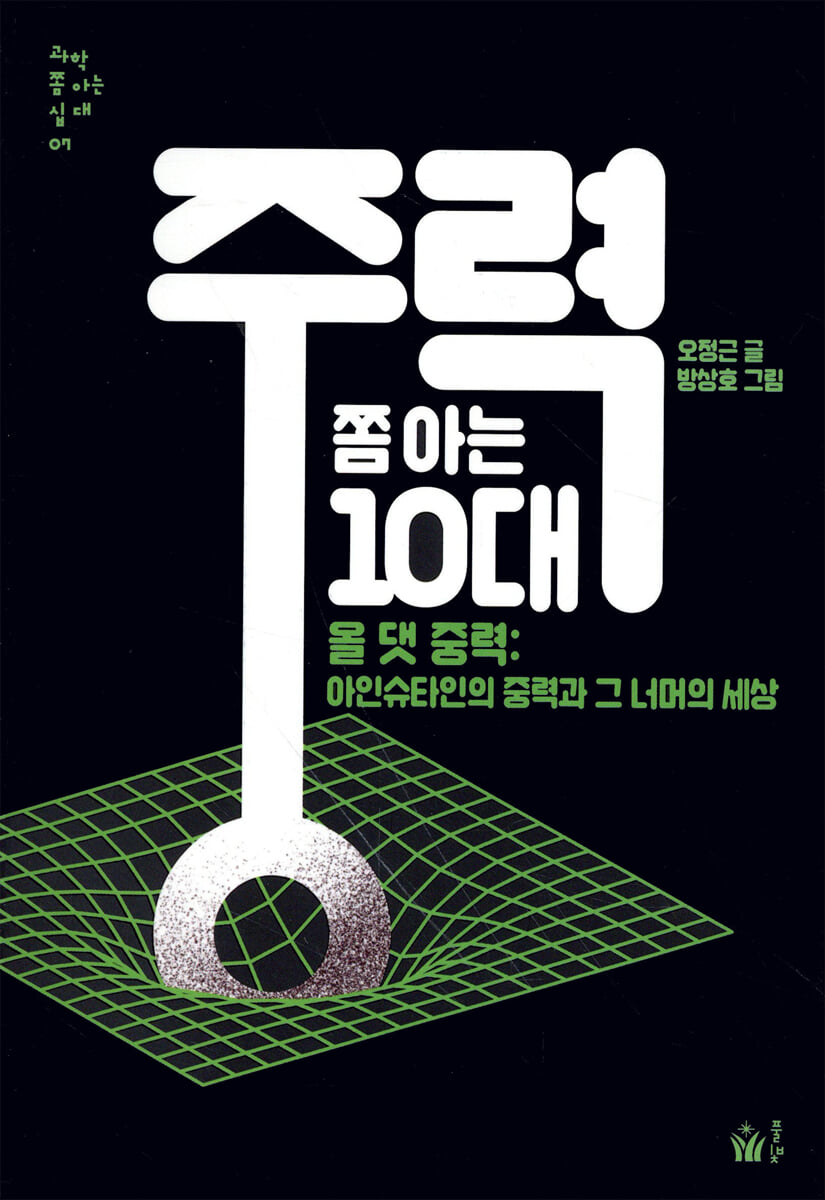
A teenager who knows a little about gravity
 |
Description
Book Introduction
Let's go further by riding gravity!
The seventh book in the Grass Light Youth Culture Science Series [Teenagers Who Know a Little About Science], 『Teenagers Who Know a Little About Gravity - All That Gravity: Einstein's Gravity and the World Beyond』 (hereafter referred to as 『Teenagers Who Know a Little About Gravity』), has been published.
Dr. Oh Jeong-geun, a scientist who writes to spread the knowledge and research results that can only be obtained in the laboratory to the public, has taken up his pen.
For the young man, who is now my nephew, but could soon become my successor, researching gravity with me and suggesting groundbreaking ideas, I armed myself with the kindness of bringing friendly illustrations and photographs of the latest research results, rather than the intensity with which I usually write papers.
The author delivers precise knowledge and empirical facts that would be difficult for anyone but an expert to grasp, yet he delivers them in such a captivating tone and style that it's hard to tell whether he's discussing science or simply telling a story. And as if light were being sucked into a black hole, readers will find themselves captivated by the author's charm—or rather, his magic—and unable to put the book down.
Through the previously published 『Big Bang for Teens』 and 『Elements for Teens』, we have learned about the principles of the birth of the universe and the elements that make up stars.
Next, we will learn about gravity, which attracts matter and creates planets like Earth, where we live, and makes our daily lives possible.
Some may ask why we need to learn gravity, which has been with us since birth and now seems to be one body.
However, as you follow in the footsteps of Einstein and the scholars who have studied gravity, deepen your knowledge of gravity, and witness cases where the impossible becomes reality without giving up, you will feel a surge of confidence that you can do it, rather than the feeling of defeat that whatever you do will never work out.
The 200-page book, "Teenagers Who Know a Little About Gravity," contains both past and present-day gravity.
From Newton's gravity, represented by an apple tree, to Einstein's gravity, explained as a net through the theory of general relativity, to the measurement of gravitational waves, which scientists joked would be impossible in this lifetime.
If we fill our heads with the endless details of gravity, we will begin to see that even black holes, with their powerful gravity that even the fastest light cannot escape, are not just scary entities, but also useful tools.
Now, as readers break down their prejudices about gravity one by one, they will feel the unexpected charm of gravity (gap moe) that they had not known before, and further, they will feel a pure interest in science and the 'joy of discovery' beyond the specific case of gravity.
The seventh book in the Grass Light Youth Culture Science Series [Teenagers Who Know a Little About Science], 『Teenagers Who Know a Little About Gravity - All That Gravity: Einstein's Gravity and the World Beyond』 (hereafter referred to as 『Teenagers Who Know a Little About Gravity』), has been published.
Dr. Oh Jeong-geun, a scientist who writes to spread the knowledge and research results that can only be obtained in the laboratory to the public, has taken up his pen.
For the young man, who is now my nephew, but could soon become my successor, researching gravity with me and suggesting groundbreaking ideas, I armed myself with the kindness of bringing friendly illustrations and photographs of the latest research results, rather than the intensity with which I usually write papers.
The author delivers precise knowledge and empirical facts that would be difficult for anyone but an expert to grasp, yet he delivers them in such a captivating tone and style that it's hard to tell whether he's discussing science or simply telling a story. And as if light were being sucked into a black hole, readers will find themselves captivated by the author's charm—or rather, his magic—and unable to put the book down.
Through the previously published 『Big Bang for Teens』 and 『Elements for Teens』, we have learned about the principles of the birth of the universe and the elements that make up stars.
Next, we will learn about gravity, which attracts matter and creates planets like Earth, where we live, and makes our daily lives possible.
Some may ask why we need to learn gravity, which has been with us since birth and now seems to be one body.
However, as you follow in the footsteps of Einstein and the scholars who have studied gravity, deepen your knowledge of gravity, and witness cases where the impossible becomes reality without giving up, you will feel a surge of confidence that you can do it, rather than the feeling of defeat that whatever you do will never work out.
The 200-page book, "Teenagers Who Know a Little About Gravity," contains both past and present-day gravity.
From Newton's gravity, represented by an apple tree, to Einstein's gravity, explained as a net through the theory of general relativity, to the measurement of gravitational waves, which scientists joked would be impossible in this lifetime.
If we fill our heads with the endless details of gravity, we will begin to see that even black holes, with their powerful gravity that even the fastest light cannot escape, are not just scary entities, but also useful tools.
Now, as readers break down their prejudices about gravity one by one, they will feel the unexpected charm of gravity (gap moe) that they had not known before, and further, they will feel a pure interest in science and the 'joy of discovery' beyond the specific case of gravity.
- You can preview some of the book's contents.
Preview
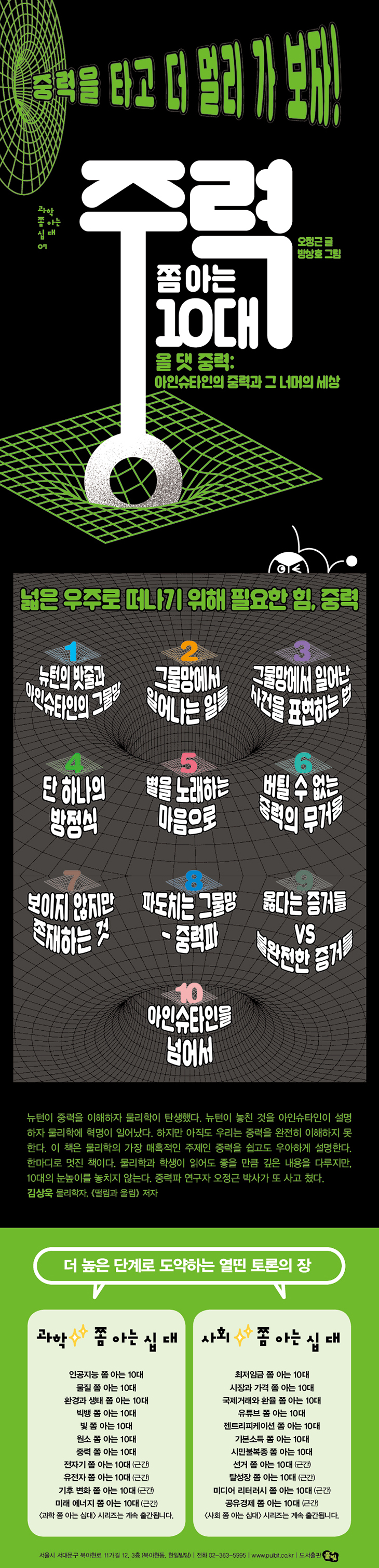
index
Warm-up to overcome gravity
Entering the Gravity Field - The Bread Cat Defeating Gravity
Chapter 1: Newton's Rope and Einstein's Net
Newton on Force and Motion | Objects Connected by Ropes |
Newton's swaying rope and Einstein's rising net | Follow the geodesic lines
Chapter 2: What Happens in the Net
Light's Path in 3D Space | Gravity as a Lens and Einstein's Rings | Breaking News: Mercury Declares Support for Einstein!!
Chapter 3: How to Express Events in a Network
Pythagorean Summoning! | Let's Use Vectors | Let's Measure the Shortest Distance on a Curved Surface
Chapter 4: A Single Equation
Tensors and Curvature | The Equivalence Principle and Inertial Reference Frames | Who Dare to Warp Spacetime?
Chapter 5 With a heart that sings of stars
A Starry Universe | A Tearful Effort to Understand the Universe | We Must Unite to Survive! | Stars, the Chemical Factory of the Universe
Chapter 6: The Unbearable Weight of Gravity
And it actually happened | The tragedy of a genius ahead of his time | Supernovas, neutron stars, and gravitational contraction
Chapter 7: What is invisible but exists
Light Spreads Out | Black Holes Spin Like Tops | Black Holes and Hawking Radiation | Black Hole Observations Finally Realized
Chapter 8: The Wave-Waving Net - Gravitational Waves
We did it! | Wanted: Gravitational Waves | A Different Kind of Gravitational Wave
Chapter 9: Proof vs. Incomplete Evidence
Einstein's Predictive Abilities Are Unparalleled in the Universe! | Light-Fast Gravitational Waves | The World of Singularities | You're Getting Farther Away
Chapter 10 Beyond Einstein
Why the Two Theories Must Join Hands | 1+1=? | The Continuous Evolution of Theory
Escaping the Gravity Field - How to Use Gravity
Entering the Gravity Field - The Bread Cat Defeating Gravity
Chapter 1: Newton's Rope and Einstein's Net
Newton on Force and Motion | Objects Connected by Ropes |
Newton's swaying rope and Einstein's rising net | Follow the geodesic lines
Chapter 2: What Happens in the Net
Light's Path in 3D Space | Gravity as a Lens and Einstein's Rings | Breaking News: Mercury Declares Support for Einstein!!
Chapter 3: How to Express Events in a Network
Pythagorean Summoning! | Let's Use Vectors | Let's Measure the Shortest Distance on a Curved Surface
Chapter 4: A Single Equation
Tensors and Curvature | The Equivalence Principle and Inertial Reference Frames | Who Dare to Warp Spacetime?
Chapter 5 With a heart that sings of stars
A Starry Universe | A Tearful Effort to Understand the Universe | We Must Unite to Survive! | Stars, the Chemical Factory of the Universe
Chapter 6: The Unbearable Weight of Gravity
And it actually happened | The tragedy of a genius ahead of his time | Supernovas, neutron stars, and gravitational contraction
Chapter 7: What is invisible but exists
Light Spreads Out | Black Holes Spin Like Tops | Black Holes and Hawking Radiation | Black Hole Observations Finally Realized
Chapter 8: The Wave-Waving Net - Gravitational Waves
We did it! | Wanted: Gravitational Waves | A Different Kind of Gravitational Wave
Chapter 9: Proof vs. Incomplete Evidence
Einstein's Predictive Abilities Are Unparalleled in the Universe! | Light-Fast Gravitational Waves | The World of Singularities | You're Getting Farther Away
Chapter 10 Beyond Einstein
Why the Two Theories Must Join Hands | 1+1=? | The Continuous Evolution of Theory
Escaping the Gravity Field - How to Use Gravity
Detailed image
Publisher's Review
From Newton's gravity to Einstein's gravity
“Gravity? Didn’t you discover that under the apple tree?”
I don't know if my memories are mixed up or if they're distorted from being so old, but it's time to leave these thoughts in the past and update them with newly discovered facts.
In addition to apple trees, Newton's theory of gravity, which states that objects are connected by invisible strings, has contributed greatly to the development of human civilization.
Newton's greatness in discovering the existence of gravity through the law of universal gravitation will remain in the history of science for a long time, but what is needed now that the stage of human activity has expanded from Earth to space is not Newton's gravity but Einstein's gravity.
“What is Newton’s gravity and what is Einstein’s gravity?”
It may seem like gravity is different for each discoverer, but the concept is actually the same.
The only difference is where it is applied.
Gravity on Earth, which was used as a concept of 'a force acting on an object with mass', could be sufficiently explained by Newton's gravity, which states that objects attract each other.
However, as technology developed, strange phenomena appeared in the observed universe, such as ① light that was thought to travel straight bending, ② the distance traveled increasing, so the arrival time was delayed, ③ the observed position of a star and its actual position were slightly different, ④ and the existence of black holes that even suck in light, etc., which could not be explained by Newtonian gravity, so a theory that could explain these logically and scientifically became necessary.
What appeared at this time was Einstein's gravity, which he explained by comparing gravity to a net rather than a rope.
After discovering that the universe is made up of a four-dimensional space-time structure consisting of one time and three spaces, Einstein believed that if an object with a large mass, such as the Earth or the Sun, were placed in this space-time, the space-time would be warped.
As questions are being answered one by one, such as light moving along the warped space-time and light coming from or reflected from stars being distorted and changing position, Einstein's gravity is now becoming the mainstream of the academic world.
“Wouldn’t it be possible for them to come up with this idea because they were originally smart?”
Einstein predicted all this 100 years ago.
It's just that I couldn't measure it.
『10 Things You Need to Know About Gravity』 contains the laughter and tears of countless scientists who have tried to interpret and understand the universe based on the theories predicted and established by Einstein.
Eddington, Schwarzschild, Hilbert, Grossmann, Chandrasekhar, and others did not understand and realize everything from the beginning. Just as you can't get full from the first drink, they were able to achieve their achievements only after much hard work.
The rising generation needs this kind of attitude of constant challenge and questioning. By observing those who never gave up, they can freely dream of the future and develop the imagination that they can change that future with their own hands.
An appetizer to truly savor the universe
Among other science books, there are some that use complex formulas to explain science, or simply list various phenomena without explanation that are difficult for young people to understand.
But 『Teenagers Who Know a Little About Gravity』 is different.
Although basic formulas and calculation methods appear in this book, they are only to the extent of confirming their existence and are by no means the main focus.
Above all, this book encourages young people who avoid science and lack interest in it because they view it as a difficult subject, by introducing in detail, at a level that is suitable for young people, the amazing and surprising phenomena that seem like they would only see in dreams, so that they do not find it difficult.
However, it aims to stimulate interest in space by including interesting illustrations and photos of celestial phenomena that are difficult to see on Earth, giving it the feel of an otherworldly exploration book that is popular among teenagers these days.
Gravity has always been with us.
All civilizations achieved by humans were built on the premise that gravity is always at work around us.
But as we begin to feel the need to fly into the sky and go into space, and realize that overcoming gravity and achieving it is not easy, we begin to wonder if gravity is not an obstacle that suppresses our freedom.
You might think, “If only there was no gravity,” but gravity can actually be more useful if used well.
GPS in car navigation systems or mobile phones inevitably experiences location distortion when receiving signal information from satellites.
The cause of the positional distortion is that the gravity experienced by a GPS satellite floating 20,000 meters above the ground is only about a quarter of that of the Earth, and if you think about the general theory of relativity, which states that time passes faster in places with lower gravity than in places with higher gravity, understanding the principle will be of great help in solving the problem.
This book encourages young people's desire for scientific exploration by providing them with a key to solving their curiosity through methods that clearly explain various phenomena related to gravity.
This book shows the efforts of scientists (chapters 4-5), such as explaining phenomena that cannot be explained by Newtonian gravity using Einsteinian gravity (chapters 1-3) and organizing and clarifying the formulas.
And in the process, after explaining the observed gravitational contraction phenomenon, supernova, neutron stars and black holes, and Hawking radiation (Chapters 6-7), gravitational waves were measured and black holes were photographed (Chapters 8-9), but just as Einstein's theory emerged to explain phenomena that could not be explained by Newton's theory, it shows that when phenomena that could not be explained by Einstein's theory were observed, a demand for a new theory arose (Chapter 10).
String theory could be an alternative, but it remains at a standstill, and the author emphasizes that he believes our youth will ultimately provide the answer to this problem.
Gravitational waves: Another tool for humanity with power comparable to light.
The fall of 2016 was a historic year for physics.
We have actually measured gravitational waves, a long-held dream.
Gravitational waves are the aftereffects of motion that occur when the mesh of space-time is shaken, and their existence was first mentioned 100 years ago when Einstein announced his theory of general relativity.
However, ① the technology to measure gravitational waves is lacking, ② they occur too far away, and ③ although gravitational waves pass by the Earth, their speed is comparable to the speed of light, so they have never been measured before. However, the LIGO Institute in the United States has achieved this.
Since the emergence of mankind on Earth, the only observational tool we have relied on to explore the universe beyond Earth has been light.
Although there have been dramatic advancements in the scope of observation since the introduction of the latest telescope technology, observation with the naked eye has not been able to move beyond the act of observing light that has flown through space.
For humanity, the discovery and measurement of gravitational waves means that another observational tool with performance comparable to that of light has been created.
In the past, we could not see the bones under the skin with our eyes, so we could not detect fractures or sprains in time, and in severe cases, the patient often died.
However, thanks to the discovery of X-rays, the impossible became possible to see inside the body without opening it up, and it played a huge role in the advancement of medicine, saving many lives.
The same goes for gravitational waves.
Until now, we have observed the universe by 'seeing' it with our eyes, but the discovery of gravitational waves means that we can now 'hear' celestial bodies such as black holes that are too far for light to reach or that absorb light and thus cannot be observed, and thus it means that humanity has gained momentum to leap into a new world, and it will be able to make a great contribution to the future development of physics and astronomy.
When you know and use gravity, imagination becomes reality!
In the manga "Dragon Ball," Son Goku and his rival Vegeta often enter an artificial gravity chamber that can control gravity to fight enemies, and through repeated training, they are shown rapidly increasing their fighting power in a short period of time.
Sigma, a hero in the online game [Overwatch], attacks enemies using the 'Gravity Collapse' technique, which controls gravity to lift the opponent into the air and then slam them down.
Of course, the actual implementation of such technology is a distant future, but is there any way to harness gravity in the present?
The September 2016 Gyeongju earthquake in North Gyeongsang Province was the most powerful earthquake in South Korea's seismic history, with a magnitude of 5.8, injuring dozens of people and causing enormous property damage.
Because our country was considered to be safe from earthquakes compared to other countries, we were not properly prepared, and the damage was exacerbated because the news of an earthquake was not quickly communicated to the public.
Since then, the system has been reorganized and a manual has been created, enabling faster information transmission during the 2017 Pohang earthquake, but research is being conducted to utilize gravitational waves for even faster transmission.
After an earthquake, the Earth's gravitational field is disturbed almost instantaneously. Unlike P-waves and S-waves, which travel at only 8 kilometers per second and 4 kilometers per second respectively, gravitational waves travel at a speed comparable to the speed of light, 300,000 kilometers per second. If we could build a system to detect earthquakes, we would be able to detect and prepare for them much sooner.
Gravitational waves also help us see the invisible.
For a long time, when humans observed something, it meant that their eyes observed the incoming light.
Since then, there have been technological advancements, such as the emergence of astronomical telescopes and the installation of the Hubble Space Telescope in space, but from the perspective of humanity, observation has not been able to escape the concept of confirming with the eyes.
Because of this, it was impossible to observe stars that were too far away for light to reach, or stars that were far behind celestial bodies that were incomparably large compared to the sun, or black holes that absorbed light and were invisible.
However, the concept of human observation has been greatly expanded since it became possible to measure gravitational waves created by the collision of black holes or neutron stars.
Gravity also gives us the force to extend to distant places.
Humanity has already realized swing-by technology, which uses Jupiter's gravity to increase the speed of a probe.
But what if we could harness the gravity of a black hole, vastly larger than Jupiter, to accelerate a spaceship through space? Wouldn't that shorten the travel time from Earth to distant celestial bodies? The reason we feel both awe and fear of black holes is that they possess such powerful gravity that they can suck in even light, making them invisible to the naked eye. If we were to accidentally enter a black hole, we would be inescapable, and if we were sucked inside, our bodies could be shattered.
However, recent research results show that black holes emit particles by experiencing Hawking radiation, and the Penrose process, which allows Dr. Brand to escape by obtaining energy from a black hole in the movie [Interstellar], has been proven, and various methods of utilizing black holes are being studied.
Harnessing gravity is no longer a dream.
Created to help our youth realize the practical application of gravity, "Teenagers Who Know a Little About Gravity" provides both courage and fun.
A place for heated scientific debate, leaping to the next level [Teenagers who know a little about science]
The '2015 Revised Curriculum' pursues an image of a human being who is independent, creative, and lives together.
Under this value system, we focus on strengthening basic literacy education in the humanities, social sciences, and science and technology, focusing on core concepts and principles for each subject, while also promoting integrated and convergent education across subjects.
In line with this educational trend of fostering future talent, Poolbit has planned a science series for youth that selects core concepts rather than focusing on the amount of knowledge, and clearly explains the principles behind them and how they can be applied.
A humanistic reflection that encourages questions and discussions on the three pillars of core, principle, and application is what middle school readers, field teachers, and parents want, and is the clear direction that the [Teenagers Who Know a Little About Science] series aims for in studying science.
The [Teenagers Who Know a Little About Science] series has shown an active effort to connect scientific knowledge to our lives, starting with the first book, “10 Things You Know About Artificial Intelligence,” which dissected the reality of artificial intelligence, a cutting-edge science and technology, in detail by connecting it to realistic problems that can easily arise, followed by the second book, “10 Things You Know About Materials,” which explores the essence of the world through elements that are full of various components and can be easily seen around us, and the third book, “10 Things You Know About Environment and Ecology,” which raises awareness of the environment through eight consumption patterns that we easily engage in in our daily lives.
After that, the 4th 『10 Things to Know About the Big Bang』, which covers the theory of the birth of the universe, the 5th 『10 Things to Know About Light』, which covers the world of light that contributed to the creation and development of civilization, and the 6th 『10 Things to Know About Elements』, which organizes the smallest units of matter representing the fields of earth science, physics, and chemistry, centered on elements, laid the foundation for introducing the basic knowledge necessary to understand the universe.
Now is the time to move on to the stage where you can utilize the knowledge you have gathered so far.
The book that shows the cause of new and unusual phenomena appearing in space is the 7th book, "10 Things You Need to Know About Gravity."
The upcoming books, 『10 Things You Should Know About Electromagnetism』, 『10 Things You Should Know About Genes』, 『10 Things You Should Know About Climate Change』, and 『10 Things You Should Know About Future Energy』, will delve into the most basic and core areas of natural science, namely physics, life science, and earth science.
From future-oriented real-world materials to core concepts that form the foundation of basic science, [Science for Teens] covers science from all angles.
We do not simply impart this knowledge to others.
We, who have experienced it, know better than anyone that such spoon-fed education no longer works, and we must not allow such things to happen again for the sake of the next generation, the youth.
What is needed now is understanding, not memorization.
This series features a three-dimensional approach where an uncle and aunt explain to their middle school-aged nephew what the principles of creation are, how they are applied, what unresolved scientific problems exist, what issues they raise, and ultimately how we should accept and interpret them.
[Science for Teens] is all about providing the friendliest and easiest explanations at the level of teenagers.
It has the charm of allowing readers to read it from beginning to end without losing their curiosity, with photographs that enrich the content and illustrations that delve into the core but are armed with wit.
I suggest keeping [Teenagers Who Know a Little About Science] by your side as a friend, as it is a book that has put a lot of effort into content and format for teenagers without missing even the smallest details.
“Gravity? Didn’t you discover that under the apple tree?”
I don't know if my memories are mixed up or if they're distorted from being so old, but it's time to leave these thoughts in the past and update them with newly discovered facts.
In addition to apple trees, Newton's theory of gravity, which states that objects are connected by invisible strings, has contributed greatly to the development of human civilization.
Newton's greatness in discovering the existence of gravity through the law of universal gravitation will remain in the history of science for a long time, but what is needed now that the stage of human activity has expanded from Earth to space is not Newton's gravity but Einstein's gravity.
“What is Newton’s gravity and what is Einstein’s gravity?”
It may seem like gravity is different for each discoverer, but the concept is actually the same.
The only difference is where it is applied.
Gravity on Earth, which was used as a concept of 'a force acting on an object with mass', could be sufficiently explained by Newton's gravity, which states that objects attract each other.
However, as technology developed, strange phenomena appeared in the observed universe, such as ① light that was thought to travel straight bending, ② the distance traveled increasing, so the arrival time was delayed, ③ the observed position of a star and its actual position were slightly different, ④ and the existence of black holes that even suck in light, etc., which could not be explained by Newtonian gravity, so a theory that could explain these logically and scientifically became necessary.
What appeared at this time was Einstein's gravity, which he explained by comparing gravity to a net rather than a rope.
After discovering that the universe is made up of a four-dimensional space-time structure consisting of one time and three spaces, Einstein believed that if an object with a large mass, such as the Earth or the Sun, were placed in this space-time, the space-time would be warped.
As questions are being answered one by one, such as light moving along the warped space-time and light coming from or reflected from stars being distorted and changing position, Einstein's gravity is now becoming the mainstream of the academic world.
“Wouldn’t it be possible for them to come up with this idea because they were originally smart?”
Einstein predicted all this 100 years ago.
It's just that I couldn't measure it.
『10 Things You Need to Know About Gravity』 contains the laughter and tears of countless scientists who have tried to interpret and understand the universe based on the theories predicted and established by Einstein.
Eddington, Schwarzschild, Hilbert, Grossmann, Chandrasekhar, and others did not understand and realize everything from the beginning. Just as you can't get full from the first drink, they were able to achieve their achievements only after much hard work.
The rising generation needs this kind of attitude of constant challenge and questioning. By observing those who never gave up, they can freely dream of the future and develop the imagination that they can change that future with their own hands.
An appetizer to truly savor the universe
Among other science books, there are some that use complex formulas to explain science, or simply list various phenomena without explanation that are difficult for young people to understand.
But 『Teenagers Who Know a Little About Gravity』 is different.
Although basic formulas and calculation methods appear in this book, they are only to the extent of confirming their existence and are by no means the main focus.
Above all, this book encourages young people who avoid science and lack interest in it because they view it as a difficult subject, by introducing in detail, at a level that is suitable for young people, the amazing and surprising phenomena that seem like they would only see in dreams, so that they do not find it difficult.
However, it aims to stimulate interest in space by including interesting illustrations and photos of celestial phenomena that are difficult to see on Earth, giving it the feel of an otherworldly exploration book that is popular among teenagers these days.
Gravity has always been with us.
All civilizations achieved by humans were built on the premise that gravity is always at work around us.
But as we begin to feel the need to fly into the sky and go into space, and realize that overcoming gravity and achieving it is not easy, we begin to wonder if gravity is not an obstacle that suppresses our freedom.
You might think, “If only there was no gravity,” but gravity can actually be more useful if used well.
GPS in car navigation systems or mobile phones inevitably experiences location distortion when receiving signal information from satellites.
The cause of the positional distortion is that the gravity experienced by a GPS satellite floating 20,000 meters above the ground is only about a quarter of that of the Earth, and if you think about the general theory of relativity, which states that time passes faster in places with lower gravity than in places with higher gravity, understanding the principle will be of great help in solving the problem.
This book encourages young people's desire for scientific exploration by providing them with a key to solving their curiosity through methods that clearly explain various phenomena related to gravity.
This book shows the efforts of scientists (chapters 4-5), such as explaining phenomena that cannot be explained by Newtonian gravity using Einsteinian gravity (chapters 1-3) and organizing and clarifying the formulas.
And in the process, after explaining the observed gravitational contraction phenomenon, supernova, neutron stars and black holes, and Hawking radiation (Chapters 6-7), gravitational waves were measured and black holes were photographed (Chapters 8-9), but just as Einstein's theory emerged to explain phenomena that could not be explained by Newton's theory, it shows that when phenomena that could not be explained by Einstein's theory were observed, a demand for a new theory arose (Chapter 10).
String theory could be an alternative, but it remains at a standstill, and the author emphasizes that he believes our youth will ultimately provide the answer to this problem.
Gravitational waves: Another tool for humanity with power comparable to light.
The fall of 2016 was a historic year for physics.
We have actually measured gravitational waves, a long-held dream.
Gravitational waves are the aftereffects of motion that occur when the mesh of space-time is shaken, and their existence was first mentioned 100 years ago when Einstein announced his theory of general relativity.
However, ① the technology to measure gravitational waves is lacking, ② they occur too far away, and ③ although gravitational waves pass by the Earth, their speed is comparable to the speed of light, so they have never been measured before. However, the LIGO Institute in the United States has achieved this.
Since the emergence of mankind on Earth, the only observational tool we have relied on to explore the universe beyond Earth has been light.
Although there have been dramatic advancements in the scope of observation since the introduction of the latest telescope technology, observation with the naked eye has not been able to move beyond the act of observing light that has flown through space.
For humanity, the discovery and measurement of gravitational waves means that another observational tool with performance comparable to that of light has been created.
In the past, we could not see the bones under the skin with our eyes, so we could not detect fractures or sprains in time, and in severe cases, the patient often died.
However, thanks to the discovery of X-rays, the impossible became possible to see inside the body without opening it up, and it played a huge role in the advancement of medicine, saving many lives.
The same goes for gravitational waves.
Until now, we have observed the universe by 'seeing' it with our eyes, but the discovery of gravitational waves means that we can now 'hear' celestial bodies such as black holes that are too far for light to reach or that absorb light and thus cannot be observed, and thus it means that humanity has gained momentum to leap into a new world, and it will be able to make a great contribution to the future development of physics and astronomy.
When you know and use gravity, imagination becomes reality!
In the manga "Dragon Ball," Son Goku and his rival Vegeta often enter an artificial gravity chamber that can control gravity to fight enemies, and through repeated training, they are shown rapidly increasing their fighting power in a short period of time.
Sigma, a hero in the online game [Overwatch], attacks enemies using the 'Gravity Collapse' technique, which controls gravity to lift the opponent into the air and then slam them down.
Of course, the actual implementation of such technology is a distant future, but is there any way to harness gravity in the present?
The September 2016 Gyeongju earthquake in North Gyeongsang Province was the most powerful earthquake in South Korea's seismic history, with a magnitude of 5.8, injuring dozens of people and causing enormous property damage.
Because our country was considered to be safe from earthquakes compared to other countries, we were not properly prepared, and the damage was exacerbated because the news of an earthquake was not quickly communicated to the public.
Since then, the system has been reorganized and a manual has been created, enabling faster information transmission during the 2017 Pohang earthquake, but research is being conducted to utilize gravitational waves for even faster transmission.
After an earthquake, the Earth's gravitational field is disturbed almost instantaneously. Unlike P-waves and S-waves, which travel at only 8 kilometers per second and 4 kilometers per second respectively, gravitational waves travel at a speed comparable to the speed of light, 300,000 kilometers per second. If we could build a system to detect earthquakes, we would be able to detect and prepare for them much sooner.
Gravitational waves also help us see the invisible.
For a long time, when humans observed something, it meant that their eyes observed the incoming light.
Since then, there have been technological advancements, such as the emergence of astronomical telescopes and the installation of the Hubble Space Telescope in space, but from the perspective of humanity, observation has not been able to escape the concept of confirming with the eyes.
Because of this, it was impossible to observe stars that were too far away for light to reach, or stars that were far behind celestial bodies that were incomparably large compared to the sun, or black holes that absorbed light and were invisible.
However, the concept of human observation has been greatly expanded since it became possible to measure gravitational waves created by the collision of black holes or neutron stars.
Gravity also gives us the force to extend to distant places.
Humanity has already realized swing-by technology, which uses Jupiter's gravity to increase the speed of a probe.
But what if we could harness the gravity of a black hole, vastly larger than Jupiter, to accelerate a spaceship through space? Wouldn't that shorten the travel time from Earth to distant celestial bodies? The reason we feel both awe and fear of black holes is that they possess such powerful gravity that they can suck in even light, making them invisible to the naked eye. If we were to accidentally enter a black hole, we would be inescapable, and if we were sucked inside, our bodies could be shattered.
However, recent research results show that black holes emit particles by experiencing Hawking radiation, and the Penrose process, which allows Dr. Brand to escape by obtaining energy from a black hole in the movie [Interstellar], has been proven, and various methods of utilizing black holes are being studied.
Harnessing gravity is no longer a dream.
Created to help our youth realize the practical application of gravity, "Teenagers Who Know a Little About Gravity" provides both courage and fun.
A place for heated scientific debate, leaping to the next level [Teenagers who know a little about science]
The '2015 Revised Curriculum' pursues an image of a human being who is independent, creative, and lives together.
Under this value system, we focus on strengthening basic literacy education in the humanities, social sciences, and science and technology, focusing on core concepts and principles for each subject, while also promoting integrated and convergent education across subjects.
In line with this educational trend of fostering future talent, Poolbit has planned a science series for youth that selects core concepts rather than focusing on the amount of knowledge, and clearly explains the principles behind them and how they can be applied.
A humanistic reflection that encourages questions and discussions on the three pillars of core, principle, and application is what middle school readers, field teachers, and parents want, and is the clear direction that the [Teenagers Who Know a Little About Science] series aims for in studying science.
The [Teenagers Who Know a Little About Science] series has shown an active effort to connect scientific knowledge to our lives, starting with the first book, “10 Things You Know About Artificial Intelligence,” which dissected the reality of artificial intelligence, a cutting-edge science and technology, in detail by connecting it to realistic problems that can easily arise, followed by the second book, “10 Things You Know About Materials,” which explores the essence of the world through elements that are full of various components and can be easily seen around us, and the third book, “10 Things You Know About Environment and Ecology,” which raises awareness of the environment through eight consumption patterns that we easily engage in in our daily lives.
After that, the 4th 『10 Things to Know About the Big Bang』, which covers the theory of the birth of the universe, the 5th 『10 Things to Know About Light』, which covers the world of light that contributed to the creation and development of civilization, and the 6th 『10 Things to Know About Elements』, which organizes the smallest units of matter representing the fields of earth science, physics, and chemistry, centered on elements, laid the foundation for introducing the basic knowledge necessary to understand the universe.
Now is the time to move on to the stage where you can utilize the knowledge you have gathered so far.
The book that shows the cause of new and unusual phenomena appearing in space is the 7th book, "10 Things You Need to Know About Gravity."
The upcoming books, 『10 Things You Should Know About Electromagnetism』, 『10 Things You Should Know About Genes』, 『10 Things You Should Know About Climate Change』, and 『10 Things You Should Know About Future Energy』, will delve into the most basic and core areas of natural science, namely physics, life science, and earth science.
From future-oriented real-world materials to core concepts that form the foundation of basic science, [Science for Teens] covers science from all angles.
We do not simply impart this knowledge to others.
We, who have experienced it, know better than anyone that such spoon-fed education no longer works, and we must not allow such things to happen again for the sake of the next generation, the youth.
What is needed now is understanding, not memorization.
This series features a three-dimensional approach where an uncle and aunt explain to their middle school-aged nephew what the principles of creation are, how they are applied, what unresolved scientific problems exist, what issues they raise, and ultimately how we should accept and interpret them.
[Science for Teens] is all about providing the friendliest and easiest explanations at the level of teenagers.
It has the charm of allowing readers to read it from beginning to end without losing their curiosity, with photographs that enrich the content and illustrations that delve into the core but are armed with wit.
I suggest keeping [Teenagers Who Know a Little About Science] by your side as a friend, as it is a book that has put a lot of effort into content and format for teenagers without missing even the smallest details.
GOODS SPECIFICS
- Date of issue: February 17, 2020
- Page count, weight, size: 196 pages | 304g | 140*203*20mm
- ISBN13: 9791161727363
- ISBN10: 1161727361
You may also like
카테고리
korean


korean

![GQ KOREA Mark (Monthly): December [2025]](http://librairie.coreenne.fr/cdn/shop/files/8ef265dbbfbf186523ed75ba7319009d.jpg?v=1765340328&width=3840)


