

Lee Jung-seob's letters and drawings, 1916–1956
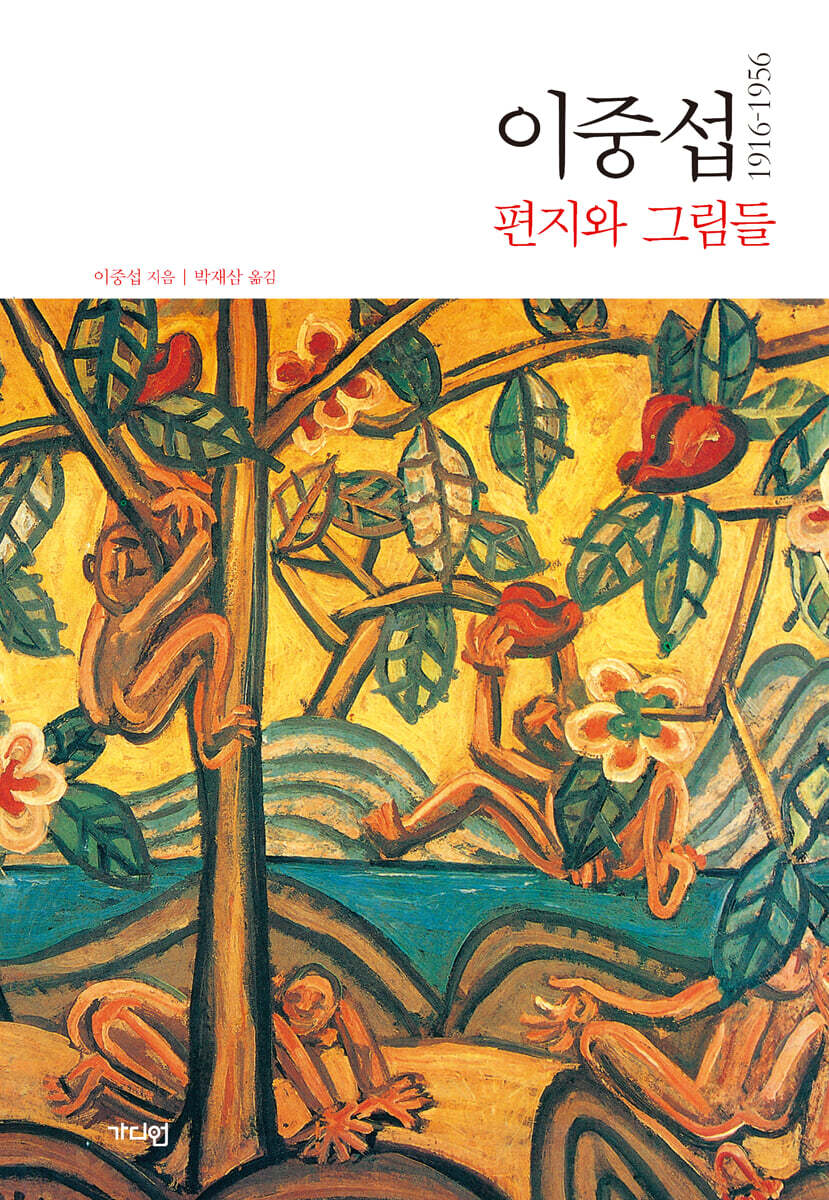 |
Description
Book Introduction
The only book that has been officially contracted and verified by Lee Jung-seop's bereaved family!
90 representative works and letters filled with his longing for his wife and children
Poet Park Jae-sam translated what Lee Jung-seop wrote and drew himself.
This is a revised edition of Lee Jung-seop's letters and drawings that were warmly loved by readers.
The book contains around 90 of Lee Jung-seop's representative works, including oil paintings, watercolors, sketches, gouaches, and silver paper paintings, as well as letters Lee Jung-seop sent to his wife, Ms. Nam-deok Lee (Masako), and two sons in Japan from 1953 to 1955, letters Ms. Nam-deok Lee sent to Lee Jung-seop, and postcards Lee Jung-seop sent to Masako before his marriage.
This collection of letters, written by the painter Lee Jung-seop himself rather than a third party and re-written in beautiful Korean by the late poet Park Jae-sam, pitifully expresses Lee Jung-seop's impoverished life at the time, his passionate love and longing for his wife and children, and his fanatical obsession with art.
Contains two poems from the Lee Jung-seop series by the late poet Kim Chun-su.
We added two poems from the Lee Jung-seop series by the late poet Kim Chun-soo, famous for his theory of meaninglessness, the late art critic Lee Gyeong-seong's 'Theory of Lee Jung-seop's Art,' and the late poet Gu Sang's writings on Lee Jung-seop's life and art.
These vivid testimonies and evaluations from friends who witnessed Lee Jung-seob's fierce struggle for life, love, and art are the only ways to truly experience Lee Jung-seob.
90 representative works and letters filled with his longing for his wife and children
Poet Park Jae-sam translated what Lee Jung-seop wrote and drew himself.
This is a revised edition of Lee Jung-seop's letters and drawings that were warmly loved by readers.
The book contains around 90 of Lee Jung-seop's representative works, including oil paintings, watercolors, sketches, gouaches, and silver paper paintings, as well as letters Lee Jung-seop sent to his wife, Ms. Nam-deok Lee (Masako), and two sons in Japan from 1953 to 1955, letters Ms. Nam-deok Lee sent to Lee Jung-seop, and postcards Lee Jung-seop sent to Masako before his marriage.
This collection of letters, written by the painter Lee Jung-seop himself rather than a third party and re-written in beautiful Korean by the late poet Park Jae-sam, pitifully expresses Lee Jung-seop's impoverished life at the time, his passionate love and longing for his wife and children, and his fanatical obsession with art.
Contains two poems from the Lee Jung-seop series by the late poet Kim Chun-su.
We added two poems from the Lee Jung-seop series by the late poet Kim Chun-soo, famous for his theory of meaninglessness, the late art critic Lee Gyeong-seong's 'Theory of Lee Jung-seop's Art,' and the late poet Gu Sang's writings on Lee Jung-seop's life and art.
These vivid testimonies and evaluations from friends who witnessed Lee Jung-seob's fierce struggle for life, love, and art are the only ways to truly experience Lee Jung-seob.
- You can preview some of the book's contents.
Preview
index
1.
My precious special feature is the cute Namdeok
Lovers - Postcards of Love
2.
My beloved and precious Agori
3.
My smart and kind sons, Taehyun and Taesung
Lee Jung-seob's life, love, and art
annual report
My precious special feature is the cute Namdeok
Lovers - Postcards of Love
2.
My beloved and precious Agori
3.
My smart and kind sons, Taehyun and Taesung
Lee Jung-seob's life, love, and art
annual report
Detailed image
Into the book
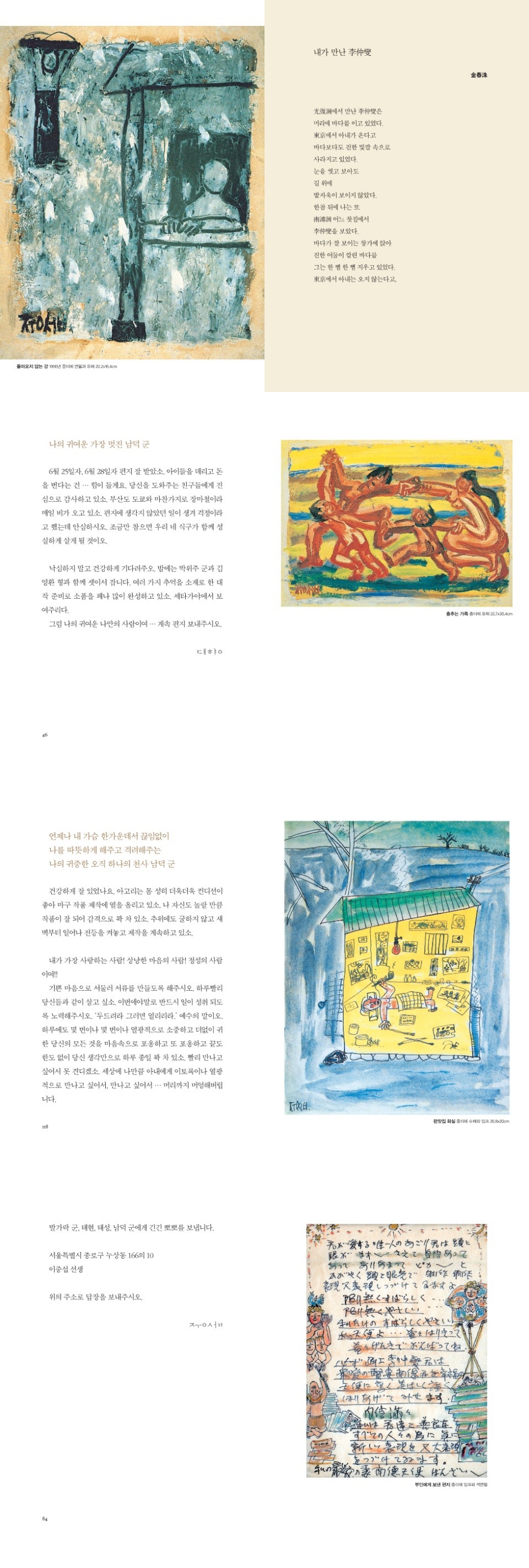
Lee Jung-seop, whom I met
金春洙
Lee Jung-seop, whom I met in Gwangbok-dong
He had the sea on his head.
My wife is coming from Tokyo
Into a color darker than the sea
It was disappearing.
Even if you wash your eyes and look
On the road
No footprints were visible.
After a while I again
At a tea house in Nampo-dong
I saw Lee Jung-seop.
Sitting by the window with a good view of the sea
The sea covered in deep darkness
He was erasing it inch by inch.
My wife is not coming from Tokyo,
As a Korean, I must correctly and proudly represent everything about Korea to the world.
I call myself an honest Korean artist.
Leaving my homeland, which is in such difficult circumstances… there are many things I must consider, especially in order to create excellent works that will delight and delight the people of my homeland, and to achieve a truly new expression that is correct and beautiful, not inferior to that of any artist in any other country.
People around the world know that Koreans are living under the worst conditions and want to see and hear the right cry.
--- p.99
A person who cannot truly and completely love his precious wife, whom he loves the most, will never be able to do great things.
There are some people who make it alone, but Agori is not that type of artist.
You are seeing yourself correctly.
Art is an expression of boundless love.
It is an expression of true affection.
Only when true affection is filled can the mind become clear.
Only when the mirror of the mind is clear can everything in the universe be reflected correctly in the mind, right? It doesn't matter what others love.
Just love with all your might and love endlessly.
Heaven has given me all the loveliness of Namdeok, whom I must love endlessly and who I love infinitely now.
However, all you have to do is love, love, and love the infinitely precious Namdeok more deeply, thickly, and passionately, and truly create and express anew everything in life that is reflected in the clear hearts of the two of you.
--- p.128
Feeling your strong affection all over his body, Namdeok's heart was filled with joy.
I am the happiest person in the world, receiving this much love.
(…) Only after we broke up like this did the foolish Namdeok realize how much he needed you and how deeply he loved you with all his body and soul.
But it's not too late.
From now on, isn't a longer, more hopeful future ahead of us? Let us stand firm, unwavering in the face of any obstacle, and forge ahead on the path Heaven has laid out for us.
Thank you so much for the lovely photos.
I was so happy to see my beloved Agori's face after so many months that I kissed her without thinking.
I like your nice lips, but your eyes look weak and your cheeks look thin.
How is your eating these days?
Isn't it true that you only eat it once or twice a day?
金春洙
Lee Jung-seop, whom I met in Gwangbok-dong
He had the sea on his head.
My wife is coming from Tokyo
Into a color darker than the sea
It was disappearing.
Even if you wash your eyes and look
On the road
No footprints were visible.
After a while I again
At a tea house in Nampo-dong
I saw Lee Jung-seop.
Sitting by the window with a good view of the sea
The sea covered in deep darkness
He was erasing it inch by inch.
My wife is not coming from Tokyo,
As a Korean, I must correctly and proudly represent everything about Korea to the world.
I call myself an honest Korean artist.
Leaving my homeland, which is in such difficult circumstances… there are many things I must consider, especially in order to create excellent works that will delight and delight the people of my homeland, and to achieve a truly new expression that is correct and beautiful, not inferior to that of any artist in any other country.
People around the world know that Koreans are living under the worst conditions and want to see and hear the right cry.
--- p.99
A person who cannot truly and completely love his precious wife, whom he loves the most, will never be able to do great things.
There are some people who make it alone, but Agori is not that type of artist.
You are seeing yourself correctly.
Art is an expression of boundless love.
It is an expression of true affection.
Only when true affection is filled can the mind become clear.
Only when the mirror of the mind is clear can everything in the universe be reflected correctly in the mind, right? It doesn't matter what others love.
Just love with all your might and love endlessly.
Heaven has given me all the loveliness of Namdeok, whom I must love endlessly and who I love infinitely now.
However, all you have to do is love, love, and love the infinitely precious Namdeok more deeply, thickly, and passionately, and truly create and express anew everything in life that is reflected in the clear hearts of the two of you.
--- p.128
Feeling your strong affection all over his body, Namdeok's heart was filled with joy.
I am the happiest person in the world, receiving this much love.
(…) Only after we broke up like this did the foolish Namdeok realize how much he needed you and how deeply he loved you with all his body and soul.
But it's not too late.
From now on, isn't a longer, more hopeful future ahead of us? Let us stand firm, unwavering in the face of any obstacle, and forge ahead on the path Heaven has laid out for us.
Thank you so much for the lovely photos.
I was so happy to see my beloved Agori's face after so many months that I kissed her without thinking.
I like your nice lips, but your eyes look weak and your cheeks look thin.
How is your eating these days?
Isn't it true that you only eat it once or twice a day?
--- p.165~173
Publisher's Review
Genius painter, national painter, folk painter, pioneer of modern Korean art.
A happy painter with all sorts of fancy adjectives in front of him.
Dire poverty, separation from beloved family, and a lonely death.
An unfortunate painter who burned his artistic soul in all kinds of suffering.
The book, “Letters and Paintings of Lee Jung-seop 1916-1956,” contains around 90 of Lee Jung-seop’s representative works, including oil paintings, watercolors, sketches, gouaches, and silver paper paintings, as well as letters Lee Jung-seop sent to his wife, Ms. Nam-deok (Masako), and two sons in Japan from 1953 to 1955, letters Ms. Nam-deok sent to Lee Jung-seop, and postcards Lee Jung-seop sent to Masako before his marriage.
This collection of letters, written by the painter Lee Jung-seop himself rather than a third party and re-written in beautiful Korean by the late poet Park Jae-sam, pitifully expresses Lee Jung-seop's impoverished life at the time, his passionate love and longing for his wife and children, and his fanatical obsession with art.
The dramatic life and desperate love of Lee Jung-seop's family, who met a Japanese woman during the colonial era, married her, lived a life of poverty that threatened their lives while traveling between Busan and Jeju Island during the Korean War, and were eventually separated by the Korea Strait, are still heartbreaking to watch even after so many years have passed.
Meanwhile, each brush stroke and color of the paintings he completed one by one with all his heart and soul are his alter egos, bearing the traces of Lee Jung-seob's efforts and concerns, who called himself an "honest painter" in art.
There is no more precious and truthful source for feeling and understanding his life and art.
In addition, it includes two poems from the Lee Jung-seop series by the late poet Kim Chun-su, the late art critic Lee Gyeong-seong's 'Theory of Lee Jung-seop's Art,' and the late poet Gu Sang's writings on Lee Jung-seop's life and art.
These vivid testimonies and evaluations from friends who witnessed Lee Jung-seob's fierce struggle for life, love, and art up close allow us to encounter the true Lee Jung-seob.
This book seeks to soothe the sorrow felt by Lee Jung-seob, who passed away several years ago amidst controversy over forgery, and to convey to readers his love and desperate longing for his family, along with his works that embody his anguish, exploration, and tireless passion for art.
“Looking at Hyung Jung-seop’s paintings, I feel strongly that art is difficult to achieve without innate talent.
Brother Jungseop has something really brave.
How they come up with such things and express them so boldly is what truly makes them unique and a national art.
“Brother Jung-seop is the painter I respect the most and is a shining star in our art world.” - Painter Kim Hwan-ki
“Lee Jung-seop had a world of art that appealed to everyone.
He was a pioneer of modernization who was the first to shed backwardness during the period of introduction of Western painting in Korea. Although he painted with Western materials, he was an individualistic and local artist who completely absorbed them as his own.
…dark native colors… almost perfectly capture the formal and dreamlike qualities of oriental painting.
…he had a distinct self, as if he had never described anything Japanese, even though he had stayed in Japan and studied.
Once he picked up the brush, he painted what flowed in his blood: the breath and dreams of the hometown that raised him.
“His paintings have a more Korean and traditional atmosphere than any other modern Korean artist, and they escape the vulnerability of traditional landscape paintings and contain a much grander and infinite world because such breathing and dreams are alive and wriggling.” - Painter Kim Byeong-gi
“Lee Jung-seop is a painter who lived in a society of chaos and constant turmoil, from oppression to freedom to war, and he is a painter who succeeded in expressing this turmoil and chaos more vividly than anyone else.
At least Lee Jung-seob lived with a keen sense of the reality of the times and society he lived in, and he knew how to express and draw his experiences and situations vividly.
“He lived so intensely that it could be said that no other artist lived through that chaotic era as rewardingly as Lee Jung-seop.” - Critic Choi Seok-tae
A happy painter with all sorts of fancy adjectives in front of him.
Dire poverty, separation from beloved family, and a lonely death.
An unfortunate painter who burned his artistic soul in all kinds of suffering.
The book, “Letters and Paintings of Lee Jung-seop 1916-1956,” contains around 90 of Lee Jung-seop’s representative works, including oil paintings, watercolors, sketches, gouaches, and silver paper paintings, as well as letters Lee Jung-seop sent to his wife, Ms. Nam-deok (Masako), and two sons in Japan from 1953 to 1955, letters Ms. Nam-deok sent to Lee Jung-seop, and postcards Lee Jung-seop sent to Masako before his marriage.
This collection of letters, written by the painter Lee Jung-seop himself rather than a third party and re-written in beautiful Korean by the late poet Park Jae-sam, pitifully expresses Lee Jung-seop's impoverished life at the time, his passionate love and longing for his wife and children, and his fanatical obsession with art.
The dramatic life and desperate love of Lee Jung-seop's family, who met a Japanese woman during the colonial era, married her, lived a life of poverty that threatened their lives while traveling between Busan and Jeju Island during the Korean War, and were eventually separated by the Korea Strait, are still heartbreaking to watch even after so many years have passed.
Meanwhile, each brush stroke and color of the paintings he completed one by one with all his heart and soul are his alter egos, bearing the traces of Lee Jung-seob's efforts and concerns, who called himself an "honest painter" in art.
There is no more precious and truthful source for feeling and understanding his life and art.
In addition, it includes two poems from the Lee Jung-seop series by the late poet Kim Chun-su, the late art critic Lee Gyeong-seong's 'Theory of Lee Jung-seop's Art,' and the late poet Gu Sang's writings on Lee Jung-seop's life and art.
These vivid testimonies and evaluations from friends who witnessed Lee Jung-seob's fierce struggle for life, love, and art up close allow us to encounter the true Lee Jung-seob.
This book seeks to soothe the sorrow felt by Lee Jung-seob, who passed away several years ago amidst controversy over forgery, and to convey to readers his love and desperate longing for his family, along with his works that embody his anguish, exploration, and tireless passion for art.
“Looking at Hyung Jung-seop’s paintings, I feel strongly that art is difficult to achieve without innate talent.
Brother Jungseop has something really brave.
How they come up with such things and express them so boldly is what truly makes them unique and a national art.
“Brother Jung-seop is the painter I respect the most and is a shining star in our art world.” - Painter Kim Hwan-ki
“Lee Jung-seop had a world of art that appealed to everyone.
He was a pioneer of modernization who was the first to shed backwardness during the period of introduction of Western painting in Korea. Although he painted with Western materials, he was an individualistic and local artist who completely absorbed them as his own.
…dark native colors… almost perfectly capture the formal and dreamlike qualities of oriental painting.
…he had a distinct self, as if he had never described anything Japanese, even though he had stayed in Japan and studied.
Once he picked up the brush, he painted what flowed in his blood: the breath and dreams of the hometown that raised him.
“His paintings have a more Korean and traditional atmosphere than any other modern Korean artist, and they escape the vulnerability of traditional landscape paintings and contain a much grander and infinite world because such breathing and dreams are alive and wriggling.” - Painter Kim Byeong-gi
“Lee Jung-seop is a painter who lived in a society of chaos and constant turmoil, from oppression to freedom to war, and he is a painter who succeeded in expressing this turmoil and chaos more vividly than anyone else.
At least Lee Jung-seob lived with a keen sense of the reality of the times and society he lived in, and he knew how to express and draw his experiences and situations vividly.
“He lived so intensely that it could be said that no other artist lived through that chaotic era as rewardingly as Lee Jung-seop.” - Critic Choi Seok-tae
GOODS SPECIFICS
- Date of issue: July 10, 2024
- Format: Hardcover book binding method guide
- Page count, weight, size: 255 pages | 336g | 133*194*18mm
- ISBN13: 9791167781239
- ISBN10: 1167781236
You may also like
카테고리
korean


korean

![GQ KOREA Mark (Monthly): December [2025]](http://librairie.coreenne.fr/cdn/shop/files/8ef265dbbfbf186523ed75ba7319009d.jpg?v=1765340328&width=3840)


