

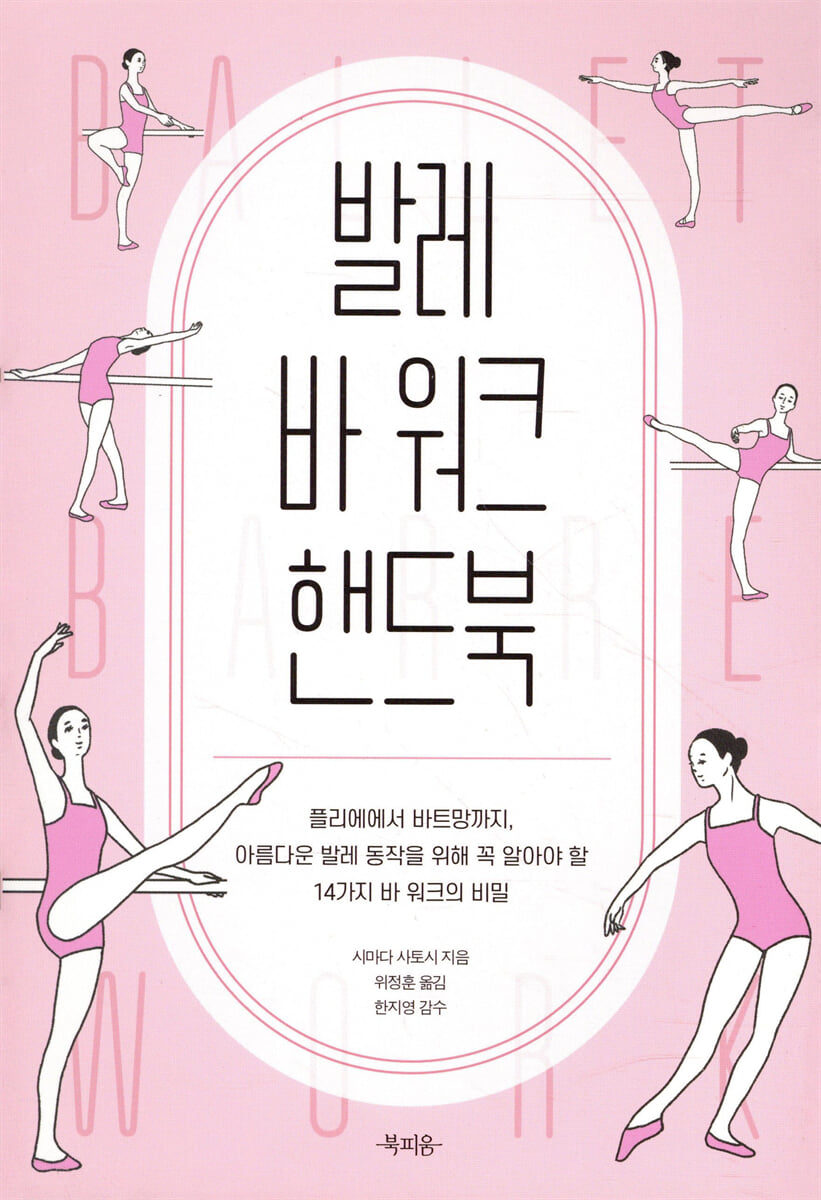
Ballet Barre Work Handbook
 |
Description
Book Introduction
Leotards, tights, ballet flats, and…
Another essential item in your ballet bag, the 『Ballet Bar Work Handbook』!
Read before going to the ballet, and read again after going to the ballet.
The world's friendliest 'bar work' textbook!
Why you need to be good at bar work to be good at center work
Uncover the anatomical secrets hidden in bar work!
- Why do you start bar work with plie?
- Why do you move your arms along with your legs when doing barre work?
- When turning, the back of the tank and the standing leg plie determine 70% of the rotation amount?
- How do I raise my leg high in Devloppe or Bateman?
- Why do our eyes follow the fingertips in ballet movements?
- If there are difficult movements or difficult postures, should I practice cambrai?
- How can I make my body's axis slim and strong?
The ballet boom is strong.
Many people start ballet as a hobby as adults and then become completely captivated by its charm. Many toddlers and elementary school students also learn ballet because it helps them develop a beautiful body, correct their posture, and grow taller.
Ballet, an art form symbolizing the extremes of beauty, has come down to earth and come to us from heaven.
People who are romantic about ballet will start learning ballet imagining themselves wearing pointe shoes, a white tutu, and striking wonderful poses like arabesques or attitudes.
But once you start learning, the difficult struggle begins.
And then, you realize.
There is no royal road to ballet.
In order to do ballet, or the ballet movements that we think of in our heads, there is a 'course of destiny' that we must go through.
It is called 'Ballet Bar Walk'.
The 'bar walk', which must be performed for 40 to 50 minutes when dancing ballet, is essentially a mandatory process that requires repeating the same movements, and no one, whether a beginner amateur ballet dancer or a prima donna from the world's best ballet company, can skip it or pass it over lightly.
Another essential item in your ballet bag, the 『Ballet Bar Work Handbook』!
Read before going to the ballet, and read again after going to the ballet.
The world's friendliest 'bar work' textbook!
Why you need to be good at bar work to be good at center work
Uncover the anatomical secrets hidden in bar work!
- Why do you start bar work with plie?
- Why do you move your arms along with your legs when doing barre work?
- When turning, the back of the tank and the standing leg plie determine 70% of the rotation amount?
- How do I raise my leg high in Devloppe or Bateman?
- Why do our eyes follow the fingertips in ballet movements?
- If there are difficult movements or difficult postures, should I practice cambrai?
- How can I make my body's axis slim and strong?
The ballet boom is strong.
Many people start ballet as a hobby as adults and then become completely captivated by its charm. Many toddlers and elementary school students also learn ballet because it helps them develop a beautiful body, correct their posture, and grow taller.
Ballet, an art form symbolizing the extremes of beauty, has come down to earth and come to us from heaven.
People who are romantic about ballet will start learning ballet imagining themselves wearing pointe shoes, a white tutu, and striking wonderful poses like arabesques or attitudes.
But once you start learning, the difficult struggle begins.
And then, you realize.
There is no royal road to ballet.
In order to do ballet, or the ballet movements that we think of in our heads, there is a 'course of destiny' that we must go through.
It is called 'Ballet Bar Walk'.
The 'bar walk', which must be performed for 40 to 50 minutes when dancing ballet, is essentially a mandatory process that requires repeating the same movements, and no one, whether a beginner amateur ballet dancer or a prima donna from the world's best ballet company, can skip it or pass it over lightly.
- You can preview some of the book's contents.
Preview
index
preface
〈Part 1〉 Building a Body Optimized for Ballet through 'Breathing' and 'Body Connection'
- Things to do if you want to be good at ballet
Self-Tuning 1: Diaphragm Stretching to Increase Breathing Power
Self-Tuning 2 Twist and Stretch the Diaphragm
Self-Tuning 3: Stretching the Diaphragm by Stretching the Sides
Self-Tuning 4 Diaphragm Stretch: Turn Out Version
Self-Tuning 5 Correct the position of the shoulder blades using breathing and arms.
Self-Tuning 6: Bend and straighten the instep
Self-Tuning 7 Toe Release
Self-Tuning 8 Stretch your calves while straightening your pelvis
Self-Tuning 9-Step Solar Bladder Meridian Activation
Self-Tuning Activate the 10-Hand Link!
〈Part 2〉 14 Bar Work Secrets Based on Breathing and Body Connection
- Things to do when you want to excel at difficult or challenging ballet movements
What if the plie is difficult?
- If you do arm movements together, the inside of your body will stretch and you can push off the floor!
Cambrai / What if Cambrai is difficult?
What if Relevé/Relevé is difficult?
Tangdui / What if Tangdui is difficult?
What if Jute/Jute is difficult?
Long de Jangbe a Ter / What if Long de Jangbe a Ter is difficult?
Sur le Coudpier and Le Tire / What if Coudpier and Le Tire are difficult?
Fondue / What if fondue is difficult?
What if suit is difficult?
Bateman Frappé / What if Bateman Frappé is difficult?
Petit Bateman / What if Petit Bateman is difficult?
What if Batmang Batu is difficult?
Long de Jean-Bou en Ler / What if Long de Jean-Bou en Ler is difficult?
What if Devloppe / Devloppe is difficult?
Grand Bateman / What if Grand Bateman is difficult?
Appendix - Bar Work Checkpoint List / Original Ballet Terminology in This Book
〈Part 1〉 Building a Body Optimized for Ballet through 'Breathing' and 'Body Connection'
- Things to do if you want to be good at ballet
Self-Tuning 1: Diaphragm Stretching to Increase Breathing Power
Self-Tuning 2 Twist and Stretch the Diaphragm
Self-Tuning 3: Stretching the Diaphragm by Stretching the Sides
Self-Tuning 4 Diaphragm Stretch: Turn Out Version
Self-Tuning 5 Correct the position of the shoulder blades using breathing and arms.
Self-Tuning 6: Bend and straighten the instep
Self-Tuning 7 Toe Release
Self-Tuning 8 Stretch your calves while straightening your pelvis
Self-Tuning 9-Step Solar Bladder Meridian Activation
Self-Tuning Activate the 10-Hand Link!
〈Part 2〉 14 Bar Work Secrets Based on Breathing and Body Connection
- Things to do when you want to excel at difficult or challenging ballet movements
What if the plie is difficult?
- If you do arm movements together, the inside of your body will stretch and you can push off the floor!
Cambrai / What if Cambrai is difficult?
What if Relevé/Relevé is difficult?
Tangdui / What if Tangdui is difficult?
What if Jute/Jute is difficult?
Long de Jangbe a Ter / What if Long de Jangbe a Ter is difficult?
Sur le Coudpier and Le Tire / What if Coudpier and Le Tire are difficult?
Fondue / What if fondue is difficult?
What if suit is difficult?
Bateman Frappé / What if Bateman Frappé is difficult?
Petit Bateman / What if Petit Bateman is difficult?
What if Batmang Batu is difficult?
Long de Jean-Bou en Ler / What if Long de Jean-Bou en Ler is difficult?
What if Devloppe / Devloppe is difficult?
Grand Bateman / What if Grand Bateman is difficult?
Appendix - Bar Work Checkpoint List / Original Ballet Terminology in This Book
Detailed image
Into the book
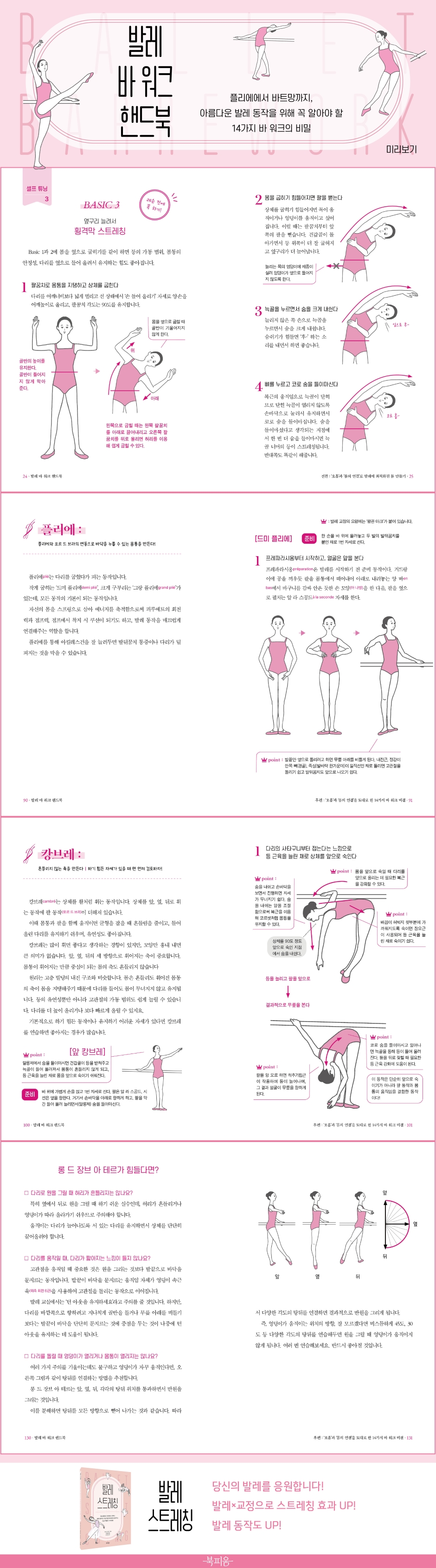
Why do we move our arms and legs together while looking at our hands?
The main reason is that by connecting the muscles inside the body, it becomes much easier to use the limbs.
For example, when you squat down in a plie and stand up with your legs straight, look at your hands and twist your back as you spread them out to the side.
At this time, if you keep your ribs and pelvis closed so that your stomach does not spread out too far to the side or your shoulders do not lean back, you will feel your upper body tightening.
As you extend your legs, your thighs rotate inward, and by maintaining the rotational force from your upper body and the turn out, the force acts in a spiral, creating a "push-turn" motion, much like turning a drill or screw.
--- p.98
Cambrai is a movement that bends the upper body like a bow.
The upper body bends forward, sideways, and backward, with added arm movement (port de bra).
Moving your torso and arms together at this time will reduce sway when maintaining balance, make it easier to maintain the raised leg, and also improve flexibility.
Cambrai tends to think that the more it bends, the better, but if you just imitate the shape, it doesn't mean much.
The axis that bends in three directions - forward, sideways, and backward - is important.
As the torso bends, the central axis of the body also does not shake.
The principle is similar to the earthquake-resistant structure of high-rise buildings.
Even if the body shakes, the axis of the curved torso supports the body, so the body remains upright without collapsing even if the legs are raised.
You can easily increase the flexibility of your back as well as the range of motion of your hip joints.
You can raise your legs higher or faster.
If you have a movement that is difficult to do or a posture that is difficult to maintain, practicing cambrai will often help.
--- p.100
What if it's hard for you?
- Is your pelvis tilted?
Especially if your hips seem to rise when you do side lunges, this is a sign that your pelvis is tilted.
However, if you consciously try to lower your raised hips, the turnout will be released and your legs will turn inward, resulting in a bowlegged stance. So, think of stretching your entire body up and down using your standing leg as the axis.
This will prevent your pelvis from being misaligned.
- Are there any directions where your legs don't go up well?
Practice the appropriate movements below depending on the direction in which your legs do not rise.
· It is difficult to raise the leg forward: Practice moving the front cambre using the psoas and abdominal muscles in order.
· Difficulty raising legs to the side: Exercises that move the spine with side cambras or use the transverse abdominis.
· Difficulty lifting the leg back: Check the posterior cambra.
The main reason is that by connecting the muscles inside the body, it becomes much easier to use the limbs.
For example, when you squat down in a plie and stand up with your legs straight, look at your hands and twist your back as you spread them out to the side.
At this time, if you keep your ribs and pelvis closed so that your stomach does not spread out too far to the side or your shoulders do not lean back, you will feel your upper body tightening.
As you extend your legs, your thighs rotate inward, and by maintaining the rotational force from your upper body and the turn out, the force acts in a spiral, creating a "push-turn" motion, much like turning a drill or screw.
--- p.98
Cambrai is a movement that bends the upper body like a bow.
The upper body bends forward, sideways, and backward, with added arm movement (port de bra).
Moving your torso and arms together at this time will reduce sway when maintaining balance, make it easier to maintain the raised leg, and also improve flexibility.
Cambrai tends to think that the more it bends, the better, but if you just imitate the shape, it doesn't mean much.
The axis that bends in three directions - forward, sideways, and backward - is important.
As the torso bends, the central axis of the body also does not shake.
The principle is similar to the earthquake-resistant structure of high-rise buildings.
Even if the body shakes, the axis of the curved torso supports the body, so the body remains upright without collapsing even if the legs are raised.
You can easily increase the flexibility of your back as well as the range of motion of your hip joints.
You can raise your legs higher or faster.
If you have a movement that is difficult to do or a posture that is difficult to maintain, practicing cambrai will often help.
--- p.100
What if it's hard for you?
- Is your pelvis tilted?
Especially if your hips seem to rise when you do side lunges, this is a sign that your pelvis is tilted.
However, if you consciously try to lower your raised hips, the turnout will be released and your legs will turn inward, resulting in a bowlegged stance. So, think of stretching your entire body up and down using your standing leg as the axis.
This will prevent your pelvis from being misaligned.
- Are there any directions where your legs don't go up well?
Practice the appropriate movements below depending on the direction in which your legs do not rise.
· It is difficult to raise the leg forward: Practice moving the front cambre using the psoas and abdominal muscles in order.
· Difficulty raising legs to the side: Exercises that move the spine with side cambras or use the transverse abdominis.
· Difficulty lifting the leg back: Check the posterior cambra.
--- p.126~127
Publisher's Review
Is the ballet 'Bar Walk' the 'Piano's 'Hannon'?
But wait, why do we have to work so hard at bar work, which is not very fun and requires repetitive movements? For one thing, bar work is difficult.
When performing a movement, you must maintain the turnout of your legs, extend your toes all the way, straighten your legs, keep your back straight, and follow the movement with your eyes. There are many things to pay attention to.
Even your posture and movements don't improve right away.
No matter how hard they try, they can't get good at it, and most amateur ballet dancers want to reduce the time spent doing barre work and practice more center work, which is more ballet-like(?) movements.
But in ballet classes, teachers never reduce the time spent on barre work and increase the time spent on center work.
There's a reason for everything.
In fact, ballet is a science.
This means that it is an exercise that precisely matches the principles and rules applied to ballet movements.
If you think about it the other way around, it means that ballet becomes much easier if you just know the principles and principles accurately.
Let's think back to the "Hannon" that we had to play when learning piano as a child.
The mechanical repetition of notes, “Hanong,” is boring and uninteresting, so if you keep playing similar scales, you will remember your soul wandering through space and only your fingers moving vaguely.
But why did you learn "Hanong"? "Hanong" is the best textbook for finger practice and technique training.
Even piano masters like Rachmaninoff trained for five years by playing only "Hannon" and even took exams.
The barre in ballet is like the piano's "Hannon."
It is a process of creating a ‘body optimized for ballet’ before starting the center.
It's like giving your body a physical signal saying, 'Okay, I'm going to do ballet now.'
That is, through barre work, you can realign your hip joints and spine to perform movements unique to ballet, align your torso with your breathing and gaze, and make your body's axis centered inward, and only then can you move to the center.
In the 'Preface', the author clearly explains the essence of ballet barre work.
“The desire to perform beautiful ballet movements at the center will be like a chimney.
But to do that, you absolutely need to go through the process of building your body through bar work.
“If you don’t do bar work properly, you won’t be able to do much more at the center.”
14 Bar Works: If you're good at plie, you'll be good at battman!
So, how can we master this crucial barre? Let's take a closer look at the contents of the "Ballet Barre Work Handbook."
The Ballet Bar Work Handbook consists of two parts: Part 1 and Part 2.
〈Part 1〉 introduces the ‘process of creating a body optimized for bar work.’
It introduces 'diaphragmatic breathing' and hand and toe exercises, which are essential for ballet, and is explained in a friendly manner with pictures, making it easy to follow along on your own.
The greatest strength of the "Ballet Bar Work Handbook" is that it explains why these exercises are necessary.
Knowing the reason makes it easier to understand, and it goes without saying that being easy to understand makes you more motivated.
The second half explains the 14 movements of full-fledged bar work.
It explains in detail why we do the 14 movements of barre work, including plié, cambrai, tandu, fondue, debloffe, relevé, jouté, ron de zanve, sur le coudepièce, battement, frappé, passé, stnu en tournant, and batu, what the principles of the movements are, how to make each movement easier, and what to fix or practice if you are not good at it.
For example, plie, cambrai, and relevé are 'movements to build a foundation', while tandu, jouté, and long de jangbe are 'movements to increase leg movement and hip joint range of motion'.
For example, why does bar work start with plie? Because bar work progresses from small movements to large ones.
So, we start with the most basic leg bend, the plie, and end with the grand battement, the biggest movement.
Why do we look at our hands and move our limbs together when doing barre work? The main reason is that engaging the muscles within our bodies makes it much easier to use our limbs.
Cambrai, which bends its body forward, sideways, and backward like a bow, is good for the body if it bends a lot? No.
The most important thing in Cambrai is to maintain the axis.
The Cambrai principle is similar to the earthquake-resistant structure of high-rise buildings.
Even if the body shakes, the axis of the curved torso supports the body, so the body remains upright without collapsing even if the legs are raised.
To you who wants to dance ballet a little more beautifully tomorrow than today
In this way, the 『Ballet Bar Work Handbook』 teaches the principles of ballet movements and even the secrets to performing them well, so it helps beginners learn accurate ballet movements more quickly, and helps those with 2-3 years of ballet experience perform smoother and more beautiful movements.
If there are movements that you can't seem to improve even after practicing ballet for a long time, following the solutions presented in the book will definitely be effective.
It is a very helpful teaching material not only for those learning ballet but also for teachers who teach it.
If you want to make barre work easier and center work much smoother and more elegant, be sure to pack the "Ballet Barre Work Handbook" in your ballet bag along with your leotard, tights, and shoes.
This is another essential ballet book that you can read before going to the ballet and read again afterward.
But wait, why do we have to work so hard at bar work, which is not very fun and requires repetitive movements? For one thing, bar work is difficult.
When performing a movement, you must maintain the turnout of your legs, extend your toes all the way, straighten your legs, keep your back straight, and follow the movement with your eyes. There are many things to pay attention to.
Even your posture and movements don't improve right away.
No matter how hard they try, they can't get good at it, and most amateur ballet dancers want to reduce the time spent doing barre work and practice more center work, which is more ballet-like(?) movements.
But in ballet classes, teachers never reduce the time spent on barre work and increase the time spent on center work.
There's a reason for everything.
In fact, ballet is a science.
This means that it is an exercise that precisely matches the principles and rules applied to ballet movements.
If you think about it the other way around, it means that ballet becomes much easier if you just know the principles and principles accurately.
Let's think back to the "Hannon" that we had to play when learning piano as a child.
The mechanical repetition of notes, “Hanong,” is boring and uninteresting, so if you keep playing similar scales, you will remember your soul wandering through space and only your fingers moving vaguely.
But why did you learn "Hanong"? "Hanong" is the best textbook for finger practice and technique training.
Even piano masters like Rachmaninoff trained for five years by playing only "Hannon" and even took exams.
The barre in ballet is like the piano's "Hannon."
It is a process of creating a ‘body optimized for ballet’ before starting the center.
It's like giving your body a physical signal saying, 'Okay, I'm going to do ballet now.'
That is, through barre work, you can realign your hip joints and spine to perform movements unique to ballet, align your torso with your breathing and gaze, and make your body's axis centered inward, and only then can you move to the center.
In the 'Preface', the author clearly explains the essence of ballet barre work.
“The desire to perform beautiful ballet movements at the center will be like a chimney.
But to do that, you absolutely need to go through the process of building your body through bar work.
“If you don’t do bar work properly, you won’t be able to do much more at the center.”
14 Bar Works: If you're good at plie, you'll be good at battman!
So, how can we master this crucial barre? Let's take a closer look at the contents of the "Ballet Barre Work Handbook."
The Ballet Bar Work Handbook consists of two parts: Part 1 and Part 2.
〈Part 1〉 introduces the ‘process of creating a body optimized for bar work.’
It introduces 'diaphragmatic breathing' and hand and toe exercises, which are essential for ballet, and is explained in a friendly manner with pictures, making it easy to follow along on your own.
The greatest strength of the "Ballet Bar Work Handbook" is that it explains why these exercises are necessary.
Knowing the reason makes it easier to understand, and it goes without saying that being easy to understand makes you more motivated.
The second half explains the 14 movements of full-fledged bar work.
It explains in detail why we do the 14 movements of barre work, including plié, cambrai, tandu, fondue, debloffe, relevé, jouté, ron de zanve, sur le coudepièce, battement, frappé, passé, stnu en tournant, and batu, what the principles of the movements are, how to make each movement easier, and what to fix or practice if you are not good at it.
For example, plie, cambrai, and relevé are 'movements to build a foundation', while tandu, jouté, and long de jangbe are 'movements to increase leg movement and hip joint range of motion'.
For example, why does bar work start with plie? Because bar work progresses from small movements to large ones.
So, we start with the most basic leg bend, the plie, and end with the grand battement, the biggest movement.
Why do we look at our hands and move our limbs together when doing barre work? The main reason is that engaging the muscles within our bodies makes it much easier to use our limbs.
Cambrai, which bends its body forward, sideways, and backward like a bow, is good for the body if it bends a lot? No.
The most important thing in Cambrai is to maintain the axis.
The Cambrai principle is similar to the earthquake-resistant structure of high-rise buildings.
Even if the body shakes, the axis of the curved torso supports the body, so the body remains upright without collapsing even if the legs are raised.
To you who wants to dance ballet a little more beautifully tomorrow than today
In this way, the 『Ballet Bar Work Handbook』 teaches the principles of ballet movements and even the secrets to performing them well, so it helps beginners learn accurate ballet movements more quickly, and helps those with 2-3 years of ballet experience perform smoother and more beautiful movements.
If there are movements that you can't seem to improve even after practicing ballet for a long time, following the solutions presented in the book will definitely be effective.
It is a very helpful teaching material not only for those learning ballet but also for teachers who teach it.
If you want to make barre work easier and center work much smoother and more elegant, be sure to pack the "Ballet Barre Work Handbook" in your ballet bag along with your leotard, tights, and shoes.
This is another essential ballet book that you can read before going to the ballet and read again afterward.
GOODS SPECIFICS
- Date of issue: July 8, 2024
- Page count, weight, size: 200 pages | 372g | 150*220*13mm
- ISBN13: 9791198762900
- ISBN10: 119876290X
You may also like
카테고리
korean


korean

![GQ KOREA Mark (Monthly): December [2025]](http://librairie.coreenne.fr/cdn/shop/files/8ef265dbbfbf186523ed75ba7319009d.jpg?v=1765340328&width=3840)


