

Turntable, Life, Design
 |
Description
Book Introduction
- A word from MD
- [LP, Turntable, Tonearm, Cartridge] Contains the history of turntables that have evolved since the blueprint was presented in 1857.
The rich collection of photos of iconic turntables will captivate not only LP and turntable lovers, but also anyone who loves music.
With analog music making a comeback, this book will help you experience the classic authenticity that only a turntable can provide.
- Ahn Hyun-jae, art producer
『Turntable·Life·Design』, the sequel to 『Audio·Life·Design』, which was well-received both domestically and internationally as an audio art book and history book, has been published.
This book contains the history of the turntable, which has continuously evolved since the blueprint for the turntable was presented in 1857, when Edison invented the phonograph in 1877, to the present.
Iconic turntables are comprehensively presented with abundant photographic documentation, including the Hydraulic Reference by Transcriptus, the turntable that Stanley Kubrick meticulously selected for the film A Clockwork Orange and Steve Jobs' beloved turntable, the Technics SL-1200 that laid the foundation for the birth of hip-hop in 1970s New York, the Mickeyphone, the portable phonograph that inspired the birth of the Apple iPod, and the famous machines of industrial designers Dieter Rams, Jakob Jensen, and Jon Vasos who brought design to the world of audio.
This book contains the history of the turntable, which has continuously evolved since the blueprint for the turntable was presented in 1857, when Edison invented the phonograph in 1877, to the present.
Iconic turntables are comprehensively presented with abundant photographic documentation, including the Hydraulic Reference by Transcriptus, the turntable that Stanley Kubrick meticulously selected for the film A Clockwork Orange and Steve Jobs' beloved turntable, the Technics SL-1200 that laid the foundation for the birth of hip-hop in 1970s New York, the Mickeyphone, the portable phonograph that inspired the birth of the Apple iPod, and the famous machines of industrial designers Dieter Rams, Jakob Jensen, and Jon Vasos who brought design to the world of audio.
- You can preview some of the book's contents.
Preview
index
Introduction
Chapter 1: 1857–1919: The Acoustic Era
Chapter 2: 1920–1949: The Early Electrical Period
Chapter 3: The 1950s
Chapter 4: The 1960s
Chapter 5: The 1970s
Chapter 6 1980s-1990s
Chapter 7: The 2000s
Translator's Note
Americas
Photo source
Search
Chapter 1: 1857–1919: The Acoustic Era
Chapter 2: 1920–1949: The Early Electrical Period
Chapter 3: The 1950s
Chapter 4: The 1960s
Chapter 5: The 1970s
Chapter 6 1980s-1990s
Chapter 7: The 2000s
Translator's Note
Americas
Photo source
Search
Detailed image

Into the book
We want to experience the performance in the recording studio or concert hall in the most direct and honest way.
The fundamental human desire to experience music that captures the essence of live performances is the catalyst and driving force behind the LP renaissance of 2020.
We are all beneficiaries of this amazing time machine.
--- p.7, from “Introductory Remarks”
Scott de Martinville's experiments focused on reverse engineering the workings of the human eardrum, with the goal of "reproducing a part of the human ear organ and extracting the desired result."
He used leather (cow's veil) and boxwood sandwiched between gold foil to replicate the interior of the human ear, including the eardrum and ossicles, to capture sound vibrations from the device's transmitter, essentially successfully replicating the human ear canal.
A hand-operated cylinder created mechanical movement, and when sound waves vibrated, a stylus (this time using stiff hairs instead of a needle) engraved repetitive images on oil-based paper.
On March 25, 1857, the phonotograph was granted French patent number 17,897/31,470.
--- p.13, from “Chapter 1 1857-1919: The Acoustic Era”
It is no exaggeration to say that LPs ushered in the era of high fidelity, a term widely used in audio marketing in the 1950s.
The promise of LPs, with their wider dynamic range, lower noise, longer playback times, and superior sound quality, sparked a phenomenon in audio manufacturing:
As audio shows began to dazzle consumers with a huge number of devices, a strong obsession with high-fidelity standalone devices took root in the market.
--- p.92, from “Chapter 3, 1950s”
After World War II, Dieter Rams's brilliant vision of a new world gave birth to the Braun turntable, a symbol of unparalleled German modernism.
(…) In the 1950s, Braun released the SK4, the company's iconic record player, the 'Snow White's Coffin'.
This model represents mid-century audio from the 1950s.
The combination of painted steel, elm, acrylic, and a Perspex dust cover garnered rave reviews from design critics. The SK4 was even exhibited at the Museum of Modern Art (MoMA) in New York from 1958 to 1959.
--- p.93~94, from “Chapter 3, 1950s”
By the 1970s, two major trends in turntables were emerging that would determine the future of the audio market.
First, there was a movement to elevate audio to the realm of luxury goods, accessible only to the upper class.
Turntables of the 1970s successfully broke away from the tank-like broadcast turntable designs that had dominated the 1960s, packing more modern technology into a smaller form factor.
Audio Research, Dahlquist, Infinity, Nakamichi, Mark Levinson, Quad, and Threshold are the key players that created the luxury audio segment in the audio equipment market.
On the other hand, polarization emerged as mass-produced audio products from Asia (mainly Japan) dominated the global market due to their low prices.
--- p.167, from “Chapter 3, 1970s”
Listening to music on LPs, turntables, tonearms, and cartridges takes more effort than listening to music via internet streaming.
However, humans have an innate desire to experience the real thing, regardless of their own success or gain.
In this sense, analog music is inseparable from those who pursue authenticity in music reproduction.
As long as the supernatural vitality of analog music persists, turntables will survive.
The fundamental human desire to experience music that captures the essence of live performances is the catalyst and driving force behind the LP renaissance of 2020.
We are all beneficiaries of this amazing time machine.
--- p.7, from “Introductory Remarks”
Scott de Martinville's experiments focused on reverse engineering the workings of the human eardrum, with the goal of "reproducing a part of the human ear organ and extracting the desired result."
He used leather (cow's veil) and boxwood sandwiched between gold foil to replicate the interior of the human ear, including the eardrum and ossicles, to capture sound vibrations from the device's transmitter, essentially successfully replicating the human ear canal.
A hand-operated cylinder created mechanical movement, and when sound waves vibrated, a stylus (this time using stiff hairs instead of a needle) engraved repetitive images on oil-based paper.
On March 25, 1857, the phonotograph was granted French patent number 17,897/31,470.
--- p.13, from “Chapter 1 1857-1919: The Acoustic Era”
It is no exaggeration to say that LPs ushered in the era of high fidelity, a term widely used in audio marketing in the 1950s.
The promise of LPs, with their wider dynamic range, lower noise, longer playback times, and superior sound quality, sparked a phenomenon in audio manufacturing:
As audio shows began to dazzle consumers with a huge number of devices, a strong obsession with high-fidelity standalone devices took root in the market.
--- p.92, from “Chapter 3, 1950s”
After World War II, Dieter Rams's brilliant vision of a new world gave birth to the Braun turntable, a symbol of unparalleled German modernism.
(…) In the 1950s, Braun released the SK4, the company's iconic record player, the 'Snow White's Coffin'.
This model represents mid-century audio from the 1950s.
The combination of painted steel, elm, acrylic, and a Perspex dust cover garnered rave reviews from design critics. The SK4 was even exhibited at the Museum of Modern Art (MoMA) in New York from 1958 to 1959.
--- p.93~94, from “Chapter 3, 1950s”
By the 1970s, two major trends in turntables were emerging that would determine the future of the audio market.
First, there was a movement to elevate audio to the realm of luxury goods, accessible only to the upper class.
Turntables of the 1970s successfully broke away from the tank-like broadcast turntable designs that had dominated the 1960s, packing more modern technology into a smaller form factor.
Audio Research, Dahlquist, Infinity, Nakamichi, Mark Levinson, Quad, and Threshold are the key players that created the luxury audio segment in the audio equipment market.
On the other hand, polarization emerged as mass-produced audio products from Asia (mainly Japan) dominated the global market due to their low prices.
--- p.167, from “Chapter 3, 1970s”
Listening to music on LPs, turntables, tonearms, and cartridges takes more effort than listening to music via internet streaming.
However, humans have an innate desire to experience the real thing, regardless of their own success or gain.
In this sense, analog music is inseparable from those who pursue authenticity in music reproduction.
As long as the supernatural vitality of analog music persists, turntables will survive.
--- p.267, from “Chapter 7, 2000s”
Publisher's Review
A turntable with amazing vitality
Its 143-year history
From 1877, when Edison invented the phonograph, until 1981, when conductor Herbert von Karajan, along with Sony, introduced the compact disc to the world at the Salzburg Easter Festival, the turntable was the dominant physical music medium.
Turntables, which had since ceded power to CDs, survived resolutely and managed to reclaim their throne in 2020 when LPs surpassed CD sales.
Today, turntables are gaining new recognition as a symbol of analog culture, allowing people to enjoy music while savoring its physical properties.
This is surprising given the extinction of so many media in the video sector, including film, VHS, LD, and DVD.
Author Gideon Schwartz calls this phenomenon the "turntable renaissance."
This book covers the history of the turntable from its birth to the present day, and argues that its revival today is the result of constant innovation.
In the late 1970s, turntable technology reached its peak of unprecedented perfection, and the 1980s and 1990s, often characterized by the rise of the CD and the decline of the LP, saw further advancements in turntable technology and design.
Many predicted that turntables would die out, much like horse-drawn carriages were replaced by automobiles in the early 20th century. But surprisingly, the turntable industry has survived to this day, enjoying a prosperous period with both established brands and emerging talent.
In an age where everything is becoming digital, turntables are becoming more prominent as they serve as the driving force behind the analog renaissance.
The history of this musical medium, which embodies the essence of craftsmanship and industrial design, awakens readers to the value of things that do not fade with time and the vitality of material properties that can be felt with the hands.
Laying the foundation for the birth of hip-hop and exhibited in an art museum
This book examines the turntable from a technological, design, and cultural perspective, spanning the decade from the acoustic era (1857–1919) before the advent of the electric phonograph, through the early electric era (1920–1949) until the mid-20th century, and from the 1950s to the 2000s, when LPs became popular.
Over the years, the components that make up a turntable, such as the tonearm, cartridge, and platter, have continuously achieved technological innovation to deliver live music as close to reality as possible.
The evolution of these turntables has also closely followed the music scene.
Designed by engineer Shuichi Obata of Japan Technics, the SL-1200 is a turntable that symbolizes 1970s DJ culture.
This model featured full speed control, allowing DJs to move the record back and forth on the platter (a technique called scratching) and then instantly return to the speed they had set.
Grandmaster Flash, known as a pioneer of hip-hop, has released "The Adventures of Grandmaster Flash on the Wheels of Steel" (1981), a song produced by cutting and scratching LPs using a Technics SL-1200.
The technological prowess condensed under the name of turntable served as a catalyst for the birth of a new art form called hip-hop.
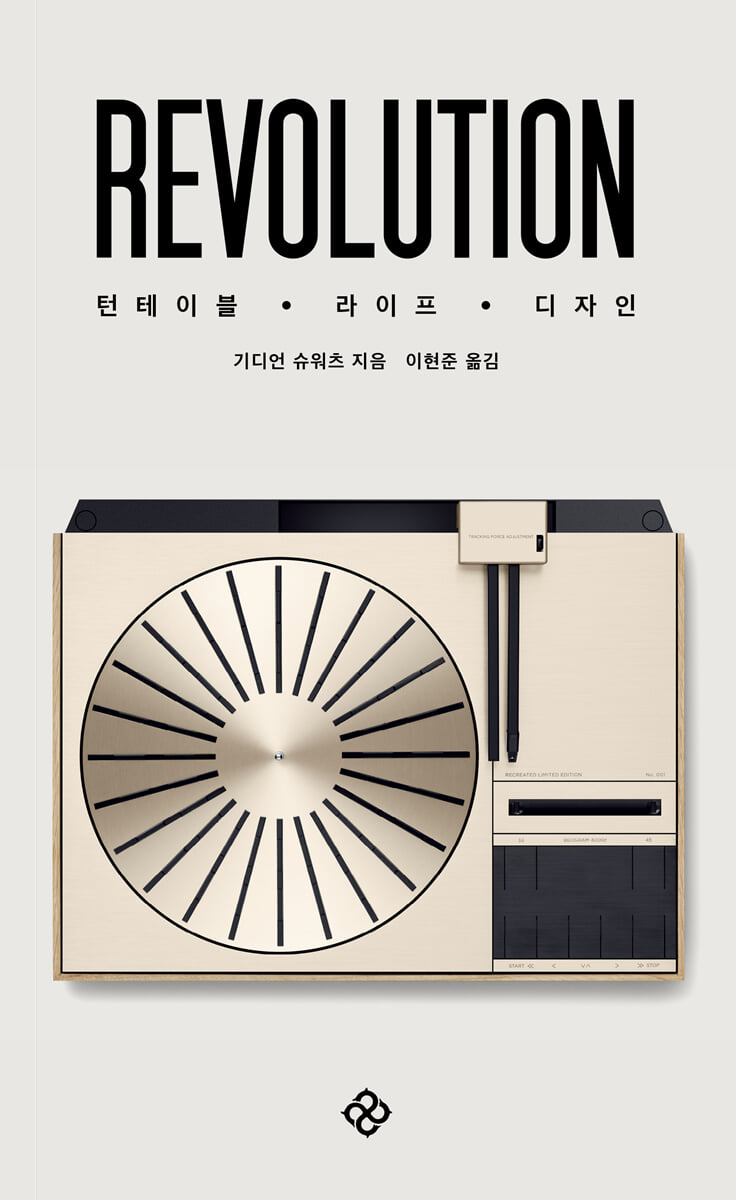
The turntable that graces the cover of 『Turntable? Life? Design』 is Bang & Olufsen's legendary model Beogram 4000c.
Jakob Jensen, who designed this model, which caused a culture shock among consumers in the 1970s, defined his design philosophy as “different, but not strange.”
Through his collaborations with Carl Gustau Seuten and Bill Hansen, he created a style completely different from conventional turntables, revolutionizing an industry that was then content with wooden plinths and bulky broadcast designs.
In addition, a feast of turntable designs that led the industrial design of the time is presented with over 300 illustrations, including quirky and witty products such as Electrohome's Apollo series inspired by science fiction, Dieter Rams' Braun turntable that symbolized the unique German modernism of the 1950s, and Acoustic Research's XA turntable that was recognized for its artistry and exhibited at the Museum of Modern Art (MoMA) in New York.
Captivating both enthusiasts and beginners
Korea's only turntable specialized book
The author, a successful lawyer in New York, quit his job and started an audio company to pursue his dream of creating audio systems.
My love and passion for music and audio systems led me to become a so-called 'fanatic', change my career, and even write a book about audio.
While the previous volume, 『Audio·Life·Design』, covered the entire audio system, including turntables, speakers, and amplifiers, this book focuses solely on the turntable, which is the core of the audio system.
Rather than simply listing manufacturers and model names, it is read as a tribute to the creators, just like the previous installment, in that it is packed with the people, efforts, and innovations that went into making the turntable what it is today.
This is the only turntable book in Korea that will captivate both audiophiles and beginners.
Its 143-year history
From 1877, when Edison invented the phonograph, until 1981, when conductor Herbert von Karajan, along with Sony, introduced the compact disc to the world at the Salzburg Easter Festival, the turntable was the dominant physical music medium.
Turntables, which had since ceded power to CDs, survived resolutely and managed to reclaim their throne in 2020 when LPs surpassed CD sales.
Today, turntables are gaining new recognition as a symbol of analog culture, allowing people to enjoy music while savoring its physical properties.
This is surprising given the extinction of so many media in the video sector, including film, VHS, LD, and DVD.
Author Gideon Schwartz calls this phenomenon the "turntable renaissance."
This book covers the history of the turntable from its birth to the present day, and argues that its revival today is the result of constant innovation.
In the late 1970s, turntable technology reached its peak of unprecedented perfection, and the 1980s and 1990s, often characterized by the rise of the CD and the decline of the LP, saw further advancements in turntable technology and design.
Many predicted that turntables would die out, much like horse-drawn carriages were replaced by automobiles in the early 20th century. But surprisingly, the turntable industry has survived to this day, enjoying a prosperous period with both established brands and emerging talent.
In an age where everything is becoming digital, turntables are becoming more prominent as they serve as the driving force behind the analog renaissance.
The history of this musical medium, which embodies the essence of craftsmanship and industrial design, awakens readers to the value of things that do not fade with time and the vitality of material properties that can be felt with the hands.
Laying the foundation for the birth of hip-hop and exhibited in an art museum
This book examines the turntable from a technological, design, and cultural perspective, spanning the decade from the acoustic era (1857–1919) before the advent of the electric phonograph, through the early electric era (1920–1949) until the mid-20th century, and from the 1950s to the 2000s, when LPs became popular.
Over the years, the components that make up a turntable, such as the tonearm, cartridge, and platter, have continuously achieved technological innovation to deliver live music as close to reality as possible.
The evolution of these turntables has also closely followed the music scene.
Designed by engineer Shuichi Obata of Japan Technics, the SL-1200 is a turntable that symbolizes 1970s DJ culture.
This model featured full speed control, allowing DJs to move the record back and forth on the platter (a technique called scratching) and then instantly return to the speed they had set.
Grandmaster Flash, known as a pioneer of hip-hop, has released "The Adventures of Grandmaster Flash on the Wheels of Steel" (1981), a song produced by cutting and scratching LPs using a Technics SL-1200.
The technological prowess condensed under the name of turntable served as a catalyst for the birth of a new art form called hip-hop.
The turntable that graces the cover of 『Turntable? Life? Design』 is Bang & Olufsen's legendary model Beogram 4000c.
Jakob Jensen, who designed this model, which caused a culture shock among consumers in the 1970s, defined his design philosophy as “different, but not strange.”
Through his collaborations with Carl Gustau Seuten and Bill Hansen, he created a style completely different from conventional turntables, revolutionizing an industry that was then content with wooden plinths and bulky broadcast designs.
In addition, a feast of turntable designs that led the industrial design of the time is presented with over 300 illustrations, including quirky and witty products such as Electrohome's Apollo series inspired by science fiction, Dieter Rams' Braun turntable that symbolized the unique German modernism of the 1950s, and Acoustic Research's XA turntable that was recognized for its artistry and exhibited at the Museum of Modern Art (MoMA) in New York.
Captivating both enthusiasts and beginners
Korea's only turntable specialized book
The author, a successful lawyer in New York, quit his job and started an audio company to pursue his dream of creating audio systems.
My love and passion for music and audio systems led me to become a so-called 'fanatic', change my career, and even write a book about audio.
While the previous volume, 『Audio·Life·Design』, covered the entire audio system, including turntables, speakers, and amplifiers, this book focuses solely on the turntable, which is the core of the audio system.
Rather than simply listing manufacturers and model names, it is read as a tribute to the creators, just like the previous installment, in that it is packed with the people, efforts, and innovations that went into making the turntable what it is today.
This is the only turntable book in Korea that will captivate both audiophiles and beginners.
GOODS SPECIFICS
- Date of issue: May 25, 2024
- Page count, weight, size: 355 pages | 552g | 132*215*21mm
- ISBN13: 9788932475097
- ISBN10: 8932475091
You may also like
카테고리
korean


korean

![GQ KOREA Mark (Monthly): December [2025]](http://librairie.coreenne.fr/cdn/shop/files/8ef265dbbfbf186523ed75ba7319009d.jpg?v=1765340328&width=3840)


