

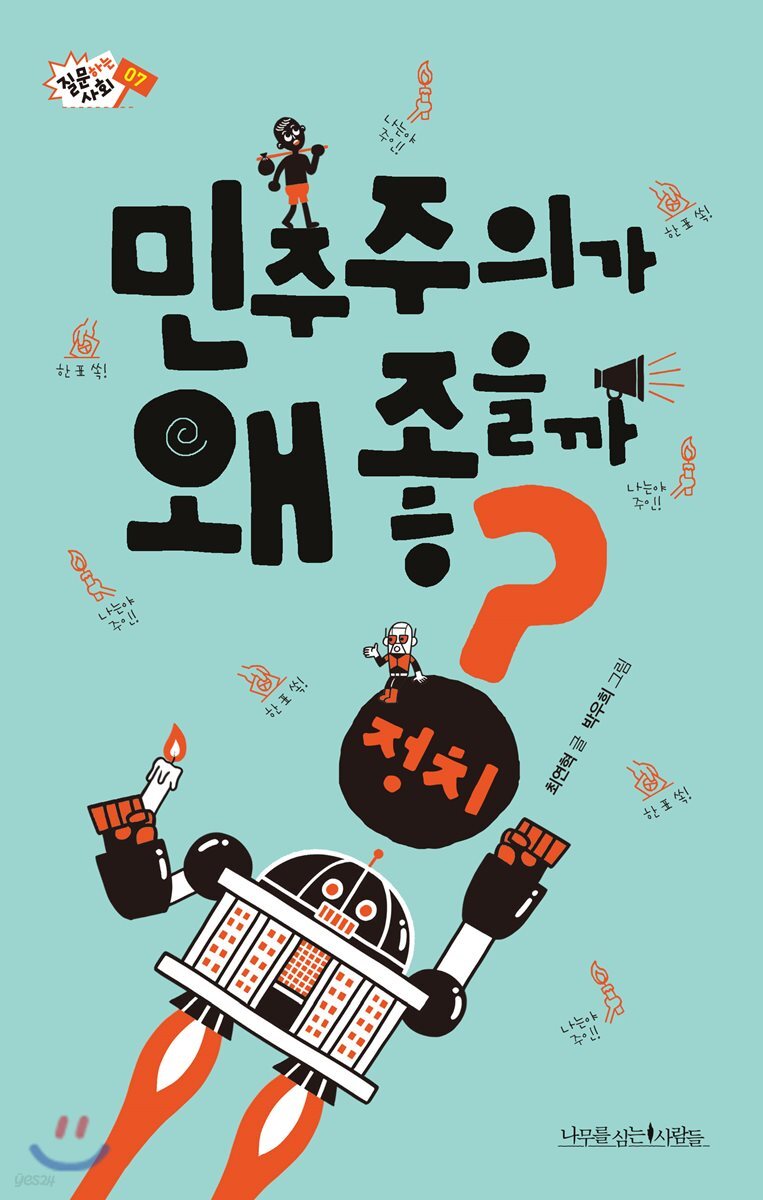
Why is democracy good?
 |
Description
Book Introduction
Professor Choi Yeon-hyeok of the Department of Political Science at Linnaeus University in Sweden
A Democracy Textbook Written for Korean Youth
What Makes Good Politics? A Global Journey of Democracy
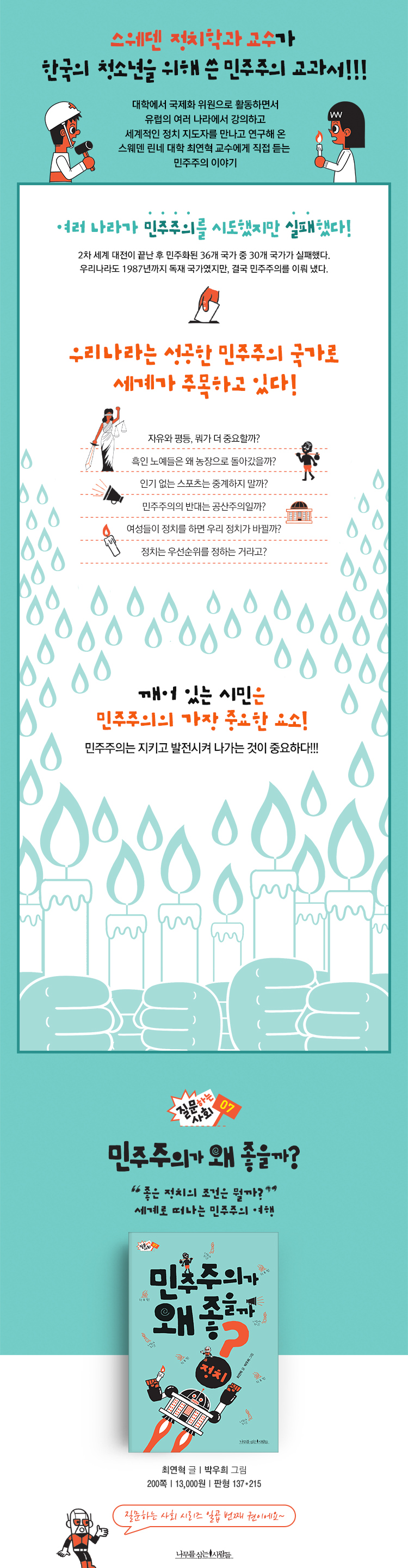
Freedom or equality, which is more important? / Why did black slaves return to the plantations?
Should unpopular sports not be broadcast? / Is the opposite of democracy communism?
If women got into politics, would our politics change? / Is politics about setting priorities?
"Why is Democracy Good?" is a political science book for young adults that organizes the most fundamental topics discussed in political science into 40 fun questions.
Freedom or equality, which is more important? What are the characteristics of democracy? Curious about the development process of democracy? What are the conditions for good governance? Is international politics driven solely by power? What kind of person should be a political leader? This book explores the entire field of political science through intriguing questions ranging from political systems to international politics to the qualities of a good ruler.
[Questioning Society] Series Volume 7
A Democracy Textbook Written for Korean Youth
What Makes Good Politics? A Global Journey of Democracy
Freedom or equality, which is more important? / Why did black slaves return to the plantations?
Should unpopular sports not be broadcast? / Is the opposite of democracy communism?
If women got into politics, would our politics change? / Is politics about setting priorities?
"Why is Democracy Good?" is a political science book for young adults that organizes the most fundamental topics discussed in political science into 40 fun questions.
Freedom or equality, which is more important? What are the characteristics of democracy? Curious about the development process of democracy? What are the conditions for good governance? Is international politics driven solely by power? What kind of person should be a political leader? This book explores the entire field of political science through intriguing questions ranging from political systems to international politics to the qualities of a good ruler.
[Questioning Society] Series Volume 7
- You can preview some of the book's contents.
Preview
index
prolog
An awakened citizenry protects democracy.
Chapter 1: Freedom or Equality: Which is More Important?
1 Why did black slaves return to the plantation?
2 How did the Count of Monte Cristo gain his freedom?
3 Can we be equal when our starting points are different?
4 Aren't we different?
Chapter 2: Characteristics of Democracy
5 What do democracy and clean air have in common?
6 What is the secret to a happy community?
Curious about the 7th democracy?
8 Should unpopular sports not be broadcast?
9 Power has three faces?
10 Are charismatic leaders cool?
Chapter 3: What kind of society do we live in?
11 Is the opposite of democracy communism?
12 Are you curious about the process of democratic development?
13 Britain is the holy land of democracy?
14 How to prevent democracy from failing?
15 Will democracy spread as the economy develops?
Chapter 4: A Democracy Journey Around the World
16 How is democracy different in Europe?
17 Who is more important, the President or the Prime Minister?
18 Are there many countries that have fallen off the wave?
19 Which three countries have been successful in surfing?
30 out of 36 democratized countries have failed?
How to get majority support in the 21st presidential election?
22 Political systems, like houses, need repairs?
Chapter 5: What are the conditions for good politics?
23 The government protects our happiness?
24 Big government or small government, which is better?
25 How many parties would be best?
26 The purpose of political parties is to gain political power?
27 The older the party, the better?
28 Will our politics change if women enter politics?
29 You learn democracy in a club?
Chapter 6: A World Where Giants and Refugees Coexist
30 Would one giant be better or two?
31 Which country puts the brakes on the giant's solo run?
32 Is international politics driven solely by power?
33 Why leave the country?
34 We are having a hard time too, should we help refugees?
35 Hard diplomacy, soft diplomacy, which is better?
Chapter 7: What kind of person should become a political leader?
36 Politics is about setting priorities?
37 What must a leader do?
38 Why are Lincoln and Mandela truly respected?
39 How to avoid corrupting society?
40 Are political leaders born or made?
An awakened citizenry protects democracy.
Chapter 1: Freedom or Equality: Which is More Important?
1 Why did black slaves return to the plantation?
2 How did the Count of Monte Cristo gain his freedom?
3 Can we be equal when our starting points are different?
4 Aren't we different?
Chapter 2: Characteristics of Democracy
5 What do democracy and clean air have in common?
6 What is the secret to a happy community?
Curious about the 7th democracy?
8 Should unpopular sports not be broadcast?
9 Power has three faces?
10 Are charismatic leaders cool?
Chapter 3: What kind of society do we live in?
11 Is the opposite of democracy communism?
12 Are you curious about the process of democratic development?
13 Britain is the holy land of democracy?
14 How to prevent democracy from failing?
15 Will democracy spread as the economy develops?
Chapter 4: A Democracy Journey Around the World
16 How is democracy different in Europe?
17 Who is more important, the President or the Prime Minister?
18 Are there many countries that have fallen off the wave?
19 Which three countries have been successful in surfing?
30 out of 36 democratized countries have failed?
How to get majority support in the 21st presidential election?
22 Political systems, like houses, need repairs?
Chapter 5: What are the conditions for good politics?
23 The government protects our happiness?
24 Big government or small government, which is better?
25 How many parties would be best?
26 The purpose of political parties is to gain political power?
27 The older the party, the better?
28 Will our politics change if women enter politics?
29 You learn democracy in a club?
Chapter 6: A World Where Giants and Refugees Coexist
30 Would one giant be better or two?
31 Which country puts the brakes on the giant's solo run?
32 Is international politics driven solely by power?
33 Why leave the country?
34 We are having a hard time too, should we help refugees?
35 Hard diplomacy, soft diplomacy, which is better?
Chapter 7: What kind of person should become a political leader?
36 Politics is about setting priorities?
37 What must a leader do?
38 Why are Lincoln and Mandela truly respected?
39 How to avoid corrupting society?
40 Are political leaders born or made?
Detailed image
Publisher's Review
Full of fresh and interesting political stories
"Is the older a political party, the better? How many parties is a good number? Why did black slaves return to the plantations? Why is there so much mafia in southern Italy? Which three countries succeeded in surfing? What are the sanctuaries of democracy? Are two superpowers more stable?" This book is filled with intriguing questions that even adults find difficult to answer.
Most people think they know a lot about politics, or they find it boring or dismissive, but reading this book will make you realize that politics is a truly fascinating world.
Let's learn something good.
A democratic journey around the world
Northern Europe is hot.
'Hygge' means a comfortable and pleasant state in Danish and Norwegian, and 'lagom' means a state of being appropriate, sufficient, and just right in Swedish.
Both are words that have become trendy in recent years.
Many people want to emulate the Nordic lifestyle, which values time with loved ones, including family and friends, and enjoys a simple and leisurely daily life.
While it's certainly good to pursue a simple and balanced life, focusing only on your personal life won't lead to lasting happiness.
We should not only like hygge, YOLO, and lagom, but also pay attention to welfare, education, and gender equality in Northern Europe.
This book deals with democracy around the world.
There are many examples, such as why Britain is called the holy land of democracy, which three countries have never had a constitutional government suspended, and which countries have succeeded in their democratic experiments.
Facts and a value-neutral perspective stand out over claims.
Author Choi Yeon-hyeok said, 'While writing the manuscript, I tried to write in a way that was between progressive and conservative values.
I hope that teachers and students at school will naturally develop their own thoughts through discussion while reading.
In order for a book to aim to cultivate healthy citizens of a country, it must not follow trends but rather maintain a clear central direction.
As with other disciplines, an objective and value-neutral perspective is especially necessary when introducing political science to young people.
Rather than emphasizing claims, it is better to deal with facts and let young people think for themselves.
This book introduces the ideologies of both conservatives and progressives, the future direction of the country, and the differences in specific policies, and asks young people to decide which side they prefer and which they believe is more correct.
An awakened citizenry is the most important element of democracy.
The author says that after 31 years in Sweden, meeting diverse people and discussing with students in class, he came to realize that an conscious citizenry is the most important element of democracy.
He also said that he has come to realize that an awakened citizenry is an important key to producing politicians who serve.
Through this book, young people will think about why democracy is a good system and how to preserve it.
A democracy textbook written for youth by a Swedish political science professor
Author Choi Yeon-hyeok received his Ph.D. in political science from the University of Gothenburg, Sweden in 1997, and is currently a professor in the Department of Political Science at Linnaeus University, Sweden.
While working as a member of the Internationalization Committee at my university, I had the opportunity to visit and experience over 60 universities around the world firsthand.
He also went to Estonia, Hungary, Czechoslovakia, Poland, and other countries as an exchange professor to give lectures.
The author, who studied comparative democracy and political leaders, said he had the opportunity to meet many politicians who were respected by the public and was deeply moved by their humility and simplicity.
He was quite different from most politicians in Korea.
The author stated that after receiving the request for a manuscript and pondering it for several days, he began writing with the belief that making political science easily accessible to middle school students, whose social cognitive abilities are rapidly developing, would also serve as a foundation for national change.
Political classes that grasp the concept naturally connect with the curriculum.
Even content that felt difficult, boring, and rigid becomes easy to understand once you grasp the concept, and you even gain confidence.
This book clearly explains dry and complex topics such as the characteristics of democracy, the role of government, the purpose of political parties, and the concept of politics.
Once you understand that the purpose of a political party is to gain political power and that politics is about setting priorities, the subject of politics becomes easier.
Young people will gain confidence in their political studies by reading through the questions and answers that are faithful to the curriculum.
"Is the older a political party, the better? How many parties is a good number? Why did black slaves return to the plantations? Why is there so much mafia in southern Italy? Which three countries succeeded in surfing? What are the sanctuaries of democracy? Are two superpowers more stable?" This book is filled with intriguing questions that even adults find difficult to answer.
Most people think they know a lot about politics, or they find it boring or dismissive, but reading this book will make you realize that politics is a truly fascinating world.
Let's learn something good.
A democratic journey around the world
Northern Europe is hot.
'Hygge' means a comfortable and pleasant state in Danish and Norwegian, and 'lagom' means a state of being appropriate, sufficient, and just right in Swedish.
Both are words that have become trendy in recent years.
Many people want to emulate the Nordic lifestyle, which values time with loved ones, including family and friends, and enjoys a simple and leisurely daily life.
While it's certainly good to pursue a simple and balanced life, focusing only on your personal life won't lead to lasting happiness.
We should not only like hygge, YOLO, and lagom, but also pay attention to welfare, education, and gender equality in Northern Europe.
This book deals with democracy around the world.
There are many examples, such as why Britain is called the holy land of democracy, which three countries have never had a constitutional government suspended, and which countries have succeeded in their democratic experiments.
Facts and a value-neutral perspective stand out over claims.
Author Choi Yeon-hyeok said, 'While writing the manuscript, I tried to write in a way that was between progressive and conservative values.
I hope that teachers and students at school will naturally develop their own thoughts through discussion while reading.
In order for a book to aim to cultivate healthy citizens of a country, it must not follow trends but rather maintain a clear central direction.
As with other disciplines, an objective and value-neutral perspective is especially necessary when introducing political science to young people.
Rather than emphasizing claims, it is better to deal with facts and let young people think for themselves.
This book introduces the ideologies of both conservatives and progressives, the future direction of the country, and the differences in specific policies, and asks young people to decide which side they prefer and which they believe is more correct.
An awakened citizenry is the most important element of democracy.
The author says that after 31 years in Sweden, meeting diverse people and discussing with students in class, he came to realize that an conscious citizenry is the most important element of democracy.
He also said that he has come to realize that an awakened citizenry is an important key to producing politicians who serve.
Through this book, young people will think about why democracy is a good system and how to preserve it.
A democracy textbook written for youth by a Swedish political science professor
Author Choi Yeon-hyeok received his Ph.D. in political science from the University of Gothenburg, Sweden in 1997, and is currently a professor in the Department of Political Science at Linnaeus University, Sweden.
While working as a member of the Internationalization Committee at my university, I had the opportunity to visit and experience over 60 universities around the world firsthand.
He also went to Estonia, Hungary, Czechoslovakia, Poland, and other countries as an exchange professor to give lectures.
The author, who studied comparative democracy and political leaders, said he had the opportunity to meet many politicians who were respected by the public and was deeply moved by their humility and simplicity.
He was quite different from most politicians in Korea.
The author stated that after receiving the request for a manuscript and pondering it for several days, he began writing with the belief that making political science easily accessible to middle school students, whose social cognitive abilities are rapidly developing, would also serve as a foundation for national change.
Political classes that grasp the concept naturally connect with the curriculum.
Even content that felt difficult, boring, and rigid becomes easy to understand once you grasp the concept, and you even gain confidence.
This book clearly explains dry and complex topics such as the characteristics of democracy, the role of government, the purpose of political parties, and the concept of politics.
Once you understand that the purpose of a political party is to gain political power and that politics is about setting priorities, the subject of politics becomes easier.
Young people will gain confidence in their political studies by reading through the questions and answers that are faithful to the curriculum.
GOODS SPECIFICS
- Date of issue: April 22, 2019
- Page count, weight, size: 200 pages | 260g | 137*215*20mm
- ISBN13: 9791186361887
- ISBN10: 1186361883
You may also like
카테고리
korean


korean

![GQ KOREA Mark (Monthly): December [2025]](http://librairie.coreenne.fr/cdn/shop/files/8ef265dbbfbf186523ed75ba7319009d.jpg?v=1765340328&width=3840)


