

The architect who doesn't build
 |
Description
Book Introduction
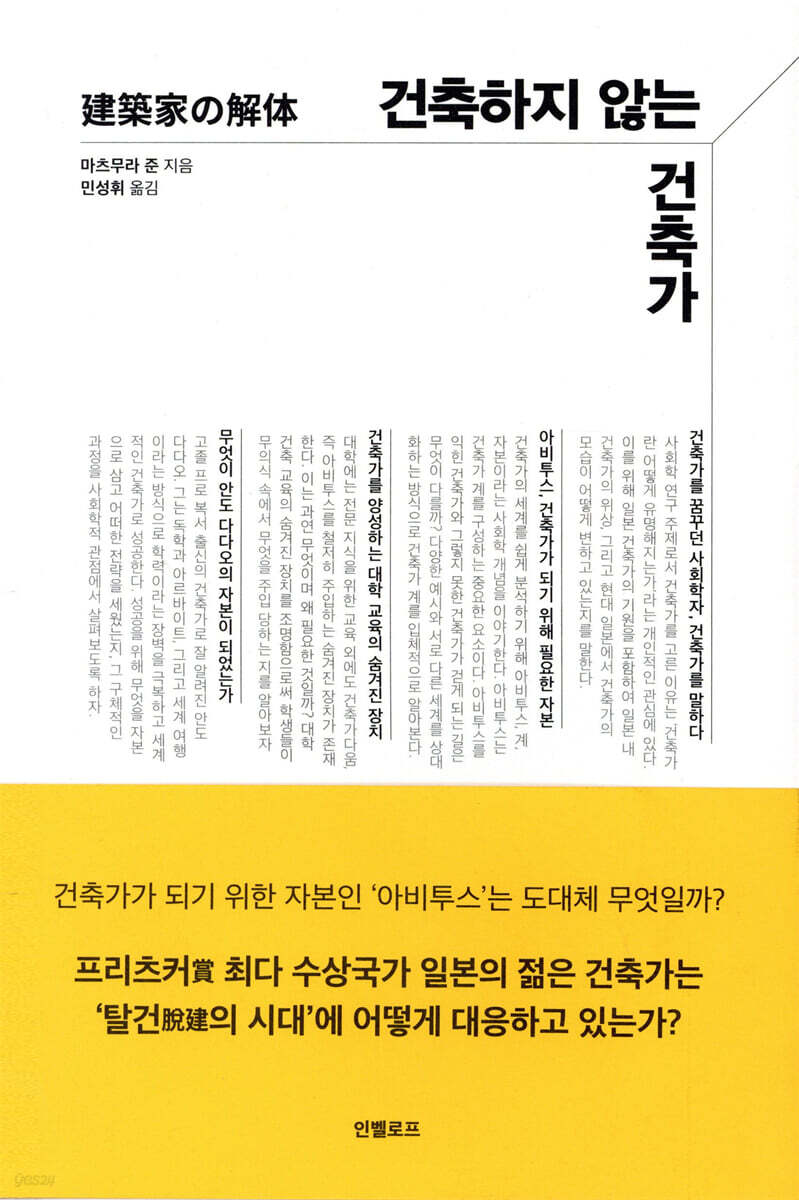
What exactly is the "habitus"—the capital necessary to become an architect—and how are young architects responding to the era of post-constructionism in Japan, the country with the most Pritzker Prize winners?
As an architect, we live in an era where we cannot make a living through architecture alone.
This is the story of young Japanese architects who took to the streets, dismantling and reassembling the architect's habitus to suit the times.
As an architect, we live in an era where we cannot make a living through architecture alone.
This is the story of young Japanese architects who took to the streets, dismantling and reassembling the architect's habitus to suit the times.
- You can preview some of the book's contents.
Preview
index
A sociologist who dreamed of becoming an architect speaks about architects.
The reason I chose architects as a sociological research topic was because of my personal question, 'How do architects become famous?'
I am interested.
To this end, the status of architects in Japan, including the origins of Japanese architects, and modern
It talks about how the image of architects is changing in Japan.
Abitus, the capital needed to become an architect
To easily analyze the world of architects, we discuss the sociological concepts of habitus, system, and capital.
Habitus is an important element that constitutes the architectural world.
What is the difference between the paths taken by architects who have mastered habitus and those who have not?
We explore the world of architecture in three dimensions through various examples and by relativizing different worlds.
The Hidden Device of University Education to Train Architects
In addition to providing specialized knowledge, universities also have a hidden mechanism to thoroughly instill the habitus, or the quality of being an architect.
What exactly is this and why is it necessary?
By illuminating the hidden mechanisms of university architectural education, we explore what students are unconsciously being taught.
What Made Tadao Ando's Capital
Tadao Ando, a well-known architect who was a high school graduate and former professional boxer.
He overcame the barrier of academic background through self-study, part-time work, and world travel to become a successful world-class architect.
What capital did you use for success and what strategies did you set up?
Let's look at the specific process from a sociological perspective.
An architect who has no choice but to design a house
In the competition with architects, housing becomes nothing more than a means to make a living.
Nevertheless, architects who dream of excellence through housing are beginning to appear, and the
What on earth was the new path?
A shift in the ideal attitude toward architects
Since the 1970s, the era of late modernity has arrived.
This led to a significant change in the ideal attitude toward architects, ultimately forcing them into an unstable position as professionals.
To reconnect with society, architects choose to illuminate faces rather than remain anonymous.
Kengo Kuma, an architect who embodies the times and a strategist.
Kengo Kuma is an architect with a critical perspective.
He diligently seeks out an architectural vision that suits the times, and sometimes reflects on himself with a reflective attitude.
It talks about how he prepares for the unknown tomorrow by always looking back and updating himself.
The architect who found his name and face on the street
The purpose of 'Deconstruction of the Architect' is to deconstruct the traditional role of the architect and create a new image of the architect.
Like an architect who does not build or an architect whose face is reflected in the street,
Architects who presented the deconstruction of architecture appeared.
It talks about the background of their emergence and the architecture they create.
The reason I chose architects as a sociological research topic was because of my personal question, 'How do architects become famous?'
I am interested.
To this end, the status of architects in Japan, including the origins of Japanese architects, and modern
It talks about how the image of architects is changing in Japan.
Abitus, the capital needed to become an architect
To easily analyze the world of architects, we discuss the sociological concepts of habitus, system, and capital.
Habitus is an important element that constitutes the architectural world.
What is the difference between the paths taken by architects who have mastered habitus and those who have not?
We explore the world of architecture in three dimensions through various examples and by relativizing different worlds.
The Hidden Device of University Education to Train Architects
In addition to providing specialized knowledge, universities also have a hidden mechanism to thoroughly instill the habitus, or the quality of being an architect.
What exactly is this and why is it necessary?
By illuminating the hidden mechanisms of university architectural education, we explore what students are unconsciously being taught.
What Made Tadao Ando's Capital
Tadao Ando, a well-known architect who was a high school graduate and former professional boxer.
He overcame the barrier of academic background through self-study, part-time work, and world travel to become a successful world-class architect.
What capital did you use for success and what strategies did you set up?
Let's look at the specific process from a sociological perspective.
An architect who has no choice but to design a house
In the competition with architects, housing becomes nothing more than a means to make a living.
Nevertheless, architects who dream of excellence through housing are beginning to appear, and the
What on earth was the new path?
A shift in the ideal attitude toward architects
Since the 1970s, the era of late modernity has arrived.
This led to a significant change in the ideal attitude toward architects, ultimately forcing them into an unstable position as professionals.
To reconnect with society, architects choose to illuminate faces rather than remain anonymous.
Kengo Kuma, an architect who embodies the times and a strategist.
Kengo Kuma is an architect with a critical perspective.
He diligently seeks out an architectural vision that suits the times, and sometimes reflects on himself with a reflective attitude.
It talks about how he prepares for the unknown tomorrow by always looking back and updating himself.
The architect who found his name and face on the street
The purpose of 'Deconstruction of the Architect' is to deconstruct the traditional role of the architect and create a new image of the architect.
Like an architect who does not build or an architect whose face is reflected in the street,
Architects who presented the deconstruction of architecture appeared.
It talks about the background of their emergence and the architecture they create.
Into the book
Even if you aim to become an architect and work as an architect, when introducing yourself to others, you will inadvertently say, “I am not an architect,” or “It is presumptuous to call myself an architect.”
Having an unstable professional identity in one's professional life is not a very happy thing.
It distinguishes between architecture and ordinary buildings, between buildings that should be preserved and old buildings that can be torn down, between work that should be done even if it costs a small amount of money and work that one does not want to get involved in even if it costs a lot of money, and furthermore, between architects and non-architects.
The criteria for making these distinctions, which architects practice unconsciously and automatically every day, are largely consistent among architects.
Why 'The Deconstruction of the Architect'?
In short, this means that the environment surrounding architects, which has been taken for granted until now, is being greatly shaken.
In the past, if you got a chance to create a piece and build a reputation by having it published in a magazine, you could get even better opportunities.
The architect's success story was that as the amount of work gradually increased, he was flooded with requests for large projects such as houses, commercial facilities, office buildings, and soon art galleries and government buildings.
However, most of these stories have now been dismantled.
This book does not want to say, “Architecture has been dismantled,” or “That’s the end.”
Rather, the argument is that the way for architects to survive is to first dismantle (the existing) architects and then create a new form of architecture from them.
From the design sense, aesthetic eye, spatial understanding, and design ability that architects have cultivated over a long period of time, these senses and skills are capital that function (only) within the architectural world.
Therefore, if the architectural world collapses, it is highly likely that some of the habitus or capital that architects have accumulated will no longer be capital.
However, in the architectural world, there are no ‘walls’ such as qualifications or systems.
Residents from other fields, such as interior designers and artists, are always on the lookout to invade the architectural world's territory.
To protect the architectural profession from such situations, each member of the profession, that is, an architect, must act as a barrier.
What the architectural community can do here is to loudly declare the difference between those who are architects and those who are not.
Whether it's a voice, text, or tweet, it's about creating a barrier in the architectural world by highlighting the differences between the two.
Compared to professionals like doctors or lawyers, the position of architects as professionals is unstable and weak.
This is because, unlike doctors or lawyers, national qualifications and professions are not firmly linked.
The national qualification of architect does not support the profession of architects alone, as it is held by many professionals involved in architecture, including architectural engineers, civil servants, managers, teachers, and carpenters.
There is no national qualification that guarantees professional competence for architects, like a medical license or a lawyer's license.
That is why we must continue to convey the meaning and value of the profession of architect so that it is not lost.
It is no exaggeration to say that the capital of the younger generation is nothing more than a logic that denies the previous generation.
And the more extreme it is, the more attention it gets.
But at the same time, it is also a very dangerous act.
We, living in the late modern era, must constantly reflect, introspect, and update ourselves to prepare for the unknown tomorrow.
This applies not only to individuals but also to all professionals.
The image of an architect embodied by Kuma can be said to be that of an architect well adapted to the late modern era.
In the process of constant reflection and progress, he reveals his own suffering that is cut to the bone by the contradiction between ideals and reality, and puts it into words that are easy to understand.
This is exposed to the public in print, and in this way, it creates people who sympathize with the architect Kengo Kuma, and strengthens the brand of Kengo Kuma.
Abitus makes you see only what you want to see.
Anything that does not fit one's values or aesthetic sense is hated and excluded.
Architects have been separating and privileging the buildings they create themselves from ordinary ‘buildings’ by calling them ‘architecture.’
Other than that, I didn't even bother to discuss it, as if it wasn't worth discussing.
However, even among the things that architects have hated and excluded, there are increasing numbers of scenes that require the architect's skills.
In other words, the future role of architects will be related to 'buildings', something they never even thought of caring about.
Rather, an architect's habitus can become a shackle to the free exercise of his or her profession.
There is no use in distinguishing between empty houses or empty stores by saying, “This is architecture,” or “That is a building.”
Moreover, it is meaningless to distinguish between architects and non-architects in an effort to preserve the function of architects.
Because in the future, there will be many scenes of flexible collaboration with many players with various functions.
It may be that the era has come when, rather than calling someone who specializes in architectural design and supervision an architect, we call the “total of all architectural-related functions,” including not only architectural design but also construction, architectural planning, and event promotion and operation.
In this book, we call those who create places with such players and two-person triangular arrangements street architects, and they are also architects with local roots.
They don't really want their work published in magazines or to become famous as architects.
In other words, I do not wish to excel in the architectural field.
They sometimes participate in place-making, such as operating a share house or co-working space as a player themselves, while also working with clients on construction or planning.
The direct response of contributing to the client's joy and the development of the street is worth more than the reward of having your work published or gaining fame.
Having an unstable professional identity in one's professional life is not a very happy thing.
It distinguishes between architecture and ordinary buildings, between buildings that should be preserved and old buildings that can be torn down, between work that should be done even if it costs a small amount of money and work that one does not want to get involved in even if it costs a lot of money, and furthermore, between architects and non-architects.
The criteria for making these distinctions, which architects practice unconsciously and automatically every day, are largely consistent among architects.
Why 'The Deconstruction of the Architect'?
In short, this means that the environment surrounding architects, which has been taken for granted until now, is being greatly shaken.
In the past, if you got a chance to create a piece and build a reputation by having it published in a magazine, you could get even better opportunities.
The architect's success story was that as the amount of work gradually increased, he was flooded with requests for large projects such as houses, commercial facilities, office buildings, and soon art galleries and government buildings.
However, most of these stories have now been dismantled.
This book does not want to say, “Architecture has been dismantled,” or “That’s the end.”
Rather, the argument is that the way for architects to survive is to first dismantle (the existing) architects and then create a new form of architecture from them.
From the design sense, aesthetic eye, spatial understanding, and design ability that architects have cultivated over a long period of time, these senses and skills are capital that function (only) within the architectural world.
Therefore, if the architectural world collapses, it is highly likely that some of the habitus or capital that architects have accumulated will no longer be capital.
However, in the architectural world, there are no ‘walls’ such as qualifications or systems.
Residents from other fields, such as interior designers and artists, are always on the lookout to invade the architectural world's territory.
To protect the architectural profession from such situations, each member of the profession, that is, an architect, must act as a barrier.
What the architectural community can do here is to loudly declare the difference between those who are architects and those who are not.
Whether it's a voice, text, or tweet, it's about creating a barrier in the architectural world by highlighting the differences between the two.
Compared to professionals like doctors or lawyers, the position of architects as professionals is unstable and weak.
This is because, unlike doctors or lawyers, national qualifications and professions are not firmly linked.
The national qualification of architect does not support the profession of architects alone, as it is held by many professionals involved in architecture, including architectural engineers, civil servants, managers, teachers, and carpenters.
There is no national qualification that guarantees professional competence for architects, like a medical license or a lawyer's license.
That is why we must continue to convey the meaning and value of the profession of architect so that it is not lost.
It is no exaggeration to say that the capital of the younger generation is nothing more than a logic that denies the previous generation.
And the more extreme it is, the more attention it gets.
But at the same time, it is also a very dangerous act.
We, living in the late modern era, must constantly reflect, introspect, and update ourselves to prepare for the unknown tomorrow.
This applies not only to individuals but also to all professionals.
The image of an architect embodied by Kuma can be said to be that of an architect well adapted to the late modern era.
In the process of constant reflection and progress, he reveals his own suffering that is cut to the bone by the contradiction between ideals and reality, and puts it into words that are easy to understand.
This is exposed to the public in print, and in this way, it creates people who sympathize with the architect Kengo Kuma, and strengthens the brand of Kengo Kuma.
Abitus makes you see only what you want to see.
Anything that does not fit one's values or aesthetic sense is hated and excluded.
Architects have been separating and privileging the buildings they create themselves from ordinary ‘buildings’ by calling them ‘architecture.’
Other than that, I didn't even bother to discuss it, as if it wasn't worth discussing.
However, even among the things that architects have hated and excluded, there are increasing numbers of scenes that require the architect's skills.
In other words, the future role of architects will be related to 'buildings', something they never even thought of caring about.
Rather, an architect's habitus can become a shackle to the free exercise of his or her profession.
There is no use in distinguishing between empty houses or empty stores by saying, “This is architecture,” or “That is a building.”
Moreover, it is meaningless to distinguish between architects and non-architects in an effort to preserve the function of architects.
Because in the future, there will be many scenes of flexible collaboration with many players with various functions.
It may be that the era has come when, rather than calling someone who specializes in architectural design and supervision an architect, we call the “total of all architectural-related functions,” including not only architectural design but also construction, architectural planning, and event promotion and operation.
In this book, we call those who create places with such players and two-person triangular arrangements street architects, and they are also architects with local roots.
They don't really want their work published in magazines or to become famous as architects.
In other words, I do not wish to excel in the architectural field.
They sometimes participate in place-making, such as operating a share house or co-working space as a player themselves, while also working with clients on construction or planning.
The direct response of contributing to the client's joy and the development of the street is worth more than the reward of having your work published or gaining fame.
--- From the text
Publisher's Review
“If the emergence of postmodernism was a turning point in ‘architecture’ that questioned the ideal architecture,
“Now is the turning point for ‘architects,’ where the profession of architect must be dismantled and reassembled.”
The author, who majored in architecture and is currently working as a sociologist, says the above.
Why should we dismantle and reassemble the profession of architect?
Architecture of the past that has aimed to create a ‘place’ that is unique in the world.
In the process of creating a 'space' to generate maximum profits,
The architect's name and face were forgotten by society.
But in the future, more than anything, a place for people to meet each other is needed.
Architects must go out into the streets and show their names and faces.
This is precisely why the profession of architect must be dismantled and reassembled.
In a rapidly changing society, it is difficult for architects to establish their professional identity.
May this be an opportunity to dismantle and reassemble your own functions.
For us who are walking in a society where we cannot see even an inch ahead,
May you have the courage to flexibly accept the changing times and live positively!
“Now is the turning point for ‘architects,’ where the profession of architect must be dismantled and reassembled.”
The author, who majored in architecture and is currently working as a sociologist, says the above.
Why should we dismantle and reassemble the profession of architect?
Architecture of the past that has aimed to create a ‘place’ that is unique in the world.
In the process of creating a 'space' to generate maximum profits,
The architect's name and face were forgotten by society.
But in the future, more than anything, a place for people to meet each other is needed.
Architects must go out into the streets and show their names and faces.
This is precisely why the profession of architect must be dismantled and reassembled.
In a rapidly changing society, it is difficult for architects to establish their professional identity.
May this be an opportunity to dismantle and reassemble your own functions.
For us who are walking in a society where we cannot see even an inch ahead,
May you have the courage to flexibly accept the changing times and live positively!
GOODS SPECIFICS
- Date of issue: April 22, 2024
- Page count, weight, size: 364 pages | 473g | 140*210*30mm
- ISBN13: 9791198698704
- ISBN10: 1198698705
You may also like
카테고리
korean


korean

![GQ KOREA Mark (Monthly): December [2025]](http://librairie.coreenne.fr/cdn/shop/files/8ef265dbbfbf186523ed75ba7319009d.jpg?v=1765340328&width=3840)


