

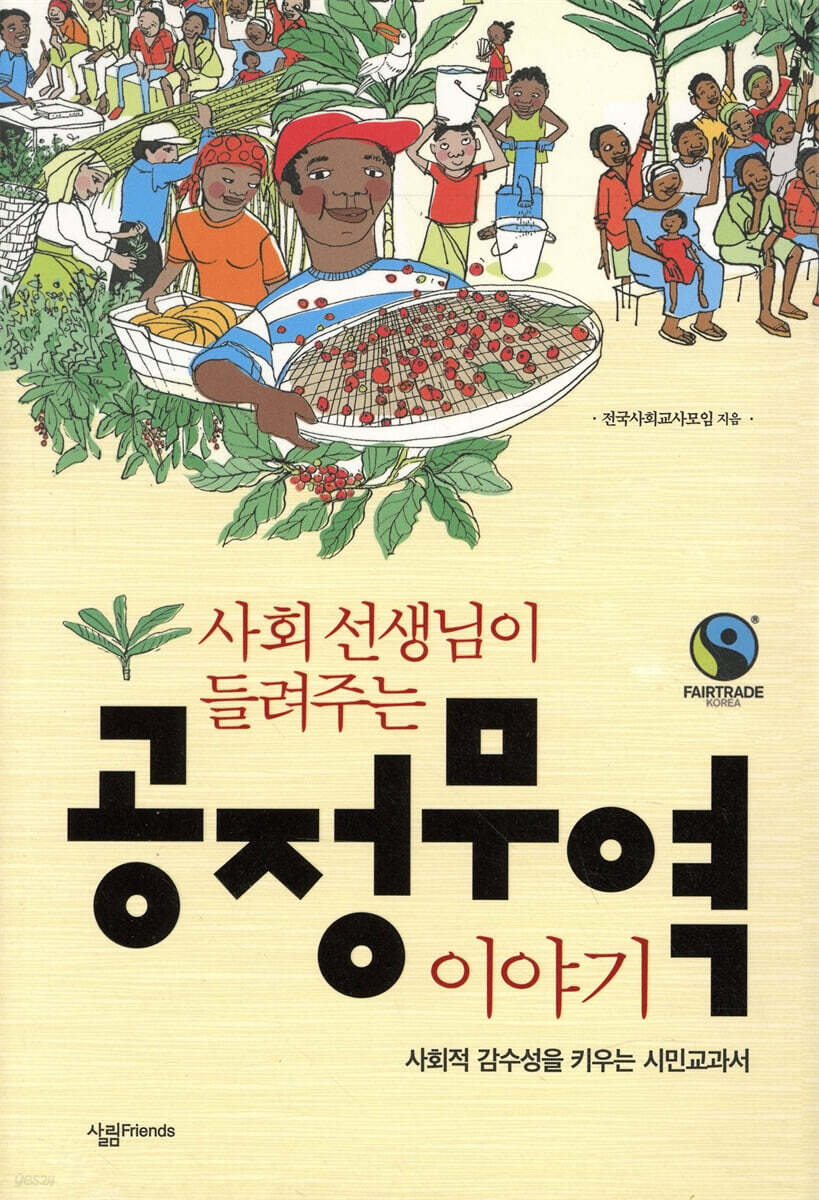
Fair Trade Stories from a Social Studies Teacher
 |
Description
Book Introduction
Before delving into the full scope of fair trade, we will examine the significance of consumption (Chapter 1), the problem of poverty (Chapter 2), and the problem of trade (Chapter 3) to provide direction on the context in which fair trade should be approached.
And based on this, we were able to think about the hopeful social image that can be created through fair trade (Chapter 4).
Through the vivid stories of producers related to fair trade (Chapter 5) and consumers (Chapter 6), I wanted to convey that the stories about fair trade discussed above are stories of life and practice.
We also covered cooperatives (Chapter 7), which play a central role in the fair trade process.
This may help us understand the characteristics of fair trade as a social economy.
And through the story of food (Chapter 8), one of the most sensitive issues in our lives, we were able to think about how fair trade can change our lives and society.
Finally, the appendix provides guidance on fair trade education activities that can be conducted in schools based on actual educational experiences.
This book is the sixth work of the National Social Studies Teachers Association, which has previously written educational books for youth, such as “Economic Stories Told by Social Studies Teachers” and “Tax Stories Told by Social Studies Teachers.”
The National Social Studies Teachers Association studies various social studies topics together and develops and shares diverse teaching materials.
This book is an excellent educational resource that broadens young people's understanding of fair trade, including the gap between rich and poor across countries and a proper understanding of the market economy.
Through their journey of understanding fair trade, readers will be able to understand not just a simple phenomenon, but the structural problems of the global economy that lie behind it.
And based on this, we were able to think about the hopeful social image that can be created through fair trade (Chapter 4).
Through the vivid stories of producers related to fair trade (Chapter 5) and consumers (Chapter 6), I wanted to convey that the stories about fair trade discussed above are stories of life and practice.
We also covered cooperatives (Chapter 7), which play a central role in the fair trade process.
This may help us understand the characteristics of fair trade as a social economy.
And through the story of food (Chapter 8), one of the most sensitive issues in our lives, we were able to think about how fair trade can change our lives and society.
Finally, the appendix provides guidance on fair trade education activities that can be conducted in schools based on actual educational experiences.
This book is the sixth work of the National Social Studies Teachers Association, which has previously written educational books for youth, such as “Economic Stories Told by Social Studies Teachers” and “Tax Stories Told by Social Studies Teachers.”
The National Social Studies Teachers Association studies various social studies topics together and develops and shares diverse teaching materials.
This book is an excellent educational resource that broadens young people's understanding of fair trade, including the gap between rich and poor across countries and a proper understanding of the market economy.
Through their journey of understanding fair trade, readers will be able to understand not just a simple phenomenon, but the structural problems of the global economy that lie behind it.
- You can preview some of the book's contents.
Preview
index
preface
Chapter 1: What to Buy and How to Live
The power of consumers to move society
“Am I not a man and a brother?”
The Power of Not Buying: How Boycotts Can Change Society
Chapter 2: Why is the world so poor?
Poverty and Democracy
Norma, the Curse of Hunger
Is poverty caused by food shortages?
Where does poverty come from?
Poverty is not a lack of resources, but a lack of democracy.
Chapter 3: If there is a life that does not change even if you change it (Trade)
Trade Story
Why is trade important?
What Can We Learn from the History of Trade?
How do trade profits arise?
The Benefits of Trade: Truth or Myth?
Is trade fair to everyone?
How can we achieve fair trade?
Chapter 4: Fair Trade: Creating Hope
Characteristics of fair trade
What's happening in Côte d'Ivoire
Why are their lives so different from ours?
Could aid be the answer?
How to trade fairly
How Fair Trade Changes People's Lives
What can I do
Chapter 5: Fair Trade Producer Stories
People I met in India and the Philippines
The life of an Indian farmer, captured in a T-shirt
What are t-shirts made of?
What changed the lives of sugarcane workers?
Chapter 6: Fair Trade Consumer Stories
People I met in England and Korea
Marsha's Fair Trade Story from England
Where is the world's first fair trade village?
Why is the fair trade movement so active in the UK?
Seoyoung's Fair Trade Story from Korea
Fair trade has arrived before we knew it.
Where can I find fair trade products in Korea?
How are producers and consumers connected through fair trade?
Chapter 7: Why Fair Trade Organizations Partner with Cooperatives
A Look Inside the Cooperative
Why did Alda Saracho choose a cooperative?
If you run a bakery as a cooperative
Cooperatives and Fair Trade
Chapter 8: Which World to Choose
Fair Trade Food Story
Can you tell the difference by looking at it and smelling it?
Is this an actor advertising a product?
Is it a fair trade mark?
There are ingredients you won't find in fair trade foods.
Can GMOs Be Fair Trade Foods?
Pesticides: For Whom Are They Used?
Which world will we choose?
Appendix Practicing Fair Trade at School
References
Chapter 1: What to Buy and How to Live
The power of consumers to move society
“Am I not a man and a brother?”
The Power of Not Buying: How Boycotts Can Change Society
Chapter 2: Why is the world so poor?
Poverty and Democracy
Norma, the Curse of Hunger
Is poverty caused by food shortages?
Where does poverty come from?
Poverty is not a lack of resources, but a lack of democracy.
Chapter 3: If there is a life that does not change even if you change it (Trade)
Trade Story
Why is trade important?
What Can We Learn from the History of Trade?
How do trade profits arise?
The Benefits of Trade: Truth or Myth?
Is trade fair to everyone?
How can we achieve fair trade?
Chapter 4: Fair Trade: Creating Hope
Characteristics of fair trade
What's happening in Côte d'Ivoire
Why are their lives so different from ours?
Could aid be the answer?
How to trade fairly
How Fair Trade Changes People's Lives
What can I do
Chapter 5: Fair Trade Producer Stories
People I met in India and the Philippines
The life of an Indian farmer, captured in a T-shirt
What are t-shirts made of?
What changed the lives of sugarcane workers?
Chapter 6: Fair Trade Consumer Stories
People I met in England and Korea
Marsha's Fair Trade Story from England
Where is the world's first fair trade village?
Why is the fair trade movement so active in the UK?
Seoyoung's Fair Trade Story from Korea
Fair trade has arrived before we knew it.
Where can I find fair trade products in Korea?
How are producers and consumers connected through fair trade?
Chapter 7: Why Fair Trade Organizations Partner with Cooperatives
A Look Inside the Cooperative
Why did Alda Saracho choose a cooperative?
If you run a bakery as a cooperative
Cooperatives and Fair Trade
Chapter 8: Which World to Choose
Fair Trade Food Story
Can you tell the difference by looking at it and smelling it?
Is this an actor advertising a product?
Is it a fair trade mark?
There are ingredients you won't find in fair trade foods.
Can GMOs Be Fair Trade Foods?
Pesticides: For Whom Are They Used?
Which world will we choose?
Appendix Practicing Fair Trade at School
References
Publisher's Review
Fair trade, good consumption that creates hope in our lives!
The problem of the gap between rich and poor among countries requires a correct understanding of the market economy.
You can see the trends and outlook of the global economy!
Books that reflect on and criticize capitalism, such as Jean Ziegler's "Why Half the World is Starving," Kayoko Ikeda's "If the World Were a Village of 100 People," and Ha-Joon Chang's "Kick Away the Ladder," have become issues.
Capitalism, which was said to collapse when it reached imperialism and could no longer find a market, has prospered so far, while socialism has collapsed.
But is capitalism still developing?
If you treat a disease called Noma within three weeks and provide nutrition, you can survive.
This disease can cause death in 3 to 5 weeks without 3 euros (about 4,200 won).
It may not seem balanced or rational.
At least if you see the starving Earthlings… … .
According to this book, "Noma" is a disease that can be cured with just 3 euros (about 4,200 won), but people suffer because they miss the treatment window (pp. 33-35).
This book presents examples of countries that responded differently to the same disease, leading to starvation in one country and economic prosperity in another.
First, the cases of Ireland and England from 1845 to 1852 are presented.
The British just watched as the Irish starved to death from potato blight (pp. 41-45).
And then he used a policy of discrimination against the dying Irish, saying they were lazy.
Second, it talks about how Ethiopia and Botswana, both in the same African continent, dealt with the severe drought problem in 1984.
At the time, Ethiopia was not interested in solving the drought or alleviating the poor, but Botswana distributed food to the poor who were on the verge of starvation and provided large-scale jobs, saving its citizens from famine (pp. 47-48).
The song “We are the World” was sung by singers who participated without pay for the dying Africans at that time.
A closer look at fair trade reveals the kind of community we should pursue.
This book contains thoughts on how we can recognize and connect the social value of fair trade to our lives.
Through the stories of life contained in fair trade, I hope to discover the connections between my life and the lives of others, and my life and the environment, and to contribute in a small way to building a mature civic consciousness that can cherish all of these.
Fair trade is not simply a profit-seeking activity that seeks to maximize economic benefits through international division of labor and exchange.
Fair trade is an alternative economic and social movement that began with concerns about poverty and environmental issues.
It provides a foundation for fair trade producers to start a better life, and encourages companies to produce eco-friendly products, thereby expanding the opportunities for consumers to live healthier lives.
In this respect, fair trade can be seen as a form of mature civil society that examines its economic activities in relation to the lives of others and the environment.
The problem of the gap between rich and poor among countries requires a correct understanding of the market economy.
You can see the trends and outlook of the global economy!
Books that reflect on and criticize capitalism, such as Jean Ziegler's "Why Half the World is Starving," Kayoko Ikeda's "If the World Were a Village of 100 People," and Ha-Joon Chang's "Kick Away the Ladder," have become issues.
Capitalism, which was said to collapse when it reached imperialism and could no longer find a market, has prospered so far, while socialism has collapsed.
But is capitalism still developing?
If you treat a disease called Noma within three weeks and provide nutrition, you can survive.
This disease can cause death in 3 to 5 weeks without 3 euros (about 4,200 won).
It may not seem balanced or rational.
At least if you see the starving Earthlings… … .
According to this book, "Noma" is a disease that can be cured with just 3 euros (about 4,200 won), but people suffer because they miss the treatment window (pp. 33-35).
This book presents examples of countries that responded differently to the same disease, leading to starvation in one country and economic prosperity in another.
First, the cases of Ireland and England from 1845 to 1852 are presented.
The British just watched as the Irish starved to death from potato blight (pp. 41-45).
And then he used a policy of discrimination against the dying Irish, saying they were lazy.
Second, it talks about how Ethiopia and Botswana, both in the same African continent, dealt with the severe drought problem in 1984.
At the time, Ethiopia was not interested in solving the drought or alleviating the poor, but Botswana distributed food to the poor who were on the verge of starvation and provided large-scale jobs, saving its citizens from famine (pp. 47-48).
The song “We are the World” was sung by singers who participated without pay for the dying Africans at that time.
A closer look at fair trade reveals the kind of community we should pursue.
This book contains thoughts on how we can recognize and connect the social value of fair trade to our lives.
Through the stories of life contained in fair trade, I hope to discover the connections between my life and the lives of others, and my life and the environment, and to contribute in a small way to building a mature civic consciousness that can cherish all of these.
Fair trade is not simply a profit-seeking activity that seeks to maximize economic benefits through international division of labor and exchange.
Fair trade is an alternative economic and social movement that began with concerns about poverty and environmental issues.
It provides a foundation for fair trade producers to start a better life, and encourages companies to produce eco-friendly products, thereby expanding the opportunities for consumers to live healthier lives.
In this respect, fair trade can be seen as a form of mature civil society that examines its economic activities in relation to the lives of others and the environment.
GOODS SPECIFICS
- Date of issue: January 25, 2017
- Page count, weight, size: 272 pages | 474g | 152*224*16mm
- ISBN13: 9788952235763
- ISBN10: 8952235762
You may also like
카테고리
korean


korean

![GQ KOREA Mark (Monthly): December [2025]](http://librairie.coreenne.fr/cdn/shop/files/8ef265dbbfbf186523ed75ba7319009d.jpg?v=1765340328&width=3840)


