

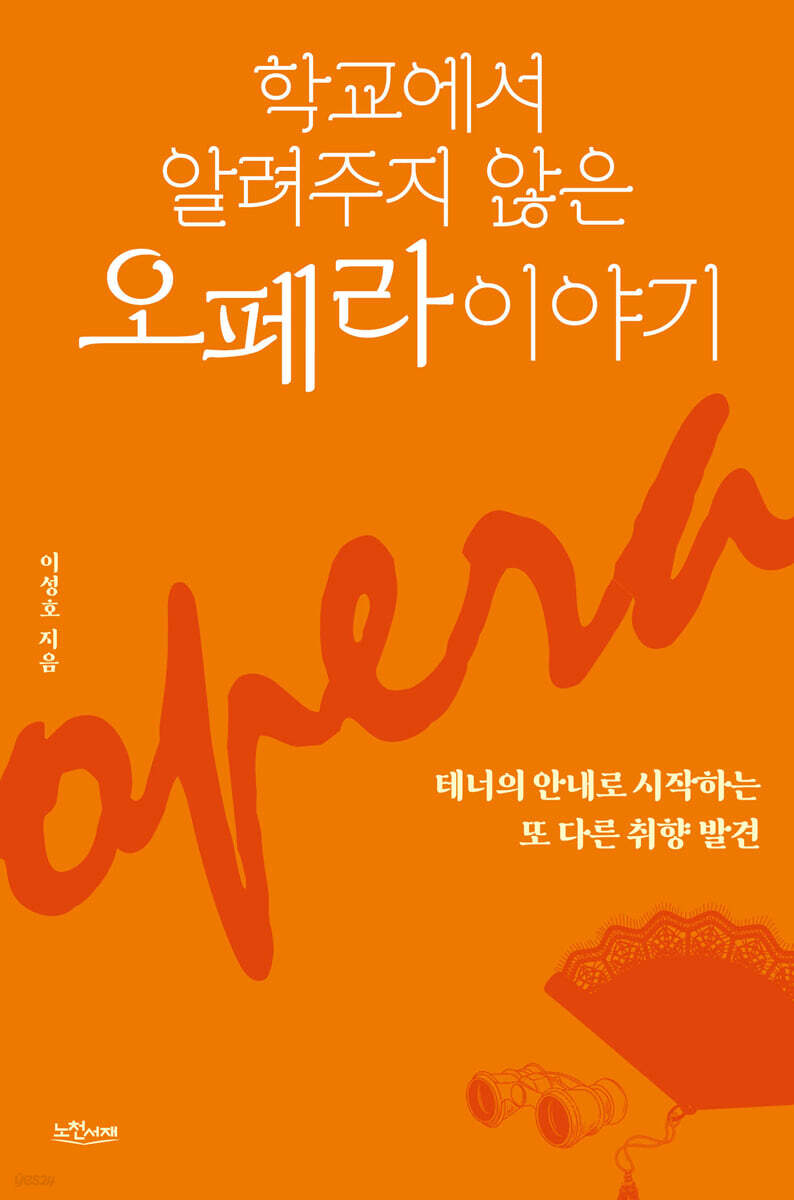
Opera Stories You Didn't Learn at School
 |
Description
Book Introduction
A song that sticks to your ears,
A story more thrilling than a daily drama…
I have been mistaken in thinking that opera is the exclusive domain of the 'educated'.
A book for you
-Did Verdi know from the beginning that 'A Woman's Heart' would come to him?
-What happens when both the person singing the 'Cheers Song' and the person listening feel awkward at the same time?
-Do students in the vocal music department also speak German or Italian well?
-How was Wagner able to both compose and write plays?
-Why were there criticisms that disparaged Puccini?
-Why are so many operas set in the Andalusian region of Spain?
As we follow the guidance of the author, a tenor and classical music commentator,
Before I knew it, my playlist was enriched!
How many people in our country have seen an opera performance at least once in their lives? There's no way to get a definitive answer, but it's safe to assume the number isn't very high.
Compared to musicals, which are so popular that they even give rise to terms like 'picketing' and 'repeated viewings,' there seems to be a fairly common prejudice that opera is a difficult genre.
For those who still think that opera is an art form enjoyed only by special people, this book, “Opera Stories They Don’t Teach You in School,” serves as a friendly guide.
The author, who has performed on stage as a tenor and has also consistently worked as a music commentator and performance planner, carefully follows the flow of music history and illuminates eighteen operas in his own unique way.
He covers a variety of topics, including the arias and overtures in the work, the lives of the composer and librettist, and sometimes introduces the characteristics of the piece by drawing on his own stage experience, or offers advice on vocal technique.
Furthermore, the author's writing, which covers a wide range of literary works that influenced the birth of opera, as well as scenes from world history related to the period of composition and playwriting, also provides an enjoyable humanistic approach to opera.
You can follow along with "Opera Stories They Never Taught You in School" and listen to the familiar melodies of arias that have survived for hundreds of years, or you can first skim through popular narratives that rival any daily drama.
It won't take long to get close to the opera.
It's okay if you've never seen an opera performance in person at a theater, and you don't remember learning opera properly in music class at school.
What's the problem with music streaming sites that only play songs at the top of the charts and never even think to look for opera arias?
Through this book, you will be able to get closer to a new and wonderful taste in music, starting today.
A story more thrilling than a daily drama…
I have been mistaken in thinking that opera is the exclusive domain of the 'educated'.
A book for you
-Did Verdi know from the beginning that 'A Woman's Heart' would come to him?
-What happens when both the person singing the 'Cheers Song' and the person listening feel awkward at the same time?
-Do students in the vocal music department also speak German or Italian well?
-How was Wagner able to both compose and write plays?
-Why were there criticisms that disparaged Puccini?
-Why are so many operas set in the Andalusian region of Spain?
As we follow the guidance of the author, a tenor and classical music commentator,
Before I knew it, my playlist was enriched!
How many people in our country have seen an opera performance at least once in their lives? There's no way to get a definitive answer, but it's safe to assume the number isn't very high.
Compared to musicals, which are so popular that they even give rise to terms like 'picketing' and 'repeated viewings,' there seems to be a fairly common prejudice that opera is a difficult genre.
For those who still think that opera is an art form enjoyed only by special people, this book, “Opera Stories They Don’t Teach You in School,” serves as a friendly guide.
The author, who has performed on stage as a tenor and has also consistently worked as a music commentator and performance planner, carefully follows the flow of music history and illuminates eighteen operas in his own unique way.
He covers a variety of topics, including the arias and overtures in the work, the lives of the composer and librettist, and sometimes introduces the characteristics of the piece by drawing on his own stage experience, or offers advice on vocal technique.
Furthermore, the author's writing, which covers a wide range of literary works that influenced the birth of opera, as well as scenes from world history related to the period of composition and playwriting, also provides an enjoyable humanistic approach to opera.
You can follow along with "Opera Stories They Never Taught You in School" and listen to the familiar melodies of arias that have survived for hundreds of years, or you can first skim through popular narratives that rival any daily drama.
It won't take long to get close to the opera.
It's okay if you've never seen an opera performance in person at a theater, and you don't remember learning opera properly in music class at school.
What's the problem with music streaming sites that only play songs at the top of the charts and never even think to look for opera arias?
Through this book, you will be able to get closer to a new and wonderful taste in music, starting today.
- You can preview some of the book's contents.
Preview
index
Opening remarks
How to get one step closer to opera
Part 1.
A special way music and story meet
·Handel, still relevant today, and the now-extinct castrati
-Handel, Rinaldo
·What comes first, music or narrative?
-Gluck, Orfeo ed Euridice
·〈Conversation with a Tenor〉 What is the difference between opera and musical?
·The relationship between revolution and opera
-Mozart, The Marriage of Figaro
·〈Conversation with a Tenor〉 How on earth does one vocalize?
·Recalling memories of the 19+ rated "Don Juan"
-Mozart, Don Giovanni
·Magic flute? Not a magician?
-Mozart, The Magic Flute
·If you endure a little longer, an opportunity will come!
-Beethoven, Fidelio
·〈Conversation with a Tenor〉 About a slightly special overture
·The special charm of orchestral music experienced at opera
-Weber, The Freischutz
·The world of the composer Wagner
-Wagner, Tannhäuser
Part 2.
To better understand bel canto and Verdi
If there was a drug that would help you fall in love
-Donizetti, The Elixir of Love
·The librettists of the opera "Conversation with a Tenor"
·The difficult process leading to marriage
-Rossini, The Barber of Seville
Camellia and Violetta
-Verdi, La traviata
·I have a feeling it will be a big hit
-Verdi, Rigoletto
·Kim Seon-dal, Trovatore, and Creator
-Verdi, Il trovatore
·〈Conversation with a Tenor〉 How is an opera made?
Part 3.
More realistically or with a more beautiful melody!
·The special charm of ordinary people
-Bizet, Carmen
·Realistically, more realistically
-Mascagni, Cavalleria rusticana
Why we need to distinguish between drama and reality
-Ruggero Leoncavallo, Pagliacci
·〈Conversation with a Tenor〉 If you go to the vocal music department
·The audacity to hit the back of the head until the very end
-Puccini, Gianni Schicchi
The power of storytelling
-Puccini, Turandot
References
How to get one step closer to opera
Part 1.
A special way music and story meet
·Handel, still relevant today, and the now-extinct castrati
-Handel, Rinaldo
·What comes first, music or narrative?
-Gluck, Orfeo ed Euridice
·〈Conversation with a Tenor〉 What is the difference between opera and musical?
·The relationship between revolution and opera
-Mozart, The Marriage of Figaro
·〈Conversation with a Tenor〉 How on earth does one vocalize?
·Recalling memories of the 19+ rated "Don Juan"
-Mozart, Don Giovanni
·Magic flute? Not a magician?
-Mozart, The Magic Flute
·If you endure a little longer, an opportunity will come!
-Beethoven, Fidelio
·〈Conversation with a Tenor〉 About a slightly special overture
·The special charm of orchestral music experienced at opera
-Weber, The Freischutz
·The world of the composer Wagner
-Wagner, Tannhäuser
Part 2.
To better understand bel canto and Verdi
If there was a drug that would help you fall in love
-Donizetti, The Elixir of Love
·The librettists of the opera "Conversation with a Tenor"
·The difficult process leading to marriage
-Rossini, The Barber of Seville
Camellia and Violetta
-Verdi, La traviata
·I have a feeling it will be a big hit
-Verdi, Rigoletto
·Kim Seon-dal, Trovatore, and Creator
-Verdi, Il trovatore
·〈Conversation with a Tenor〉 How is an opera made?
Part 3.
More realistically or with a more beautiful melody!
·The special charm of ordinary people
-Bizet, Carmen
·Realistically, more realistically
-Mascagni, Cavalleria rusticana
Why we need to distinguish between drama and reality
-Ruggero Leoncavallo, Pagliacci
·〈Conversation with a Tenor〉 If you go to the vocal music department
·The audacity to hit the back of the head until the very end
-Puccini, Gianni Schicchi
The power of storytelling
-Puccini, Turandot
References
Into the book
The sound produced when the vocal cords on both sides vibrate without contact is falsetto, and the sound produced when the vocal cords on both sides vibrate while contacting each other is true.
Sounds that involve excessive vocal cord contact are commonly referred to as 'raw voice'.
For vocalization, you must use your true voice, so it is important to train yourself to produce sounds with little vocal cord contact.
This technique is called 'timbro' in Italian.
In addition to meaning tone and quality, it also has the meaning of a seal or stamp.
--- p.44~45
The citizens of Prague were enthusiastic about The Marriage of Figaro.
They wanted Mozart to stay in Prague and to premiere his new opera there.
Eventually, Mozart composed and premiered an opera in Prague, Czech Republic in 1787, and that work was the opera “Don Giovanni,” written with a libretto by Lorenzo da Ponte.
Some might argue that Da Ponte's libretto is not a perfect creation, as there were other works that influenced the writing of the libretto for Don Giovanni.
However, it is clear that da Ponte made this work into a masterpiece that has remained beloved for hundreds of years.
--- p.55
I have never performed Tannhäuser, but I remember singing the Pilgrim's Chorus two or three times.
This male choir piece, often sung in choir performances, is actually quite difficult.
When you think the harmony is right, it isn't, and when it doesn't seem right, you find yourself singing with the harmony right.
Aren't these characteristics also a perfect example of Wagner's greatness?
--- p.94
Above all, the most famous aria from “The Elixir of Love” is “Tears shed in secret.”
This famous song, sung by the poor male protagonist Nemorino, who thinks his love for Adina is almost fulfilled, begins in a dark minor key, but changes to a bright major key as the song progresses.
Romani, who wrote the script, reportedly recommended revisions to the song, saying it would disrupt the overall flow.
But Donizetti wanted to proceed, and the result was a great success.
--- p.104~105
It is said that through the work on the libretto for the opera "Carmen," many of the cruel and provocative contents depicted in the original realistic novel were removed.
Nonetheless, the libretto and music of Carmen were considered quite new and groundbreaking when it premiered in 1875.
In fact, the Comique Theatre in France, where the premiere took place, was a popular place for families to watch performances at the time.
However, the Carmen premiered here was far from a family drama with a beautiful story or moving music.
It was understandable that the audiences and critics of the Comique theater would have found it difficult to accept a work in which a soldier deserts for the sake of a gypsy woman who works in a cigarette factory, mixes with smugglers, and lives in a criminal organization, and in the end, the soldier, blinded by jealousy, kills his lover after losing everything.
--- p.157
Although there is some debate as to whether it is based on a true story, Pagliacci is considered one of the representative works of realistic opera, or verismo opera.
Traditionally, in tragedy, the protagonists were often gods, royalty, or nobles.
In operas, the protagonists of tragedies were usually of high social status, but starting with Bizet's opera "Carmen," the protagonists and content of tragedies began to change.
Young Italian composers were shocked when they saw Carmen performed in Paris.
And I felt a sense of crisis that operas from Germany and France were leading the change more than operas from Italy, the home of opera.
The new attempt that resulted from this was the verismo opera.
--- p.172
Through choir classes, we learned to cultivate our own strong individuality and collaborate with each other.
Almost everyone who majors in vocal music wants to work as a soloist, but the feeling of unity through this choir is also a great benefit.
Some schools have concert choirs comprised solely of vocalists and musicians.
If you choose to major in opera, you can also experience a workshop class where you can create opera scenes together.
--- p.180
Sometimes, because he put forward beautiful melodies that garnered immediate popular response, Puccini was often criticized by critics as being light and shallow.
Nonetheless, there is no doubt that Puccini was a great composer with the ability to please the public's ears.
The ability to create so-called 'catchy' melodies is not something that just anyone can possess.
Sounds that involve excessive vocal cord contact are commonly referred to as 'raw voice'.
For vocalization, you must use your true voice, so it is important to train yourself to produce sounds with little vocal cord contact.
This technique is called 'timbro' in Italian.
In addition to meaning tone and quality, it also has the meaning of a seal or stamp.
--- p.44~45
The citizens of Prague were enthusiastic about The Marriage of Figaro.
They wanted Mozart to stay in Prague and to premiere his new opera there.
Eventually, Mozart composed and premiered an opera in Prague, Czech Republic in 1787, and that work was the opera “Don Giovanni,” written with a libretto by Lorenzo da Ponte.
Some might argue that Da Ponte's libretto is not a perfect creation, as there were other works that influenced the writing of the libretto for Don Giovanni.
However, it is clear that da Ponte made this work into a masterpiece that has remained beloved for hundreds of years.
--- p.55
I have never performed Tannhäuser, but I remember singing the Pilgrim's Chorus two or three times.
This male choir piece, often sung in choir performances, is actually quite difficult.
When you think the harmony is right, it isn't, and when it doesn't seem right, you find yourself singing with the harmony right.
Aren't these characteristics also a perfect example of Wagner's greatness?
--- p.94
Above all, the most famous aria from “The Elixir of Love” is “Tears shed in secret.”
This famous song, sung by the poor male protagonist Nemorino, who thinks his love for Adina is almost fulfilled, begins in a dark minor key, but changes to a bright major key as the song progresses.
Romani, who wrote the script, reportedly recommended revisions to the song, saying it would disrupt the overall flow.
But Donizetti wanted to proceed, and the result was a great success.
--- p.104~105
It is said that through the work on the libretto for the opera "Carmen," many of the cruel and provocative contents depicted in the original realistic novel were removed.
Nonetheless, the libretto and music of Carmen were considered quite new and groundbreaking when it premiered in 1875.
In fact, the Comique Theatre in France, where the premiere took place, was a popular place for families to watch performances at the time.
However, the Carmen premiered here was far from a family drama with a beautiful story or moving music.
It was understandable that the audiences and critics of the Comique theater would have found it difficult to accept a work in which a soldier deserts for the sake of a gypsy woman who works in a cigarette factory, mixes with smugglers, and lives in a criminal organization, and in the end, the soldier, blinded by jealousy, kills his lover after losing everything.
--- p.157
Although there is some debate as to whether it is based on a true story, Pagliacci is considered one of the representative works of realistic opera, or verismo opera.
Traditionally, in tragedy, the protagonists were often gods, royalty, or nobles.
In operas, the protagonists of tragedies were usually of high social status, but starting with Bizet's opera "Carmen," the protagonists and content of tragedies began to change.
Young Italian composers were shocked when they saw Carmen performed in Paris.
And I felt a sense of crisis that operas from Germany and France were leading the change more than operas from Italy, the home of opera.
The new attempt that resulted from this was the verismo opera.
--- p.172
Through choir classes, we learned to cultivate our own strong individuality and collaborate with each other.
Almost everyone who majors in vocal music wants to work as a soloist, but the feeling of unity through this choir is also a great benefit.
Some schools have concert choirs comprised solely of vocalists and musicians.
If you choose to major in opera, you can also experience a workshop class where you can create opera scenes together.
--- p.180
Sometimes, because he put forward beautiful melodies that garnered immediate popular response, Puccini was often criticized by critics as being light and shallow.
Nonetheless, there is no doubt that Puccini was a great composer with the ability to please the public's ears.
The ability to create so-called 'catchy' melodies is not something that just anyone can possess.
--- p.189
Publisher's Review
The world of opera arias becomes more captivating the more you know about them.
Actually, if you think about it, opera is a pretty easy genre.
There was a time in this country when even elementary school students who had no idea what “Rigoletto” was doing would hum a few lines of “A Woman’s Heart,” albeit with the lyrics changed to “Give me some time, I have places to go.”
Some people may not know the Magic Flute very well, but they probably remember the high-pitched voices of celebrities who imitated it on variety shows, so they probably know the aria sung by the Queen of the Night.
Meanwhile, there are probably quite a few people out there who are still captivated by the shout of "Vinchero!" by a singer who sings both trot and vocal music, and who know the meaning of the phrase "Nessun dorma" even though they have never seen the play "Turandot."
If you think about it, there are already more than enough opera arias we know.
Just by considering that it is a cradle of famous songs that have already become familiar to us, whether we know it or not, opera can already be considered a comprehensive art form with sufficient popularity.
This book, "Opera Stories They Don't Teach You in School," tells us in another way that opera is a genre that is "easy to approach and becomes more interesting the more you learn about it."
The first chapter also begins with a story about the opera Rinaldo and the song "Lascia ch'io pianga" that anyone who hears it will know.
If you have ever been captivated by the voice of a castrato after hearing the song "Let Me Cry" inserted in the movie "Farinelli," you will be able to more easily approach the narrative of "Rinaldo" and Handel's life introduced by the author.
The author devotes ample space to explaining what meaning the popularly known arias have in opera and what musical characteristics they have.
Through this book, some readers may enjoy learning that the famous "Oh, My Dear Father" is a song of a daughter desperately asking her conman father to help her marry the man she loves, and that "A Woman's Heart," which seems to be a song of lively and beautiful courtship, is actually an aria of a lustful man expressing the reasons for his womanizing.
Following the author's commentary on songs that could be called "Koreans' favorite opera arias," such as "Tears Shed in Secret," "Cheers," "Toreador's Song," and "Let No One Sleep," you will be able to experience hearing those familiar songs in a new way.
Reading free-spirited comprehensive art alongside history and literature
Of course, not all of the music is familiar.
The charm of opera also lies in the story.
In fact, the narratives contained in many operas are more popular than one might think.
Furthermore, it is provocative.
Is Carmen the only story about a woman who works in a silk cigarette factory and lives with smugglers, and a man who, blinded by love and jealousy, deserts and even commits murder?
In Cavalleria Rusticana, a representative work of the 'verismo opera' that realistically depicts characters and events, a man who continues to meet his old lover even after marriage dies after a duel with the so-called 'current husband of his ex-girlfriend'.
Pagliacci, one of the verismo operas, is also quite impressive.
This work contains a tragic narrative of a husband who witnesses his wife's infidelity and becomes so enraged that he commits murder.
Another unique pleasure this book offers is that you can experience the 'spicy' story of a popular opera, sometimes as spicy as any drama, without the language barrier.
Opera is a comprehensive art form that has survived for hundreds of years, and it can be enjoyed with a different charm when viewed with a focus on a specific point in world history.
This book also suggests a way to become familiar with opera through a slightly more humanistic approach.
The author discusses Beethoven's only opera, Fidelio, mentioning the relationship between Beethoven and Napoleon, and in his essay on The Barber of Seville, he discusses why Andalusia, Spain, was chosen as the setting for the work in an era when censorship of art was severe.
After reading this book, some people will be able to see the connection between the French Revolution and Mozart while watching The Marriage of Figaro.
The author's story about the characteristics of the composer's era and the historical background of the work will certainly serve as a meaningful guide for those who want to enjoy 'reading' opera from a historical perspective.
In "Opera Stories They Don't Teach You in School," the close relationship between opera and literature is often discussed.
Explanations of the novel by Alexandre Dumas fils, which influenced the creation of "La Traviata," and the short story of the same name, which is the original work of "Carmen," provide a foundation for a richer appreciation of the opera.
Some readers may encounter the narratives of Orpheus and Eurydice or Turandot in this book and then look for and read Greek Mythology or A Thousand and One Days.
Meanwhile, the author also piques the reader's curiosity with stories about librettists like Lorenzo da Ponte, who created operas together with composers.
While some composers, like Wagner, were both composers and librettists, many others collaborated with librettists to create operas. Readers will be able to broaden their perspectives on operas by learning about those who wrote the operas.
Discover new musical tastes through the guidance of a tenor
Even among those who enjoy classical music to a great extent, there are many who frequently attend recitals, solo concerts, and orchestral performances, but still find it difficult to readily 'challenge' opera.
Perhaps the language barrier could be one of the reasons.
To better enjoy songs in languages other than English, such as German or Italian, you need to at least look at the translated lyrics, and the passion to go through that effort is less common than you might think.
This book serves as a more practical guide for readers who only knew the melody but did not have the opportunity to know what the lyrics were about or which part of the work it was used in.
For example, the aria "Nessun dorma (Let No One Sleep)", which is considered the best aria in Turandot, is remembered by its title "The Princess Cannot Sleep" and many people think it is a song about a princess who is so in love that she cannot sleep. However, it is actually a song sung by a prince who has a premonition of victory as he watches the princess pestering her subjects all night to solve a riddle.
The lyrics of 'Vincero' sound a little more special when you read and listen to this content.
The author, who is active as a vocalist, also sparks interest in vocal music in a special way by sharing his experiences singing on stage.
Reading the author's writing about the occasion when he sang "Tears Shed in Secret" in front of a single audience member, and the reason why he might feel embarrassed by the audience's applause when singing "The Song of Celebration," gives one the pleasure of getting a glimpse into the life of a vocalist.
Readers who broaden their musical tastes by following stories about the lives of composers or the history of music will find this book worth paying attention to, including the conflict between the Wagner and Brahms factions and Gluck's opera reforms that emphasized narrative.
Furthermore, readers who feel particularly burdened by the language barrier are more likely to truly discover the charm of opera only in the world of opera overtures guided by the author.
On the other hand, this book also shows the possibility of becoming closer to opera through film.
Film fans who particularly remember the scene in The Shawshank Redemption where the prisoners listen to the aria together through the prison speaker or the tragic ending of The Godfather: Part III will be even more delighted to read about The Marriage of Figaro or Cavalleria Rusticana.
Readers interested in vocal music may want to pay more attention to the section titled 'Conversation with a Tenor.'
In 'Conversation with a Tenor', the author explains breathing, vocal cords, resonance, etc., introduces vocal techniques, and also tells you what classes you will take if you go to a vocal music department.
Information that is difficult to access without taking vocal lessons for entrance exams or as a hobby is sometimes provided professionally and sometimes casually.
How many people in this world actually bother to listen to music? Even those who enjoy music quite a bit tend to just tune in to the top charts on streaming sites, or they rely on the algorithms of video sites to keep them going.
But aren't there days when you suddenly feel like listening to music you normally wouldn't listen to?
On such a day, listening to the opera arias in this book might be a pretty good choice.
The fact that the song has survived for hundreds of years is probably a pretty reliable indicator anyway.
In fact, filling a meager playlist and sloppy tastes isn't all that difficult.
Actually, if you think about it, opera is a pretty easy genre.
There was a time in this country when even elementary school students who had no idea what “Rigoletto” was doing would hum a few lines of “A Woman’s Heart,” albeit with the lyrics changed to “Give me some time, I have places to go.”
Some people may not know the Magic Flute very well, but they probably remember the high-pitched voices of celebrities who imitated it on variety shows, so they probably know the aria sung by the Queen of the Night.
Meanwhile, there are probably quite a few people out there who are still captivated by the shout of "Vinchero!" by a singer who sings both trot and vocal music, and who know the meaning of the phrase "Nessun dorma" even though they have never seen the play "Turandot."
If you think about it, there are already more than enough opera arias we know.
Just by considering that it is a cradle of famous songs that have already become familiar to us, whether we know it or not, opera can already be considered a comprehensive art form with sufficient popularity.
This book, "Opera Stories They Don't Teach You in School," tells us in another way that opera is a genre that is "easy to approach and becomes more interesting the more you learn about it."
The first chapter also begins with a story about the opera Rinaldo and the song "Lascia ch'io pianga" that anyone who hears it will know.
If you have ever been captivated by the voice of a castrato after hearing the song "Let Me Cry" inserted in the movie "Farinelli," you will be able to more easily approach the narrative of "Rinaldo" and Handel's life introduced by the author.
The author devotes ample space to explaining what meaning the popularly known arias have in opera and what musical characteristics they have.
Through this book, some readers may enjoy learning that the famous "Oh, My Dear Father" is a song of a daughter desperately asking her conman father to help her marry the man she loves, and that "A Woman's Heart," which seems to be a song of lively and beautiful courtship, is actually an aria of a lustful man expressing the reasons for his womanizing.
Following the author's commentary on songs that could be called "Koreans' favorite opera arias," such as "Tears Shed in Secret," "Cheers," "Toreador's Song," and "Let No One Sleep," you will be able to experience hearing those familiar songs in a new way.
Reading free-spirited comprehensive art alongside history and literature
Of course, not all of the music is familiar.
The charm of opera also lies in the story.
In fact, the narratives contained in many operas are more popular than one might think.
Furthermore, it is provocative.
Is Carmen the only story about a woman who works in a silk cigarette factory and lives with smugglers, and a man who, blinded by love and jealousy, deserts and even commits murder?
In Cavalleria Rusticana, a representative work of the 'verismo opera' that realistically depicts characters and events, a man who continues to meet his old lover even after marriage dies after a duel with the so-called 'current husband of his ex-girlfriend'.
Pagliacci, one of the verismo operas, is also quite impressive.
This work contains a tragic narrative of a husband who witnesses his wife's infidelity and becomes so enraged that he commits murder.
Another unique pleasure this book offers is that you can experience the 'spicy' story of a popular opera, sometimes as spicy as any drama, without the language barrier.
Opera is a comprehensive art form that has survived for hundreds of years, and it can be enjoyed with a different charm when viewed with a focus on a specific point in world history.
This book also suggests a way to become familiar with opera through a slightly more humanistic approach.
The author discusses Beethoven's only opera, Fidelio, mentioning the relationship between Beethoven and Napoleon, and in his essay on The Barber of Seville, he discusses why Andalusia, Spain, was chosen as the setting for the work in an era when censorship of art was severe.
After reading this book, some people will be able to see the connection between the French Revolution and Mozart while watching The Marriage of Figaro.
The author's story about the characteristics of the composer's era and the historical background of the work will certainly serve as a meaningful guide for those who want to enjoy 'reading' opera from a historical perspective.
In "Opera Stories They Don't Teach You in School," the close relationship between opera and literature is often discussed.
Explanations of the novel by Alexandre Dumas fils, which influenced the creation of "La Traviata," and the short story of the same name, which is the original work of "Carmen," provide a foundation for a richer appreciation of the opera.
Some readers may encounter the narratives of Orpheus and Eurydice or Turandot in this book and then look for and read Greek Mythology or A Thousand and One Days.
Meanwhile, the author also piques the reader's curiosity with stories about librettists like Lorenzo da Ponte, who created operas together with composers.
While some composers, like Wagner, were both composers and librettists, many others collaborated with librettists to create operas. Readers will be able to broaden their perspectives on operas by learning about those who wrote the operas.
Discover new musical tastes through the guidance of a tenor
Even among those who enjoy classical music to a great extent, there are many who frequently attend recitals, solo concerts, and orchestral performances, but still find it difficult to readily 'challenge' opera.
Perhaps the language barrier could be one of the reasons.
To better enjoy songs in languages other than English, such as German or Italian, you need to at least look at the translated lyrics, and the passion to go through that effort is less common than you might think.
This book serves as a more practical guide for readers who only knew the melody but did not have the opportunity to know what the lyrics were about or which part of the work it was used in.
For example, the aria "Nessun dorma (Let No One Sleep)", which is considered the best aria in Turandot, is remembered by its title "The Princess Cannot Sleep" and many people think it is a song about a princess who is so in love that she cannot sleep. However, it is actually a song sung by a prince who has a premonition of victory as he watches the princess pestering her subjects all night to solve a riddle.
The lyrics of 'Vincero' sound a little more special when you read and listen to this content.
The author, who is active as a vocalist, also sparks interest in vocal music in a special way by sharing his experiences singing on stage.
Reading the author's writing about the occasion when he sang "Tears Shed in Secret" in front of a single audience member, and the reason why he might feel embarrassed by the audience's applause when singing "The Song of Celebration," gives one the pleasure of getting a glimpse into the life of a vocalist.
Readers who broaden their musical tastes by following stories about the lives of composers or the history of music will find this book worth paying attention to, including the conflict between the Wagner and Brahms factions and Gluck's opera reforms that emphasized narrative.
Furthermore, readers who feel particularly burdened by the language barrier are more likely to truly discover the charm of opera only in the world of opera overtures guided by the author.
On the other hand, this book also shows the possibility of becoming closer to opera through film.
Film fans who particularly remember the scene in The Shawshank Redemption where the prisoners listen to the aria together through the prison speaker or the tragic ending of The Godfather: Part III will be even more delighted to read about The Marriage of Figaro or Cavalleria Rusticana.
Readers interested in vocal music may want to pay more attention to the section titled 'Conversation with a Tenor.'
In 'Conversation with a Tenor', the author explains breathing, vocal cords, resonance, etc., introduces vocal techniques, and also tells you what classes you will take if you go to a vocal music department.
Information that is difficult to access without taking vocal lessons for entrance exams or as a hobby is sometimes provided professionally and sometimes casually.
How many people in this world actually bother to listen to music? Even those who enjoy music quite a bit tend to just tune in to the top charts on streaming sites, or they rely on the algorithms of video sites to keep them going.
But aren't there days when you suddenly feel like listening to music you normally wouldn't listen to?
On such a day, listening to the opera arias in this book might be a pretty good choice.
The fact that the song has survived for hundreds of years is probably a pretty reliable indicator anyway.
In fact, filling a meager playlist and sloppy tastes isn't all that difficult.
GOODS SPECIFICS
- Date of issue: April 2, 2024
- Page count, weight, size: 200 pages | 140*210*20mm
- ISBN13: 9791197765315
- ISBN10: 119776531X
You may also like
카테고리
korean


korean

![GQ KOREA Mark (Monthly): December [2025]](http://librairie.coreenne.fr/cdn/shop/files/8ef265dbbfbf186523ed75ba7319009d.jpg?v=1765340328&width=3840)


