

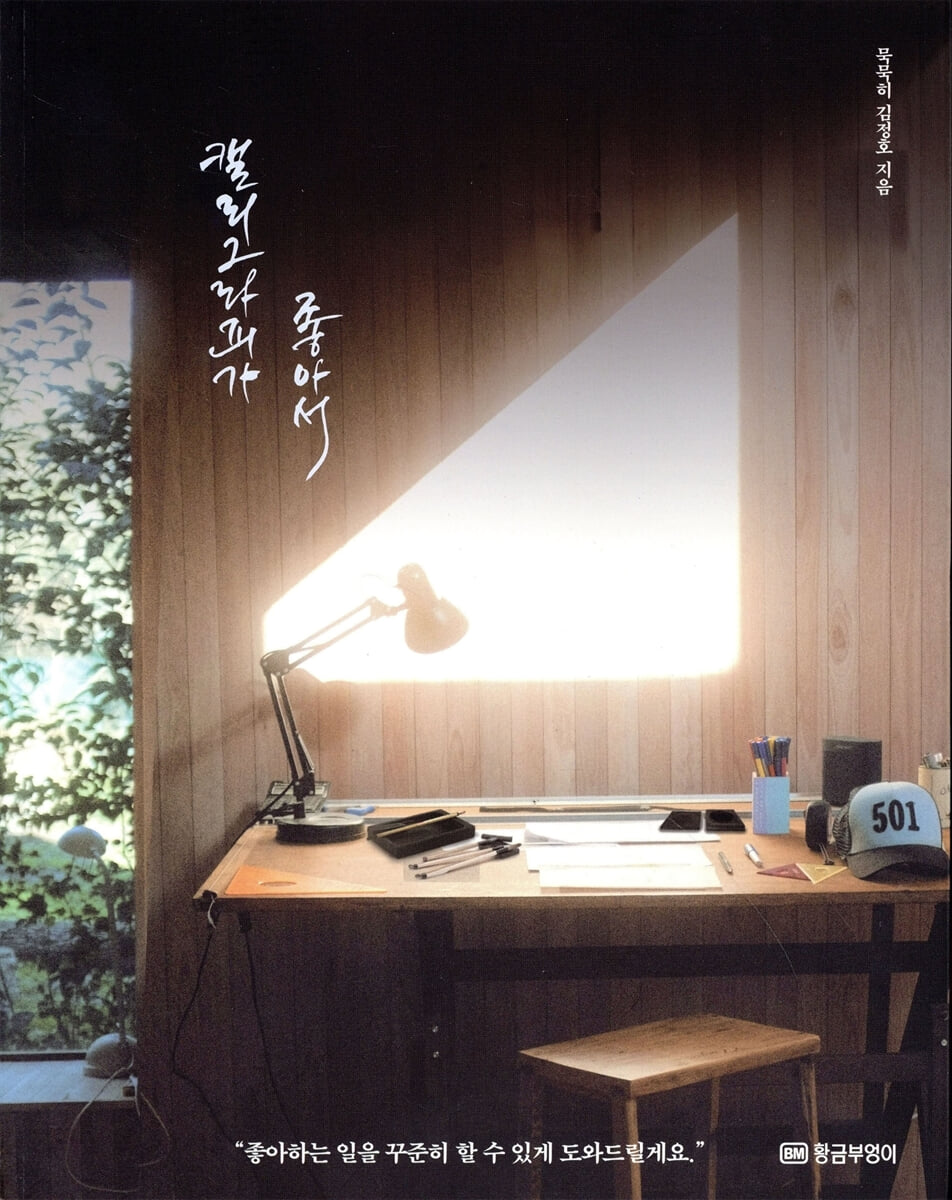
Because I like calligraphy
 |
Description
Book Introduction
Writing has the power to heal the heart!
This is an era where you can create the illustrations you want with AI without even holding a pen and drawing.
Aside from signing documents, we rarely have a specific need to handwrite in our daily lives. Why do so many people still learn and enjoy handwriting? The answer lies in the time spent focusing solely on writing, rather than the desire to show off your beautiful handwriting to others.
When you immerse yourself in writing, complicated thoughts subside and a moment of comfort comes.
Just as organizing and tidying a dirty house not only makes the house cleaner, but also improves the quality of your life, learning calligraphy is like acquiring a cheat key to life that will organize your mind and elevate your quality of life.
This is an era where you can create the illustrations you want with AI without even holding a pen and drawing.
Aside from signing documents, we rarely have a specific need to handwrite in our daily lives. Why do so many people still learn and enjoy handwriting? The answer lies in the time spent focusing solely on writing, rather than the desire to show off your beautiful handwriting to others.
When you immerse yourself in writing, complicated thoughts subside and a moment of comfort comes.
Just as organizing and tidying a dirty house not only makes the house cleaner, but also improves the quality of your life, learning calligraphy is like acquiring a cheat key to life that will organize your mind and elevate your quality of life.
- You can preview some of the book's contents.
Preview
index
1.
Getting started with calligraphy
What is calligraphy?
Characteristics of calligraphy
Calligraphy supplies
How to hold a brush
Writing posture
Brush handling
Draw a straight line
Change direction
Drawing a curve
2.
Laying the foundations of calligraphy_Printed calligraphy
What is a block font?
Writing a collection of block letters
Writing consonants in the original font
Composing a plate body
Writing in block letters
Changes in calligraphy
Transform the font L
Transform the original font ㅊ
Modify the original font
Transform the remaining consonants
Write one letter
Write two letters
Write three letters
Writing multiple lines
Creating a Calligraphy Edition
Practice calligraphy in block print
3.
Practical Calligraphy: Flowing Calligraphy
Soft concept_Gungseo font
Writing in the palace script
Writing consonants in Gungseo style
Writing in Gungseo style
What is a flow?
Transforming flowing consonants
Writing vertical vowels in cursive
Writing horizontal vowels in cursive
Strong concept_Angled writing
Strong concept_Italic writing
Strong concept_Writing with the center of gravity in mind
Writing with split strokes
Creating Flow Calligraphy
Writing in flowing calligraphy
Writing in flowing calligraphy ㅊ
Writing in flowing calligraphy ㅎ
Writing consonants with various concepts
Writing various calligraphy
4.
Mastering Advanced Calligraphy_Sculptural Calligraphy
Bringing up an image
Expressing stereotypes
Expressing it in a picture
Expressing waves
Expressing sharpness
Expressing a circular shape
Expressing with a brush
Expressing with slope
Expressing with rotation
Expressing onomatopoeia and mimetic words
5.
Creating calligraphy works
Creating calligraphy works
Thinking about various works
6.
Writing calligraphy with various tools - colored pencils, brush pens, marker pens, wooden chopsticks, etc.
Pencil calligraphy
Sharp calligraphy
Colored pencil calligraphy
Watercolor pencil calligraphy
Brush pen calligraphy
Marker pen calligraphy
Wooden Chopsticks Calligraphy
Cotton swab calligraphy
7.
Drawing ink drawings and sumi-e illustrations
Ink_Three Ink Method
Black_smear
Expressing with dots
Expressing with strokes
Expressing in terms of surface
Pencil drawing
Drawing briquettes
Drawing wings
Drawing grapes
Drawing cherries
Drawing strawberries
Drawing a watermelon
Drawing a carrot
Drawing maple leaves
Drawing Lilacs
Drawing plum blossoms
Drawing a carnation
Drawing a bouquet of flowers
Drawing patbingsu
Getting started with calligraphy
What is calligraphy?
Characteristics of calligraphy
Calligraphy supplies
How to hold a brush
Writing posture
Brush handling
Draw a straight line
Change direction
Drawing a curve
2.
Laying the foundations of calligraphy_Printed calligraphy
What is a block font?
Writing a collection of block letters
Writing consonants in the original font
Composing a plate body
Writing in block letters
Changes in calligraphy
Transform the font L
Transform the original font ㅊ
Modify the original font
Transform the remaining consonants
Write one letter
Write two letters
Write three letters
Writing multiple lines
Creating a Calligraphy Edition
Practice calligraphy in block print
3.
Practical Calligraphy: Flowing Calligraphy
Soft concept_Gungseo font
Writing in the palace script
Writing consonants in Gungseo style
Writing in Gungseo style
What is a flow?
Transforming flowing consonants
Writing vertical vowels in cursive
Writing horizontal vowels in cursive
Strong concept_Angled writing
Strong concept_Italic writing
Strong concept_Writing with the center of gravity in mind
Writing with split strokes
Creating Flow Calligraphy
Writing in flowing calligraphy
Writing in flowing calligraphy ㅊ
Writing in flowing calligraphy ㅎ
Writing consonants with various concepts
Writing various calligraphy
4.
Mastering Advanced Calligraphy_Sculptural Calligraphy
Bringing up an image
Expressing stereotypes
Expressing it in a picture
Expressing waves
Expressing sharpness
Expressing a circular shape
Expressing with a brush
Expressing with slope
Expressing with rotation
Expressing onomatopoeia and mimetic words
5.
Creating calligraphy works
Creating calligraphy works
Thinking about various works
6.
Writing calligraphy with various tools - colored pencils, brush pens, marker pens, wooden chopsticks, etc.
Pencil calligraphy
Sharp calligraphy
Colored pencil calligraphy
Watercolor pencil calligraphy
Brush pen calligraphy
Marker pen calligraphy
Wooden Chopsticks Calligraphy
Cotton swab calligraphy
7.
Drawing ink drawings and sumi-e illustrations
Ink_Three Ink Method
Black_smear
Expressing with dots
Expressing with strokes
Expressing in terms of surface
Pencil drawing
Drawing briquettes
Drawing wings
Drawing grapes
Drawing cherries
Drawing strawberries
Drawing a watermelon
Drawing a carrot
Drawing maple leaves
Drawing Lilacs
Drawing plum blossoms
Drawing a carnation
Drawing a bouquet of flowers
Drawing patbingsu
Detailed image

Into the book
Calligraphy is a form of writing that is suitable for communicating with others and expressing emotions because it possesses both commercial and artistic qualities.
Only by making good use of these two characteristics can you write good calligraphy.
Beginners often mistake calligraphy for 'writing your own handwriting'.
Of course, creating your own font is something that a calligrapher must do.
But before you can create your own handwriting, you need to learn how to communicate with others.
Insisting on using only one's own handwriting without empathizing with others is a misunderstanding and failure to properly utilize calligraphy, the art of 'emotional communication.'
You must first establish a common ground with others to communicate with them, and then study calligraphy that allows you to express your own individuality.
--- p.12
If you create various consonant shapes in advance, it will be easier to add variation when writing calligraphy.
Let's create various consonant shapes by modifying the font we learned earlier.
Among them, we will learn how to transform letters into ㄹ, ㅊ, and ㅎ, which can be considered representative consonants of the Korean alphabet.
If you learn how to transform these consonants in calligraphy, you can easily transform the remaining consonants.
--- p.46
From two letters onwards, you need to pay attention to the letter size and spacing (the space between letters).
Depending on how much space you use between letters, your concept can look better or worse.
It must be well conceived, taking into account both readability and attention.
By changing the font size appropriately, you can write letters that feel alive and rhythmic.
--- p.65
When designing calligraphy, the first line is very important.
Because depending on how you decide on the font size of the first line, you'll end up with a completely different sized calligraphy.
There is no right answer to how to change the font size.
You just need to follow the rule of 'making the front and back letters different sizes'.
--- p.80
Because Hangul is a composite alphabet, simply tilting the letters to the right does not correct the center of gravity.
The center of gravity must be shifted as the tilt progresses.
If the center of gravity is well aligned, the writing will feel stable.
Here we will learn how to use it without collapsing the center of gravity.
Practice balancing your words by writing them in different ways.
--- p.136
When you write with a cotton swab, it feels fluffy.
If you want to make it feel a little more fluffy, you can tear off the cotton swab and fluff it up.
You can achieve a similar effect to a cotton swab by using cotton.
However, cotton swabs have a stick, so they can be used to write more conveniently than cotton.
Only by making good use of these two characteristics can you write good calligraphy.
Beginners often mistake calligraphy for 'writing your own handwriting'.
Of course, creating your own font is something that a calligrapher must do.
But before you can create your own handwriting, you need to learn how to communicate with others.
Insisting on using only one's own handwriting without empathizing with others is a misunderstanding and failure to properly utilize calligraphy, the art of 'emotional communication.'
You must first establish a common ground with others to communicate with them, and then study calligraphy that allows you to express your own individuality.
--- p.12
If you create various consonant shapes in advance, it will be easier to add variation when writing calligraphy.
Let's create various consonant shapes by modifying the font we learned earlier.
Among them, we will learn how to transform letters into ㄹ, ㅊ, and ㅎ, which can be considered representative consonants of the Korean alphabet.
If you learn how to transform these consonants in calligraphy, you can easily transform the remaining consonants.
--- p.46
From two letters onwards, you need to pay attention to the letter size and spacing (the space between letters).
Depending on how much space you use between letters, your concept can look better or worse.
It must be well conceived, taking into account both readability and attention.
By changing the font size appropriately, you can write letters that feel alive and rhythmic.
--- p.65
When designing calligraphy, the first line is very important.
Because depending on how you decide on the font size of the first line, you'll end up with a completely different sized calligraphy.
There is no right answer to how to change the font size.
You just need to follow the rule of 'making the front and back letters different sizes'.
--- p.80
Because Hangul is a composite alphabet, simply tilting the letters to the right does not correct the center of gravity.
The center of gravity must be shifted as the tilt progresses.
If the center of gravity is well aligned, the writing will feel stable.
Here we will learn how to use it without collapsing the center of gravity.
Practice balancing your words by writing them in different ways.
--- p.136
When you write with a cotton swab, it feels fluffy.
If you want to make it feel a little more fluffy, you can tear off the cotton swab and fluff it up.
You can achieve a similar effect to a cotton swab by using cotton.
However, cotton swabs have a stick, so they can be used to write more conveniently than cotton.
--- p.287
Publisher's Review
A proper textbook to accompany you on your journey to perfecting beautiful handwriting.
“Because I Love Calligraphy” is a beginner’s guidebook that explains the basics of calligraphy in an easy-to-understand way.
The structure, which begins with the most basic aspects of calligraphy, such as selecting and managing the four tools of the pen, holding the brush, and drawing strokes, expands to practicing single letters, writing words, forming sentences, expressing formative calligraphy, writing calligraphy with various tools, and drawing ink paintings and sumi-e illustrations, is faithful to the right path.
Thanks to this structure, the previous work, 『Everyday Calligraphy』, was adopted as a textbook for many calligraphy classes and received consistent love.
This renewed edition of the book has been designed to meet the needs of today's readers and boldly removes outdated content to enhance practicality.
A reliable guide for beginners exploring calligraphy.
Are you struggling with handwriting that hasn't improved despite practicing with books and even taking online classes? It's because you lack the "basics."
You will never improve your skills by simply copying well-written letters without a full understanding of the Korean alphabet.
You can write pretty handwriting with just a little effort.
But that's all.
‘Real’ writing is born from the ‘basics’.
So, calligraphy instructors go around and around and end up going to calligraphy classes.
The author, who has been writing in ink for over 30 years, emphasizes that you need to have the basics to create your own handwriting, and generously shares all the know-how he has acquired over the years.
With the know-how built on the 'basics' that I have never neglected while teaching countless students at schools and centers and serving as a judge for various calligraphy competitions, you will be able to complete your own solid handwriting.
Write from the beginning of the story
You need to know and use the structure of consonants and vowels to write properly.
After learning the consonants and vowels in the basic square and feminine scripts of Hangul, you will be able to write any word with confidence.
Transforming text in various ways
ㄹ, ㅊ, ㅎ are representative Korean consonants that have the structure of all consonants.
Learn in detail how to transform spaces, angles, points, diagonals, etc. using ㄹ, ㅊ, and ㅎ.
Once you know how to transform, you can easily transform the remaining consonants and create your own font based on them.
Writing with various concepts
After thinking about the phrase you want to write in calligraphy, you need to decide on a concept.
Once you decide whether to go for softness or a strong feel, you can write letters with the concept you want.
Writing with pictures
You can write pictorial letters by changing the shapes of consonants and vowels.
After learning various methods, such as conjuring up images of words and expressing stereotypes in pictures, you can complete your own unique calligraphy.
Writing with various tools such as pencils, mechanical pencils, wooden chopsticks, and cotton swabs
Calligraphy isn't just about using a brush.
You can use calligraphy with writing instruments such as pencils, mechanical pencils, and colored pencils, as well as everyday tools such as wooden chopsticks and cotton swabs.
If you follow the examples that well reflect the characteristics of each tool, you will be able to write calligraphy well with any tool.
Ink smearing and ink drawing that goes well with calligraphy
You can make your calligraphy stand out by using ink smears and ink drawings.
It explains in detail how to create a blur effect with various colors, and how to draw pencils/wings/watermelon/strawberries/bouquets, etc. in ink.
“Because I Love Calligraphy” is a beginner’s guidebook that explains the basics of calligraphy in an easy-to-understand way.
The structure, which begins with the most basic aspects of calligraphy, such as selecting and managing the four tools of the pen, holding the brush, and drawing strokes, expands to practicing single letters, writing words, forming sentences, expressing formative calligraphy, writing calligraphy with various tools, and drawing ink paintings and sumi-e illustrations, is faithful to the right path.
Thanks to this structure, the previous work, 『Everyday Calligraphy』, was adopted as a textbook for many calligraphy classes and received consistent love.
This renewed edition of the book has been designed to meet the needs of today's readers and boldly removes outdated content to enhance practicality.
A reliable guide for beginners exploring calligraphy.
Are you struggling with handwriting that hasn't improved despite practicing with books and even taking online classes? It's because you lack the "basics."
You will never improve your skills by simply copying well-written letters without a full understanding of the Korean alphabet.
You can write pretty handwriting with just a little effort.
But that's all.
‘Real’ writing is born from the ‘basics’.
So, calligraphy instructors go around and around and end up going to calligraphy classes.
The author, who has been writing in ink for over 30 years, emphasizes that you need to have the basics to create your own handwriting, and generously shares all the know-how he has acquired over the years.
With the know-how built on the 'basics' that I have never neglected while teaching countless students at schools and centers and serving as a judge for various calligraphy competitions, you will be able to complete your own solid handwriting.
Write from the beginning of the story
You need to know and use the structure of consonants and vowels to write properly.
After learning the consonants and vowels in the basic square and feminine scripts of Hangul, you will be able to write any word with confidence.
Transforming text in various ways
ㄹ, ㅊ, ㅎ are representative Korean consonants that have the structure of all consonants.
Learn in detail how to transform spaces, angles, points, diagonals, etc. using ㄹ, ㅊ, and ㅎ.
Once you know how to transform, you can easily transform the remaining consonants and create your own font based on them.
Writing with various concepts
After thinking about the phrase you want to write in calligraphy, you need to decide on a concept.
Once you decide whether to go for softness or a strong feel, you can write letters with the concept you want.
Writing with pictures
You can write pictorial letters by changing the shapes of consonants and vowels.
After learning various methods, such as conjuring up images of words and expressing stereotypes in pictures, you can complete your own unique calligraphy.
Writing with various tools such as pencils, mechanical pencils, wooden chopsticks, and cotton swabs
Calligraphy isn't just about using a brush.
You can use calligraphy with writing instruments such as pencils, mechanical pencils, and colored pencils, as well as everyday tools such as wooden chopsticks and cotton swabs.
If you follow the examples that well reflect the characteristics of each tool, you will be able to write calligraphy well with any tool.
Ink smearing and ink drawing that goes well with calligraphy
You can make your calligraphy stand out by using ink smears and ink drawings.
It explains in detail how to create a blur effect with various colors, and how to draw pencils/wings/watermelon/strawberries/bouquets, etc. in ink.
GOODS SPECIFICS
- Date of issue: March 20, 2024
- Page count, weight, size: 336 pages | 806g | 180*240*20mm
- ISBN13: 9788960306288
- ISBN10: 8960306282
You may also like
카테고리
korean


korean

![GQ KOREA Mark (Monthly): December [2025]](http://librairie.coreenne.fr/cdn/shop/files/8ef265dbbfbf186523ed75ba7319009d.jpg?v=1765340328&width=3840)


