

Free country, equal country
 |
Description
Book Introduction
Are we really living in a free world?
Would a world where everyone lives equally be happy?
“Free Country, Equal Country” is “a philosophical novel for children of today who have a future.”
Do we truly live in a free world? Would a world where everyone lives equally be a happy place? Freedom and equality are the most fundamental concepts of democracy.
These two have been debated and fought over for centuries, and most social problems still arise between them.
The author of this book, Hitoshi Ogawa, has a unique background, having worked as a freelancer, office worker, and civil servant before becoming a philosopher.
He is now one of Japan's leading civic philosophers.
I have been writing introductory philosophy books that are easy for the general public to understand, and I also give lectures to the public in cafes and on the streets to help them solve their concerns about life, both big and small.
In this book, he attempted to write in novel form for the first time.
I thought that if I turned a philosophical topic into a story, I could convey the message more impressively.
I thought it would be especially effective for young children.
Hitoshi Ogawa presents the concepts of freedom and equality, which everyone thinks about at least once in their lives, in an interesting way that appeals to the perspectives of young people.
Would a world where everyone lives equally be happy?
“Free Country, Equal Country” is “a philosophical novel for children of today who have a future.”
Do we truly live in a free world? Would a world where everyone lives equally be a happy place? Freedom and equality are the most fundamental concepts of democracy.
These two have been debated and fought over for centuries, and most social problems still arise between them.
The author of this book, Hitoshi Ogawa, has a unique background, having worked as a freelancer, office worker, and civil servant before becoming a philosopher.
He is now one of Japan's leading civic philosophers.
I have been writing introductory philosophy books that are easy for the general public to understand, and I also give lectures to the public in cafes and on the streets to help them solve their concerns about life, both big and small.
In this book, he attempted to write in novel form for the first time.
I thought that if I turned a philosophical topic into a story, I could convey the message more impressively.
I thought it would be especially effective for young children.
Hitoshi Ogawa presents the concepts of freedom and equality, which everyone thinks about at least once in their lives, in an interesting way that appeals to the perspectives of young people.
- You can preview some of the book's contents.
Preview
index
6 for Korean readers
Prologue_Border 15
Chapter 1: Free Country 28
Chapter 2: Equal Country 64
Chapter 3: Revolution 90
Chapter 4: Dreamland 110
Epilogue_Eternal Story 133
Hints for Thinking About Freedom and Equality 138
Hint 157 for those who want to enjoy "Free Country, Equal Country" more
Author's Note 164
Prologue_Border 15
Chapter 1: Free Country 28
Chapter 2: Equal Country 64
Chapter 3: Revolution 90
Chapter 4: Dreamland 110
Epilogue_Eternal Story 133
Hints for Thinking About Freedom and Equality 138
Hint 157 for those who want to enjoy "Free Country, Equal Country" more
Author's Note 164
Publisher's Review
Is there an ideal way to live freely and equally?
Can we change the world?
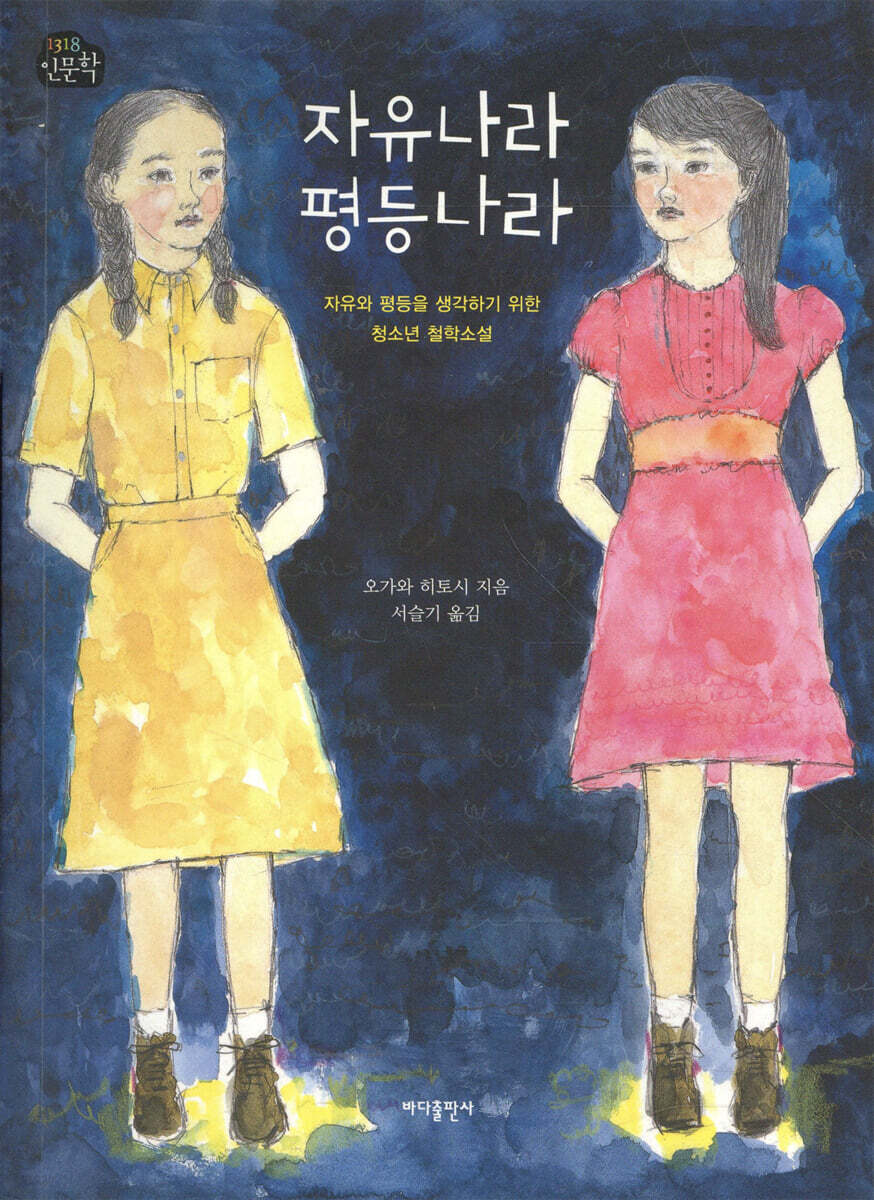
A world where the values of freedom and equality coexist, as dreamed by two girls.
Let's think again about the meaning of freedom and equality!
In the novel, the free country and the equal country are blocked by a thick, high iron wall.
They can't come and go from each other.
In this situation, two girls appear.
Belle lives in a free country, Ku lives in a country of equality.
The two girls look identical.
Belle and Ku, who met by chance at the border between the free country and the equal country, swapped clothes out of curiosity about each other's countries and experienced each other's countries.
In doing so, we discover the good and bad points of a free and equal country.
Belle and Koo, who have returned to their respective countries, plan a small revolution to bring out the good points of both countries and improve the bad points to move towards a 'dream country' where freedom and equality are in harmony.
In this novel, the people of a free country defend only 'freedom'.
I have no interest in equality whatsoever.
For example, even when the streets are overflowing with beggars due to extreme wealth disparity, no one holds anyone ethically accountable.
There is no awareness of the problem of sharing.
The same goes for people in equal countries.
They only uprightly realize 'equality'.
I think freedom only brings suffering.
For example, we consider it natural that we may not have the job we want or that we do not have the freedom to dress in that way.
Don't feel uncomfortable or dissatisfied with the lack of freedom.
"Freedom, Equality" shows us, at a level we can realistically consider, the good points of freedom and the problems that arise when we pursue it alone, and conversely, the good points of equality and the problems that arise when we pursue it alone.
The author does not say which is right and which is wrong.
It depicts the efforts of two girls who clearly judge the pros and cons of a free country and a country of equality and struggle to improve them.
This novel offers a forward-looking perspective on how young people should view liberalism and socialism as ideologies and what alternatives might be available.
The alternative is none other than the heart to think of one another, help one another, and share in times of difficulty.
At the end of the novel, the word 'ten out of ten' appears as a word that connects freedom and equality.
It may be a simple and obvious conclusion, but this is precisely what is most important for living freely and peacefully beyond ideological debate.
The theme of this novel is to think about what an ideal society should be like based on an understanding of the concepts of freedom and equality.
The author offers two hints to help young children think more concretely about the book's theme.
The first is “Hints for Thinking About Freedom and Equality” (pp. 138-156).
This article explains the meaning of freedom and equality within the historical context and flow.
This is an academic article written at a level suitable for children, explaining where the concepts of freedom and equality came from, what changes and modifications they went through, and what a "dreamland" should look like based on the good and bad aspects of freedom and equality.
The second is “Hints for those who want to read “Free Country, Equal Country” more enjoyably” (pp. 157-163).
Here, the author kindly explains the literary devices of this philosophical novel and the concepts that appear in the text.
After reading the novel, these two hints will help you understand the symbolism and meaning more deeply.
Can we change the world?
A world where the values of freedom and equality coexist, as dreamed by two girls.
Let's think again about the meaning of freedom and equality!
In the novel, the free country and the equal country are blocked by a thick, high iron wall.
They can't come and go from each other.
In this situation, two girls appear.
Belle lives in a free country, Ku lives in a country of equality.
The two girls look identical.
Belle and Ku, who met by chance at the border between the free country and the equal country, swapped clothes out of curiosity about each other's countries and experienced each other's countries.
In doing so, we discover the good and bad points of a free and equal country.
Belle and Koo, who have returned to their respective countries, plan a small revolution to bring out the good points of both countries and improve the bad points to move towards a 'dream country' where freedom and equality are in harmony.
In this novel, the people of a free country defend only 'freedom'.
I have no interest in equality whatsoever.
For example, even when the streets are overflowing with beggars due to extreme wealth disparity, no one holds anyone ethically accountable.
There is no awareness of the problem of sharing.
The same goes for people in equal countries.
They only uprightly realize 'equality'.
I think freedom only brings suffering.
For example, we consider it natural that we may not have the job we want or that we do not have the freedom to dress in that way.
Don't feel uncomfortable or dissatisfied with the lack of freedom.
"Freedom, Equality" shows us, at a level we can realistically consider, the good points of freedom and the problems that arise when we pursue it alone, and conversely, the good points of equality and the problems that arise when we pursue it alone.
The author does not say which is right and which is wrong.
It depicts the efforts of two girls who clearly judge the pros and cons of a free country and a country of equality and struggle to improve them.
This novel offers a forward-looking perspective on how young people should view liberalism and socialism as ideologies and what alternatives might be available.
The alternative is none other than the heart to think of one another, help one another, and share in times of difficulty.
At the end of the novel, the word 'ten out of ten' appears as a word that connects freedom and equality.
It may be a simple and obvious conclusion, but this is precisely what is most important for living freely and peacefully beyond ideological debate.
The theme of this novel is to think about what an ideal society should be like based on an understanding of the concepts of freedom and equality.
The author offers two hints to help young children think more concretely about the book's theme.
The first is “Hints for Thinking About Freedom and Equality” (pp. 138-156).
This article explains the meaning of freedom and equality within the historical context and flow.
This is an academic article written at a level suitable for children, explaining where the concepts of freedom and equality came from, what changes and modifications they went through, and what a "dreamland" should look like based on the good and bad aspects of freedom and equality.
The second is “Hints for those who want to read “Free Country, Equal Country” more enjoyably” (pp. 157-163).
Here, the author kindly explains the literary devices of this philosophical novel and the concepts that appear in the text.
After reading the novel, these two hints will help you understand the symbolism and meaning more deeply.
GOODS SPECIFICS
- Date of issue: September 14, 2015
- Page count, weight, size: 168 pages | 336g | 154*210*13mm
- ISBN13: 9788955617757
- ISBN10: 8955617755
You may also like
카테고리
korean


korean

![GQ KOREA Mark (Monthly): December [2025]](http://librairie.coreenne.fr/cdn/shop/files/8ef265dbbfbf186523ed75ba7319009d.jpg?v=1765340328&width=3840)


