

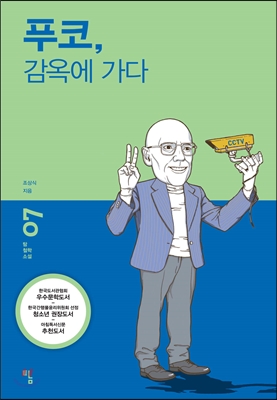
Foucault goes to prison
 |
Description
Book Introduction
Korean Library Association Outstanding Literature Book
Korean Publication Ethics Commission Recommended Books for Youth
Morning Reading Newspaper Recommended Books
By integrating Foucault's important ideas in three stages into a single story, we have made his somewhat difficult philosophy easy and fun to understand.
From Plato through Kant, mainstream Western philosophy has defined and promoted the concept of 'reason'.
However, Foucault doubts the truth of the times, saying, "Madmen are not born, they are made."
Foucault raises questions about the violence of 'reason' and the modern 'power' hidden behind it, not only in philosophy but also in history, literary theory, social science, psychology, and even medicine.
Furthermore, the author points out that the world we live in today is not much different from the direction he diagnosed, and asks young people to think about the direction in which the current society should move through Foucault's ideas.
Korean Publication Ethics Commission Recommended Books for Youth
Morning Reading Newspaper Recommended Books
By integrating Foucault's important ideas in three stages into a single story, we have made his somewhat difficult philosophy easy and fun to understand.
From Plato through Kant, mainstream Western philosophy has defined and promoted the concept of 'reason'.
However, Foucault doubts the truth of the times, saying, "Madmen are not born, they are made."
Foucault raises questions about the violence of 'reason' and the modern 'power' hidden behind it, not only in philosophy but also in history, literary theory, social science, psychology, and even medicine.
Furthermore, the author points out that the world we live in today is not much different from the direction he diagnosed, and asks young people to think about the direction in which the current society should move through Foucault's ideas.
- You can preview some of the book's contents.
Preview
index
Preface to the Revised Edition
- Foucault is near you!
Preface to the First Edition
- Doubt the truth of the times!
prolog
- May heat wave
1.
Towards the top
2.
Gwangsik hyung, Gwangtae
3.
Foucault is everything.
4.
Underground
5.
My brother is back
6.
Ship of Madmen
7.
trapped people
8.
The Birth of a Mental Hospital
9.
Question the truth of the times
10.
The light will enclose you
11.
To be reborn
Epilogue
-Someone is watching
supplement
Introduction to Michel Foucault
The Life of Michel Foucault
Read and solve
- Foucault is near you!
Preface to the First Edition
- Doubt the truth of the times!
prolog
- May heat wave
1.
Towards the top
2.
Gwangsik hyung, Gwangtae
3.
Foucault is everything.
4.
Underground
5.
My brother is back
6.
Ship of Madmen
7.
trapped people
8.
The Birth of a Mental Hospital
9.
Question the truth of the times
10.
The light will enclose you
11.
To be reborn
Epilogue
-Someone is watching
supplement
Introduction to Michel Foucault
The Life of Michel Foucault
Read and solve
Into the book
“The episteme controls a society through discourse.
“In the 17th century, when power used madness to exclude people, it was also discourse that supported it.”
“What is that?”
“The concept of discourse is important.
The word discourse is 'discourse' in English, and when translated, it means 'powerful words'.
In fact, words are completely governed by power relations.
For example, if a friend tells you that a celebrity was involved in a car accident, you might be skeptical, but if it's on the news, you'll believe it 100 percent.
“Speech that is so powerful is called discourse.”
“Even underground, the doctor’s words are the most powerful.”
"okay.
In that sense, the discourse of those who lead a society can be seen as defining the discourse of others.
Not everyone's words are accepted.
This isn't a question of freedom of the press.
Even in a society where freedom of the press is 100% permitted, the discourse of the powerful dominates that society, and power becomes justice.
The impact in the real world can vary greatly depending on who speaks and what is said.
It is only when many people talk about the same thing that words become more alive and powerful than when one person talks about it.
If you talk about who is dating who alone, it has no power, but if many people talk about it, it becomes powerful.
This is also called a story structure.
Words that require so much force make knowledge possible.
Powerful words are the truth, and they are treated as knowledge.
Because of this power, I believe that any powerful words floating around the world can never be neutral or objective.
So, we can say that discourse is always a battleground where we compete to see who is right.”
--- pp.216-217
“Why? What are you going to do here?”
“Listen carefully.
A patient is an individual governed by the oppressive power apparatus called the hospital, and a student is also an individual governed by the oppressive power apparatus called the school.
The power applied to an individual in this way is inevitably routine, diverse, and therefore profound.
This is the same even when you go up to the ground.
“Since we are all individuals who belong to a power relationship, no matter where we are, we are all in prison.”
“No! This is a prison, and if we go up to that land, we will find freedom.
“You don’t have to be locked up in prison anymore.”
“I will stay here and resist.
“I will try various forms of resistance with those who are excluded from this society, those who are under surveillance, and those who suppress themselves.”
“What kind of resistance is that, going back to prison! I can’t go.
“I’m not going alone.”
“You go back! You’ll find out soon when you go back.
Whether you live on the surface or I live in the panopticon underground, it's all the same whether we're in prison.
And then go back and take an interest in the social operating mechanisms that are centered around surveillance and punishment of individuals.
And resist.
Resist, resist again and again.
“See you again.”
“In the 17th century, when power used madness to exclude people, it was also discourse that supported it.”
“What is that?”
“The concept of discourse is important.
The word discourse is 'discourse' in English, and when translated, it means 'powerful words'.
In fact, words are completely governed by power relations.
For example, if a friend tells you that a celebrity was involved in a car accident, you might be skeptical, but if it's on the news, you'll believe it 100 percent.
“Speech that is so powerful is called discourse.”
“Even underground, the doctor’s words are the most powerful.”
"okay.
In that sense, the discourse of those who lead a society can be seen as defining the discourse of others.
Not everyone's words are accepted.
This isn't a question of freedom of the press.
Even in a society where freedom of the press is 100% permitted, the discourse of the powerful dominates that society, and power becomes justice.
The impact in the real world can vary greatly depending on who speaks and what is said.
It is only when many people talk about the same thing that words become more alive and powerful than when one person talks about it.
If you talk about who is dating who alone, it has no power, but if many people talk about it, it becomes powerful.
This is also called a story structure.
Words that require so much force make knowledge possible.
Powerful words are the truth, and they are treated as knowledge.
Because of this power, I believe that any powerful words floating around the world can never be neutral or objective.
So, we can say that discourse is always a battleground where we compete to see who is right.”
--- pp.216-217
“Why? What are you going to do here?”
“Listen carefully.
A patient is an individual governed by the oppressive power apparatus called the hospital, and a student is also an individual governed by the oppressive power apparatus called the school.
The power applied to an individual in this way is inevitably routine, diverse, and therefore profound.
This is the same even when you go up to the ground.
“Since we are all individuals who belong to a power relationship, no matter where we are, we are all in prison.”
“No! This is a prison, and if we go up to that land, we will find freedom.
“You don’t have to be locked up in prison anymore.”
“I will stay here and resist.
“I will try various forms of resistance with those who are excluded from this society, those who are under surveillance, and those who suppress themselves.”
“What kind of resistance is that, going back to prison! I can’t go.
“I’m not going alone.”
“You go back! You’ll find out soon when you go back.
Whether you live on the surface or I live in the panopticon underground, it's all the same whether we're in prison.
And then go back and take an interest in the social operating mechanisms that are centered around surveillance and punishment of individuals.
And resist.
Resist, resist again and again.
“See you again.”
--- pp.249-250
Publisher's Review
The seventh book in the "Tham Philosophy Novel" series
Question the truth of the times!
Looking at people and things from a different angle
Meet Foucault, the original thinker!
* A series of philosophical novels for young people who are just beginning to study the humanities.
The [Youth Philosophy Novels] series, which was evaluated as an innovation in the field of youth humanities literature and received favorable reviews from middle and high school teachers and students, has been revamped and republished as the [Exploring Philosophy Novels] series.
[The Philosophy Novel] is a series of educational novels for young adults that unravel the thoughts of philosophers who occupy important positions in the history of Eastern and Western thought in a single novel.
As you read along, enjoying it as if you were reading a novel, you will soon find yourself easily understanding the philosophers' rigid theories and relating them to your own life.
The [Tam Philosophy Novel] series has been recognized for its excellent content and has been selected as an excellent book by several public institutions and youth-related organizations.
★Selected as an excellent liberal arts book by the Ministry of Culture, Sports and Tourism ★Selected as a recommended book for youth by the Korea Publication Ethics Commission
★Youth Book of the Year by the Korean Publishers Association ★Book of the Month by the Korean Publishers Association
★Recommended books for teachers who create a warm world through books ★Recommended books of the year selected by the Hanuri Reading Movement Headquarters
★Morning Reading Newspaper Recommended Books
Foucault, who was always present at the sites of resistance by the marginalized, how about looking at people and things from a different perspective based on the originality of his philosophy?
* Can we find freedom in prison, a symbol of surveillance and punishment?
Gwangsik, a high school senior, gets caught by the student council president for drawing a picture of a man taking off his clothes in his textbook and is transferred to a school where he is trained to become 'normal'.
We hear that it is an underworld operating in the style of the early 19th century, and that a wanted man named Foucault is leading the escape of its people.
Based on some clues, Gwangsik guesses that Foucault might be the one who studied madmen.
The older brother, who suddenly disappeared and then reappeared, travels through time and space, telling of his travels in Europe from the late 15th century, the end of the Middle Ages, to the classical period of the 17th century, and to the 18th and 19th centuries, when the era of modernity began.
Will Gwangsik and his brother be able to escape prison, a symbol of surveillance and punishment, and find the freedom they long for? This book captivates readers with its compelling narrative, worthy of being selected as an Outstanding Literature Book by the Korean Library Association, while maintaining the core message of Foucault's philosophy.
After reading the text, you can download the post-reading activity sheet from blog.naver.com/totobook9.
Question the truth of the times!
Looking at people and things from a different angle
Meet Foucault, the original thinker!
* A series of philosophical novels for young people who are just beginning to study the humanities.
The [Youth Philosophy Novels] series, which was evaluated as an innovation in the field of youth humanities literature and received favorable reviews from middle and high school teachers and students, has been revamped and republished as the [Exploring Philosophy Novels] series.
[The Philosophy Novel] is a series of educational novels for young adults that unravel the thoughts of philosophers who occupy important positions in the history of Eastern and Western thought in a single novel.
As you read along, enjoying it as if you were reading a novel, you will soon find yourself easily understanding the philosophers' rigid theories and relating them to your own life.
The [Tam Philosophy Novel] series has been recognized for its excellent content and has been selected as an excellent book by several public institutions and youth-related organizations.
★Selected as an excellent liberal arts book by the Ministry of Culture, Sports and Tourism ★Selected as a recommended book for youth by the Korea Publication Ethics Commission
★Youth Book of the Year by the Korean Publishers Association ★Book of the Month by the Korean Publishers Association
★Recommended books for teachers who create a warm world through books ★Recommended books of the year selected by the Hanuri Reading Movement Headquarters
★Morning Reading Newspaper Recommended Books
Foucault, who was always present at the sites of resistance by the marginalized, how about looking at people and things from a different perspective based on the originality of his philosophy?
* Can we find freedom in prison, a symbol of surveillance and punishment?
Gwangsik, a high school senior, gets caught by the student council president for drawing a picture of a man taking off his clothes in his textbook and is transferred to a school where he is trained to become 'normal'.
We hear that it is an underworld operating in the style of the early 19th century, and that a wanted man named Foucault is leading the escape of its people.
Based on some clues, Gwangsik guesses that Foucault might be the one who studied madmen.
The older brother, who suddenly disappeared and then reappeared, travels through time and space, telling of his travels in Europe from the late 15th century, the end of the Middle Ages, to the classical period of the 17th century, and to the 18th and 19th centuries, when the era of modernity began.
Will Gwangsik and his brother be able to escape prison, a symbol of surveillance and punishment, and find the freedom they long for? This book captivates readers with its compelling narrative, worthy of being selected as an Outstanding Literature Book by the Korean Library Association, while maintaining the core message of Foucault's philosophy.
After reading the text, you can download the post-reading activity sheet from blog.naver.com/totobook9.
GOODS SPECIFICS
- Date of issue: September 25, 2013
- Page count, weight, size: 272 pages | 354g | 144*210*20mm
- ISBN13: 9788964961575
- ISBN10: 8964961579
You may also like
카테고리
korean


korean

![GQ KOREA Mark (Monthly): December [2025]](http://librairie.coreenne.fr/cdn/shop/files/8ef265dbbfbf186523ed75ba7319009d.jpg?v=1765340328&width=3840)


