

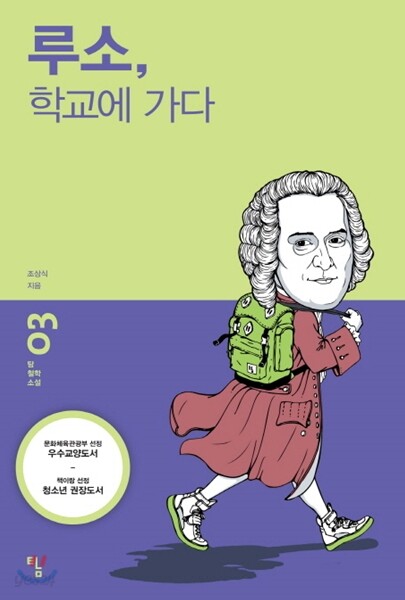
Rousseau goes to school
 |
Description
Book Introduction
The "Youth Philosophy Novel Series," which was evaluated as an innovation in the field of youth humanities literature and received favorable reviews from middle and high school teachers and students, has been revamped and republished as the "Exploring Philosophy Novels" series.
"The Philosophy Novel" is a series of educational novels for young adults that unravel the thoughts of philosophers who occupy important positions in the history of Eastern and Western thought in a single novel.
As you read along, enjoying it as if you were reading a novel, you will soon find yourself easily understanding the philosophers' rigid theories and relating them to your own life.
The "Exploring Philosophy Novels" series has been recognized for its excellence in content and has been selected as an excellent book by several public institutions and youth-related organizations.
"The Philosophy Novel" is a series of educational novels for young adults that unravel the thoughts of philosophers who occupy important positions in the history of Eastern and Western thought in a single novel.
As you read along, enjoying it as if you were reading a novel, you will soon find yourself easily understanding the philosophers' rigid theories and relating them to your own life.
The "Exploring Philosophy Novels" series has been recognized for its excellence in content and has been selected as an excellent book by several public institutions and youth-related organizations.
- You can preview some of the book's contents.
Preview
index
Preface to the Revised Edition - For Students and Parents
Preface to the First Edition - Hope for Lonely Youth
Prologue - Iko's Spring in 3rd Grade of Middle School
1.
2106 AD, school
School scenery
JJ Project Interim Report
2.
Children in Wonderland
M-0427, Echo
Emil in the Cottage
Secret Door
3.
Iko meets Emil
Child in the Mirror
Emil, reading a fairy tale
Albert's letter
4.
Boys, get lost
Rousseau, who are you?
Strange Competitors
Lost in the forest
Find the exit!
5.
Into the world
2nd meeting of the Board of Education
Why am I like this?
Second birth
Final meeting of the Board of Education
For me, you and us
Moral Homework - On Religion
The fate of JJ Project
Spring again in 2013
Epilogue - Rousseau Goes to School
supplement
Introduction to Jean-Jacques Rousseau
The Life of Jean-Jacques Rousseau
Read and solve
Preface to the First Edition - Hope for Lonely Youth
Prologue - Iko's Spring in 3rd Grade of Middle School
1.
2106 AD, school
School scenery
JJ Project Interim Report
2.
Children in Wonderland
M-0427, Echo
Emil in the Cottage
Secret Door
3.
Iko meets Emil
Child in the Mirror
Emil, reading a fairy tale
Albert's letter
4.
Boys, get lost
Rousseau, who are you?
Strange Competitors
Lost in the forest
Find the exit!
5.
Into the world
2nd meeting of the Board of Education
Why am I like this?
Second birth
Final meeting of the Board of Education
For me, you and us
Moral Homework - On Religion
The fate of JJ Project
Spring again in 2013
Epilogue - Rousseau Goes to School
supplement
Introduction to Jean-Jacques Rousseau
The Life of Jean-Jacques Rousseau
Read and solve
Into the book
Main text
"Yes, first of all, what was Rousseau's goal of education—that is, what kind of desirable human being did he seek to cultivate through education?"
“That is an important and essential question.
In short, he is a moral natural person.”
"hmm…….
“It’s a bit difficult, but what kind of person is this moral natural person?”
“It refers to a person who voluntarily practices the moral standards required by society while retaining their original human nature.
“As we live in the world, we are human beings who pursue the highest state of freedom: seeing with our own eyes, feeling with our own emotions, and judging and acting with our own reason.”
“Could you explain it a little more simply?”
“It is natural for humans to know how to be sad when they are sad, to know how to be happy when they are happy, and to know how to be angry when they see evil.
“It refers to a person who retains the emotions that humans originally possess, while following the norms that society demands, such as laws and customs, of their own free will.”
“Before going back to Rousseau’s original intention, let’s talk again about the basic educational environment that Rousseau assumed.
Emile in Rousseau's novel grew up in a rural area isolated from civilization.
However, it is impossible for today's children to live free from the harmful customs of the big city that Rousseau so desperately sought to avoid.
In fact, it is now impossible to set up a setting where one is completely guided by a parent or teacher in an environment isolated from civilization.
On this point, didn't Rousseau himself confess that Emile might be nothing more than a dream about education written by a visionary?
Commissioner Duchamp glared at Albert and asked.
This is the expected counterargument.
But isn't that a claim without an answer?
Albert was annoyed.
“Sometimes a perfect fantasy can give greater insight than a cool-headed analysis of reality.
I am not suggesting that we simply apply Rousseau's setting to reality and change the entire educational environment.
Let's positively develop the good aspects of Rousseau's educational philosophy to improve our country's educational environment, make each student happier, and help them grow into happy adults.
And this is what will truly benefit the nation.”
“But why do we have to be moral people?”
Emil asked.
“To become a happy person.
All the education you have received so far has been for your happiness.
Whether it's education, culture, or politics, all of these are ultimately means to achieve human happiness.
You said that you hate it when other people become unhappy because of you. A good person, a moral person, acts according to conscience and reason, so he does not make others unhappy.
If you don't make others unhappy, you will have less heartache.
In other words, living morally is the best way to avoid suffering.”
Having said this, Professor Henri observed Emile's expression for a moment.
Emil nodded with a very serious expression.
“If your mind is not troubled, you will be able to become that much happier, and it would be even better if you could share that happiness with others. To do that, you will inevitably have to live together with other people. It seems that it is time for you to socialize more with others, in other words, it is time for you to enter society.
At least now you won't be harming anyone else.
To develop compassion means to discover the need for others and to feel the need for social relationships.
You will now want to know first friendship and then love in social relationships.
And as you grow older, you will also need to learn about religion to become a more moral person.
As such, there is an order to all learning.
So when you asked me yesterday to talk about religion, I said I would when you turned eighteen.”
"Yes, first of all, what was Rousseau's goal of education—that is, what kind of desirable human being did he seek to cultivate through education?"
“That is an important and essential question.
In short, he is a moral natural person.”
"hmm…….
“It’s a bit difficult, but what kind of person is this moral natural person?”
“It refers to a person who voluntarily practices the moral standards required by society while retaining their original human nature.
“As we live in the world, we are human beings who pursue the highest state of freedom: seeing with our own eyes, feeling with our own emotions, and judging and acting with our own reason.”
“Could you explain it a little more simply?”
“It is natural for humans to know how to be sad when they are sad, to know how to be happy when they are happy, and to know how to be angry when they see evil.
“It refers to a person who retains the emotions that humans originally possess, while following the norms that society demands, such as laws and customs, of their own free will.”
“Before going back to Rousseau’s original intention, let’s talk again about the basic educational environment that Rousseau assumed.
Emile in Rousseau's novel grew up in a rural area isolated from civilization.
However, it is impossible for today's children to live free from the harmful customs of the big city that Rousseau so desperately sought to avoid.
In fact, it is now impossible to set up a setting where one is completely guided by a parent or teacher in an environment isolated from civilization.
On this point, didn't Rousseau himself confess that Emile might be nothing more than a dream about education written by a visionary?
Commissioner Duchamp glared at Albert and asked.
This is the expected counterargument.
But isn't that a claim without an answer?
Albert was annoyed.
“Sometimes a perfect fantasy can give greater insight than a cool-headed analysis of reality.
I am not suggesting that we simply apply Rousseau's setting to reality and change the entire educational environment.
Let's positively develop the good aspects of Rousseau's educational philosophy to improve our country's educational environment, make each student happier, and help them grow into happy adults.
And this is what will truly benefit the nation.”
“But why do we have to be moral people?”
Emil asked.
“To become a happy person.
All the education you have received so far has been for your happiness.
Whether it's education, culture, or politics, all of these are ultimately means to achieve human happiness.
You said that you hate it when other people become unhappy because of you. A good person, a moral person, acts according to conscience and reason, so he does not make others unhappy.
If you don't make others unhappy, you will have less heartache.
In other words, living morally is the best way to avoid suffering.”
Having said this, Professor Henri observed Emile's expression for a moment.
Emil nodded with a very serious expression.
“If your mind is not troubled, you will be able to become that much happier, and it would be even better if you could share that happiness with others. To do that, you will inevitably have to live together with other people. It seems that it is time for you to socialize more with others, in other words, it is time for you to enter society.
At least now you won't be harming anyone else.
To develop compassion means to discover the need for others and to feel the need for social relationships.
You will now want to know first friendship and then love in social relationships.
And as you grow older, you will also need to learn about religion to become a more moral person.
As such, there is an order to all learning.
So when you asked me yesterday to talk about religion, I said I would when you turned eighteen.”
---From the text
Publisher's Review
The third 'philosophical novel'
Rousseau's "Emile" Reimagined for Young Adults
A series of philosophical novels for young readers just beginning their studies in the humanities.
The youth philosophy novel series, which was evaluated as an innovation in the field of youth humanities and received favorable reviews from middle and high school teachers and students, has been revamped and republished as the Exploring Philosophy Novel Series.
The Tam Philosophy Novel series is a series of educational novels for young adults that unravel the thoughts of philosophers who occupy important positions in the history of Eastern and Western thought.
As you read along, enjoying it as if you were reading a novel, you will soon find yourself easily understanding the philosophers' rigid theories and relating them to your own life.
The Tam Philosophy novel series has been recognized for its excellence in content and has been selected as an excellent book by several public institutions and youth-related organizations.
★Selected as an excellent liberal arts book by the Ministry of Culture, Sports and Tourism
★Recommended books for youth selected by the Korea Publication Ethics Commission
★Korean Publishers Association Youth Book of the Year
★Book of the Month selected by the Korean Publishers Association
★Recommended books for teachers who create a warm world through books
★Recommended Book of the Year by the Hanuri Reading Movement Headquarters
★Morning Reading Newspaper Recommended Books
★Books and recommended books for young people
Rousseau's "Emile" Reimagined for Young Adults
The third book in the Tam Philosophy Novel series, Rousseau Goes to School, presents the educational philosophy of Jean-Jacques Rousseau, a representative French thinker and novelist of the 18th century, as contained in his educational novel, Emile.
《Emile》 is a book that contains both the educational methods that Rousseau criticized in the 18th century and the human education that he himself thought was desirable.
Surprisingly, his educational philosophy is still reflected in our current educational practices.
Rousseau's ideas could be summarized in modern terms as student-centered, self-directed inquiry learning and character education.
However, our educational field is currently suffering from serious illnesses such as bullying, school violence, suicide, and entrance exam depression.
Rousseau's educational philosophy can help us find the answer.
Considering the eye level of young readers, "Rousseau Goes to School" has been reborn as an interesting novel, and it will provide an opportunity to think for yourself about what kind of education is right and what problems there are in education in this era.
Iko and Emil, the intertwined fates and encounters of two boys
In 2113 AD, a revolutionary education system based on Plato's educational philosophy is revealed to be flawed.
Accordingly, the government decided to create the 'JJ Project', which faithfully reproduced Jean-Jacques Rousseau's educational novel 'Emile', and to investigate its educational effectiveness.
'Emile', who was selected as the subject of the experiment, lives with his teacher, Henri, who follows Rousseau's educational method, in a village that recreates the appearance of an 18th-century countryside.
Meanwhile, 'Iko', who attends a future school that is only concerned with improving his grades, is an ordinary boy living in another world.
Iko, who was mistaken for cheating on a test, ends up being punished and ends up in the virtual village where Emil lives. The two end up in each other's space due to a coincidence...
The fierce debate between the Platonic school, which advocated for the rule of the philosopher-king, and the Rousseauian school, which advocated for a return to nature and a non-action-based approach, unfolds through the intertwined fates and encounters of two boys.
After reading the text, you can download a post-reading activity sheet reflecting on Rousseau's ideas from blog.naver.com/totobook9.
Rousseau's "Emile" Reimagined for Young Adults
A series of philosophical novels for young readers just beginning their studies in the humanities.
The youth philosophy novel series, which was evaluated as an innovation in the field of youth humanities and received favorable reviews from middle and high school teachers and students, has been revamped and republished as the Exploring Philosophy Novel Series.
The Tam Philosophy Novel series is a series of educational novels for young adults that unravel the thoughts of philosophers who occupy important positions in the history of Eastern and Western thought.
As you read along, enjoying it as if you were reading a novel, you will soon find yourself easily understanding the philosophers' rigid theories and relating them to your own life.
The Tam Philosophy novel series has been recognized for its excellence in content and has been selected as an excellent book by several public institutions and youth-related organizations.
★Selected as an excellent liberal arts book by the Ministry of Culture, Sports and Tourism
★Recommended books for youth selected by the Korea Publication Ethics Commission
★Korean Publishers Association Youth Book of the Year
★Book of the Month selected by the Korean Publishers Association
★Recommended books for teachers who create a warm world through books
★Recommended Book of the Year by the Hanuri Reading Movement Headquarters
★Morning Reading Newspaper Recommended Books
★Books and recommended books for young people
Rousseau's "Emile" Reimagined for Young Adults
The third book in the Tam Philosophy Novel series, Rousseau Goes to School, presents the educational philosophy of Jean-Jacques Rousseau, a representative French thinker and novelist of the 18th century, as contained in his educational novel, Emile.
《Emile》 is a book that contains both the educational methods that Rousseau criticized in the 18th century and the human education that he himself thought was desirable.
Surprisingly, his educational philosophy is still reflected in our current educational practices.
Rousseau's ideas could be summarized in modern terms as student-centered, self-directed inquiry learning and character education.
However, our educational field is currently suffering from serious illnesses such as bullying, school violence, suicide, and entrance exam depression.
Rousseau's educational philosophy can help us find the answer.
Considering the eye level of young readers, "Rousseau Goes to School" has been reborn as an interesting novel, and it will provide an opportunity to think for yourself about what kind of education is right and what problems there are in education in this era.
Iko and Emil, the intertwined fates and encounters of two boys
In 2113 AD, a revolutionary education system based on Plato's educational philosophy is revealed to be flawed.
Accordingly, the government decided to create the 'JJ Project', which faithfully reproduced Jean-Jacques Rousseau's educational novel 'Emile', and to investigate its educational effectiveness.
'Emile', who was selected as the subject of the experiment, lives with his teacher, Henri, who follows Rousseau's educational method, in a village that recreates the appearance of an 18th-century countryside.
Meanwhile, 'Iko', who attends a future school that is only concerned with improving his grades, is an ordinary boy living in another world.
Iko, who was mistaken for cheating on a test, ends up being punished and ends up in the virtual village where Emil lives. The two end up in each other's space due to a coincidence...
The fierce debate between the Platonic school, which advocated for the rule of the philosopher-king, and the Rousseauian school, which advocated for a return to nature and a non-action-based approach, unfolds through the intertwined fates and encounters of two boys.
After reading the text, you can download a post-reading activity sheet reflecting on Rousseau's ideas from blog.naver.com/totobook9.
GOODS SPECIFICS
- Date of issue: May 13, 2013
- Page count, weight, size: 232 pages | 400g | 144*210*20mm
- ISBN13: 9788964961391
- ISBN10: 8964961390
You may also like
카테고리
korean


korean

![GQ KOREA Mark (Monthly): December [2025]](http://librairie.coreenne.fr/cdn/shop/files/8ef265dbbfbf186523ed75ba7319009d.jpg?v=1765340328&width=3840)


