

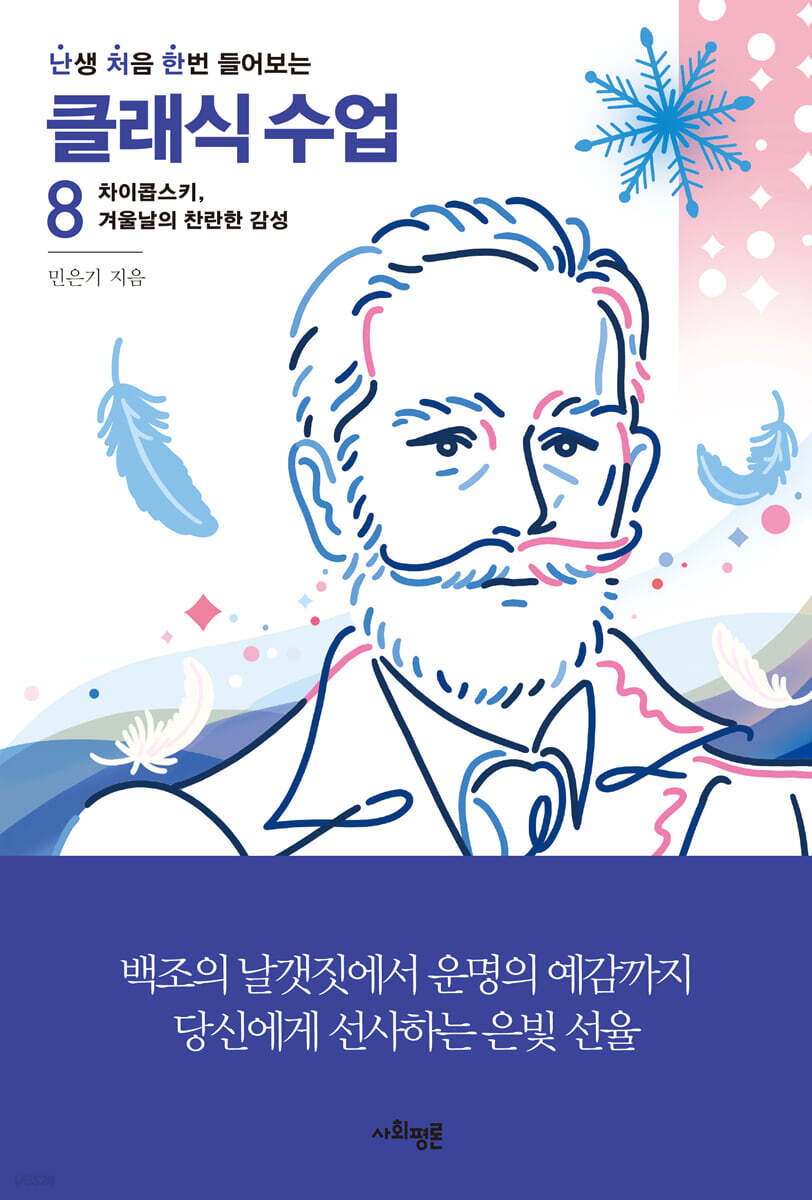
Embarrassing Classical Lesson 8
 |
Description
Book Introduction
『Awkward Classics Class』, this time in Russia!
From the outskirts of classical music to music loved by people around the world,
Experience the classical tales of Russia, both far and near, through Tchaikovsky's melodies!
"The First Classical Music Class I've Ever Taken" (hereafter "The Embarrassing Classical Music Class") is an introductory book to classical music for those who are drawn to classical music but are "embarrassed" to approach it rashly.
Professor Min Eun-ki of Seoul National University's Department of Composition, a first-generation Korean musicologist and active researcher, has interpreted classical music in the easiest and most enjoyable way.
This 8th volume explores the life and works of Tchaikovsky, the representative Russian musician.
Even if you are not familiar with classical music, you may have heard of Tchaikovsky at least once.
He is known as a master of ballet music, so much so that his name automatically comes to mind when you think of ballet, such as [Swan Lake] and [The Nutcracker].
In addition, he is a composer who is loved both in the past and present, presenting masterpieces in various genres such as symphonies, concertos, and operas.
Tchaikovsky's music always takes the listener into a world of fantasy.
But just as the toes of a graceful ballerina are imbued with invisible tears and sweat, Tchaikovsky's beautiful melodies are also the result of pain and patience.
The author follows in Tchaikovsky's footsteps and focuses on his three-dimensional music and identity.
It illuminates the life of a man who was multifaceted and full of wounds, beyond simply describing him as a ‘representative Russian musician’ or a ‘popular classical composer.’
Through this, we can enjoy Tchaikovsky's world of works more broadly and deeply, and also get a glimpse into the society of the time.
Additionally, in Volume 8, you can meet Russian musicians who followed in Tchaikovsky's footsteps and survived the era of revolution and war, such as Rachmaninoff, Stravinsky, and Shostakovich.
As you follow their journey, overcoming the twists and turns of history to create their own unique music, you will soon encounter the vast world of "Russian classical music."
From the outskirts of classical music to music loved by people around the world,
Experience the classical tales of Russia, both far and near, through Tchaikovsky's melodies!
"The First Classical Music Class I've Ever Taken" (hereafter "The Embarrassing Classical Music Class") is an introductory book to classical music for those who are drawn to classical music but are "embarrassed" to approach it rashly.
Professor Min Eun-ki of Seoul National University's Department of Composition, a first-generation Korean musicologist and active researcher, has interpreted classical music in the easiest and most enjoyable way.
This 8th volume explores the life and works of Tchaikovsky, the representative Russian musician.
Even if you are not familiar with classical music, you may have heard of Tchaikovsky at least once.
He is known as a master of ballet music, so much so that his name automatically comes to mind when you think of ballet, such as [Swan Lake] and [The Nutcracker].
In addition, he is a composer who is loved both in the past and present, presenting masterpieces in various genres such as symphonies, concertos, and operas.
Tchaikovsky's music always takes the listener into a world of fantasy.
But just as the toes of a graceful ballerina are imbued with invisible tears and sweat, Tchaikovsky's beautiful melodies are also the result of pain and patience.
The author follows in Tchaikovsky's footsteps and focuses on his three-dimensional music and identity.
It illuminates the life of a man who was multifaceted and full of wounds, beyond simply describing him as a ‘representative Russian musician’ or a ‘popular classical composer.’
Through this, we can enjoy Tchaikovsky's world of works more broadly and deeply, and also get a glimpse into the society of the time.
Additionally, in Volume 8, you can meet Russian musicians who followed in Tchaikovsky's footsteps and survived the era of revolution and war, such as Rachmaninoff, Stravinsky, and Shostakovich.
As you follow their journey, overcoming the twists and turns of history to create their own unique music, you will soon encounter the vast world of "Russian classical music."
- You can preview some of the book's contents.
Preview
index
Ⅰ Finding Buried Voices - The Wave of Nationalism
01 Music transcends borders
02 Containing Russian national consciousness
Ⅱ At the Fork in the Road - Tchaikovsky's Growth and Challenges
01 Glass Child
02 The rise of a late-blooming musician
03 Soar like a swan
III Parallel Lines of Despair and Hope - New Relationships and Slumps
01 Irresistible Fate
02 Leap in the Dark
Ⅳ Like a Burning Flame - At the Top
01 Finishing the wandering
02 Days of Brilliant Creation
V Captivating the World - Russian Musicians
01 A fairy tale created in sorrow
02 Sudden breakup
03 Masters Born from the Conservatory
04 Revolution and Music
01 Music transcends borders
02 Containing Russian national consciousness
Ⅱ At the Fork in the Road - Tchaikovsky's Growth and Challenges
01 Glass Child
02 The rise of a late-blooming musician
03 Soar like a swan
III Parallel Lines of Despair and Hope - New Relationships and Slumps
01 Irresistible Fate
02 Leap in the Dark
Ⅳ Like a Burning Flame - At the Top
01 Finishing the wandering
02 Days of Brilliant Creation
V Captivating the World - Russian Musicians
01 A fairy tale created in sorrow
02 Sudden breakup
03 Masters Born from the Conservatory
04 Revolution and Music
Into the book
The main character of this lecture is Tchaikovsky, whom you all really love.
When listening to Tchaikovsky, there are times when I am amazed at how such captivating melodies can be expressed through an orchestra.
It seems as if a melody of ecstasy is constantly welling up from him like a spring.
Is it just the melody?
His harmonies are supple and rich, and the orchestral colors he creates are beyond gorgeous and even fantastical.
--- p.5 From “Opening Volume 8”
The influence of nationalism that heated up Europe ushered in an era of nationalism not only in national politics but also in music.
Until the 19th century, the centers of music were France, Italy, and Germany.
Other countries were content to follow the music of these three countries.
However, due to the influence of nationalism, so-called nationalistic music based on the unique traditions and emotions of the people began to emerge even in regions where musical development had been slow.
--- p.30 From “Music Crosses Borders”
There is no one in the world who can sum up in one fell swoop what is Russian.
When looking at the era of nationalism, I think what's important isn't the Russianness itself, but the will of the artists of the time to "create something Russian."
It was a time when we were trying to invent and create something Russian.
--- p.86 From “Containing Russian National Consciousness”
Tchaikovsky experienced his mother's death and his first love, and expressed his feelings through music, which brought him one step closer to music.
But until then, no one, not even Tchaikovsky himself, had predicted that he would one day become a professional musician.
I was just enjoying music as an amateur.
--- p.108 From “The Glass Child”
Although Swan Lake remains popular to this day, Tchaikovsky never enjoyed that glory.
Swan Lake received harsh criticism at its premiere for its poor choreography and stage design.
So Tchaikovsky vowed to himself never to write ballet music again.
In fact, after Swan Lake, Tchaikovsky did not touch ballet music for over a decade.
It's such a shame considering Tchaikovsky's achievements.
Not only did it elevate ballet music, which had been treated as mere accompaniment music, to the level of art, but it also suggested the possibility that ballet itself could become the ultimate comprehensive art form.
--- p.172 From "Flying Like a Swan"
The symphony is a genre that has historically developed an adventurous narrative of challenge and triumph.
At the top of that is Beethoven's symphony.
Beethoven created the image of a 'real man' who fought against fate without giving in to it.
But Tchaikovsky tells the story in a completely different way, using a different type of character who is far from a hero.
It's as if the 'weak man', free from patriarchal expectations, is left in agony instead of struggling in the face of adversity.
--- p.193 From "Irresistible Fate"
The years from 1878 to 1885 were dark for Tchaikovsky.
I was in a deep slump.
Tchaikovsky spends his time in anxiety and fear that he will never be able to compose again.
But in reality, Tchaikovsky wasn't so desperate that he couldn't even begin to compose.
Rather, I never stopped composing.
Even though I was suffering, I whipped myself and devoted myself to composing.
Although many good works were produced during this period, Tchaikovsky himself felt that they were lacking.
--- p.219 From "Leap in the Dark"
This is a quote from Symphony No. 4, but Tchaikovsky resigned himself to the idea that humans cannot escape their tragic fate, accepting it. Even in Symphony No. 5, the notes he left on the handwritten score indicate that the melody of the first movement's introduction is "complete surrender to fate."
What's notable here is that this melody appears throughout all movements.
As if a fate to which one has no choice but to submit continues to follow one.
--- p.260 From "Finishing the Wandering"
After 1889, Tchaikovsky reached the peak of his popularity and creativity.
At this time, many of Tchaikovsky's representative works were created in a short period of time.
He composed "Sleeping Beauty" in about 40 days, "The Queen of Spades" in 43 days, and the draft of his last symphony, "Symphony No. 6," was completed in 24 days.
As experience was added to the original composing skills, they gained elasticity.
In fact, during this period, Tchaikovsky was busy touring and working as a conductor, but he also devoted himself to composing.
--- p.271 From “Days of Brilliant Creation”
It may have been to further emphasize the atmosphere of the fourth movement, which seems to be falling into despair.
Tchaikovsky placed a very dark and slow movement at the end of his Symphony No. 6.
Considering that most symphonies end with a splendid triumph, this is a truly revolutionary attempt.
The sorrowful and mournful theme melody begins with strings, then expands to all instruments, building to a crescendo before slowly descending into despair.
The final part of the fourth movement, with its continuously falling melody fading away for a long time, vividly expresses the end of life and death.
Since then, the 4th movement of Symphony No. 6 has become synonymous with symphonies that deal with the themes of death and separation.
--- p.343 From "Sudden Parting"
Russia was a country that only listened to the works of foreign composers because it did not have any decent music of its own until the early 19th century.
But surprisingly, it caught up with Western Europe in a short period of time.
The rapid improvement in the level of music in Russia can be attributed, above all, to music education.
The St. Petersburg Conservatory and the Moscow Conservatory, which I mentioned earlier when giving lectures on Tchaikovsky, played a big role.
One is where Tchaikovsky graduated, and the other is where he worked as a professor.
--- p.358 From “Masters Produced by the Music Academy”
Because the situation in Russia was so turbulent at the time, musicians took completely different paths.
Even though they were born in the same Russian land and educated at the same music conservatory, they often pursued different music.
So, when I describe Russian musicians from the turbulent early 20th century, I sometimes wonder if they are really Russians.
However, if there is one thing they have in common, it is that they are all more 'sincere' about music than anyone else.
When listening to Tchaikovsky, there are times when I am amazed at how such captivating melodies can be expressed through an orchestra.
It seems as if a melody of ecstasy is constantly welling up from him like a spring.
Is it just the melody?
His harmonies are supple and rich, and the orchestral colors he creates are beyond gorgeous and even fantastical.
--- p.5 From “Opening Volume 8”
The influence of nationalism that heated up Europe ushered in an era of nationalism not only in national politics but also in music.
Until the 19th century, the centers of music were France, Italy, and Germany.
Other countries were content to follow the music of these three countries.
However, due to the influence of nationalism, so-called nationalistic music based on the unique traditions and emotions of the people began to emerge even in regions where musical development had been slow.
--- p.30 From “Music Crosses Borders”
There is no one in the world who can sum up in one fell swoop what is Russian.
When looking at the era of nationalism, I think what's important isn't the Russianness itself, but the will of the artists of the time to "create something Russian."
It was a time when we were trying to invent and create something Russian.
--- p.86 From “Containing Russian National Consciousness”
Tchaikovsky experienced his mother's death and his first love, and expressed his feelings through music, which brought him one step closer to music.
But until then, no one, not even Tchaikovsky himself, had predicted that he would one day become a professional musician.
I was just enjoying music as an amateur.
--- p.108 From “The Glass Child”
Although Swan Lake remains popular to this day, Tchaikovsky never enjoyed that glory.
Swan Lake received harsh criticism at its premiere for its poor choreography and stage design.
So Tchaikovsky vowed to himself never to write ballet music again.
In fact, after Swan Lake, Tchaikovsky did not touch ballet music for over a decade.
It's such a shame considering Tchaikovsky's achievements.
Not only did it elevate ballet music, which had been treated as mere accompaniment music, to the level of art, but it also suggested the possibility that ballet itself could become the ultimate comprehensive art form.
--- p.172 From "Flying Like a Swan"
The symphony is a genre that has historically developed an adventurous narrative of challenge and triumph.
At the top of that is Beethoven's symphony.
Beethoven created the image of a 'real man' who fought against fate without giving in to it.
But Tchaikovsky tells the story in a completely different way, using a different type of character who is far from a hero.
It's as if the 'weak man', free from patriarchal expectations, is left in agony instead of struggling in the face of adversity.
--- p.193 From "Irresistible Fate"
The years from 1878 to 1885 were dark for Tchaikovsky.
I was in a deep slump.
Tchaikovsky spends his time in anxiety and fear that he will never be able to compose again.
But in reality, Tchaikovsky wasn't so desperate that he couldn't even begin to compose.
Rather, I never stopped composing.
Even though I was suffering, I whipped myself and devoted myself to composing.
Although many good works were produced during this period, Tchaikovsky himself felt that they were lacking.
--- p.219 From "Leap in the Dark"
This is a quote from Symphony No. 4, but Tchaikovsky resigned himself to the idea that humans cannot escape their tragic fate, accepting it. Even in Symphony No. 5, the notes he left on the handwritten score indicate that the melody of the first movement's introduction is "complete surrender to fate."
What's notable here is that this melody appears throughout all movements.
As if a fate to which one has no choice but to submit continues to follow one.
--- p.260 From "Finishing the Wandering"
After 1889, Tchaikovsky reached the peak of his popularity and creativity.
At this time, many of Tchaikovsky's representative works were created in a short period of time.
He composed "Sleeping Beauty" in about 40 days, "The Queen of Spades" in 43 days, and the draft of his last symphony, "Symphony No. 6," was completed in 24 days.
As experience was added to the original composing skills, they gained elasticity.
In fact, during this period, Tchaikovsky was busy touring and working as a conductor, but he also devoted himself to composing.
--- p.271 From “Days of Brilliant Creation”
It may have been to further emphasize the atmosphere of the fourth movement, which seems to be falling into despair.
Tchaikovsky placed a very dark and slow movement at the end of his Symphony No. 6.
Considering that most symphonies end with a splendid triumph, this is a truly revolutionary attempt.
The sorrowful and mournful theme melody begins with strings, then expands to all instruments, building to a crescendo before slowly descending into despair.
The final part of the fourth movement, with its continuously falling melody fading away for a long time, vividly expresses the end of life and death.
Since then, the 4th movement of Symphony No. 6 has become synonymous with symphonies that deal with the themes of death and separation.
--- p.343 From "Sudden Parting"
Russia was a country that only listened to the works of foreign composers because it did not have any decent music of its own until the early 19th century.
But surprisingly, it caught up with Western Europe in a short period of time.
The rapid improvement in the level of music in Russia can be attributed, above all, to music education.
The St. Petersburg Conservatory and the Moscow Conservatory, which I mentioned earlier when giving lectures on Tchaikovsky, played a big role.
One is where Tchaikovsky graduated, and the other is where he worked as a professor.
--- p.358 From “Masters Produced by the Music Academy”
Because the situation in Russia was so turbulent at the time, musicians took completely different paths.
Even though they were born in the same Russian land and educated at the same music conservatory, they often pursued different music.
So, when I describe Russian musicians from the turbulent early 20th century, I sometimes wonder if they are really Russians.
However, if there is one thing they have in common, it is that they are all more 'sincere' about music than anyone else.
--- p.383 From “Revolution and Music”
Publisher's Review
★ Listen to music through books! The eighth lecture in "The Awkward Classical Music Class," which raises the quality of knowledge and lowers the threshold for learning.
★ A journey to Russia, a country so far away yet so close! The name may be unfamiliar, but it's time to listen to the classical music again, properly familiarized with its music.
Meet Tchaikovsky, a fantastic melody that blossomed in the classical periphery.
★ Enjoy a personalized classical music lecture anytime, anywhere with a QR code! Experience classical music more vividly with 116 music resources that you can listen to while reading the text.
Tchaikovsky, a musician who dreamed of an eternal fairy tale with his feet firmly on the ground.
“Please purchase an instrument called ‘Celesta Mustel’ instead.
…please take care that no one sees this instrument.
“I’m worried that someone will use the celesta’s incredible effects before I do.”
In June 1891, Tchaikovsky sent a letter to an acquaintance.
The request was to purchase a recently invented musical instrument as quickly as possible.
One can sense the excitement of being able to incorporate new sounds into music, as well as the anxiety of who might be the first to utilize this instrument.
Tchaikovsky's masterpiece, The Nutcracker, was born from this passion.
The Nutcracker, which unravels mysterious events that occur in the middle of the night with colorful choreography and fantastic production, is a popular performance that returns without fail every year-end.
Among them, Tchaikovsky's ballet music, which drives the entire play, is loved for its melody alone.
But there is a hidden story behind the heavenly sound that leads to the fantastic festival.
At the time he composed The Nutcracker, Tchaikovsky was suffering from anxiety, having just lost his younger sister to heaven.
The melody that the composer created when he was at his most unhappy still brings happiness to people all over the world.
In this way, Tchaikovsky's life, works, and the evaluations surrounding him are full of twists and turns.
Tchaikovsky was not only the most recognized musician in Russia, to the point of being commissioned to compose the Tsar's coronation march, but his fame spread throughout Europe and the United States, bringing him both fame and fortune.
However, due to his sensitive nature, he suffered from nervous breakdowns and struggled with his sexual identity throughout his life.
Tchaikovsky's duality, a man with a successful outward appearance but a dark inner self, overlaps with the portrait of a modern person who lives a busy life but is always lonely.
In this way, the prejudice that Tchaikovsky's music is just 'pretty music' that is easy to listen to is shattered the moment you learn about his life.
Through his music, which did not give up on creation even in times of anxiety, we reflect on the loneliness and wounds within us and are comforted again.
An era of reading through music
Just as music appears differently when you know the life of a musician, music can be heard more deeply when you understand the spirit of the times.
Just as learning about Tchaikovsky's life allows us to experience his world of work in a three-dimensional way, understanding the times in which Tchaikovsky lived allows us to appreciate another value of music.
The late 19th century, when Tchaikovsky lived, was the so-called 'age of nationalistic music.'
In the era of nationalism, which called for independence based on national and ethnic pride, nationalist music, which sought to express national identity through music, was also an important task for Tchaikovsky.
Until the 19th century, the center of culture and art was Western Europe, and Russia was merely on the periphery.
Musicians from the periphery wanted to present 'their own music, the music of our people,' and the country's nature, folk music, and mythology were good materials.
Tchaikovsky also made great efforts to express the emotions and natural scenery of the country of Russia through melody.
For example, his representative work, Symphony No. 1, was titled “Winter Dream” and was created to evoke the image of a Russian winter landscape.
These Russian characteristics made Tchaikovsky's music even more special.
This book explores Tchaikovsky's life and works, while also broadly examining the careers of contemporary musicians.
From Norway's Grieg and Czech Smetana, who expressed their nation's unique emotions through diverse music, to the five-member "Mighty Few" who pioneered Russian nationalist music, we delve into the world of contemporary musicians who enriched the music of the late 19th century.
This not only serves as another guide to reading Tchaikovsky's music, but also helps us understand that classical music has also been influenced by historical developments.
The attempt to read the times through music has continued beyond the 19th century to the present.
Today, Russian classical music enjoys a high reputation.
This book recommends that after meeting the most popular Russian musician, Tchaikovsky, you should then meet later Russian musicians, such as Rachmaninoff, Stravinsky, and Shostakovich.
The author particularly notes that their lives and works changed in their respective ways as they encountered war and revolution.
The intertwining of individual choices and the flow of the times has created a completely different kind of music.
In this way, music is constantly reinterpreted and given new meaning when encountered in historical, social, and cultural contexts.
Listening to classical music is also an act of confronting the harsh realities of that era.
Now, at that starting point, this book will be waiting for you.
For “familiar” classical music
"Awkward Classical Music Class" is a series that was first released in late 2018 after extensive preparation by Professor Min Eun-ki and Social Criticism Publishing, who shared the same concern that there was a lack of accessible introductory classical music books for music-interested readers.
"The Awkward Classical Lesson," presented in lecture format by a classical music expert, does not skimp on explanations of fundamental musical concepts or historical events.
It serves as the most friendly guide to the world of classical music, step by step, transcending time, space, and genre.
This is the reason why it was able to establish itself as a 'bible' for beginners, with favorable reviews such as "a classical music class book that is easy to read" and "a friendly introduction to classical music that explains it step by step so that even those who have built a wall around music can understand it."
Professor Min Eun-ki, the first female professor of composition at Seoul National University, is not only a first-generation Korean musicologist, but also a social intellectual who has reached people outside of the university through numerous public lectures and writings.
There is probably no other scholar who has worked as hard as Professor Min Eun-ki to introduce the wonderful world of classical music.
“Classical music is a type of music that moves you more deeply the more you listen to it.
You can listen to it for a long time without getting tired of it.
As is often the case with other things that bear the name of classic.”
The author explained why the classics were important at the beginning of Volume 1:
Classics are the result of the pursuit of ultimate beauty, and they are a shared cultural heritage of humanity created in an era that will never return.
If we are beings who have to listen to something to survive, wouldn't timeless classics be the music genre we can listen to for the longest time?
While 『The Story of Studying Art for the First Time in My Life』, which opened the 'Embarrassing Series' with unprecedented success as a domestically planned art textbook, arranged the illustrations and explanations on one page for easy viewing, 『Embarrassing Classical Music Class』 allows readers to listen to music directly with a QR code without having to search for the music themselves.
The unique structure of the 'Embarrassing Series', that is, the dialogue format in which the professor lectures and the student responds, provides a vivid feeling of receiving one-on-one tutoring, and the illustrator Kang Han's sensory illustrations placed throughout add to the fun of viewing.
It can be said that the composition was designed with the generation in mind who is more familiar with colloquial language than written language and with images than with print.
In particular, the recently published 8th volume of 『Embarrassing Classical Music Class』 provides a sense of presence through live photos of various ballet and opera performances, and 116 music links allow you to access classical music spanning from the late 19th century to the 20th century.
This will be an opportunity for melodies you've likely heard before to no longer feel unfamiliar, but rather to come across in a deeper and richer way.
★ A journey to Russia, a country so far away yet so close! The name may be unfamiliar, but it's time to listen to the classical music again, properly familiarized with its music.
Meet Tchaikovsky, a fantastic melody that blossomed in the classical periphery.
★ Enjoy a personalized classical music lecture anytime, anywhere with a QR code! Experience classical music more vividly with 116 music resources that you can listen to while reading the text.
Tchaikovsky, a musician who dreamed of an eternal fairy tale with his feet firmly on the ground.
“Please purchase an instrument called ‘Celesta Mustel’ instead.
…please take care that no one sees this instrument.
“I’m worried that someone will use the celesta’s incredible effects before I do.”
In June 1891, Tchaikovsky sent a letter to an acquaintance.
The request was to purchase a recently invented musical instrument as quickly as possible.
One can sense the excitement of being able to incorporate new sounds into music, as well as the anxiety of who might be the first to utilize this instrument.
Tchaikovsky's masterpiece, The Nutcracker, was born from this passion.
The Nutcracker, which unravels mysterious events that occur in the middle of the night with colorful choreography and fantastic production, is a popular performance that returns without fail every year-end.
Among them, Tchaikovsky's ballet music, which drives the entire play, is loved for its melody alone.
But there is a hidden story behind the heavenly sound that leads to the fantastic festival.
At the time he composed The Nutcracker, Tchaikovsky was suffering from anxiety, having just lost his younger sister to heaven.
The melody that the composer created when he was at his most unhappy still brings happiness to people all over the world.
In this way, Tchaikovsky's life, works, and the evaluations surrounding him are full of twists and turns.
Tchaikovsky was not only the most recognized musician in Russia, to the point of being commissioned to compose the Tsar's coronation march, but his fame spread throughout Europe and the United States, bringing him both fame and fortune.
However, due to his sensitive nature, he suffered from nervous breakdowns and struggled with his sexual identity throughout his life.
Tchaikovsky's duality, a man with a successful outward appearance but a dark inner self, overlaps with the portrait of a modern person who lives a busy life but is always lonely.
In this way, the prejudice that Tchaikovsky's music is just 'pretty music' that is easy to listen to is shattered the moment you learn about his life.
Through his music, which did not give up on creation even in times of anxiety, we reflect on the loneliness and wounds within us and are comforted again.
An era of reading through music
Just as music appears differently when you know the life of a musician, music can be heard more deeply when you understand the spirit of the times.
Just as learning about Tchaikovsky's life allows us to experience his world of work in a three-dimensional way, understanding the times in which Tchaikovsky lived allows us to appreciate another value of music.
The late 19th century, when Tchaikovsky lived, was the so-called 'age of nationalistic music.'
In the era of nationalism, which called for independence based on national and ethnic pride, nationalist music, which sought to express national identity through music, was also an important task for Tchaikovsky.
Until the 19th century, the center of culture and art was Western Europe, and Russia was merely on the periphery.
Musicians from the periphery wanted to present 'their own music, the music of our people,' and the country's nature, folk music, and mythology were good materials.
Tchaikovsky also made great efforts to express the emotions and natural scenery of the country of Russia through melody.
For example, his representative work, Symphony No. 1, was titled “Winter Dream” and was created to evoke the image of a Russian winter landscape.
These Russian characteristics made Tchaikovsky's music even more special.
This book explores Tchaikovsky's life and works, while also broadly examining the careers of contemporary musicians.
From Norway's Grieg and Czech Smetana, who expressed their nation's unique emotions through diverse music, to the five-member "Mighty Few" who pioneered Russian nationalist music, we delve into the world of contemporary musicians who enriched the music of the late 19th century.
This not only serves as another guide to reading Tchaikovsky's music, but also helps us understand that classical music has also been influenced by historical developments.
The attempt to read the times through music has continued beyond the 19th century to the present.
Today, Russian classical music enjoys a high reputation.
This book recommends that after meeting the most popular Russian musician, Tchaikovsky, you should then meet later Russian musicians, such as Rachmaninoff, Stravinsky, and Shostakovich.
The author particularly notes that their lives and works changed in their respective ways as they encountered war and revolution.
The intertwining of individual choices and the flow of the times has created a completely different kind of music.
In this way, music is constantly reinterpreted and given new meaning when encountered in historical, social, and cultural contexts.
Listening to classical music is also an act of confronting the harsh realities of that era.
Now, at that starting point, this book will be waiting for you.
For “familiar” classical music
"Awkward Classical Music Class" is a series that was first released in late 2018 after extensive preparation by Professor Min Eun-ki and Social Criticism Publishing, who shared the same concern that there was a lack of accessible introductory classical music books for music-interested readers.
"The Awkward Classical Lesson," presented in lecture format by a classical music expert, does not skimp on explanations of fundamental musical concepts or historical events.
It serves as the most friendly guide to the world of classical music, step by step, transcending time, space, and genre.
This is the reason why it was able to establish itself as a 'bible' for beginners, with favorable reviews such as "a classical music class book that is easy to read" and "a friendly introduction to classical music that explains it step by step so that even those who have built a wall around music can understand it."
Professor Min Eun-ki, the first female professor of composition at Seoul National University, is not only a first-generation Korean musicologist, but also a social intellectual who has reached people outside of the university through numerous public lectures and writings.
There is probably no other scholar who has worked as hard as Professor Min Eun-ki to introduce the wonderful world of classical music.
“Classical music is a type of music that moves you more deeply the more you listen to it.
You can listen to it for a long time without getting tired of it.
As is often the case with other things that bear the name of classic.”
The author explained why the classics were important at the beginning of Volume 1:
Classics are the result of the pursuit of ultimate beauty, and they are a shared cultural heritage of humanity created in an era that will never return.
If we are beings who have to listen to something to survive, wouldn't timeless classics be the music genre we can listen to for the longest time?
While 『The Story of Studying Art for the First Time in My Life』, which opened the 'Embarrassing Series' with unprecedented success as a domestically planned art textbook, arranged the illustrations and explanations on one page for easy viewing, 『Embarrassing Classical Music Class』 allows readers to listen to music directly with a QR code without having to search for the music themselves.
The unique structure of the 'Embarrassing Series', that is, the dialogue format in which the professor lectures and the student responds, provides a vivid feeling of receiving one-on-one tutoring, and the illustrator Kang Han's sensory illustrations placed throughout add to the fun of viewing.
It can be said that the composition was designed with the generation in mind who is more familiar with colloquial language than written language and with images than with print.
In particular, the recently published 8th volume of 『Embarrassing Classical Music Class』 provides a sense of presence through live photos of various ballet and opera performances, and 116 music links allow you to access classical music spanning from the late 19th century to the 20th century.
This will be an opportunity for melodies you've likely heard before to no longer feel unfamiliar, but rather to come across in a deeper and richer way.
GOODS SPECIFICS
- Date of issue: December 21, 2023
- Page count, weight, size: 432 pages | 670g | 152*225*28mm
- ISBN13: 9791162733202
- ISBN10: 1162733209
You may also like
카테고리
korean


korean

![GQ KOREA Mark (Monthly): December [2025]](http://librairie.coreenne.fr/cdn/shop/files/8ef265dbbfbf186523ed75ba7319009d.jpg?v=1765340328&width=3840)


