

Jehol Diary
 |
Description
Book Introduction
"Yeolha Diary" that children can read and understand on their own
『Yeolha Diary - Young People, Let's Meet Yeonam』 is a re-release of 『Yeolha Diary』, which was first translated in its entirety by North Korean scholar Lee Sang-ho in the 1950s, tailored to the level of our youth.
Although it was written for teenagers, it has been condensed into one volume so that adults who find the classic "Yeolha Diary" burdensome can read it easily and enjoyably.
In particular, the recently published Yeolha Diary is centered around stories experienced during the trip, but it is written in a way that removes a lot of Chinese characters to make it easier for young people to read, making it less burdensome.
It fully captures Park Ji-won's remarkable insight into various fields, including thought, history, literature, and science, as well as his humorous and lively sentences.
Many people think of the Jehol Diary as simply a travelogue of China, but in fact, it is a literary record that covers a wide range of topics, including politics, culture, society, and ideology, of that era.
To help our youth properly understand the works of Park Ji-won, one of the most frequently encountered classics both inside and outside of school, we have refined them to be as readable and accessible as possible.
You can find a variety of stories, including a story about the hardships of crossing a river due to heavy rain, a humorous and humane story about meeting Qing people, a story about how the Liaodong Plain is a place where you can cry, and a story about crossing a river nine times in one night and realizing that sounds and colors are external things outside of the mind.
『Yeolha Diary - Young People, Let's Meet Yeonam』 is a re-release of 『Yeolha Diary』, which was first translated in its entirety by North Korean scholar Lee Sang-ho in the 1950s, tailored to the level of our youth.
Although it was written for teenagers, it has been condensed into one volume so that adults who find the classic "Yeolha Diary" burdensome can read it easily and enjoyably.
In particular, the recently published Yeolha Diary is centered around stories experienced during the trip, but it is written in a way that removes a lot of Chinese characters to make it easier for young people to read, making it less burdensome.
It fully captures Park Ji-won's remarkable insight into various fields, including thought, history, literature, and science, as well as his humorous and lively sentences.
Many people think of the Jehol Diary as simply a travelogue of China, but in fact, it is a literary record that covers a wide range of topics, including politics, culture, society, and ideology, of that era.
To help our youth properly understand the works of Park Ji-won, one of the most frequently encountered classics both inside and outside of school, we have refined them to be as readable and accessible as possible.
You can find a variety of stories, including a story about the hardships of crossing a river due to heavy rain, a humorous and humane story about meeting Qing people, a story about how the Liaodong Plain is a place where you can cry, and a story about crossing a river nine times in one night and realizing that sounds and colors are external things outside of the mind.
- You can preview some of the book's contents.
Preview
index
Part 1: Crossing the Yalu River into China
On June 24, 1780, we finally crossed the Yalu River.
Sitting leisurely by the stream on June 25th
Just one step into Chinese territory on June 27th
June 28th: The neat and seamless texture of things
The Fate of the Pig That Went Into Another's Field on July 2nd
July 5th, I hope our poor brothers and sisters escape the hardships of winter.
Shenyang in my dream on July 6th
July 7th I never thought I'd be this fast
July 8th is a day worth crying over.
July 9th, with the trumpet leading the way
Part 2: Passing through Shenyang, where the Qing Dynasty arose
Shenyang, where the Qing Dynasty arose on July 10th, is our land.
If anyone comes looking for me on July 11th, tell them I went to the back room.
I missed the pharmacy tour on July 12th because I was busy.
July 13th, humiliation at a pawn shop
People lined up to have their letters written on July 14th.
Part 3: The Road to Sanhae Pass
On July 15th, the broken roof tiles and manure were a spectacular sight.
How to make a ceremonial rite
The sun rises in the west on July 16th
July 17th: Ssangrim's Korean and Jangbok's Chinese
The trouble at Gogyobo and the grooms of Uiju on July 18th
July 22nd, exchanging precious silver for that fur hat
On July 23rd, I climbed high on the pole and looked down.
Shanhaiguan, where the Great Wall begins
Part 4: From Shanhaiguan to Beijing
July 25th Annoying Joseon Guest
July 26th Is the landscape like a painting or is the painting like a landscape?
On July 27th, Baek Yi-suk's homework will catch people.
A story about a hometown friend and his dog looking at each other like chickens on July 28th
Tiger's scolding
August 1st, finally in Beijing
On August 3rd, I visited Dangwonhang's house.
August 4th Someone who knows me
Elephant Story
Part 5: Running for five days and five nights to Jehol
August 5th, the country has the power to take care of itself.
The young master of the room was struck by lightning in the middle of the night on August 6th.
On August 7th, Changdae hurt his foot
Going out of Gobuk-gu at night
Cross the river nine times in one night
August 8th, a thousand days and one more day
On August 9th, I arrived in Jehol and entered Taehak.
See the Qianlong Emperor in the sixth section
There's no one to play with under the bright moon on August 9th.
When our envoy goes to Gwiyang on August 10th, I'll be able to see as much as I want.
Summer palaces and mountain retreats
On August 11th, I met the emperor and reported to the rebels.
Watching a play beyond the palace walls on August 12th
August 13th, the Emperor's birthday
On August 14th, the cattle were not settled, so they were poor.
Magic spectacle
Part 7: Returning to Beijing
On August 15th, the Ministry of Rites revised our writing.
The Teachings of a Few Omija Grains on August 17th
August 18th: The mountains and rivers are the same, but the hearts of the people are so different.
What's in my bag on August 20th?
Economic and cultural exchanges, diplomatic processions
Park Ji-won, a great man of the dawn of time
Friends of Yeonam
On June 24, 1780, we finally crossed the Yalu River.
Sitting leisurely by the stream on June 25th
Just one step into Chinese territory on June 27th
June 28th: The neat and seamless texture of things
The Fate of the Pig That Went Into Another's Field on July 2nd
July 5th, I hope our poor brothers and sisters escape the hardships of winter.
Shenyang in my dream on July 6th
July 7th I never thought I'd be this fast
July 8th is a day worth crying over.
July 9th, with the trumpet leading the way
Part 2: Passing through Shenyang, where the Qing Dynasty arose
Shenyang, where the Qing Dynasty arose on July 10th, is our land.
If anyone comes looking for me on July 11th, tell them I went to the back room.
I missed the pharmacy tour on July 12th because I was busy.
July 13th, humiliation at a pawn shop
People lined up to have their letters written on July 14th.
Part 3: The Road to Sanhae Pass
On July 15th, the broken roof tiles and manure were a spectacular sight.
How to make a ceremonial rite
The sun rises in the west on July 16th
July 17th: Ssangrim's Korean and Jangbok's Chinese
The trouble at Gogyobo and the grooms of Uiju on July 18th
July 22nd, exchanging precious silver for that fur hat
On July 23rd, I climbed high on the pole and looked down.
Shanhaiguan, where the Great Wall begins
Part 4: From Shanhaiguan to Beijing
July 25th Annoying Joseon Guest
July 26th Is the landscape like a painting or is the painting like a landscape?
On July 27th, Baek Yi-suk's homework will catch people.
A story about a hometown friend and his dog looking at each other like chickens on July 28th
Tiger's scolding
August 1st, finally in Beijing
On August 3rd, I visited Dangwonhang's house.
August 4th Someone who knows me
Elephant Story
Part 5: Running for five days and five nights to Jehol
August 5th, the country has the power to take care of itself.
The young master of the room was struck by lightning in the middle of the night on August 6th.
On August 7th, Changdae hurt his foot
Going out of Gobuk-gu at night
Cross the river nine times in one night
August 8th, a thousand days and one more day
On August 9th, I arrived in Jehol and entered Taehak.
See the Qianlong Emperor in the sixth section
There's no one to play with under the bright moon on August 9th.
When our envoy goes to Gwiyang on August 10th, I'll be able to see as much as I want.
Summer palaces and mountain retreats
On August 11th, I met the emperor and reported to the rebels.
Watching a play beyond the palace walls on August 12th
August 13th, the Emperor's birthday
On August 14th, the cattle were not settled, so they were poor.
Magic spectacle
Part 7: Returning to Beijing
On August 15th, the Ministry of Rites revised our writing.
The Teachings of a Few Omija Grains on August 17th
August 18th: The mountains and rivers are the same, but the hearts of the people are so different.
What's in my bag on August 20th?
Economic and cultural exchanges, diplomatic processions
Park Ji-won, a great man of the dawn of time
Friends of Yeonam
Publisher's Review
The writing and language are alive and the reading is easy, "Yeolha Diary"
Among our classics, the one we encounter most often both inside and outside of school is Park Ji-won's.
We have compiled the essential "Yeolha Diary" for our youth into one volume so that they can read it in one sitting.
We have refined the awkward parts that were felt when translating Chinese characters into Korean and the parts that were difficult to read due to the many Chinese characters mixed in, to make them easier to read.
Parts that require lengthy explanations are provided in footnotes, and difficult words or expressions are explained in the main text as much as possible.
You can also encounter a wealth of Korean expressions such as 'tumihada, pundeobunhada, heueopseureumhada, eombeongbbang, meongmeonghi, hendunghada, cheongcheojimhada'.
The pictures are arranged so that you can read the text with full concentration.
《Yeolha Diary》, which was difficult for even adults to read, is now available for easy reading.
From the coachman to the emperor and the Panchen Lama, the living and breathing people of "Yeolha Diaries"
From the coachman Changdae and the horseman Jangbok who helped him on his journey near Yeonam, to the doctor Byeon Gyeham and the chief of the Sangbangbijang Jeong Jinsa who were his companions, to the people he met at fortune tellers and on the streets of China, to the Wanggokjeong and Yun Gajeon he met in Jehol, and even the emperor and the Panchen Lama he saw at the Manshu Festival, you can vividly meet people of all social classes, from the lowly to the high, transcending national borders.
You can find a variety of stories, including a story about struggling to cross a river because of heavy rain, a humorous and human story about meeting Qing people, a story about how the Liaodong Plain is a place where you can cry, and a story about crossing a river nine times in one night and realizing that sounds and colors are external things outside of the mind.
Exploring 18th-Century Chinese Culture with a Single Volume of "Yeolha Diary"
If you follow Yeonam's journey through Beijing and Jehol, you will see the mountains and rivers of China unfold before your eyes, and you will have a fun encounter with 18th-century civilization and the lives of the people who lived during that era.
The diary written in chronological order and the short stories added later provide a comprehensive look into not only one person's travels and life, but also Yeonam's appearance as a Silhak scholar.
We can also examine the new idea that the first minister of China said was dung, the Chinese-style kang, and the Chinese methods of raising carts and horses, and then examine the idea of reforming the wrong customs of Joseon.
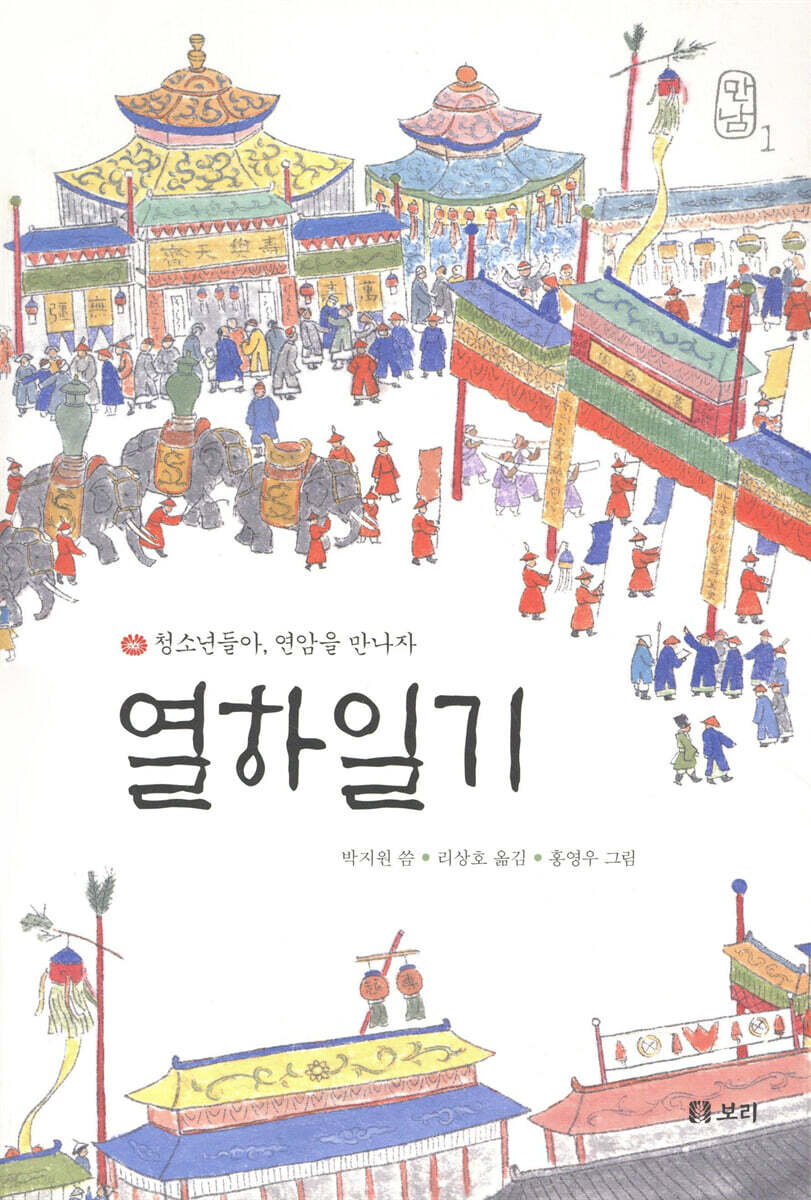
A painting by artist Hong Young-woo, known as the Kim Hong-do of the 21st century.
We added a spreadsheet at the beginning of each section and a page picture at the beginning of each new day's diary to make it more enjoyable to read and look at.
The pictures in the text, as well as the procession of messengers, the people who appear, and the pictures of Yeonam and his friends were all drawn by Mr. Hong Young-woo.
Using traditional painting techniques, the text is filled with colorful pictures to enhance the fun, and the text at the beginning and end of the text features monochrome drawings of the deceased, making it look like a black and white photograph.
Among our classics, the one we encounter most often both inside and outside of school is Park Ji-won's.
We have compiled the essential "Yeolha Diary" for our youth into one volume so that they can read it in one sitting.
We have refined the awkward parts that were felt when translating Chinese characters into Korean and the parts that were difficult to read due to the many Chinese characters mixed in, to make them easier to read.
Parts that require lengthy explanations are provided in footnotes, and difficult words or expressions are explained in the main text as much as possible.
You can also encounter a wealth of Korean expressions such as 'tumihada, pundeobunhada, heueopseureumhada, eombeongbbang, meongmeonghi, hendunghada, cheongcheojimhada'.
The pictures are arranged so that you can read the text with full concentration.
《Yeolha Diary》, which was difficult for even adults to read, is now available for easy reading.
From the coachman to the emperor and the Panchen Lama, the living and breathing people of "Yeolha Diaries"
From the coachman Changdae and the horseman Jangbok who helped him on his journey near Yeonam, to the doctor Byeon Gyeham and the chief of the Sangbangbijang Jeong Jinsa who were his companions, to the people he met at fortune tellers and on the streets of China, to the Wanggokjeong and Yun Gajeon he met in Jehol, and even the emperor and the Panchen Lama he saw at the Manshu Festival, you can vividly meet people of all social classes, from the lowly to the high, transcending national borders.
You can find a variety of stories, including a story about struggling to cross a river because of heavy rain, a humorous and human story about meeting Qing people, a story about how the Liaodong Plain is a place where you can cry, and a story about crossing a river nine times in one night and realizing that sounds and colors are external things outside of the mind.
Exploring 18th-Century Chinese Culture with a Single Volume of "Yeolha Diary"
If you follow Yeonam's journey through Beijing and Jehol, you will see the mountains and rivers of China unfold before your eyes, and you will have a fun encounter with 18th-century civilization and the lives of the people who lived during that era.
The diary written in chronological order and the short stories added later provide a comprehensive look into not only one person's travels and life, but also Yeonam's appearance as a Silhak scholar.
We can also examine the new idea that the first minister of China said was dung, the Chinese-style kang, and the Chinese methods of raising carts and horses, and then examine the idea of reforming the wrong customs of Joseon.
A painting by artist Hong Young-woo, known as the Kim Hong-do of the 21st century.
We added a spreadsheet at the beginning of each section and a page picture at the beginning of each new day's diary to make it more enjoyable to read and look at.
The pictures in the text, as well as the procession of messengers, the people who appear, and the pictures of Yeonam and his friends were all drawn by Mr. Hong Young-woo.
Using traditional painting techniques, the text is filled with colorful pictures to enhance the fun, and the text at the beginning and end of the text features monochrome drawings of the deceased, making it look like a black and white photograph.
GOODS SPECIFICS
- Date of issue: September 27, 2010
- Page count, weight, size: 247 pages | 426g | 153*224*20mm
- ISBN13: 9788984286283
- ISBN10: 8984286281
You may also like
카테고리
korean


korean

![GQ KOREA Mark (Monthly): December [2025]](http://librairie.coreenne.fr/cdn/shop/files/8ef265dbbfbf186523ed75ba7319009d.jpg?v=1765340328&width=3840)


