

Stephen Hawking's A Brief History of Time
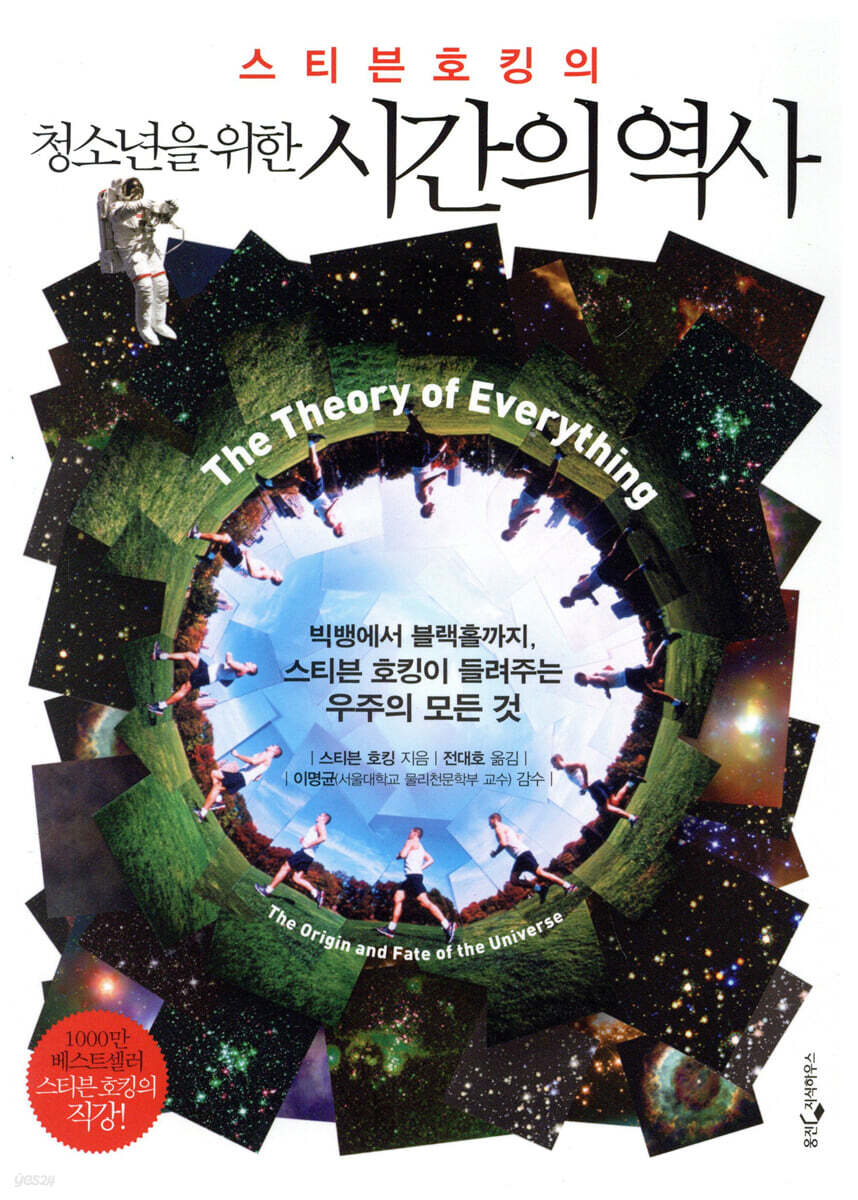 |
Description
Book Introduction
Stephen Hawking, the greatest physicist of this century, following in the footsteps of Newton and Einstein.
His representative work, A Brief History of Time, was translated into 40 languages and sold over 10 million copies, becoming the best science textbook of the 20th century.
However, for young people and general readers unfamiliar with astrophysics, A Brief History of Time remains a difficult book to approach despite its splendid reputation.
Stephen Hawking, who had been dreaming of 'popularizing science' for over 20 years, opened a lecture on astrophysics for young people and the general public at Cambridge University immediately after the publication of 'A Brief History of Time'.
In a series of seven lectures, he explained the core concepts of astrophysics, from the Big Bang and black holes to general relativity and quantum mechanics, in an easy-to-understand and friendly manner, with his signature sense of humor.
"A Brief History of Time for Young Adults" is a science textbook based on lectures given at the time, and contains the voice of Stephen Hawking.
The core content of 『A Brief History of Time』 is included without omission, and content that is difficult for the general public to understand, such as quantum mechanics, the uncertainty principle, and space-time theory, is boldly omitted.
For this reason, it was completed as an 'easy space education book' that can be read without burden by young people and general readers interested in space science.
His representative work, A Brief History of Time, was translated into 40 languages and sold over 10 million copies, becoming the best science textbook of the 20th century.
However, for young people and general readers unfamiliar with astrophysics, A Brief History of Time remains a difficult book to approach despite its splendid reputation.
Stephen Hawking, who had been dreaming of 'popularizing science' for over 20 years, opened a lecture on astrophysics for young people and the general public at Cambridge University immediately after the publication of 'A Brief History of Time'.
In a series of seven lectures, he explained the core concepts of astrophysics, from the Big Bang and black holes to general relativity and quantum mechanics, in an easy-to-understand and friendly manner, with his signature sense of humor.
"A Brief History of Time for Young Adults" is a science textbook based on lectures given at the time, and contains the voice of Stephen Hawking.
The core content of 『A Brief History of Time』 is included without omission, and content that is difficult for the general public to understand, such as quantum mechanics, the uncertainty principle, and space-time theory, is boldly omitted.
For this reason, it was completed as an 'easy space education book' that can be read without burden by young people and general readers interested in space science.
- You can preview some of the book's contents.
Preview
index
Editor's Note | For All Who Dream of Being Hawking
Introduction | Starting the lecture
Lecture 1 | Thoughts on the Universe
Lecture 2 | The Expanding Universe
Lecture 3 | Black Holes
Lecture Four | Black Holes Aren't Completely Black
Lecture Fifth | The Origin and Fate of the Universe
Lecture Six | The Direction of Time
Lecture Seven | The Theory of Everything
Search
Image source
Introduction | Starting the lecture
Lecture 1 | Thoughts on the Universe
Lecture 2 | The Expanding Universe
Lecture 3 | Black Holes
Lecture Four | Black Holes Aren't Completely Black
Lecture Fifth | The Origin and Fate of the Universe
Lecture Six | The Direction of Time
Lecture Seven | The Theory of Everything
Search
Image source
Into the book
In this series of lectures, I'll outline our ideas about the history of the universe, from the Big Bang to black holes.
The first lecture will explore how ancient people thought about the universe and how we arrived at our current perspective.
I think this lecture could be titled 'A History of the History of the Universe'.
--- p.10
In conclusion, current evidence suggests that the universe will probably continue to expand forever.
But don't trust it too much.
All we can really be sure of is that even if the universe were to re-contract, it wouldn't do so for at least another 10 billion years.
There is no need to worry about re-shrinkage.
By then, humanity will have long since gone extinct due to the demise of our sun.
--- p.51
I made a bet with Kip Thorne of Caltech.
I'm betting that there is no black hole in Cygnus X-1.
For me, it's a kind of insurance strategy.
I've done a lot of research on black holes, and if it turns out they don't exist, all that research will be for nothing.
But in that case, I'd win the bet and get a four-year free subscription to the humor magazine "Private Eye," and if there was a black hole, Kip would get a one-year free subscription to the racy magazine "Penthouse."
--- p.89
How do you react when you realize you've made a mistake? (Omitted) I think it's better and more liberating to admit in writing that you were wrong.
An exemplary figure who did so is Einstein.
He said that the cosmological constant he introduced to create a static model of the universe was the biggest mistake of his life.
The first lecture will explore how ancient people thought about the universe and how we arrived at our current perspective.
I think this lecture could be titled 'A History of the History of the Universe'.
--- p.10
In conclusion, current evidence suggests that the universe will probably continue to expand forever.
But don't trust it too much.
All we can really be sure of is that even if the universe were to re-contract, it wouldn't do so for at least another 10 billion years.
There is no need to worry about re-shrinkage.
By then, humanity will have long since gone extinct due to the demise of our sun.
--- p.51
I made a bet with Kip Thorne of Caltech.
I'm betting that there is no black hole in Cygnus X-1.
For me, it's a kind of insurance strategy.
I've done a lot of research on black holes, and if it turns out they don't exist, all that research will be for nothing.
But in that case, I'd win the bet and get a four-year free subscription to the humor magazine "Private Eye," and if there was a black hole, Kip would get a one-year free subscription to the racy magazine "Penthouse."
--- p.89
How do you react when you realize you've made a mistake? (Omitted) I think it's better and more liberating to admit in writing that you were wrong.
An exemplary figure who did so is Einstein.
He said that the cosmological constant he introduced to create a static model of the universe was the biggest mistake of his life.
--- p.168
Publisher's Review
Stephen Hawking lectures to the public at Cambridge University.
Stephen Hawking, who was suddenly diagnosed with Lou Gehrig's disease in his 20s, lost his voice in 1985 after undergoing tracheotomy for pneumonia.
But all these physical trials could not dampen his passion and will to unlock the secrets of the vast universe and nature.
It was from this time that Hawking began using the high-performance speech synthesizer attached to his wheelchair, which became his trademark.
And the year after publishing A Brief History of Time, he gave a lecture to the general public at Cambridge University.
Although the lectures were delivered in a muffled, mechanical tone rather than a clear voice, hundreds of students were able to experience new perspectives and theories on understanding the universe and nature through seven lectures.
The lecture was full of Hawking's signature humor and wit throughout.
He used only the physics formula E=mc², but he explained it using examples that people could have experienced in their daily lives, and he also honestly shared funny episodes that happened to him and his co-researchers.
Black holes aren't 'black'?
This book, “A Brief History of Time (by Stephen Hawking)”, begins with the ancient people’s view of the universe.
The ancient idea that the Earth was flat was developed by Aristotle and Ptolemy into the belief that the Earth was round and that the sun and planets revolved around it.
Newton discovered that the moon revolves around the Earth and the Earth and planets revolve around the Sun through his theory of universal gravitation, and later in the 20th century, Edwin Hubble's observations revealed that the universe is expanding infinitely.
The Big Bang theory, which explains the early universe, faced a number of objections early on.
However, as a result of general relativity and astronomical observations, the claim that the present universe is a result of the Big Bang singularity has become more persuasive.
It was discovered that black holes, whose gravitational fields are so strong that no light can escape, actually emit as much radiation as the energy that enters them, thus not breaking the second law of thermodynamics.
The original title of this book, 'Theory of Everything', refers to a grand unified theory that can explain the birth of the early universe and the boundaries of space and time.
Can a "theory of everything" that integrates general relativity and the uncertainty principle of quantum mechanics, which can explain the Big Bang, the birth of the universe, and black holes that are not "black", ever be born?
Stephen Hawking, who has long felt a thirst for this, cautiously predicts its birth in this book.
A Carefree Space Journey with Stephen Hawking
Everyone has a curiosity about space.
What kind of world exists beyond the sky, how the universe came into being, and what the future of the Earth will be like are questions that have plagued all mankind, regardless of whether ancient or modern.
Fortunately, thanks to the work of great scientists like Newton, Einstein, and Stephen Hawking, we no longer believe in the myths that the Earth is flat or that the Sun revolves around the Earth.
Moreover, these days, the first Korean astronaut has been born, and even children are talking about black holes and the Big Bang.
The golden cosmology explained by Stephen Hawking in A Brief History of Time has become essential knowledge for everyone living today.
This is especially true for the ‘science and engineering dreamers’ who dream of becoming the future Stephen Hawking.
For young readers and general readers who have a vague understanding of modern cosmology and physics but have not yet fully grasped them, and for those who have not even read two pages of A Brief History of Time, Stephen Hawking's A Brief History of Time will surely be a pleasant and accessible textbook on the universe.
The reliability of the content was further enhanced by the review of Professor Lee Myeong-gyun of Seoul National University.
We invite many readers to a stress-free space journey presented by Stephen Hawking, the great 20th century astrophysicist.
By simply leaning back in a comfortable chair or bed and opening a book, you will be attending Stephen Hawking's 'Author Lecture'.
But all these physical trials could not dampen his passion and will to unlock the secrets of the vast universe and nature.
It was from this time that Hawking began using the high-performance speech synthesizer attached to his wheelchair, which became his trademark.
And the year after publishing A Brief History of Time, he gave a lecture to the general public at Cambridge University.
Although the lectures were delivered in a muffled, mechanical tone rather than a clear voice, hundreds of students were able to experience new perspectives and theories on understanding the universe and nature through seven lectures.
The lecture was full of Hawking's signature humor and wit throughout.
He used only the physics formula E=mc², but he explained it using examples that people could have experienced in their daily lives, and he also honestly shared funny episodes that happened to him and his co-researchers.
Black holes aren't 'black'?
This book, “A Brief History of Time (by Stephen Hawking)”, begins with the ancient people’s view of the universe.
The ancient idea that the Earth was flat was developed by Aristotle and Ptolemy into the belief that the Earth was round and that the sun and planets revolved around it.
Newton discovered that the moon revolves around the Earth and the Earth and planets revolve around the Sun through his theory of universal gravitation, and later in the 20th century, Edwin Hubble's observations revealed that the universe is expanding infinitely.
The Big Bang theory, which explains the early universe, faced a number of objections early on.
However, as a result of general relativity and astronomical observations, the claim that the present universe is a result of the Big Bang singularity has become more persuasive.
It was discovered that black holes, whose gravitational fields are so strong that no light can escape, actually emit as much radiation as the energy that enters them, thus not breaking the second law of thermodynamics.
The original title of this book, 'Theory of Everything', refers to a grand unified theory that can explain the birth of the early universe and the boundaries of space and time.
Can a "theory of everything" that integrates general relativity and the uncertainty principle of quantum mechanics, which can explain the Big Bang, the birth of the universe, and black holes that are not "black", ever be born?
Stephen Hawking, who has long felt a thirst for this, cautiously predicts its birth in this book.
A Carefree Space Journey with Stephen Hawking
Everyone has a curiosity about space.
What kind of world exists beyond the sky, how the universe came into being, and what the future of the Earth will be like are questions that have plagued all mankind, regardless of whether ancient or modern.
Fortunately, thanks to the work of great scientists like Newton, Einstein, and Stephen Hawking, we no longer believe in the myths that the Earth is flat or that the Sun revolves around the Earth.
Moreover, these days, the first Korean astronaut has been born, and even children are talking about black holes and the Big Bang.
The golden cosmology explained by Stephen Hawking in A Brief History of Time has become essential knowledge for everyone living today.
This is especially true for the ‘science and engineering dreamers’ who dream of becoming the future Stephen Hawking.
For young readers and general readers who have a vague understanding of modern cosmology and physics but have not yet fully grasped them, and for those who have not even read two pages of A Brief History of Time, Stephen Hawking's A Brief History of Time will surely be a pleasant and accessible textbook on the universe.
The reliability of the content was further enhanced by the review of Professor Lee Myeong-gyun of Seoul National University.
We invite many readers to a stress-free space journey presented by Stephen Hawking, the great 20th century astrophysicist.
By simply leaning back in a comfortable chair or bed and opening a book, you will be attending Stephen Hawking's 'Author Lecture'.
GOODS SPECIFICS
- Date of issue: September 28, 2009
- Page count, weight, size: 200 pages | 310g | 153*224*20mm
- ISBN13: 9788901101163
- ISBN10: 8901101165
You may also like
카테고리
korean


korean

![GQ KOREA Mark (Monthly): December [2025]](http://librairie.coreenne.fr/cdn/shop/files/8ef265dbbfbf186523ed75ba7319009d.jpg?v=1765340328&width=3840)


