

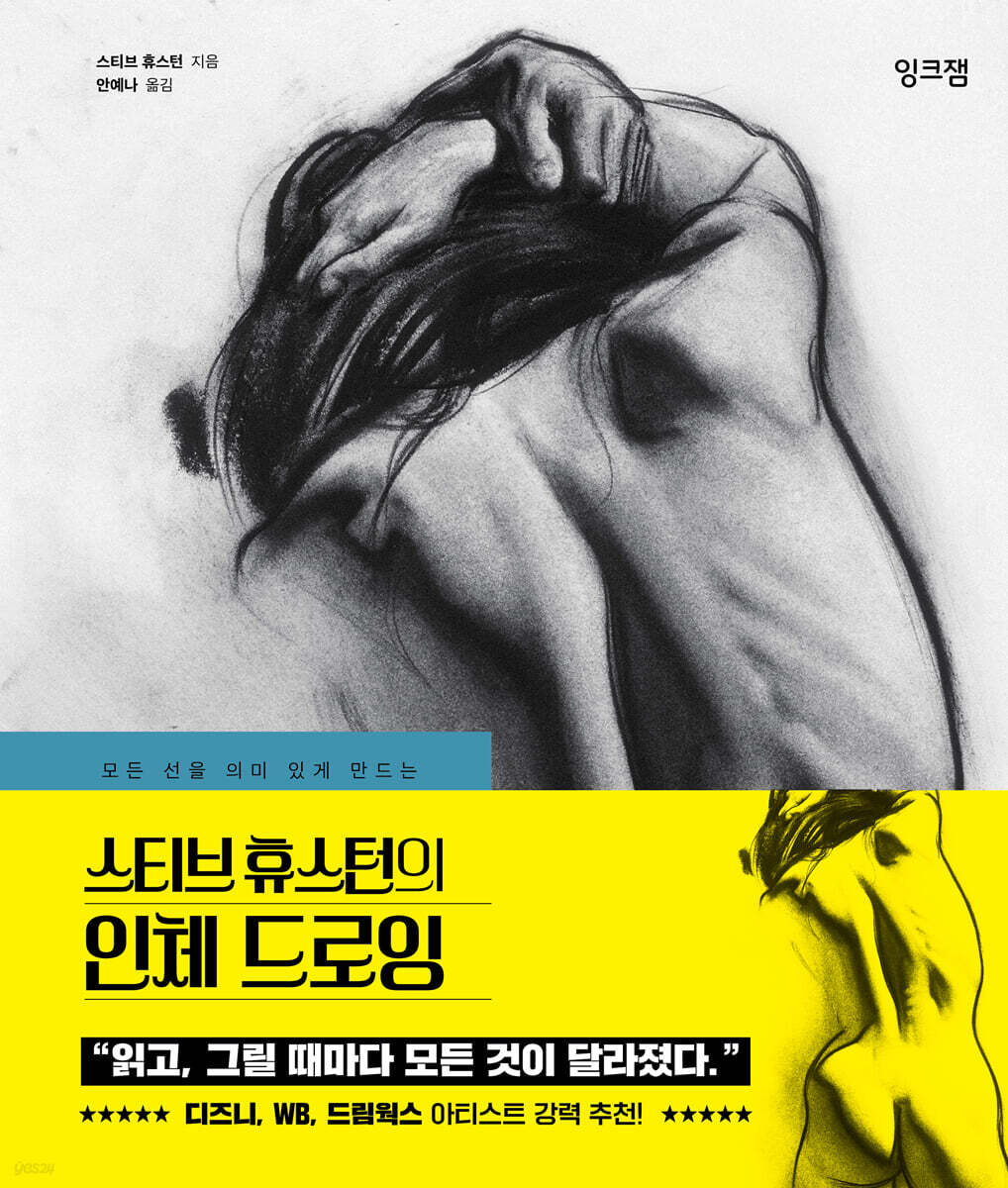
Steve Houston's human body drawings
 |
Description
Book Introduction
What Disney, DreamWorks, and Warner Bros. artists learned
A persuasive and expressive human figure drawing technique
Michelangelo, Rodin, Raphael, Sorn, Sargent
Finding the answer to drawing in a masterpiece that transcends time and space
『Steve Houston's Human Drawing』, which reinterprets human drawing through masterpieces of the century, is an original and systematic human drawing technique book containing the know-how of Steve Houston, a renowned art instructor and fine art painter.
With a distinguished career, he teaches human figure drawing to aspiring artists and artists working in renowned studios.
This book introduces how to draw the human body 'simply yet characteristically' based on basic design lines, such as the structure that forms the frame and the gestures hidden within it.
In particular, it has provided insight to numerous artists by illuminating human body drawing from various perspectives through the works of great masters such as Michelangelo and Rodin.
This book starts with the basic concepts of drawing, such as introduction to materials, line drawing, shape expression, perspective, and shading, and then moves on to the finishing touches, such as the expression of the human body structure and details, such as the head, torso, hands, and feet.
Throughout the entire process, he observes the subject of the drawing, the 'human body', in detail, while presenting unique methods such as drawing the side view of the head in the shape of a triangular sail or expressing the eyes as the holes of a whistle.
The works of masters who express the dynamism and vitality of the human body in their own unique styles make us realize that originality, achieved through a thorough understanding of the human body, is an essential element for an artist.
This book, which has been adopted as a drawing textbook in many art schools around the world and has been consistently loved, will lay the foundation for human figure drawing with its abundant examples and explanations, and will serve as the driving force for finding your own style.
A persuasive and expressive human figure drawing technique
Michelangelo, Rodin, Raphael, Sorn, Sargent
Finding the answer to drawing in a masterpiece that transcends time and space
『Steve Houston's Human Drawing』, which reinterprets human drawing through masterpieces of the century, is an original and systematic human drawing technique book containing the know-how of Steve Houston, a renowned art instructor and fine art painter.
With a distinguished career, he teaches human figure drawing to aspiring artists and artists working in renowned studios.
This book introduces how to draw the human body 'simply yet characteristically' based on basic design lines, such as the structure that forms the frame and the gestures hidden within it.
In particular, it has provided insight to numerous artists by illuminating human body drawing from various perspectives through the works of great masters such as Michelangelo and Rodin.
This book starts with the basic concepts of drawing, such as introduction to materials, line drawing, shape expression, perspective, and shading, and then moves on to the finishing touches, such as the expression of the human body structure and details, such as the head, torso, hands, and feet.
Throughout the entire process, he observes the subject of the drawing, the 'human body', in detail, while presenting unique methods such as drawing the side view of the head in the shape of a triangular sail or expressing the eyes as the holes of a whistle.
The works of masters who express the dynamism and vitality of the human body in their own unique styles make us realize that originality, achieved through a thorough understanding of the human body, is an essential element for an artist.
This book, which has been adopted as a drawing textbook in many art schools around the world and has been consistently loved, will lay the foundation for human figure drawing with its abundant examples and explanations, and will serve as the driving force for finding your own style.
- You can preview some of the book's contents.
Preview
index
To become familiar with the tool called art... 9
PART 1 Basic Drawing Concepts
CHAPTER 1 Structure ··· 23
CHAPTER 2 Basic Gestures... 37
CHAPTER 3: Advanced Gesture Concepts... 49
CHAPTER 4 Perspective... 59
CHAPTER 5: THE LAWS OF LIGHT... 69
PART 2 HUMAN STRUCTURE AND FOOTAGE
CHAPTER 6: The Basic Structure of the Human Body... 91
CHAPTER 7 Head... 119
CHAPTER 8: BODY ··· 139
CHAPTER 9 Arms and Hands... 153
CHAPTER 10 Legs and Feet... 165
CHAPTER 11 Completing the Details: Light and Shade... 177
The Value of 5 Minutes of Practice... 186
About the Author... 190
Acknowledgments... 191
PART 1 Basic Drawing Concepts
CHAPTER 1 Structure ··· 23
CHAPTER 2 Basic Gestures... 37
CHAPTER 3: Advanced Gesture Concepts... 49
CHAPTER 4 Perspective... 59
CHAPTER 5: THE LAWS OF LIGHT... 69
PART 2 HUMAN STRUCTURE AND FOOTAGE
CHAPTER 6: The Basic Structure of the Human Body... 91
CHAPTER 7 Head... 119
CHAPTER 8: BODY ··· 139
CHAPTER 9 Arms and Hands... 153
CHAPTER 10 Legs and Feet... 165
CHAPTER 11 Completing the Details: Light and Shade... 177
The Value of 5 Minutes of Practice... 186
About the Author... 190
Acknowledgments... 191
Detailed image

Into the book
What is art? Answering this question would require a whole book.
No, we might need the entire library.
---From the "first sentence"
The mind is the realm where art comes to life.
Art was not created to persuade rationally.
That's science's job.
The most powerful art, like mythology, appeals to the emotions.
--- p.9
Gestures are built into living forms, a lifeline that appears similarly in many creatures.
It also makes the work look natural.
If you're drawing a tall building, you don't have to worry about gestures.
Because almost everything contained in a building is hard and mechanical.
--- p.24
For the artist, the essence of a living organism is fluid and elegant curves like water.
Assuming that each organism contains gestures, try to find them.
Notice how the forearm rises and falls along the wavy contours.
Let's also look for curvatures in the spine.
--- p.39
What's really cool is that if you walk around the statue, you can see the curves from any angle.
The curves are composed by placing the head and torso in two large, simple, and contrasting rhythms.
The limbs are like small stories in the plot, but they have their own rhythm and move according to the larger rhythm, or in the opposite direction.
--- p.55
When it comes to the dramatic effect of revealing form in space, nothing surpasses chiaroscuro.
Chiaroscuro is the easiest way to add light and shade, complexity, and realism to your work.
If light and darkness are not separated, the shape will not pop out of the screen.
--- p.74
To draw a good profile, the back of the skull should be higher than the chin.
Look straight ahead and use your fingers to feel where your skull meets your neck at the very top of your spine.
And bring your fingers forward while keeping them horizontal.
Your fingers will be positioned just above your eyeballs.
--- p.95
The artists I love don't "capture" living things (even though that's possible).
Instead, it transforms living things.
In other words, it reveals something new in the character.
Good proportions have a rhythm that makes them seem plausible.
--- p.114
The hips are the only structure in the human body that is wider than it is long.
An angular shape seems appropriate to show the basic durability of the buttocks.
On the other hand, if expressed in a rounded manner, it can imply that the hips are the axis of rotation of the human body.
The biggest difference between male and female silhouettes is mainly seen in the hips.
--- p.147
Some of the imperfect curves become steep and change direction quickly, forming vertices.
The vertices of these curves resemble corners.
In other words, curves also have corners.
The corners within the curve prevent the outline from looking rubbery and give it an organic, sophisticated and realistic feel.
--- p.168
There is a famous anecdote about Anders Zorn, although the source may not be clear.
Sorn studied at art school for eight hours a day, but that wasn't all.
It is said that even eight hours was not enough for such a great talent, so Sorn went home and painted for four more hours.
Twelve hours a day, that's how much time Sorn dedicated to developing his skills.
No, we might need the entire library.
---From the "first sentence"
The mind is the realm where art comes to life.
Art was not created to persuade rationally.
That's science's job.
The most powerful art, like mythology, appeals to the emotions.
--- p.9
Gestures are built into living forms, a lifeline that appears similarly in many creatures.
It also makes the work look natural.
If you're drawing a tall building, you don't have to worry about gestures.
Because almost everything contained in a building is hard and mechanical.
--- p.24
For the artist, the essence of a living organism is fluid and elegant curves like water.
Assuming that each organism contains gestures, try to find them.
Notice how the forearm rises and falls along the wavy contours.
Let's also look for curvatures in the spine.
--- p.39
What's really cool is that if you walk around the statue, you can see the curves from any angle.
The curves are composed by placing the head and torso in two large, simple, and contrasting rhythms.
The limbs are like small stories in the plot, but they have their own rhythm and move according to the larger rhythm, or in the opposite direction.
--- p.55
When it comes to the dramatic effect of revealing form in space, nothing surpasses chiaroscuro.
Chiaroscuro is the easiest way to add light and shade, complexity, and realism to your work.
If light and darkness are not separated, the shape will not pop out of the screen.
--- p.74
To draw a good profile, the back of the skull should be higher than the chin.
Look straight ahead and use your fingers to feel where your skull meets your neck at the very top of your spine.
And bring your fingers forward while keeping them horizontal.
Your fingers will be positioned just above your eyeballs.
--- p.95
The artists I love don't "capture" living things (even though that's possible).
Instead, it transforms living things.
In other words, it reveals something new in the character.
Good proportions have a rhythm that makes them seem plausible.
--- p.114
The hips are the only structure in the human body that is wider than it is long.
An angular shape seems appropriate to show the basic durability of the buttocks.
On the other hand, if expressed in a rounded manner, it can imply that the hips are the axis of rotation of the human body.
The biggest difference between male and female silhouettes is mainly seen in the hips.
--- p.147
Some of the imperfect curves become steep and change direction quickly, forming vertices.
The vertices of these curves resemble corners.
In other words, curves also have corners.
The corners within the curve prevent the outline from looking rubbery and give it an organic, sophisticated and realistic feel.
--- p.168
There is a famous anecdote about Anders Zorn, although the source may not be clear.
Sorn studied at art school for eight hours a day, but that wasn't all.
It is said that even eight hours was not enough for such a great talent, so Sorn went home and painted for four more hours.
Twelve hours a day, that's how much time Sorn dedicated to developing his skills.
--- p.186
Publisher's Review
Contrapposto in Michelangelo's sketches
The large gestural curves expressed in Rodin's sculptures
The masterpiece already contains the finest human figure drawings.
From the outset, this book emphasizes that art is a language that deals with fiction, appeals to the emotions, and expresses thoughts through lines and tones.
If you try to draw the human body as it appears, you will often lose sight of your intentions.
A representative example is gestures. Since the human body is not linear like a building, it must be fluid through gestures.
According to this book, gestures are the connections and relationships between forms, their lifeline, and they prevent a drawing from looking stiff and composed.
Gestures are the movement between forms and the design lines that breathe life into them, such as the wavy lines hidden in body movements, the asymmetrical curves in a leaning posture, and the subtle curves of muscles and bones connecting the skull and face.
Designing with ‘structure’ and ‘gesture’
Simple yet distinctive human figure drawing
The simple structure becomes a tool to capture gestures in a way that characterizes the human body and is intended to be used.
This book begins by drawing the main features of each human body part, such as fingers that taper from a cylindrical shape to a cone, interlocking joints like bolts and nuts, and the 'column and beam' structure that forms the pelvis and legs.
Here, various poses, gestures, and light and shade expressions continue.
These structures and gestures connect with and expand upon familiar artistic concepts found in masterpieces.
From the tug-of-war between symmetry and asymmetry in the Venus de Milo, to Michelangelo's extreme use of contrapposto, to Sargent's portrait rendered even more vividly with chiaroscuro, to Peter Lelly's arm expressed in egg-shaped and cylindrical shapes, these excellent examples can help us understand this more clearly.
According to this book, there is no great painter or art movement that has copied nature exactly as it is.
They do not 'capture' living things, but reveal something new within them.
Starting from simple shapes, he draws hidden gestures while also boldly omitting visible parts depending on his intention.
Also, by taking advantage of the human body drawing, the background is blurred and the character is highlighted more.
In this book, you can easily learn these characteristics of masterpieces through drawing exercises.
Like the great artists who are recognized today for their unique perspectives, let's open up our own possibilities through this book.
The large gestural curves expressed in Rodin's sculptures
The masterpiece already contains the finest human figure drawings.
From the outset, this book emphasizes that art is a language that deals with fiction, appeals to the emotions, and expresses thoughts through lines and tones.
If you try to draw the human body as it appears, you will often lose sight of your intentions.
A representative example is gestures. Since the human body is not linear like a building, it must be fluid through gestures.
According to this book, gestures are the connections and relationships between forms, their lifeline, and they prevent a drawing from looking stiff and composed.
Gestures are the movement between forms and the design lines that breathe life into them, such as the wavy lines hidden in body movements, the asymmetrical curves in a leaning posture, and the subtle curves of muscles and bones connecting the skull and face.
Designing with ‘structure’ and ‘gesture’
Simple yet distinctive human figure drawing
The simple structure becomes a tool to capture gestures in a way that characterizes the human body and is intended to be used.
This book begins by drawing the main features of each human body part, such as fingers that taper from a cylindrical shape to a cone, interlocking joints like bolts and nuts, and the 'column and beam' structure that forms the pelvis and legs.
Here, various poses, gestures, and light and shade expressions continue.
These structures and gestures connect with and expand upon familiar artistic concepts found in masterpieces.
From the tug-of-war between symmetry and asymmetry in the Venus de Milo, to Michelangelo's extreme use of contrapposto, to Sargent's portrait rendered even more vividly with chiaroscuro, to Peter Lelly's arm expressed in egg-shaped and cylindrical shapes, these excellent examples can help us understand this more clearly.
According to this book, there is no great painter or art movement that has copied nature exactly as it is.
They do not 'capture' living things, but reveal something new within them.
Starting from simple shapes, he draws hidden gestures while also boldly omitting visible parts depending on his intention.
Also, by taking advantage of the human body drawing, the background is blurred and the character is highlighted more.
In this book, you can easily learn these characteristics of masterpieces through drawing exercises.
Like the great artists who are recognized today for their unique perspectives, let's open up our own possibilities through this book.
GOODS SPECIFICS
- Date of issue: August 16, 2023
- Page count, weight, size: 192 pages | 216*254*20mm
- ISBN13: 9788979293760
- ISBN10: 8979293763
You may also like
카테고리
korean


korean

![GQ KOREA Mark (Monthly): December [2025]](http://librairie.coreenne.fr/cdn/shop/files/8ef265dbbfbf186523ed75ba7319009d.jpg?v=1765340328&width=3840)


